Up next in 10

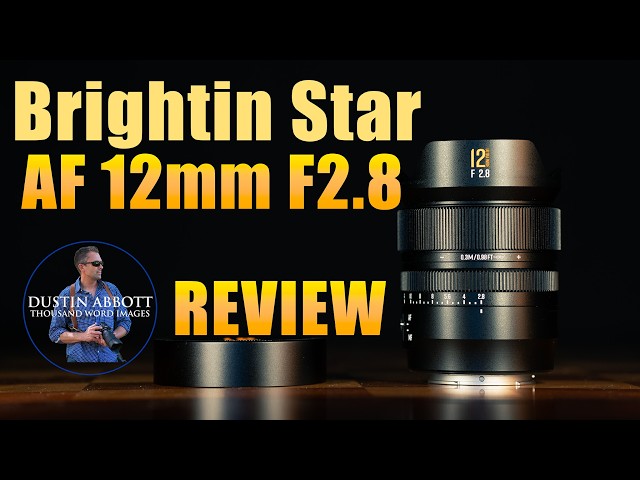
Brightin Star AF 12mm F2.8 Review | Brightin Star Levels Up
May 29, 2026

Photographer Dustin Abbott takes a deep dive look at Brightin Star's new autofocusing 12mm F2.8. Is this ultrawide prime worth buying? | Read the Text Review: https://tinyurl.com/BSAF12mmDA | Purchase the Brightin Star 12mm F2.8 @ B&H Photo https://bhpho.to/4v6LIzA | Amazon https://amzn.to/4tVmjb2 | Amazon Canada https://amzn.to/4nOxFwh
Check out the DA Merch here: https://bit.ly/TWIMerch | Become a Patron: https://www.patreon.com/dustinabbott | On the Web: http://dustinabbott.net/ | Sign up for my Newsletter: http://bit.ly/1RHvUNp | Instagram: http://bit.ly/DLAinsta | Facebook: http://on.fb.me/1nuUUeH | Flickr: http://bit.ly/1UcnC0B | 500px: http://bit.ly/1Sy2Ngu Follow Craig @ https://www.instagram.com/craigstoffersen/
Want to support this channel? Use these affiliate links to shop at:
B&H Photo: http://bhpho.to/1TA0Xge
Adorama: https://howl.link/nt4zdz1goa7ql
Camera Canada: http://bit.ly/DLACameraCan
Sony Canada: https://www.thesonyshop.ca/?ref=abbott
Amazon: https://amzn.to/3HrY64d
Amazon Canada: https://amzn.to/3qG1p18
Ebay: http://bit.ly/DustineBay
Into the AM Clothing: https://bit.ly/intotheAMda and use code DUSTIN10 for 10% off
Fioboc Clothing: https://tinyurl.com/FiobocDA20 and us code DUSTIN20 for 20% off
Make a donation via Paypal: https://www.paypal.com/paypalme/dustinTWI
=============================
Table of Contents:
=============================
0:00 - Intro
Show More Show Less View Video Transcript
0:10
Over the last few years, we have seen a
0:13
huge rise of Chinese lens makers and it
0:16
seems like a lot of those lens makers
0:18
are starting to level up at this point.
0:20
One of the less known players on the
0:23
market is the company Brightonar and
0:25
they have jumped upscale and into the
0:28
autofocus market with their new AF1 12mm
0:31
f2.8.
0:32
It has an extremely wide 122.5 degree
0:36
angle of view. And as you can see here,
0:39
uh even though I'm only about 8 feet
0:40
away from the camera, it has a lot in
0:43
the frame. So, this lens, it tests a new
0:46
price point for them and it also tests
0:49
autofocus. And as we're going to see in
0:51
today's review, they've really done
0:53
quite a compelling job on a lot of these
0:55
fronts. At the same time, however, there
0:57
are some alternatives, including one
0:59
from a more established brand like LAA
1:01
and their own autofocusing 12mm f/2.8.
1:04
So, does Brightonar have enough to
1:06
distinguish themselves from the pack
1:08
here? Well, that's what we're here to
1:10
explore in today's review. Before I jump
1:12
in, I do want to say a big thank you to
1:14
Brightonar for sending me a copy for
1:17
review. At the same time, they have had
1:19
no input in this review. They will not
1:21
see it before you. This is a completely
1:23
independent review, and my conclusions
1:25
are my own. That aside, let's jump in.
1:28
Let's take a look. All right, let's take
1:29
a closer look at the build and the
1:31
design of the Brighton Star here. So
1:34
price is currently at launch at $69.99
1:38
USD and it will jump up to $659 later
1:41
on. The LAA 12mm f/2.8 autofocus lens
1:45
retails for about $6.99 and so this is
1:47
going to run anywhere between $50 and
1:49
$90 less depending on when you buy it.
1:51
Now as far as the advantages of the LA
1:53
which I reviewed a year or so ago, it is
1:56
lighter. It can receive traditional
1:58
front filters on it. It has some
2:01
advantages when it comes to the aperture
2:03
blades uh just the overall shape of the
2:05
sunar there and its close focus ability.
2:08
The brighten star advantages is that it
2:09
is smaller. It has more features to it.
2:13
It has less vignette. It's a very
2:15
competent lens. This is a very very wide
2:18
angle of view. 122.5
2:21
degrees of view. And so just pointing
2:23
down at my shoes you can see it's a long
2:25
way down to my shoes there. Part of the
2:28
design here is that there is a front
2:31
fixed lens hood. This is not removable
2:33
and so traditional filtering is out and
2:36
so they try to compensate by giving you
2:38
a rear filter thread here. It's somewhat
2:41
odd 34 mm filters. However, they do sell
2:44
them in a very inexpensive price
2:47
purposely designed for this. And so you
2:49
can get this is a clear night filter,
2:50
but you can also get a couple of
2:52
different ND variations, ND-1000, ND64,
2:56
and those would be very useful for long
2:58
exposure. And so you just can unthread
3:00
those at the back and apply them. Other
3:03
thing you'll see here is a weather
3:05
sealing gasket. It is the only gasket
3:07
here. Um there's no other internal
3:09
seals. My bigger complaint is that the
3:13
uh actual fixed lens hood, it when
3:15
you're out in weather like rain, rain
3:18
particularly will hit from the side and
3:19
get on that. And as you can see from
3:21
these shots, you can definitely see it
3:23
uh in images. And so that's a little bit
3:25
of a concern there. It does have an
3:27
aperture ring. It is uh decllicked and
3:30
that's the only option. There's a nice
3:32
firm detent between F-16 and A. I like
3:35
that it's it's nice and firm there.
3:36
There is no iris lock, however, and so
3:39
you can rack through all of the aperture
3:41
like I've done here with this shot with
3:43
the flare. And so you can see going
3:45
through those aperture options smoothly.
3:47
You also have a function button here
3:50
that is whatever value you have assigned
3:52
from within camera and an AFMF switch.
3:55
Uh a nice feature set there. You know,
3:56
it's not exceptional, but definitely
3:58
more than what the LAWA offers. The
4:00
build quality here is actually really
4:02
nice. It's a nice looking lens, very
4:04
traditional looking, but you know, it's
4:06
going to look still look good in, you
4:09
know, another 20 years. And so all of
4:11
that is fine. It is a little bit heavy,
4:14
however, because everything here is
4:15
pretty dense metals on it. And so it
4:18
weighs in at right under 500 g or 17.6
4:21
oz. So it is considerably heavier than
4:23
the LA even though it's a smaller lens.
4:26
The lens is 70 mm in diameter or 2.75
4:30
in. But because of that fixed lens hood
4:32
and that curved front element, it's a
4:34
little bit longer. So 96.6 millimeters
4:37
or 3.8 inches. As you can see, in
4:39
general though, it is a very compact
4:41
lens. It pretty much fits in your hand.
4:44
There are seven blades inside. I don't
4:47
love the sun stars and so I definitely
4:49
prefer the five blade uh version of the
4:51
LAA when it comes to sun stars. Another
4:54
place where I definitely prefer the LAA
4:56
is when it comes to the minimum focus
4:57
distance. Here it is just 30 cm. So
5:01
that's pretty long for such a wide lens.
5:03
And the resulting magnification is super
5:06
low. It's not listed, but it's somewhere
5:08
around 0.05 or 0.06. Very, very low. The
5:12
LA will allow you to focus 16 mm closer,
5:14
which is obviously results in much
5:16
higher levels of magnification. So a
5:19
very nice build quality and it's a very
5:21
functional lens. I enjoyed using it out
5:23
in the field. Other than just that issue
5:25
where rain we get on that front element.
5:27
I do wish you could use traditional
5:29
front filters as well. But uh those kind
5:32
of niggling concerns aside, it is a
5:34
nicely done lens. So let's talk
5:36
autofocus. Now this is the first
5:38
autofocus lens from Brightonar that I've
5:40
reviewed, but it comes across as being a
5:44
pretty mature product in many ways. Now
5:46
to be fair, wide-angle lenses like this
5:48
tend to have a lot in focus all the
5:51
time. Right now, I'm only about a meter
5:53
away from the camera, but as you can
5:55
see, not only is am I in focus, but this
5:58
whole scene is in focus as well. And so,
6:01
for that reason, autofocus travel
6:03
doesn't have to go very far. But at the
6:05
same time, I don't want to underell what
6:06
Bright and Star has done here because
6:08
autofocus, I'm assuming from an STM type
6:10
focus motor, it is fast, it is utterly
6:13
quiet, and it is smooth and accurate in
6:16
operation. You can see here in my formal
6:18
test as autofocus goes back and forth
6:20
that there's not a huge focus change is
6:23
taking place, but definitely we're
6:24
moving f back and forth with good speed
6:26
there and I never heard any sound from
6:28
the focus motor in operation. What's
6:31
more, I use this lens actually to do
6:34
some supplemental photos at a wedding I
6:36
shot last weekend and on the dance
6:39
floor, for example, I was getting, you
6:40
know, the bride and groom's first dance
6:42
and some other dances there. And and so
6:44
I sometimes I used a a flash with it,
6:47
but sometimes I wanted just a little bit
6:49
more mood in the shot. And so even
6:51
though I was shooting in a very dim
6:53
setting, obviously autofocus was
6:55
instantly snappy and it was accurate in
6:57
that setting. it was quick enough to be
6:59
able to stop action and I didn't have to
7:01
worry about it at all under that
7:02
circumstance. So, I would say that
7:04
autofocus really does a great job and no
7:07
concerns with it on that front. Now, on
7:09
the video side of things, again, there's
7:11
not a huge focus change taking place
7:13
here. And so, if you look at my touch to
7:15
focus, you'll see that it's moving back
7:17
and forth with good smoothness. There's
7:19
a minimal amount of focus breathing, but
7:21
that's largely because there isn't a
7:23
whole lot of focus shift that's taking
7:24
place. I did notice in my hand test that
7:27
despite there not being a lot of focus
7:29
breathing, there is just a little bit of
7:30
that kind of lurching sensation that
7:33
isn't quite as cinematic as what I would
7:34
like. But obviously, this is going to be
7:36
a great focal length for things like
7:38
vlogging or uh you know using on a
7:40
gimbal when you want to have a lot uh in
7:42
the frame all the time. And so I think
7:44
it has some very interesting video
7:46
applications. And I had no problems with
7:48
autofocus. And as you've probably
7:49
noticed in these segments that I'm
7:51
shooting on the lens itself, it has no
7:53
problem, you know, keeping focus on me
7:56
and not jumping around or being
7:58
unstable. So, in general, autofocus I
8:00
thought was pretty great. All right,
8:01
we'll start by taking a look at the
8:03
optical design here. We have 15 elements
8:05
in 11 groups. And you can see that
8:07
includes a couple of spherical lenses, a
8:10
couple of low dispersion lenses, and
8:12
then a couple of high refraction
8:14
refractive index elements as a part of
8:16
it. Taking a look at the MTF and we're
8:18
going to focus on the green because
8:19
that's more relevant with modern
8:22
resolution cameras. You can see that in
8:24
the center of the frame, extremely
8:26
sharp. Mid-frame, it's still looking
8:28
quite good. As we get towards the
8:30
corners, however, you can see it's a
8:31
pretty steep drop, averaging out
8:34
somewhere here in this 45% ratio. Now,
8:37
this is a very wide angle of view. And
8:39
if I just rotated the camera down and
8:41
shot towards my feet, you can see that
8:43
it's a long way down to the ground. And
8:45
that's the effect you're going to see
8:46
with a wide-angle lens like this. This
8:49
is 122 1/2 degree angle of view. So,
8:51
it's really going to, you know, visually
8:54
give the illusion of pushing things away
8:56
from the camera. Now, obviously with a
8:58
really wide angle lens, there are a
9:00
couple of things that you're typically
9:01
going to run into. One of those is
9:03
distortion and the other is vignette.
9:05
Now, I will say that the distortion is
9:08
exaggerated some because of the close
9:10
focus distance at 12 mm. And so, it's
9:13
not going to look like this in almost
9:15
any kind of real world situation. That
9:17
being said, this isn't a bad amount of
9:19
barrel distortion for uh you know this
9:22
wide of a focal length. However, it is
9:25
very slightly complex and so you can see
9:27
that by correcting most of the middle
9:29
actually will create a little bit of a
9:31
pin cushion effect on the very edges.
9:33
And so you kind of have to, you know,
9:35
pick your poison there. And
9:36
unfortunately, there isn't going to be
9:38
in camera correction profiles available
9:40
for the lens itself. This is about a a
9:44
plus 11 or 12 to correct to this degree.
9:46
Now, the vignette, although it's not
9:48
perfectly corrected, and it does have a
9:50
very slight amount of discoloration,
9:52
there is a significant amount of less
9:54
vignette than what I saw on the LA 12mm
9:57
f2.8. I used a plus 74 to correct for
10:00
this. Whereas with the LAA, I had to max
10:02
out the slider at 100 and still had
10:05
about this amount of uh vignette left
10:07
over. So, obviously, a lens this wide is
10:09
going to be an interesting one for
10:11
shooting interior spaces. And in
10:13
general, this has zero correction on
10:15
here. I wasn't unhappy with this at all.
10:17
As you can see, you don't really see
10:19
that barrel distortion very much with
10:21
when shooting in uh a perspective where
10:24
you're not right on top of the subject
10:25
like we were with the test chart. And so
10:27
you can see here again with all of the
10:29
lines, there's a little bit of curvature
10:31
on this line right here, but I think
10:34
that most people could probably live
10:35
with that. Here's another kind of
10:37
interior space. And again, right off to
10:39
the very edge, you can see that there's
10:40
a bit of a bow to this line. You could
10:42
correct that fairly easily, and I don't
10:44
think you would have any kind of major
10:46
issue. So, it definitely could be an
10:48
interesting lens to use for interior
10:50
space slash, you know, real estate
10:52
photography, architecture, things like
10:54
that. So, we're going to take away a
10:55
couple of things from this image. First
10:57
of all, if we look closely here, you can
11:00
see it's nice and sharp. That's not
11:01
really our takeaway, but we're looking
11:02
more for fringing. Um, as you go out of
11:05
focus, and we see just a very minimal
11:08
amount of fringing, just a tiny bit in
11:10
some of those specular highlights there.
11:12
The truth of the matter is is that
11:13
there's going to be very few situations
11:15
where you're going to be able to create
11:17
this degree of defocus. Anyway, the
11:19
other thing is to look very quickly at
11:21
bokeh. Not that bokeh is a primary
11:23
concern for this lens, but just to give
11:25
you an idea that if you are able to
11:27
create a little bit of defocus, what
11:30
you're going to see is a fair bit of
11:31
outlining, kind of a a little bit of a
11:33
soap bubble effect. And so, it's not the
11:36
smoothest bokeh that I've ever seen, but
11:37
then again, this is not the purpose you
11:39
buy this lens for. More important would
11:42
be lateral style chromatic aberrations.
11:44
And while we see a tiny bit of those, it
11:46
is very, very well controlled. And so,
11:48
that's not going to be any kind of real
11:50
factor. So, here's the test chart that
11:52
we're going to examine. This is shot on
11:54
a 61 megapixel A7R Mark I. And I'm going
11:56
to show you results at 200%. So, I
11:59
that's extremely demanding. That's what
12:01
I work with here. We can see in the
12:03
center of the frame that as the MTF
12:04
suggests, results are fantastic. Very
12:07
sharp, very good contrast, just pretty
12:10
much perfect. The mid-frame is a little
12:12
bit less good than what I anticipated.
12:16
And it isn't just on that side over
12:18
here. It's looking equal as I look in
12:20
these places. I expected a little bit
12:22
more than what I'm seeing here. And the
12:24
corners, as expected, are looking a
12:26
little bit softer. I tried focusing in
12:28
the corners to see if that made a
12:30
difference, and it really didn't. And
12:32
so, um, unfortunately here, as we move
12:34
off towards the mid-frame in the
12:36
corners, it's just at f2.8, it's not
12:38
nearly as sharp as what it is in the
12:40
center of the frame. In a real world
12:42
shot here, we can see that at f2.8, I
12:45
mean, that's very nice and crisp in the
12:47
center of the frame. And obviously depth
12:49
of field means that in a lot of these
12:51
situations, you know, the focus point is
12:54
here. But as I look off towards the
12:56
sides here, I feel like, you know, that
12:58
is definitely very acceptable focus for
13:00
this kind of work. I can see all of the
13:02
details there. And I have no problems
13:05
with any of that. If we compare f2.8 to
13:08
f4, we can see that there is a little
13:10
bit more contrast and resolution in the
13:11
center of the frame. But frankly, that's
13:13
not really where we need it. what we
13:16
need it as we is where we start to move
13:17
off towards the edge of the frame. Now,
13:19
you can see that while it isn't like all
13:21
of a sudden perfect, it is improved
13:24
here. Uh that's all the writing here is
13:26
a little clearer. This kind of logo
13:28
symbol here is looking clear as well.
13:31
Likewise, there's just a little bit less
13:32
of a jittery quality, though contrast is
13:34
still not fantastic in this zone. If we
13:37
look down towards the extreme corner,
13:39
again, we see definitely improving, just
13:42
not excellent yet. Comparing f4 and
13:44
f5.6, I don't really see any kind of
13:47
improvement in the center of the frame.
13:48
It was already great there. Here in the
13:51
midframe, it is again it's it's a slight
13:54
improvement. It's not like radically
13:56
sharp yet. The corners here are you can
13:58
definitely see a strong improvement
14:00
here. It's more just in that last little
14:02
bit that they're not improving as much.
14:04
That's also true here where this is
14:06
looking pretty decent. But as we look
14:08
off towards ends of the frame, you can
14:10
see even from this zone to right here
14:12
that things are really starting to
14:13
soften. Again, to put that in some real
14:15
world perspective here at f5.6 at 100%
14:19
magnification, you can see that the
14:21
detail is looking really quite
14:23
fantastic. And if I pan off towards the
14:25
edge of the frame, yes, it's falling off
14:27
a little bit right here at the very
14:28
corner. But frankly, I don't know that
14:31
too many people are going to be
14:32
examining your image right there at the
14:34
very very corner. And if we look at any
14:36
place where a little bit more of it is
14:39
apparent, that's actually looking quite
14:41
crisp and nicely detailed. Here's a
14:43
second example here at f5.6. And so you
14:46
can see in this zone, I mean, that's
14:48
beautiful detail. As we move off towards
14:50
the edge, you can see it start to fall
14:53
off here in that last few percentage
14:55
points. But again, it's not until you're
14:57
getting to that very, very edge and even
14:59
out just a little bit, the detail looks
15:01
much better. There's not really much of
15:03
a further improvement at f8. It looks
15:06
kind of more lateral compared to f5.6.
15:08
At f11, we're going to start to see the
15:11
some softening due to defraction. Though
15:13
in this case, it's not extreme. You can
15:15
definitely see it gets progressively
15:17
worse by f-16, which is the minimum
15:19
aperture, but it's not a huge variation.
15:22
Now, as previously discussed, the
15:23
magnification level is really, really
15:26
low here. And we can see that in the
15:28
center of the frame on the subject, the
15:30
lens is nice and sharp, but it's not a
15:32
particularly flat plane of focus. And so
15:34
we can see if we look off here towards
15:36
the edges, obviously it's falling off as
15:38
we get towards the corners. Not nearly
15:40
as good there as what it is in the
15:42
center of the frame. Now, when it comes
15:44
to flare resistance, it's largely okay,
15:47
particularly at larger apertures. Um,
15:49
however, you've probably seen in some of
15:51
the shots of where I'm filming that you
15:54
can definitely see a bit of ghosting
15:55
artifacts. You'll see it a bit here.
15:57
Here, if you stop all the way down to
15:59
f-16, you get the most pronounced sun
16:01
stars. But I also feel like you get the
16:03
most strongly pronounced flare pattern.
16:05
And you can see here is if I do this
16:06
aperture rack that as I stop the lens
16:09
down, the flare effects get more
16:11
noticeable. If I pan back and forth a
16:14
bit, you can see that in general flare
16:16
resistance is fairly good. But I would
16:19
keep it at hopefully, you know, less
16:22
than f8, somewhere in that range. so
16:25
that you're getting a little bit better
16:27
kind of flare resistance than what you
16:29
get at smaller apertures like f11 or
16:31
f-16. So what's my conclusion? Well, in
16:34
many ways I think that Brightonar has
16:37
done a pretty impressive job with this
16:39
lens. And it, you know, when I go into
16:42
reviews, I try to go in with minimal
16:45
expectations, but I do have some
16:47
expectations. And in this case, I would
16:49
say that this lens pretty easily
16:50
exceeded those expectations. It did not
16:53
feel like a budget lens really in any
16:56
particular way. And while there's a few
16:58
design choices that I didn't necessarily
17:00
love, it's not because the lens feels
17:02
cheap or unfinished in any way. In many
17:04
ways, it feels like quite a polished
17:06
product. I see two potential challenges
17:08
for Bright and Star that are somewhat
17:10
connected. The first of those is that
17:13
they are not at this point the market is
17:16
fairly saturated and there are some, you
17:18
know, good products including, you know,
17:20
a 12mm f2.8 date autofocus lens from LAA
17:23
that's not a whole lot more. And of
17:25
course, LAA is a more recognized
17:27
established brand that allows you to do
17:29
front filtering, has closer uh focus.
17:32
It's a lighter lens, you know, that has
17:34
some things going for it. Also, they are
17:37
testing a higher price point than what
17:39
they've done for. This is the first lens
17:41
that I can find that they've sold north
17:43
of $500. and anywhere between $610 and
17:47
$660
17:49
uh US means that we're now up into a
17:52
range where there's a fair amount of
17:54
competition at that price point. Maybe
17:56
not at this exact focal length and
17:58
aperture combination, but certainly
18:00
options in the market. And so I think
18:03
that, you know, they're going to have to
18:05
find out whether or not the market is
18:08
ready for a bright and star lens at that
18:10
particular price point. At the same
18:12
time, however, you got to make the move
18:14
at some point. And so, I want to commend
18:15
Brightonar for being bold here and
18:18
expanding their horizons with autofocus
18:21
and feature set and even with price. And
18:23
in many ways, I would say that this lens
18:25
does feel deserving of that price. In
18:27
fact, when I was doing the text review
18:29
and I was looking through my image
18:31
quality results and looking at chart
18:33
test, it kind of struck me that when I
18:36
started doing reviews of of camera
18:39
lenses 15, 16 years ago, this lens is
18:42
way better optically than what even the
18:44
expensive Canon L series zooms that I
18:47
was testing at that point, wide angle
18:48
zooms, able of giving us much, much
18:51
better corner performance, just better
18:53
sharpness in general. And so it really
18:56
strikes me how far lens design has come.
18:59
And so this is a very capable lens in
19:01
its own right. But it does of course
19:03
come to a much more saturated
19:05
competitive market. But I do wish
19:07
Brighton Star the very best. And if
19:08
you're considering this lens, it is
19:10
definitely worthy of consideration. And
19:13
so I commend them for this. And I hope
19:15
that this is the beginning of many more
19:17
excellent lenses from them in the
19:19
future. If you want more information,
19:21
you can check out my full text review
19:22
which is linked in the description down
19:24
below. There's also some buying links
19:26
there if you'd like to purchase one. As
19:28
always, thanks for watching. Have a
19:29
great day and let the light in.
#Science