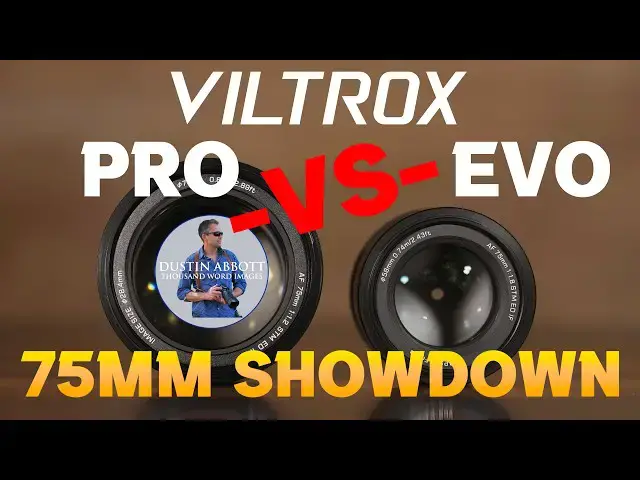
0:10
Viltrox's ProAF 75mm F1.2 was really the
0:15
lens in many ways that kind of signaled
0:17
to me that Viltrox had really arrived as
0:19
a company. It's kind of the grandfather,
0:21
although it's not very old, of their
0:24
renaissance where they have really been
0:26
pretty dominant over the past few years.
0:28
So, it's a little bit surprising to see
0:32
lens arrive, which, you know, not
0:34
exactly the world's most popular focal
0:37
length, but these lenses that play out
0:39
to about 112.5 millimeters, a full-frame
0:42
equivalency, uh, because they are
0:44
designed for APS-C kind of hit a sweet
0:47
spot when it comes to portrait work that
0:49
maybe isn't quite as long as 135
0:51
millimeter focal length, but still
0:53
allows you to get really nice, you know,
0:55
shallow depth of field separation from
0:58
So, these are interesting lenses. And
1:00
so, the Pro Series and the Evo series
1:03
now are going to finally come
1:05
head-to-head in a comparison here. And
1:08
that I'm going to take a look at the
1:10
newcomer, the EVO, and compare it to the
1:12
Pro Series across a wide variety of
1:14
disciplines, and we're going to see who
1:16
comes out on top as the winner. Let's
1:19
dive in. Let's take a look. Today's
1:21
episode is sponsored by Lano and their
1:23
CS3 fast camera battery charger. The CS3
1:26
utilizes sleek camera inspired design
1:28
language to house not only a dual bay
1:31
power delivery rated 20 watt fast
1:33
charger that can charge two camera
1:35
batteries up to 58% faster than standard
1:38
chargers, but also an integrated 12,400
1:41
mAh power bank that you can use to
1:43
charge your batteries or your phone on
1:45
the fly. Because of the dual USB C
1:48
ports, you can even send power through
1:50
the CS3 to charge a third battery in
1:52
your camera. The easyto- read front
1:54
display will show you the stage of
1:56
charge for the internal battery, the
1:58
status of the camera batteries, and the
1:59
charging progress. There are versions
2:01
for Sony, Canon, Nikon, Fuji, and
2:04
Lmount, all available. And for Prime
2:06
Day, they will all be discounted, 20%
2:08
off. Never be caught with a dead battery
2:10
again. Slip your LON CS3 into your
2:13
camera bag for mobile power on demand.
2:16
See the links in the description for
2:17
more information. So, in round one,
2:20
we'll take a look at build and handling
2:22
feature set to see how these two
2:24
compare. Starting with price. And here's
2:26
where the Evo takes an early win.
2:29
Because it's MSRP, it's just $329.
2:32
Whereas the bigger, more expensive Pro
2:35
Series lens cost $580.
2:39
So, not quite twice as much, but within
2:41
that realm of possibility. Pretty
2:43
obviously when you put them side by
2:45
side, the Evo lens is the much smaller
2:47
lens. It is 2.71 in by a little over 3
2:51
in or 69 by 78 mm. Whereas the bigger
2:56
Pro Series lens is 87 mm in diameter and
2:59
101 mm in length or 3.4x 4 in. So it is
3:04
23 mm longer and probably most
3:07
importantly it is 18 mm wider in
3:11
diameter. And so all throughout it is
3:14
just a much much larger lens to
3:16
accommodate those larger glass elements
3:18
for that f1.2 aperture. The Evo lens
3:24
g whereas the Pro Series lens is 675 g.
3:29
So it is literally twice as heavy. So
3:31
obviously that is going to be a very
3:33
noticeable factor if you're out using
3:35
these, particularly on a smaller APS-C
3:38
camera. Front filter threads also favor
3:40
the EVO. It uses a 58 millimeter front
3:43
filter thread, which is very common and
3:45
shared across this entire series.
3:47
Whereas the Pro Lens uses a much much
3:49
larger 77 millimeter filter thread. When
3:52
the filter threads are close, I don't
3:54
consider that a one a win for one or the
3:56
other. But in this case, you're
3:57
definitely going to pay more for 77mm
3:59
filters than you are for 58 mm filters.
4:02
And so that does come out as a win for
4:05
the EVO. However, there are some other
4:07
areas in build and handling where the
4:09
Pro Series lens is going to win. Both of
4:11
these have some degree of weather
4:13
sealing. They both have a gasket at the
4:14
back. They're both have some internal
4:16
seals, but Philtrox is not really being
4:18
too bold about the claims of the Evo
4:20
series because I think the seals inside
4:22
are more like a felt and not really a
4:24
rubber seal. So, it's not to the same
4:26
degree, whereas the Pro Series lens has
4:28
a pro degree of build. And so, it's got
4:31
a thorough set of seals, rubber seals
4:34
all throughout. And it has held up for
4:36
years in terms of the weather sealing on
4:38
it. Build quality here is also I mean
4:41
just more high-end on the Pro Series
4:43
lens. It's you know made of a very very
4:45
nice metals as a part of it. It's it's a
4:48
high-end construction. It very much
4:49
feels like a premium lens. I actually
4:51
think that the EVO lenses feel very very
4:53
nice but not quite as upscale. There's
4:56
one exception that I will say for the
4:58
EVO lens that I do like better and that
5:00
is I find that the lens hood just fits a
5:02
little bit better. Just a little bit
5:03
tighter and it feels like it kind of
5:05
clicks into place a little bit better on
5:06
the EVO lens. But in general, I would
5:08
say that the build quality is better on
5:10
the Pro Series lens. Likewise, it has 11
5:13
rounded aperture blades versus nine for
5:16
the EVO. And as we're going to see later
5:17
on, it definitely does a better job as a
5:20
result of getting to not only completely
5:22
circular shapes across the frame more
5:24
quickly, but does a little bit better
5:26
job of preserving those circular shapes
5:28
as the aperture is stopped down. Now,
5:31
interestingly, because Viltrox
5:33
essentially took the whole set of
5:35
features from the Pro series and, you
5:38
know, brought them down to the EVO
5:39
series, there isn't a win here for
5:41
either lens when it comes to the feature
5:43
set. Both of them are very featurerich.
5:45
They both have an aperture ring that can
5:47
either be clicked or decllicked. They
5:49
have a function button on the side. They
5:52
have an AFMF switch. And so, I mean,
5:55
both of them have the exact same feature
5:57
set and perform similarly in that
5:59
fashion. So coming out of that round, we
6:02
have five points for the EVO lens. We
6:05
have three points for the Pro Series
6:08
lens. Moving on into the next category
6:11
is autofocus. Now, here's an area where
6:13
I had probably my first surprise in this
6:16
because both lenses are using STM or
6:18
stepping focus motors. I basically
6:20
assumed that this was going to be a a
6:23
win for the EVO lens for the simple
6:25
reason that it's moving much smaller
6:26
glass elements as compared to the uh the
6:30
f1.2 2 lens, which also is, you know,
6:33
it's one of the first lenses that they
6:34
had in this this series like this. And
6:37
so, it's just a little bit older in
6:38
terms of the focus technology. But what
6:41
I found is that both of them focused at
6:43
pretty close to the same speed. And I
6:46
would say as I looked at my tests going
6:48
back and forth that I really couldn't
6:50
tell a winner. Both of them are not
6:52
quite instant, but not far from it in my
6:55
actual formal test and jump back and
6:57
forth very, very nicely. both of them
6:59
proved very very accurate and you know
7:01
whatever shot that I was shooting um
7:04
whether I was shooting portraits whether
7:05
I was shooting just out in real world
7:07
shots I found that both of them both in
7:10
my head-to-head test but just shooting
7:12
them independently both of them were
7:13
very very accurate particularly here on
7:15
Sony where I'm doing this comparison and
7:18
you know delivered really really
7:22
so I would say the one area that does
7:24
differentiate them very slightly is I
7:26
did notice a little bit more noise from
7:28
the focus motor when I was going back
7:30
and forth in my formal test. And so I
7:32
heard a little bit more from the Pro
7:34
Series lens, just kind of a little bit
7:35
of like kind of a scratchy type sound as
7:37
it went back and forth. Whereas the STM
7:40
motor on the EVO lens was pretty close
7:42
to silent in operation. And so I would
7:45
say coming out of that, I'm going to
7:46
award one point to the EVO lens. And so
7:49
that gives us six points for the EVO and
7:51
we're still at three points for the Pro
7:55
So when I shifted into the video
7:57
category again I wasn't quite sure what
7:59
I would find out of that. What I did
8:02
find is that again the touch to focus
8:05
was better than what I expected for the
8:06
pro series lens. And I would say that
8:08
across the two of them it was basically
8:10
an equal type performance. Both of them
8:12
were confident in moving from point A to
8:14
point B as I did touch to focus and did
8:17
focus pools and both of them didn't show
8:20
any kind of visible steps. No pulsing,
8:22
no settling. it was just good confident
8:24
moves back and forth. Now, obviously, if
8:26
you're using these lenses, either one of
8:28
them on Fuji, you're going to get a
8:30
little more hinky results when it comes
8:32
to that. But in general, um I would say
8:34
that here and then also on Nikon, you're
8:38
going to get, you know, fairly good
8:39
results when it comes to that. I also
8:41
found that when I tested for manual
8:43
focus and video work that I got about
8:45
the same results. Both of them have a
8:48
manual focus ring that has a good level
8:50
of damping. A little bit firmer on the
8:52
EVO than what it is on the Pro, but both
8:54
of them move smoothly and there's no
8:56
real visible lag. And so I was able to
8:59
do manual focus pulls and video work as
9:01
well. And in this setting, I didn't
9:04
really notice a difference when it came
9:05
to the focus noise. And so it's again,
9:07
there's just maybe a little a slight
9:09
d-tuning when it comes to, you know, the
9:11
speed, the thrust that's being used
9:13
there. And so I didn't hear any noises
9:15
out of the Pro Series lens. So no
9:17
problem there. When I tested for focus
9:19
breathing, both of them do exhibit
9:22
definite levels of focus breathing. I
9:24
did feel like it was slightly less
9:26
pronounced on the EVO lens. And when I
9:29
you kind of test it at the margins, it
9:31
was uh sucking in just a little bit
9:33
less. And so I'll give it a a point
9:36
there, though it's not a strong point.
9:39
One area where I did see an unexpected
9:41
difference was when it came to the
9:43
aperture racking. And I'm able to do
9:45
aperture racks in both of them. But for
9:48
some reason with the uh Pro Series lens,
9:51
it feels like it's quite a long rack um
9:53
as I go through it. And because there is
9:55
a little bit of lag in this kind of
9:57
performance, I found that I wasn't able
10:00
to do it quite as smoothly as what I did
10:02
on the EVO lens. And so I tried
10:03
intentionally to be as smooth as
10:05
possible, but I was able to get a little
10:07
bit better results on the EVO because it
10:09
felt like the the throw for one thing
10:10
was a little less long and so I was able
10:13
to do that a little bit better. What I
10:15
do have to give the Pro one point here
10:17
and that is that you know the video
10:19
footage because of that f1.2 aperture,
10:22
it's just more special looking than what
10:24
you're going to get out of the EVO lens.
10:26
And so I mean that's you know at the end
10:28
of the day it's not just the means of
10:30
capturing the footage, it's what that
10:31
footage looks like. And certainly this
10:33
is a really really special lens
10:34
optically and so I'm going to give it a
10:36
point there. So coming out of that round
10:38
we have eight points for the Evo lens
10:40
and we are now up to four points for the
10:44
That brings us to our final category and
10:47
that is the optical performance. And
10:49
here obviously this is the place where
10:51
we would expect the Pro Series lens to
10:54
kind of get some payoff for its weight
10:56
and size and all of those things. So, we
10:59
do have to start with the elephant in
11:01
the room here, and that is there is an
11:03
obvious win for the Pro Series lens when
11:06
it comes to the brightness of the lens
11:08
itself. It basically has less than a
11:10
full stop of additional light. And so,
11:12
that means that in all other things
11:14
being equal, that you're going to be
11:16
able to get a much faster shutter speed
11:18
using the Pro Series lens than you are
11:21
with the EVO lens. And so, that's going
11:23
to be a definite advantage. And it, you
11:24
know, plays out in a number of ways when
11:26
it comes to depth of field, you know,
11:28
low light potential, all of those
11:29
things. There are definite winds that
11:32
come being associated with that bright
11:33
f1.2 aperture. Moving on, in some other
11:36
categories, both of them are basically
11:38
neutral when it comes to distortion. And
11:40
so, both of them do a great job of
11:42
optical correction, not showing up with
11:44
any kind of distortion. What we would
11:46
expect at this long a focal length is to
11:48
see some pin cushion style distortion,
11:50
but they've done a great job of
11:51
mitigating that. Both of them actually
11:54
show, you know, very moderate levels of
11:57
vignette here on Sony. There's no major
11:59
issues there. And they were very, very
12:01
close. Just a few points separating
12:03
them. Not enough to be a meaningful
12:04
difference. So, I'm going to call that a
12:06
tie there as well. Now, here's where
12:08
things got interesting because as I
12:10
headed into the sharpness segment, my
12:12
expectation was I know that this is an
12:14
elite level lens optically and I didn't
12:16
think that the EVO was going to match
12:18
it. and in wide openen sharpness. And so
12:21
that's, you know, f1.2 or even stopping
12:24
down to f1.8 versus f1.8, I found that
12:27
the EVO was actually a little bit
12:29
sharper in the center of the frame,
12:30
which surprised me. And then as we move
12:32
towards the midframe and then off to the
12:35
corners, the Pro was just it was more
12:38
consistent off towards the edges. And so
12:40
in this case, it's going to be kind of
12:42
an I'm going to give it just no points
12:44
here because the EVO is actually sharper
12:46
in the center of the frame. And so, I
12:48
mean, it's it's kind of depends on where
12:50
you look in the frame. When I stopped
12:51
things down, I actually found that the
12:54
EVO lens was slightly sharper across the
12:57
majority of the frame. Not only in the
12:59
center at f2.8, for example, but off in
13:02
the mid-frame, it had a very slight
13:03
edge. And only in the corners would I
13:05
say that the Pro was equal or marginally
13:08
better than that. And so, I am going to
13:10
give one point there. Here's where I
13:12
really was surprised and that was when I
13:15
was comparing contrast in images. I
13:17
actually felt like the contrast very
13:20
slightly favored the EVO lens. And in a
13:22
variety of situations, it showed a
13:25
surprisingly strong level of con
13:27
contrast in those settings. It was very,
13:29
very strong. And also surprising to me
13:32
is that when I did headtohead and I was
13:34
looking at fringing, there is a little
13:36
bit of fringing with the Pro Series
13:38
lens, whereas the EVO lens is basically
13:41
flawless in that regard, showing almost
13:43
no kind of longitudinal fringing at all.
13:46
And so some unexpected wins for the
13:49
smaller, cheaper EVO lens. Both of
13:52
these, by the way, are exceptionally
13:54
sharp, exceptionally good contrast, and
13:56
very, very low levels of fringing. And
13:58
so I'm not putting this to slam a lens
14:00
that I've previously praised again and
14:02
again and again there. It's very very
14:04
strong in those categories. But the EVO
14:05
was surprisingly just marginally better
14:08
in a few areas. Now when it comes to the
14:10
overall rendering, obviously here's a
14:13
place where the the Pro Series lens gets
14:16
some wins. It has the nicer bokeh in
14:19
general. And so if you just look at the
14:21
general rendering across the frame, it's
14:23
able to produce just more special images
14:26
that have that are that are softer that
14:28
are smoother in the overall background.
14:30
I also noted that while both of them are
14:32
extremely smooth in terms of the inner
14:35
circle of specular highlights, bokeh
14:38
balls, the Pro is able to achieve
14:40
consistently circular images across the
14:43
frame by just f2. Whereas it is not
14:46
until about f3.2 2 that I saw the same
14:49
from the EVO lens. So, both of those,
14:51
you know, it is it's it's not quite two
14:54
stops down, but you know, it's it's more
14:56
like a a stop and a third, a stop and a
14:58
half to get to that point, but obviously
15:00
f2 comes much much earlier. And so, it
15:03
definitely uh allows you to shoot with
15:05
still a very bright aperture, but if
15:06
you're looking for those perfect circles
15:09
all across the frame in the background,
15:10
you're able to get that much sooner and
15:12
more usably on the f1.2 lens. I also
15:16
found that when it comes to the portrait
15:19
rendering and subject isolation,
15:22
obviously this is where f1.2 totally
15:25
pays off. And so you get that more
15:26
shallow cutout look. Backgrounds are
15:28
just softer and creamier and nicer and
15:31
head-to-head portrait situations. And so
15:34
when it comes to the various categories
15:36
regarding the overall rendering and the
15:38
bokeh quality, definite wins for the Pro
15:41
Series lens there. And so it does make
15:43
up some ground here and it gets five
15:46
points out of this round bringing its
15:48
total up to nine. However, there is some
15:51
unexpected wins for the Evo lens and so
15:53
it managed to rack three points in this
15:56
round bringing its total up to 11. Leads
16:00
me to an unexpected conclusion. I came
16:02
out of this comparison somewhat
16:04
surprised. I expected the Pro to clean
16:06
up in basically all of the image quality
16:09
comparisons and I expected the EVO to
16:11
win in the autofocus sections doing to
16:14
having slightly newer technology and
16:16
that smaller workload that I mentioned
16:17
on the STM focus motors. But neither of
16:20
these were completely true. There's no
16:22
question that the f1.2 aperture in the
16:24
pro allows it to produce the more
16:26
special images. But the Evo is a
16:28
surprisingly strong performer as well.
16:31
And it's also of course much much
16:33
smaller, lighter, and cheaper. And so,
16:37
while it's not a big win in this
16:39
category, and still if you're looking
16:40
for the absolute best image quality, the
16:43
most special images, still go for the
16:45
Pro Series lens. But if you're
16:46
wondering, is it totally blowing the EVO
16:49
out of the water? Well, in many ways,
16:51
the answer is no. The Evo lens continues
16:53
to impress me, really finding a sweet
16:56
spot when it comes to size, weight, and
16:59
feature set while still having an
17:01
amazing optical performance. Viltrox is
17:04
killing it in both of these categories.
17:06
But the Evo series is undoubtedly
17:09
special. If you want more information,
17:12
you can check out my full text and video
17:14
reviews of both of these lenses. They're
17:16
linked in the description down below.
17:17
There's also some buying links there
17:19
along with a discount code that can save
17:21
you 5% off of them. As always, thanks
17:24
for watching. Have a great day and let