Up next in 10

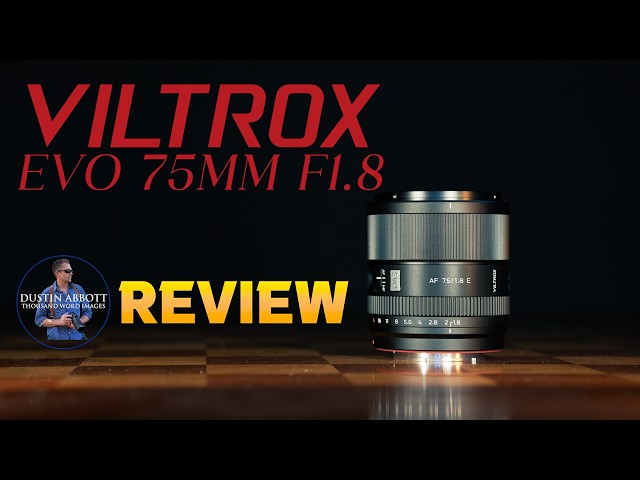
Viltrox EVO 75mm F1.8 Review | Smaller, Lighter, Better?
Jun 3, 2026

Photographer Dustin Abbott takes a deep dive look at the Viltrox AF 75mm F1.8 from their EVO series in a Sony E-Mount. Does this 75mm F1.8 make more sense than the Pro 75mm F1.2? | Read the Text Review: https://tinyurl.com/EVO75Review | Purchase the Viltrox EVO 75mm F1.8 @ Viltrox https://tinyurl.com/BuyEVO75mm (use code DUSTINABBOTT for 5% off) | B&H https://bhpho.to/4e5jgIV| Adorama https://prf.hn/l/3Pkzedw/ | Amazon https://amzn.to/4vGGY49 | Amazon Canada https://amzn.to/43WKL18 | Amazon UK https://amzn.to/4oiAlT0 | Amazon Germany https://amzn.to/4et5a42
Check out the DA Merch here: https://bit.ly/TWIMerch | Become a Patron: https://www.patreon.com/dustinabbott | On the Web: http://dustinabbott.net/ | Sign up for my Newsletter: http://bit.ly/1RHvUNp | Instagram: http://bit.ly/DLAinsta | Facebook: http://on.fb.me/1nuUUeH | Flickr: http://bit.ly/1UcnC0B | 500px: http://bit.ly/1Sy2Ngu Follow Craig @ https://www.instagram.com/craigstoffersen/
Want to support this channel? Use these affiliate links to shop at:
B&H Photo: http://bhpho.to/1TA0Xge
Adorama: https://howl.link/nt4zdz1goa7ql
Camera Canada: http://bit.ly/DLACameraCan
Sony Canada: https://www.thesonyshop.ca/?ref=abbott
Amazon: https://amzn.to/3HrY64d
Amazon Canada: https://amzn.to/3qG1p18
Ebay: http://bit.ly/DustineBay
Into the AM Clothing: https://bit.ly/intotheAMda and use code DUSTIN10 for 10% off
Fioboc Clothing: https://tinyurl.com/FiobocDA20 and us code DUSTIN20 for 20% off
Make a donation via Paypal: https://www.paypal.com/paypalme/dustinTWI
=============================
Table of Contents:
=============================
0:00 - Intro
Show More Show Less View Video Transcript
0:00
[music]
0:10
>> Hi, I'm Dustin Abbott. Well, good
0:12
[music] weather has finally arrived here
0:14
in Canada and with it has come a couple
0:17
of new lenses from Viltrox. This is the
0:20
first of their Evo series for APS-C
0:23
specifically and I've already released a
0:25
review of the 90mm f/2.2 and today I'm
0:28
going to be covering the new 75mm f/1.8.
0:32
Now, this lens will be coming for Sony
0:34
E-mount, which is what I've tested here,
0:36
also for Fuji X-mount and then Nikon
0:39
Z-mount. Unfortunately, our friends on
0:42
Leica L-mount and Canon RF-mount are
0:45
still out in the cold. However, this
0:47
series I like the approach here because
0:50
rather than giving us some of the
0:51
typical focal lengths that, you know,
0:53
are covered very thoroughly, you know,
0:55
the equivalents of 35, 50, 85mm, we
0:59
instead have lenses that are a little
1:01
bit longer here. And so this lens giving
1:03
us a full full frame equivalent of
1:05
112.5mm
1:07
while the 90mm gives us a full frame
1:09
equivalent of 135mm.
1:12
There's far fewer lenses in this
1:13
category and so it gives us just a
1:16
little bit more options. And the Evo
1:18
series has been pretty universally
1:20
fantastic so far and we're going to
1:22
explore today why that tradition
1:23
continues with the new 75mm f/1.8. Now,
1:27
Viltrox already does have an existing
1:29
Pro series 75mm f/1.2 for all of these
1:33
mounts. Difference here being is that we
1:35
have a radically smaller lens, also a
1:37
lens that is much less expensive, weighs
1:40
half as much. And so while it doesn't
1:42
have as bright a maximum aperture, I
1:44
think it's going to hit the sweet spot
1:45
for those that have been intrigued by
1:47
the 75mm f/1.2 but just don't want such
1:50
an extreme lens. The Evo lens is
1:53
anything but that. So today we're going
1:55
to explore just how good it is together.
1:57
Now, before we jump in, I want to say a
1:59
big thank you to Viltrox for sending me
2:01
a review sample of this lens. They have
2:03
had zero input in this review. They're
2:05
not going to see my findings before you
2:07
do. So, this is a completely independent
2:09
review. So, we're going to jump in and
2:11
take a look at the build and handling
2:12
right after a word from our sponsor.
2:14
Today's episode is sponsored by the all
2:16
new Phantom Tracker 2.0. Phantom has not
2:19
only seriously upgraded the visual look
2:21
of the card, but now we have a superior
2:23
build quality made with tempered glass
2:25
and metal alloys. This credit card size
2:27
tracker can be locally tracked via a 90
2:30
decibel beeping noise, but also on a
2:32
global level via Apple's Find My Network
2:34
and its map. The addition of NFC means
2:37
that you can also use the card to
2:38
trigger an automation. Just tap it. The
2:41
tracker fits perfectly in any wallet or
2:43
bag and assures you won't lose your
2:45
valuables. It has a built-in
2:46
rechargeable battery that can be easily
2:48
charged via any wireless charger, and a
2:51
single charge can last up to 6 months.
2:53
The Phantom Tracker 2.0 makes for a
2:55
seriously cool gift. So, visit
2:57
store.phantomwallet.com
3:00
and use code Dustin20 at checkout for
3:02
20% off. That's store.phantomwallet.com
3:05
and use code Dustin20 for 20% off. All
3:09
right, let's take a closer look at the
3:10
build and handling of this lens. We do
3:13
have the new 90mm 2.2 as well, and you
3:17
can see that size and almost weight is
3:20
almost identical between the two.
3:22
The 75mm sports a focal length that's a
3:25
full frame equivalent of 112.5
3:28
mm due to that 1.5 times crop factor
3:31
that we find on Sony E-mount, which I'm
3:33
testing here, Fuji X-mount, and then
3:35
Nikon Z-mount. The price here has not
3:38
been settled at the time of this review,
3:39
but like all the other Evo lenses, it
3:41
should fall under 400 US dollars. While
3:44
we don't have a lot of direct
3:45
competition, the closest one I can think
3:47
of is there is a 75mm f/1.8 from Samyang
3:51
that comes in at $450.
3:54
So, that is available only for Fuji X
3:57
mount. There are some full-frame options
3:59
that cover the same focal length and
4:01
aperture, also some 75 mm F2 lenses. So,
4:04
those might also be considered, though
4:07
this lens is probably going to give you
4:08
the best combination of uh features and
4:10
performance due to the fact that it's
4:12
actually designed for the APS-C
4:14
platform.
4:15
Build quality here, I've I've got zero
4:17
complaints with the Evo formula here in
4:20
terms of the build quality. They've hit
4:21
a nice stride while making the materials
4:23
nice and premium feeling while also
4:26
maintaining a lightweight. At the back
4:29
of the lens, we've got a weather sealing
4:31
gasket and a USB-C port where you can do
4:34
easy firmware updates for the lens.
4:36
There are some internal seals, a total
4:38
of seven points, but Viltrox has pointed
4:40
out to me that those internal seals are
4:42
felt rather than rubber, so they're not
4:44
quite to the same quality. And so, they
4:46
don't really tout the weather sealing of
4:48
this lens, even though it does have a
4:50
decent degree of weather sealing. As you
4:53
can see, it does come with the lens
4:54
hood. Lens hood bay bayonets on nice and
4:57
accurately and clicks into place with
4:59
good precision and holds nicely there.
5:01
There's also a little pouch that comes
5:03
with the lens as well.
5:05
Now, this lens is more feature-rich than
5:07
what a lot of opposing lenses are. I
5:09
will point out, however,
5:11
that if you're buying the Fuji version,
5:13
the Fuji versions are stripped down a
5:15
bit, mostly because Fujifilm doesn't
5:16
support all of these features. So, this
5:18
is the feature set that I'm going to
5:20
show that you're going to get on either
5:22
Sony or Nikon. So, that starts with an
5:24
aperture ring that can either be
5:26
de-clicked, where you can smoothly rack
5:28
through it and do aperture racks like
5:30
this. It also has the ability to click
5:33
the aperture with 1/3 stop detents, and
5:35
then there is a little resistance
5:37
between F16 and then automatic. I wish
5:40
that that was actually a little bit more
5:42
intense. There is no iris lock here,
5:44
either. We also have a custom button. We
5:47
have an AF MF switch. And overall, a
5:50
nice robust feature set that is there.
5:52
The actual
5:54
manual focus ring has a good level of
5:56
damping. I was able to manually focus
5:58
with good precision here on Sony and
6:00
then also on Nikon. You'll be able to
6:01
get full-time manual focus override,
6:04
which is very nice to have. Inside, we
6:06
have the nine aperture blades. It does a
6:09
reasonably good job of maintaining a
6:10
circular shape as you stop down, though
6:13
not quite as good as lenses with a
6:15
higher blade count.
6:17
The physical dimensions of the lens
6:18
here, which are pretty common throughout
6:20
this series, it is 69 mm in diameter or
6:24
2.71 in, 76 mm or right under 3 in in
6:28
length. You can add on two more
6:29
millimeters if you're using the Nikon Z
6:31
mount version. Um that compares to the
6:34
Pro series lens, as you can see here,
6:36
which is has an F brighter F1.2
6:38
aperture, but it is radically bigger.
6:40
That 18 extra millimeters in diameter
6:42
makes the lens look like it's twice as
6:43
wide from the front. And that 25 mm of
6:46
additional length just shows you that
6:48
we're in a radically different size
6:50
class with the 75 mm F1.2. And that
6:53
definitely shows up in the weight. This
6:55
lens is just 335 g in E mount or 11.81
7:00
oz. That is exactly half the weight of
7:03
the F1.2 lens, which is 670 g.
7:07
Definitely on the heavy side for an
7:08
APS-C lens.
7:10
All of these Evo lenses, now five of
7:12
them share a 58 mm front filter thread
7:15
up front. Fantastic view on multiple
7:17
lenses and you can share filters across
7:19
them.
7:20
Our minimum focus distance is 74 cm, and
7:24
that gives us a posted magnification
7:26
figure of 0.12 times. Now, Viltrox, like
7:29
Fuji, when they're listing that maximum
7:31
magnification for APS-C lenses, they do
7:33
it without the crop factor attached. So,
7:36
on full-frame, that 0.12 times would
7:38
look more like 0.18 times. And as you
7:41
can see in this comparison, it
7:43
definitely gives a much higher level of
7:44
magnification than what the 75 mm F1.2
7:48
does. As with all of these Evo lenses,
7:50
the up close performance is really quite
7:52
good. And so you can get some nice
7:54
looking images up close and blur out
7:56
backgrounds pretty strongly with it.
7:58
Overall, this is really a fantastic
8:00
package. I've got very little to
8:02
complain about here. I love it. So let's
8:04
talk autofocus. As with all of the other
8:07
Evo lenses, autofocus comes via an STM
8:10
focus motor. Now while this isn't as
8:12
sophisticated as the hyper VCM focus
8:14
motors we're seeing in the Pro and Lab
8:16
series,
8:17
for these, you know, smaller, lighter
8:19
elements in these lenses, it's mostly
8:22
getting the job done. Withholding the
8:24
hyper VCM focus motors from the Evo
8:26
series is I think at least one of the
8:28
areas that Viltrox is using to
8:30
differentiate this lineup from the more
8:32
premium lineups.
8:34
That being said, autofocus moves with
8:36
fairly good speed. Here you can see
8:38
going back and forth with little
8:39
hesitation. It's not quite instant and
8:42
as with, you know, I would always say if
8:44
you're looking to shoot something like
8:46
sports, I'm not sure that third-party
8:48
lenses are your best option anyway
8:51
because they are dealing with typically
8:52
having to reverse engineer focus
8:54
algorithms. And so there there are a few
8:56
more limitations there. At the same
8:58
time, autofocus I found was fantastic
9:00
for everything that I used it for. So
9:02
that was true whether I was shooting
9:04
things with, you know, very fine
9:06
subjects and fine detail and I got good
9:08
autofocus there. It worked well when I
9:10
used it for portraits and I got well
9:12
focused results for portrait work. I
9:14
used it some for B-roll during a wedding
9:17
that I shot. And so whether that was
9:19
shooting some,
9:20
you know, shots of the groom getting
9:22
ready or some shots of groom with his
9:24
parents, some of the decorations at the
9:25
wedding, I got really good results with
9:28
all of those things. and so autofocus
9:30
was always precise and accurate whether
9:32
I was focusing in, you know, brighter
9:34
situations or, you know, the more dim
9:36
situations like at the reception. So,
9:39
I'd no reservations on that front.
9:41
Autofocus generally, you know, focus
9:43
accurately on the eye and delivered good
9:44
results. Now, I tested on Sony and
9:47
that's best-case scenario here. You're
9:49
going to find mostly the same but very,
9:52
very slightly lower results on Nikon Z
9:55
mount if experience holds here and
9:58
somewhat lesser results on Fuji X mount
10:01
due to the limitations of autofocus
10:02
system there. In general, however,
10:04
though autofocus is solid. There's
10:06
nothing wrong with the lenses based
10:08
autofocus, although some of the
10:10
differences in those systems is going to
10:11
manifest when you have the opportunity
10:12
to compare side by side by side with
10:15
each one of those systems on a native
10:17
mount for each of those lenses. Now, on
10:19
the video side of things, again,
10:21
autofocus was largely good. Focus pulls
10:23
are smooth going back and forth. On
10:26
Sony, the touch to focus is responsive
10:29
and so I didn't have any issues with
10:30
that. I did see some focus breathing as
10:32
you can see here and even when I
10:35
actually tested for it with my test
10:37
chart, you can see that if I'm making
10:38
extreme focus changes, there is some
10:40
obvious focus breathing. However, when I
10:42
switch over to doing my hand test where
10:44
I transition from the hand to the eye,
10:46
that shorter throw, you can see that the
10:48
autofocus
10:50
or the focus breathing is is far less
10:52
obvious in settings like that. So, maybe
10:54
that will help you to determine whether
10:55
or not it's actually going to be an
10:56
issue for you. When I approach the
10:59
camera, I had no issues there. It
11:01
tracked me perfectly as I came up close.
11:03
I ducked out of the frame, it left, I
11:05
stepped back in, it returned to me
11:07
quickly. Likewise, when I moved
11:09
laterally and then came back in, all of
11:11
that, no problems on that front and
11:13
you've probably noticed from these
11:14
outdoor segments, all of which I'm
11:16
filming on the 75 mm f/1.8
11:20
mounted on my Sony Alpha 1 Mark II,
11:23
autofocus has been solid and stable in
11:26
all of these shots as well as it has
11:28
been in some previous episodes that I've
11:30
shot for my YouTube channel that I
11:31
didn't disclose were filmed on this
11:33
previously unreleased lens. And so auto
11:36
focus there has been fine and in my
11:39
various video clips, I didn't see
11:41
anything that caused any concern for me
11:43
on the video side of things. Again, on
11:46
Nikon, you're going to get, you know,
11:48
slightly less results and definitely far
11:51
rougher results on the Fuji side of
11:54
things and I definitely notice that when
11:55
reviewing the XF version of the 90 mm F
11:59
2.2 on my Fujifilm X-H2. But again,
12:02
that's par for the course. So all things
12:04
considered, auto focus is solid here.
12:07
All right, we'll start by taking a look
12:08
at the optical design here. We have an
12:10
optical design of 11 elements in nine
12:13
groups and that includes two high
12:14
refractive
12:16
index elements and then two extra low
12:17
dispersion elements. The MTF chart, and
12:20
I'm particularly looking at the 30 lines
12:22
pair per millimeter line, which is right
12:25
here. You can see that it starts off in
12:27
excellent level, really quite flat until
12:30
basically like the last third, where you
12:32
see some drop off, but still we're
12:33
averaging out somewhere near about 68,
12:36
69%
12:37
between the sagittal and meridional
12:39
lines. So that typically indicates
12:41
fairly good contrast and low
12:43
astigmatism. It was interesting when I
12:45
pulled up the Pro 75 mm F 1.2 and then
12:48
usually I put a line through it 80%. In
12:50
this case, I put it at 90% because so
12:52
much of both of these lenses is above
12:54
that threshold. So almost all in the
12:56
outstanding range. You can see that
12:58
comparing them that in this area right
13:00
here, the F 1.2 lens just kind of goes
13:03
up into epic territory there and it
13:06
truly is an elite lens and definitely it
13:08
averages out here at the end at a higher
13:10
level, somewhere around 79 to 80% all
13:13
the way out to the corner. And so it is
13:15
stronger in the corner. It's stronger
13:17
just in in general. However, what really
13:19
stands out to me is that we have a very
13:20
linear fade with the 75 mm F 1.8. Now in
13:25
In of other metrics, we see here that we
13:27
have basically no distortion. That's
13:29
fantastic and a minimal amount of
13:31
vignette at least here on Sony. Only had
13:33
to dial in a plus 38 to correct for
13:35
that. That's really fantastic. Now, when
13:37
it comes to longitudinal style chromatic
13:40
aberrations, we see a minimal amount
13:42
before the plane of focus, very little
13:44
after the plane of focus, nice and clean
13:46
there. And if I take a peek here even at
13:48
a high level of magnification of my
13:50
dad's old SLR, I don't see any kind of
13:53
fringing here in the transitions from
13:55
black to white. And if I look at these
13:56
shiny bits up into the specular
13:58
highlights, very, very clean. We'll note
14:01
that like the 90 mm, we do have very,
14:03
very clean
14:04
just kind of inner specular highlights,
14:06
not any kind of noise or concentric
14:08
circles. Very, very nice.
14:11
Now, in terms of that geometry, you can
14:13
see some cat eye shape towards the edge
14:15
stopping down here to F2.8. It a lot of
14:19
it resolved just some clipping towards
14:20
the very edge. By F4, you know, it's
14:23
still not quite perfect. And so, if
14:25
you're looking for a lens that's going
14:26
to give you just perfectly round
14:28
specular highlights all across the
14:30
frame, well, this is probably not it.
14:32
Lateral style chromatic aberrations near
14:34
the edge of the frame are also well
14:36
controlled with clean transitions from
14:38
black to white there. All of that is
14:40
great. Now, in terms of resolution here
14:42
on Sony, the highest resolution
14:44
currently available
14:46
on APSC is 26 megapixels. Though the new
14:50
A7R 6 gives us a little bit higher
14:53
resolution than that, but taking a look
14:55
here at 26 megapixels, 200%
14:58
magnification, we see that the center of
15:00
the frame is really, really sharp. Great
15:02
detail, great contrast. Mid frame is
15:04
looking very good. If I look down here,
15:07
there's only a mild amount of loss from
15:09
the upper left corner to the lower
15:11
right. And down into the corner, it is a
15:13
little bit softer and a little bit lower
15:15
contrast, but still at a very good
15:16
level. For real world perspective, we
15:19
can see if we punch in here that detail
15:21
and contrast looks really beautiful. And
15:23
as you can see, rendering as a whole, as
15:25
we'll get to in a moment, is fantastic.
15:27
Here's a quick portrait shot I took
15:29
during filming this today, and you can
15:31
see that detail and contrast are very
15:34
good. And then the overall just kind of
15:37
rendering out of focus, everything is
15:39
quite nice. Shot here of Nala shows
15:41
great detail and contrast in and around
15:43
the fur around her eyes and the iris
15:45
itself. I'm very, very happy with all of
15:48
that. So, is there more in cap if we
15:50
stop down? Well, that mild stop down to
15:52
F2, we can see that it might have a hair
15:56
more contrast, but I would say the
15:58
images largely look the same. From F2 to
16:01
F2.8, there is an improvement, however,
16:04
and you can see looking at this seal,
16:05
for example, contrast is better. All of
16:08
the writing is just a little inkier and
16:10
more clearly defined. Over here on the
16:12
left side, you can see again that some
16:15
of that fine kind of just text printing
16:17
is showing up better there. And if we
16:19
pop up into the this corner, we can see
16:21
that, you know, looks really good
16:23
actually right out to the very edge
16:25
here. We can see all of that writing at
16:26
F2.8, all looks very good. The seal
16:29
stands out nicely. In general, I think
16:31
it looks pretty fantastic. Now, stopping
16:33
on down from F2.8 to F4 and beyond, I
16:36
didn't really see too much gains beyond
16:38
that. There's maybe a tiny bit more
16:40
contrast there, but not enough that you
16:42
would even notice if it wasn't side by
16:44
side at 200%. Taking a look at a
16:47
portrait shot at F3.2, you can see
16:49
detail all looks really fantastic. All
16:51
of the beard hairs are really tightly
16:53
defined, looks really fantastic. Here
16:56
looking at a landscape style shot, you
16:58
can see just how fine all the detail is
17:01
there. And if I pull down here towards
17:02
the corner, it's only till I get out of
17:04
the depth of field that we start to lose
17:06
anything. Over on this side, however,
17:08
where it's still within the depth of
17:10
field, we see it all looks really,
17:12
really great. So, after F8, we'll start
17:14
to see some effects of diffraction start
17:17
to set in, so you can see it's a little
17:18
bit less soft at F11, a little bit
17:20
softer still at F16. Expect that to be
17:23
far more pronounced if you're looking on
17:25
the Fuji 40 megapixel sensor. So, as
17:27
noted, the the new F1.8 lens has a
17:30
significantly higher level of
17:32
magnification than the F1.2 Pro Series
17:35
lens. So, we can see here that if we
17:37
look at the seal, for example, you're
17:39
getting a lot higher level of
17:40
magnification, and up close, it's
17:42
delivering really good results, crisp
17:45
good detail, good contrast, no
17:46
complaints. Now, obviously, F1.8 is not
17:49
going to give you the same degree of
17:51
defocus as an F1.2 lens, and so we can
17:55
see in this image, for example, with a
17:56
lot of really hard edges, it looks a
17:58
little bit busy, a little bit more hard
18:01
edges than what I would like, but that's
18:02
the exception to the rule. As I looked
18:04
through other images, I found that for
18:06
the most part, I actually thought the
18:07
rendering from the lens was really nice.
18:09
And so, you can see here, contrast and
18:11
detail really beautiful, and the
18:13
transition to defocus fantastic. This
18:16
shot here, again, there's some areas
18:18
that are in that transition zone that
18:19
could be a little bit busier, but
18:21
overall, I think that the rendering is
18:22
quite nice in this image, and I've got
18:24
no complaints about that. I think here
18:27
it's gorgeous. I mean, we've got great
18:28
detail on our subject, and then as we
18:31
look towards the transition to defocus,
18:34
it's handled really beautifully. No
18:36
complaints there. This shot I thought
18:38
really stood out that just a lot of
18:41
different transitions to different
18:42
layers, and each one of those
18:44
transitions to me looks really good.
18:46
Even in this transition zone here, where
18:48
it could be rougher, it's not, and then
18:50
as you get out here, it's just beautiful
18:52
cream. I'm really happy with that end
18:54
result. Here in the morning, and we're
18:56
going to transition to looking at our
18:57
flare resistance, too, and so you can
18:59
see just a little bit of a glow effect
19:00
from the sun hitting there, but you can
19:02
see the blade of grass with all the dew
19:05
on it, and you can see lots of kind of a
19:07
soap bubble effect here, which is, you
19:09
know, the look I'm going for with this
19:10
style of shot, but, you know, to me it
19:12
looks really good. Flare resistance
19:14
there I think is just pleasing. In this
19:16
shot here, you know, you can see there
19:18
are a few flaws. There's a little bit of
19:19
a ghosting effect here, some veiling in
19:21
this section right here, but again, I to
19:24
me this image actually the result is
19:27
artistic, and so I'm not dissatisfied
19:30
with that at all. I did notice in an
19:33
image like this, again, this is at
19:34
f/1.8. It's the same kind of thing,
19:37
little bit of mild of a ghosting effect
19:39
here. Now, if I stopped on down a bit,
19:41
the blades from the actual like sun star
19:44
sunburst effect, they become much more
19:46
dominant, and so that's a taste thing.
19:49
You either like or you don't like that.
19:51
Again, we've got a little ghosting
19:52
artifact here. Nothing too major or too
19:54
concerning here that I'm seeing.
19:57
You can, however, at a very certain
19:59
position get this veiling effect, and so
20:01
just be aware of that that as the the
20:04
sun is right out of the frame or the
20:06
light source, you can lose contrast.
20:09
Again, in some situations that might
20:10
work, but in other situations that could
20:12
be a negative impact, so just be careful
20:15
in your composition. Overall, really
20:17
beautiful optics here. So, what's my
20:19
conclusion? Well, as you've probably
20:21
heard me say before, this Viltrox Evo
20:23
series is probably the series current
20:27
series that I'm the most excited about
20:29
in photography generally. Not because it
20:31
is the highest end or even necessarily
20:33
the highest performing, but because I
20:35
think it really hits a sweet spot of
20:37
packaging and performance that is within
20:41
the range of basically almost all
20:43
photographers. And so the combination of
20:46
getting, you know, a robust set of
20:47
features and a compact lens at a price
20:50
under $400 with the kind of optical
20:53
performance that we've seen throughout
20:55
this series is really to me very, very
20:57
impressive. And I think the 75 mm is,
21:00
again, it's one of the sweet lenses in
21:02
the series. I find that there's a great
21:04
blend here of sharpness and then bokeh
21:07
rendering that even though it's not as
21:09
bright as the Pro series F1.2 nor is
21:12
necessarily as elite as what that lens
21:15
is, this is going to be the kind of
21:16
optical performance I think it's going
21:18
to be satisfying for nearly everyone.
21:20
And to get that in such an accessible
21:22
package is so handy. I also love the
21:24
fact that this slightly longer focal
21:26
length gives people a different
21:28
perspective for portraits. And the
21:30
longer that you get between 85 mm and
21:32
135 mm, I think that you get
21:35
increasingly more special looking
21:37
images. And while this lens isn't going
21:40
to be quite as special in terms of
21:42
subject separation as what a 135 mm lens
21:46
is, the fact that this still retains a
21:48
fairly bright maximum aperture and
21:50
allows you to still allows you to get a
21:52
pretty nice separation even at
21:54
full-length portrait of your subject
21:55
from the background. And you're going to
21:56
find that that kind of shot is unique
21:59
and special and I think it's a look
22:01
that, you know, if you're shooting for
22:02
clients, they're probably going to like.
22:05
So, there's a lot of good going on here.
22:06
Autofocus was solid here on Sony. And in
22:09
general, I don't find a whole lot to
22:11
complain about here, frankly.
22:13
And again, it's such a great lens in
22:16
terms of the price-to-performance ratio
22:18
that if you're looking for a focal
22:20
length like this, this is kind of a
22:22
no-brainer at this kind of price.
22:25
If you want more informa- information,
22:26
you can check out my full text review
22:28
which is linked in the description down
22:29
below.
22:30
Um also, there's some buying links there
22:32
and a discount code if you'd like to
22:33
purchase one for yourself. As always,
22:35
thanks for watching. Have a great day
22:37
and let the light in.
#Science