Up next in 10

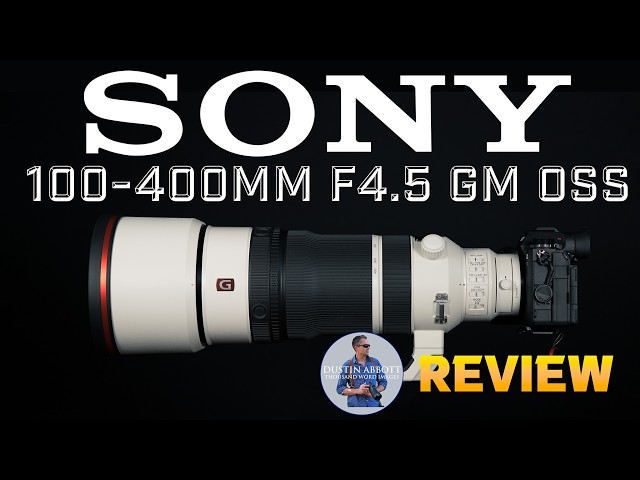
Sony 100-400mm F4.5 GM OSS Review | the Best 100-400 Ever!
May 6, 2026

Photographer Dustin Abbott takes a deep dive look at the Sony 100-400mm F4.5 GM OSS and concludes that it is the best 100-400mm lens ever! | This episode is sponsored by Fantom Tracker. Visit store.fantomwallet.com and use code DUSTIN20 for 20% off. | Read the Text Review: | Purchase the Sony 100-400mm F4.5 GM @ B&H Photo | Adorama | Sony USA | Amazon | Sony Canada | Camera Canada | Amazon Canada | Amazon UK | Amazon Germany
Check out the DA Merch here: https://bit.ly/TWIMerch | Become a Patron: https://www.patreon.com/dustinabbott | On the Web: http://dustinabbott.net/ | Sign up for my Newsletter: http://bit.ly/1RHvUNp | Instagram: http://bit.ly/DLAinsta | Facebook: http://on.fb.me/1nuUUeH | Flickr: http://bit.ly/1UcnC0B | 500px: http://bit.ly/1Sy2Ngu Follow Craig @ https://www.instagram.com/craigstoffersen/
Want to support this channel? Use these affiliate links to shop at:
B&H Photo: http://bhpho.to/1TA0Xge
Adorama: https://howl.link/nt4zdz1goa7ql
Camera Canada: http://bit.ly/DLACameraCan
Sony Canada: https://www.thesonyshop.ca/?ref=abbott
Amazon: https://amzn.to/3HrY64d
Amazon Canada: https://amzn.to/3qG1p18
Ebay: http://bit.ly/DustineBay
Into the AM Clothing: https://bit.ly/intotheAMda and use code DUSTIN10 for 10% off
Fioboc Clothing: https://tinyurl.com/FiobocDA20 and us code DUSTIN20 for 20% off
Make a donation via Paypal: https://www.paypal.com/paypalme/dustinTWI
=============================
Table of Contents:
=============================
0:00 - Intro
Show More Show Less View Video Transcript
0:10
100 to 400 millimeter lenses have
0:12
followed a pretty consistent formula.
0:15
They are always variable aperture. They
0:17
are externally zooming and they fall
0:20
into basically the same kind of price
0:22
point. Typically around $2500 to $2,700
0:26
for the premium options from the first
0:29
party brands. Sony however has changed
0:32
all of that. Their new 100 to 400
0:34
millimeter G Master lens has a constant
0:36
aperture maximum aperture of f4.5.
0:40
It is an internally zooming design and
0:42
it's about 50% more expensive. Oh, and
0:46
it's 100% more awesome. Today, we're
0:49
taking a look at the new Sony G Master
0:51
100 to 400 millimeter f4.5
0:55
Goss lens and going to examine why this
0:58
completely different approach to this
1:00
classic focal range. Really makes for a
1:03
uniquely awesome lens. Now, as
1:06
mentioned, it is more expensive. It's
1:07
going to come to market at about $4,300
1:09
US. And so it is a little bit more
1:13
inaccessible than lenses like this in
1:15
the past. However, think of this lens
1:17
more as a bridge between the typical
1:20
variable aperture zooms and then those
1:22
really high-end, really expensive prime
1:25
lenses that cover some of these same
1:27
focal lengths because in many ways it's
1:29
got some of the same advantages as some
1:31
of those lenses. No, it's not quite as
1:33
bright as those, but it's bright enough
1:35
that you can throw on a 1.4 four times
1:37
teleconverter, get up to 560 mm and
1:40
still only be at f6.3. Throw on a two
1:42
times teleconverter and you can get all
1:44
the way to 800 mm. That adds a whole lot
1:47
of versatility to this lens and there's
1:49
a reason why I'm really excited about
1:52
it. We're going to dive in today and
1:54
we're going to put it through the paces
1:56
and come back and to see why this maybe
1:58
should go to the top of your list of the
2:00
most desirable telephoto zoom you can
2:03
get for your Sony E-mount camera that's
2:05
out there. I want to say thanks to Sony
2:07
USA for sending me a laner of this lens.
2:09
It will be going back to them after this
2:11
review. They have had zero input in this
2:13
review and they will not see it before
2:15
you do. All of that aside, let's jump
2:17
in. Let's take a look. Today's episode
2:19
is sponsored by the all-new Phantom
2:21
Tracker 2.0. Phantom has not only
2:23
seriously upgraded the visual look of
2:25
the card, but now we have a superior
2:27
build quality. Made with tempered glass
2:29
and metal alloys, this credit card size
2:32
tracker can be locally tracked via a
2:34
90de beeping noise, but also on a global
2:36
level via Apple's Find My Network and
2:39
its map. The addition of NFC means that
2:41
you can also use the card to trigger an
2:43
automation. Just tap it. The tracker
2:46
fits perfectly in any wallet or bag and
2:48
assures you won't lose your valuables.
2:50
It has a built-in rechargeable battery
2:52
that can be easily charged via any
2:54
wireless charger, and a single charge
2:56
can last up to 6 months. The Phantom
2:58
Tracker 2.0 makes for a seriously cool
3:01
gift. So visit store.fanomwallet.com
3:04
and use code dustin20 at checkout for
3:06
20% off. That's store.fanomwallet.com
3:10
and use code dustin20 for 20% off. All
3:13
right, quick look at the bad this bad
3:15
boy and all of its features and handling
3:18
here. You can see it is a sizable lens.
3:21
There's no question about that. And
3:22
certainly we have scaled up the size
3:24
relative to the previous 100 to 400
3:27
millimeter. However, I will note that
3:29
with the previous GM lens completely
3:31
zoomed to 400 mm, it was only about 30
3:34
mm shorter than what this lens is. And
3:38
so um you know it's it's because of the
3:40
difference in the internal zooming
3:41
design. And then of course this is a
3:43
larger maximum aperture that does play a
3:45
factor in this. Up front we have our
3:48
biggest diameter here. The lens is 119.8
3:51
8 mm in diameter or 4 and 3/4 in. The
3:54
length here is 328 mm or 13 in in
3:58
length. And it weighs in, and this is
4:01
where it really kind of surprised you.
4:02
First, you notice the size of it, and
4:04
then you notice that, hey, the weight
4:06
isn't too bad. It's 1840 g, which isn't
4:09
light. However, it feels light relative
4:11
to the size of the lens. That's 65 o. To
4:14
give you some perspective, the 200 to
4:16
600 millimeter is 2,115
4:19
g. and so not quite 300 g heavier. The
4:23
400 to 800 mm is right under 2500 g and
4:28
so over about 600 g heavier. And then
4:31
the the big one is the Sigma 300 to 600
4:34
F4 which weighs in at right under 4 kg
4:38
3,970 g or more than twice as much. Now,
4:42
I'm used to, you know, carrying hefty
4:44
lenses. And so, you know, to me, the
4:46
weight wasn't bad, but it was interested
4:47
to see. I handed it to my wife and I
4:50
said, "What do you feel about the weight
4:51
here?" And she says, "It's actually not
4:53
bad." She says, "It balances really
4:55
well." And so, she's not accustomed to
4:57
using big lenses. And so, the fact that
4:59
she had that positive feedback, I
5:01
thought was telling. One thing I can
5:03
tell you is that this lens I could
5:05
easily handhold and use for all of my
5:07
shots. a l a lens like the Sigma 300 to
5:10
600 or even the 400 to 800 millimeter. I
5:13
really felt like I needed to use a
5:14
monopod if I was going to shoot for any
5:16
length of time. So, as you can see, this
5:19
is an internally zooming lens. It is
5:21
about 85 degrees of rotation, which is
5:24
about 10° too long. 75° is where the 200
5:28
to 600 millimeter lay. And I found that
5:30
to be about perfect. This, if I'm trying
5:32
to do a smooth zoom during video, it's
5:34
just a just a hair too long. This is
5:37
about where I get stuck in that rotation
5:39
typically. And so I would just like to
5:42
see just a little shorter focus row, but
5:44
anyway, it is what it is. They do have
5:47
options here when it comes to the
5:48
tension here. And so right now I've got
5:50
it on what's called the tight setting.
5:52
So you can put it on the smooth setting
5:54
if you're wanting to make quick changes
5:56
or if you want to zoom during video.
5:58
That's probably going to be preferred.
5:59
However, I will note that it in this
6:02
that it will actually zoom creep. it is
6:04
internally, but it will creep on you.
6:06
And so, just be aware of that. And so,
6:08
if you're out in the field carrying on a
6:10
strap or something, you might want to
6:11
switch to the tight because, as you can
6:13
see, there is no zoom creep there. This
6:16
lens has a constant maximum aperture of
6:19
f4.5. And that's huge for so many
6:21
reasons when it comes to the rendering,
6:23
the light gathering, the situations
6:25
where you can use it in, and also when
6:27
it comes to its compatibility with
6:29
teleconverters. You throw on the 1.4
6:31
four times teleconverter and all of a
6:34
sudden you've got 140 to 560 millimeter
6:37
lens with a maximum aperture of f6.3
6:40
making it as fast as the 200 to 600
6:43
millimeter in terms of that aperture.
6:45
Throw on a two times teleconverter and
6:48
you have a 200 to 800 mm f9 lens which
6:52
is almost as fast as the 400 to 800
6:55
millimeter um from Sony. And I'll also
6:57
note in both of those cases, you
6:59
actually have a far more compelling zoom
7:01
range. Rather than starting at 400 mm,
7:04
you're starting at 200 mm. Rather than
7:06
starting at 200 millimeters on the 200
7:08
to 600, you're starting at 140. And so I
7:11
love that. Another twist when you're
7:13
throwing on the teleconverters is that
7:15
our minimum focus distance here is 1.5
7:18
m, which is fairly close. And it gives
7:20
you a very useful 0.25 times level of
7:23
magnification. However, you throw on the
7:26
1.4 4 times teleconverter and that
7:28
minimum focus distance doesn't change.
7:30
Now you're shooting at 560 millimeters
7:33
and your magnification jumps to 0.35
7:36
times. Throw on a two times
7:37
teleconverter and again now you're
7:40
working with up to 800 mm and your
7:42
magnification can be as high as 050
7:45
times. Obviously that's going to be very
7:47
very useful and extends the versatility
7:49
of the lens all at that rather low
7:52
minimum focus distance of 1.5 m. Up
7:55
front here you have a typical 95
7:57
millimeter filter thread. However, we do
8:00
have an option here to uh utilize dropin
8:03
filters and a 40.5
8:06
um millimeter size. A couple of things
8:09
about this. It isn't to me it isn't as
8:11
well executed as what I saw on the
8:12
recent Sigma. I find that this uh you
8:16
know control here is just a little bit
8:18
fidgety. It doesn't seem to fit in quite
8:20
as tightly. And the one other thing I
8:22
will note is that it doesn't have any
8:24
ability to rotate. And so you can't
8:26
throw a circular polarizer or variable
8:28
ND on there and rotate it through this.
8:31
And that is uh something I wish was
8:34
implemented. Again, Sigma did it better
8:36
with the 300 to 600. Now, this is the
8:38
first of their zoom lenses to get the
8:40
function ring that we've only seen on
8:41
some of the big telephoto primes
8:43
previously. And so you can either use
8:46
this for a variety of things. You can
8:47
use it for power focus, so kind of a
8:49
power driven manual focus. Um, you can
8:52
use it to switch between APS-C and full
8:55
frame. Or you can do a preset focus
8:58
where you set a focus position. You hold
9:00
this to the bring to the side and it
9:02
will preset that position. And then
9:03
whenever you uh you just kind of rotate
9:05
it either direction, it'll quickly go to
9:07
that focus position. And so that could
9:09
be useful if you're shooting sports or
9:11
something like that. We have four custom
9:13
buttons. Um, these are redundant and so
9:15
whatever setting you apply them to in
9:17
camera and so that just makes one
9:19
available whatever shooting position
9:21
that you are in. In terms of our bank of
9:24
switches here, we have an AFMF switch.
9:27
We have a switch that allow you to
9:28
switch whether or not you want to have
9:30
full-time direct manual focus enabled.
9:32
You have a focus limiter. It's just two
9:34
positions either full or eliminating the
9:36
close focus position to where focus only
9:38
comes as close as 4 meters out to
9:40
infinity. We have an onoff for the
9:42
optical steady shot inside. And then we
9:45
have an option of three different modes
9:47
to access for that. One being standard,
9:49
two for panning, and three where you're
9:52
going to focus on keeping viewfinder
9:54
stability. It's a good mode if you're
9:56
wanting to shoot video with the lens,
9:58
for example. I did not see a rating for
10:00
the OSS. However, I could get reasonably
10:03
decent results um at as little as 0.4
10:07
four or 0.5 seconds at 400 millimeters
10:11
handheld. So, not bad for sure. We have
10:13
an integrated tripod collar and foot
10:16
here. The foot is removable, but it is a
10:18
tool removal. It's not a toolless. We do
10:22
have one um negative and one positive
10:24
here. And so, the negative is that it
10:28
continues to not be Arca compatible. So,
10:30
as you can see, I have a quick release
10:31
plate on there. So, I don't like that. I
10:33
do like the fact that it has kind of an
10:35
ergonomic padding there, making it easy
10:36
to hold. And then one other interesting
10:38
feature here is that we do have an
10:40
option here for controlling whether or
10:43
not you want clicks or detents here or
10:45
if you just want to rotate smoothly. I
10:48
personally like having the detents
10:49
because it just makes sure that it's
10:51
easy to line up those positions
10:53
perfectly at the cardinal positions. But
10:55
if you want to freely rotate, you do
10:56
have that option there. The lens is
11:00
thoroughly weather sealed and and so you
11:02
know it's got gasket at the rear mount.
11:04
It's got internal seals all throughout
11:06
flooring coating on the front element.
11:08
All of that is highly executed. It does
11:11
come with the lens hood. The lens hood
11:15
is kind of set apart with that orange
11:17
ring kind of showing off a little more
11:18
premium. It does have a lock. However,
11:20
it doesn't have any door for filter
11:22
rotation which is fine. I find that to
11:24
be a bit of a gimmick. Anyway, it does
11:26
come with a very large padded case. And
11:29
I have only one critique about the case.
11:32
Um, and that is that they didn't leave
11:34
sufficient room up top. So, you could
11:37
mount put the lens face down in there
11:39
with a camera mounted on top. And that
11:41
to me is a missed opportunity because it
11:43
could be a convenient way to uh just
11:45
kind of travel ready to go, ready to
11:47
shoot. And you could just pull the
11:49
camera lens out quickly and utilize it
11:51
there. There are also straps for both
11:54
the bag itself and for the lens. And
11:57
there are a couple of attach points here
11:59
if you want to throw a strap on the
12:01
lens. All told, this is a beautifully
12:03
executed lens. It's a mix of metals and
12:06
some engineered plastics, but it feels
12:08
tough and robust, and yet they've
12:10
managed to make it very lightweight at
12:11
the same time. Hey, that's all you could
12:13
ask for. So, let's talk autofocus. For
12:16
this segment, I'm going to be filming on
12:17
the bad boy. And so Sony has equipped
12:20
this 100 to 400 millimeter lens with
12:23
quad XD. That stands for extreme dynamic
12:26
linear motors. And so this gives you
12:29
about according to them about three
12:31
times as much focus speed as what the
12:34
previous 100 to 400 millimeter G Master
12:36
lens did. And they say it has about 50
12:39
50% more efficiency in tracking. All of
12:42
that boils down to a lens that is really
12:44
exceptional when it comes to autofocus.
12:47
In terms of the actual quality of focus
12:50
of these four different linear motors at
12:52
work, they are utterly silent in
12:54
operation. You're not going to hear any
12:56
kind of focus sound. And they are
12:58
extremely fast. Truth be told, with a
13:01
lens like this, when you get into the
13:02
longer focal lengths, you're going to
13:04
spend more time, frankly, just making
13:06
sure that you're lined up on your
13:08
subject and what you are in actual
13:09
autofocus. And once you've acquired a
13:11
subject, basically all you got to do is
13:13
keep putting it pulling that trigger and
13:15
just moving around and tracking
13:17
whatever's going on because it's pretty
13:19
much effortless to do that. In terms of
13:21
raw focus speed, I found that focus
13:24
changes were basically instant going
13:25
from close to distant. I threw on the
13:28
1.54 times teleconverter and focus speed
13:31
was unchanged. It basically was instant
13:34
going back and forth. I even tried with
13:36
the Viltrox two times teleconverter
13:38
because I don't own Sony's two times
13:39
teleconverter and I was surprised to
13:41
find that it's focus is still pretty
13:44
much instant and and so it was
13:45
incredibly fast in operation and so what
13:48
I found in various situations whether I
13:50
was shooting birds that whatever I had
13:52
on there I had no problem in tracking.
13:55
Obviously best results are going to be
13:57
with the Sony branded uh teleconverter
14:00
1.4 four times or the bear lens itself
14:02
as opposed to the Viltrox. But I still
14:04
got good results with the Viltrox in
14:06
this segment for example tracking dogs.
14:08
And thanks again to my friend Jennifer
14:10
from Gengar Golden's uh for setting up
14:13
this king up the session and so I could
14:15
get some subjects to track. You can see
14:18
that it really tracked very well.
14:19
There's this kind of this little blip in
14:21
between where it went from one dog to
14:23
the other, but you know outside of that
14:25
it really delivered quite good results.
14:27
And when I used either the 1.4 four
14:29
times teleconverter or I just shot with
14:31
the bare lens. It basically did not miss
14:34
a shot. It was flawless whether I was
14:36
shooting birds or shooting the dogs as
14:39
they were charging towards me. It was
14:40
really just effortless in picking them
14:42
up. And then some of the bird shots I
14:44
noted that even if I was shooting
14:45
through obstructions, it locked on
14:47
really quickly and accurately. It just
14:50
takes all of the guesswork out of
14:52
tracking. And of course, while this
14:54
isn't going to be as good as an f2.8 8
14:57
or an F4 lens when it comes to indoor
14:59
work. F4.5 is still bright enough to get
15:03
away with in a lot of uh stadium or
15:05
court lighting conditions. And so those
15:07
of you that that shoot sports may
15:09
actually find this lens to be an
15:11
attractive option for you. You're going
15:13
to have to crank that ISO up a little
15:14
bit more. But we're so much better off
15:17
than what we are with, you know, for
15:18
example, the previous generation G
15:20
Master lens. Yes, it started at f4.5 at
15:24
100 millimeters, but it had already
15:25
switched by about 115 mm over to f5 and
15:29
by about 163 mm to f5.6. That's where it
15:33
remained throughout the rest of the
15:34
range. And so this is a much much
15:36
brighter lens. And so autofocus for
15:39
stills was simply fantastic. I have zero
15:41
complaints. It was quiet. It was
15:43
blazingly fast. It was accurate.
15:46
Now, on the video side of things, it's a
15:49
little bit of a different equation in
15:50
that there are some people that are
15:52
going to use long lenses for video,
15:54
obviously, but for most people, it's
15:56
going to be more of a stills lens.
15:58
However, there are some strengths to be
15:59
had when it comes to the video side of
16:02
things. For one thing, I found that uh
16:05
it has basically no observable focus
16:08
breathing. And by the time you use any
16:09
kind of focus breathing compensation,
16:11
it's going to have mathematically no
16:13
focus breathing. And so that's a really
16:15
great feature. Even at 400 millimeters,
16:17
you can see here that the subject just
16:18
doesn't really change. And so that's
16:20
fantastic for that. Those focus pools,
16:23
you know, they're smooth. There's no
16:24
problem with that. And you trying to do
16:26
something like my traditional hand test
16:28
is a little bit tough because it's hard
16:30
to have my hand block enough in the
16:32
frame. But it would have no problem in
16:35
going in between a more traditional
16:37
subject in and out. And as you can see
16:39
in this segment, it has no problem
16:41
tracking me. And so I haven't focused on
16:43
this lens as much as a video type lens.
16:46
Uh but from what I can tell and what I
16:48
know of Sony um in the kind of general
16:51
performance of this, you're going to
16:52
have zero problems with this. And you
16:54
can see from some of these clips that
16:56
autofocus is really just doing a
16:57
fantastic job. So autofocus is just
17:00
amazing from this new lens. And it's
17:02
just one more reason why it's on my
17:03
personal wish list. All right, I have
17:06
less of the chart and MTF things to show
17:08
you because Sony's a little paranoid
17:10
about putting those out before uh in
17:12
prely situations like this. So, taking a
17:15
look at my own test, you'll see here
17:16
that at 100 millimeters, we really see
17:18
nothing in terms of vignette and
17:20
distortion. And that is because this
17:21
file is coming with corrections already
17:24
embedded in it, even though it's a raw
17:26
file. Now, as I do sometimes, I can open
17:28
things up in Luminar Neo and get a
17:30
different look at things. Now, at 100
17:32
millimeters, there really wasn't much to
17:33
see. As we go throughout the zoom range,
17:35
however, you can see that there is a
17:37
little bit of pin cushion distortion
17:38
that's showing up. It's heaviest at
17:40
about 400 millimeters and it only
17:42
required about a minus5 to correct. I
17:44
will also note that throwing the 1.4
17:47
times teleconverter on there actually
17:48
adds barrel distortion and basically
17:51
just kind of inverts this. It almost
17:53
like it corrects the the distortion at
17:55
the 560 mm or 400 millimeter end. And so
17:58
it actually leaves a tiny amount of
18:00
barrel distortion like a plus one. So
18:02
neither vignette nor distortion or any
18:04
kind of real factor with this. I also
18:06
didn't notice any kind of issue with
18:08
fringing. Um here we can see taking a
18:11
very close look here. You can see that
18:13
on all of these shiny bits and
18:14
transition areas there really isn't much
18:16
showing up there in terms of
18:18
longitudinal style chromatic
18:19
aberrations. One more real world shot at
18:22
100% magnification. You can see that in
18:25
all these layers of transition from
18:27
focus defocus lots of potential for
18:29
fringing. not really seeing anything
18:31
there. Likewise, if we look for lateral
18:33
style chromatic aberrations near the
18:35
edge of the frame, it's just really
18:36
nothing to see there. It's pretty
18:38
flawless in those transitions from black
18:40
to white. And so, fringing very, very
18:42
well controlled in this lens. I didn't
18:44
really see fringing on any of my shots.
18:47
So, how about resolution and contrast?
18:48
Here I'm showing you my test chart at a
18:51
200% level of magnification. This is on
18:54
a 61 megapixel A7R5.
18:57
Now, one quick caveat. I have to take
18:59
everything out out of doors when I'm
19:00
shooting very very long telephoto lenses
19:02
and so I can't control uh variables
19:05
quite as much. And so those of you that
19:06
really love to look at, you know,
19:08
figures when it comes to shutter speeds
19:11
and things like that, you can't read too
19:13
much into this because I can't control
19:15
the lighting perfectly. However, I do
19:17
feel like I got good results. I shot it
19:18
multiple times. You can see here in the
19:20
center of the frame at 100 millimeters,
19:22
f4.5, fantastically sharp, great
19:25
contrast. mid-frame looks fabulous. This
19:29
all looks really, really impressively
19:31
good. And right off into the corners, I
19:33
mean, it's falling off a little bit
19:35
right there at the edge, but it's still
19:36
really, really strong. And what's more,
19:38
it's really consistent. You can see that
19:41
as we take a little, you know, kind of
19:43
tour around here. It's consistently
19:45
sharp, very well centered. A fantastic
19:47
result. So, if we stop on down to f5.6,
19:50
you can see there's a bit of a boost in
19:52
contrast. The darks are just a little
19:54
bit inkier looking. But frankly, it
19:56
already looked fantastic. And it doesn't
19:58
necessarily look a whole lot different.
20:01
In fact, here in the corners, I mean, it
20:03
seems like it's just a hair softer to me
20:05
than what it was at f4.5.
20:08
The good news here is that you're going
20:10
to get pretty much your maximum
20:11
performance shooting wide open f4.5. It
20:14
stays strong through f8. By f11, you're
20:16
starting to see a little bit of
20:17
softening due to defraction. And then by
20:19
the time you get to f32, which is the
20:22
minimum aperture, it's getting really
20:24
soft because of the effects of
20:25
defraction on a high resolution body. So
20:28
I would avoid that. Moving on to 200 mm,
20:31
f4.5,
20:33
always the constant maximum aperture.
20:35
Center looks fantastic. Mid-frame looks
20:39
fantastic. Corners look fantastic. It is
20:43
super sharp and extremely consistent at
20:45
200 mm. This is about as good as you're
20:48
going to get. It's a really fantastic
20:50
result. Moving on to 300 mm, you can see
20:52
center of the frame is pin sharp,
20:55
amazing contrast, mid-frame looks
20:57
excellent, corners look excellent. This
21:00
is a super consistent performance, and
21:03
it's just really a delight everywhere
21:04
you look in the frame. Moving on to 400
21:07
mm, you can see in the center of the
21:09
frame that it's still looking extremely
21:12
good. Maybe just a hair less sharp, but
21:14
not hardly. Mid-frame looks amazingly
21:17
good. corners are still looking really,
21:20
really strong. I mean, again, the
21:22
consistency of this lens throughout the
21:24
zoom range is fabulous. So, for a quick
21:26
point of comparison, let's see how it
21:28
compares to the 200 to 600 millimeter, a
21:30
lens that I've owned for years. And so,
21:32
it's starting at f5.6 gets to f6.3.
21:36
Well, by 400 millimeters, it's
21:37
definitely at f6.3.
21:39
And so, if we look in the center of the
21:42
frame, I'll line those up a little bit
21:44
better. We can see that the uh even
21:48
though this is at f4.5, you can see it's
21:50
just showing a little bit more detail in
21:52
some of these areas. It's close. It's
21:54
not a radical difference, but it's just
21:56
a little bit sharper in those zones. If
21:58
we look at the mid-frame, the mid-frame
22:00
is definitely just cleaner. You can see
22:02
looking at the text here, it's a little
22:04
bit soft looking, very, very crisp here
22:07
on the 100 to 400. Down into the
22:10
corners, it's a pretty radical
22:11
difference. And it's definitely more
22:13
consistent there. Though I will note
22:15
that the um my own lens at um 400 mm
22:19
it's it's better up in this upper left
22:21
corner than it is in that lower right
22:23
corner. And these you can tell are just
22:25
a little bit more consistently aligned
22:27
here and up here on this side. So it's
22:29
basically the right side generally. You
22:31
can see that it's a little bit softer
22:33
whereas the 100 to 400 is more
22:35
consistent and sharper. All right. So
22:37
what if you throw the 1.4x teleconverter
22:40
on there? This is the Sony branded
22:42
converter at 560 millimeters f6.3. You
22:45
can see in the center of the frame it's
22:47
very very slightly less sharp but still
22:49
super sharp and very high contrast.
22:51
Remember this is 200% magnification. You
22:54
can see looking here that again it's
22:56
just a hair softer but still extremely
22:58
sharp. You could compare that to a lot
23:00
of lenses and be very very happy with
23:03
that end result. For perspective, I've
23:05
got the 200 to 600 millimeter in that
23:07
same zone here. And both of them are at
23:10
f6.3. You can see in the center of the
23:12
frame with the teleconverter, the 100 to
23:15
400 is sharper and higher contrast. In
23:18
the midframe, it is looking better. It's
23:21
not radically better, but it's
23:23
definitely better. I mean, look at this
23:24
versus here. You can see a definite
23:26
difference there. In the corners, it's
23:28
quite obviously better. And if we look
23:30
up at this side where my 200600 tends to
23:32
be stronger, you can see that it's still
23:35
competing very very well. And so it's
23:37
it's a very impressive performance. Now,
23:39
my 800 millimeter f result with the
23:42
Viltrox teleconverter, it got a little
23:45
bit messed up in terms of focus. And so
23:46
it's I'm not going to show you that cuz
23:48
it's not really reflective. This, I
23:49
think, is consistent with what I saw
23:51
here. You can see that contrast isn't
23:53
quite as good here in this real world
23:56
image, but at the same time, it's still
23:58
a very usable result at 800 mm. Um, and
24:01
I'm assuming that it would be this good
24:03
or a hair better with the Sony
24:05
teleconverter. In real world shooting, I
24:07
was just so impressed with using the
24:09
teleconverter performance. You can see
24:11
here this Blackbird. Just look at the
24:13
beautiful detail um that's captured in
24:16
the wings, you know, as it's flying
24:17
there. this 560 mm f6.3. It's just
24:21
really beautiful result. Now, what
24:23
really stands out to me as compared to
24:25
the variable aperture zooms is the
24:28
quality of the defocus. And so, in this
24:30
shot, you can see it's part of a
24:32
high-speed sequence. This is at 560 mm
24:35
with the teleconverter on there. So, you
24:37
know, theoretically, this is eroding the
24:39
bokeh quality a bit, but you can see the
24:41
transition to defocus is just lovely.
24:43
And I've shot in this environment with
24:45
the dogs as you probably know in many
24:47
settings before. This is definitely a
24:49
superior result to what I've seen
24:51
before. Even with the Viltrox on the two
24:54
times teleconverter, you can see here
24:56
that first of all, detail and contrast
24:58
still looks very good, very usable, and
25:00
the quality of the bokeh is still really
25:03
quite nice. Here is the bare lens. And
25:05
you can see that in these transition
25:07
towards defocus here that it's just
25:10
really, really nice. There's very very
25:12
crisp delineation of the subject here.
25:14
All of the fur and the tongue and all of
25:16
that stuff is very beautifully defined.
25:18
But then the transition to defocus, even
25:20
the layers of dirt that are going to
25:22
defocus, it all looks really fantastic.
25:24
Even if we grab a distant example like
25:26
this, you know, where you're going to be
25:28
stuck sometimes with your subject not
25:30
being as close as what you would like.
25:31
This is 400 millimeters, f4.5. You can
25:34
see number one, detail on the subject is
25:36
fantastic. Nice slim depth of field
25:40
there. nice defocus beforehand.
25:42
Beautifully uh you know blurred out
25:45
background. It all just looks really
25:47
fantastic. It looks like you're shooting
25:48
with one of those high-end primes. And
25:50
so that's what really makes the image
25:51
quality stand out to me. Obviously at a
25:54
closer focus distance, you can just
25:55
completely blur out backgrounds. And so
25:57
that in itself is useful. But even at a
26:00
closer distance like this, this is 191
26:02
mm. You know, it's not a great ratio
26:05
necessarily to the background. Still a
26:07
lot of hard edges on some bare tree
26:08
branches, but you can see that the image
26:11
still looks really quite good.
26:13
Obviously, good detail in the net here,
26:15
but then looking at this background, the
26:16
bokeh quality looks just fine. Now,
26:19
flare resistance is helped by the
26:21
excellent nano coatings that uh Sony
26:24
uses. And so, you can see here that, you
26:26
know, I could get a few little tiny
26:28
little artifacts there, but you know,
26:30
it's it's very minimal. And that's
26:32
shooting right up towards a very bright
26:34
sun. I zoomed in a little bit more and
26:36
you can see I'm not getting a whole lot
26:38
out of it. And as I kind of pan back and
26:41
forth here, you can see whether I'm
26:43
shooting at a large aperture or then at
26:46
a smaller aperture that overall I'm
26:48
getting a pretty strong performance with
26:50
just minor flare there. And so in
26:53
general, the optical performance from
26:54
this lens is put simply fantastic. So
26:57
what's my conclusion? Well, for someone
27:00
like me who reviews new lenses all of
27:03
the time, it is a genuine pleasure to
27:05
get to cover something that is actually
27:08
new and different from what has been on
27:10
the market. Over the years, I've
27:12
reviewed a lot of 100 to 400 millimeter
27:15
or 50 to 400 millimeter variants along
27:18
the way. And so, I've seen pretty much
27:20
an established formula with few dev
27:23
deviations along the way. But Sony has
27:25
brought something legitimately different
27:27
here. And in many ways, this feels a lot
27:29
like the 50 to 150 mm in terms of being
27:34
kind of that next level up in terms of a
27:36
premium zoom lens. It's priced a little
27:38
bit higher than what maybe the standard
27:41
G Master lens might be, but it's also an
27:45
an extra level of performance overall
27:48
when it comes to the optical
27:50
performance, the autofocus, you know,
27:52
the build and the features. And really,
27:54
I think that the new 100 to 400
27:55
millimeter f4.5 GM OSS falls into that
27:59
category. It is kind of the next level
28:02
of premium of zoom lenses, but still
28:05
attainable. It's expensive, don't get me
28:07
wrong, but it's not so expensive that
28:10
it's out of the realm of possibility.
28:12
And it is good enough and flexible
28:15
enough that it just might be worth
28:17
selling a lens or two, saving a little
28:20
bit longer and acquiring this lens
28:22
because it is genuinely special. Not
28:24
everyone is going to love the bigger
28:26
form factor and certainly a lot of
28:27
people aren't going to love the higher
28:29
price. But what I see this is being is
28:31
kind of a bridge lens between the
28:33
typical variable aperture zoom that
28:35
we're accustomed to and then the ultra
28:38
expensive telephoto prime lenses. This
28:41
falls in between those closer to the the
28:44
standard zoom in terms of pricing, but
28:46
given us performance that starts to
28:48
bridge that gap to those higherend
28:50
lenses. And certainly the versatility
28:52
that this lens affords is topnotch. I
28:54
really, really love it. And all I can
28:56
say is that I'm starting to do my own
28:58
preparations in terms of selling and
29:01
then saving because I plan to add one of
29:04
these to my own kit. If you want more
29:06
information, check out my full text
29:07
review which is linked in the
29:08
description down below on
29:10
dustinbott.net. net. I go even deeper
29:12
into different aspects of performance
29:14
there. There's also some buying links
29:16
there if you'd like to purchase one for
29:18
yourself. Get that pre-order in. As
29:20
always, thanks for watching. Have a
29:21
great day and let the light in.
#Science