Up next in 10

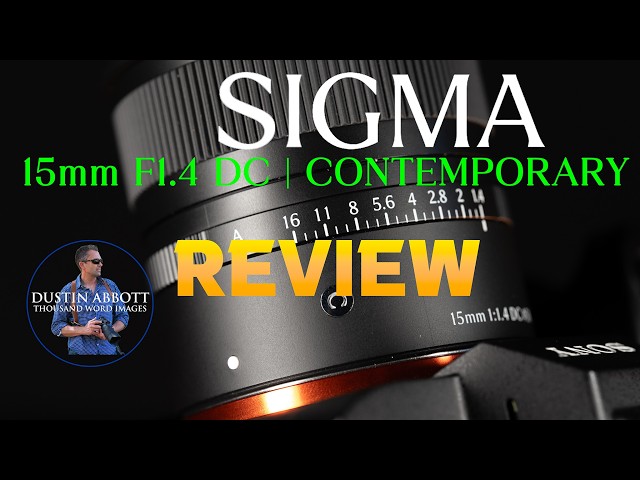
Sigma 15mm F1.4 DC | Contemporary (APS-C) Review - Another Wide Angle Gem?
Feb 18, 2026

Photographer Dustin Abbott shares a deep dive review of the compact Sigma 15mm F1.4 DC wide-angle prime lens for Sony E, Canon RF, and Fuji X-mounts. | Read the Text Review: | Purchase the Sigma 15mm F1.4 DC @ B&H Photo https://bhpho.to/4s3IQCd | Adorama https://prf.hn/l/0egwn1w/ | Amazon https://amzn.to/46MvDVX | Camera Canada https://tidd.ly/3ZJj2is | Amazon Canada https://amzn.to/4rPS3Oi | Amazon UK https://amzn.to/3MPVANB | Amazon Germany https://amzn.to/4tE7DOR
Check out the DA Merch here: https://bit.ly/TWIMerch | Become a Patron: https://www.patreon.com/dustinabbott | On the Web: http://dustinabbott.net/ | Sign up for my Newsletter: http://bit.ly/1RHvUNp | Instagram: http://bit.ly/DLAinsta | Facebook: http://on.fb.me/1nuUUeH | Flickr: http://bit.ly/1UcnC0B | 500px: http://bit.ly/1Sy2Ngu Follow Craig @ https://www.instagram.com/craigstoffersen/
Want to support this channel? Use these affiliate links to shop at:
B&H Photo: http://bhpho.to/1TA0Xge
Adorama: https://tinyurl.com/AdoramaDA
Camera Canada: http://bit.ly/DLACameraCan
Sony Canada: https://www.thesonyshop.ca/?ref=abbott
Amazon: https://amzn.to/3HrY64d
Amazon Canada: https://amzn.to/3qG1p18
Ebay: http://bit.ly/DustineBay
Into the AM Clothing: https://bit.ly/intotheAMda and use code DUSTIN10 for 10% off
Fioboc Clothing: https://tinyurl.com/FiobocDA20 and us code DUSTIN20 for 20% off
Make a donation via Paypal: https://www.paypal.com/paypalme/dustinTWI
=============================
Table of Contents:
=============================
Show More Show Less View Video Transcript
0:00
[music and bell]
0:10
Hi, I'm Dustin Abbott [music] and I'm
0:12
here today to give you my review of
0:14
Sigma's newest APS-C lens, the 15mm f1.4
0:19
DC contemporary lens. This follows up
0:21
the 12mm f1.4 4 that was released last
0:25
summer and is a great addition to what
0:28
is now a growing lineup of wide-angle
0:30
prime options that are available on Sony
0:32
E-mount which I'm testing today, Fuji
0:34
Xmount, but also Canon RF mount where
0:37
I'm sure it will be very very
0:38
appreciated. The 15mm f1.4 falls into a
0:43
category where it's going to directly
0:44
comp compete with on Sony with Sony's
0:48
own 15mimeter f1.4G lens. And so being
0:51
able to get a an alternative that is,
0:54
you know, similarly featured and
0:56
performing for a much lower price is
0:58
obviously going to be an attractive
1:00
option there. And of course on Canon RF
1:02
in particular, getting any kind of
1:04
premium wide angle options is hugely
1:06
appreciated on that platform. This is a
1:09
little bit less wide than last year's
1:11
12mm f1.4 four and so it falls into
1:14
maybe a more conventional focal length
1:16
for a lot of people, but I suspect it's
1:19
going to be another lens that will be
1:20
popular for Sigma. And it comes at at a
1:23
price point of $579
1:26
or about $50 cheaper than the 12mm f1.4
1:29
from last year. I really liked the 12mm
1:32
and in some ways the 15mimeter isn't
1:35
quite as excellent as that lens.
1:37
However, it is still a very featurerich,
1:40
compact, high-erforming lens that
1:42
probably is going to hit the sweet spot
1:44
in terms of its focal length for perhaps
1:46
even more people. Now, before we dive
1:48
in, I do want to say a big thank you to
1:51
Sigma Canada and their distributor,
1:52
Gentech, for sending me a loaner copy of
1:55
this lens for evaluation. They have had
1:57
no input on this review. However, the
1:59
lens will be going back to them after
2:01
the review is completed. This is
2:03
completely independent and they will not
2:05
see the video before you do. With that
2:07
aside, let's jump in and let's take a
2:09
look. Okay, let's take a look at the
2:11
build and handling here. First of all, a
2:13
quick look at price. $579
2:16
is the MSRP for the 15mm f1.4. That
2:19
compares to the Sony 15mm f1.4G at $949
2:24
USD, so nearly $400 more. There isn't a
2:28
direct analog on Fuji, but Fuji's 14mm
2:31
f2.8 8 comes in at an even $1,000. And
2:35
so obviously this is a true winner when
2:38
it comes to the price point here. Really
2:41
the only direct competitor that is
2:44
cheaper that I would point to is
2:46
Viltrox's 15mimeter. It's just an F1.7,
2:50
not F1.4. But you can get this lens for
2:53
under $250. So it is the value leader.
2:56
Though the Sigma is a more premium lens
2:58
with more premium features and build
3:01
quality to it. Now this focal length is
3:03
the equivalent of 22 1.5 mm on either
3:06
Fuji or Sony E-mount which I'm testing
3:08
here on uh Canon RF mount with its 1.6
3:12
times crop factor. That is a 24
3:14
millimeter full-frame equivalent. The
3:16
lens as you can see is very nice and
3:18
compact. It is just 64 millime or 2.5 in
3:22
in diameter and 64.8 8 mm right under 65
3:27
mm or 2.6 in in length. So that makes it
3:30
about 35% shorter than Sigma's older
3:33
16mm f1.4 which was 92.3 mm in length.
3:38
It's also 5 mm shorter than the 12mm
3:41
f1.4 that was released last year. It
3:44
weighs in at just 220 g or 7.8 o. The RF
3:51
mount version will be a little bit
3:52
heavier because it needs to be wider in
3:54
the diameter to accommodate the larger
3:56
Canon RF mount. And so it'll be 240
3:59
grams, but still either way, this makes
4:00
this the lightest uh lens in the series
4:03
of the f1.4 options from Sigma. So that
4:07
obviously is fantastic for those of you
4:09
that want to travel small and light. We
4:12
have got a filter thread size of 58 mm
4:15
up front. Very, very common. All of that
4:17
is great. Terms of the feature set, we
4:20
do have a clicked aperture ring,
4:22
one-/ird stop to tense. There is no
4:24
D-click option. My only complaint about
4:26
the aperture ring is that there is not a
4:28
whole lot of resistance between f-16 and
4:31
this automatic point here. I'd like to
4:33
see that to be a little bit stiffer
4:35
between that and so you don't
4:36
inadvertently go over to the automatic.
4:38
But outside of that, it is great to have
4:39
an aperture ring on a lens like this.
4:41
And then obviously on Fuji in particular
4:43
where that's very much standard
4:45
protocol. This lens is going to fit very
4:47
very nicely there. Now on the Canon RF
4:50
version, we don't have a traditional
4:52
aperture ring, but instead we have a
4:53
customizable control ring and so that it
4:55
matches the RF sensibilities. So all of
4:58
that is great. The 12mm last year and
5:01
then this 15 mm is definitely a step up
5:04
in terms of the weather sealing for a
5:06
contemporary lens. We have a full
5:08
weather sealing about six different seal
5:10
points it looks like according to this
5:11
diagram. Starting with the gasket, the
5:13
lens mount, some internal seals
5:15
throughout the lens itself. So again, a
5:17
little bit more upscale there. The
5:20
Aperture Iris has nine rounded blades.
5:23
It does a fairly good job of maintaining
5:25
a circular shape as you can see here.
5:27
And then when stopped down, we'll create
5:30
a nice sunst star with 18 points. The
5:33
manual focus ring has a nice degree of
5:35
damping. The focus motor is responsive
5:37
enough that it does give you a good
5:39
manual focus simulation. So, all of that
5:42
is good. Sigma makes very nice lens
5:45
hoods. They're definitely more upscale
5:47
than what opposing brands are. We've got
5:49
a rubberized surface. We've got a grip
5:51
surface here. It clicks into place with
5:53
good confidence and everything feels as
5:56
it should. So, nice on that point there
5:59
as well. Minimum [snorts] focus distance
6:01
here is just 7 in or 17.7 cmters. Though
6:05
it seems to me like with a 12 millimeter
6:07
I can actually get in a little bit
6:09
closer than that. The magnification is
6:11
rated at 0.12 times but again it seems
6:14
higher than that. The plane of focus is
6:17
not particularly flat at that very close
6:19
focus distance and so it works better
6:21
with threedimensional subjects that you
6:23
can compose uh better with but you know
6:25
useful to be able to get a nice degree
6:27
of magnification there. One the final
6:30
note that I will point out on this
6:31
section is that I complained loudly
6:33
about Sony's eco packaging on the uh
6:37
Alpha 1 M I. And while Sigma is also
6:40
doing an eco packaging with their newest
6:42
products, it's actually has this retro
6:45
style. It's cool. I don't mind it at
6:47
all. I think it it has a great kind of
6:49
vintage photography feel to it. So Sigma
6:51
shows that you can do eco packaging,
6:53
right? So I'll give them some kudos on
6:55
that as well. So, let's talk autofocus.
6:59
Autofocus is coming from an SDM or
7:01
stepping type focus motor, but as Sigma
7:03
did with the 12mm f1.4, the 50mm f1.4
7:07
has just a single focusing element. And
7:10
so, that allows it to actually have
7:12
really quick, quiet autofocus because
7:15
while it's just an STM focus motor, it's
7:17
not moving a lot of glass. And so, that
7:19
allows it to have some additional thrust
7:21
and speed because all that is going into
7:23
just one element. As a byproduct, I
7:25
found that autofocus changes are pretty
7:27
close to instant, just a split second
7:30
behind instant with lots of thrust back
7:32
and forth and good accuracy in all of my
7:35
test. Autofocus was fast enough that
7:38
even in some difficult situations where
7:40
the lighting wasn't great and I had Nalo
7:42
walking towards me, a small subject, you
7:45
know, with that continual movement
7:46
towards camera, a lot of times I find
7:48
that lenses will back focus a bit in
7:50
that setting. No problem with that.
7:52
here. Autofocus was nice and snappy,
7:54
locked on where it should on her and
7:56
delivered accurately focused results.
7:58
And so I had zero issues with that in
8:00
terms of the overall uh sound. It's
8:02
very, very quiet in operation. No
8:04
audible sounds at all. So you won't have
8:05
to worry about picking up anything on
8:07
camera if you're doing it for video
8:09
recording. And so in general, I felt
8:11
like autofocus did everything that I
8:13
wanted. I think that this is probably
8:14
snappy enough. You could even use it in
8:16
a sports type setting if that was so
8:19
desired. So, autofocus for stills really
8:21
really found fantastic. On the video
8:23
side of things, I also saw basically
8:25
just good results in terms of the actual
8:28
focus changes back and forth. When I did
8:30
touch to focus on screen, uh they went
8:33
back and forth with good confidence, no
8:35
visible steps along the way. You can see
8:37
that there is the tiniest amount of
8:39
focus breathing, but it's quite well
8:40
controlled. And so, that's another
8:42
strength for the lens. Likewise, in the
8:44
transitions during my hand test, it
8:47
transitioned from my hand to my eye back
8:49
and forth. And again, because there's a
8:50
small, very small amount of focus
8:52
breathing, those transitions look quite
8:54
natural and cinematic without this kind
8:55
of obvious lurching effect back and
8:58
forth. Likewise, when I approached the
9:00
camera and uh allowed it to track me as
9:03
I moved towards the camera and stepped
9:05
in and out of frame, it snapped back to
9:07
me with good efficiency. you've been
9:09
able to see I've been filming on these
9:10
outdoor segments with it and you can see
9:12
that it's, you know, sticky on my face
9:14
and I can see looking at the screen
9:16
right now that it's locked onto my eye
9:18
and it's tracking it in real time as it
9:20
should. All of that good stuff. No
9:22
complaints about that. And so, in
9:24
general, I think that uh you're going to
9:26
be very happy with autofocus from this
9:28
lens. Sigma has done a very good job.
9:30
And I was reminded when doing this
9:31
particular review that there was a time
9:33
not all that long ago that I couldn't
9:35
hardly do a Sigma review without
9:37
complaining in some way about autofocus.
9:39
It's amazing how far those days are
9:41
behind us and Sigma is really doing a
9:43
fantastic job on that end. So kudos to
9:46
them. So let's take a look at the
9:47
optical performance here. We have got an
9:49
optical design of 13 elements in 11
9:52
groups. That includes one LD element. We
9:56
have a total of three SLD elements. And
9:59
then you can also see there are a total
10:01
of three aspherical elements. All of the
10:03
aspherical art of the double-sided
10:06
variety. Now the MTF chart on the left
10:08
side here, it shows a good strong and
10:11
fairly even performance. I've added the
10:14
last year's 12mm alongside it. And you
10:17
can see that basically all across the
10:19
frame. The 12 mm is just a little bit
10:22
better pretty much everywhere that you
10:24
look. And so a 15 millimeter is very
10:27
good and very competitive, just not
10:28
quite as good as last year's 12
10:30
millimeter. Now, continuing in that
10:32
theme, I was actually surprised to find
10:33
that the 15 millimeter actually sported
10:35
more barrel distortion and vignette than
10:38
last year's 12mm lens did. That kind of
10:41
is the opposite of what I would expect.
10:43
Usually, the wider you go, the more
10:44
difficult it is to control distortion
10:47
and also vignette as well. And yet, this
10:49
has a little bit stronger on both
10:51
metrics. to achieve this result here.
10:53
You can see I dialed in a plus 29 to
10:55
correct for the barrel distortion. It's
10:57
fairly linear, not perfectly. So, you
10:59
can see it's starting to pin cushion out
11:00
in the corners a bit as I've corrected,
11:02
but not too bad. Uh vignetting is a plus
11:06
83, which is quite heavy to correct
11:08
that. Now, fortunately, the standard
11:10
profile either in camera or the one
11:13
available for raw editing does a nice
11:16
clean job of cleaning that up. You can
11:17
see that result here. However, if we
11:19
take a look at a before and after here,
11:22
when it comes to the distortion, the
11:24
uncorrected raw on the left, and then
11:25
after the correction profile on the
11:27
right, you can see that it's definitely
11:29
going to be needed. Otherwise, you're
11:31
going to get some definite obvious
11:33
barrel distortion bend to straight
11:35
lines. And so, definitely uh enable
11:37
those prof profile corrections in
11:39
camera. And if you need the raw profile
11:42
in post, you're going to want to make
11:43
sure to grab that. Now, another area
11:45
that I was underwhelmed by the optical
11:47
performance of the 15 mm is that you can
11:49
see that in the correct situations,
11:52
you're going to see quite pronounced
11:54
amounts of chromatic aberration,
11:56
particularly the longitudinal style. You
11:58
can see they look quite strong. That
12:00
green fringing really stands out here.
12:02
And so on my dad's old SLR, you can see,
12:05
boom, lots of that green fringing on the
12:07
shiny bits definitely showing up there.
12:10
Showing up a bit here around specular
12:12
highlights as well. Now, on the note of
12:14
those specular highlights, you can see
12:16
that they do turn a little bit lemon or
12:18
cat eye shape in the corners. Stop down
12:20
to f2, we've got perfect roundness all
12:22
across the frame. And by f2.8, it's
12:25
still very round, but you can startly
12:27
start to see that nine or nonagonal
12:30
shape of the actual aperture blades as
12:33
the iris starts to close down.
12:35
Fortunately, in a wide angle lens, the
12:38
chromatic aberrations you're more likely
12:40
to see are lateral style near the edge
12:42
of the frame in landscape shots, things
12:44
like that. Those are well controlled
12:46
here. So, you can see very little of
12:48
that showing up. Now, some of you like
12:50
to buy APS-C lens to use as full-frame
12:52
lenses in the hope that it's going to
12:54
cover the full-frame image circle. You
12:56
can see shooting in full frame. It is
12:58
not. And so I had to crop all the way
13:01
down to the image on the right to get
13:03
rid of all of the hard mechanical
13:05
vignette for it not covering the
13:07
full-frame image circle. And you can see
13:09
here that while that is very slightly
13:11
wider than the APS-C crop, it isn't, you
13:14
know, meaningfully so. And so unless you
13:17
really want to do that work all the
13:18
time, I would stick with this lens for
13:20
APS-C. So let's take a look at
13:22
resolution and contrast. I'm testing
13:24
here on a 26 megapixel which on Sony
13:27
which is currently the highest available
13:29
there. However, there is higher
13:31
resolutions available both on Canon and
13:33
Fuji. So, you can expect these results
13:35
to look just ever so slightly lower on
13:38
those platforms due to the higher amount
13:41
of resolution but also pixel density on
13:44
those sensors. Now, in the center of the
13:46
frame, we see good detail and contrast
13:48
as suggested by the MTF chart. Contrast
13:52
not off the charts, but you know, it
13:54
looks good, solid. The mid-frame also
13:57
still looking very, very good. Very,
13:59
very little drop off there. And as we go
14:01
down here, you know, it's pretty
14:03
consistent from this corner to this
14:05
corner. And as we get off towards the
14:07
very edge of the frame, we can see it
14:09
declining out in that last few
14:11
percentage points. Now, to put that in
14:13
perspective, if we compare to last
14:15
year's 12mm f1.4, for you can see that
14:18
the center performance uh if anything I
14:20
would very slightly favor the 15 mm in
14:23
my results here in the mid-frame they
14:26
look very close to the same in the
14:28
corners it's a little bit more
14:30
consistent out to the extreme corner
14:32
with the 12 mm and that was a pattern
14:35
that I saw pretty consistently as I went
14:38
on throughout uh other aperture values
14:40
that you can just see it holds out to
14:42
the edge just a little bit better now
14:45
for a bit of real world perspective
14:46
active. This is what a real world image
14:49
looks like at f1.4. You can see it looks
14:51
pretty fantastic. Good detail. Uh good
14:54
contrast everywhere. I think that pretty
14:56
much everybody's going to be happy with
14:58
that level of performance. You will see
15:00
a little bit of that fringing, however,
15:02
and that's going to be our biggest
15:04
negative takeaway. Now, some lenses take
15:06
this revolutionary leap forward as you
15:08
stop them down. That's not really been
15:10
the case for either one of these
15:11
Sigments. They're pretty optimized for
15:14
as close as possible to their best
15:16
performance. Close to wide open or stop
15:18
down just a little. So you can see here
15:20
in the center of the frame, there is
15:21
definitely more contrast, a little bit
15:23
more detail at f2 versus f1.4.
15:26
Likewise with the mid-frame, you can see
15:29
that that those darker points are just a
15:31
little bit darker, allowing the, you
15:32
know, brighter points to pop a little
15:34
bit more. A little bit better detail
15:36
overall there. But as we look towards
15:37
the corners, the corners are not
15:40
radically improved. That's true as we
15:42
stop down from f2 to f2.8.
15:46
From f2.8 to f4, we're seeing mild
15:49
improvements, but nothing significant.
15:52
We can see that, you know, the corners
15:53
are looking good, but not necessarily
15:56
great. At f5.6,
15:59
this is pretty close to the peak
16:00
performance. And you can see again that
16:02
it looks it looks just fine. detail is
16:04
good, but again it's neither is it
16:06
exceptional. If we check back in with
16:08
last year's 12mm, we can see it's at
16:10
f5.6. It's got just a little bit more
16:13
contrast in the center of the frame,
16:14
maybe a little bit more pump there. In
16:16
the mid-frame, contrast is about the
16:19
same, but detail probably still favors
16:21
the 15 mm just a hair. Moving into the
16:24
corners, we can see there's just a
16:26
little bit more pop and contrast moving
16:28
out into the far corner. If you look for
16:31
example at this insignia here versus
16:33
here, it just has a little bit more
16:35
clarity, a little bit more brightness
16:36
and contrast on the 12 mm. Now, if we
16:40
check in with the Viltrox 15mm f1.7,
16:44
Viltrox is there such an amazing
16:47
performance to value proposition. And I
16:49
would say that at least stopped down.
16:51
The Viltrox is probably a little bit
16:53
sharper in some of the areas that I
16:55
look. You can see there's just a little
16:56
bit more crisp detail that is there at a
16:59
stopped down level. And this is coming
17:02
off of the Fuji version of that lens.
17:04
And I have reduced this down to the
17:06
similar resolution level from the 40
17:08
megapixel Fuji sensor. And so that may
17:11
give it a very slight advantage. But you
17:13
can see though at a a pretty close to
17:15
apples to apples comparison that the
17:18
Viltrox lens is maybe just a little bit
17:20
more consistently sharp across the frame
17:22
at smaller apertures. But to put that
17:24
into perspective, if we pop in and we
17:26
look at a pixel level uh from the Sigma,
17:30
you can see it is it's fantastically
17:32
sharp here at f5.6 everywhere you look
17:35
all across the frame. Great detail,
17:37
great contrast. You're not going to be
17:40
dissatisfied with the sharpness from
17:41
this lens. Now, after f8, defraction is
17:44
going to start to set in. And the higher
17:46
resolution camera you have, the more
17:48
obvious that that's going to be. You can
17:50
see that f11 isn't as sharp as what we
17:52
saw at f5.6 or f8. And by f-16, the
17:55
minim minimum aperture, it's softer
17:57
still. And so, just be aware that
17:59
defraction could play a bit of an issue
18:02
when it comes to sharpness as you stop
18:03
the lens down. Now, going back to our
18:05
minimum focus distance for a moment, you
18:07
know, up close, detail and contrast look
18:10
good, but it's not a very flat plane of
18:12
focus at all, as you can see. And so,
18:14
you're going to get that sharpness kind
18:16
of within that sweet spot because it
18:18
doesn't just focus consistently on that
18:21
flat level. Now, if you're working with
18:22
a threedimensional subject, you don't
18:24
necessarily need that same flat flip of
18:27
poke focus, and so it's not such a big
18:29
deal. And we can see here that we got,
18:31
you know, nice detail up close here. And
18:33
then a pretty nice fall-off when it
18:35
comes to the bokeh smoothness uh as we
18:38
move on into the image. Likewise in this
18:40
image here, you know, good detail and
18:42
contrast at f1.4. Background looking
18:45
fairly soft. You know, there's a little
18:47
bit of that green fringing there. Some
18:49
of these edges, they're a little bit
18:50
harder than what I like, but this is a
18:51
wide angle prime lens. And I would say
18:53
in general, that looks pretty good. This
18:56
being a little bit more complex. Detail
18:58
and contrast look really great here. And
19:00
again, yeah, this there isn't a lot of
19:02
room for everything to become strongly
19:03
defocused, but I think that the image
19:05
works and so that's a valuable a extra
19:08
aspect of the optical design. Now, a
19:10
wideangle lens with a bright maximum
19:12
aperture is going to be a tempting one
19:13
to use to shoot the night sky. And this
19:16
is a solid choice. You can see in the
19:18
center of the frame that star points are
19:19
nice and crisp. As we move off towards
19:22
the edge of the frame, yeah, there's a
19:23
little bit of fringing showing up here
19:25
in this really bright area. and we can
19:27
see just a little bit of coma effect,
19:29
but by and large it is pretty well
19:32
controlled even at f1.4. Certainly a
19:34
very usable image for that kind of work.
19:37
Finally, when we talk about flare
19:38
resistance, I would say that the biggest
19:40
uh issue when it comes to flare is this
19:42
kind of streak effect that you will see
19:43
at f1.4
19:45
and and I saw it in uh several
19:47
situations. You stop down, flare
19:49
resistance is actually quite excellent
19:50
and you can see that sunburst or sun
19:52
star effect showing there. As we pan
19:55
back and forth, you can see as far as
19:56
ghosting or loss of contrast, neither
19:59
one of those things is a big issue at
20:01
all. And that's true either wide open or
20:03
stop down. Basically, just that kind of
20:06
streak effect that takes place is the
20:07
only negative I can point to. By and
20:10
large, the coatings are doing a good job
20:11
when it comes to flare resistance.
20:13
Overall, outside of the fringing in
20:15
particular and a bit more distortion and
20:17
vignette to what I would like, this is a
20:19
pretty solid optical performance. So,
20:22
what's my conclusion? This lens, as I
20:24
mentioned in the intro, it doesn't quite
20:26
strike me as being as strong as the 12mm
20:29
f1.4, but that's setting the bar fairly
20:32
high as that is one of the probably more
20:34
excellent wide angle APS-C primes that
20:37
we have ever seen in all of cameras
20:39
history. So, I think that this lens is
20:41
still in very, very good company. It
20:43
does have a little bit more chromatic
20:44
aberration. of what I would like. And I
20:47
was surprised that it had a bit more
20:48
barrel distortion and vignette than what
20:50
the wider lens did. But those latter two
20:53
things can be corrected quite easily
20:55
through the uh the actual profiles
20:57
either in camera or through software uh
21:00
in your post-processing. So probably not
21:02
going to be that big a deal. And with a
21:04
wide-angle lens, that bit of fringing
21:06
that I mentioned is mostly going to be
21:08
visible when you're shooting in very
21:09
close subjects and very specific
21:11
instances there. So, I don't think that
21:14
that's going to set too many people back
21:15
very far. This is going to prove a very
21:18
popular focal length for a lot of
21:20
people. It's not quite as extreme as the
21:22
12 millimeter in terms of the, you know,
21:24
actual angle of view. And so, it's
21:26
falling close into that, you know, very
21:28
popular 24 millimeter angle of view. And
21:30
with that bright maximum aperture, the
21:32
ability to capture night scenes with
21:34
good autofocus to capture stars, there's
21:36
a lot of good things going on here. And
21:38
the fact that it is so compact and
21:41
reasonably priced I think is going to
21:43
suit a lot of people. I would say the
21:46
only fly in the ointment for Sigma is
21:48
term in terms of competition is the fact
21:50
that Viltrox is 15mm f1.7 from their air
21:54
series. It is significantly cheaper and
21:56
it's you know as Viltrox tend to do it's
21:58
a very strong lens optically and so in
22:01
terms of the pure optics it competes I
22:03
would say fairly well with this lens.
22:05
However, it doesn't have an aperture
22:06
ring. it doesn't have uh any kind of
22:10
weather sealing or things like that and
22:11
so it's just not as uh high-end a lens
22:15
in terms of overall performance. I think
22:17
if you're comparing it to the first
22:18
party options that are running up
22:20
pushing near $1,000, this lens actually
22:23
comes out looking really, really good.
22:25
So, at the end of the day, I think that
22:26
Sigma has done exactly what it needed to
22:28
do once again. And I'm really glad to
22:30
see them kind of pushing further into
22:32
the APS-C space because that gives hope
22:34
for those of you who are APS-C shooters
22:37
that your platform is going to continue
22:38
to be supported. And so that's great
22:41
whether you are a Sony, a Fuji, or a
22:44
Canon shooter. And here's hoping that at
22:46
some point in the near future, we're
22:48
going to see Sigma lenses on Nikon as
22:50
well. If you want more information, you
22:52
can check out the full text review
22:54
that's linked in the description down
22:56
below. As always, thanks for watching.
22:58
Have a great day and let the light in.
#Science