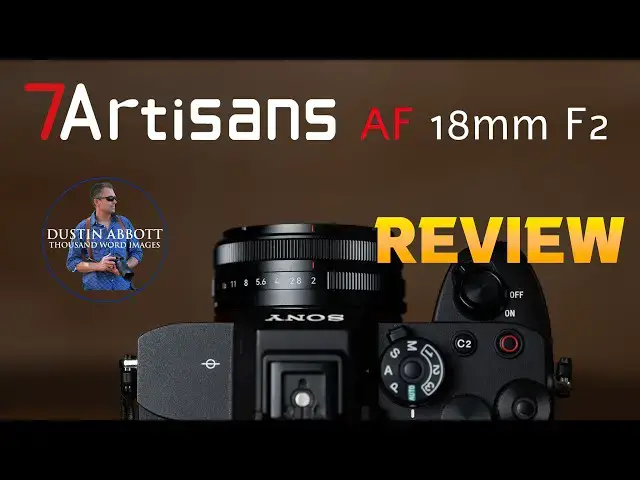
0:00
This summer Viltrox brought us a very popular pancake style lens in their 26mm f2.8 for full
0:17
frame cameras. And now 7Artisans has essentially brought us a very similar type lens for APS-C
0:22
cameras in their new 18mm f2 autofocus lens. Like the Viltrox it has a little aperture ring
0:29
it's very very compact and lightweight however in this case it is much less expensive just 169 us
0:36
dollars we already know from the response of people to other pancake lenses that this form
0:41
factor is very popular particularly for people who are looking for a very discreet compact lens for
0:47
street photography or for someone like myself who does less city and more out in the woods just
0:52
having a nice walk around style lens for hiking something you could clip on to your backpack and
0:58
and it would be very lightweight and easy to access. So we know that the form factor is appealing
1:02
but is the lens itself worthy of your consideration? Well, I'm filming on it today
1:06
and so you can get a sense of its rendering in these kinds of situations, and I will be doing my best to break down all of its performance as we dive through
1:13
First of all, however, I do want to say thank you to Seven Artisans for sending me a review sample of the lens
1:18
As always, this is a fully independent review. However, Seven Artisans has not seen the content
1:23
has had zero input in this review, and they won't see it until you do
1:27
All of that aside, let's dive in. Let's take a look. All right, let's take a closer look at the little 18mm F2
1:34
which in many ways to me is essentially kind of an APS-C equivalent of the full-frame Viltrox 26mm F2.8
1:43
This 18mm F2 has a 27mm full-frame equivalent focal length, so very similar
1:51
Although the big difference here is that it is a lot less expensive
1:56
It's $169, which obviously is inexpensive for those that are looking for a compact pancake-style lens
2:04
And it is very compact. It is 64 millimeters in diameter, which, as you can see, is narrower than what the Viltrox is
2:11
though this lens is just a little bit thicker at 27 millimeters
2:15
so that's 2.5 inches by right over an inch deep. This weighs in just 109 grams or 4 ounces, however
2:23
making it very lightweight, easy to throw on even the most compact APS-C cameras without having any
2:29
issues there. It does have an aperture ring, which is clicked. There is no de-click option
2:34
There are one-third stop detents in between the marked full positions, and then a little bit of
2:41
resistance between F16 and automatic, though I would like there to be more. We also have a manual
2:46
aperture ring that is fairly well damped and moves well. Build quality is decent here. It seems
2:51
primarily to be metals. What I don't see is any kind of weather sealing gasket here, unfortunately
2:58
Other thing that's unfortunate is rather than having a USB-C port for firmware updates on the
3:03
mount, we instead have it here on the side and there is this little tiny rubber gasket that
3:10
covers up that port. And so that's going to be very, very easy to lose, obviously. And then of
3:15
course, once you have lost it, you have a potential ingress point for water in particular to get into
3:23
the lens and affect electronics. So I don't love that design. Up front, we have a 52 millimeter
3:28
front filter thread. However, we do have a somewhat odd lens hood here that has a rectangular opening
3:37
here. But as you can see, it's fairly narrow at this point. And so unfortunately, at least with
3:42
the filter. I only have one 52 millimeter filter on hand to test. It's not super thin. It definitely
3:48
did not fit under there though. And so you would have to have a very, very thin filter for it to
3:53
fit under that. So it seems in this case, mostly to be kind of an either or situation as far as that
3:58
goes There are nine blades in the Aputure Iris itself Minimum focus distance is 20 centimeters and the magnification seems to be somewhere around 0 times very similar to what the Viltrox provides Overall it a compact lens and that is its primary strength
4:15
The fact that it does have an aperture ring at such an inexpensive price makes this a nice little package
4:20
even if we are lacking anything like weather sealing, and this is a little bit of an odd convention here
4:26
So let's talk autofocus. Seven Artisans has equipped this lens with an SDM, or stepping-style focus motor
4:31
and because the elements are very lightweight in a compact lens like this, you don't need a huge
4:37
amount of thrust and fortunately this motor seems to have plenty of thrust to get the job done
4:42
You can see the autofocus zips back and forth with good speed and alacrity and so I had no
4:47
problem in that sense. The focus motor is quiet and I found that for general purpose, you know
4:53
single shot type things that focus was accurate as well. What I find with lenses like this
4:58
however, is that focus isn't nearly as good if you have a subject that is moving. You know
5:03
if Nala is moving towards me, for example, it's much harder to get well-focused results in that
5:08
kind of situation. But for most of the things that people are going to do with a lens like this
5:12
not action, but just capturing everyday events, I think that autofocus is going to do just fine
5:18
On the video side of things, you can see that the focus pulls are fairly smooth. However
5:24
there is definitely some focus breathing here and so that does feel a little bit more kind of lurchy
5:29
or abrupt and so unfortunately it's not a particularly cinematic lens if you want to
5:34
make major focus changes but as you've probably picked up on these outdoor filming segments that
5:39
I've been doing it has no problem in having stable focus when it's locked onto a subject
5:44
and in my basic video clips I didn't have any kind of issues particularly when I was dealing with
5:49
static subjects or subjects that were moving in a consistent fashion without any kind of great
5:56
speed or kind of erratic behavior in terms of moving back and forth. And so for most general
6:03
purpose video shooting, even if you're wanting to throw this on a gimbal, for example, or maybe even
6:09
use it for vlogging, I think that for those type applications, it's going to be fine. But I don't
6:14
think it's the most cinematic lens in terms of the quality of the focus pulls and the focus
6:19
breathing that accompanies it that. And so maybe taking all of that into account, you can determine
6:24
whether or not this is a lens that's going to suit your purpose when it comes to the video side of
6:28
things. All right, let's start our optical breakdown by taking a look at the optical design
6:32
here. We have a design of nine elements in seven groups. We can see of that two of those are extra
6:37
low dispersion elements and then four or five of them are high refractive index elements. So that
6:43
only leaves two normal elements as a part of the design. Our MTF chart shows a pretty steady fade
6:50
towards the corners. The center is sharp-ish, but I'm typically accustomed to seeing lens performance
6:56
these days typically being above that 0.8 line there, and so we're definitely starting a little
7:02
bit softer, and as you can see by the time we hit to the mid-frame, we're already into relatively
7:07
soft area. We get to the corners, and the corners are going to be pretty soft. We see we're averaging
7:12
out at about a 45% level there. Now, despite being a very compact design, barrel distortion isn't too
7:19
bad here. You can see my correction on the right, which is not perfect, but it's pretty close
7:24
And that only required a plus five to correct for the barrel distortion. There is definitely
7:29
some obvious vignette. You can see it's fairly concentrated in the corners and I needed a plus
7:35
55. So roughly two stops to correct for that in the result on the right. Moving on to fringing
7:41
and we can see that there is definitely some fringing here, particularly some green fringing after the plane of focus
7:47
If I take a look at a three-dimensional subject here, we can see that there are definitely some green fringing
7:53
that's showing up on some of these shiny bits and then also some around those specular highlights
7:59
You can see just kind of jumping ahead to that that there is definitely some pretty serious outlining
8:05
around specular highlights, some pretty strong busyness like onion-style bokeh inside. We can also see as you stop the lens down that it doing a pretty decent job of maintaining a circular shape Though as we get up here you know there a little bit of stretching that is in some of those lateral style chromatic
8:22
aberrations definitely do exist and you can see all throughout this there's some false color on
8:28
either side of the black and white transition lines and so this is definitely an area of weakness for
8:33
this lens so here's a look at the test chart that we'll be getting our sharpness and contrast results
8:38
from. I'll be shooting this on a 26 megapixel Sony APS-C sensor and looking at the results at a 200
8:46
level of magnification. So as the MTF suggested, we can see that center detail is okay, but contrast
8:53
is not super high. In the mid-frame, it's definitely transitioning towards looking softer there
9:00
And if I pull down here towards the corners, we can see that the corners, they are softer
9:06
but really relative to the rest of the frame, they're not terrible. This upper left corner to me looks a little bit rougher
9:13
and I would say that right side generally is looking a little bit better than left side
9:18
so maybe a very mild centering issue. Now in terms of real-world shooting at f2
9:22
you can see here that detail and contrast aren't off the charts, but it looks really good, I would say, overall
9:29
The result is nice and crisp there. Another shot here, and you can see, again
9:34
And I'm perfectly satisfied with the amount of detail and contrast here in this zone
9:39
Definitely see some of that, you know, soap bubble type effect in the bokeh and some green fringing around those
9:45
But I don't think that it's a deal breaker as far as their performance. Now, one thing that I did notice is that if you get close or a little too close in this lens, that you get definitely less contrast
9:58
And so towards the minimum focus distance, which is close to it here, you can see that there's not a lot of contrast
10:03
in some of those blossoms. I moved just a little bit further back and you can see I definitely got more contrast in the results
10:09
So going back and forth, you can see the magnification isn't as high, but definitely the level of contrast is superior
10:16
In this shot here, we can see again that the contrast again isn't fantastic
10:21
There's a little bit of nervousness in that transition towards defocus. But in this case, there's some of that soak bubble effect
10:27
but it's less pronounced with a less bright background. And so overall, I mean, some people like that effect
10:32
And so if you like that effect, maybe it will appeal to you. But that gives you a look at a kind of a broader image
10:38
Again, here at that medium focus distance, which I think is best case scenario for this lens
10:43
you can see that the contrast and detail looks pretty decent there
10:47
And it's really at close focus and then infinity focus that you don't get quite as good
10:52
Here again at, you know, closer to that medium distance, we can see that contrast and detail looks pretty good
10:58
Definitely the soap bubble effect in this image here. and so that's either good or bad depending on your taste. Here at a closer focus distance in
11:06
in this shot you can see that that contrast is not fantastic and so that's definitely something
11:12
to watch for. So is there improvement if you stop down? Yes we can see from f2 to f2.8 we've
11:17
definitely got more contrast in the image here and I would say that gives us a little bit more
11:21
detail in the text which becomes a little more readable. It's still not what I would call fantastic
11:26
but definitely improved. Look at the word Canada here versus here, and you can see just a lot better
11:31
contrast. The seal is much more pronounced, looking better there. We move down towards the corner
11:37
The corner is definitely looking better than what it did at F2, and if we look up into this corner
11:43
it's improved. It's still not as good as the lower right corner, however. We can see further gains in
11:48
this upper left corner from f2.8 to f4 and very slightly more from f4 to f5.6 taking a look at a
11:57
few real world landscape images at f5.6 so if we're looking here in the center of the frame you can see
12:02
the detail and contrast is looking fairly good so we pan down towards the corners you know in this
12:07
case i would be happy with this image that's pretty decent detail all throughout there so
12:12
no major problems there likewise in this image which i thought looks quite good you know good
12:17
detail and contrast Again the lateral style chromatic aberration not looking too bad in this real world shot You know colors look good here in this image however i definitely had some disappointment so while the center looks pretty good here as we move
12:31
off axis you can see that the edges are getting much softer and and so just not quite as much
12:38
detail there and so a little mushy towards the corners but again the image you know at large
12:43
looks pretty decent now as you move on to f11 diffraction will start to set in and then by f16
12:49
which is the minimum aperture, it's going to be a little more pronounced. It's not too bad here on
12:53
Sony. It's going to be more pronounced if you're looking at the Fujifilm 40 megapixel sensor when
12:59
a version comes for X mount. Close-up performance, you can see that we don't have a particularly flat
13:05
plane of focus, and so we have kind of this narrow area. Sharpness and contrast looks pretty good
13:10
right in this zone right here, but you can see that it almost has a three-dimensional effect
13:14
because it seems to be going out of focus, which is not really the case. It's just a matter of
13:19
just having some field curvature here that causes that issue. Taking a closer look at bokeh, we've already looked at it in some aspects
13:28
This image, I think, holds up pretty well. It's a little bit busy or nervous down in this zone
13:32
but I would say that this particular transition to defocus looks pretty good
13:36
In this shot here, I mean, again, it's a little bit further out, and so we got better contrast here
13:41
but the problem is that leaves more in the transition zone, and so I would say that all of this stuff has much more outlining
13:48
than what I would prefer. you know, bokeh as subjective. So I'll just let you kind of look at it. I don't love the soap bubble
13:54
effect, but if you like it, this lens has definitely got it here with a less preferred ratio between
14:00
the subject and then the background that looks fairly busy to my eye, too many hard edges for
14:05
my taste, but you know, it doesn't look terrible either. Now, when it comes to flare resistance
14:10
this lens has some issues wide open, some ghosting pattern effect. As you stop it down
14:16
that ghosting and flare pattern becomes much more pronounced. And particularly these, where there's these really kind of color blobs
14:23
they're not useful in my eye. You can see in this shot, even at a wider aperture
14:28
that at certain angles you're going to get just some internal reflections
14:32
and some issues popping around. And even here at F2, it's kind of almost like a flashing effect
14:39
If I pan back and forth at F2, you can see that the flare pattern isn't terrible
14:45
but if we switch over to f11 and it stopped down more, all of that becomes much more pronounced
14:50
And so what we have here is an okay but not exceptional optical performance. There's
14:55
definitely some flaws in this tiny lens. So what's my conclusion? There are a lot of similarities to
15:01
the Viltrox, at least on a superficial level in terms of the basic build and kind of how the lens
15:06
presents itself, but the Viltrox is definitely a more robust optical instrument than what the
15:12
7 Artisans lens is. I think that in general I found that the overall sharpness and contrast was just
15:19
okay and not exceptional and definitely as we saw in our breakdown it's somewhat situational what
15:24
kind of performance you're going to get. Corners are never particularly sharp with this lens and it
15:29
does have some issues with flare along the way as well and so there definitely are some optical
15:34
limitations but at the same time I found that I could get some very nice looking images. It's a
15:40
delightful package in terms of being so compact. And of course, it's at a very different price
15:44
point than what the Viltrox is in that that lens is going to run you closer to 300 plus range
15:50
whereas this one at 169 is close to 50% of the price. So I think that this is a lens that more
15:56
people can afford. And if you're on a tight budget and you love the idea of having a little
16:00
compact lens that has a very useful focal length, a useful maximum aperture, and can do a variety of
16:07
things reasonably well, then the 7 Artisans AF 18mm F2 might just be interesting to you. If you
16:13
want more information, feel free to check out the link in the description to my full text review
16:17
which where I break things down in even greater detail there. There's also some buying links there
16:22
As always, thanks for watching. Have a great day and let the light in