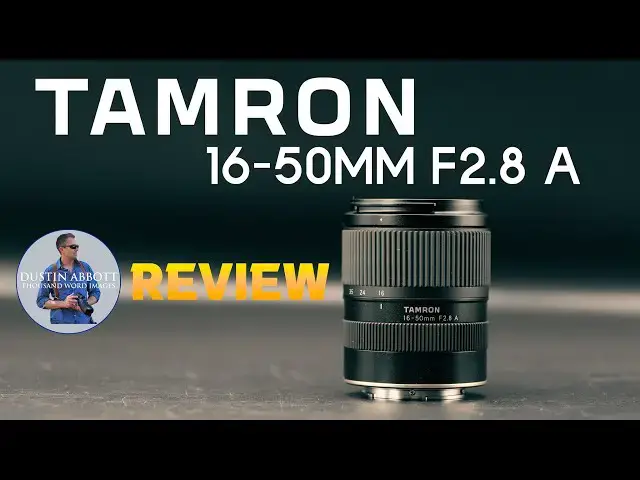
0:00
Since 2021, if people have asked me for a lens that can be an alternative to the very expensive
0:17
first-party fast APS-C zooms for their various camera systems, I have been pointing them to the
0:23
Sigma 18-50mm f2.8 from their DN lineup because it was basically the compact option out there
0:32
Tamron has had a 17-70mm f2.8 which is actually a really interesting lens but it is much much
0:38
bigger and a very different kind of lens in many ways. I might have a new answer when people ask
0:44
me that question now as Tamron has just released a new lens that goes wider than the Sigma as wide
0:50
16 millimeters and it's 16 to 50 millimeter f 2.8 a lens is has a lot of the things that i love about
0:58
the sigma lens but it improves in some areas with superior build quality and weather sealing
1:04
faster autofocus a wider focal length and a lower price at just 529 us dollars this undercuts the
1:12
sigma by about 130 bucks making the tamron an interesting new alternative and so should you
1:18
consider the new Tamron 16-50mm f2.8 for your APS-C camera? Well, that's what we're here to
1:24
explore. First of all, I do want to say a big thank you to Tamron USA for sending me a loaner
1:29
of this lens. However, they have had no one put in the review. It is completely independent
1:34
So all of that aside, let's jump in and take a look right after a word from our sponsor
1:39
Today's episode is sponsored by the all-new Phantom Tracker 2.0. Phantom has not only
1:44
seriously upgraded the visual look of the card, but now we have a superior build quality made with
1:49
tempered glass and metal alloys. This credit card size tracker can be locally tracked via a 90
1:54
decibel beeping noise, but also on a global level via Apple's Find My Network and its map. The
2:00
addition of NFC means you can also use the card to trigger an automation. Just tap it. The tracker
2:06
fits perfectly in any wallet or bag and assures you won't lose your valuables. It has a built-in
2:11
rechargeable battery that can be easily charged via any wireless charger and a single charge can
2:16
last up to six months the phantom tracker 2.0 makes for a seriously cool gift so visit store.fantom
2:23
wallet.com and use code dustin20 at checkout for 20 off that's store.fantom wallet.com and use code
2:31
dustin20 for 20 off all right let's start by taking a look at price at 529 dollars for the sony
2:38
Nikon or Canon versions, and then 549 for the Nikon version, probably some kind of
2:44
license taking place there. This definitely undercuts lenses like the Sigma, which is $659
2:50
And then when you talk about first-party lenses, the cheapest alternative is the Nikon
2:54
which is around $900. Fuji's 16-55 is $1,400. And then Sony's is nearly $1,700. And so
3:04
making the Tamron definitely the bargain of the bunch. This focal length is 24 to 75 millimeters
3:11
full-frame equivalent on Nikon, Sony, and Fuji on Canon RF with a 1.6 times crop factor. It is a 25.6
3:20
to 80 millimeter zoom range equivalent, full-frame equivalent. Tamron has simplified their naming
3:26
nomenclature. It is just the 16 to 50 millimeter F2.8A, and the A stands for APS-C, but none of the
3:34
extra additions on there. And so I like that. They've also got some new design language that
3:40
starts with their packaging, which is, you know, kind of the modern eco look. And then they've got
3:46
a new lens cap design, which I really like. And then they've got slightly different design language
3:51
which they call toned profile next, which feels like it's a little bit lost in translation
3:56
but it looks good. It feels a little bit more upscale than previous lenses. The lens is in
4:01
in fact, more upscale than a lens like the Sigma, for example, 18 to 50, which I've owned for years
4:07
at this point. This has a much more thorough weather sealing. We've got a gasket here at
4:13
the lens mount, but then we've got a total of nine different seal points and a flooring coating
4:16
on the front element. And so that's more of a professional grade of weather sealing. The size
4:22
here is very, very comparable, as you can see, to that of the Sigma. It is 64.4 millimeters in
4:29
diameter and right under 80 millimeters long. And so that is five millimeters longer than what
4:35
the Sigma is. And it weighs in at 305 grams or 10.8 ounces, which is 15 grams heavier than the
4:43
Sigma. So very, very similar in overall size. And of course, you're getting that additional
4:48
two millimeters on the wide end, which is huge. There aren't really anything here in terms of
4:55
other than we have a weather sealed USB-C port that'll allow you to connect to Tamron's lens utility
5:01
which will allow you to customize things like the behavior of the focus ring which direction you want it to focus how long you want the focus throw to be and even in their zoom action here the zoom action is designed to have a small
5:14
throw here the barrel will extend by about 19 millimeters so it is externally zooming
5:19
but it's very very smooth and it's very quick allowing you to make those really quick changes
5:23
in the field it also works quite well for video the other thing however that this usbc port allows
5:28
is that at least on Sony and Nikon, you have compatibility with the little Tamron Link accessory
5:36
which you can plug into that lens, and it allows you to have Bluetooth accessibility
5:40
through your phone, and you can do a number of things in terms of the customizations
5:44
that you can do through a computer, but also you can remote control the lens. And so interestingly in video, for example
5:50
I set up to where I programmed a close and a distant shot, and I could instantly jump back and forth
5:55
by just touching on my smartphone to that place I wanted to be. So it could be very useful for certain people in different applications
6:03
Up front, we have a 55 millimeter front filter thread. You can see we have a lens hood that is
6:08
included. Looking on inside, there are seven aperture blades, which do a fairly good job of
6:13
keeping a circular aperture shape as I stop down F2.8, F4, and then F5.6. There are two different
6:20
minimum focus distances. On the wide end, you can get as close as 15 centimeters and get a 0.22
6:26
times level of magnification, though with a little bit of field curvature. At 50 millimeters
6:31
you get a flatter plane of focus and very slightly less magnification, 0.21 times, but your minimum
6:37
focus distance grows to 29 centimeters, and it's just, to me, easier to get images on that end
6:43
You also get a little bit more blurred, compressed backgrounds, and so that is my preferred place
6:48
All in all, however, we have a nicely compact palm-sized lens that is very, very versatile in
6:54
terms of its zoom range, very affordable. And of course, as we've seen, we have got quite a premium
6:59
build quality. So let's talk autofocus. As part of Tamron's new kind of simplify minimalist approach
7:06
to lens design, they have standardized the focus motor that they're using in all of their lenses
7:11
including APS-C lenses like this. Fortunately, that is their premium VXD focus motor, which
7:17
stands for voice coil extreme drive. And so we've got a voice coil style, linear style autofocus
7:23
motor here. And in a lens like this, that means that autofocus is pretty much instant. You can see
7:29
here in my test going back and forth that focus essentially just jumps from one point to the other
7:34
without any kind of pause and no needing to build up inertia or anything like that. It just jumps
7:40
back and forth. What's more, it is pretty close to completely silent in operation. Very, very smooth
7:45
no issues with it at all for things like that. So the end result was that it's very, very easy to
7:50
just snapshots. I mean, and I took a number of quick shots, either whether out golfing or hiking
7:56
just taking quick shots, you know, where I'm not having to put a lot of thought into focus because
8:00
focus is basically instantly there. I haven't really tested in a sports type application, but
8:06
you know, outside of any kind of typical, you know, third party limitation, I don't see any
8:11
reason why you couldn't use it in that application. And in this case, because Sony does own a stake
8:16
in Tamron, it always feels like Tamron has got just a little bit better autofocus than what other
8:21
third-party brands do here on Sony's platform. And of course, they have developed lenses for
8:26
Nikon as well. So it just feels like that they, with some of the premium brands, they have a
8:31
special relationship. And I think that that does pay dividends when it comes to autofocus
8:36
Likewise, on the video side of things, I was particularly impressed on the video side of
8:40
things for a number of important reasons. First of all, focus pulls are not only extremely smooth
8:45
and quiet, very linear in operation. But focus breathing is so low that there's none of that
8:51
kind of lurching feeling back and forth. It's just, you know, you basically just notice all
8:56
of a sudden that one thing is no longer in focus and another thing is, but there's no change of
9:01
size through that. I also noted very importantly that when I zoomed in and out, there wasn't any
9:06
of the lag that I sometimes see with lenses where you can noticeably see that things are not in
9:12
focus and then focus will kind of catch up a second or split second later. As I went back and
9:17
forth, it all seemed to be very, very smooth in operation. And what's more, the zoom ring
9:22
even though it's externally zooming, is smooth enough that I was able to do smooth movements
9:28
What's more, I found that even if I was just kind of panning along in some of these
9:32
objects in my living room and then kind of pushing focus to move to another point
9:37
just by bringing the camera up. That transition is very, very smooth and thus it just doesn't take
9:43
you out of the shot. It feels like a seamless uninterrupted shot. You add to that the fact that
9:48
it is very lightweight and it is wide enough to use for vlogging and I think you have a lens that
9:54
is a very, very interesting option for video work with good autofocus, good smoothness
10:00
and a lot of these important attributes when it comes to video capture. All right, let's start by
10:05
taking a look at the optical design here. We have 14 elements in 10 groups, and that includes two
10:10
glass molded aspherical elements one low dispersion element and two hybrid aspherical lenses in the design Now the MTF charts are interesting in that on the wide end it super sharp in the center of
10:23
the frame, good in the mid frame, but then has a very steep decline out into the very corners
10:29
Probably the compromise from going to 16 millimeters. Here at the telephoto end we can see it's not
10:34
quite as sharp in the center of the frame or it's close in the mid frame but not quite as good but
10:39
It doesn't get nearly as bad in the corners. Now, kind of the big deal here is that the Tamron goes all the way to 16 millimeters
10:45
And in fact, if we compare it to the Sigma here on the right, we can see that the Tamron is letting a lot more into the frame
10:52
And so that does give it a pretty huge advantage. That two millimeters makes a surprising amount of difference
10:58
Now, that does come at some cost. There is slightly more barrel distortion than what the Sigma had
11:03
Both of them have some significant amount, but the Tamron has a bit more
11:07
And so I needed a plus 27 to correct for that vignette compared to a plus 21 to correct for the Sigma
11:13
You can see that there is a very mild wave pattern there, but it's not too pronounced
11:18
So not too bad on that front. Vignette is pretty mild here. I needed just a plus 45 to correct for the vignette on the wide end
11:25
That distortion will invert to a pincushion style later on in the zoom range
11:30
And so here at 50 millimeters, I still needed a minus 11 to correct for the pincushion distortion
11:34
So that is a significant amount. and the Sigma was similar to that by the way
11:40
I needed a plus 41 to correct for the vignette which is a bit less than what the Sigma requires
11:45
We can see looking here at my test chart that there is a bit of longitudinal style chromatic aberrations
11:50
just a tiny bit before the plane of focus but a bit of green after the plane of focus
11:55
You can definitely see that on the shiny edges though it's not too bad in the specular highlights
12:00
just a little bit around those. Speaking of those specular highlights you can see that even at f2.8, it's fairly round here, stopping down to f4, retains that f5.6
12:11
getting a little squeezed, but still fairly circular shapes. If we look into the corners
12:15
we can see that lateral style chromatic aberrations are fairly well controlled
12:20
And in fact, I didn't see any issues with that in my real world images. So let's talk resolution and contrast. I'm shooting on 26 megapixels here on Sony
12:29
which isn't as high as what you can get on either Canon or on Fuji, but this is what we have to
12:35
evaluate on. We can see looking in the center of the frame that resolution and contrast are good
12:40
Looking in the mid-frame, also looking very good. However, if we pan down towards the corners
12:45
as the MTF chart suggested, things get considerably softer. And we can see that that's true as I look
12:51
over on the other side as well, just not nearly as sharp in the corners. So looking back a bit
12:57
how does that compare to the Sigma at 18 millimeters? We can see that the Sigma has a
13:01
bit more contrast in the center of the frame and similar levels of detail, though a bit more
13:06
fringing showing up there. If we look here towards the mid-frame, they are similar, but I would say
13:12
that there's still slightly more contrast for the Sigma. And if we look down into the corners
13:17
the Sigma is more consistent right out to the edge of the frame. And it's not as good on this
13:21
left side. They're more comparable there, but we're seeing similar levels of results. Now
13:26
Stopping the Tamron down a bit to F4 definitely improves the contrast. You can see it start to kick up there
13:32
And looking here into the midframe, the midframe is now looking really, really good there, very strong
13:37
And if we look up into the corners, we can see that they're starting to improve. Less so out here on the edge, but if we look in this zone, starting to look better for sure
13:45
From F4 to F5.6, we can see that the sharpness is creeping over
13:50
It's now in this seal. Looking on at F8, we can see it's kind of balancing out at that point
13:55
Not really any better, except for maybe right out here in the number one
13:59
Now, diffraction isn't quite as severe here on Sony as it's going to be on Fuji's 40 megapixel or Canon's 33 megapixel sensors
14:07
But we can see that it is a little bit softer at f11, but more noticeably at f16, though still not terrible here on Sony
14:15
Now, at 24 millimeters, we just have a more consistent performance all across the frame
14:19
It's sharper and higher contrast in the center of the frame. Not as much gained at f4 because it's already very good
14:24
Mid-frame is already looking excellent, and I would say a bit better there at F4 in the mid-frame
14:32
And then looking into the corners, the corners start off stronger, and they get better still as you stop it down a little bit
14:37
At 35mm, I would say the contrast isn't quite as high as 24mm, but looking really strong still
14:43
Overall, mid-frame is looking excellent. Looking up into the corners, the corners are definitely more consistent
14:49
You can see there are just a little bit lower contrast at 35mm F2.8
14:54
By f4, however, they are at excellent levels. Moving on to 50mm, and we find that the mid-frame is looking excellent, as the MTF suggests
15:02
Not really any big improvement stopping it down to f4. However, in the mid-frame, you start to see more contrast punch there at f4 versus f2.8, though f2.8 looks good
15:13
And here the corners are decent at f2 but you can see they definitely better by f4 Popping back to the Sigma for a moment you can see that I would say the Tamron is a little crisper in the center of the frame looking better there If we look at the mid frame
15:30
I would say Tamron is still looking pretty good. But in the corners, I would say Sigma is definitely
15:35
better, just more consistent right out to the edge of the frame. So Tamron has a bit of an
15:39
advantage in some places. Sigma has better corners. Now in the macro range, we can see that as we
15:44
talked about earlier, there's a bit of field curvature here at 16 millimeters. The center
15:49
however, is very, very nice and sharp, high contrast. So that's going to be easier with
15:54
three-dimensional objects. And if we move on to 50 millimeters, we find that flatter plane of focus
16:01
and detail and contrast still look good, though I would say right in that center of the frame
16:06
it's not quite as sharp as at 16 millimeters. Still, I was quite pleased with some of the
16:11
up close shots I got at 50 millimeters, you can see here that, you know, there's good detail on
16:16
the mushroom as you look at that, but the overall defocus is nice. I also felt that this shot of a
16:22
leaf on the morning grass with the dew behind it, you know, there's good detail and contrast here on
16:27
the leaf. And then as you look towards the defocus, you know, all of that is looking quite nice
16:31
Now at close focus distances, you can fairly strongly blur the background. So obviously that
16:36
helps a lot. I do see a bit of outlining on some of those specular highlights in a shot like this
16:42
And if the ratio isn't as favorable and the background's a little busier, you know, that's
16:46
going to show up a little bit more as in this shot, which I find a little bit busy in that
16:50
background. Less harsh backgrounds, however, can look softer as here. So it's really going to be
16:55
somewhat situational. Now this lens has Tamron's B-bar generation two coatings. And so in some
17:01
situations, like in this shot, in the position of the sun, you can see that contrast and detail is
17:05
held up really well. Likewise here with the morning sun you can see there's a little bit of a ghosting
17:11
artifact that's showing up here but not terrible. If I pan back and forth in video you can see that
17:18
there's certain angles at f2.8 that are going to show more of the ghosting artifacts so it's
17:23
certainly not a flawless performance. When I stop down to f11 those flare patterns just get a little
17:29
bit more complex and so I mean it's got Tamron's good coatings but they're not flawless in all
17:34
situations. I was actually pleasantly surprised by the Koma performance, particularly considering
17:39
that it's 16mm f2.8. I wasn't blown away by corner sharpness, but in the center of the frame
17:45
star points look really, really crisp and clean. No problems there, but surprisingly
17:49
they still look pretty good into the corners as well. And you can see there's a little bit of a
17:53
wedge shape on a few of those points, but by and large, I would say that Koma is not bad
17:59
And that's really a pretty decent night sky astrophotography type lens, which just adds to its all-in-one capabilities
18:07
Overall, I would say that this is a lens that is capable of producing nice images with good clarity and contrast, good colors
18:14
And in general, it's a very versatile optic. So what's my conclusion
18:19
Well, I can't help but think that this lens, particularly at this price, is going to be a really intriguing alternative
18:24
for people that are considering maybe a first party, you know, 16 to 50 or 16 to 55 millimeter
18:31
zoom when you consider the fact that you can get this lens at, you know, maybe as little as a third
18:36
of the price when it comes to the Sony first party here. And even compared to the Sigma
18:41
while I don't think that the advantage of the Tamron is so much optically, the lenses are
18:46
they're roughly similar, but I would say overall I would probably give Sigma a very, very slight
18:51
edge and pure optical performance. But the advantage for the Tamron is it goes wider
18:56
it has far more sophisticated autofocus, it has a much more professional grade when it comes to
19:01
the weather sealing, and then of course because of that USB-C port there is a depth of customization
19:07
that you simply can't get on the Sigma lens. And when you consider that it's $130 cheaper
19:13
I think that for me I would say that the Tamron is probably the more appealing of the two lenses
19:17
when you add up the sum total of what they represent. The big deal for a lot of people is going to be that extra two millimeters on the wide end
19:24
because it does make a significant difference in what you can get in the frame
19:28
And that's really important in today's world where often because of higher resolution
19:32
you have the ability to crop in, but high resolution doesn't allow you to go wider and to frame wider
19:38
And so I think that that's where that advantage comes. So at the end of the day, I think that Tamron has really given us something very useful
19:45
This isn't an exciting, sexy lens in terms of being exotic in some way, but these are the kind of lenses that end up on a lot of people's cameras because they can provide maybe 80 plus percent of what a person needs in one compact lens
20:01
And in this case, not only compact, but reasonably priced as well. So kudos to Tamron. I would love to see them follow up with a new telephoto addition to this lineup similar to what Sigma has recently done and giving us another option on that front
20:14
That would be fantastic if you're paying attention, Tamron. If you want more information, feel free to check out my full text review
20:20
which is linked in the description down below. As always, thanks for watching. Have a great day and let the light in