Up next in 10


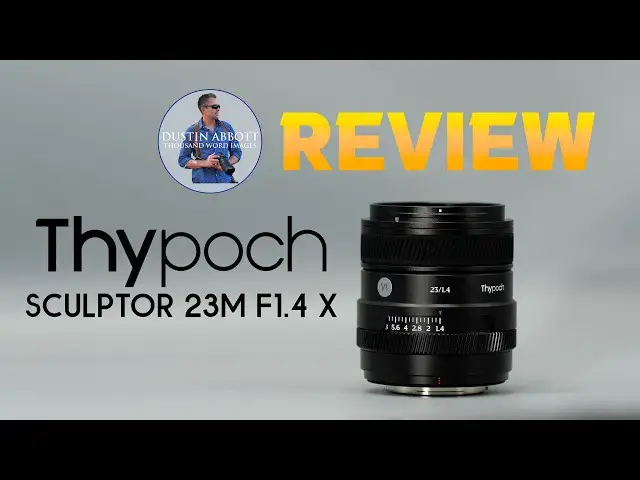
Photographer Dustin Abbott takes a deep dive look at the Thypoch Sculptor 23mm F1.4 autofocus lens for Fuji X-mount. At $349, it is far cheaper than Sigma or Fuji...but is it any good? | Read the Text Review: | Purchase the Thypoch Sculptor 23mm F1.4 @ B&H Photo https://bhpho.to/4dF9mNq | Adorama https://prf.hn/l/VxNpx48/ | Amazon https://link.amazon/B03SJe5SC | Amazon Canada https://link.amazon/B0dOJtP3I
Check out the DA Merch here: https://bit.ly/TWIMerch | Become a Patron: https://www.patreon.com/dustinabbott | On the Web: http://dustinabbott.net/ | Sign up for my Newsletter: http://bit.ly/1RHvUNp | Instagram: http://bit.ly/DLAinsta | Facebook: http://on.fb.me/1nuUUeH | Flickr: http://bit.ly/1UcnC0B | 500px: http://bit.ly/1Sy2Ngu Follow Craig @ https://www.instagram.com/craigstoffersen/
Want to support this channel? Use these affiliate links to shop at:
B&H Photo: http://bhpho.to/1TA0Xge
Adorama: https://howl.link/nt4zdz1goa7ql
Camera Canada: http://bit.ly/DLACameraCan
Sony Canada: https://www.thesonyshop.ca/?ref=abbott
Amazon: https://amzn.to/3HrY64d
Amazon Canada: https://amzn.to/3qG1p18
Ebay: http://bit.ly/DustineBay
Into the AM Clothing: https://bit.ly/intotheAMda and use code DUSTIN10 for 10% off
Fioboc Clothing: https://tinyurl.com/FiobocDA20 and us code DUSTIN20 for 20% off
Make a donation via Paypal: https://www.paypal.com/paypalme/dustinTWI
=============================
Table of Contents:
=============================
0:00 - Intro
1:00 - Disclosure
1:51 - Build and Features
5:01 - Autofocus
6:44 - Video
7:54 - Image Quality
17:57 - Conclusion and Pricing
---------------------------------------------------------
Oben Tabletop Tripod shown in video: https://bhpho.to/3vL8YWy
My Cameras:
Purchase the Sony a7RV @ B&H Photo https://bhpho.to/3ZivNyZ | Adorama https://howl.me/cjNY1LU3gFH | Amazon https://amzn.to/3CRCDlq | Camera Canada https://shrsl.com/3vulf | Sony Canada https://bit.ly/BuyA7R5 | Amazon Canada https://amzn.to/3H8yeNH | Amazon UK https://amzn.to/3kbg5FM
Purchase the Sony Alpha 1 @ Camera Canada https://shrsl.com/2wdk2 | B&H Photo https://bhpho.to/3upRFZd | Adorama https://howl.me/cj2nQpjLBKW | Amazon https://amzn.to/3t1m8MD | Sony Canada https://bit.ly/BuySonyA1 |Amazon Canada https://amzn.to/3cVFrBB | Amazon UK https://amzn.to/2OtrjGe | Amazon Germany https://amzn.to/3d0GtMO | Ebay https://ebay.us/i371Vs
Canon EOS R5: B&H Photo https://bhpho.to/3iMH18x | Amazon https://amzn.to/33L3D53 | Camera Canada https://shrsl.com/2jqth
Purchase the Fujifilm X-H2 @ B&H Photo https://bhpho.to/3KAInTC | Adorama https://howl.me/cjyzbiO5lVp | Amazon https://amzn.to/41zMzKl | Camera Canada https://shrsl.com/4128o | Amazon Canada https://amzn.to/40gY4W7 | Amazon UK https://amzn.to/43Grn7a | Amazon Germany https://amzn.to/3L6hwjR
Get a discount off all Skylum Editing Software (Luminar, Aurora HDR, AirMagic) by using code DUSTINHDR at checkout: http://bit.ly/LuminarDLA
DISCLAIMER: This video and description contains affiliate links, which means that if you click on one of the product links, I’ll receive a small commission. As an Amazon Associate I earn from qualifying purchases.
Keywords: Thypoch, Thypoch Sculptor, 23mm, F1.4, Thypoch Sculptor 23mm F1.4, X-Mount, Autofocus, FUJIFilm, X-H2, X-T5, X-T6, Review, Hands On, Dustin Abbott, Real World, Comparison, Sharpness, Bokeh, Flare Resistance, Autofocus, Image Quality, Sample Images, Video, Photography, let the light in, weathersealing, #letthelightin, DA
Show More Show Less View Video Transcript
0:10
Hi, I'm Dustin Abbott. Out of the many
0:12
new Chinese lens makers, Taipok has
0:14
emerged as one of the more interesting
0:16
ones. They tackle a lot of different
0:19
style projects, and most of their lenses
0:21
would fit into a category that I would
0:23
call unconventional to this point. Their
0:26
newest lens, however, may be the most
0:27
conventional that we have seen. Their
0:29
new Sculptor series is an APS-C specific
0:33
series of lenses that are autofocus and
0:36
in many ways are just going to be what
0:38
seems to be less expensive um
0:41
counterparts to lenses from Fuji, Sigma,
0:44
and then maybe perhaps other first-party
0:47
brands. The lens I'm looking at today is
0:49
the Taipox Sculptor 23mm F1.4, 4 and it
0:53
slots in as a less expensive and yet
0:56
still good quality alternative to lenses
0:59
like the Sigma 23mm f1.4 and then the
1:03
very good but very expensive uh Fujon
1:06
23mm f1.4 WR lens. And so today we're
1:10
going to explore whether or not this
1:12
lens should jump to the top of your list
1:14
when you consider that it is close to
1:16
half the price of the Sigma and only a
1:18
third of the price of the uh Fuji lens
1:21
while still delivering a really really
1:22
nice optical performance. I'm filming on
1:24
it right now and as we just talked about
1:26
with my recent review of the Sigma 50 to
1:28
120 mm, that can be a bit of an
1:30
adventure on Fuji with its somewhat
1:32
quirky autofocus, but hopefully we'll
1:34
get good results here today with this
1:36
and give you a look at how the lens
1:37
renders. Before I jump in, I do want to
1:39
say a big thank you to Taipok for
1:41
sending me a review sample of this lens.
1:43
However, they have had no input in the
1:45
final review. They will not see it
1:46
before you do. This is a completely
1:48
independent review. Let's dive in and
1:50
let's take a look. All right, let's take
1:52
a quick look at price. First of all, at
1:54
$349,
1:55
it is just right under half the price of
1:57
the Sigma, which is $659, and it is a
2:01
third of the price of the Fujon, which
2:03
is $1,50.
2:05
Also a win for Taipok here is the fact
2:08
that this is the most lightweight at 283
2:11
g or 10 oz. That makes it lighter than
2:14
the Sigma, which is 340 g. So almost 60
2:17
g lighter there. And then the Fuji lens
2:20
is 375 g. And so that makes this lens
2:23
almost 100 g lighter than what the Fuji
2:26
lens is. And so if you're wanting to
2:27
travel light and that's a priority to
2:29
you, you can get a high quality lens at
2:31
a, you know, relatively lightweight
2:34
here. The lens is compact 63 mm in
2:37
diameter or 2.5 in. It is 72 mm or 2.83
2:42
in in overall length. The materials here
2:45
are very very nice. It's all anodi
2:47
anodized metal body here. And then we
2:50
have a metal aperture ring. Then a
2:53
rubberized focus ring here that is nice
2:56
to touch and feels good. We can see a
2:59
USBC port here at the lens mount for
3:02
easy firmware updates. We also see a
3:04
weather sealing gasket here. And when I
3:06
asked them to clarify about the weather
3:08
sealing, they claimed that the lens
3:11
itself, just the bare lens, has an IP52
3:13
rating. You add a front filter at front
3:16
and that rises to an IP53
3:19
uh rating. Up front, we have a 52mm
3:21
front filter thread. That is somewhat
3:23
complicated though by a somewhat odd
3:25
lens hood here. It almost has an
3:27
anamorphic opening type shape here. But
3:30
what I found is that while there is some
3:31
space for a very slim filter in there,
3:34
the 152mm filter that I have isn't super
3:37
slim and it actually would not fit with
3:39
the lens hood going on there. And so
3:41
your mileage may vary on that, but it
3:43
may be a one or the other thing for you
3:45
if you want to filter the lens. Also odd
3:48
because of this lens hood design is this
3:50
front lens cap, which is a rubber piece
3:52
that kind of stretches over that
3:54
opening. To me, it's not a particularly
3:56
elegant solution. And yet, you can see
3:58
it is kind of a lint magnet. And so, I
4:01
don't see any advantage over this over
4:03
just a traditional bayonet style hood.
4:06
But anyway, that's what we have here.
4:08
Inside we have 10 aperture blades, which
4:11
makes for keeps the aperture fairly
4:13
round. As you can see here, minimum
4:15
focus distance is 25 cm, and it gives
4:19
you I estimate around a 0.13 times level
4:22
of magnification.
4:24
In terms of Fuji terms, this has kind of
4:27
the main features that we're looking
4:29
for. It has the R for aperture ring, and
4:33
that's a clicked aperture ring, as they
4:34
all are, and a nice firm detent between
4:36
F-16 and automatic. Um, you can
4:39
definitely hear those clicks as you go
4:41
back and forth, but it's a nicely
4:43
executed. And then on top of that, we do
4:45
have the WR or the weather resistance.
4:47
And so, overall, a nice package for just
4:49
$350. I wouldn't call this my favorite
4:52
Taipok design in terms of the design
4:54
language. However, it is a nice
4:56
functional design that handles well in
4:58
the field outside of the quirky lens
5:00
hood and front cap. So, let's talk
5:02
autofocus. Taipok is using an SDM style
5:05
focus motor here, a stepping motor. And
5:09
while stepping motors are not the
5:11
equivalent of say the Fuji's uh linear
5:14
motors, this is a lens that I think gets
5:16
the job done in terms of autofocus for
5:19
at least some situations. When it comes
5:22
to your general purpose everyday
5:23
shooting, the lens does absolutely fine.
5:25
Autofocus, as you can see here, is
5:27
relatively quick and it is very quiet in
5:30
operation. There's no drama. There's no
5:32
noise associated with it. It just goes
5:34
back and forth with fairly good speed. I
5:37
also found I had good focus accuracy
5:39
when I was shooting a variety of
5:41
different subjects, whether it's
5:42
pictures of Nala, general purpose
5:44
shooting, uh, in general, focus was
5:46
accurate and it got the job done. Now,
5:49
if things are moving, however, that's
5:51
where autofocus just isn't quite keeping
5:53
up. And what I found when Nala started
5:55
to move towards the camera is that there
5:57
was almost always back focus. And so, it
5:59
wasn't getting on the eye, but it would
6:01
be back on the shoulder or even further
6:02
back. And so certainly when it comes to
6:04
trying to capture high-speed action,
6:06
you're going to have more of an issue
6:08
with that. And so autofocus is fine if
6:10
you're using it in less complicated
6:13
circumstances. But if you're wanting to
6:15
shoot uh in a more complicated situation
6:18
and you need 23 millimeter and f1.4,
6:21
which you know, frankly, is not a very
6:23
common action lens. But let's say you do
6:25
need it for an action lens, I would say
6:27
that you probably need to invest in the
6:28
Fuji lens instead. Even if you're doing
6:31
something like journalism, however, I
6:32
think that this lens would probably work
6:34
for you just fine. And if it suits your
6:36
budget better, I think you'll get along
6:38
just fine. And of course, as focus
6:40
hopefully continues to improve here on
6:41
Fuji, you'll probably get increasingly
6:43
better results in the future. Now, on
6:46
the video side of things, uh you can see
6:48
that focus pools move back and forth
6:50
with, you know, fairly decent results.
6:53
You know, there's always the issue with
6:55
touch to focus, though. Uh, in this
6:57
case, I mean, I was able to get, you
6:59
know, reasonable results in pulling back
7:01
and forth. There's not a lot of visible
7:03
steps. And what I found in just shooting
7:06
a variety of video clips is that I
7:08
mostly got good results. It's not
7:10
particularly cinematic in the jumps, you
7:12
know, to and from subjects, but, you
7:15
know, it it gets the job done. And for
7:17
the most part, you can see on these
7:18
clips, even though I'm shooting at f1.4,
7:20
for that focus is relatively stable and
7:23
it's doing a decent job of tracking me
7:25
as I move in and out towards the camera.
7:27
And I can see as I move in right now,
7:29
for example, that that box is staying
7:31
locked on my eye without any kind of
7:33
issue. There is some focus breathing,
7:35
but it's not particularly pronounced
7:37
here. So, I don't consider that to be a
7:38
major issue. And so, in general, I would
7:41
say that it's a decent video lens, and I
7:44
found that I liked the footage just
7:46
fine. And at the end of the day, $350 is
7:49
a very affordable price for a bright
7:52
23mm lens here on the Fuji platform. All
7:55
right, we have an optical design of 12
7:57
elements in 10 groups. And you can see
7:58
down here that that includes two
8:00
aspherical, four extra low dispersion,
8:02
and one high refractive index elements.
8:04
So a total of seven of the 12 elements
8:07
are exotics. What's more, this lens does
8:09
a better job than its competition when
8:11
it comes to vignette and distortion. It
8:14
has very, very little distortion. There
8:16
is a tiny bit of wave there, but I only
8:18
used a minus one to correct for it. And
8:20
frankly, it's debatable whether or not
8:22
that improved anything. Likewise with
8:24
the vignette, it's under a plus 50 to
8:26
correct for the vignette. And so again,
8:28
for an f1.4 lens, not bad at all. When
8:31
it comes to the control of longitudinal
8:33
style chromatic aberrations before and
8:35
after the plane of focus, it's not bad.
8:38
It's not great either. You can see a bit
8:40
of magenta before, a little bit of green
8:42
afterward. We can see here, and this is
8:45
a typical high contrast scene. You can
8:47
see a little bit of green fringing along
8:49
the edges here, maybe a little bit along
8:51
the window, but again, it's not
8:53
pronounced enough that you were probably
8:55
going to spot it in a real world photo
8:58
um without really looking for it. You
8:59
know, for example, here you can see
9:01
contrast and detail looks pretty good.
9:02
As I look up here at these ascending
9:04
high contrast layers, I can see a little
9:06
bit of green fringing there, but again,
9:08
it's not highly pronounced. Not a major
9:11
problem for sure.
9:13
When it comes to lateral style chromatic
9:15
aberrations, those are well controlled
9:16
here. And not only do the corners look
9:18
crisp here at f8, but you can see very
9:20
little like false color, you know,
9:23
before and after the black and white
9:25
transitions. Now, Taipok has chosen to
9:27
release this lens to the Fuji Xmount
9:29
platform, which has the highest current
9:32
highest resolution sensor on the market
9:35
for APS-C at 40 megapixels, which is
9:37
extremely pixel dense on that small
9:39
sensor. We can see, however, in the
9:42
center of the frame that things are
9:43
really looking quite good. Uh, a decent
9:46
amount of contrast. Contrast is not off
9:48
the charts, but really a good amount of
9:49
detail. The mid-frame is looking fairly
9:52
good here as well. No major issues
9:54
there. As I move towards the corners,
9:56
the corners definitely look softer, just
9:59
not as much resolution there. Look up
10:01
into this upper left corner and it looks
10:03
better on this side. So either a tiny
10:05
bit of tilt of the camera itself cuz or
10:08
a little bit of centering, but it does
10:10
look a little bit better on the left
10:12
side than what it does on the right. Now
10:14
if you can compare to some of the
10:15
competition, the Sigma, a 23mm f1.4, and
10:18
by the way, these were shot with
10:20
different lighting setup and so don't
10:22
read anything into the shutter speeds
10:24
here, but the Sigma is definitely higher
10:26
contrast and maybe a little bit more
10:28
detail there. The Sigma is also showing
10:30
a little bit of fringing issues,
10:32
however, that aren't showing up on the
10:34
Taipok lens. Uh, if we take a look at
10:37
the mid-frame result here, you can
10:39
definitely see that richer contrast and
10:41
just definitely more of the patterning
10:43
that's showing up there. Looking up
10:45
towards the edge, we can see that here
10:48
again, there's more contrast for the
10:50
Sigma. Definitely see it all throughout
10:51
this writing. And along the edge, a tiny
10:54
bit maybe more detail. If we compare it
10:56
to the Fuji, the Fuji is really the star
10:58
of the bunch. in that it has the uh
11:00
contrast and a little bit more
11:02
resolution than with the Sigma, but it
11:03
does so with any without any kind of
11:05
fringing. So, it's a really clean
11:07
looking result chart differences there.
11:09
But, if we look over in this side where
11:10
they're the same, you can just see a lot
11:12
more detail, more particularly comes
11:14
from having higher contrast than what
11:17
the Taipok has. And if we look up here
11:19
once again towards the edge of the
11:21
frame, we can see that more detail and
11:24
definitely more contrast for the Fuji
11:27
lens. So, let's put that in context with
11:29
a few real world shots here at f1.4 here
11:32
is what I got in terms of resolution and
11:34
contrast. You can see that around the
11:36
eye, you know, detail and contrast looks
11:38
fairly good. You can just see though the
11:40
fur that you it's not as perfectly
11:42
delineated. It's not like every single
11:44
hair perfectly defined in the way that I
11:46
see with more higher contrast lenses.
11:49
This image right here I think really
11:50
shows off the full story though because
11:53
if we jump into the pixel level we can
11:55
see that the detail and contrast what we
11:57
might call the micro contrast at a pixel
12:00
level it is just so so. But if you look
12:02
at the image globally the global
12:04
contrast the colors the def you know
12:07
transition to defocus it all looks
12:08
really fantastic. And that I think tells
12:10
the story of this lens that you know at
12:12
a pixel level for pixel peepers it's
12:15
okay but it looks really great if you
12:17
just look at images as a whole. If you
12:19
stop the lens down to f2 you can see
12:21
there's definitely an uptick in overall
12:23
contrast and a little bit in detail. It
12:26
is starting to improve. And we can see
12:27
here that looking towards the mid-frame.
12:29
The mid-frame clearly looks much better.
12:31
Better contrast, better detail. If we
12:33
look up into the corners we can see that
12:35
also detail and contrast is improving on
12:38
that front. You can just see that while
12:40
um it's still not like pin sharp, it's
12:43
definitely showing superior contrast. If
12:45
we check back in with lenses like the
12:47
Sigma for example though, you can see
12:48
that its contrast is just boosted way up
12:52
relative to what the Taipok is capable
12:55
of. And so if you're all about
12:57
resolution and contrast, definitely the
12:59
Sigma. Or if we switch over and take a
13:02
look at the Fuji, we can see also that
13:04
it has sharpened e up even even higher
13:07
and it's giving really really fantastic
13:09
results. And so in terms of raw
13:10
sharpness and contrast, this lens is not
13:13
really competing with those lenses. On
13:15
that front, we can see a little bit more
13:17
contrast here at f2.8 and then slightly
13:21
more at f4. If we're stopping down, we
13:24
can see the mid-frame is looking to me
13:26
looking pretty awesome here by f4. And
13:29
then into the corner here. And we can
13:32
see again it's not at that epic level
13:33
that we see from the Fuji lens, but I
13:35
would say that for most people in most
13:37
situations, it is certainly going to be
13:39
sufficient. And we can see that now I
13:42
mean up here in this upper left corner,
13:43
I would say particularly at f4 looking
13:45
quite good. Going back to some real
13:46
world examples here for looking at
13:48
landscape type images, this shot is at
13:51
f4. And you know definitely in the main
13:53
area focus, I think contrast and detail
13:56
looks really fantastic even on the high
13:57
resolution body. Now, you can see that
13:59
the corners aren't as sharp. We can also
14:02
see, however, that fringing up here in
14:04
this area, even though it's very, very
14:06
high contrast. It's very low, but
14:08
definitely we're not seeing the same
14:10
level of detail at the edge that we are
14:12
here in the middle of the frame. Couple
14:14
of other real world examples. This is at
14:15
f5.6. And so, you can see detail and
14:18
contrast as we pan up the building.
14:20
Looking really fantastic here in that
14:22
mid-frame area. As we move off to the
14:24
left side, again, it's not as sharp, but
14:27
certainly, I mean, it is sharp enough
14:29
that you're going to be able to see all
14:31
the detail that you would want. I think
14:32
most people will be, you know, happy
14:34
with that. Here's a look back down over
14:36
Salt Lake City after on a hike. And you
14:39
can see that here in the center of the
14:40
frame, there's some heat haze out there,
14:42
but you can see all the fine detail on
14:44
this main boulevard of uh, you know, of
14:47
cars moving along there. If I look up
14:49
towards this edge in the plane of focus,
14:52
you can see that the details are not as
14:54
crisp, but they're still very usable,
14:56
perfectly fine there on that left side
14:58
and over here on the right side. Again,
14:59
I can see the vehicles moving here,
15:01
traffic moving on the highway and up
15:04
into this area looking just fine. Now,
15:06
as always, defraction is going to be an
15:08
issue on such a pixel dense body. And
15:10
so, we can see by f11, we're starting to
15:12
lose some contrast. And then by f-16,
15:14
which is minimum aperture, things are
15:16
getting softer still. And so you might
15:18
want to avoid going beyond f11 if at all
15:21
possible. I also found that at minimum
15:23
focus distance, the image is
15:25
considerably softer. We're losing even
15:27
more contrast. The detail is not bad,
15:29
but the contrast is not great there. It
15:32
just kind of feels like there's a bit of
15:33
a Vaseline smear over the top of
15:35
everything. So your uplose work is not
15:37
going to be fantastic on this lens, even
15:39
if the magnification is usable. Looking
15:41
at bokeh quality here is kind of not
15:44
quite medium distance, but not close
15:46
either. And so you can see definitely a
15:48
little bit of outlining in the specular
15:49
highlights, but overall looking pretty
15:52
good. You know, detail and contrast I
15:54
would say is certainly usable there.
15:55
Here in this shot, we can see that again
15:58
it's the strength is not at close focus
16:00
distance. It's not the contrast and the
16:02
detail, but I do think that the
16:04
transition to defocus even in these
16:06
complex areas is really pretty good
16:08
here. And we can see in this early
16:10
morning shot of a blade of grass, again,
16:13
contrast and detail not off the charts.
16:15
There is some fringing there, but the
16:18
overall, you know, bokeh quality, I
16:19
think, looks pretty decent. This image,
16:22
I think, is another one that really kind
16:23
of highlights the strengths of this
16:24
lens. The contrast and detail are
16:26
enough. As you can see here, uh,
16:29
definitely a decent threedimensional
16:30
quality there, but then the overall
16:32
defocus here, I'd say looks pretty nice.
16:35
I also felt like this lens really was a
16:37
nice match for Fuji's color science. And
16:39
here for example, classic chrome, you
16:42
know, good great city kind of look and
16:44
works well with that. Here, just
16:46
shooting a more conventional I think a
16:48
provia um just, you know, colors look
16:51
really rich and saturations levels look
16:53
good. So, I'm happy with all of that.
16:55
Now, when it comes to flare resistance,
16:57
there are definitely some flaws. We do
16:59
have their epic coatings on this lens,
17:01
but uh while this image is fine, I think
17:04
that there's certainly instances where
17:06
you're going to see some ghosting. We'll
17:07
see in just a moment. When you're
17:09
stopped down here at f11, you can see
17:11
that we have a 10-pointed sunst star,
17:13
which I actually think is quite
17:15
interesting looking. But we're also
17:16
getting this kind of halo effect here
17:19
and a little bit of ghosting artifact.
17:21
And if we pan across first at f1.4, you
17:24
can definitely see there are some
17:25
ghosting artifacts at certain angles.
17:28
That's going to be an issue. Uh you can
17:30
see if we stop down that it becomes just
17:32
more complex and more busy. And so in
17:35
intense sun situations, I don't think
17:37
you're going to be delighted with some
17:39
of those issues. However, here where
17:42
the, you know, lighting is a little bit
17:43
less harsh, uh, kind of end of the day
17:45
sun, the overall colors and just the
17:48
glow to the image I think is really
17:50
quite nice. And so again, it's going to
17:52
be situational, but definitely probably
17:54
not up to the Fuji level in particular
17:56
when it comes to the coatings on the
17:58
lens. So what's my conclusion? Well, at
18:00
the end of the day, I think that the
18:01
Taipok is a very interesting alternative
18:03
to the far more expensive Sigma and
18:06
Fujon lenses. As we've just seen, it
18:09
doesn't quite match those lenses
18:10
optically in terms of the sharpness and
18:12
the contrast. Though, I will say when it
18:15
comes to the overall rendering from the
18:16
lens, I think that it definitely rivals
18:18
those other two. I would say that the
18:20
bokeh quality is probably a little bit
18:21
better than that of the Sigma. And I
18:24
would say that it is close to matching
18:25
that from the Fuji lens, which is an
18:27
exceptional lens. I think it's actually
18:28
one of Fuji's current best prime lenses
18:31
that they have, but it's also three
18:33
times as much. If you are a pixel
18:36
peeper, I think that you won't be as
18:38
impressed with the kind of micro
18:41
contrast or the fine details,
18:43
particularly at, you know, wide
18:45
apertures. But if you're someone that
18:46
just looks at images as a whole, it
18:48
actually delivers really beautiful
18:50
results. And I felt like images had nice
18:52
global contrast. They had, you know,
18:55
good detail, color pop, rendering. It
18:57
just looks really nice, particularly
18:59
from a lens that again is only $350. And
19:02
as far as the actual quality of the
19:04
lens, its build quality, and its overall
19:07
feature set matches that of the Fuji
19:09
lens, and it has the aperture ring,
19:11
which Fuji shooters love, that the Sigma
19:13
lens actually lacks. And so, in many
19:16
ways, it's a more complete lens than
19:18
what the Sigma is when it comes to the
19:20
build and the handling side of things.
19:23
So, I hope that this is the first of
19:25
many lenses in this new Typo Sculptor
19:27
series. And I'm glad to see Taipo maybe
19:29
moving into a more conventional uh lane
19:32
because there's always room for less
19:34
expensive alternatives that are actually
19:36
quality to the more expensive brands
19:39
that we see here on Fuji. If you want
19:40
more information, feel free to check out
19:42
my full text review which is linked in
19:44
the description down below. There's also
19:45
some buying links there. As always,
19:47
thanks for watching. Have a great day
19:49
and let the light in.
Science