0:00
Hi, I'm Dustin Abbott and I'm here today to give you my review of the just announced
0:14
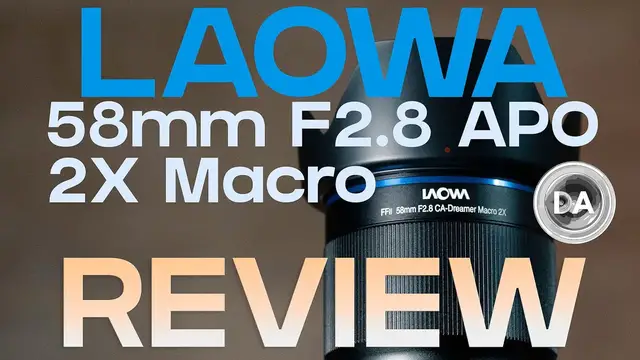
Laowa 58mm f2.8. This is a 2x apochromatic APO or APO macro lens. So this follows in a series of
0:26
excellent apochromatic macro lenses that Laowa has been churning out that started with the 100
0:31
millimeter f2.8 two times macro I reviewed a few years ago they followed that up with a 65
0:37
millimeter for APS-C which is exceptional and then earlier this year I reviewed the very good 90
0:44
millimeter that I ended up buying and selling my 100 millimeter to buy and it's an awesome lens and
0:49
now they followed it up with a little bit wider a focal length and this 58 millimeter lens so I
0:55
will say this, all of these lenses have been really exceptional optically, particularly the 65, 90, and
1:01
this 58 millimeter lens. And so in many ways, I think that when you're considering the 90 millimeter
1:06
and the 58 millimeter, it's going to be less about what separates the two of them in terms of size
1:12
performance, you know, handling, because in many ways, these two lenses are extremely similar
1:17
as we'll explore just a little bit more in just a moment. But really, it comes down to what focal
1:22
length is going to work better for you. And in our conclusion, we will talk about, you know
1:27
what might work better for different persons. I really do enjoy this lens and there's a lot of
1:33
things that I think come highly recommended about it. Now I have reviewed it today in a Canon RF
1:39
mount. You can also get it in an Icon Z or Z mount, a Sony E mount, and a Leica L mount. Basically the
1:45
major full frame mirrorless mounts available at this point. Before I go any further, I do want to
1:51
express my gratitude to so many of you who were very kind in reaching out to me and just
1:58
sharing your thoughts and prayers as I walk through a difficult period after the loss of my dad and
2:05
some other loss, some heavy things that I'm carrying at this moment. And this review here
2:09
is bittersweet because this is the lens that I took along on my trip to Arizona to go for my dad's
2:15
funeral. And I had a chance to get out and do some shooting with it, got some beautiful images. But
2:20
Of course, there were some tears along the way in this process
2:24
And thank you for walking this journey with me and for all of your consideration
2:29
And so today, this is going to be looking at breaking this lens down and seeing whether
2:33
or not this is a macro lens that you're looking for. And I'll dive into that in detail right after a word from our sponsor
2:40
Today's episode is brought to you by Phantom Wallet, the minimalist modern wallet that is
2:44
now even better with the new Phantom X that is crafted from aluminum right here in Canada
2:49
It is 22% smaller and 35% lighter, while still making it easy to access your cards and money when you need them, thanks to their unique fanning mechanism
2:59
You could even customize your wallet due to its modular design, with accessories like a money clip, cash holder, ID display, and even Chipolo and AirTag tracking integration
3:10
Visit store.phantomwallet.com to check out their unique sizes, styles, and finishes that span from aluminum to wood to carbon fiber
3:19
And use code DUSTIN15 for 15% off when you're ready to check out
3:26
Now, I love this particular focal length. And as mentioned, I think it's a really versatile one
3:32
I actually own multiple macro lenses at this point. a 65 millimeter Voigtlander, which many of you know is a lens that I love. I've got, as mentioned
3:41
the Laowa 90 millimeter. Then I also have the IREX 150 millimeter. And so, you know, 65 millimeter
3:47
90 millimeter, and 150 millimeter, all of them useful for different things. But the Voigtlander
3:53
and also similarly the Zeiss macro planar 50 millimeter F2 have always stood out to me for
4:00
being lenses that are very versatile as kind of general purposes lenses that also happen to do
4:04
macro, though they don't do macro the way that this lens does macro. Both of those lenses are a
4:10
one to two times or 0.50 times, so half life size. And so one of the things that I took of my
4:19
father's is that he was a photographer back in his day. He shot a lot of slides, thousands and
4:25
thousands of slides. In many ways, he inspired me. Well, I got one of his old Pentax cameras
4:31
mostly just for sentimental value, but I took some photos of it, and so here's what it looks
4:36
like at that half-life size, which is the maximum achievable by the Voigtlander and the Zeiss
4:41
macro planar. Now, most macro lenses go to a one-to-one or a one-times magnification level
4:49
and so that looks like this. These Laowa lenses, including this one, go to a two-to-one ratio or
4:55
two-times life size, which gives you a much higher magnification level like that. And so as a
5:01
by-product, this is going to be very, very useful as a macro lens for the ability that you just have
5:06
more macro on tap than what you do with your typical macro type lens Now as noted this lens is very very similar in design If you just look at the bare lens it near identical It about three millimeters shorter
5:20
and as far as the weight goes, it's about 31 grams lighter, but you'll have a hard time telling them
5:25
apart visually because they are very similar. One thing that is different is the shape of the lens
5:29
hood. More on the lens hood in just a moment. But that size is 74 millimeters in diameter
5:36
which gives you a 67 millimeter front filter thread, which it shares with some of these other
5:40
lenses. It is 117 millimeters in length. So as noted, three millimeters shorter than the 120
5:46
millimeters of the 90 millimeter lens. And it weighs in at 564 grams by my weight. And so as
5:56
noted, that's about three millimeters shorter and about 31 grams lighter than the other
6:00
this is a fully manual lens it is manual focus manual aperture there are no electronics which
6:07
remains you know one of the main drawbacks of these laowa lenses they are pretty bare bones
6:11
though the actual physical design feels very premium it just lacks some of the bells and
6:17
whistles that other lenses have and so this is all metal in glass the focus ring moves very nice has
6:24
nice damping, moves very smoothly. As you can see, it is internally focusing, though you can see
6:30
through that fixed front element, there is a lot of internal movement as you go throughout the
6:35
roughly 200 degrees of focus throw, which by the way, that is a great amount of focus throw. It
6:41
gives you enough precision to do both macro and standard length photography without any kind of
6:46
issue. And it's not so ridiculously long as what say the Zeiss Planar was. And so I definitely
6:53
I like the focus ring and the focus throw there. The manual aperture ring here has very light
7:00
detents at the full stops f2.8 through f22 though there's plenty of room to select a kind of in
7:08
between stops and one thing that is very strong about this particular aperture iris is that it
7:13
has 13 rounded blades and as you can see it does stay very round as you rack it down and so that's
7:18
going to help you to have nice symmetrical bokeh even when the lens is stopped down and by the way
7:23
that's one area where the straight blades of my Voigtlander 65mm are not so great. And very
7:29
quickly you see the blade shape, which you're not going to here. And so outside of that, there's not
7:35
a lot to talk about except for the lens hood, which remains the weak link. Now, as you can see
7:40
it is a more of a tulip shaped lens hood as opposed to the deeper lens hood for either the 90 or 100
7:45
millimeter, but it feels very cheap and plasticky, which frankly doesn't seem to fit this otherwise
7:50
very metal, very nice lens. But my biggest complaint with these Laowa lenses is that they
7:56
don't bayonet on very well. And so it doesn't feel very precise. You're never quite sure
8:01
is it actually locked in place? Because neither does it lock very good, nor is there any kind of
8:06
definite click when you get there. I also note that when I have the lens cap in place, it's even
8:11
harder to put on. And so I just don't love the lens hood. And I really wish that's an area where
8:16
they would improve upon in their overall design. What is here, however, is very nice, very functional
8:23
and I've owned a number of Laowa lenses at this point, and they have held up just fine for me in
8:28
ongoing use. As far as the manual focus process goes, I mean, it has helped so much by the fact
8:34
that we're using mirrorless bodies these days, and of course, I did my review on the EOS R5
8:39
so because there's no electronic communication, I did have to manually set the in-body image
8:43
stabilization, but I was able to very easily get handheld macro with the excellent in-body image
8:49
stabilization in this body. A lot of these modern cameras do have IBIS, which certainly helps out
8:54
But I did find that there was enough precision there that I was able to nail focus at a variety
8:59
of focus distances, up to including portraits, where I had no problem in achieving accurate
9:04
focus. Though, if you're going to, you know, visually confirm, which I like to do
9:08
your portrait process does slow down, particularly in these days of IAF
9:13
but I think that the results that this lens can achieve are probably worth being a little bit more deliberate about it
9:19
Let's dive in. Let's take a look together. So as pretty typical for macro lenses, there isn't much in terms of distortion here
9:27
Very, very little distortion, and so that's obviously great. This does make it useful for reproducing documents, for example
9:35
where you need to get a flat plane of focus and no distortion, and so all of that is good
9:42
and you can see that there certainly is some vignette here in the corner. I've given you a
9:46
manual correction here on the right side and so as far as vignette distortion I've done nothing
9:52
As far as vignette I've added a 38 and then slid the midpoint over and so really not a bad
9:59
correction there at all particularly for a lens that can you know go to a two to one times a
10:04
magnification. That's certainly a very very mild amount of vignette and distortion. Now a huge deal
10:10
for doing macro is the fact that this is an apochromatic design
10:13
which means that there is very little longitudinal chromatic aberration. That's a big deal because at macro levels
10:19
depth of field is incredibly tiny, as you can see here. And it a byproduct There going to be a lot that is not in focus when shooting macro And so a lot of opportunities to have you know to have chromatic aberrations fringing of various kinds
10:34
This is a lens, the front of a lens at two to one magnification
10:40
And so there's a lot of potential here in these various transitions of the places where it has been, you know, stamped and painted in
10:48
And with lenses that struggle, this is something that just destroys them
10:52
And so as you can see, it's passing this test with no problem at all. Likewise, lateral chromatic aberrations are not an issue
10:58
You can see here towards the edge of the frame, we've got no fringing that is taking place
11:03
And so chromatic aberrations, a complete non-issue with this lens, as I have found with all of these Laowa apochromatic lenses
11:10
Now, I've been universally impressed with the optical performance from all of these apochromatic macro lenses from Laowa
11:17
and this is no exception at all. At 200% magnification on the 45 megapixels of the EOS R5
11:24
the center is flawless. The mid-frame just really stands out to me to be exceptionally good
11:29
That contrast level is fantastic. You can see here, I mean, that is just popping even at that 200% magnification
11:37
And right down here into the corner, everything looks great with just a very mild drop-off in the extreme corner
11:43
stopping on down to f4 and you can see a very mild improvement there in the corner and then on to f5.6
11:52
and a little bit more you can see even out in this area now though we're exceptionally exceptionally
11:59
crisp we'll pop over to this side you can see it just i mean the contrast is just popping
12:04
here and so very very strong performance and in the mid frame you can just see that contrast is
12:12
at just an exceptional level in the center of the frame. Mid-frame is exceptionally good
12:17
So obviously as a by-product of this, this lens, even more so than any of the others
12:21
is going to be a really great landscape lens for the simple reason that this focal length is just
12:27
so much more useful for going out and shooting landscapes. And so you can see here that in the
12:33
areas where, and obviously I was able to shoot in Arizona with this lens, and you can just see
12:39
There's just tons of detail everywhere that you look, even towards the far distant, the communication towers on the top of the mountain there
12:47
You can see all the saguaro cactus delineated along there. Just really, really beautiful
12:53
A more subtle image here, but, you know, once again, it just, I really liked it also as a landscape lens
13:00
You know, has such crisp detail. No worry about chromatic aberrations. Be able to resolve a lot of really fine details
13:07
and nice color rendition just makes it really really nice. A final one here before we move on
13:12
another image that I just really love great color rendition and as you can see if we pop in here to
13:18
a pixel level you can just see that the detail that is captured by the sensor is really exceptionally
13:25
good and it's just you know it's fantastic all the different degrees of light and luminosity that is
13:31
captured there. Just a really, really beautiful end result. Now our minimum aperture here is f22
13:38
but as you can see, you really do lose a lot due to diffraction on, you know, modern high resolution
13:44
sensors. And so, you know, that amazing contrast is just muffled down by diffraction. I would try
13:51
to use f11 as a limit and, you know, f16 in a pinch if absolutely necessary. So my standard test
13:59
of up close minimum focus distance. Obviously, in this case, we're able to get really, really close
14:05
at that two-to-one level of magnification. And so as a byproduct here, obviously great detail
14:12
a fairly flat plane of focus, but not as flat, maybe as either the 90 or the 100 millimeter
14:18
for the simple reason that at 58 millimeters, you're getting a little bit closer
14:23
And so just as a byproduct, you get a little less flat plane of focus
14:27
Now, the downside of apochromatic lenses tends to be that the bokeh is a little less soft
14:32
And so, you know, in general, I have found that Laowa hasn't done a bad job with this
14:37
I still think that the bokeh is pretty decent. It's not absolute top tier, but just a few examples here
14:44
We can see that the geometry, it's not flawless, but, you know, you're able to get nicely to focus results here
14:50
This is a Hammond organ. Another shot here, this is of cacti
14:55
And so, you know, up close, obviously, you're going to really be able to blur out backgrounds
14:59
The detail is fabulous from this lens. That's the huge strength. And in this case, when you're up close like that, you're defocusing the background so much that you're not going to have to worry about that
15:09
In this case, a little more layers where you get a little bit more potential for busyness
15:13
But again, frankly, this really isn't too bad. And it was a bright sun
15:18
And so this obviously is handled really well. if this lens was prone towards chromatic aberrations at all this image would be a mess
15:25
because it was shot in bright Arizona type conditions and the sun is very bright in Arizona
15:31
and so as a byproduct I was actually really pleasantly surprised by how the image turned out under the circumstances this is a little bit more of a medium distance and as you can see I really feel like it still handled fairly well There some potential for
15:47
busyness. I mean, again, the subject matter, it looks just fantastic. This area here, there's a
15:53
little bit of busyness, but as I look at the image at large, I still really like it. Another example
15:58
here back in Ontario, and here you can see that the bokeh circles, they look pretty decent, and again
16:05
And subject matter looks fabulous. Obviously, this is a lens that really thrives at doing macro kinds of things
16:11
And so, you know, if we zoom in there to a pixel level, it's just fabulous, you know, controlling all of that
16:17
You know, I think that here there's a little potential to where there's a little bit more of a prismatic effect than what I would, you know, say that I loved
16:26
But in general, I still really like the image. So obviously, a lens like this is going to be a nice option for portraiture
16:34
F 2.8 isn't a huge maximum aperture, but the lens having such amazing contrast and detail means that you can shoot at F 2.8 all day and just be very thrilled with the results
16:46
I also don't find these lenses hard to focus on, particularly on a body like the EOS R5 that has a great viewfinder and good overlays
16:55
And so because the lens is so sharp, it's actually quite easy to nail focus using overlays and magnification if necessary
17:04
Now, as far as flare goes, there is obviously some ghosting pattern that you can see here
17:10
I would say that it is because it is so kind of neatly organized
17:15
It's really not bad. This image I just love. It's maybe my favorite that I took on this trip
17:22
And so in this case, flare is handled just like I would want it to be handled
17:27
Here again, there's a little bit of that ghosting pattern. But it is, frankly, rather artistic and not as a byproduct
17:34
It's not really destructive. It's not just kind of random blobs, but they're ordered and stylish
17:39
And here you can see, again, this is maybe my least favorite of the impact of them
17:44
But still, I look at the image and I still think it has aesthetic value
17:48
So, of course, your mileage may vary on what you like or don't like. Overall, however, this lens delivered essentially exactly what I expected
17:56
and that is a nearly flawless optical performance. So at the end of the day, this is an apochromatic design and it shows
18:03
It has a tremendous amount of popped images, a great contrast, great resolution
18:10
Fringing is extremely well controlled. That makes it very effective as a macro lens where there tends to be a lot of shiny surfaces
18:17
and it also makes it very effective for shooting everything from the landscapes that I shot
18:22
to portraits to just general purpose trail shots. And that brings us back in conclusion to talking about the focal length
18:30
I like a wider focal length for its versatility. I like it better for shooting product photography, for example
18:36
where sometimes a longer lens feels just a little bit too narrow. I like it for the versatility as like a trail lens
18:42
where I can shoot a little bit of landscape. I can also get in close and shoot the macro shots or the close focus shots
18:49
What you lose is working distance. In this case, between the 90mm and the 58mm, it's only 3cm
18:56
but that means you're that much closer at these close macro distances. It means there's more of a chance of maybe shading your subject
19:04
scaring your subject if you're working with something live. And so, I mean, that brings its own challenges
19:11
And so, in those situations, like with insects, my favorite lens is actually the 150mm
19:16
where I can shoot from a little bit further away and still get a high degree of magnification
19:20
The other thing that you lose is the ability to blur out backgrounds as much as you will with a longer lens with more compression
19:27
At the end of the day, however, it really comes down to what kind of lens you're using for and what your major applications are going to be
19:33
And I hope that this review helps you to make that decision. One thing I can say for certain is that while I don't know definitively the final price on this
19:40
they've all been priced at roughly the same point, which is right under $500
19:44
US dollars. And this is an excellent value for that, particularly on platforms like Canon, RF
19:51
Nikon Z or Z, where there frankly aren't a lot of lens options and certainly not a lot of very good
19:57
and expensive lens options. And that makes this lens extremely appealing. If you'd like more
20:02
information, you can check out my full text review, which you can find in the linkage down below
20:06
There's also linkage to an image gallery where there's a lot of beautiful, those bittersweet
20:11
photos that I invite you to go and to check out there. There's also buying links, though, as always
20:16
when I'm reviewing something brand new, it may take a few days, a few weeks for those to populate
20:20
but I really appreciate those of you that take the time to come back and to buy through those links
20:25
as it does help to support this channel. And so thank you so much for that. There's also
20:29
linkage there to follow myself or Craig on social media. Check out our collaborative channel
20:34
Let The Light In TV. You can purchase channel merchandise through linkage there, become a patron
20:38
And of course, if you haven't already, please click that subscribe button right here on YouTube
20:43
Thanks for watching. Have a great day and let the light in