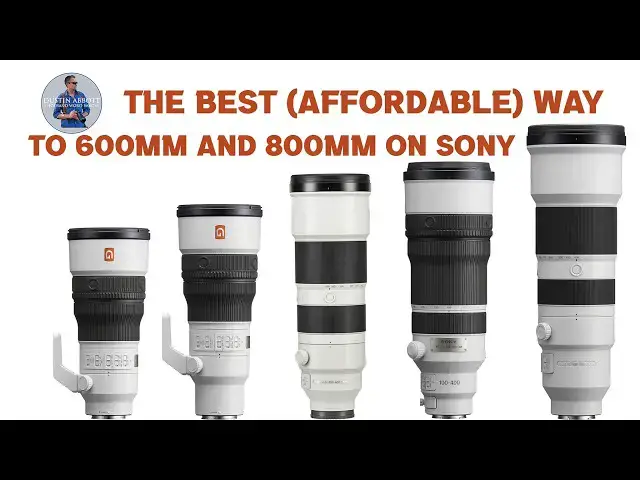
0:10
Hi, I'm Dustin Abbott. Last week, I
0:12
released my reviews of Sony's new 400mm
0:15
F4.5 and 600mm F6.3 lightweight G Master
0:19
prime lenses. Both of them are
0:21
incredible lenses. But of course, the
0:23
moment that I release a review of one
0:25
lens, people immediately begin to ask,
0:26
"Well, how does it compare to this lens?
0:29
So, what I'm going to do in today's
0:31
video is I'm going to show you how my
0:34
results compared. And I'll give you a
0:35
few caveats in just a moment, but I'm
0:37
going to compare the 400 and 600 mm
0:40
prime lenses to the existing zooms that
0:43
cover those same focal lengths. So, what
0:44
we're looking at is the best reasonably
0:47
affordable way to get to 600 mm and 800
0:50
mm on Sony E-mount. Now, obviously,
0:54
that's going to exclude the really
0:55
expensive super telephoto primes. And
0:57
so, we're going to be looking at some of
0:59
the zooms that get you to that same
1:00
point, including the new 100 to 400
1:02
millimeter uh f4.5 G Master uh zoom.
1:06
We're going to look at the 200 to 600
1:08
millimeter F5 to 6.3G lens and then the
1:11
400 to 800 millimeter, F6.3 to 8 GO
1:16
lenses. The oldest of those being the
1:18
200 to 600 millimeter, which has been
1:20
around for a while, but frankly is still
1:21
holding up quite well. Most of these
1:23
other lenses being much newer, released
1:25
within the last 2 years. So, a few of
1:28
those caveats that I mentioned. First of
1:29
all, I'm going to be showing you my
1:31
findings in my test with the copies of
1:34
the lenses and teleconverters that I had
1:37
access to. You may find that another
1:39
reviewer comes to some different result.
1:42
And my recommendation to you is that if
1:44
you are serious about a particular lens
1:46
or you looking between a couple of
1:48
lenses, look at my findings, but also
1:51
look at other reviews and try to find a
1:53
consensus between those as to which is
1:55
the better for you. Obviously, with an
1:57
independent reviewer of myself, in most
1:59
cases, I'm going to be working with one
2:01
specific copy um of each lens or
2:04
teleconverter, not a variety of them.
2:05
And so, it's it's nice to look at a
2:07
variety of different opinions. The
2:09
second caveat is there are a number of
2:10
you I know that are looking for
2:11
comparisons to the Sigma 500 millimeter
2:14
f5.6 sport lens which is an excellent
2:17
lens that I reviewed years ago.
2:19
Unfortunately, I reviewed it using a
2:21
different test chart and so my results
2:23
are just not applicable enough to use.
2:25
And unfortunately for this particular
2:26
comparison, the fact that you cannot use
2:28
teleconverters with that lens means that
2:31
it can't get you to 600 mm and it can't
2:34
get you to 800 mm either. and so it's
2:36
not uh going to be available for this
2:39
comparison. My third caveat is that
2:42
testing telephoto lenses is notoriously
2:45
difficult because for me at least I have
2:48
to take those outside. You need a really
2:50
long working distance to test some of
2:52
these combinations which means that for
2:54
me I have to do it out of doors which
2:56
means that there are different variables
2:57
with lighting, air currents, things like
2:59
that just things that complicate uh
3:02
extra variables that don't exist when
3:03
I'm able to test indoors. And so, as
3:05
always, I take my findings with a grain
3:08
of salt here. Before we jump into my
3:11
actual rankings, what I will do in this
3:13
is I'm going to give you my rankings,
3:14
how they compared, getting close to 600
3:17
millimeters, which again, when you're
3:18
using teleconverters, it's not an exact
3:20
science. So, in the 600 millimeter
3:22
category, we're going to be looking at
3:24
560 mm. That's the 400 millimeter lenses
3:27
with a 1.4 times on them, up to a true
3:30
600 mm. So, there's a little bit of play
3:32
there. And then on the 800 millimeter
3:34
end, again, it's not an exact science.
3:36
Some of them are going to get us up to
3:37
840 mm when you're adding a 1.4 times to
3:41
a 600 millimeter combination. So, just
3:44
know that, you know, there's a a little
3:45
bit of play there. But what I will do is
3:48
I'm going to tell you my findings and
3:50
then if you want to see my findings at
3:52
the end of the video, I'm going to jump
3:54
in and show you with the actual images
3:56
and compare back and forth and so that
3:58
you can actually see how that played
3:59
out. But for those of you that just want
4:01
to know what I found, you'll get that
4:02
much more quickly. Finally, a word on
4:05
pricing. Obviously, there is some
4:06
variability here when it comes to
4:08
pricing. In the bare lenses, uh the 200
4:10
to 600 millimeter is the cheapest. It is
4:16
These prices are all from B&H Photo as
4:18
of today. The 400 to 800 millimeter G
4:25
The 400mm f4.5 is also $2,698.
4:29
The 600mm f6.3 $3,698.
4:34
And then finally, the 100 to400 millm
4:36
f4.5 G Master is $4,298,
4:40
making it by far the most expensive
4:43
here. However, note with all of these
4:45
that if you want to get further reach,
4:46
you're going to have to add
4:47
teleconverters. So Sony's 1.4 four times
4:50
or two times teleconverters, they run
4:55
a piece. And so in the most expensive
4:57
configuration, you could potentially be
4:59
adding on nearly $1,200. So, for
5:01
example, with the 400 millimeter f4.5 if
5:04
you get both teleconverters, that's
5:05
going to get you up to $3,894.
5:09
That being said, you know, that's only a
5:11
couple hundred more than just buying the
5:13
bare 600mm f6.3, for example. And so,
5:16
you know, there's definitely some play
5:18
on things here. Just know that there is
5:19
some variability in pricing. The most
5:21
expensive combination that I'm looking
5:23
at today is going to be the 100 to 400
5:25
millm f4.5 G Master, which is the most
5:28
expensive lens to begin with. Then you
5:30
throw a couple of teleconverters into
5:31
the mix and you can get up to $4,896
5:35
if you're buying one. If you're buying
5:36
both teleconverters, $5,494.
5:41
So, that aside, let's look at the
5:43
rankings. So, at 600 millimeterish, here
5:46
are my rankings. In first place is the
5:49
five is the 400 millimeter f4.5g master
5:53
with the 1.4x teleconverter. And by the
5:56
way, you'll find that these lenses,
5:58
these new prime lenses take the 1.4 time
6:00
Sony teleconverter exceptionally well.
6:03
Very, very little loss of image quality.
6:05
Autofocus is fabulous. It's a great
6:07
combination. Though obviously you're
6:09
getting less light and you're going to
6:11
have to deal with that. In this case,
6:12
it's not all that big of a hit. And so
6:14
we're at f6.3 as our maximum aperture,
6:17
which is true across all of these save
6:19
one as we're going to see in just a
6:20
moment. And so it was my sharpest
6:22
combination and and at 560 mm f6.3
6:26
delivered fantastic results. Second
6:28
place is the 600 millm f6.3 G Master.
6:32
It's an amazingly sharp lens, but I just
6:34
found at least with my copy of the 400
6:36
millimeter and the 1.4 times, it was a
6:38
hair sharper. In third place is the 100
6:41
to 400 100 to 400 millimeter G Master
6:44
zoom lens with the 1.4 times. Again,
6:46
that's a 560 millimeter f6.3
6:48
combination, but delivers really really
6:50
fantastic results. In fourth place is
6:53
the 200 to 600 millimeter uh zoom lens,
6:56
and so you're at the end of the
6:57
telephoto range on that zoom lens. You
6:58
have a maximum aperture of f6.3. It
7:01
delivers really good results in the
7:02
center, but not nearly as good in the
7:04
mid-frame and the corners relative to
7:06
the first three. In fifth place is
7:09
actually the 400 to 800 millimeter. The
7:12
copy I tested was not amazing at 600 mm.
7:15
And what's more, you have the slowest
7:17
maximum aperture of f8 here. And you
7:20
know that is 2/3 of a stop less sprite.
7:22
And so you know you are talking about a
7:24
significantly less amount of light
7:26
coming through at 600 millm. And so for
7:29
that reason it was the lowest in my
7:31
ranking. Now moving on to 800
7:34
millimeterish. Here are my ranking. And
7:37
I do have one tie here. And so we only
7:38
have four places. In first place was
7:41
actually the 600mm f6.3
7:43
G Master prime lens with the 1.4x
7:46
teleconverter. Now that actually gets
7:48
you up to 840 mm at a maximum aperture
7:51
of f9, but it delivered really really
7:54
strong results. Again they take these
7:56
1.4 times teleconverters very well. In
7:59
second place is the native 400 to 800 mm
8:02
uh G uh zoom lens. And so it is giving
8:05
you the brightest maximum aperture of
8:07
f8. Though the difference between f8 and
8:09
f9 is only one/ird of a stop. And so
8:11
it's not a major difference here, but it
8:13
is a little bit brighter. And it
8:15
delivered good results there. Though
8:17
contrast is not off the charts, as we'll
8:19
see in the breakdown. In third place is
8:21
a tie between the 200 to 600 millimeter
8:24
with a 1.4x teleconverter. Again, that's
8:27
840 mm f. And then the 400mm f4.5 with a
8:32
two times teleconverter. So that's 800
8:34
mm f9 in this case. Again, there's some
8:38
give and take across the frame, but I
8:40
didn't feel like one combination was
8:42
actually better than the other overall.
8:45
And in fourth place, though by a very
8:47
small margin, is the 100 to 400
8:50
millimeter f4.5 G Master zoom with the
8:53
two times teleconverter. And so that is
8:54
800 millime F9. And it was very very
8:57
lightly slightly less sharp than what
9:00
the uh other combinations were. So, that
9:04
is what my findings were. If you would
9:06
like to see that, um, just in a moment,
9:08
we'll jump into that together. If you
9:10
want more information on any one of
9:11
these lenses, however, look in the
9:13
description down below. I have links to
9:15
my full text and video reviews for each
9:17
one of these lenses. And so, if there's
9:19
one of them that intrigues you, you can
9:21
dive into that more. Now, without
9:22
further ado, if you want to see how I
9:25
got to my results, let's jump in. Let's
9:27
take a look. So, our top ranking at the
9:29
600 millimeterish zone is the new 400mm
9:32
f4.5 with the 1.4x teleconverter, which
9:36
is slightly better than the 600mm f6.3
9:39
in the bare lens. Surprisingly, you can
9:41
see in the center of the frame, we've
9:42
got just a little bit more contrast and
9:44
detail. If we move to the mid-frame, you
9:48
can see that while they're close, this
9:50
text just pops a little bit more here.
9:52
If we look at this seal, all the
9:54
contrast around there is stronger. And
9:56
right up into the corners, we can see
9:58
that something similar is true, though
10:00
they are closer up here in the corner.
10:03
Okay, for the second round, if we move
10:04
the 600 mm, which is in second place,
10:06
our third place is the 100 to 400 millm
10:09
f4.5GM with the 1.4x teleconverter. Here
10:13
in the center of the frame, you can see
10:15
that contrast is close between the two
10:17
lenses. And if we move to the mid-frame,
10:20
you can see that the prime lens just has
10:22
a little bit more pop overall. Um, it's
10:25
close, but it has a little bit more of a
10:27
win there. And it's a little bit more
10:28
consistent out here in the corners. You
10:30
can see that it's definitely sharper uh
10:32
in the corners than what the 100 to 400
10:35
with the 1.4 times is. So, moving the
10:38
100 to 400 with the 1.4 times into the
10:41
primary slot here. We'll compare it with
10:43
the number four, which is the 200 to 600
10:45
millimeter. And you can see that in the
10:47
center of the frame, again, there's just
10:49
a little bit more contrast and pop for
10:52
the prime with the 1.4. four times. We
10:54
move to the mid-frame. You can see again
10:56
here just the text is and all of this
10:58
text just a little bit better contrast
11:01
and just a little bit better overall
11:02
detail. We move off into the corners and
11:05
you can see that while the corners are
11:07
closer, there's just a little bit more
11:09
contrast and detail than what we see
11:11
from the 200 to 600. Now, in last place
11:14
is actually the 400 to 800. And it gets
11:17
a little bit of a knockoff here because
11:19
it is slower at f8 than all the rest of
11:24
And you can also just see that it isn't
11:27
quite as just clear in terms of its
11:29
detail in the center of the frame. Here
11:31
in the mid-frame, it's it's competing
11:33
better here. But I would still take if
11:36
you look at the writing here, for
11:37
example, compared to this, there's just
11:39
a little bit more clarity with the 200
11:41
to 600. And that's true up into the
11:43
corners. This actually looks better in
11:45
the corners, but it's uh by a small
11:48
margin. And again, it does have a bit of
11:50
an aperture disadvantage. And so I would
11:52
say that it's better in the corners, but
11:53
the 200 to 600 is better everywhere
11:55
else. All right, if we move on to our
11:58
800 millimeter fight, we can see that
11:59
actually our best in terms of sharpness
12:02
and overall performance is actually the
12:04
new 600 millimeter F6.3 GM with the 1.4
12:07
times. These primes are really showing
12:09
how good they are with teleconverters.
12:12
And so we can see we're up to 840 mm in
12:15
f9. And so just a little bit slower, 1/3
12:18
stop less bright than the 800 millimeter
12:21
or 400 800 at f8. But we can just see
12:24
that the contrast and the detail is
12:26
particularly contrast is just much
12:28
better in the mid-frame. Much I mean
12:31
look at how much better this is than
12:32
that in terms of raw contrast. And right
12:35
up into the corners we can just see that
12:38
everything just pops more. And so this
12:40
is definitely the winner. If you want to
12:41
get it to 800 plus millimeters um at a
12:44
reasonable price with great performance,
12:46
the new 500 or excuse me 600 with the
12:48
1.4 times is the way to go. Okay, we've
12:51
determined our first and second place
12:52
winners. We actually have for third
12:54
place, we have a tie between the 200 to
12:56
600 with the 1.4 times teleconverter and
12:59
then the 400 f4.5 with a two times
13:02
teleconverter. Now neither of these
13:04
results are really fantastic. As you can
13:06
see here, what the prime brings to the
13:09
table is a little bit more contrast. I
13:11
think actually there's a little bit more
13:13
detail on the 200 to 600. If we move
13:16
into the mid-frame, we can see kind of a
13:18
similar truth. There's a little bit more
13:20
detail here. Um, you can just see some
13:23
things showing up, but the contrast,
13:24
just the overall brightness of the
13:26
image. Uh, just kind of the look and
13:28
clarity favors the uh the prime combo.
13:32
You can see moving up into the corners,
13:33
the corners are definitely stronger with
13:36
the uh the 400 millimeter with the two
13:39
times teleconverter. So there's some
13:40
give and take across the frame. I would
13:42
rank them basically equal. So
13:44
unsurprisingly, last place goes to our
13:46
other lens that has to use the two times
13:48
teleconverter and that is the zoom, the
13:50
100 to 400 f.5. Now in the center of the
13:53
frame, contrast is not too bad. Detail
13:56
isn't fantastic. If we move into the
13:58
midframe, however, the results aren't
14:00
quite as good. Just again, not quite as
14:02
much pop. Detail isn't bad, but contrast
14:05
results not quite the same. And moving
14:07
up into the corners, definitely the
14:09
corners favor the prime lens. You can
14:12
see it holds up a little bit better in
14:14
some of the other places where we look.
14:16
And so it's not a big loss here, but
14:20
because neither one of them is
14:21
exceptional. These these last three are
14:23
fairly close to together, but we can see
14:25
that it's just not quite as good as you
14:27
look at different places across the
14:29
frame. As always, thanks for watching.
14:30
Have a great day and let the light in.