Up next in 10

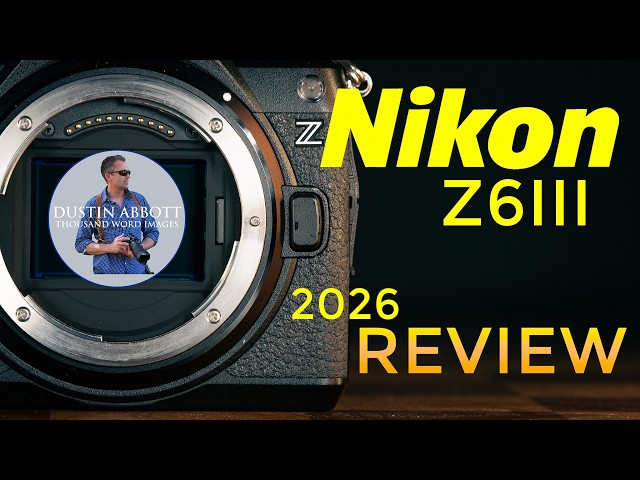
Nikon Z6III Review in 2026 | Still Worth It?
Apr 14, 2026

Photographer Dustin Abbott shares a deep dive review of the Nikon Z6III and its partially stacked, high-speed sensor. Is the Z6III still worth considering in 2026? Find out in Dustin's review. | This episode is sponsored by Fantom Tracker. Visit store.fantomwallet.com and use code DUSTIN20 for 20% off. | Read the Text Review: https://tinyurl.com/Z6IIIreview | Purchase the Nikon Z6III @ B&H Photo https://bhpho.to/4tovjpb | Adorama https://prf.hn/l/qXvv29p/ | Amazon https://amzn.to/4sO3uH7 | Camera Canada https://tidd.ly/4sWigM7 | Amazon Canada https://amzn.to/4mvH0IN | Amazon UK https://amzn.to/4sejkJO | Amazon Germany https://amzn.to/4dOgGav
Check out the DA Merch here: https://bit.ly/TWIMerch | Become a Patron: https://www.patreon.com/dustinabbott | On the Web: http://dustinabbott.net/ | Sign up for my Newsletter: http://bit.ly/1RHvUNp | Instagram: http://bit.ly/DLAinsta | Facebook: http://on.fb.me/1nuUUeH | Flickr: http://bit.ly/1UcnC0B | 500px: http://bit.ly/1Sy2Ngu Follow Craig @ https://www.instagram.com/craigstoffersen/
Want to support this channel? Use these affiliate links to shop at:
B&H Photo: http://bhpho.to/1TA0Xge
Adorama: https://tinyurl.com/AdoramaDA
Camera Canada: http://bit.ly/DLACameraCan
Sony Canada: https://www.thesonyshop.ca/?ref=abbott
Amazon: https://amzn.to/3HrY64d
Amazon Canada: https://amzn.to/3qG1p18
Ebay: http://bit.ly/DustineBay
Into the AM Clothing: https://bit.ly/intotheAMda and use code DUSTIN10 for 10% off
Fioboc Clothing: https://tinyurl.com/FiobocDA20 and us code DUSTIN20 for 20% off
Make a donation via Paypal: https://www.paypal.com/paypalme/dustinTWI
=============================
Table of Contents:
=============================
0:00 - Intro
Show More Show Less View Video Transcript
0:10
Hi, I'm Dustin Abbott and I'm here today
0:12
to give you my review of the Nikon Z6
0:15
Mark III. Now, I recognize that this
0:17
camera is now a couple of years old, but
0:20
I am continuing to work my way through
0:22
some of Nikon's existing important
0:24
models and lenses, and so that I have a
0:26
better sense of them uh when I review
0:28
newer releases in the future. It's also
0:31
interesting to hit this kind of review
0:34
now with newer releases that have
0:36
followed from both Canon with the R six
0:38
Mark III and then also from Sony with
0:41
the A75. as these are the two primary
0:43
models to compete with the Z6 Mark III.
0:47
Now, there are certainly areas where
0:48
both of those cameras in their own way
0:50
have leapfrogged the Z6 Mark III. Though
0:52
the Z63 does retain a important
0:55
advantage for those of you that are
0:57
looking for a sports type camera,
0:59
combining the blackout free viewfinder
1:02
with a fast burst rate and a deep
1:05
buffer, which isn't the case necessarily
1:07
with the other cameras, in this case,
1:08
allowing you to get over a thousand raw
1:11
images before you fill that buffer.
1:12
That's obviously going to be very useful
1:14
for a specific type of photographer.
1:16
Now, at the same time, these cameras
1:18
tend to be jack of all trades, these
1:20
kind of mid-tier models. But while it
1:23
can't compete quite as well in a few
1:25
categories with those cameras, one big
1:28
advantage that comes in 2026 when I'm
1:30
reviewing is the fact that at the moment
1:32
Nikon has steeply discounted this
1:34
camera, where it can now be had for
1:36
about $2,000.
1:38
that sets you apart by either $8 or $900
1:42
compared to the other two models, which
1:44
obviously is going to play into that
1:46
decision process for some people. So,
1:48
we're going to dive through all areas of
1:51
build and performance to help you to
1:53
determine whether or not in 2026 the
1:55
Nikon Z6 Mark III is still a worthy
1:58
consideration for you. I want to thank
2:01
Nikon Canada for sending me a loaner of
2:03
this camera. It will be going back to
2:05
them after this review. As always, this
2:07
is a completely independent review and
2:08
they have had no input on my findings.
2:11
That aside, let's dive in. Let's take a
2:13
look. Today's episode is sponsored by
2:15
the all-new Phantom Tracker 2.0. Phantom
2:18
has not only seriously upgraded the
2:20
visual look of the card, but now we have
2:22
a superior build quality. Made with
2:23
tempered glass and metal alloys, this
2:26
credit card size tracker can be locally
2:28
tracked via a 90 decel beeping noise,
2:30
but also on a global level via Apple's
2:32
Find My Network and its map. The
2:35
addition of NFC means that you can also
2:37
use the card to trigger an automation.
2:39
Just tap it. The tracker fits perfectly
2:41
in any wallet or bag and assures you
2:43
won't lose your valuables. It has a
2:45
built-in rechargeable battery that can
2:47
be easily charged via any wireless
2:49
charger, and a single charge can last up
2:51
to 6 months. The Phantom Tracker 2.0
2:54
makes for a seriously cool gift. So,
2:56
visit store.fanomwallet.com
2:59
and use code dustin20 at checkout for
3:01
20% off. That's store.fanomwallet.com.
3:03
phantomwallet.com and use code dustin20
3:06
for 20% off. All right, let's take a
3:08
closer look at the build features, the
3:10
design here of the Z6 Mark 3. So,
3:15
obviously we have a 24.5 megapixel
3:17
partially stack CMOS sensor. That's kind
3:19
of the big deal on the overall design
3:22
here. So, that sensor gives us lots of
3:24
speed and it's backed up by the XED 7
3:26
image processor. This body has grown a
3:30
bit relative to what we saw with the Z6
3:33
Mark II. It is now 138.5 mm in width or
3:38
5.5 in. So about four or five millime
3:42
wider, is 101.5 mm uh tall or 4 in. And
3:49
then it is 74 mm deeper or 74 mm deep.
3:53
So, a little bit deeper than the
3:54
predecessor or 2.9 in, giving us a
3:57
little bit more grip. And you'll also
3:59
note it's a little bit thicker through
4:01
the viewfinder stack there as well.
4:04
Because of that extra size, it does
4:06
weigh in a little bit more. It weighs in
4:08
at 760 g or 1.68 lb, making this the uh
4:13
heaviest of this these mid-level
4:15
contenders between the Sony A75 and the
4:18
Canon R six Mark III. Now, one of the
4:20
standout qualities of the C63 is its
4:23
viewfinder, which is higher resolution
4:25
than competing viewfinders, 5.7 6
4:28
million dots. Um, it also is very
4:31
bright, 4,000 nits of brightness. You
4:33
can have it up to 120 frames per second.
4:36
I would definitely take this viewfinder
4:38
over what I find in either the Canon or
4:40
the Sony. It stands out. We also have a
4:43
3.2 in articulating LCD screen, which is
4:47
a touchscreen. resolution is 2.1 million
4:50
dots. And so both of those
4:52
specifications, you know, rank on the
4:54
the high side of things. We also have
4:56
the ability to use both SD UHS2 cards
5:00
along with more importantly the CF
5:02
Express TypeB cards here, which allow
5:05
you to get obviously those much faster
5:07
right and read speeds there. All of that
5:10
is good. The VR and the camera is rated
5:12
for up to eight stops. So that's another
5:14
significant area improvement. And again,
5:16
I think that uh that Nikon is doing VR
5:18
really, really well or inbody image
5:20
stabilization. Up front, one of the
5:22
things that we do have that we don't
5:23
have necessarily on competing models is
5:26
we have two custom or function buttons
5:28
here. Though I will note that Sony often
5:30
includes a little bit more custom
5:31
buttons on top. Up top here, we have a
5:34
slight rearrangement of just where these
5:36
same three buttons, but on where they're
5:38
located here. And one thing that I will
5:41
say that I consider to be a negative is
5:43
that it's a kind of two-step operation.
5:45
If you want to do, you know, exposure
5:47
compensation, you've got to hold that
5:49
down and rotate this rear dial or you
5:51
can set in the menu to where you can
5:53
just touch it and then rotate it. But
5:55
either way, it takes twostep operation
5:57
to make some of those changes. We do
6:00
have, you know, unlike the Z5 Mark II,
6:02
we do have a top-mounted LCD screen,
6:04
which by the way is something that, you
6:06
know, compares favorably to the Sony
6:08
A75. rest of the control scheme. We have
6:10
our mode dial here over on the left side
6:13
of the view sign viewfinder stack. We
6:16
have our typical button placement that
6:18
you're probably pretty familiar with if
6:19
you're familiar at all with Nikon
6:21
cameras. The one thing that I would love
6:22
to see them embrace is that rather than
6:24
a D-pad here to actually have another
6:27
wheel that could also function as a
6:28
D-pad, but would allow you to make some
6:30
setting changes there. I do like their
6:32
joysticks, however, they uh function
6:35
well. I like the ability to have switch
6:37
between a standard photo or video setup
6:41
here. That has become kind of the the
6:43
standard across the all of these cameras
6:45
at this point. The body itself is
6:47
robust. It's magnesium alloy. You can
6:50
see here there is a thorough weather
6:51
sealing throughout. All of that is
6:54
obviously great. The
6:57
battery here is the typical Nikon
6:59
battery. It's the ENL15C.
7:02
And so it is rated for 16 W hours. That
7:07
is a 2280 mAh battery pack.
7:10
Unfortunately, the specs here are a
7:13
little bit underwhelming. It's rated for
7:15
360 shots if you're using the
7:17
viewfinder, 390 if you're using the LCD.
7:20
Unfortunately, that's about half of what
7:22
the new Sony A75 is able to produce. So,
7:25
you're definitely going to want to have
7:26
an extra battery or two. ports are
7:29
pretty Nikon standard here on the side.
7:31
One major difference between the Z6
7:34
lineup and the Z5 lineup is that we do
7:36
have fullsize HDMI which is very very
7:39
welcome there. Outside of that, nothing,
7:42
you know, particularly enlightening or
7:43
impressive when it comes to the actual
7:46
ports that are available here. I do wish
7:48
that Canon and Nikon would be a little
7:50
bit more like Sony and that we would
7:52
have actually doors that open up here
7:54
instead of these flaps, which as you can
7:56
see can be a bit of a pain to receat
7:59
sometimes. At the end of the day,
8:00
however, this is an obviously great
8:03
value at its current price in the US of
8:05
around $2,000 US. Here in Canada,
8:08
because there isn't that same discount,
8:10
it's going for about 3,400 Canadian, so
8:13
not nearly as good of a bargain. The
8:16
autofocus system is the 299 point
8:19
autofocus system that we first saw with
8:20
the Z9, then came to the Z8, and then is
8:23
filtered down to other models like this.
8:26
It is a very competent autofocus system
8:28
with points covering basically the whole
8:31
uh frame. And then the ability to detect
8:33
up to about nine different subjects. And
8:36
probably most importantly to me, there
8:38
is the automatic mode where the actual
8:40
processor will select detect what kind
8:43
of subject is on frame and track it
8:45
accordingly. And that saves, you know,
8:47
hunting through the uh either the menus
8:49
or having to assign a custom button to
8:51
switch between those options. So, I
8:53
appreciate that. Nikon's autofocus when
8:56
it comes to stills, I think, is at this
8:59
stage very, very close to what we're
9:00
seeing from Canon and Sony. I would
9:02
still give both of those a slight edge,
9:04
but the difference is minuscule at this
9:07
point. You have the ability to quickly
9:10
pick up subjects and obviously it's
9:11
going to be specific to whatever lens
9:13
you have attached, but the focus system
9:15
itself seems to work well with a wide
9:17
variety of both first and third party
9:19
lenses in my test. And for example here
9:21
using the 14 to 30 millimeter f4s lens I
9:25
was able to shoot these bursts kind of
9:27
trying to film an airwalk type scene
9:30
with someone going over the top of me
9:32
with me set up right down on the ground.
9:34
And by the way that's one area where
9:36
having that um actual very very angle
9:39
viewfinder helps so much and so you can
9:41
get right down and still see what you're
9:43
doing. But I was able to track
9:45
throughout that with you know well
9:47
focused results. you know, other
9:48
situations where I was, you know, taking
9:50
pictures of uh sheep moving around. I
9:52
went out to visit a sheep farm and uh
9:54
and so I mean, the lambs running around,
9:57
I was able to, you know, accurately
9:58
track them and get good results. So, you
10:00
know, all of that was good. I don't
10:02
really have any kind of complaints when
10:03
it comes to autofocus during my review
10:05
of the Z6 Mark III. And of course,
10:07
probably most importantly for those of
10:09
you that are wanting to track sports,
10:10
not only do we have that blackout free
10:13
viewfinder and so you can stay locked in
10:15
on the action and that fast burst rate,
10:17
but also you have very deep buffers
10:20
here. All right, let's talk a bit about
10:22
the internals here. Starting with the
10:24
shutter options that we have here. We
10:26
have both a mechanical and electronic
10:28
shutter options. The mechanical shutter
10:30
has an upper limit of 18,000th of a
10:32
second shutter speed. You can go up
10:34
another stop to 116,000th of a second
10:37
with the electronic shutter. This is a
10:40
partially stacked COS sensor. And so the
10:43
upside is that you do get a very fast
10:45
readout speed relative to a model like
10:48
the Z5 Mark II, which is not stacked.
10:51
And so you get a readout speed of about
10:54
50.8 milliseconds uh with the Z5 Mark
10:58
II. here with the Z6 Mark III that drops
11:00
all the way down to 14 milliseconds,
11:02
which is competitive with what we're
11:04
seeing from either the Sony A75 or from
11:08
the Canon R six Mark III. That's kind of
11:10
the threshold that all of them have
11:11
started to kind of benchmark. Now, you
11:14
can using the mechanical shutter, you
11:16
can get up to a 1/200th of a second uh
11:19
shutter sync speed with flash work. And
11:23
so, you know, that is possible to get
11:24
some cool strobe effects like this. Now,
11:26
when it comes to the speed, you can get
11:29
with the mechanical shutter, you can get
11:30
up to 14 frames per second, which is
11:32
good. And then with the electronic
11:34
shutter, you can get up to 20 frames per
11:36
second when shooting RAWs. If you're
11:38
willing to switch into JPEGs, you can
11:40
get all the way up to 60 frames per
11:42
second. And even 120 frames per second,
11:44
though, that comes at a significant crop
11:47
factor and lowers you down to about 11
11:49
megapixels of resolution. So, obviously,
11:51
I would only do that if absolutely
11:54
necessary. That being said, obviously
11:56
you can achieve really fantastic burst
11:58
speeds here. And you now have
12:00
pre-release capture options to where if
12:02
you have that enabled even as you start
12:05
to depress the shutter even before it's
12:07
fully engaged, it will start that burst
12:09
and so that you don't miss moments. And
12:10
by the way, this is a much more
12:12
compelling feature on a camera like this
12:14
that has extremely deep buffer depth.
12:17
That buffer depth is over a thousand
12:19
images regardless of the format you're
12:21
using using. And so even if you're using
12:23
a, you know, a lossless compressed RAW
12:26
type format, you know, that has a little
12:27
bit more processing attached to it, it
12:29
still can run those images off. And so
12:31
you can hold your finger down for a long
12:34
time before that buffer fills up.
12:36
Obviously, that means you have a much
12:37
higher likelihood of actually catching
12:39
your moment. And so I think that that is
12:41
hugely important there. So all of that
12:44
adds up to a very, very competent sports
12:46
camera. I, you know, thought about this
12:49
when I was writing my text review, but
12:51
this just, you know, right now for
12:52
$2,000, you can get the kind of sports
12:54
camera that a decade ago. You just, you
12:56
couldn't get at any price something
12:58
that's this competent with that deep of
13:00
buffers, that great of autofocus. It's
13:03
pretty amazing how spoiled we are in
13:04
that regard. So, how about the video
13:06
side of things? This has pretty
13:09
impressive specifications when it comes
13:10
to video. So you have the ability to do
13:13
internal recording up of 6K 60 frames
13:16
per second in RAW which is impressive.
13:19
Obviously you can also shoot 6K30 a
13:22
ProRes RAW HQ here. In other formats you
13:25
can shoot up to 5.4K
13:28
uh 60 frames per second and then in you
13:31
know 4K modes you can shoot all the way
13:33
up to 120 frames per second. All of this
13:36
is over sampled from 6K to give you very
13:38
high quality. In full HD, you can shoot
13:40
as fast as 240 frames per second for
13:44
some serious slow motion. And so all of
13:46
that is going to be useful as well. You
13:49
do have op also the ability to do 10bit
13:52
uh recording. You have in log, HLG,
13:55
those things. And so that you have, you
13:57
know, more room for editing your your
13:59
actual uh footage. This is designed for
14:02
quality heat dissipation, which, you
14:05
know, can be a liability on some of
14:06
those other models. And so you can, they
14:08
say that at 4K 60 you can get up to 125
14:11
minutes of recording time, which by the
14:14
way is probably longer than what the
14:16
battery is going to last if you're not
14:17
powering through some of the means. And
14:19
so, you know, that may be the least of
14:21
your worries there. But fortunately, no
14:23
serious overheating issues and obviously
14:26
after two years of being on the market
14:27
or nearly two years, if those
14:29
overheating issues would existed, you
14:31
definitely would have heard about them
14:32
here on YouTube. They also have a
14:35
feature that they call high-res zoom,
14:36
which is similar to Sony's clear image
14:38
zoom. It's taking advantage of that
14:40
extra resolution on the the sensor
14:42
that's not being used. And so in 4K, you
14:45
can zoom in to 1.4 times. And so it
14:47
gives you a little bit of flexibility
14:49
there if you're shooting in full HD.
14:51
Obviously, more room to play with. And
14:52
you can get two time zoom. Now, while
14:54
that's not an optical zoom, it's not a
14:57
true digital zoom in the sense that it's
14:59
not just cropping in on the existing
15:01
image. it's actually taking advantage of
15:03
extra pixels and so that you're actually
15:05
not losing any quality when you're
15:07
zooming into those points at least. When
15:10
it comes to the autofocus side of things
15:12
on video, I find on Nikon, Nikon's uh
15:14
video AF is getting very good. I
15:17
wouldn't say it is as good as either
15:19
Sony or Canon at this point. Sometimes I
15:22
do still see if you're doing it like an
15:24
intentional focus pull, it will rack a
15:26
bit in the wrong direction and that
15:28
seems to happen whether I'm using
15:30
firstparty or third-party lenses. It
15:33
just seems to be a bit of an issue still
15:34
on Nikon. But in general, I find that I
15:37
get very very good results. I don't
15:38
hesitate to use Nikon bodies to do
15:41
filming here on my channel and so I do
15:43
trust them. I trust the reliability of
15:45
the autofocus and so all of it is good.
15:47
There's just a few kind of specific
15:48
instances where I feel like Canon and
15:50
Nikon or Canon and Sony I should say are
15:53
just a little bit better in that regard.
15:55
All told, however, while we don't have
15:57
things like opengate video here like the
15:59
R six Mark III, this is a very very
16:02
competitive uh video feature set that
16:04
definitely outstrips a camera like the
16:06
Sony A75. All right, let's take a look
16:08
at the sensor performance from the Z6
16:11
Mark III. This is a partially stacked
16:13
BSI CMOS sensor with 24 1.5 megapixels
16:17
of resolution. Now, the advantage of
16:20
this sensor over the previous generation
16:22
is that the readout speed is about 3.5
16:24
times faster. So, obviously for the
16:27
sports aspect, it's fantastic. However,
16:30
there are some costs that come
16:32
associated with that faster sensor. It's
16:34
a faster sensor, but it's not
16:36
necessarily a better sensor when it
16:38
comes to things like dynamic range or uh
16:41
low light performance. One area of
16:44
significant disadvantage comparing to
16:46
the competition at this point is that
16:48
the Canon is 32 1.5 megapixels, the Sony
16:52
is 33 megapixels. This at 24 1/2, it's
16:55
left behind obviously. And so here, for
16:58
example, if I'm taking a 24.5 megapixel
17:01
image, and so let's say I want to just
17:03
take a 16-9 crop out of the middle,
17:06
well, I've got I'm starting off with
17:08
6,048x 4,032
17:11
uh pixels. And so by the time I've
17:13
cropped that 16-9 crop, well, you can
17:15
see I'm just barely um have more
17:18
resolution than my 4K monitor here. That
17:21
crop has 432x
17:24
2268 pixels left. And so that is just
17:27
about 9 1/2 megapixels. So obviously if
17:31
I wanted to take that crop and then
17:32
reproduce it on a canvas for example,
17:35
well that would be insufficient
17:37
resolution. All right, let's take a look
17:39
at some other metrics. So we're going to
17:41
start with low light performance. The
17:43
native ISO range runs from ISO 100 up to
17:46
ISO 64,000. You can have it go into an
17:49
expanded range, but obviously that's
17:50
going to come with some penalty. Most
17:53
modern cameras are very very good
17:55
through ISO600. And if we pop in here to
17:57
a pixel level comparing to base ISO, we
18:00
can see that basically all we're seeing
18:02
is just the tiniest bit of pattern noise
18:04
there. Um, and no kind of discoloration.
18:08
The, you know, blacks still look nice
18:10
and inky. Really, there's not a whole
18:12
lot of loss here. It's looking quite
18:14
good as expected. If I kick that up to
18:17
ISO 3200, we can see that the noise is
18:20
very slightly rougher up here in the
18:22
color swatches relative to base ISO. And
18:25
the shadow information is not quite as
18:28
dark here, but in general, it's still
18:30
looking nice and clean. No obvious rough
18:32
noise, no kind of speckle pattern out
18:34
here with hot pixels showing up. And so,
18:37
in general, I would say it's looking
18:39
pretty good. So, because that was still
18:41
pretty clean at 3200, we'll use that now
18:43
as our standard moving ahead. So, if we
18:45
compare that to ISO 6400, we're going to
18:49
see that, you know, it's it's still
18:51
looking pretty good. It's the shadows
18:53
have raised a little bit and so we're
18:54
getting a little bit less consistency in
18:56
terms of the pixels there. You can see
18:58
that in these swatches, it's looking a
19:01
little bit rougher, but in these, you
19:03
know, these shades of gray here, they're
19:05
staying consistent. There's no kind of
19:08
color, you know, banding or anything
19:10
like that that's showing up. Likewise in
19:12
this area, this is where I I often will
19:14
see it in doing these type of tests on
19:16
sensors. All of that is staying clean so
19:18
far. If we step up one more stop to
19:21
12,800, we can see basically a
19:23
continuation of that pattern. Again,
19:25
there's no uh like pattern noise in
19:28
terms of coloration, but the actual like
19:31
just general noise is a little bit
19:32
rougher. Shadows aren't quite as dark.
19:34
If we pop down to here, we can see it's
19:36
starting to look rougher in this area.
19:39
However, if we set 12,800 as our news
19:42
baseline and we move beyond there, we
19:44
can see that the noise doesn't take a
19:46
huge jump at 25,600. This is often where
19:49
I see it really start to break down and
19:51
start to look ugly. It really doesn't
19:54
look ugly. I can start to see a little
19:56
bit of the snow out there where there's
19:58
a little bit more of that speckled
19:59
pattern, but in general, the the blacks
20:02
are still reasonably black looking. And
20:04
here in the color swatches, it's it's
20:06
very slightly rougher, but I don't know
20:08
without having them side by side if
20:09
you'd really notice the difference
20:10
between 12,800 and 25,600.
20:14
If I jump that on up to 51,200 here, you
20:17
can see that again, it really doesn't
20:19
look radically different compared to
20:20
12,800. Very, very slightly rougher. And
20:23
if we look out here, it's the blacks
20:25
aren't quite as as black and there's a
20:27
little bit, you know, that more of that
20:29
speckle down in here. It's going to look
20:31
a little bit rougher, but really not
20:33
radically so. And if we pop back and
20:35
look at it at a global level, there's no
20:37
color shifting. Uh, you know, there's no
20:40
obvious like honeycomb pattern showing
20:41
up. Really not bad. And if we compare
20:44
all the way up to the top at 64,000, we
20:47
can see comparing 51,200 and 64,000.
20:50
Even though that this is the, you know,
20:51
the upper limit of the native range,
20:54
it's holding up really pretty decent
20:56
there. And so I'm actually impressed by
20:59
how well it kind of holds its own. It's
21:01
not necessarily anything particularly
21:02
special through 12,800,
21:05
but beyond that, it actually does quite
21:06
a good job. We'll finish off with a few
21:08
real world shots here at 25,600, which I
21:11
typically would consider an upper limit.
21:13
So what we're seeing is that yes,
21:15
there's definitely some rough noise in
21:17
these areas that should be uniform, but
21:20
colors look just fine. Detail, you can
21:22
see on the Xbox still looking quite good
21:25
here. If we look at this again, we're
21:27
mostly seeing it out here. And I think
21:29
that maybe there's the tiniest bit of
21:31
discoloration out there, but it doesn't
21:33
look bad at all. It's mostly just that
21:35
kind of rough noise that you could
21:37
attribute that to almost being film
21:39
grain. Uh, this image, I think, is, you
21:42
know, perfectly usable. There's no odd
21:44
color shift, and yes, there's some noise
21:46
to it, but in general, I mean, there's
21:48
some people that actually really like
21:49
that kind of look. There's nothing
21:51
that's destructive here. like the blacks
21:52
don't do anything weird and so that's
21:55
kind of where they really start to fall
21:56
apart at high ISO. So actually I think I
21:59
would personally use this this camera at
22:01
high ISO without worrying about it too
22:03
much. So kudos to Nikon for doing a good
22:05
job in the upper limits. Now
22:07
unfortunately dynamic range is
22:08
definitely something that took a hit
22:10
losing about a stop of dynamic range
22:12
relative to the previous generation. And
22:14
if the blue here represents the Z6, you
22:18
can see that it's down at, you know, the
22:21
bottom of the heap. And so, right under
22:23
10 1/2 stops according to Photons of
22:25
Photos, which I consider to be a good
22:27
reliable source in their measurements,
22:29
right under 10 1/2 stops here at the
22:32
base ISO. Now, that falls behind
22:34
something like the R six Mark III, which
22:36
is rated at 11.6 stops. But one area
22:39
where the R six Mark III really takes a
22:41
hit is if you look here at using the
22:44
electronic shutter. The electronic
22:46
shutter, it basically drops down to
22:48
being no better than the Z6. Uh because
22:52
it really takes a hit, losing basically
22:53
a stop of uh dynamic range if you drop
22:56
to the electronic shutter. Now, that's
22:59
not the case for the um the Sony A75,
23:03
which is easily the best of the bunch
23:05
here. It's about two stops better and
23:06
you can see all the way down all across
23:09
all the different you know ISO values
23:11
it's still the best. I will note one
23:13
other thing and that is that by the time
23:14
you hit ISO 800 there's not really a
23:17
meaningful difference between these less
23:18
than a half stop um between any of them
23:21
on that metric. And so I mean we'll
23:24
we'll take a look at how it holds up in
23:26
our own test here starting with shadow
23:28
recovery. And so here I have
23:30
underexposed about four stops. And you
23:32
can see I've added that that actual
23:35
exposure back in in post. So four stops
23:38
added back in. We can see if we jump in
23:40
here that, you know, it's really done
23:42
quite a clean job. There's not a lot of
23:44
extra noise in the color swatches. We
23:46
can see the information here showing up
23:49
in the, you know, the actual grip
23:52
pattern there inside here. Looking at
23:54
the mirror looks quite clean. And over
23:56
here it looks, you know, nice and clean.
23:57
And we've already seen from our high ISO
23:59
kind of the things that start to show up
24:01
when you're when you're dealing with
24:03
that. And in this case, it's recovering
24:04
those shadows quite cleanly. Now, if we
24:07
move on to closer to five stops of
24:09
recovery, there are a couple of things.
24:11
And so, I've used the four stop
24:13
recovery, which we saw was pretty clean,
24:14
to give us a baseline. If we look inside
24:16
here, we can see there's a little bit
24:18
more noise in the mirror there. Look up
24:20
here in the color swatches. There's a
24:22
little bit more obvious noise. And if
24:23
you'll look in this square right here,
24:25
you can see there's a bit of a pattern
24:26
noise kind of some magenta and green
24:29
that's crept in there that we don't see
24:31
here at the the four stop recovery down
24:34
into this area here. It's still not bad,
24:36
but you can see there is some roughness
24:38
in this area. It's not bright enough to
24:39
really show it off. So, it would look
24:41
worse in if you kind of expose that a
24:44
little bit brighter, but anyway. And so,
24:46
it's it's doing a decent job. Close to
24:48
five stops recovery, but not a perfect
24:51
job. However, that's a bit of an ext
24:53
extreme test there. This shot, for
24:55
example, I was intentionally going for a
24:57
rim lighting kind of look for this young
24:59
man. He's releasing his first single and
25:02
so I did some album album cover work for
25:04
him. But anyway, in this we were kind of
25:06
going for a particular look here. But
25:08
let's just say that instead this was an
25:10
issue where one of my strobes hadn't
25:13
fired and so we missed our kind of our
25:15
main fill light there. We can see if I
25:17
just try to recover that in post, adding
25:19
that exposure in that we've got all of
25:22
that detail brought back. You can see
25:24
even here in like the eyelashes, it
25:26
looks nice and clean. No problems there.
25:28
There's no color blotching that's
25:30
showing up in the skin tones or down
25:31
here in the in the shirt. And so for a,
25:34
you know, a more typical type recovery
25:35
like this, you can see it's doing it
25:37
just fine. Now, if we go the other
25:39
direction, here's a two uh stop
25:41
overexposure. My experience is is that
25:43
modern cameras are typically better at
25:45
recovering shadows than they are
25:46
highlights. We can see here however that
25:49
you know all these color swatches that
25:51
have been you know washed out and the
25:53
color has been lost the what's been lost
25:55
in the timer face and then on the front
25:57
of the SLR we can see that in the
25:59
recovery where I bring the exposure back
26:01
down that we have mostly regained the
26:04
texture information here. You can see
26:06
here at the advanced lever that you know
26:08
all of the metal texture information
26:10
it's it's all distinguished again as it
26:12
should. The timer face clear and
26:14
consistent color all looks fine there.
26:17
And then the color swatches we've got
26:19
them back and they look basically
26:22
natural at this point. Now where things
26:24
fall apart is a camera like the A75 for
26:27
example. It has no problem at three
26:29
stops of recovering information. We can
26:31
see here at three stops that we have not
26:33
had a successful recovery at all. You
26:36
can see that where it's a bit shadowed,
26:38
the color information is there, but in
26:40
the middle where there's the highlights,
26:41
hotspot, all that information is lost.
26:44
If we look at the, you know, the front
26:46
of the the SLR here, you can see again
26:49
all of that metal texture information is
26:50
lost here for the advanced lever. You
26:53
know, there's none of the texture
26:54
information that's there anymore. And
26:56
then in some of these color swatches,
26:57
you can see this outline again where
26:59
there's a little bit of shadow, but the
27:01
colors themselves inside have not been
27:03
recovered. You can see that in some of
27:05
these others here. And so it's not what
27:07
I would call a successful recovery. If
27:09
we go back and compare the two stop to
27:11
the three stop recovery, you can just
27:13
see what a difference there is there.
27:15
That, you know, just a lot of this
27:17
information here has been totally lost
27:19
where it was retained there in that
27:21
timer face. You really see the
27:23
difference. And then of course in some
27:24
of these color swatches, it looks
27:25
consistently green here. Here you just
27:27
have a green outline on a gray box. It
27:30
gives you a sense of your limits of
27:32
highlight recovery. Again, going out
27:33
into the real world, you know, this
27:35
shot, I think, would work just fine. You
27:37
know, you've got the highlights from the
27:39
sun here. You have, if I wanted to
27:41
recover the information in the shadows
27:43
here, I think that that's, you know,
27:45
that's perfectly doable. So, at the end
27:47
of the day, you know, for most people in
27:49
most situations, the dynamic range is
27:51
sufficient. It's just not up to the
27:52
level of the competition. Finally, in
27:54
terms of the color science, I think that
27:56
if you are familiar with Nikon's color
27:59
science, you're going to be just fine
28:00
with the Z6 Mark III. It seems to be
28:02
consistent in terms of skin tones and
28:05
basic color science to the other Nikon
28:08
cameras that I've shot with. And so, so
28:10
long as you're happy with Nikon colors,
28:12
you're going to be happy with what you
28:13
get here. And the camera does have a
28:15
variety of different color styles I
28:17
think that are useful. Some of them that
28:19
I really enjoy using. So my conclusion
28:21
is is that this sensor I think is going
28:23
to be adequate for most people in most
28:25
situations. However, it isn't as good as
28:28
some of the level of the competition. So
28:30
what's my conclusion? Well, obviously
28:33
with the release of the Canon R six Mark
28:36
III and the Sony A75, this space has
28:39
gotten even more competitive. And so
28:42
when it comes to some metrics, say on
28:44
the video front, there is definitely
28:46
some give and take there. But there are
28:48
some things for example that the R six
28:50
can Mark III can do in terms of opengate
28:53
video that you can't do here. I would
28:55
say as far as the sensor goes the Sony
28:57
A75 has the best sensor in terms of the
29:01
actual images you can produce. And in
29:03
both cases we've got more resolution 32
29:06
and 33 megapixels with the Sony and the
29:09
Canon than what we have here with just
29:11
the 24.5 megapixels. And so it really
29:14
kind of comes down to your series of
29:15
priorities. I would say that if you're
29:17
looking at just kind of a multi-purpose
29:19
camera that can do everything well, you
29:21
might want to consider one of those
29:23
other models. But if you're looking for
29:25
something for sports, I would say that
29:28
still the Z6 Mark III might be the best
29:30
of the bunch. Primarily do due to having
29:32
those very, very deep buffers, blackout
29:35
free viewfinder, and of course very,
29:36
very high burst rates. You've got more
29:38
flexibility than what you do with either
29:40
of those other cameras when it comes to
29:42
capturing fast action. And I think that
29:45
particularly at the current price, it
29:47
makes it a very very compelling camera.
29:49
And I don't know that for around $2,000,
29:51
I don't know that I can't think of a
29:54
better sports camera for that money. And
29:56
so I think that that makes it, you know,
29:58
a well worthy of consideration in 2026
30:01
if that happens to be your set of
30:02
priorities. If those aren't your set of
30:04
priorities, I think you need to really
30:06
kind of consider the whole platform
30:08
altogether. There are things that Nikon
30:10
has going for it that maybe Canon
30:12
doesn't have, you know, access to
30:13
certain third party lenses. Sony, of
30:16
course, has a very, very robust system
30:18
of lenses and accessories that is
30:20
probably tops in the market right now.
30:22
However, the A75 is the most expensive
30:24
camera of this current generation of
30:27
competitors. So, you know, there are
30:29
factors in either direction. At the end
30:31
of the day, however, all of these
30:32
cameras are really pretty amazing, and
30:34
it's hard to say that you're you have
30:36
made a bad choice if you choose any of
30:38
them. So, I would say that the Z6 Mark
30:40
III remains a compelling option in 2026,
30:43
particularly at that reduced price tag.
30:45
If you want something with higher
30:47
resolution, obviously, you're going to
30:48
have to spend more money to get it. You
30:49
know, at the end of the day, maybe it's
30:51
just not worth it to you. If you want
30:53
more information, you can check out my
30:54
full text review, which is linked in the
30:56
description down below. As always,
30:58
thanks for watching. Have a great day
31:00
and let the light in.
#Science