Up next in 10

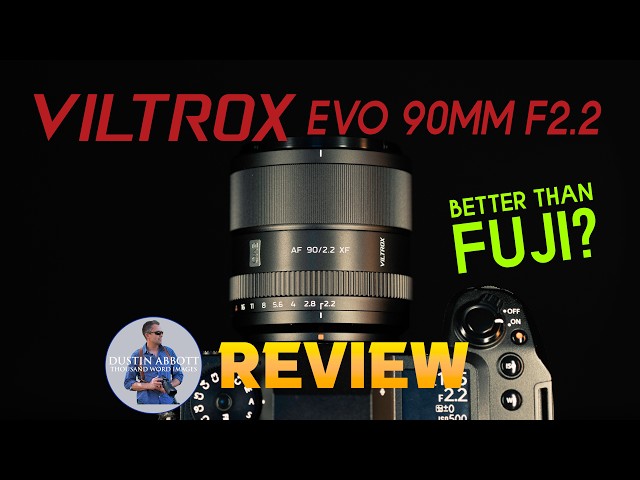
Viltrox EVO 90mm F2.2 XF Review | Better than Fuji?
May 31, 2026

Photographer Dustin Abbott takes a deep dive look at the Viltrox AF 90mm F2.2 from their EVO series in a Fuji XF mount. Is this the 90mm lens to buy? | Read the Text Review: https://tinyurl.com/EVO90XFda | Purchase the Viltrox EVO 90mm F2.2 @ Viltrox https://tinyurl.com/BuyEVO90XF (use code DUSTINABBOTT for 5% off) | B&H https://bhpho.to/4ujy0bF | Adorama https://prf.hn/l/8jk8bqA/ | Amazon https://amzn.to/4og3I8h | Amazon Canada https://amzn.to/3RUfFEM | Amazon UK https://amzn.to/4ugihKt | Amazon Germany https://amzn.to/4vvDlxG
Check out the DA Merch here: https://bit.ly/TWIMerch | Become a Patron: https://www.patreon.com/dustinabbott | On the Web: http://dustinabbott.net/ | Sign up for my Newsletter: http://bit.ly/1RHvUNp | Instagram: http://bit.ly/DLAinsta | Facebook: http://on.fb.me/1nuUUeH | Flickr: http://bit.ly/1UcnC0B | 500px: http://bit.ly/1Sy2Ngu Follow Craig @ https://www.instagram.com/craigstoffersen/
Want to support this channel? Use these affiliate links to shop at:
B&H Photo: http://bhpho.to/1TA0Xge
Adorama: https://howl.link/nt4zdz1goa7ql
Camera Canada: http://bit.ly/DLACameraCan
Sony Canada: https://www.thesonyshop.ca/?ref=abbott
Amazon: https://amzn.to/3HrY64d
Amazon Canada: https://amzn.to/3qG1p18
Ebay: http://bit.ly/DustineBay
Into the AM Clothing: https://bit.ly/intotheAMda and use code DUSTIN10 for 10% off
Fioboc Clothing: https://tinyurl.com/FiobocDA20 and us code DUSTIN20 for 20% off
Make a donation via Paypal: https://www.paypal.com/paypalme/dustinTWI
=============================
Table of Contents:
=============================
Show More Show Less View Video Transcript
0:10
Viltrox's Evo series has been pretty
0:12
indomitable so far in the first three
0:15
full-frame releases, including the 85mm
0:17
f2 and then the 35mm and 55mm f1.8
0:21
lenses. They are now moving into the
0:23
APS-C space with two lenses being
0:26
released at the same time, including the
0:27
90mm f/2.2 2 that I'm reviewing today
0:31
along with the 75mm f1.8.
0:35
I'm actually filming with the 75mm f1.8
0:38
right now and I will shoot with this for
0:40
at least one segment. However, I elected
0:42
to get the 90mm f/2.2 on Fuji for the
0:46
simple reason that there is really the
0:49
closest comparison available on all of
0:51
these platforms which include Sony,
0:53
Nikon, and Fuji. Only really Fuji has a
0:56
comparable 90 millimeter F2 which I
0:59
reviewed back in 2019. I was excited
1:02
about this particular lens however
1:03
because while the 90 millimeter f2 is an
1:06
exciting lens uh for Fuji with a 135
1:10
millimeter comparable focal length on
1:12
fullframe it is a quite an expensive
1:15
lens about $1,150
1:17
which means that for most people most of
1:19
the time they're just not going to shoot
1:22
that often with 135 millimeter focal
1:24
length and so while it is an excellent
1:26
lens in many ways it gets a little
1:28
underutilized. The new Evo lens here, I
1:31
think, is going to be very attractive to
1:32
people because it's only one/ird stop
1:34
less bright and has a price tag of under
1:37
$400. It's going to set you back only
1:40
about a third of the price of the actual
1:42
Fuji lens, which makes it a really
1:44
intriguing lens on all three of these
1:46
platforms. So, today we're going to dive
1:48
in and take a look whether or not it
1:50
should be on your must buy list for your
1:53
Fuji, Sony, or Nikon APS-C camera.
1:58
Before we jump in, however, I do want to
1:59
say a big thank you to sending me
2:01
Viltrox evaluation copies of these
2:03
lenses. As always, however, they have
2:05
had zero input in my actual review
2:07
process, and they will not see my
2:09
findings before you do. This is a
2:11
completely independent review. All the
2:13
boiler plate aside, let's jump in and
2:15
take a look at the build and handling of
2:17
this new 90mm F2.2. Today's episode is
2:20
sponsored by the all-new Phantom Tracker
2:23
2.0. Phantom has not only seriously
2:25
upgraded the visual look of the card,
2:27
but now we have a superior build
2:29
quality. Made with tempered glass and
2:30
metal alloys, this credit card size
2:33
tracker can be locally tracked via a 90
2:35
decel beeping noise, but also on a
2:37
global level via Apple's Find My Network
2:40
and its map. The addition of NFC means
2:42
that you can also use the card to
2:44
trigger an automation. Just tap it. The
2:46
tracker fits perfectly in any wallet or
2:48
bag and assures you won't lose your
2:50
valuables. It has a built-in
2:52
rechargeable battery that can be easily
2:54
charged via any wireless charger, and a
2:56
single charge can last up to 6 months.
2:59
The Phantom Tracker 2.0 makes for a
3:01
seriously cool gift. So, visit
3:03
store.fanomwallet.com
3:05
and use code dustin20 at checkout for
3:07
20% off. That's store.fanomwallet.com
3:11
and use code dustin20 for 20% off. All
3:14
right, let's take a closer look at the
3:16
build and design here. So, all of these
3:18
EVO lenses are designed around a
3:20
commonality of overall design. They're
3:23
utilizing the same basic housing, which
3:25
is why we end up with this somewhat odd
3:27
f2.2 maximum aperture because that's
3:30
what fits into these overall external
3:32
dimensions. The upside here, however, is
3:34
that we're able to share filters across
3:36
all of the Evo series. They all have the
3:38
feature set set up in the same place.
3:41
Now, the one area where that differs is
3:43
because I'm reviewing the XF version of
3:45
the lens here on Fuji. it is decontented
3:48
a bit and it's only because Fuji doesn't
3:50
support some of the features that we
3:52
typically see on Sony or Nikon. So, we
3:55
don't have the ability, for example, to
3:57
declick the aperture because that's not
3:59
something that Fuji supports. So, we do
4:01
have an aperture ring, but it will be
4:03
clicked one third stop apertures and
4:05
then a firmer uh detent between F-16 and
4:09
automatic. I actually wouldn't mind that
4:11
detent being heavier still to make sure
4:13
that you don't inadvertently do it, but
4:15
it's not bad overall. But we're also
4:17
missing both the AFMF switch and then
4:20
the custom button. Fuji doesn't really
4:22
support the custom buttons. And when it
4:24
comes to AFMF switch, they typically
4:26
want to handle that through, you know,
4:28
their own lever. In the case of the XH2,
4:30
it's a button that allows you to switch
4:31
between those things. And so anyway, so
4:34
we get a little bit less feature set
4:35
here. Now, when it comes to this
4:37
particular focal length with the 1.5
4:39
times crop factor on Fuji bodies, which
4:41
is also true of Sony and Nikon, we have
4:43
135mm full-frame equivalent. The final
4:46
price has not been established, but I'm
4:48
expecting it to be right under $400.
4:51
And to give you an equivalent, the Fuji
4:53
90mm F2 is $1,149.
4:57
So, really, we're getting a great great
4:59
price. And the other thing that's
5:00
fantastic here relative to the Fuji lens
5:02
is a simple fact that this lens is so
5:05
much smaller and lighter. It is, you
5:09
know, it's maybe not quite as nice of
5:10
build quality as the Fuji lens, but it's
5:12
a very, very nice lens that, as you can
5:14
see, is a very natural fit aesthetically
5:16
here. And so that's all great. It does
5:19
have some weather sealing here. Now, on
5:22
Fuji, they elected for the weather
5:23
sealing gasket to be black as opposed to
5:26
the kind of bright orange red that it is
5:28
on Nikon. and Sony. I'm not quite sure
5:30
why that needs to be different, but
5:32
anyway, it is there. And so maybe a
5:35
little bit, you know, again,
5:36
aesthetically matching to the Fujifilm
5:38
bodies. There are other seals inside.
5:41
However, it's the rubber gasket there at
5:42
the lens mount. The other internal seals
5:44
that are shown here are felt seals. And
5:47
so weather sealing probably not to the
5:49
degree of the XF 90mm F2, but still, you
5:52
know, useful enough. I'm not concerned
5:54
about shooting in it in inclement
5:55
weather. It's internally focusing and so
5:58
nothing's moving in and out. So, it
5:59
should be pretty good on that front. We
6:01
do have a USBC port here for firmware
6:04
updates and those are really easy to ex
6:06
execute through Vtrox's desktop app. It
6:09
does include the lens hood here and a
6:12
pouch. The lens hood is actually nicer.
6:15
Ironically, it is nicer than the premium
6:17
Fuji uh lens, which it has a lens hood
6:21
that scratched quite easily. It didn't
6:23
like lay it into place as as nicely as
6:26
what I would like. So, all of that is
6:27
good here. Aperture iris is nine blades
6:31
as you can see here. Geometry is pretty
6:33
good. As you start to stop the lens
6:35
down, we get circular shapes across the
6:37
the whole frame. When you stop it down a
6:40
stop or two, physical size here is 69
6:43
millimeters and 2.7 in in diameter by
6:45
just 76 millimeters, right under 3 in in
6:48
length. And so just to give you an idea,
6:50
comparable to the Fuji lens, the XF90
6:52
millimeter F2 is 6 millimeter
6:55
millimeters wider in diameter and a
6:57
whopping 29 millimeters longer. Also,
7:00
this lens weighs only 325 gram or right
7:03
under 11 12 O. The Fuji lens weighs 540
7:07
g. So significantly heavier. Focus ring
7:10
moves nicely here. It has good damping.
7:12
It's responsive enough that uh I found
7:14
that when doing manual focusing here on
7:16
Fuji that it was a pretty good manual
7:18
focus simulation. So, no problem there.
7:20
Minimum focus distance isn't quite as
7:22
good as what the Fuji lens is. It's only
7:25
focus as closely as 74 cm. However, it
7:29
does produce a 0.14 times level of magna
7:32
magnification. That's not as good as
7:34
what the Fuji lens is. It has 0.20 20
7:36
times magnification, but it's also in
7:39
both cases those are higher than what
7:40
those numbers suggest because uh 0.14
7:44
times they're not including the crop
7:45
factor. So that actually gives you
7:47
closer to a 0.21 times full-frame
7:49
equivalent magnification. You can see
7:51
here compared to 0.14 times on the case
7:54
85mm f1.4 that I reviewed last year that
7:58
radically different result. And so the
8:00
magnification here is quite useful and
8:02
up close performance is quite good.
8:04
Overall, I think this is a really nice
8:07
package and the thing that's going to be
8:08
most attractive to a lot of uh shooters
8:11
on all of these platforms is the lens
8:13
being so compact. And here on Fuji, even
8:16
though I'm shooting with an XH2, which
8:17
is a good size body, if you're shooting
8:19
with one of the smaller cameras, this is
8:21
actually going to be a much nicer fit to
8:23
your smaller camera than what Fuji's own
8:25
lens is. So, let's talk autofocus.
8:28
always a bit of a sore spot for me when
8:30
I'm reviewing anything on a Fuji
8:32
platform for the simple reason that I
8:34
looked back at my review in 2019 of the
8:37
XF uh 90mm f2, a lens by the way which
8:41
is equipped with quad linear motors and
8:44
so definitely has a high-end focus
8:45
system in the lens itself. But I looked
8:47
back at my comments in my review this
8:49
this past week reviewing that article
8:52
and I saw that all of the complaints I
8:54
made at that point, a little less
8:56
autofocus precision than what I would
8:57
like with some misses and then issues
8:59
with autofocus when it came to the video
9:01
side of things. It was basically I could
9:03
have written it for my review of the Evo
9:06
lens here talking nearly seven years
9:08
later. And that's really disappointing
9:10
to me. At the time I was reviewing on a
9:12
Fujifilm XT3
9:15
and here we are filming on the XH2 you
9:18
know a couple of generations later and
9:20
unfortunately the state of autofocus has
9:22
really not improved at all. I still have
9:24
the same kind of issues in that while
9:27
the Viltrox doesn't have on paper as
9:29
sophisticated an autofocus system with
9:31
an STM style focus motor and only a
9:34
single motor. You can see in the actual
9:36
focus test that when focus, you know,
9:39
changes, it's moving with a good amount
9:41
of speed, but there's just a general
9:43
lack of confidence there at times.
9:45
Sometimes it'll rack in the wrong
9:46
direction briefly. Um, and so I also
9:49
find just inconsistency in how quick
9:51
those focus pulls, jumping back and
9:53
forth takes place. And so focus is a
9:56
bit, you know, all over the map on that
9:58
front. I also found that while I got
10:00
good results generally when I shot um
10:03
using the lens as as kind of B-roll with
10:06
my second shooter and then some myself
10:08
when shooting at a wedding, um I found
10:11
that for the most part I got good
10:13
results. But when I'm looking critically
10:15
at images, you know, this image for
10:16
example of the bride, it's a lovely
10:18
shot, but when I look critically at it,
10:20
I realize that rather than being on the
10:22
eye, it's actually more on the nose.
10:24
It's those little things to where focus
10:26
is just it's just more imprecise than
10:29
what I'm used to at this state of
10:31
reviewing on four different camera
10:33
systems on a regular basis. And so I am
10:36
disappointed when it comes to that. That
10:38
being said, I did get a lot of really
10:40
good shots during the either the
10:42
ceremony and then shooting in low light
10:44
typically at ISO 3200 and 6400 at the
10:47
reception venue. I was able to get good
10:49
results and you know in general the lens
10:52
was a delight to use. You know, I'm
10:54
accustomed to the limitations on Fuji,
10:56
which any of you that are considering
10:58
buying the lens on Fuji, you would feel
10:59
this you're familiar with all of those.
11:01
And so, I think it's just as possible to
11:03
get good results with this lens as what
11:04
you could really with any other. So, I
11:07
would say that unfortunately really the
11:10
limiting principle here on both the EVO
11:12
lens and then looking back at the S XF
11:14
90mm f2, the limiting principle is not
11:17
the lens's autofocus system. That's just
11:19
the state of autofocus generally on
11:21
Fuji, which unfortunately has not really
11:23
progressed much since 2019, leaving it
11:26
falling further and further behind other
11:28
platforms when it comes to the quality
11:30
of autofocus. I suspect that with better
11:33
autofocus in the future, a lens like
11:34
Fuji's XF9mm F2 should fly with those
11:38
quad linear motors. But unfortunately,
11:39
right now, it can't really focus any
11:42
better than what the EVO lens does for
11:43
the simple reason that it's not the lens
11:45
that's holding things back. But I say
11:47
that also to say that if you're going to
11:48
buy this new 90mimeter f2.2 on either
11:52
Sony or Nikon Zmount, you're going to
11:54
have no problems with autofocus at all.
11:56
I've reviewed now well over half a dozen
11:58
different configurations on different
12:00
platforms with the EVO series and had
12:03
great autofocus both on Nikon and on
12:05
Sony. And so I think that you're going
12:07
to get great results there. Now, on the
12:10
video side of things, unfortunately all
12:12
of my typical frustrations are present.
12:14
So when it comes to doing touch to
12:16
focus, trying to force focus pulls, uh
12:18
the biggest frustration is that most of
12:20
the time I touch and there's just this
12:22
huge pause where nothing happens, you
12:25
know, and I touch again and maybe
12:26
eventually it'll get in its mind that
12:28
it's going to shift focus to another
12:29
position, but when it does so, there's
12:31
visible steps. It's not smooth or
12:34
cinematic in the least. And
12:35
unfortunately, that's almost always my
12:37
findings when it comes to trying to do
12:39
that test on Fuji. things are a little
12:43
better when doing my hand test, but
12:45
you'll see that, you know, in one time
12:48
that I did it, you'll find that indoors
12:50
that focus ended up a lot of times more
12:52
like on my ear rather than on my eye.
12:54
Even after focus transitions have been
12:56
made and then outdoors, it just seemed
12:58
like a lot of times focus just didn't
13:01
move at all. Likewise, when I approached
13:03
the camera out of doors, uh it did okay
13:06
when it was tracking me and I was moving
13:09
towards the camera. When I stepped out
13:10
of the frame again, it's that lack of
13:12
reactiveness. It's like nothing had
13:14
changed and so it just stayed right
13:16
there. So when I stepped back in the
13:17
frame, yeah, great. I was in focus. I
13:19
moved out again. I stepped back into the
13:21
frame. Well, this time it had shifted
13:23
towards the background. And again, that
13:24
lack of reactiveness, it sunk the rest
13:27
of that shot because it never picked
13:29
focus back up on me. Even as I
13:31
approached to where I was dominating the
13:32
frame, it never really shifted focus
13:34
back to me. And so, frankly, I found it
13:37
frustrating. Hopefully this segment has
13:39
filmed okay without, you know, with
13:41
relatively little going on, me just
13:43
sitting here and shooting off my big
13:45
mouth. I did find that when I was just
13:47
kind of doing general transitions to
13:48
where I allowed the camera to have
13:50
something in frame and then kind of just
13:52
move towards another subject like here
13:54
in this lilac bush, it eventually would
13:57
make, you know, focus and that felt a
13:59
little bit better. And that's really
14:00
best case scenario here. So there is a
14:02
combination of things going on. Fuji's
14:05
autofocus needs serious help, but also
14:07
there is the fact that this is a
14:09
third-party lens using thirdparty
14:10
algorithms. And so I have found that
14:12
even in the Viltrox lenses that are
14:14
equipped with a more sophisticated
14:16
autofocus uh systems that typically
14:18
Fuji's own lenses get a little bit more
14:21
out of it, even with worse hardware. For
14:23
example, when I did the Pro 56
14:25
millimeter f1.2 last year and compared
14:27
it to the 56 millimeter f1.2 2WR. On
14:30
paper, the Viltrox lens has way better
14:34
autofocus capabilities, but again,
14:35
because of those third party focus
14:37
algorithm issues, I would say that the
14:39
Fujif focused as well, if not a bit
14:41
better in some of my tests. So, take
14:43
make take that for what it's worth. If
14:46
you look back at some of my reviews of
14:49
on either Sony or Nikon with other
14:51
lenses in this series, you might get a
14:53
sense of how well it's going to focus
14:55
for you in those platforms. because I
14:57
suspect here that autofocus just like
14:59
all these other EVO lenses is just fine.
15:01
It's good. It's confident and should
15:03
work really well on other platforms.
15:05
Unfortunately, here on Fuji held back a
15:07
little bit. All right, let's take a
15:08
quick look at the optical formula. Here
15:10
we have 10 elements in eight groups. So,
15:13
not bad for those of you that like
15:15
simple optical designs. You can see a
15:17
couple of high refractive index elements
15:19
and then a couple of extra low
15:20
dispersion elements as a part of that
15:22
design. The MTF chart looks fantastic.
15:25
And if we look in particular here at the
15:28
30 lines pair, which starts in this zone
15:32
here, we can see that it is super sharp
15:35
in the center of the frame, very
15:36
consistently sharp through the middle of
15:37
the frame, and then really only a mild
15:40
drop off towards the corners. We're
15:41
averaging out at about 75%.
15:44
So really, really excellent. Now, on the
15:46
vignette and distortion front, there is
15:48
no uh real distortion that needs to be
15:51
corrected at all. A bit of vignette
15:53
here. I used a plus 65 to correct with
15:55
the result on the right. So, nothing too
15:57
bad there. Filtrox is not touting this
15:59
as being an apochromatic design like the
16:01
35mm and 55mm f1.8 Evo lenses, but you
16:05
can see that the control of aberrations
16:06
is really fantastic. In fact, here that
16:09
if I zoom way in even at 200%
16:12
magnification and we look at all of the
16:14
textures here, there's just no evidence
16:17
of fringing there. And the specular
16:18
highlights, nothing showing up here.
16:20
Another thing worth noting while we're
16:22
looking at these specular highlights,
16:23
they're really nice and clean inside. No
16:26
busyiness, definitely no concentric
16:28
rings. And so that's all very nice.
16:30
Also, lateral style chromatic
16:31
aberrations, very well controlled, and
16:34
so no issues with fringing near the edge
16:36
of the frame either. So here's a look at
16:38
our test chart, and we'll look at
16:39
sharpness and contrast here. So this is
16:42
shot on a 40 megapixel XH2 body, and I'm
16:45
showing these results at 200%
16:47
magnification. So this is the ultimate
16:49
torture test because this 40 megapixels
16:51
on APS-C is the equivalent of over 90
16:54
megapixels on full frame. So it's very
16:56
very challenging and yet here in the
16:58
center of the frame it looks fabulous.
17:00
Great sharpness, great contrast.
17:02
Mid-frame looks fantastic. What really
17:05
stands out to me however is how great
17:07
the corners look. The corners are
17:10
pristine. So really really fantastic.
17:13
For some real world context here again
17:15
at f2.2 too. You can see that the
17:18
sharpness and contrast in our plane of
17:20
focus is just great. Brilliantly good.
17:23
The shot of Nala, you can see all of
17:26
those fine hairs. And then focus is
17:28
accurate here on her eyes. And so you
17:30
can see there in the iris looks really,
17:32
really crisp, really beautiful. This
17:34
image I liked. It's just stopped down to
17:36
f3.2. But you can see once again just
17:39
how great the detail and the contrast
17:40
is. And look at how right to the very
17:43
edges of the frame, even with that very
17:45
mild stop down, we can see just how
17:48
consistent sharpness is all across
17:51
frame. Colors look good, contrast looks
17:53
good. What an interesting looking tree
17:55
here. It's all really fantastic. So, is
17:58
there anything further to have out of
18:00
this design since it's so sharp to begin
18:02
with? Well, if we compare at f2.8 in the
18:04
center of the frame, there is a tiny bit
18:06
more contrast. You can see that the text
18:09
comparing here to here is just a little
18:11
bit inkier looking. I would say that the
18:13
mid-frame result again it looks just a
18:16
little bit crisper, a little higher
18:17
contrast. And then if we poke off the
18:19
other direction up here into this
18:21
corner, we can see that it just looks
18:23
great by f2.8. That seal is really
18:26
popping out of there. All of the fine
18:28
writing and throughout the bill here all
18:30
looks really, really crisp. Moving on to
18:32
f4. Again, there's a tiny little
18:35
improvement here. It's not significant
18:37
enough that you would probably notice it
18:39
if you didn't have them side by side at
18:41
such a high magnification, but
18:43
definitely hitting a very high level.
18:45
Moving on to f5.6, and I'm not sure that
18:47
you're really going to see any kind of
18:49
visible difference beyond that. Now,
18:52
defraction shows up really fast on such
18:54
a high resolution body as this Fujifilm
18:56
sensor. And so, by f11, we're starting
18:59
to definitely regress in terms of
19:01
contrast. You can see it's starting to
19:02
look a little bit smeary. and then by
19:04
f-16 definitely softer still. So I would
19:08
if at all possible keep it under f11 for
19:10
that reason. Now once again taking a
19:13
look at the close-up performance here at
19:16
f2.2 and we can see that it looks really
19:20
nice. It's a nice flat plane of focus.
19:22
Very very sharp, very crisp. So great up
19:25
close results. And again to illustrate
19:26
the point I made earlier, both of these
19:29
lenses are technically rated at 0.14
19:31
times. So the case here on the right, it
19:34
is a 0.14 times, but here on APS-C, for
19:37
whatever reason, they don't list kind of
19:40
like the it's not the same kind of
19:42
measurement. And so a in this case, 0.14
19:45
times is not including a crop factor.
19:47
And you can see it produces a much more
19:50
magnified image than what the full-frame
19:53
equivalent does. Taking a look with a
19:55
three-dimensional object, and you can
19:57
see that sharpness and contrast is
19:59
really nice up close. So great results
20:01
there. So as far as bokeh generally here
20:04
with this portrait shot here, you can
20:06
see detail is really really beautiful
20:09
and I do love Fuji's this is one of the
20:12
across um you know monochromes which I
20:14
really really love. And then the falloff
20:16
is starting to look good falling off
20:18
towards the hair in this shot of wedding
20:20
decorations. Again you can see that the
20:22
transition towards with these petals
20:25
here as we get towards complete defocus
20:26
here in this transition zone. It's not
20:29
rough or jittery. It looks really nice.
20:31
Another shot here. You know, obviously
20:33
we've got lots of people out of focus.
20:35
Um, and then varying degrees of focus on
20:37
the table, but we can see once again
20:39
that everything is just transitions
20:41
really, really nicely. This shot is what
20:43
I would say probably is the worst of
20:46
what I saw in that there's a lot of kind
20:48
of hard edges in the transition zone. It
20:50
still doesn't look bad, however, and if
20:52
I move in a little bit closer, you can
20:54
see that the background just blurs out
20:56
really, really nicely. In general, I
20:58
would say bokeh looked good. Uh, you
21:00
know, I could do storytelling shots like
21:02
this, you know, and I really was happy
21:04
with the results I got. I also feel like
21:06
color-wise, this is a great match for,
21:09
you know, the Fujifilm color science.
21:11
And so, you know, my varying images that
21:13
I shot, I really felt like colors looked
21:15
really fantastic. Now, when it comes to
21:17
flare resistance, a bit of a mixed bag
21:20
here. Uh, straight on on the sun wide
21:22
open or here, stop down to f11. Not bad
21:25
at all. But what you'll see in this if
21:27
we start to pan back and forth, you'll
21:29
notice that there is a particular point
21:31
right there when this the sun is in the
21:33
corner of the frame that there's a
21:34
flashing effect. And so that's going to
21:36
be probably your most serious optical
21:39
issue to watch out for if you want to
21:40
avoid having that kind of flash of of
21:43
light coming in. I also think it's the
21:45
kind of look you can use to aesthetic
21:48
value, however. So, what's my
21:49
conclusion? I love the EVO series and
21:52
from the response I get to my videos and
21:55
reviewing the lenses, I know that as you
21:57
as the audience are pretty excited about
21:59
them as well. And so I'm really
22:00
delighted to see some APS-C lenses come
22:03
in the series, but I of the two,
22:05
although I think the 75mm f1.8 is an
22:08
amazing lens, I I'm actually more
22:10
excited about this 90 millimeter for the
22:12
simple reason that we haven't seen a lot
22:15
of primes on any of these platforms that
22:18
are quite this long. And I know that a
22:20
lot of you as an audience who are APS-C
22:22
shooters have been really interested in
22:24
135 millimeter equivalent um on your
22:27
your platforms and getting this that has
22:30
a lens that is so competent, so
22:32
optically amazing. Getting this for this
22:35
kind of money is such a huge addition.
22:37
And I think that Viltrox, people get
22:40
really excited about Viltrox when they
22:41
release new products because they've
22:43
really struck on a winning formula. They
22:45
give us, you know, lenses that have
22:47
great feature sets, have solid
22:50
autofocus, and have, you know, really
22:53
beautiful optics in them for a very
22:55
affordable price. And that obviously is
22:57
a winning combination for a lot of us.
23:00
While there, you know, I'm obviously not
23:01
thrilled by the, you know, Fuji
23:03
deficiencies here when it comes to
23:05
autofocus and some decontenting compared
23:08
to the other platforms, I do am real
23:10
excited that this lens is here on Fuji
23:12
because I think there are a lot of
23:13
people that have been interested in a
23:15
lens like the XF9mm F2, but just can't
23:19
justify the expense of spending over
23:22
$1,000 on a lens that, you know, for
23:24
most of us, we may only use for 10% of
23:26
our shots. However, there's something
23:28
about this particular focal length that
23:30
is really, really special. And no, this
23:32
doesn't have quite the same shallow
23:34
depth of field as a 135mm, you know,
23:37
f1.8 or f2, but it still does deliver at
23:40
least some of that charm. And I think
23:42
that for a lot of people who are looking
23:44
for a different look for your portrait
23:46
photography, you're going to find a lens
23:47
like this to be pretty delightful for
23:49
that reason. On that note, I think that
23:52
Viltrox would probably find a very
23:54
receptive audience to an EVO 135mimeter
23:58
f22.8 full-frame lens if they could fit
24:01
one in a housing like this or even an an
24:03
F3.5 lens because really that's the kind
24:05
of lens that was pretty common back in
24:08
the film era that we just haven't seen
24:10
in the modern era. And I think it's a
24:12
lens that a lot of people would be
24:13
interested in for all the reasons that
24:15
I've just got through mentioning. So, at
24:16
the end of the day, this is a very
24:18
stellar addition to the the EVO series.
24:21
Optically, it is just a brilliant lens.
24:24
And so, if you're looking for this kind
24:26
of focal length for spending this kind
24:29
of money, it's a gem of a lens, just
24:31
like all the other EVO lenses. If you
24:33
want more information, you can check out
24:34
my full text review, which is linked in
24:36
the description down below. There's also
24:37
some buying links there and a discount
24:40
code. If you want to buy it from
24:41
Viltrox, you can get an extra 5% off. As
24:44
always, thanks for watching. And have a
24:45
great day and let the light in.
#Science