Up next in 10


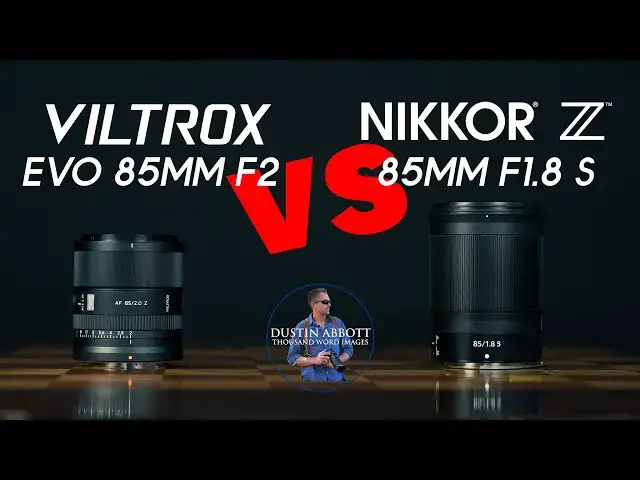
Is the Nikkor Z 85mm F1.8 S still worth paying the big bucks for now that the Viltrox EVO 85mm F2 exists? Find out here!! | This episode is sponsored by Fantom Tracker. Visit store.fantomwallet.com and use code DUSTIN20 for 20% off.
EVO Reviews - Video: https://youtu.be/RH1Qot3xGgc | Text https://tinyurl.com/EVO85Zda
S-Line Reviews - Video: https://youtu.be/GxnuXsSYN8M | Text: https://tinyurl.com/Z85Sreview
Purchase the Nikkor Z 85mm F1.8 S @ B&H Photo https://bhpho.to/3ZjiJLM | Adorama https://prf.hn/l/MbzzngO/ | Amazon https://amzn.to/4aMQhHx | Camera Canada https://tidd.ly/4gCyFlg | Amazon Canada https://amzn.to/4oYxdfz | Amazon UK https://amzn.to/3QaVYYY | Amazon Germany
Purchase the Viltrox EVO 85mm F2 @ Viltrox https://tinyurl.com/BuyEVO85Z (use code DUSTINABBOTT for 5% off) | B&H https://bhpho.to/47JIdoN | Adorama https://howl.link/c7eoxbojzefg1 | Amazon https://amzn.to/3KUzZSO | Amazon Canada https://amzn.to/3IWiW2j | Amazon UK https://amzn.to/47cGFmY | Amazon Germany https://amzn.to/48vTs6i
Check out the DA Merch here: https://bit.ly/TWIMerch | Become a Patron: https://www.patreon.com/dustinabbott | On the Web: http://dustinabbott.net/ | Sign up for my Newsletter: http://bit.ly/1RHvUNp | Instagram: http://bit.ly/DLAinsta | Facebook: http://on.fb.me/1nuUUeH | Flickr: http://bit.ly/1UcnC0B | 500px: http://bit.ly/1Sy2Ngu Follow Craig @ https://www.instagram.com/craigstoffersen/
Want to support this channel? Use these affiliate links to shop at:
B&H Photo: http://bhpho.to/1TA0Xge
Adorama: https://tinyurl.com/AdoramaDA
Camera Canada: http://bit.ly/DLACameraCan
Sony Canada: https://www.thesonyshop.ca/?ref=abbott
Amazon: https://amzn.to/3HrY64d
Amazon Canada: https://amzn.to/3qG1p18
Ebay: http://bit.ly/DustineBay
Into the AM Clothing: https://bit.ly/intotheAMda and use code DUSTIN10 for 10% off
Show More Show Less View Video Transcript
0:11
Nicor's S-line lenses, at least the f1.8
0:14
variety, are pretty unique in the
0:16
photography industry. Having premium
0:18
options with a maximum aperture of f1.8
0:21
is not really something that other
0:23
manufacturers have previously done.
0:25
Viltrox's Evo series, however, is
0:28
uniquely situated to go head-to-head
0:29
with these Nicor lenses for the simple
0:32
reason that they're following somewhat
0:33
of a similar policy. They have maximum
0:36
apertures that are often at le if not
0:38
matches close to it. In this case, f2
0:40
versus f1.8.
0:42
And they tend to have rich feature sets,
0:44
nice build quality, and really strong
0:46
optical performance. And then in that
0:48
sense, they have proved to be a very
0:50
natural competitor for these
0:52
head-to-head competitions. So today I'm
0:54
taking the Nicor 85mm f1.8s and
0:58
comparing it to the Nikon Zmount version
1:01
of Viltrox's EVO 85mm F2. And so we're
1:05
going to see which of these lenses is
1:07
the more compelling package at the end
1:09
of the day. We'll look at the build and
1:12
the features of them. We'll look at the
1:14
autofocus, the video performance, and
1:16
then of course most importantly the
1:18
optical performance and see which one
1:20
comes out on top. Today's episode is
1:22
sponsored by the all-new Phantom Tracker
1:24
2.0. Phantom has not only seriously
1:27
upgraded the visual look of the card,
1:29
but now we have a superior build
1:31
quality. Made with tempered glass and
1:32
metal alloys. This credit card size
1:35
tracker can be locally tracked via a 90
1:37
decel beeping noise, but also on a
1:39
global level via Apple's Find My Network
1:41
and its map. The addition of NFC means
1:44
you can also use the card to trigger an
1:46
automation. Just tap it. The tracker
1:48
fits perfectly in any wallet or bag and
1:51
assures you won't lose your valuables.
1:53
It has a built-in rechargeable battery
1:54
that can be easily charged via any
1:56
wireless charger, and a single charge
1:58
can last up to 6 months. The Phantom
2:01
Tracker 2.0 makes for a seriously cool
2:03
gift. So, visit store.fanomwallet.com
2:06
and use code dustin20 at checkout for
2:09
20% off. That's store.fanomwallet.com
2:12
and use code dustin20 for 20% off. All
2:16
right, round one. Let's take a look at
2:18
the build and the handling. The first
2:20
place that we have to go is where it
2:22
comes to price. And here's where EVO has
2:24
a huge advantage. MSRP is 275 USD for
2:30
this lens right now. You can get it for
2:31
about 2 and a quarter. MSRP for the S
2:34
line is right under 850 and you can get
2:37
it for about 750 right now. And so at
2:40
best it is three times the price which
2:42
obviously is going to be a serious
2:44
obstacle to overcome for that particular
2:47
lens. Also when it comes to the size the
2:50
EVO is 69 mm in diameter and it is 76 mm
2:55
in overall length whereas the S-line
2:58
lens is 75 mm in diameter and a whopping
3:02
99 mm in length. And so that's 6 mm
3:07
wider and a whopping 20 mm longer. So
3:11
obviously it is pretty radically
3:13
different when it comes to the overall
3:15
size. It also is heavier. The Evo weighs
3:19
in at 360 g whereas the S-line is 470 g.
3:25
That's 110 g difference. So again, that
3:28
is a significant increase. What's more,
3:31
because of the wider diameter, we have a
3:33
larger filter size. So, 58 millimeter on
3:36
the EVO lens, 67 mm on the S-line lens.
3:40
And normally, I wouldn't say that that's
3:42
a big enough factor to award a point,
3:44
but I am going to award a point based on
3:47
this. And that is that that 67mm filter
3:50
thread is not really shared with other
3:52
F1.8 S-line lenses. And so the 35
3:55
millimeter and the 50 millimeter, they
3:57
have a 62 millimeter front filter
3:59
thread. And then so on and so forth when
4:01
you're looking at the 20 and 24
4:03
millimeter lenses. And so unfortunately
4:05
it doesn't give you the commonality that
4:07
the Evo series does in which all the
4:09
lenses in the series so far have shared
4:10
that 58mm filter thread. That's kind of
4:13
a big deal. When it comes to the feature
4:15
side of things, the EVO wins going away.
4:18
It has a dedicated aperture ring. That
4:20
aperture ring can be either clicked or
4:22
decllicked. It has a custom button on
4:25
the side. It has an AFMF switch. The
4:27
only feature that the S-line lens has is
4:31
the AM the AFMF switch. And of course,
4:34
this ring can be a customizable control
4:37
ring. But of course, that's still true
4:38
on the EVO lens, too. Though I don't
4:41
know why you would want to use it as a
4:43
customizable control ring when you have
4:45
that dedicated aperture ring. And so, as
4:47
a byproduct, it wins hands down when it
4:50
comes to the feature set. Now, there are
4:53
a couple of areas where the S-line pulls
4:55
out a win. It has a more thorough degree
4:58
of weather sealing than what the Evo
5:01
lens does. The Evo Lens does have a
5:03
rubber rear gasket. It has some felt
5:05
internal seals, but the S-line lens is a
5:08
fully professional grade of build. It's
5:10
got internal seals throughout. I counted
5:12
about nine in this diagram. And so, it
5:14
just has a more thorough degree of
5:16
weather sealing. What's more, as a
5:18
first-party lens, you will not only get
5:20
the much broader network of service
5:23
options for a lens that obviously a
5:25
well-established brand like Nikon has.
5:27
But what's more, this lens has a proven
5:29
longevity record at this point that the
5:31
Viltrox lens simply doesn't. There have
5:33
been plenty of people that have been
5:34
using this lens since 2019 and it's
5:36
still holding up for them. And so, I
5:38
think that in that area, I definitely
5:40
give another win to the Nikon lens. I
5:43
would say as far as the build quality,
5:45
you know, I know that, you know, this is
5:46
marketed as a professional-grade lens.
5:48
Truthfully, as far as the build and the
5:50
materials, at least what is perceptive.
5:52
Outside of that weather sealing, one
5:54
doesn't necessarily feel nicer than the
5:55
other. I actually think that the EVO
5:57
lens is the more attractive lens. This
5:59
is kind of a very boring looking lens,
6:02
truth be told. But in terms of the
6:03
materials that are used, they feel
6:04
roughly the same. Both of them have nine
6:06
aperture blades, and they do roughly the
6:09
same thing. I do prefer that the Evo has
6:11
what I call an innie with the aperture
6:13
blades and so the back of the blades is
6:15
facing away from the front and this one
6:17
has an Audi where the blades are facing
6:18
towards the front. I just think that the
6:20
kind of James Bond aperture look is
6:22
cleaner looking on the EVO lens and
6:24
that's always my preference. As far as
6:26
the minimum focus distance, here's an
6:28
area where I went in thinking that there
6:29
was going to be a win for the EVO lens
6:31
because the S-line lens can only focus
6:34
as closely as 74 or excuse me as 80 cm
6:37
whereas the EVO lens can focus as
6:39
closely as 74 cm. And on paper, this
6:42
only has a 0.12 times uh magnification,
6:46
whereas the EVO lens is rated at a 0.13
6:50
times. In reality, I found that when I
6:53
lined things up that the magnification
6:55
was exactly the same between the two.
6:58
And so on paper, I don't know what
7:00
Viltrox is doing there, but they're
7:02
claiming a bit of an advantage that I
7:03
don't actually think that they have in
7:05
actuality. And so, end of the day, uh,
7:07
that's going to be a wash there. So,
7:09
coming out of round number one, we have
7:11
five points for the EVO. Definitely the
7:13
packaging wins here on the EVO. We have
7:15
only two points for the S-line. And so
7:18
starting off, the EVO lens is going to
7:21
jump out of the gate with a win in round
7:23
one. So let's jump to round two here and
7:26
let's talk about autofocus. Now on
7:29
paper, I'm going to give a win for the
7:31
focus system to the S-line lens. It has
7:33
dual focus motors, two SDM focus motors
7:36
working in tandem, whereas the EVO lens
7:38
only has one SDM focus motor. However,
7:41
when I actually went to do my formal
7:44
test, while it is very close between the
7:46
two, it's actually the EVO lens that
7:48
focuses a little faster and I would say
7:50
a little bit more confidently. I think
7:52
in part just due to having newer
7:54
autofocus technology, it manages to get
7:57
a little bit more out of less as far as
7:59
the packaging. And so, it is very
8:01
slightly faster in terms of autofocus
8:04
there. And it's also just a little bit
8:06
quieter. It's not that the S-line lens
8:08
motor is loud, but you hear some wicking
8:10
and shering here and there, whereas the
8:12
Evo lens just tends to be a little bit
8:14
quieter in operation. Both of them
8:16
focused accurately, though I'm not sure
8:18
that I would use either one of them for
8:19
sports type photography. And so, coming
8:22
out of this section, we get another
8:24
couple of points for the EVO lens and
8:26
just one more point for the S-line lens.
8:29
And so that gives us a total coming out
8:31
of round two of seven points EVO, three
8:34
points for the S-line.
8:37
Round three, we're going to talk about
8:39
video. Now, when it comes to video kind
8:42
of focus behavior, I found that my touch
8:44
to focus test, it was largely the same.
8:47
You know, depending on what test I was
8:49
doing and where I was looking at, one
8:51
felt a little bit smoother than the
8:53
other. One did a little bit less of kind
8:55
of the back racking that we see
8:56
sometimes on Nikon. But I think it was
8:59
just kind of a quirk because it wasn't
9:02
something that repeated itself in
9:04
multiple patterns. And so I would say
9:05
touch to focus was about the same. In
9:08
video mode, focus mo noise is about
9:10
equal. Both of them are tuned to where
9:11
there's basically no focus sound when
9:13
you're even when you're pulling focus
9:15
back and forth. And so that was about
9:17
the same. Likewise, when I did my hand
9:19
test where I allow the focus to shift
9:22
from my hand to my eye and back and
9:23
forth, both of them behaved about the
9:25
same way in that setting. And when it
9:27
comes to focus breathing, I would say
9:29
the EVO is a tiny fraction less, but
9:32
frankly, they play out pretty much the
9:34
same in real life if you didn't have
9:36
them side by side. However, there are
9:38
some areas where the EVO lens did take
9:41
some wins in this category. First of
9:43
all, I definitely prefer the behavior of
9:45
the ring um when it comes to manual
9:48
focus. So manual focus, there is a
9:51
little bit more feel. There is a little
9:53
bit more of a throw there. And so you're
9:55
able to be a little bit more precise.
9:57
Whereas I found with the Sline lens,
9:58
focus jumped a little too fast. And if
10:00
you're trying to pinpoint narrow focus,
10:03
can be a little bit hard to fine-tune
10:04
it. What I also found is that when it
10:07
came to the aperture racking, you have a
10:10
dedicated, you know, ring here that you
10:13
can have either clicked or decllicked.
10:14
So obviously that's an advantage in of
10:16
itself. But the other thing that I found
10:18
is that when I was doing aperture racks,
10:20
the Evo uh aperture ring is more
10:22
responsive. So there's less lag involved
10:24
there. And so that means that I could be
10:26
more precise about where I ended up in
10:28
an aperture rack and didn't have to wait
10:30
for the aperture to kind of catch up. So
10:33
I got smoother aperture racking with the
10:36
S-line lens. Remember, unfortunately
10:37
using that same ring for everything. And
10:40
so just as I didn't love it for manual
10:42
focus, I don't love it for aperture
10:44
racking either because there is quite a
10:46
bit of lag. And so by the time I get to
10:48
about f8, I learned that I needed to
10:50
stop because by the time the aperture
10:52
actually stopped moving, even though I'd
10:54
stopped doing input on the ring, it
10:55
would end up at anywhere between f11 and
10:58
f13. And so and likewise coming back the
11:01
other direction, I had to basically stop
11:03
rotating it around f2.8 and hope that I
11:06
had nailed all the way back to f1.8.
11:08
Sometimes it stopped at f2 and so it
11:10
just wasn't precise and so definitely I
11:12
preferred the behavior of the EVO lens
11:14
there. So I'm going to award a couple of
11:16
points coming out of this category which
11:18
gets the EVO lens up to nine points
11:20
while we're still at just three points
11:22
for the S-line lens in total.
11:26
Our final round is the optical
11:28
performance. And here's where I expect
11:30
the S-line to maybe make up a little bit
11:33
of ground here. Now, starting off
11:35
looking at the vignette and distortion
11:38
chart, I found that as far as
11:39
distortion, both of them have a tiniest
11:42
amount of pin cushion distortion, like a
11:43
minus one. And so, really nothing to
11:46
worry about, nothing worth awarding a
11:48
point to. However, the S-line lens is
11:50
more optimized for fully illuminating
11:52
the edges of the frame. In other words,
11:54
less vignette. I needed a plus 37 to
11:57
correct vignette on it, whereas with the
11:58
Evo lens, I needed more like a plus 59.
12:01
And so definitely roughly a stop
12:03
difference between the two. And so there
12:05
is a point for the uh S-line lens there.
12:08
And obviously it also gets a point when
12:10
it comes to its maximum aperture. It is
12:12
brighter by one/ird stop. And so that
12:14
means that you know shutter speeds I
12:16
found consistently were about one/ird
12:18
stop difference. And I also found you
12:20
know that's at maximum shooting at
12:22
maximum aperture. But also it allows the
12:24
bokeh balls specular highlights to be a
12:26
little bit bigger, the backgrounds to be
12:28
just a little bit softer. And so there's
12:30
definitely an award that comes from
12:31
having that brighter maximum aperture.
12:34
However, when you start to drill down
12:35
into sharpness, the EVO lens takes some
12:38
pretty strong wins here across a lot of
12:40
the frame. We can see when we compare
12:42
the MTF charts here that the MTF
12:44
suggests that the EVO is going to be
12:45
sharper in the center, going to be
12:47
sharper in the mid-frame, and by a
12:48
noticeable degree, but softer in the
12:50
corners. Again, by a pretty noticeable
12:52
degree. And that's exactly what I found
12:54
in actuality when I tested on a 45
12:56
megapixel Z8. These results are at 200%
12:59
magnification. You can see that the EVO
13:01
center is much sharper and higher
13:03
contrast. You're getting some of that
13:04
false color because contrast is so
13:06
intense. The mid-frame is definitely
13:09
stronger looking. And it's only when you
13:11
get all the way out into the corners
13:13
where the Sline has any kind of
13:15
advantage at all. So, I'm going to give
13:16
a point for wide openen sharpness to the
13:18
EVO. What's more, I found that pattern
13:20
remain when I stopped both lenses down
13:22
to f2.8 8 and even to f4 to where again
13:26
it was sharper in the center of the
13:28
frame at f2.8 sharper in the mid-frame
13:30
for the EVO lens and again not until the
13:32
corners did I actually find the S-line
13:35
lens to be sharper. Evo also takes a win
13:38
when it comes to the fringing. It is
13:40
near apochromatic when it comes to its
13:42
design in that there is basically no
13:45
frringing before and after the plane of
13:46
focus. Whereas there definitely is some
13:49
on the S-line. That was true on my test
13:51
charts. That was also true in, you know,
13:53
real world threedimensional objects.
13:55
Definitely more fringing showing up. Not
13:56
bad, but definitely more showing up for
13:58
the S-line lens. I would also say when
14:01
it came to flare resistance, and this
14:02
one I was a little bit surprised by,
14:04
neither one of them are exceptional, by
14:06
the way, but I definitely just see a
14:08
little bit more explosion of veiling and
14:10
some flare artifacts and my just side by
14:13
side test with the uh S-line lens and
14:16
what I did with the EVO lens. Now, when
14:19
it comes to contrast, I would say that I
14:21
slightly favor in real world shooting, I
14:23
very slightly favor the EVO lens, but
14:25
not enough to actually award it a point
14:27
because when I looked at shot after
14:29
shot, side by side, I would have to be
14:32
looking at, you know, like pixel peeping
14:34
to the mth degree to actually tell that
14:36
difference. And so, in real world
14:38
shooting, I feel like the contrast
14:40
really pops. It's actually a better
14:42
performer in terms of contrast out in
14:44
the real world, the S-line lens, than
14:45
what it is in chart testing. And so
14:47
that's enough to basically bring it up
14:49
to parody with the EVO lens. There are
14:51
some advantages here. However, for the
14:53
S-line lens when it comes to the overall
14:55
rendering, first of all, I would say
14:57
that blind test, I naturally preferred
15:00
the S-line results. They were just to me
15:03
a little bit softer, a little bit
15:04
smoother. There's a little bit more
15:06
outlining with the EVO lens. And so I
15:08
would say that there was an advantage
15:09
when it came to the overall just bokeh
15:11
rendering generally across a variety of
15:14
head-to-head images. Also again, as
15:16
we've talked about, because of that
15:17
bigger maximum aperture, we have got
15:19
bigger, softer bokeh balls. I do think
15:22
that maybe the EVO is very slightly
15:24
smoother inside, but I would still give
15:26
the advantage to the S-line lens because
15:28
it's the quantity there that is going to
15:30
make, you know, those bokeh balls just
15:33
kind of pop more in the background. Also
15:35
because of having that faster maximum
15:37
matcher and being able to have a
15:39
realworld equalization of contrast, I
15:42
found that this lens had really really
15:44
amazing three-dimensional subject
15:46
isolation, particularly for an F1.8
15:48
lens. I think that it kind of shines in
15:50
that regard and so your subjects really
15:52
kind of pop against the background and
15:54
so I would say it gives you a little bit
15:56
better subject isolation. So coming out
15:58
of the image quality round that is five
16:00
points for the S-line lens. It is four
16:03
points for the Evo lens. However, at the
16:07
end of the day, this is still an overall
16:09
points. It is a win for the Viltrox lens
16:12
with 14 total points, whereas there is
16:14
just eight points for the S-line lens.
16:18
So, at the end of the day, I would say
16:20
that the Nicor Sline lens is very, very
16:24
slightly the better optical instrument
16:27
all things considered. Not that it's
16:29
sharper, but I would say that its
16:31
strengths are just slightly stronger
16:33
than that of the Evo lens. But the Evo's
16:36
packaging is so much more compelling.
16:39
We're talking a third of the price, much
16:41
more features,
16:44
just as good, if not marginally better,
16:46
autofocus, and all of that in such a
16:49
compact lens compared to the S-line lens
16:52
at a third of the price. man, it's hard
16:54
to recommend the S-line lens, even
16:56
though I do think it is marginally
16:58
better optically. So, at the end of the
17:00
day, if you already own the S-line lens,
17:02
hey, you've already taken the hit. Hang
17:04
on to it. If you're looking on the used
17:06
market and you get a great price, it's
17:08
still a great option if you don't mind
17:09
the extra size and bulk. But if you're
17:12
buying a new lens, I would say don't
17:14
look any further than the Viltrox Evo
17:16
85mm F2. It's a pretty sweet package and
17:21
at a really sweet price. If you'd like
17:23
more information, you can check out my
17:25
full video or text review of both of
17:27
these lenses that is linked in the
17:28
description down below. There's also
17:30
some buying links there. As always,
17:32
thanks for watching. Have a great day
17:34
and let the light in.
#Science