Up next in 10


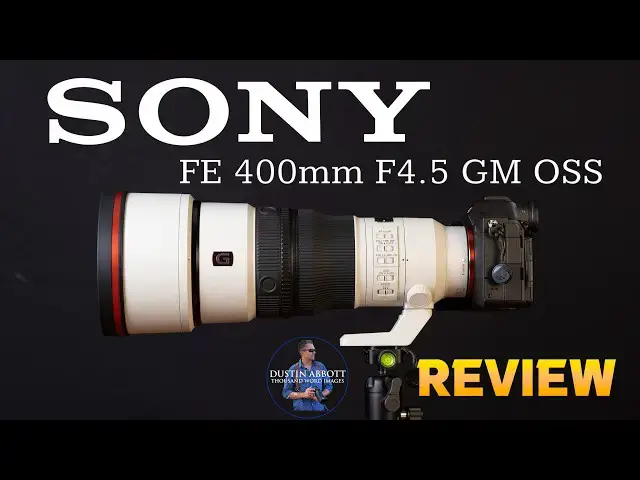
Photographer Dustin Abbott takes a deep dive look at the Sony 400mm F4.5 GM OSS compact (and inexpensive!) telephoto prime. | This episode is sponsored by Fantom Tracker. Visit store.fantomwallet.com and use code DUSTIN20 for 20% off. | Read the Text Review: |
Purchase the Sony FE 1.4x Teleconverter @ B&H Photo https://bhpho.to/3PGA7pg | Adorama https://prf.hn/l/PJe0b0A/ | Sony USA https://howl.link/8mho7b5540dul | Amazon https://amzn.to/4gO0QOd | Camera Canada https://tidd.ly/4ygUKLU | Amazon Canada https://link.amazon/B0iEEFD2b | Amazon UK https://link.amazon/B0iEEFD2b | Amazon Germany https://link.amazon/B0iEEFD2b
Check out the DA Merch here: https://bit.ly/TWIMerch | Become a Patron: https://www.patreon.com/dustinabbott | On the Web: http://dustinabbott.net/ | Sign up for my Newsletter: http://bit.ly/1RHvUNp | Instagram: http://bit.ly/DLAinsta | Facebook: http://on.fb.me/1nuUUeH | Flickr: http://bit.ly/1UcnC0B | 500px: http://bit.ly/1Sy2Ngu Follow Craig @ https://www.instagram.com/craigstoffersen/
Want to support this channel? Use these affiliate links to shop at:
B&H Photo: http://bhpho.to/1TA0Xge
Adorama: https://howl.link/nt4zdz1goa7ql
Camera Canada: http://bit.ly/DLACameraCan
Sony Canada: https://www.thesonyshop.ca/?ref=abbott
Amazon: https://amzn.to/3HrY64d
Amazon Canada: https://amzn.to/3qG1p18
Ebay: http://bit.ly/DustineBay
Into the AM Clothing: https://bit.ly/intotheAMda and use code DUSTIN10 for 10% off
Fioboc Clothing: https://tinyurl.com/FiobocDA20 and us code DUSTIN20 for 20% off
Make a donation via Paypal: https://www.paypal.com/paypalme/dustinTWI
=============================
Table of Contents:
Show More Show Less View Video Transcript
0:00
[music]
0:06
[music]
0:10
>> Sony, like Canon and Nikon, make some
0:13
amazing telephoto prime lenses. The
0:16
problem with most of them is that they
0:18
cost north of $10,000, putting them
0:21
outside of the affordability of most
0:24
photographers. For a long time, myself
0:26
and a whole lot of you have been
0:28
requesting telephoto prime lenses with
0:30
smaller maximum apertures, smaller
0:32
sizes, and far more importantly, much
0:36
smaller price tags. Well, Sony has come
0:38
through and really delivered for us in
0:40
the newly announced 400 mm F4.5 GM OSS
0:45
and 600 mm F6.3
0:48
G Master OSS. I'm reviewing the 400 mm
0:51
today and it is a stunning combination
0:54
of compact size, lightweight, and very
0:58
high performance. Light enough that it
1:00
actually weighs less than a kilogram in
1:02
optimal conditions, and it is compact
1:05
enough that I was able to put the 400
1:07
mm, 600 mm, a Sony A1 Mark II, 1.4 x and
1:12
2x teleconverter all in a medium-size
1:15
Peak Design Camera Cube. I've never been
1:17
able to say that before about any kind
1:19
of telephoto prime before. What's more,
1:22
the 400 mm F4.5 G Master can be had for
1:26
just $2700 US, making it an incredible
1:30
value. So, today we're going to explore
1:32
why this lens has such a seductive
1:35
combination of price, size, but even
1:38
more importantly, performance. This is a
1:40
serious super telephoto lens and it
1:43
performs just like you'd expect from a
1:45
Sony G Master telephoto prime. Before we
1:48
jump in, however, I do want to say a big
1:50
thank you to Sony USA for sending me
1:52
loaner copies of the 400 mm and 600 mm
1:55
lenses. They have had zero input in
1:57
these reviews. However, they will not
1:59
see them before you do. They are
2:01
completely independent reviews. All of
2:03
that aside, let's jump in and let's take
2:05
a look at this bad boy.
2:07
>> Today's episode is sponsored by the all
2:09
new Phantom Tracker 2.0. Phantom has not
2:11
only seriously upgraded the visual look
2:14
of the card, but now we have a superior
2:16
build quality made with tempered glass
2:18
and metal alloys. This credit card size
2:20
tracker can be locally tracked via a 90
2:22
decibel beeping noise, but also on a
2:24
global level via Apple's Find My Network
2:27
and its map. The addition of NFC means
2:30
that you can also use the card to
2:31
trigger an automation. Just tap it.
2:34
The tracker fits perfectly in any wallet
2:35
or bag and assures you won't lose your
2:38
valuables. It has a built-in
2:39
rechargeable battery that can be easily
2:41
charged via any wireless charger and a
2:43
single charge can last up to 6 months.
2:46
The Phantom Tracker 2.0 makes for a
2:48
seriously cool gift. So, visit
2:50
store.phantomwallet.com
2:52
and use code Dustin20 at checkout for
2:54
20% off. That's store.phantomwallet.com
2:58
and use code Dustin20 for 20% off.
3:01
>> All right, let's take a closer look at
3:03
the lens here. So, first of all, quick
3:05
quick breakdown on pricing. Pricing is
3:07
2,699
3:09
US dollars. That compares to 12,999
3:13
for the 400 mm f/2.8.
3:16
Now, the new 600 mm is going to cost
3:18
basically a thousand dollars more, about
3:20
3,700. This lens is relatively compact,
3:24
but even more impressive is how
3:25
lightweight it is. It is 108 mm in
3:27
diameter by 242 mm in length or 4.25
3:31
inches by right under 13 and a half
3:34
inches. But, amazingly, without the
3:37
tripod foot and the hood, it weighs in
3:39
at 994 g. On my scale, it's 998 g and
3:44
right over 1,200 g if you include both
3:47
the lens hood and then also the tripod
3:49
foot. So, no matter how you slice it,
3:51
this is really lightweight. And that
3:53
compares to that 994 g weight compares
3:57
to 2,896
4:00
g or almost 2 kg more for the 400 mm
4:04
f/2.8. And so, obviously, that's a
4:06
really impressive weight savings there.
4:08
What's more, they have designed this to
4:09
where there's only a single front
4:10
element. Most of the optical design is
4:12
nearer the camera body, which gives it a
4:15
really easy hand holdability. The
4:18
balance point is way back here. And so,
4:20
it's really easy to not only hand hold
4:22
it, but continue to support. You don't
4:24
have a lot of weight to support away
4:25
from your body, which is fantastic. Up
4:28
front, we have a 95 mm front filter
4:30
thread. It does come with a nice lens
4:33
hood.
4:35
And that lens hood has the rubberized
4:37
front surface. It has a locking
4:39
mechanism. All of that is fantastic.
4:42
Now, like Sony's other premium telephoto
4:44
primes, there is no aperture ring here.
4:46
However, the aperture iris itself has 11
4:49
aperture blades. We do have a tripod
4:52
collar that can be fully rotated. There
4:54
are no detents, so it freely rotates.
4:57
You're just going to need to line up the
4:58
dots and to lock it down if you want to
5:00
go to the traditional positions.
5:02
Unfortunately, there is still no Arca
5:05
grooves on here. And so, as you can see,
5:06
I had to add on a quick release plate to
5:08
throw it on this little tripod. Now, the
5:11
actual tripod collar is not removable.
5:14
However, the foot itself is very easily
5:17
removable if you want to just carry it
5:19
handheld and save yourself a little bit
5:21
of weight there. Easy to take off, and
5:23
this is a very easy lens to hand hold
5:26
for the reasons we've already discussed.
5:28
It's also fully featured lens. We've got
5:30
an AF/MF switch. We have a switch to
5:32
control whether or not you want
5:33
full-time manual override or not. We
5:37
have a two-position focus limiter.
5:38
Basically, in the limited position, it
5:41
is taking off the close focus
5:42
possibility, starting at 7 m out to
5:44
infinity or the full range there. I
5:46
didn't actually have to use that very
5:48
much because autofocus is fantastic. We
5:51
have a couple of switches dedicated to
5:52
the optical SteadyShot, an on-off
5:55
switch, and then three different modes.
5:57
First mode being your standard kind of
5:58
balanced, second being for panning, and
6:01
the third mode being the dynamic that
6:03
focuses on stabilizing at the point of
6:06
capture, less on stabilizing the
6:08
viewfinder itself. We also have four
6:11
different function buttons located all
6:13
the way around the lens, so you always
6:15
have one close to hand. It's just one
6:16
single function, and that is assigned
6:18
from within the camera body. We also
6:20
have Sony's customizable function ring
6:22
here, which can be assigned a variety of
6:24
different values from within the camera,
6:26
and so you can use that for a preset
6:28
focus positions. You can If you want to
6:30
use it to rock to select between full
6:32
frame and APS-C, I mean, there's a
6:34
variety of different functions you can
6:35
apply to that. But, we definitely have a
6:38
very similar feature set to what we have
6:40
on the higher-end telephoto primes,
6:42
except for we don't have any kind of
6:44
drop-in filter option. But, there's a
6:46
lot going on here. The lens has a lot of
6:48
controls. It's easy to use. We have a
6:50
weather sealing gasket here at the lens
6:52
mount, and as a G Master lens, it is
6:53
fully weather sealed all throughout the
6:55
lens itself. Also, fluorine coating here
6:58
on the front element. The lenses both
7:00
come with this nice zippered padded
7:02
case, and one of the things I like when
7:04
it comes to the 400mm, which isn't quite
7:07
true with the 600mm because it's a
7:09
little bit longer, is that you can fit a
7:12
both the lens with a camera body
7:14
attached, and it zips up, you know, just
7:17
fine here. And so, that provides an easy
7:20
way to transport it. I actually even
7:22
strapped it on the back of my bike and
7:24
when I was going out shooting, and just
7:26
with some of the attachment points, I
7:28
strapped it down, and that way I could
7:29
have quick access to the camera and the
7:32
lens ready to go if a shot presented
7:35
itself. Minimum focus distance here is
7:37
2.5 m, and I estimate the magnification
7:40
level to be about 0.18 times. The 600 mm
7:44
has a little bit higher level of
7:46
magnification than the 400 mm.
7:48
Obviously, the 400 mm's magnification
7:51
can be helped, however, if you attach
7:53
either the 1.4 times or two times
7:55
teleconverter. If you add the 1.4 times,
7:58
you have a 560 mm equivalent lens with a
8:01
maximum aperture of F6.3. Put the two
8:04
times teleconverter on there, you have
8:05
an 800 mm lens with a maximum aperture
8:08
of F9. All in all, this is a beautiful
8:11
package, and the standout feature here
8:13
is just how amazingly lightweight this
8:15
lens is for a 400 mm F4.5 prime lens.
8:21
So, let's talk autofocus. Sony has
8:23
equipped the 400 mm with basically the
8:25
same focus system that we see in the 400
8:28
mm F2.8 G Master that cost more than
8:31
$10,000 more. Namely, we have two XD
8:34
linear motors that are working in tandem
8:37
to drive focus back and forth. It has
8:40
the same focus capabilities in terms of
8:42
algorithms and thrust to keep up with
8:45
the A9 Mark III at 120 frames per second
8:49
or on some of Sony's other cameras when
8:51
filming at 4K 120. As you can see here,
8:55
no problem in keeping up with that
8:56
action even if we're shooting that 4K
8:58
120. And so, autofocus has plenty of
9:01
thrust, plenty of speed, and of course,
9:03
that first-party confidence that you
9:05
would expect from a top-notch Sony prime
9:08
lens matched to a top-notch Sony sports
9:11
camera. On my A1 Mark II, I was able to
9:14
effortlessly track action, and again, I
9:16
want to say thank you to my friends at
9:18
Jen Gar Goldens, and they have a new
9:21
champion that's going to stud, and then
9:23
so, they needed photos of him, and I
9:24
needed photos for these lenses, and so,
9:26
it was a match that worked out well for
9:28
both of us. But I had literally zero
9:31
issues with tracking action. They wanted
9:34
more of a
9:36
kind of profile type shots and action,
9:38
and so I shot a lot of panning shots.
9:40
Every one of them is perfectly focused.
9:42
Zero issues with that.
9:44
I had no problem when I threw on the 1.4
9:46
times teleconverter. Again, perfectly
9:49
focused results and then I even threw on
9:51
the Viltrox two times teleconverter
9:53
because that's the one that I have and
9:55
we shot a long sequence of what they
9:57
would do when they are leading the dog
9:59
in events and it's a little bit slower
10:01
action but again in that setting no
10:03
problem in keeping up with all the
10:05
action there. Likewise, whenever I
10:07
attempted to do bird in flight, instant
10:10
pick up in terms of acquisition and zero
10:13
effort in trying to track the bird. Even
10:14
in shots like this where you can see
10:17
that there's only a tiny bit of the eye
10:19
that's not obscured by the wing and yet
10:21
focus is staying locked on there. So
10:24
autofocus was really really spectacular.
10:27
Now on the video side of things,
10:29
obviously these lenses because of their
10:32
length they're going to be used less
10:34
often for video than what they are for
10:36
stills. However, there are some
10:37
applications for sports or wildlife
10:40
where someone might be shooting video.
10:41
Frankly, the biggest challenge a lot of
10:43
times with video these lenses is going
10:46
to be really just getting the framing
10:47
right. And once you have that, there's
10:50
no problem with the focus part. Focus
10:53
transitions back and forth are, you
10:55
know, good. No problems with that. Focus
10:57
breathing is well controlled and of
10:59
course you have the advantage of having
11:00
the focus breathing compensation on a
11:02
lot of Sony's cameras that will help to
11:04
basically mathematically eliminate focus
11:06
breathing and so no issues on that front
11:08
there.
11:09
As far as the actual footage, it looks
11:12
fantastic. The
11:14
optical steady shot here in the lens,
11:17
you know, working in combination with
11:18
cameras is able to provide reasonably
11:20
smooth handheld footage and of course we
11:23
have the advantage many of us of being
11:24
able to add further stabilization in
11:27
post though with tiny bit of crop there.
11:29
But the The of the day it is perfectly
11:31
usable for video, even though that
11:32
probably won't be the primary
11:34
application for things here. Okay, we
11:36
have an optical design of 22 elements in
11:38
16 groups, including three super extra
11:40
low dispersion elements and one extra
11:42
low dispersion elements. I don't have
11:44
access to the MTF charts because this is
11:46
a pre-release, so we'll just jump right
11:48
into what we can assess here. When it
11:50
comes to vignette and distortion, you
11:51
can see that this is a very
11:52
well-corrected lens. There is the
11:54
tiniest amount of pincushion distortion
11:56
and the tiniest amount of vignette. Both
11:58
are very, very easily corrected. It's
12:00
like I dialed in like a minus one to
12:02
correct for that, and then only like a
12:05
plus 12 to correct for the vignette.
12:07
Very, very easy. There's You could shoot
12:10
with this lens all day and not notice
12:12
any kind of
12:13
issues with vignette or distortion. Now,
12:15
if I add in the 1.4 times, you can see
12:17
it introduces a little bit of barrel
12:19
distortion. Vignette doesn't really
12:21
increase very much, however, and then
12:23
finally with the Viltrox two times, you
12:26
can see that it actually reduces some of
12:28
that barrel distortion, and so it
12:29
becomes a little bit more neutral.
12:30
There's a tiny amount of barrel
12:31
distortion and just a hair more
12:33
vignette, but really with none of these
12:35
combinations is this any kind of issue
12:37
at all. When it comes to any kind of
12:39
fringing, also no issue there. You can
12:41
see that even with these highly
12:43
reflective surfaces and, you know,
12:45
moving towards defocus, there is just no
12:48
issue at all. We have great contrast,
12:49
great detail, and no kind of fringing on
12:51
these transition areas. Likewise with
12:53
this shot here, we have a beautiful
12:55
portrait of this golden retriever, and
12:57
you can see right up here in the rough
13:00
at the top and then in this transition
13:01
area here, both areas where you could
13:03
see some fringing, you don't. The
13:04
contrast and detail are just exquisite.
13:07
And look at how nice the transition from
13:09
focus to defocus is. Really beautiful.
13:12
Likewise, when it comes to lateral style
13:13
chromatic aberrations, no issues in the
13:15
corners there. So, taking a look at
13:17
resolution and contrast, we're shooting
13:19
on a 61 megapixel A7R Mark V, and then
13:24
we're going to be looking at results at
13:25
a 200% level of magnification. Quick
13:27
caveat, I have to do these tests
13:29
outdoors and you can see when I'm
13:31
testing with the two-time teleconverter,
13:33
I'm a long way away from the chart. And
13:36
so, there are extra variables when
13:37
shooting outdoors. And so, you know,
13:40
we'll look at the charts, but there's
13:41
also some just real-world elements mixed
13:44
in here because it is a I can't control
13:46
all of the variables.
13:48
But, that being said, looking in the
13:49
center of the frame, we've got a
13:50
fantastic result. You can see that it's
13:53
high sharpness, high contrast. Mid-frame
13:56
looks just as good. I mean, it looks
13:58
really, really crisp, really fantastic.
14:01
As we pan down, we can see that just
14:03
everywhere we go that detail and
14:04
contrast is just holding up beautifully.
14:07
We can see it's a nice flat plane of
14:10
focus. Uh we can see very good centering
14:12
and consistency all across the frame.
14:15
So, for point of comparison, here is the
14:16
400 mm end of the 100-400 mm f/4.5 GM,
14:20
which, by the way, as zooms go, it is
14:22
awesome.
14:23
You can see in the center of the frame
14:25
that while the zoom is fantastic, it's
14:27
not quite as good as far as just the
14:30
basic details as what the prime is.
14:33
There's just a little bit more
14:34
information there. It's just rendered a
14:36
little bit more crisply. We move into
14:38
that mid-frame zone. Both of them look
14:40
fantastic, very, very close, but I would
14:42
give the edge to the prime lens. Just
14:45
these Look at the writing here. Contrast
14:47
definitely favors the prime lens and
14:49
there's just a little bit more pop to
14:51
everything. Moving down towards the
14:52
corners, both of them are excellent. In
14:54
this case, I would actually say that the
14:56
zoom is arguably a hair better in the
14:58
corners, but both of them are just
15:01
really, really fantastic. As I said,
15:02
we'll temper those, you know, chart
15:04
results with some real-world results.
15:06
You can see here that we look at this
15:09
grackle here that the detail in the
15:11
feathers and look at there and just his
15:14
talons that are there, everything is
15:16
just super crisp and very nice
15:18
transition to defocus there. Here's a
15:20
shot, you know, while moving and you can
15:23
see here that the detail and the
15:25
contrast in the fur all looks nice even
15:28
at a, you know, fast movement. Likewise
15:30
here when shooting the seagull in the
15:33
air and you can see just, you know, even
15:35
in the movement shots all the detail is
15:37
really fantastic. Here with a more
15:40
stable object you can see that the
15:42
detail is just really, really just
15:44
fantastic. All those transitions are
15:46
really nice and clean. Here's another
15:48
shot where I've intentionally shot
15:49
through some foliage just to provide a
15:52
natural frame and again, look at the
15:53
amount of detail that is there. It's
15:55
just, I love the sharpness, the contrast
15:58
from this lens. One final bird in flight
16:00
shot and you can see again if I zoom
16:02
into that, it's the focus is nailed,
16:05
detail and contrast are awesome. So does
16:07
it have more in the tank? Well, let's
16:08
see what happens when we stop it down to
16:10
F5.6.
16:11
In the center of the frame, the results
16:13
are largely the same. There's maybe a
16:15
hair more contrast but nothing
16:17
meaningful there. Likewise if we look in
16:19
the mid frame, it already was pretty
16:21
close to perfect and so it looks very,
16:24
very similar. If we look up here into
16:26
the corner, we can see that as we get
16:28
close to the edge of the frame, there's
16:30
definitely some improvement
16:32
but I would say that you're mostly
16:33
seeing that improvement as you get
16:35
towards the edge of the frame, not so
16:36
much in the center or the mid frame. Now
16:38
from F5.6 to F8, I don't really see much
16:41
of any kind of further improvement. In
16:43
fact, I would say there's a mild
16:45
regression. So F5.6 seems to be kind of
16:49
the pinnacle of sharpness with the lens.
16:51
Now after F8, you'll start to get
16:53
diminishing returns as we get on down
16:55
into the level of diffraction. So F11's
16:58
a little softer, F16 and then by the
16:59
time you get to the minimum aperture of
17:01
F32, you can see that a lot of the
17:03
sharpness and contrast has been robbed
17:05
away due to diffraction. Now how about
17:07
if we add that 1.4 times teleconverter
17:10
on there and so we have got 560mm F6.3.
17:14
We can see in the center of the frame,
17:16
it's still looks really, really
17:18
fantastic. Mid frame looks awesome. Down
17:21
into the corners looks awesome. I mean,
17:24
it holds up really, really well with the
17:26
1.4 times. Now, if I add on that Viltrox
17:29
2 times, you can see it definitely takes
17:32
more of a hit. It's not quite as sharp.
17:35
Detail is not quite as high. Contrast
17:38
isn't you know, it looks a little bit
17:40
more washed out. Remember that we
17:41
already saw that the bare lens is
17:42
softening at F8 relative to F 5.6. And
17:46
so, it's also starting to do with a bit
17:48
of diffraction there already. Here's a
17:50
real world shot at 560 mm F6.3. This is
17:55
an action shot, obviously. Even at 200%
17:57
level of magnification, you can see that
17:59
all of the detail there is really nice.
18:02
And if we drop to a more typical 100%
18:04
magnification, you can see that it just
18:06
looks gorgeous. No complaints about
18:08
that. And what's more, as I look towards
18:10
the transition towards defocus, all of
18:12
that is still nice and soft. Now, here's
18:14
a shot at 800 mm F9. And if we zoom into
18:18
that, you can see that you know,
18:20
contrast and detail is still pretty
18:22
good. Definitely very, very usable, but
18:24
it's not quite as pin sharp as what it
18:26
was before. And again, looking at the
18:28
transition to defocus, I think it's a
18:30
little busier in this transition zone,
18:33
but it still looks quite good overall.
18:35
And so, this is a lens that holds up
18:36
really well with the teleconverters.
18:38
Now, if we look at the minimum focus
18:39
distance and the up close result, it's
18:41
actually really fantastic. Look how
18:43
crisp all of that detail is. There's a
18:45
lot of punch there. It's a really nice
18:47
flat plane of focus. And so, that means
18:49
that even as we look down towards like
18:51
these stamps that are right towards the
18:53
very edge of what's being captured,
18:55
still looks really nice and crisp. So,
18:57
great up close as well. Here's a real
18:59
world example. And again, if we punch
19:01
into 100%, you can see that all of the
19:04
detail there on the flesh of the apple,
19:06
it's all very, very nice. The transition
19:08
to defocus is beautiful.
19:10
Here's another up close shot. And again,
19:12
you can see just how much punch there
19:14
is. There, all of that detail is really,
19:16
really nice. Transition to defocus is
19:18
nice.
19:20
This is a shot that really kind of stood
19:21
out to me showing with that compression
19:23
what kind of a beautiful result you can
19:25
use even for something as simple as
19:27
this. And you can see like great detail
19:29
and contrast everywhere. And then that
19:32
background is just beautifully blurred.
19:34
Another shot here as we kind of head
19:36
towards some of the fall, you know,
19:37
wildflowers. You can see that all of
19:40
that is rendered really, really nicely.
19:42
Going back to Phoenix, our champion
19:44
here, you can see another portrait of
19:46
him. And I just I really love these
19:48
shots. I love that crisp little line of
19:50
focus and then a really nice transition
19:52
towards defocus. And you can see that as
19:55
we go out in those layers out of focus,
19:57
it's really, really nicely handled. And
19:59
then, of course, the detail and contrast
20:01
on his face, fantastic. Now, on the
20:04
flare resistance side of things, this
20:05
does have Sony's Nano AR Coating Mark
20:08
II. And while it's going to be pretty
20:10
rare that, because it's such a narrow
20:12
angle of view, that you're actually
20:13
going to be pointing at a bright light,
20:15
I had no problems. You can see that, you
20:17
know, it didn't have any kind of major
20:19
flare issues. Held up really, really
20:20
nicely in that kind of setting. Top to
20:23
bottom, this is a really gorgeous
20:25
optical instrument. So, what's my
20:27
conclusion? I think that Sony has nailed
20:29
it with the 400mm f/4.5 G Master.
20:34
In many ways, I feel like this lens
20:35
fulfills the vision of what Sigma set
20:37
out to do a few years back with their
20:39
own 500mm
20:40
f/5.6 Sport lens. I really like that
20:43
lens, but of course, it was hampered
20:45
here on Sony by the fact that you had
20:47
the limited burst rate. And then also,
20:49
it didn't work with teleconverters.
20:51
The fact that this lens works not only a
20:53
bit, but works perfectly well with
20:55
Sony's teleconverters and even the
20:56
Viltrox 2x teleconverter, makes it an
20:59
incredibly versatile lens. Not to
21:01
mention the fact that you can get the
21:03
full burst rate out of any of your Sony
21:05
sports cameras.
21:07
What's more, this is my favorite of the
21:09
two newly announced G Master prime
21:11
lenses
21:12
for the simple reason that I think that
21:14
that F4.5 starting maximum aperture just
21:17
gives you more versatility. It gives you
21:19
more options in the lighting conditions
21:21
that you can use and the fact that it
21:22
plays so well with teleconverters, I can
21:24
throw on the 1.4 times and have 560 mm
21:28
F6.3, basically almost giving me the 600
21:31
mm 6.3. And then if I want even more
21:34
reach throwing on the two times
21:35
teleconverter gets me out to 800 mm and
21:38
a still usable maximum aperture of F9.
21:41
What's more, I actually prefer the
21:43
rendering from the 400 mm F4.5. I feel
21:46
like the bokeh is a little bit smoother.
21:48
It's just an amazing lens and if you're
21:50
interested at all at a 400 mm focal
21:52
length, this lens to me is a complete
21:54
no-brainer. It does everything amazingly
21:57
well and it gets you into a Sony G
22:00
Master prime telephoto lens for more
22:03
than $10,000 less than the 400 mm F2.8
22:08
GM OSS. That makes this lens an
22:10
incredible winner. If you want more
22:12
information, feel free to check out my
22:14
full text review which is linked in the
22:15
description down below. As always,
22:17
thanks for watching. Have a great day
22:19
and let the light in.
#Science