Up next in 10


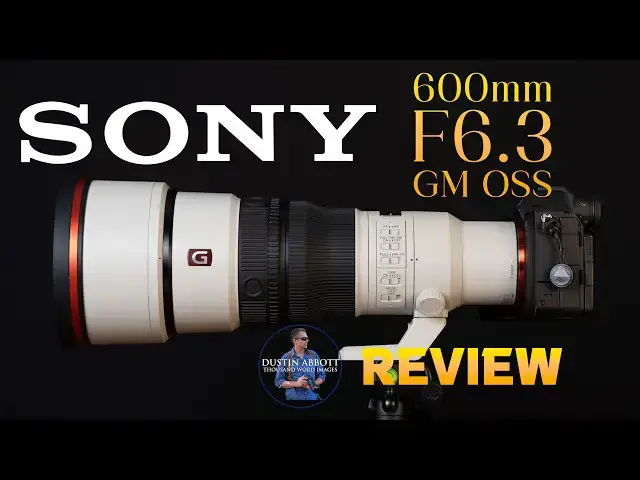
Photographer Dustin Abbott takes a deep dive look at the Sony 600mm F6.3 GM OSS compact telephoto prime. | This episode is sponsored by Fantom Tracker. Visit store.fantomwallet.com and use code DUSTIN20 for 20% off. | Read the Text Review: | Purchase the Sony 600mm F6.3 GM @ B&H Photo | Adorama | Sony USA | Amazon | Camera Canada | Amazon Canada | Amazon UK | Amazon Germany
Purchase the Sony 400mm F4.5 GM @ B&H Photo | Adorama | Sony USA | Amazon | Camera Canada | Amazon Canada | Amazon UK | Amazon Germany
Purchase the Sony FE 1.4x Teleconverter @ B&H Photo https://bhpho.to/3PGA7pg | Adorama https://prf.hn/l/PJe0b0A/ | Sony USA https://howl.link/8mho7b5540dul | Amazon https://amzn.to/4gO0QOd | Camera Canada https://tidd.ly/4ygUKLU | Amazon Canada https://link.amazon/B0iEEFD2b | Amazon UK https://link.amazon/B0iEEFD2b | Amazon Germany https://link.amazon/B0iEEFD2b
Check out the DA Merch here: https://bit.ly/TWIMerch | Become a Patron: https://www.patreon.com/dustinabbott | On the Web: http://dustinabbott.net/ | Sign up for my Newsletter: http://bit.ly/1RHvUNp | Instagram: http://bit.ly/DLAinsta | Facebook: http://on.fb.me/1nuUUeH | Flickr: http://bit.ly/1UcnC0B | 500px: http://bit.ly/1Sy2Ngu Follow Craig @ https://www.instagram.com/craigstoffersen/
Want to support this channel? Use these affiliate links to shop at:
B&H Photo: http://bhpho.to/1TA0Xge
Adorama: https://howl.link/nt4zdz1goa7ql
Camera Canada: http://bit.ly/DLACameraCan
Sony Canada: https://www.thesonyshop.ca/?ref=abbott
Amazon: https://amzn.to/3HrY64d
Amazon Canada: https://amzn.to/3qG1p18
Ebay: http://bit.ly/DustineBay
Into the AM Clothing: https://bit.ly/intotheAMda and use code DUSTIN10 for 10% off
Fioboc Clothing: https://tinyurl.com/FiobocDA20 and us code DUSTIN20 for 20% off
Make a donation via Paypal: https://www.paypal.com/paypalme/dustinTWI
Show More Show Less View Video Transcript
0:00
[music]
0:06
[music]
0:10
>> Solo shooting with a 600 mm focal length
0:14
is not an easy thing to do, but I'm
0:15
going to give it a shot today because
0:18
Sony has brought to us the second of two
0:20
very exciting new prime lenses. This is
0:22
the new 600 mm F6.3 G Master OSS lens,
0:27
which comes as a companion to the 400 mm
0:29
F4.5 GM OSS that I reviewed earlier this
0:32
week.
0:33
This is an amazingly lightweight lens
0:36
weighing under a kilogram in optimal
0:38
situations that gives you incredible
0:40
reach that can be furthered by the use
0:42
of compatibility with Sony's own
0:44
teleconverters, and it costs more than
0:47
$10,000 less than the 600 mm F4 GM OSS
0:52
lens. This is going to be a very
0:54
intriguing lens for those of you that
0:56
travel and need a lot of reach, and
0:58
maybe you're weight constrained because
1:00
while it is lightweight and relatively
1:03
compact, it packs a lot of optical punch
1:06
and can give you incredible reach. It
1:08
has great autofocus, it has great image
1:11
quality, and while there are some
1:12
practical limitations when you throw
1:14
teleconverters on a lens that starts
1:16
with a maximum aperture of F6.3, the
1:18
fact is is that as far as autofocus
1:20
goes, it continues to do very well with
1:22
those things.
1:24
So, at the end of the day, this is
1:25
another very interesting lens, but is it
1:28
a lens for you? Well, that's what we're
1:29
going to try to answer in today's
1:31
review. First of all, I do want to say a
1:33
big thank you to Sony USA for sending me
1:35
a loaner of the lens. It will be going
1:37
back to them, unfortunately, but they
1:39
have had zero input in this review, and
1:41
they will not see it before you do. This
1:43
is a completely independent review.
1:45
We're going to jump into all the good
1:47
stuff right after a word from our
1:48
sponsor. Today's episode is sponsored by
1:50
the all-new Phantom Tracker 2.0. Phantom
1:53
has not only seriously upgraded the
1:55
visual look of the card, but now we have
1:57
a superior build quality made with
1:59
tempered glass and metal alloys. This
2:01
credit card-size tracker can be locally
2:03
tracked via a 90-decibel beeping noise,
2:06
but also on a global level via Apple's
2:08
Find My Network and its map. The
2:11
addition of NFC means that you can also
2:12
use the card to trigger an automation.
2:14
Just tap it. The tracker fits perfectly
2:17
in any wallet or bag and assures you
2:19
won't lose your valuables. It has a
2:21
built-in rechargeable battery that can
2:22
be easily charged via any wireless
2:25
charger, and a single charge can last up
2:27
to 6 months. The Phantom Tracker 2.0
2:29
makes for a seriously cool gift. So,
2:32
visit store.phantomwallet.com
2:34
and use code Dustin20 at checkout for
2:37
20% off. That's store.phantomwallet.com
2:40
and use code Dustin20 for 20% off. All
2:44
right, we'll start by taking a quick
2:45
look again at price. Price MSRP is
2:48
$3,699
2:49
US.
2:50
That compares to on the high end to the
2:53
600 mm F4 G Master, which runs you about
2:56
$14,000. But, of course, you can also
2:59
reach 600 mm F6.3 through the 200-2-600
3:02
mm
3:03
um G lens, which is going to set you
3:06
back around 2,000 to 2,100 US. So, it
3:09
sits in between these, but obviously in
3:11
terms of its performance, this is a G
3:13
Master versus that other lens being a G
3:15
lens, and this is a higher-performing
3:17
lens with newer technology. The huge
3:19
standout here is the overall weight. Um
3:22
the size is is great, as you can see
3:24
here standing next to the 200-to-600. Um
3:27
this is much smaller and more compact.
3:29
However, it is still a you know, fairly
3:32
long lens here. It's 108 mm in diameter
3:35
and 263 mm long, or about 21 mm longer
3:40
than what the 400 mm F4.5 is. So, that's
3:43
4.24 by 10.35 in. So, what really stands
3:48
out, however, is the weight here. And at
3:51
its lightest, it is measured at 995 g.
3:56
That is without the hood and without the
3:58
tripod foot. But, to give you a point of
4:01
comparison, the 600 mm F4 GM weighs in
4:04
at over 3 kg, and so it is more than
4:08
three times as heavy as this lens. And
4:10
so, if you're looking for
4:11
handholdability, this is impressively
4:14
good on that front. Even with the lens
4:16
hood and the tripod foot at its
4:18
heaviest, essentially, on my scale it
4:20
weighed in at 1,217 g. And so, it is
4:22
still remarkably lightweight. What
4:24
really stood out to me is when I went
4:26
out for my photoshoot to do action shots
4:29
of a champion golden retriever, I was
4:31
able to fit both of these lenses, plus
4:33
the teleconverters, plus an Alpha 1 Mark
4:36
II, all of them into a Peak Design
4:38
Medium Camera Cube, which is really
4:41
really kind of blew my mind.
4:43
What's more, in the design of both of
4:44
these lenses, they only have a single
4:46
element up front with most of the
4:47
optical design back here, which makes
4:49
the lens really easy to handhold. Not
4:51
only is it lightweight, it's very well
4:53
balanced. And obviously, that's going to
4:55
help a lot.
4:56
Now, in terms of the feature set here
4:58
and other relative information, there is
5:00
no aperture ring, but that's true of
5:03
even the most expensive of Sony's
5:05
telephoto primes.
5:07
But, what is missing here that is
5:09
present on like the 600 mm F4 is a
5:11
drop-on a drop-in filter assembly. We
5:13
don't have that there. We do have a 95
5:16
mm front filter thread, and so you can
5:18
use traditional filters up front here.
5:20
Outside of that, however, we do have a
5:22
full bank of features here. You can see
5:25
here that we have got an AF/MF switch.
5:28
We've got a full-time
5:29
direct manual focus option, where you
5:31
can have that on or off. We have a
5:33
two-position focus limiter, and so
5:36
essentially, you can eliminate
5:37
everything from 7 m closer and just
5:40
shoot from there to infinity, or the
5:41
full range. We've got an on/off for the
5:44
OSS, and then we've got three different
5:46
modes. First being your standard, second
5:48
being panning, third being dynamic where
5:50
it's more focused on capturing or
5:52
stabilizing at the point of capture, not
5:55
so much of the viewfinder. So, all of
5:56
that is useful. As far as the OSS, I
5:59
don't I haven't seen an official figure
6:01
of its stabilization. It is good, we
6:03
know, when combined with a good camera
6:05
body, but it's I wouldn't say it's
6:06
exceptionally good. And and I've
6:08
certainly I feel like I've felt better
6:10
telephoto lenses in that regard, but
6:12
overall it is it is quite good and gets
6:15
the job done. Now, a few other features
6:16
include having four different function
6:19
buttons all located all around the lens.
6:22
They all will serve the same single
6:23
function that you program from within
6:25
the camera. Also, we have their
6:27
customizable function ring here which
6:29
you can assign different values to and
6:31
so it can be a quick way to either go to
6:34
a preset focus position, to switch
6:36
between full frame and APS-C. There's a
6:38
variety of different functions you can
6:39
assign to that. Lens hood is included.
6:42
It's a very nice lens hood that looks
6:44
very G Master It's got the rubberized
6:45
front edge. It's got a locking
6:47
mechanism. It's, you know, reasonably
6:49
lightweight and so that you can have
6:50
that on there and it doesn't break the
6:52
bank in terms of the overall weight. The
6:54
lens sports a fully G Master level of
6:57
weather sealing starting with a gasket
6:58
here, seal points all throughout the
7:01
lens at the switches, transition areas,
7:03
fluorine coating on the front element
7:06
and so that it is thoroughly equipped
7:07
for using out in a variety of weather
7:10
conditions. As noted in the intro, it is
7:12
compatible with both the 1.4 times and
7:15
two times teleconverters. Though, that's
7:18
going to be with some caveats just
7:19
because of the physical reality here.
7:21
So, with the 1.4 times teleconverter,
7:23
you've got an 800 mm F9 combination.
7:26
With a two times, you've got a 1200 mm
7:29
F13.
7:31
Obviously, because of the light
7:32
gathering potential, there are going to
7:33
be some limitations, real limitations to
7:35
come into play there. However, it is
7:38
great that it is fully compatible and
7:39
autofocus as we're going to see is
7:41
excellent with all of these attached. It
7:43
does come with a very nice padded
7:46
zippered case here. And unfortunately,
7:49
unlike with the 400 mm, because it's
7:51
just a little bit longer, I didn't find
7:53
that I could fit it
7:55
this lens with a camera attached in the
7:57
bag. I think it is possible if you
7:58
remove some of the padding from the
7:59
bottom. Some of those spacers spacers
8:02
are you might be able to make it work,
8:03
but it's the 400 mm is an easier
8:06
solution in there.
8:07
Minimum focus distance here is just 2
8:09
and 1/2 m, which is shared by the 400 mm
8:12
lens. And so that gives you a lot higher
8:13
magnification with the 600 versus the
8:15
400. I don't have an official figure,
8:18
but I'm estimating it somewhere around
8:19
0.28 times level of magnification, which
8:23
obviously is going to be very useful and
8:24
that will get even higher if you attach
8:26
any of the teleconverters because your
8:28
minimum focus distance stays the same,
8:30
but your overall focal length effective
8:33
focal length does increase. So at the
8:35
end of the day, this is a remarkably
8:37
light way to get to 600 mm. It is great
8:41
to handle in the in the field. Focus
8:43
ring moves nice and smooth. Everything
8:45
here is well executed. So let's talk
8:47
autofocus.
8:49
This, like the 400 mm F4.5, has
8:52
autofocus is driven by having two of
8:54
Sony's XD or extreme dynamic linear
8:57
motors. These are driving focus from
8:59
both in front of and in back of the
9:01
focusing group and working in harmony to
9:04
provide pretty much lightning fast
9:06
autofocus.
9:07
I would say that your biggest autofocus
9:09
challenge is really going to be your
9:10
initial framing because the angle of
9:12
view is so narrow for a lens like this.
9:15
But once you have your subject in view,
9:16
autofocus is going to pick up and track
9:19
pretty exceptionally well. In terms of
9:21
going back and forth in focus speed, you
9:23
can see here that while it's wild to try
9:25
to, you know, pinpoint and handhold this
9:27
thing, it goes back and forth near
9:29
instantly. And when I was using it
9:31
practically for my photo shoot, if I was
9:34
tracking first with the
9:36
just the bare lens at 600 mm, I had just
9:40
flawless results as the golden retriever
9:43
charged towards me.
9:45
And that sequence of about 100 frames, I
9:48
think every single one of them was
9:50
perfectly focused. Then I tried it with
9:52
the 1.4 x teleconverter and obviously
9:54
when you're out at 840 mm,
9:57
it's a little bit it's a it's a long
9:59
working distance you need to have. So
10:00
you need to have some space for that.
10:02
But still, I backed up further and I
10:03
found that I got basically equally
10:06
results throughout another about 100
10:08
frame burst for that. And so no problems
10:11
there. I was able to shoot birds in
10:13
flight. I was even able to pick a bees
10:16
out of the air
10:18
focusing on that. And so I mean
10:20
autofocus is really incredibly good. As
10:23
I said, there going to be a few kind of
10:24
just logistical challenges particularly
10:25
if you're not familiar with shooting
10:27
with very long focal lengths, but all of
10:29
those set aside, this is an amazingly
10:31
good autofocus lens. Focus is quiet. It
10:34
is smooth in operation. Zero concerns
10:37
with it on that front.
10:38
Now all of those caveats are equally if
10:42
not more true when you're talking about
10:44
video. However, the one advantage you
10:46
have on video is that you don't have to
10:47
achieve quite the same rate of
10:51
focus speeds or shutter speeds to stop
10:53
action because you have the ability to
10:55
have continual frames that are going
10:57
along. And so that does make a little
10:58
bit easier because what I found is that
11:00
trying to get shutter speeds high enough
11:03
to stop action meant that I was often
11:04
shooting at quite high ISO values which
11:07
does impact the image quality from the
11:09
lens. Video, that's less of a problem.
11:11
And I found that my biggest challenge
11:13
with video outside of the tightness of
11:15
framing was really hand holding. This is
11:17
a lens it's going to work better off of
11:19
a tripod. Obviously for shots like this
11:21
in the opening sequence, it's nice and
11:23
stable cuz I'm working on a tripod. When
11:25
I tried to hand hold, the OSS was just
11:28
not quite up to however it works in
11:30
concert with my camera body. It really
11:32
wasn't strong enough to kind of hold it
11:35
or
11:36
keep you from just kind of moving around
11:38
in general. It's just very hard with
11:40
that angle of framing. But, maybe you're
11:43
better at hand-holding than what I am
11:44
and you can get better handheld results.
11:46
But, certainly that is going to be the
11:47
chief challenge. But, in terms of the
11:49
actual autofocus, I found for example,
11:51
when I was shooting the sequence with a
11:53
turtle trying to get its way up onto a
11:55
rock and it was, you know, getting
11:56
washed away by waves that were coming
11:59
and knocking it off. The autofocus
12:01
stayed really locked onto that. And even
12:03
I shot a a brief clip of a chipmunk with
12:06
the the Viltrox two times teleconverter
12:08
on. So, at 1200 mm and while it's hard
12:11
to hand-hold that, autofocus was staying
12:13
locked on with no problem at all. And
12:15
so, the autofocus side of video is going
12:17
to be great. The footage looks great.
12:19
The biggest challenge is going to be
12:20
just the the reality of shooting with a
12:23
600 mm plus
12:25
focal length and how tight that framing
12:27
is going to be. So, first quick look at
12:29
the optical design here. We have 24
12:31
elements in 17 groups and that includes
12:33
three super extra low dispersion
12:35
elements and one extra low dispersion
12:37
element. I don't have MTF to show you,
12:40
so we'll just jump right into the actual
12:42
chart test. One quick caveat, as always
12:45
when we do these chart test, I am
12:48
shooting outdoors conditions and as you
12:50
can see, this testing it around 800 mm,
12:53
I've got to be a long way away from the
12:54
chart. So, there's a lot of factors that
12:57
come into play here. At the same time, I
12:58
think I got like pretty good results
12:59
this time.
13:01
So, you can see here that there's a tiny
13:02
bit of pincushion distortion about a
13:04
minus two to correct. Almost no
13:06
vignette. I used dialed in like a plus
13:08
nine to correct four here on the right.
13:10
So, no problems there. Now, if we
13:12
compare the wide open vignette and
13:15
distortion compared to adding the 1.4
13:17
times wide open, you can see that that
13:19
bit of pincushion distortion inverts to
13:22
just a tiny bit of barrel distortion.
13:24
You can see and a little bit more
13:25
vignette, but nothing severe. If we add
13:28
on the two times teleconverter, this is
13:30
the Viltrox, you can see that there's a
13:32
little bit less barrel distortion,
13:34
distortion is very minimal, and vignette
13:36
is ever so slightly heavier, but mostly
13:38
about the same. This is a another lens
13:40
from Sony that is very well corrected
13:42
for fringing. You can see that on all
13:44
these shiny edges, there just really
13:46
isn't much fringing at all. And as we
13:47
look towards the defocused one with the
13:49
shiny bits, I'm not really seeing any
13:51
kind of fringing around the specular
13:53
highlights there.
13:55
Likewise, lateral style chromatic
13:56
aberrations well corrected as well, no
13:59
issue with that. And you can see the
14:00
edge of the frame nice and clean. So,
14:02
how about resolution and contrast? We're
14:04
looking at the test chart. I'm shooting
14:07
at 61 megapixels, and this is 200% level
14:09
of magnification to really show off any
14:11
kind of flaws. You can see in the center
14:13
of the frame we have very good contrast
14:15
and detail, no problems there. Mid-frame
14:18
looks fantastic, very consistent
14:21
performance across there. As we pan
14:23
down, we can see as we move out towards
14:25
the edge that really our sharpness
14:28
profile goes right out towards the edge
14:30
of the frame. It is a very consistent
14:32
performance all across the frame. Now,
14:34
on Sony, the only cheaper way to get to
14:36
600 mm f/6.3 is with the 200-600 mm, and
14:41
you can see that in the center of the
14:42
frame, while the contrast isn't quite as
14:45
good, you can see that on the sharpness
14:46
level, it competes fairly well in the
14:49
center of the frame. Everywhere else,
14:50
however, there is a serious drop-off in
14:53
both resolution and contrast. You can
14:56
see here in the mid-frame how much
14:57
sharper that the prime lens is. If I pop
15:00
down here and we look towards the
15:02
corners, it's a radical difference in
15:04
terms of the sharpness profiles in
15:07
either one of the corners, basically
15:08
anywhere else but right in the center of
15:11
the frame, the prime is much, much
15:13
better. Jumping away from the charts for
15:15
a moment, let's put that in context, and
15:17
you can see here at 600 mm f/6.3 that
15:20
detail is very tight and crisp, contrast
15:23
is great. Uh we can see here if we punch
15:25
into this image just how beautiful all
15:28
of that resolution and contrast is. The
15:30
colors are super rich. Uh here in a shot
15:33
just of a seagull,
15:35
um you can see that the detail and
15:37
contrast is excellent there. You can get
15:40
a little bit of look at the defocus as
15:42
well. Even uh you know, on the wing,
15:44
birds in flight, you can see, you know,
15:46
it's the focus is so good and then the
15:49
detail and contrast is excellent. Coming
15:51
back to these turtles for a moment,
15:53
here's just a still of that same scene.
15:55
And you can just see, look how beautiful
15:57
all of the detail and the contrast is on
16:00
all of these turtles. Everything holding
16:02
up really, really nicely. So, is there
16:04
more to be had if you stop the lens
16:06
down? In the center of the frame, I
16:08
don't see a big improvement from F6.3 to
16:12
F8. In the mid-frame here, again, I
16:15
don't see a huge improvement. I do think
16:17
there's a little bit more contrast and
16:19
detail, but it's not significant. In the
16:22
corners, however, I think that there is
16:24
a little bit more punch to be found
16:26
there. And so, it's just a little more
16:28
consistent across the frame. I look at
16:30
this writing here, which looks a little
16:32
a little almost a little smudge there,
16:33
where it's crisper and the little inkier
16:36
looking here. Likewise here in this
16:38
seal, you can just see it looks just
16:40
cleaner. Um and so, there is some
16:42
improvement, but it's more off-axis as
16:44
you get towards the edge of the frame,
16:46
not so much in the center of the frame.
16:48
We can see that after F8, moving on here
16:50
to F11 on the right, you can just see
16:52
that now diffraction is starting to rob
16:55
away some of those sharpness gains. And
16:57
so, the image is looking a little
16:58
softer. And from F11 to F29, by the time
17:02
you get to the minimum aperture, you can
17:05
see that diffraction has really played
17:07
havoc with sharpness and contrast.
17:09
Definitely to be avoided. So, obviously,
17:11
this is going to be a factor when you
17:12
use teleconverters as here at 840 mm,
17:17
your maximum aperture is F9. At this
17:20
stage, however, I feel like it is still
17:22
a very usable combination. You can see
17:25
that it still looks even at 200%, it
17:27
still looks really, really crisp all
17:29
across the frame.
17:30
I think that at this point, you can
17:32
handle this without any kind of issue
17:34
and get great results. Here's another
17:36
real world result and this is with that
17:39
teleconverter on at 840 mm and you can
17:42
see that while contrast is very slightly
17:44
lower, it still is delivering a very
17:46
crisp end result here. Likewise, here
17:48
you can see great detail. I would say
17:51
your biggest factor is going to be that
17:53
your ISO value is almost certainly going
17:55
to be have to start punching up unless
17:57
you're in really bright light and that's
17:59
going to have other kind of
18:00
consequences. Now, putting on that two
18:02
times teleconverter pushes us well into
18:04
diffraction territory and you can see
18:06
that the combination of the reduced
18:08
sharpness from the teleconverter
18:09
combined with diffraction means that
18:12
we're taking a serious hit to the
18:15
overall detail even relative to using
18:17
the 1.4 times. I'm not sure I would
18:20
recommend using the two times
18:21
teleconverter except in very dire
18:23
conditions. If you absolutely need it,
18:26
but otherwise, avoid it. Now, real world
18:28
results don't look as bad as the chart
18:30
test cuz we're looking at a lower level
18:32
of magnification and so you can see here
18:35
there's still a usable amount of detail
18:36
and contrast there. It's not terrible.
18:39
You know, in this shot, again, you can
18:41
see the byproduct that I'm ending up at
18:44
ISO 10,000 trying to the shot because of
18:46
shooting at F13 and it's usable, but
18:50
it's not great. Up close performance is
18:52
pretty good. You can see the
18:53
magnification level is really high and
18:56
so that is fantastic and detail and
18:59
contrast here is quite good.
19:01
In real world shots, you can see here as
19:03
I look at
19:05
you know, not
19:07
completely up close here, but a closer
19:09
performance, you you see the specular
19:11
highlights are nice and clean with no
19:12
fringing. Here's a good up close and you
19:15
can see very very usable 600 mm F6.3
19:19
um you know, detail and contrast all
19:21
looking very good in there and of course
19:22
at this close focus distance you're
19:24
going to completely blur out backgrounds
19:26
and get really beautiful looking images.
19:29
So here again, the only challenge is you
19:31
can see some noise cuz the ISO is up you
19:33
know, again because the lighting
19:35
conditions here in the forest they're
19:37
not as bright and so ISO has to go up
19:41
This image I think is beautiful and kind
19:43
of an almost you know, green monochrome
19:45
but at the same time the noise level is
19:48
is fairly high because I'm having to
19:49
shoot at higher ISOs. Here's a little
19:51
bit better lighting and so you get a
19:53
cleaner result and you can see just how
19:55
beautiful the contrast is and then how
19:57
beautiful the defocus you can get out of
19:59
the lens itself.
20:01
Now it has the most recent coatings from
20:04
Sony and wow, this is such a narrow
20:06
angle of view you're probably really
20:08
going to get the sun in the frame. I
20:09
intentionally did so and I got good
20:12
results here. You can see that there is
20:13
no ghosting any artifacts from it and so
20:16
I mean the reality is the optics here
20:19
are fantastic. The reality of the
20:20
physics when you're starting at F6.3
20:23
particularly if you're going to add on
20:24
teleconverters that gets complicated but
20:27
the base lens is fantastic. So what's my
20:30
conclusion? Well, first of all, you
20:31
wouldn't believe how far away from the
20:33
camera I have to get to try to get any
20:36
kind of distance around me in the shot
20:39
and to frame all of this up. But that is
20:42
the reality of a 600 mm lens and
20:45
particularly once you start to add on
20:46
teleconverters and you stretch that
20:48
reach out. This is a very long focal
20:51
length and that is both the strength and
20:52
the weakness of the lens. The reality is
20:55
is that most of the complaints that I
20:56
would have about this lens really have
20:58
to do with the reality of a 600 mm lens
21:01
with a maximum aperture of F6.3. I'm
21:04
familiar with all of that because I've
21:05
been using the 200 to 600 mm f/5 to 6.3
21:09
lens for years at this point. So, I know
21:11
that when you try to add teleconverters
21:13
on, while it's theoretically possible,
21:15
and in this case certainly more possible
21:17
than what it is with the 200-600 mm
21:19
because you're starting off with better
21:20
image quality and a more modern focus
21:22
system, there are just realities that
21:25
come. You have to shoot at much higher
21:27
ISO values. You have to have a lot of
21:29
light. So, those challenges aside, the
21:31
people that are going to be interested
21:32
in this lens are going to be because
21:34
they want that maximum reach. For
21:36
someone like myself, I personally find
21:38
the 400 mm f/4.5 more interesting, as I
21:41
mentioned in my review of that lens.
21:43
But, I'm not necessarily the person that
21:45
is looking for the absolute longest
21:47
reach. And that kind of tantalizing
21:50
potential of being able to reach as far
21:51
as 1200 mm with full autofocus and still
21:55
reasonably decent image quality is going
21:58
to be very intoxicating for the right
22:00
kind of photographer. And the truth of
22:02
the matter is is that unless you're
22:04
willing to spend a whole lot more money,
22:06
you are certainly not going to get more
22:08
flexibility and similar image quality to
22:11
what you are getting out of this lens
22:13
right here. And I think that that's
22:14
going to make it very intriguing for the
22:17
right kind of photographer. Certainly, I
22:18
don't have any complaints when it comes
22:20
to the performance of the lens. The
22:21
autofocus is fantastic. The image
22:23
quality is very good. I love the
22:25
lightweight packaging. I love the rich
22:27
feature set. I love the great weather
22:29
sealing. This is an awesome lens. And
22:31
while I'm not sure I would consider it
22:33
worth a thousand dollars more than the
22:36
400 mm f/4.5,
22:38
you know, the truth of the matter is is
22:39
that 600 mm in a lens like this is a lot
22:42
of reach, and that's a great value
22:45
relative to the big brother 600 mm f/4
22:48
lens. And so, at the end of the day, for
22:50
those that would dream of having that
22:52
lens and probably are never going to get
22:54
there, this is a far more achievable
22:57
super telephoto lens. And that's pretty
22:59
super. If you want more information,
23:00
feel free to check out my full text
23:02
review which is linked in the
23:03
description down below. As always,
23:05
thanks for watching. Have a great day
23:07
and let the light in.
#Science