0:00
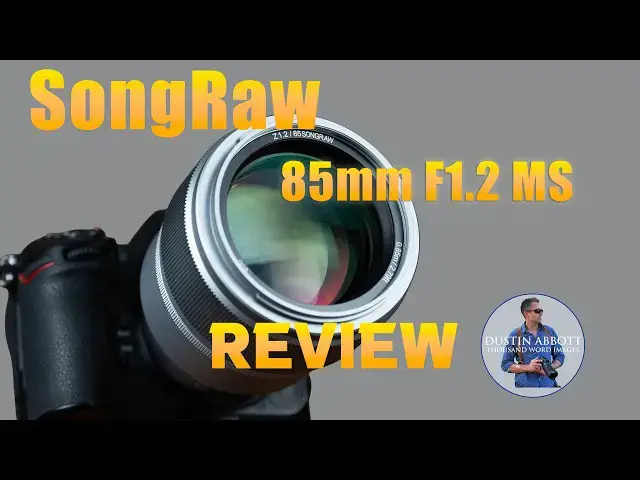
I thought Songra's first 50mm f1.2 lens was huge, but then I encountered their new lens
0:17
the 85mm f1.2, and as you can see, it dwarfs the 50mm f1.2. When I first opened the 85mm f1.2
0:27
I was initially kind of put off by just the massive size
0:30
It seemed, frankly, kind of ridiculous. But this lens really won me over as I began to test it and use it
0:37
because it has an amazing optical performance that in many ways evoked memories in my mind
0:43
of something like the Zeiss Otis 85mm f1.4, albeit a whole lot cheaper
0:50
and with a larger and brighter maximum aperture, not to mention autofocus
0:54
and so is the new song raw 85 millimeter f1.2 ms the lens to buy if you're looking for a bright
1:02
85 millimeter f1.2 on either sony or nikon z mount which i'm testing here well we're going to dive in
1:09
and explore that in today's review before we do however i do want to say a big thank you to song
1:14
raw for sending me a review sample of the lens they have had zero input in the actual review
1:19
itself however and they will not see it before you do this is a completely independent review
1:25
Let's dive in and take a look together. Today's episode is sponsored by the all-new Phantom Tracker 2.0
1:30
Phantom has not only seriously upgraded the visual look of the card, but now we have a superior build quality made with tempered glass and metal alloys
1:39
This credit card size tracker can be locally tracked via a 90-decibel beeping noise
1:43
but also on a global level via Apple's Find My Network and its map
1:48
The addition of NFC means you can also use the card to trigger an automation
1:52
Just tap it. The tracker fits perfectly in any wallet or bag and assures you won't lose your valuables
1:58
It has a built-in rechargeable battery that can be easily charged via any wireless charger
2:03
and a single charge can last up to six months. The Phantom Tracker 2.0 makes for a seriously cool gift
2:09
So visit store.phantomwallet.com and use code DUSTIN20 at checkout for 20% off
2:15
That's store.phantomwallet.com and use code DUSTIN20 for 20% off. All right, let's take a closer look at this beast. First of all, a quick look at price
2:25
This M Simplify version, MS version, is $649 USD. Now, there will be a moonlit version
2:33
that has a full aperture ring and a little bit more complex build to it, and that will be closer
2:38
to $1,000, but this one is just $649. That compares to the Sigma that I just reviewed on
2:44
the Sony platform that is about $1,600 US here on Nikon. The competitor is the S-Line lens
2:50
and it is $3,000 US dollars. And so certainly when it comes to price, this is very well positioned
2:58
Now, as you can see, this is a massive lens and no matter which direction you look at it from
3:04
it is utterly huge. Most, I think biggest standout here is how big the diameter is. It's 117 millimeters
3:12
or 4.6 inches in diameter and then 135 millimeters or 5.3 inches in length. It's that girth that
3:20
really stands out relative to the 50 millimeter f1.2 which is a big heavy lens but this lens just
3:27
scales up so much bigger than that one. Now as noted there are two variations of this lens. This
3:32
is the M Simplify version and so it doesn't have an aperture ring and there are some plastics inside
3:38
not on the outside but on the inside relative to the moonlit version that will come. The moonlit
3:42
version will have an aperture ring a little bit more metals in the construction but it will also
3:47
way more and this is already a heavy lens. It weighs in in the simplified version at 1120 grams
3:53
or right under 40 ounces but the moonlit version adds on another 105 grams or 1225
4:00
Now as heavy as that is this really isn't the exception to the rule. Now the Sigma that I just
4:07
reviewed is lighter. It weighs in at 905 grams. However the Nikkor is 40 grams heavier at 1160
4:14
grams than this lens. And then the Canon is 75 grams heavier at nearly 1200 grams. And so while
4:21
this thing is huge, it is not unnecessarily heavy for a lens like this. Now, both the Simplify
4:29
version and the Moonlit version of the lens will have this aerospace grade aluminum body shell
4:35
However, the Moonlit version will have a finish that looks more like the 50 millimeter F1.2
4:40
Moonlit that I reviewed last year, whereas this will have what they call, it's a silver finish
4:46
they call it a titanium. And so it's very, it's eye-catching for both good and bad. For the most
4:53
part, it's a good looking lens, though I do critique this font choice right here, which is
4:58
very, very hard to read. I would like to see them dump that. Now, as noted, this version
5:04
the M Simplify version, has no aperture ring or customizable control ring. This has the look of a
5:09
Nikon customizable control ring, but it is just a barrel feature. It doesn't move. The only thing
5:15
that's moving here is the focus ring. We do have an AF-MF switch and a custom or function button
5:21
The manual focus ring, it is metal ribs. It moves with a nice amount of weight to it. I only have
5:27
one critique, and that is that if you're turning fast when the lens is powered on or the camera's
5:32
powered on you going to get a little bit of focus motor sound if you making a quick focus Otherwise however focus is precise though you do need lots of rotations if you making major focus changes Now one key improvement is that the 50 millimeter had a USB port on the side with this clunky gasket rubber gasket
5:51
covering it, whereas the 85 millimeters, they have smartly just moved that USB-C port to the
5:57
mount of the lens where you don't need any gasket covering. It's already protected. It's just a
6:03
cleaner process and I found that firmware updates were simple. If you connect this to a computer
6:07
a folder drop opens up and you just drag and drop the firmware file into that and it will
6:11
automatically run the update in just a few seconds. And so simple there. There is a rubber
6:17
weather sealing gasket here along with internal seals throughout and then a flooring type coating
6:22
on the front element. And so all of that is good. Inside we have 13 aperture blades and that aperture
6:29
does a great job of keeping a circular shape as you stop the lens down. Now, one other thing that
6:34
is huge here is the front filter threads. 86 millimeters is unusually large, so that gives you
6:39
a little bit fewer filter choices. Again, I'm reminded of the Zeiss Otis 85 millimeter f1.4
6:45
that this lens in a lot of ways reminds me of optically, but it also had a massive 86 millimeter
6:50
front filter thread. Minimum focus distance here is 85 centimeters, and it gives you a slightly
6:55
better than average 0.13 times level of magnification. That is better than the Sigma
7:01
the Sony G Master, or the Nikon S-Line lens. Finally, the lens hood itself is included along
7:07
with a little pouch for the lens. Well, it's not little because the lens is huge, but this
7:13
bayonet's on with decent precision. You can see, however, it again is massive. It's a good match
7:20
and it does have the rubberized surface, which allows you to set the lens down like this
7:24
which is going to be very stable because that is very wide there. But you add that on and the lens gets huger still
7:31
And so just know this is a lens that's going to catch some eyes. So let's talk autofocus
7:36
Songra is utilizing an SDM focus motor like they did with the 50mm f1.2
7:42
And as with that lens, they also have something that they call a real-time positioning
7:46
which essentially is kind of a feedback loop that helps to assure that focus remains accurate
7:51
that i would say is certainly the strength of the autofocus system here in that i did find and this
7:57
is the second of their lenses i tested i tested the 50 millimeter f1.2 on sony and i found that i
8:02
had a very accurate results there some caveats that we'll get to in just a second and then this
8:08
now i'm testing on nikon so on two different focus systems i've had excellent autofocus accuracy in
8:14
both of them that include whether i was shooting portraits um you know real world shots in a
8:19
variety of conditions, casual shots, and in all situations, I found that I had very well
8:25
accurately focused results. Now, the caveat is that this is an STM focus motor, and as you can
8:31
see, these are big elements here. And so I would say there isn't sufficient thrust to really give
8:36
you top-notch performance. Nikon uses dual STM focus motors on their own 85mm F1.2, the Sigma
8:44
85 f1b2 art that i just reviewed that used two of their hla or high speed linear actuator focus
8:52
motors and so you're sensing a theme here that there are multiple focus motors that are driving
8:57
these i would say that autofocus in terms of its speed and its smoothness probably most closely
9:01
resembles the canon 85 millimeter f1.2 l which has a usm type focus motor which isn't quite as
9:09
smooth as some of like say the vcm style focus motors and so you can see here that focus speed
9:15
is not bad going back and forth but what i did see which i do see sometimes on nikon generally
9:21
is that there's an occasional rack in the wrong direction and obviously if you happen to hit that
9:26
cycle whatever triggers it you're going to get slower autofocus and that major focus change i
9:31
also didn't feel like the focus motor was as smooth and quiet as the best lenses have and so
9:38
there is, you know, it just draws you out of it a little bit. But I would say for the target audience
9:43
particularly those that don't want to spend thousands of dollars, but are looking for a beautiful portrait lens
9:49
that's going to deliver accurately focused results, it certainly fits the bill on that front
9:53
And it's fast enough that I wouldn't be afraid to use it
9:57
for something like a wedding ceremony either. And so as far as the stills goes
10:01
you need to understand that you're not getting the world's most sophisticated autofocus system
10:05
However, you are getting a nice, accurate autofocus, and I found that to be true on multiple platforms here at this print
10:13
And so, again, considering that price point of around $650 in mind, I think that autofocus is perfectly adequate here
10:21
and it's a lens that I personally would have no problem using with in a professional setting for portraits because the results are amazing
10:29
So how about on the video side of things? Again, those same limitations are going to be there
10:34
And I noticed when I was doing the focus pulls that there is a little lack of confidence
10:39
There is some kind of settling sometimes getting to the focus point when I'm doing touch to focus
10:45
which doesn't work quite as well on Nikon's what it does on, say, either Sony or Canon anyway
10:50
But, you know, overall, I could tell that there's just a little lack of confidence in some of those focus things
10:56
You'll also notice there's a fairly obvious amount of focus breathing. And so there's a little bit of that lurching effect as you go back and forth that will kind of pull you out of a cinematic type setting
11:05
So I would recommend using this lens more in static type shots where the footage looks beautiful because the optics are beautiful in the lens but you not having to rely on big focus changes That being said there no problem if I moving towards the camera and focus is needing to adjust to stay up with me No issue with anything like
11:25
that. All right, we have an APO or apochromatic design here and that really shows up as we're
11:31
going to see in a moment. You can see here that there are 18 elements in 10 groups and almost
11:36
all of those save one element. This element right here are all kind of like special elements. We have
11:43
We have 11 high refractive index elements. The blue, we have five extra low dispersion elements
11:48
We have one aspherical lens in the design. Taking a look at the MTF chart at f1.2, you can see a very strong center that if anything
11:57
gets better in the mid frame and only then do we start to see some tail off towards the corners
12:03
Now, in terms of vignette and distortion, there is a very mild amount of pin cushion distortion
12:08
only needing about a minus two to correct for it. You can see there is a fairly heavy vignette in the corners
12:14
It's about a plus 79 to correct for it. However, that does become part of the look
12:20
I remember having a conversation with Zeiss's engineers, and they said that the heavy vignette and the way that it kind of linearly progresses towards the center
12:28
is actually part of the look that people love about Zeiss lenses. And I can see a lot of that DNA here
12:35
An image like this, you know, it's a fairly simple image, But there is a unique fall off of the vignette that really draws the eye into the scene
12:42
Likewise, in this shot here, the vignette isn't concentrating the corners, but has this kind of organic feel
12:48
And by the way, you can see that power of that apochromatic design that even at f1.2, just look at the micro contrast pop
12:56
And again, that feels very Zeiss-like to me. Now, in terms of the correction for longitudinal style chromatic aberration, for an f1.2 lens, we have a fairly minimal amount
13:06
Just a tiny bit of magenta before, a little bit of green after, but really overall very well controlled
13:13
Likewise, if we look here at a three-dimensional object, the text pops even at f1.2
13:18
There's a tiny bit around those edges, and I see a little bit around some of the bokeh circles here
13:25
But overall, fringing is quite low for an f1.2 lens. Lateral style chromatic aberrations, again, not perfectly corrected
13:32
We can see a little tiny bit there, but overall it is very, very minimal
13:37
So we'll take a look at resolution and contrast. An aprichromatic design should stand out here, and I think we're going to see that it does
13:45
This is on a 45 megapixel Nikon Z8, so a little less demanding than what we see on Sony sensors
13:52
However, this is shown at a 200% magnification. You can see that in the center of the frame, there's lots of pop at f1.2
14:00
Great contrast, great detail. The mid-frame looks exceptionally good. I mean, just amazing
14:07
And we see that there's that great consistency as we pan down
14:11
And it's only as we get towards the corners that we see that start to drop
14:16
However, we can see that, you know, looking around, the corner performance actually still looks really quite good
14:23
There's nothing really weak here at all. Now, Sigma doesn't make a Nikon Z-mount version of this lens
14:29
And so I have the similarly priced Viltrox 85mm F1.4 from their Pro Series
14:36
And if I compare F1.2 to F4, we can see that the Songra is sharper in the center of the frame with higher contrast
14:45
The mid-frame, it is also sharper and higher contrast. We look up here into the corners, it is definitely sharper and higher contrast
14:53
And that's really true on this lower right corner. So for some real world perspective at F1.2, here's a casual shot of my grandnephew
15:02
I mean, look at the sparkle there and how much pop and detail there are in the skin textures
15:08
You know, just a casual shot of a dried weed here. But I mean, look at that micro contrast, just stunningly good at F1.2
15:16
And we can see just a beautiful transition to defocus. Sunlight coming through these leaves
15:22
And again, depth of field is very narrow. but in that depth of field you can see the plane of focus you can see that that detail and contrast
15:30
is awesome all of those edges are nice and tight no fringing there here's a monochrome of a lock
15:38
and again you can just see look at that great micro contrast in detail there this shot really
15:44
stood out i just took a shot of a bolt but i mean again if you zoom into a hundred percent level
15:49
all of those water droplets and the edge of that bolt. I mean, it's just fantastic looking
15:56
A shot of Nala because, of course, we have to have one. I mean, look at the detail in the fur there
16:02
I mean, I just love the optics from this lens. If we go from f1.2 to f4, you can see there's a little bit more contrast that's on tap there
16:11
So just a little bit more pop, though. I mean, it was already awesome
16:15
And so it's just that tiny bit degree more. If we move on from f1.4 to f2, we're getting up into pretty much perfect range
16:23
You can see that all of this is super crisp. And that's true basically anywhere that we look on the frame
16:30
I mean, the detail is just really awesome. Popping back in on the Viltrox for a moment, and we can see with both lenses at f2
16:38
the center is definitely crisper and tighter looking. The mid-frame, you can just see all of this
16:44
Look at this seal here. all of that just pops so much more the contrast is stronger up here in the corner same kind of
16:51
thing you can just see how much that pops compared to what happens on the Viltrox and the inkiness just kind of a three pop of those lettering It just really stands out as being exceptional This shot at F2 really kind of I think tells the story here
17:06
We look in at a pixel level. I mean, the amount of contrast and detail on all of that rust and those textures is just stunning
17:13
Why is it that rust is so interesting on someone else's vehicle and so terrible on your own
17:19
And it will stay that sharp through F8. At F11, it's a little bit softer due to diffraction and a little bit more at F16
17:26
The diffraction doesn't bite quite as much on the lower resolution Nikon sensor
17:30
Expect to see more diffraction if you're using the Sony E-mount version. As noted, this has a slightly better than average 0.13 times the level of magnification
17:40
and up-close performance is good. Good contrast, good detail, nice flat plane of focus as you can see
17:46
No problems there. That leads us to a discussion of bokeh. you can see that there's a little bit of busyness in these circles, but no like concentric rings
17:55
anything like that. What I found is that this lens is just fantastic for just isolating subjects
18:03
The depth field is so tiny. And I found that even on busy force floors, there's so many mushrooms
18:08
right now. The ability to kind of create this unique little world through that shallow depth
18:13
of field is just so much fun. And you can see that the amount of defocus that this lens is
18:19
capable of is just amazing. I really love this image here because I think it captures in one
18:25
shot a lot of what's awesome here. The contrast and that micro contrast is amazing in this
18:30
apochromatic design. The defocus though is really beautiful. You don't always get great defocus if
18:38
you have great contrast, but this lens manages to pull it off. And so for portraits, it's just
18:43
fantastic. I mean, great detail on all the skin textures, but then look at how soft the background
18:49
is and you know a nice cut out from the background i really love it it elevates simple shots like
18:55
this you know with the great detail and you can see that in this kind of setting it's handled the
19:00
the light fine we'll get to that more in a moment you can see here the you know fine detail on all
19:05
the stamen but look at the transition to defocus i mean and the color rendition is really gorgeous
19:11
i only i thought the song raw 50 millimeter f1.2 was just okay from colors but it's like they've
19:17
stepped up their optical glass here and I love the colors coming off of this one. Maybe it's just a
19:23
better match for the Nikon sensor. I don't know, but the colors are really stunning to me. Again
19:28
this shot looks so Zeiss to me and I just love, look at that great detail and contrast, but just
19:35
the overall look and the colors, the vignette here, it all looks very Zeiss to me. We'll transition
19:42
finally to talking about flare resistance. And so in these kinds of shots where kind of the sun is
19:48
incidental, it does just fine. This is worst case scenario where it's right out of frame and there's
19:55
a place where you're getting some internal reflections, some veiling. You can see a bit of
19:59
ghosting when it's stopped down here. If we pan back and forth, you can see that in the center of
20:04
the frame and at F1.2, it's really not bad. There's a bit of ghosting. It's only in a unique position
20:10
where you run into problems, stop down to F11, that flare pattern becomes more pronounced. But
20:16
again, there's just certain angles where you get a little bit more impact. Block that light a little
20:21
bit though, and you can get some really pretty effects out of it. And so in general, the flare
20:26
resistance is just okay, but it's not terrible either. So what's my conclusion? One of the most
20:32
important niches for third-party lenses to fill is to provide interesting alternatives to far more
20:39
expensive first-party lenses. We already have an excellent 85mm f1.2 S-line lens if you're willing
20:45
to pay $3,000, but the Songra is providing a very interesting optical alternative to that lens at a
20:51
much lower price point, and I think that they were very wise to make this move where they're offering
20:57
essentially two tiers of their lenses to where those that are interested in getting the optics
21:01
but don't want to pay full price, they're able to do that with this M Simplify version, and at $650
21:07
this lens feels like an absolute steal when it comes to the kind of images that it can produce
21:13
and the optics that you're going to get here. If you're on a tighter budget and you can handle a bigger, heavier lens
21:20
this is a lens that is really going to reward you as a portrait or event photographer
21:25
with images that are really special. I review 100 plus lenses every year
21:31
And because I review so many, it's hard for a lens to really stand out from the crowd
21:36
There's only a handful of lenses every year that I say, man, that lens is really special
21:42
This is one that is joining that list for 2026 in that the optics are really beautiful
21:46
and there's something about the images that I just really love. And it makes me a little bit more tolerant of the size and weight of the lens itself
21:55
Songra is still a relative unknown, but this may be the lens that helps to make them a
21:59
little bit more of a household name. I just hope that they are successful in starting to deliver lenses to customers because
22:06
to this date it seems like they've been better at getting review samples to reviewers than what
22:12
they have in actually getting the lens lenses to the public themselves hopefully with this lens
22:16
this changes if you want more information feel free to check out my full text review
22:20
and there are some buying links in the description down below hopefully you'll actually get one in the
22:25
near future as always thanks for watching have a great day and let the light in