0:00
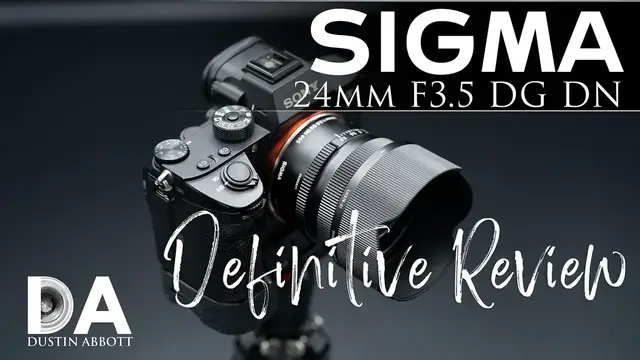
Hi, I'm Dustin Abbott and I'm here today to give you my definitive review of the new Sigma 24mm F3.5
0:18
DG DN. This is available in both Leica L and Sony full frame E mount, which is what I'm reviewing
0:25
it on here today, and this is part of their new i-series. Now, I reviewed most recently the two
0:32
newest members of the i-series in the 35mm f2dn and 65mm f2dn lenses, both of which I liked immensely
0:42
I was told about this lens at the same time, but the development cycle was a little bit longer on
0:47
it, and I have to confess that at the time, my expectations were lower for this particular lens
0:53
mostly because it's hard to get excited about a prime lens that has a smaller maximum aperture
1:00
than what equivalent zoom lenses do. But after having spent time with it, I'm actually pleasantly pleased with the end result that I got
1:09
from this particular lens, and you'll see why as we jump into the review here today
1:14
So today we're doing our definitive review, which means we're going to be looking at everything in fairly great detail
1:19
And if you want just kind of the highlights, take a look at the standard review instead
1:50
Using NordVPN is incredibly simple, with apps for all your devices that allow you to get protected with just a click of a button
1:57
With over 5,500 servers in 59 countries worldwide, it is easy to get protection without compromising speed
2:05
Visit NordVPN forward slash Dustin or use coupon code Dustin to get 70% off your subscription
2:12
We're going to start by taking a look at the build and the handling of this particular lens
2:17
and taking a look at what you're getting in a tiny and yet premium design here
2:23
So the first thing that stands out, as with all of these i-series, is that the lens is obviously very compact, but it's also really beautifully made
2:31
And just this is a, it's a small lens, but it is nonetheless a premium lens
2:37
So starting at the back, we do have a gasket here, nice and thick here at the lens mount
2:43
That is, to my knowledge, the only seal point, however. something is better than nothing and so at least you get a seal point there. Next we have the
2:51
aperture ring which like the aperture ring on the other i-series lenses there's this kind of open
2:57
slot where you've got the actual scale here to show you the various aperture settings and there
3:04
are detents at one third stops and then a harder detent between automatic and f22 and so you you
3:12
you won't inadvertently bump it that way. To my knowledge, there is no ability to de-click these
3:17
lenses, however. There is also an AF-MF switch. Now, for whatever reason, they chose to go in the
3:24
traditional kind of lateral position rather than putting it horizontally in this slot
3:31
And it is a little bit tight. It's particularly tight if you're using gloves, as I am this time
3:36
of year, mostly because you've got this raised aperture ring right here
3:42
and thus not a lot of room, and you know, normally there would be a camera here, and so not a lot of
3:46
room to get at it. So I actually would have preferred them to do the transverse position
3:50
instead. The focus ring here, once again, is it's raised, it's nicely ribbed, it moves with good
3:58
damping. Your only challenge is, is that it's not particularly wide, and so again, particularly if
4:03
you're using gloves, there's not a lot of room because of the raised lens hood. Now, I do appreciate
4:09
the fact that the lens hood, it looks comprehensive in the lens itself. It all looks like it kind of
4:14
flows together. And so they, you know, it's just not a tacked on cheap piece on a nice lens, which
4:19
kind of drives me crazy when you have a nice metal lens construction, and then you have a really cheap
4:23
lens hood tacked on there. That's not the case here. We do have a very nice metal lens hood that
4:31
is, you know, made with the same kind of, you know, engineering attention to detail that the little
4:36
lens itself does. So the lens starts to look really small when you remove the hood because
4:41
the hood is fairly substantial. And I will say this, that I don't know if it needed to be this
4:47
substantial because flare resistance is actually quite good. Maybe the hood is contributing to that
4:52
I don't know. But either way, we have a nice lens hood. And I will also note that it does reverse
4:57
nicely. Those of you that ask about rings, in this case, the lens hood is deep enough that both rings
5:02
are obstructed to some degree when the hood is reversed. Up front we have a fairly common 55
5:10
millimeter front filter thread and once again we have a two-way solution to lens cap and so you've
5:17
got typical you know traditional pinch style then they also include this magnetic style and then
5:23
there's that lanyard that we've seen previously if you want to just you know magnetically attach
5:28
it to that. But this is a nice easy solution. However, as before, it sinks in and it's a little
5:36
bit, I mean not a little bit, it's pretty near to impossible to pull it out if the lens hood is in
5:41
place. That's my only criticism of these particular caps is that it actually works better if you're
5:46
just using the bare lens itself. Now speaking of the bare lens, it weighs in at 230 grams, which is
5:53
you know really lightweight and that's eight which is right over eight ounces the dimensions
5:58
are 64 millimeters in diameter and you know it's the diameter is at the widest point so it's at
6:05
these rings and again these rings they're kind of raised and so it looks a little bit like a cine
6:10
lens to where you could apply gearing to it which of course you could in this situation here as well
6:16
if you so desire so 64 millimeters or two and a half inches it only two inches in length or 50 millimeters Inside we got seven rounded aperture blades a little bit lower a blade count here
6:30
than on the other lenses. And it may just be, it's so small, there's not room for more blades
6:37
to be a part of the equation. I don't know. 10 elements and eight groups inside. Now our minimum
6:43
focus distance here is only 10.8 centimeters or 4.3 inches. Now, as you can see from this photo
6:50
that means you're basically right on top of your subject. It's not even really room for the lens
6:54
hood to be in there, but if you can get that close, you get a very high one to two magnification
7:00
or a 0.50 times magnification, which is very, very high. I don't think there's going to be a lot of
7:07
practical applications where you're going to be able to get that close, but nonetheless, to be able, particularly with your shooting video, to not have to worry about getting too close is
7:16
also a nice option and your photography there as well. So as you can see, really very little to
7:23
complain about on the build and handling front. These i-series lenses are probably amongst my
7:28
favorite of Sigma lenses in terms of their actual physical design and the quality of construction
7:35
the attention to detail. I think they're actually quite a delight in terms of the build and for
7:40
those of you that are looking for a compact lens to, you know, fit onto a camera where you want
7:45
something small, light, unobtrusive, obviously this is going to be a really nice fit at both a
7:50
very, you know, discrete size and then also a very reasonable weight. And so, you know
7:56
good things all around on that front. Now, when it comes to the autofocus, this has a stepping
8:01
motor. And like all of these DN lenses so far, I've had very little to complain about. Autofocus
8:07
is smooth, quiet, and quick. Of course, in this case, you do have a, you know, a wide focal length
8:14
along with a small maximum aperture, which means that there is less stress put on the focus system
8:19
At the same time, however, it does have great close focus abilities, and so that can be a negative
8:25
impact, you know, on focus speed. Fortunately, it's not here, and I've gotten very good focus speed
8:31
end result. Also, as we can see, as we take a look at focus pulls, they are essentially
8:37
completely silent, nice and smooth. Let's take a look. You may have also noted there that not only is everything quiet and smooth, but we have also got
8:57
pretty good performance when it comes to focus breathing and not a significant change in the size
9:03
of the foreground or background objects, whether they're in or out of focus. So for those of you
9:08
that are into this for video, you know, maybe a positive thing for you there. Now there is no
9:13
image stabilization in the lens itself. You're going to rely on in-body image stabilization
9:19
if you happen to have that. If you don't, you know, with a wider focal length like this
9:24
it's still quite easy to handhold. So probably not a major factor there
9:29
So let's talk about the image quality itself. We're going to jump in and take a detailed look
9:34
at the performance of this little but premium lens. So first of all, we'll take a look at vignette
9:39
and distortion. So the first thing that surprised me is that when I saw a pin cushion distortion pattern
9:44
rather than barrel distortion, essentially, basically all wide angle lenses end up typically having a barrel distortion pattern
9:51
most certainly any zoom that starts at 24 millimeters. I've seen very strong barrel
9:56
distortion. So pin cushion was a surprising find. Good news though is it's nice and linear. It's not
10:01
extreme. And so you can see here, even though I've just manually corrected on the right, it corrected
10:06
nice and smooth because it was a linear distortion. So I would say this is an advantage over any zoom
10:13
that I've seen covering 24 millimeters in that you've got less distortion and a more manageable
10:18
distortion pattern for correction. Vignette's another story. Vignette is very strong, approaching
10:23
three and a half stops in the corner. A little surprising considering you've got a lens starting
10:28
at f3.5, maybe less surprising when you consider how small, physically small, the lens is, however
10:35
Now, at this point, there is no raw profile correction yet available. I'm sure it will soon
10:40
come with the next update of Adobe. But so you see my manual corrections here. I did a minus six to
10:46
correct for the distortion. A lot of vignette correction, plus 80. I slid the midpoint all the
10:52
way to the left to let it, you know, it kind of ease into the center of the frame. Good news is
10:56
is that I think the vignette is fairly linear. And so as you can see, I got what I think is a clean
11:01
correction with these settings. So depending on your shooting condition, you will certainly see
11:06
that vignette if it's left uncorrected. So if there's, you know, bright areas in the sky, you'll
11:12
see a darkening in the corners, as you can see here. And then in our foreground, since I'm shooting
11:16
with snow. Everything has snow on it right now, but you'll see that there's definitely darkening
11:22
in the corners. So these two images, all I've done is just, you know, slide over for the vignette
11:27
And so you can see it's, you know, it significantly changes the feel of the image between the two
11:32
And so, yeah, vignette is what I would consider the single greatest optical flaw here. So the good
11:38
news is starting at f3.5, here is the, you know, my test chart. This is 42 megapixel A7R Mark III
11:45
This is 200% magnification and yet you can see it looks fantastic in the center of the frame
11:51
Very sharp, very high contrast. Mid-frame also looks excellent here. Great detail
11:57
And right down into the corner, we can see that that just carries right into the very corner
12:03
And so a very strong performance right across the frame starting at f3.5
12:08
If we pop over here, we can see little evidence of lateral chromatic aberrations
12:13
You know in the black and white transitions you see no extra color fringing there and so good control of aberrations
12:20
I also didn't see much evidence of longitudinal chromatic aberrations and so here, you know
12:25
You've got a high contrast with the dark background very bright snow on it
12:29
But even as it fades towards defocus there's not a lot of evidence of fringing tiny bit of green fringing
12:35
Going into the bouquet highlights again can see a very tiny outlining on a few of them but stepping back there nothing that stands out from this that you would be able to even see without you know pixel peeping and so very good control of aberrations across the board so
12:51
that contributes to having very good acuity and sharpness wide open in this case you can tell that
12:55
focus eye af grabbed the far eye instead of the fore eye but you can also see that there's just
13:02
really beautiful detail and contrast like the micro contrast and rendering all the fine hairs
13:09
This is at f3.5, and so an impressive end result there. It's also nice and crisp if you're using it for shooting like an environmental type portrait
13:19
I think the probably greatest advantage of a lens like this is that because of the nature of the distortion pattern
13:24
you're going to have very little bulging towards the edges, and so it's probably a good lens for shooting groups with
13:31
Also here at about, even at a distance of only about two meters, a little over six feet
13:36
depth of field is actually like a meter and a half and so you can see that everything from you know
13:42
the the legs to the face you know to the ear all the way back everything is in focus and so that
13:49
can be an advantage when shooting a group that just the nature of the focal length and the you
13:53
know fairly small maximum aperture means that even shooting wide open you can have a lot of things in
13:58
focus so stopping down from f3.5 to f4 is only one third of a stop and so you can see as far as the
14:04
shutter speed. It's not a significant difference, but you do get some improvement in contrast
14:10
even in that very minor stop down. We'll see that even more up close in just a moment. But you can
14:15
see here in the mid frame, it's not significant, but there is just an improvement in the overall
14:20
contrast. I see it more significantly down here in the corner where everything looks a little bit
14:25
brighter and details are allowed to pop a little bit more due to that additional contrast. So
14:31
certainly worth the stop down without a much of a penalty to your shutter speed
14:36
So as a frame of reference I happen to get the Viltrox brand new Viltrox 24mm f1.8 also for
14:42
full frame E mount at the same time and so I do have a direct point of comparison. What you can
14:48
see is though the Viltrox has the advantage of being stopped down more. I would say that the
14:53
Sigma has a little bit better detail and contrast. You can see a little bit better acuity rendering
14:58
the fine details. The mid-frame, the difference is not as significant. They're closer and I see a
15:06
little bit of give and take there. And down into the corner, I think that the Sigma has the edge
15:11
in the details. As you can see, they're just a little more finely rendered. The Viltrox has the
15:16
advantage of delivering a brighter performance here with equal settings, maybe a little bit
15:21
better light transmission. And so contrast looks a little bit better on the Viltrox, mostly because
15:26
of that additional brightness it provides. So stopping on down to f5.6, we can see that we're
15:32
getting even better performance right off into the corner where it looks really, really fantastic now
15:38
And this little Sigma, it provides really great at, you know, kind of landscape apertures, great
15:44
great rendering of details, great contrast. It looks fantastic. Now going out into a real world
15:50
comparison, you can see, first of all, looking globally between the Sigma on the left and the
15:55
Viltrox on the right, there's not a significant difference in looking at the image globally
16:00
One thing I will point out is that the Viltrox does frame wider. As you can see, there's more
16:05
in the frame. You can also see that if we scroll right up here, you can see that there's just some
16:11
extra width there. And that width is apparent actually on both sides. And so it's not a framing
16:17
difference. It's that it's actually wider. And so either the Sigma is a little bit narrower than 24
16:24
millimeters or the Viltrox is a little bit wider. As you can see in real world use though it is not
16:29
significant. Looking in at the details I do slightly favor the performance from the Sigma
16:34
I feel like its micro contrast is a little bit better and so you can just see that the whites
16:39
look a little bit wider and the darks look a little bit darker. Colors are just ever so slightly
16:44
better saturated. Looking off towards infinity I think it's rendering some of the fine details just
16:49
a little bit better there and if we look off towards infinity here i think the same observations
16:55
are true obviously it's not a huge night and day kind of difference but i do slightly favor the
17:02
sigma results there at landscape apertures so finally stopping on down to f8 we can see that
17:08
you get even a little bit better contrast and brightness to the image and so i mean at f5.6 or
17:14
f8 you're going to get really really fantastic landscape results that's where i recommend
17:19
shooting with the lens for those kinds of applications now some of you like me to take
17:24
a look at minimum focus or minimum aperture i should say here that's f22 on this particular
17:30
lens but on a high resolution body you can see that diffraction has really robbed a lot of the
17:35
acuity away from the lens and so i don't recommend shooting at minimum aperture you know unless
17:41
absolutely necessary. So as you can see, we looked at how close you can get with minimum focus before
17:47
and you certainly get a very high level of magnification. However, with a wide angle lens
17:52
and this close, what you don't get is a flat plane of focus at all. And so you can see only a little
17:59
bit is in focus. And so you're going to have to kind of use that to your advantage. I did find
18:04
that a little bit of a stop down to F4 made a fairly significant difference in contrast. And so
18:11
The detail actually looks, you know, in contrast, actually looks quite good here
18:15
So it's definitely useful, but it's not going to be useful if you want to get everything kind of in focus across the plane there
18:23
It's only useful for isolating objects. The value I did find is that even not getting quite to that level of magnification, a little bit further away, so a little more practical, I could get good sharpness
18:34
And I think fairly nice bokeh here. you know all things considered you wouldn't expect to be able to create much bokeh at all
18:40
with this lens but the minimum focus distance does allow you to get a little bit creative with it so
18:46
that's an asset now as noted earlier there are seven blades and so wide open you know bokeh is
18:51
quite nice looking stopping down you know a bit you can see a little bit of the shape of the blade
18:57
still quite you know round but if you go one step further the lower blade count of only seven blades means that you get a little bit less circular a shape more quickly than what you would with nine aperture blades So you know something to watch out for though frankly your
19:13
your options for creating this scenario are going to be very slim with just because of the nature
19:19
of the lens. I was thoroughly impressed in real world landscape shooting, just with how crisp the
19:25
detail was, how great the contrast was, you know, across the frame, it just looked really, really
19:30
excellent. I'm very, I'm just very happy. And even in challenging lighting conditions because of good
19:35
flare resistance. So we can see either wide open or stop down that flare resistance is excellent
19:41
Contrast remains very good. Color, you know, saturation remains good. And there's very little
19:46
ghosting artifacts. You know, the sunburst effect is a little indistinguished. And so I don't
19:51
necessarily love that. 14 blades, you know, is what, you know, 14 shafts comes off of that, but
19:57
it's not really all that clearly defined. So not necessarily my favorite thing there
20:02
But what I did love is that, you know, no matter where I seem to position the sun
20:06
I achieved very, very good end results. And so as you can see, even panning across
20:11
very, very little ghosting artifacts, nothing to negatively impact. And that's true stop down as
20:17
well. So good results there. And here's a couple of more real world images that show you that
20:22
you know, with very, very bright sunny conditions, I was able to, there's no damage to the image. And
20:27
so very high marks for flare resistance. Finally, I was also quite pleasantly surprised with its
20:33
performance for Koma. I came in with fairly low expectations because it's only an f3.5 lens, but
20:39
very, very crisp star points. And as I move off towards the edge of the frame, there is only
20:45
minimal evidence of Koma. And so what you can see is that everything still looks like, you know
20:50
bright points of light, stars here even towards the edges of the frame. And so again, very pleasantly
20:56
surprised with that end result. So if you purchase the lens, go ahead and pull it out at night. And
21:01
here's a shot I took with my barrel sauna and with the stars up above. And so anyway, a lot of really
21:09
positive things about the image quality from this tiny lens. And so I think you can agree, overall
21:14
a really good performance there. The only kind of negative that we can point to is the fact that it
21:19
does have fairly pronounced vignette. And so outside of that, almost all the metrics that I
21:25
look for in a lens, it really checked all the boxes. And more importantly, I really liked the
21:30
performance in terms of the images I got. And I would look at this lens because of the nature of
21:35
the focal length and the aperture as being more of a landscape or maybe city type lens. Obviously
21:41
you're not going to be shooting anything and getting shallow depth of field unless you're
21:45
up very close with it. But for, I think it's intended purpose, if you're looking for a compact
21:52
you know, say landscape lens, this is a great option. If you're looking for a discreet street
21:57
type lens, also a great option and a lot of good things. Another thing I will note due to the
22:02
nature of the wide focal length and the small maximum aperture is this is a lens I think would
22:07
also be really nice to use on a gimbal because there's not a lot of depth of field focus changes
22:13
I think that you're going to find you're going to get nice stable performance on a gimbal
22:17
and it would obviously a great focal length for something like that and so also a reason to
22:23
consider the lens so what's the downsides here I think at the end of the day I the biggest thing
22:28
that's going to have someone take pause looking at a lens like this is that it's a lens with a
22:32
smaller maximum aperture than equivalent zoom lenses have and so you're not getting that particular
22:37
advantage though I think there are some other offset you know lower distortion maybe a little
22:42
bit better optical performance than equivalent zoom lenses. Certainly better flare resistance
22:47
than your typical zoom that covers 24 millimeters. And so you might get a little bit of advantage
22:52
there. But I mean, it is a small maximum aperture. That's two thirds of a stop slower than an f2.8
22:59
zoom. So that's obviously something to consider. And then also, it's not like it's a bargain optic
23:04
in terms of price either. I think actual performance and build, its price is probably not
23:11
too high, but I think there's a marketing perception challenge to overcome. At $550 US
23:19
you know, you're not far off of, say, a lens like Sony's 20mm f1.8 G lens, which is a fantastic lens
23:28
You know, it has a wider focal length and a wider maximum aperture. It's going to set you back about
23:32
$250 additional dollars. And so, you know, that's obviously in the possibility. And then, you know
23:39
if you're looking at some of the equivalent zooms. Obviously, they're more expensive than this lens is
23:44
but you also have the versatility of a zoom. But I think the market for this lens is those of you
23:49
that really want, you want compact lenses, but you don't want cheap lenses in terms of their
23:55
performance and their build. And much like the Zeiss Loxia series, I think that Sigma has finally
24:01
found a niche here with this eye series for a completely different kind of photographer than
24:06
what's looking at their large maximum aperture art series lenses. And if you happen to be in that
24:11
category, I think you'll actually be quite delighted with this lens. In many ways, it reminds me
24:16
probably above all, of the last 24 millimeter f3.8 lens or 3.5 lens that I handled. And that
24:22
was an SMC Takumar, a 50 year old lens. But, you know, a lot of the same aesthetics in terms of the
24:29
build quality, very nice optical performance. This is obviously at a higher level and more
24:34
corrected, but there's a lot of similarities there that I can look to. So at the end of the day
24:39
it's certainly worthy of consideration if you're not off-put by the idea of the lens itself
24:44
I'm Dustin Abbott. If you'll look in the description down below, you can find linkage to my full
24:48
text review, also linkage to an image gallery. Beyond there, there are options, you know
24:54
links to purchase one, though again, because it's so new and just coming to market, some of those
24:59
are still populating, so you may have to give them a little bit of time. Also linkage to follow me on
25:03
social media to become a patron. Sign up for my newsletter that comes out every Thursday
25:09
And of course, if you haven't already, please click that subscribe button right here on YouTube and be sure to click that notification bell and so you're notified when new content drops
25:18
Thanks for watching. Have a great day and let the light in