Up next in 10

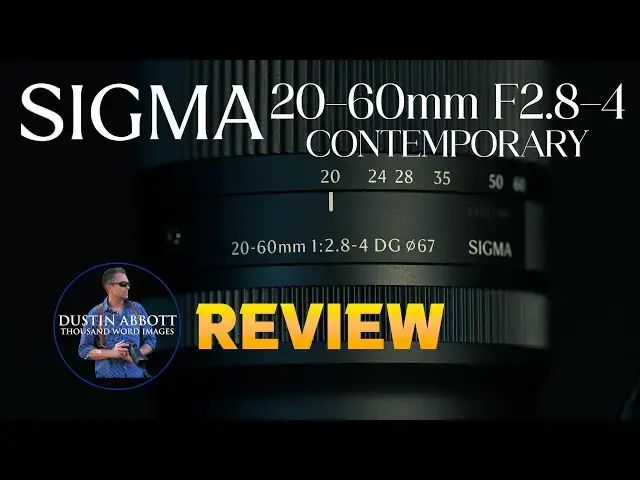
Sigma 20-60mm F2.8-4 C Review | Your New Favorite Tiny Zoom Has Arrived
Aug 30, 2026

Photographer Dustin Abbott takes a deep dive look at the Sigma 20-60mm F2.8-4 compact full frame zoom lens (with some comparisons to the Thypoch Voyager 24-50mm F2.8) | This episode is sponsored by SmartWings. Find out more at https://tinyurl.com/WELCOME5sw (use code WELCOME5 for 5% off) | Read the Text Review: | Purchase the Sigma 20-60mm F2.8-4 @ B&H Photo https://bhpho.to/4y8xZtu | Adorama https://prf.hn/l/OqQPV9y/ | Amazon https://amzn.to/4wX7OF8 | Camera Canada https://tidd.ly/4gyE9fq | Amazon Canada https://link.amazon/B035WN6jp | Amazon UK https://link.amazon/B09BrSs0A | Amazon Germany https://link.amazon/B03i5LVyp
Check out the DA Merch here: https://bit.ly/TWIMerch | Become a Patron: https://www.patreon.com/dustinabbott | On the Web: http://dustinabbott.net/ | Sign up for my Newsletter: http://bit.ly/1RHvUNp | Instagram: http://bit.ly/DLAinsta | Facebook: http://on.fb.me/1nuUUeH | Flickr: http://bit.ly/1UcnC0B | 500px: http://bit.ly/1Sy2Ngu Follow Craig @ https://www.instagram.com/craigstoffersen/
Want to support this channel? Use these affiliate links to shop at:
B&H Photo: http://bhpho.to/1TA0Xge
Adorama: https://howl.link/nt4zdz1goa7ql
Camera Canada: http://bit.ly/DLACameraCan
Sony Canada: https://www.thesonyshop.ca/?ref=abbott
Amazon: https://amzn.to/3HrY64d
Amazon Canada: https://amzn.to/3qG1p18
Ebay: http://bit.ly/DustineBay
Into the AM Clothing: https://bit.ly/intotheAMda and use code DUSTIN10 for 10% off
Fioboc Clothing: https://tinyurl.com/FiobocDA20 and us code DUSTIN20 for 20% off
Make a donation via Paypal: https://www.paypal.com/paypalme/dustinTWI
=============================
Table of Contents:
=============================
0:00 - Intro
1:47 - Disclosure
2:04 - Fantom Tracker
3:03 - Build and Features
7:02- Autofocus
8:20 - Video
11:35 - Image Quality
22:07 - Conclusion and Pricing
---------------------------------------------------------
Oben Tabletop Tripod shown in video: https://bhpho.to/3vL8YWy
My Cameras:
Purchase the Sony a7RV @ B&H Photo https://bhpho.to/3ZivNyZ | Adorama https://howl.me/cjNY1LU3gFH | Amazon https://amzn.to/3CRCDlq | Camera Canada https://shrsl.com/3vulf | Sony Canada https://bit.ly/BuyA7R5 | Amazon Canada https://amzn.to/3H8yeNH | Amazon UK https://amzn.to/3kbg5FM
Purchase the Sony Alpha 1 @ Camera Canada https://shrsl.com/2wdk2 | B&H Photo https://bhpho.to/3upRFZd | Adorama https://howl.me/cj2nQpjLBKW | Amazon https://amzn.to/3t1m8MD | Sony Canada https://bit.ly/BuySonyA1 |Amazon Canada https://amzn.to/3cVFrBB | Amazon UK https://amzn.to/2OtrjGe | Amazon Germany https://amzn.to/3d0GtMO | Ebay https://ebay.us/i371Vs
Canon EOS R5: B&H Photo https://bhpho.to/3iMH18x | Amazon https://amzn.to/33L3D53 | Camera Canada https://shrsl.com/2jqth
Purchase the Fujifilm X-H2 @ B&H Photo https://bhpho.to/3KAInTC | Adorama https://howl.me/cjyzbiO5lVp | Amazon https://amzn.to/41zMzKl | Camera Canada https://shrsl.com/4128o | Amazon Canada https://amzn.to/40gY4W7 | Amazon UK https://amzn.to/43Grn7a | Amazon Germany https://amzn.to/3L6hwjR
Get a discount off all Skylum Editing Software (Luminar, Aurora HDR, AirMagic) by using code DUSTINHDR at checkout: http://bit.ly/LuminarDLA
DISCLAIMER: This video and description contains affiliate links, which means that if you click on one of the product links, I’ll receive a small commission. As an Amazon Associate I earn from qualifying purchases.
Keywords: Sigma 20-60mm, 20-60mm, Contemporary, 2.8-4, f/2.8-4, DG, Sigma 20-60mm Review, Sigma 20-60mm F2.8-4 Review, #SIGMAEmount, #SIGMA #SIGMA20-60C, Sony 24-50mm, Thypoch 24-50mm, #SIGMAART, Full Frame, Review, Sony Alpha 1, Sony α II, Sony a7RV, a7RVI, Review, Hands On, Dustin Abbott, Real World, Comparison, Sharpness, Bokeh, Flare Resistance, Autofocus, Image Quality, Sample Images, Video, Photography, let the light in, weathersealing, #letthelightin, DA
Show More Show Less View Video Transcript
0:10
It is Sigma's 85mm f1.2 art lens that is
0:14
going to probably get most of the
0:16
headlines. But the truth of the matter
0:17
is is that the lens that will probably
0:19
end up in far more people's bag is the
0:22
lens I'm reviewing today, which is
0:24
Sigma's new 20 to 60mm f/2.8 to4. And
0:29
this is from their contemporary lineup.
0:30
It is a full-frame lens and in many ways
0:33
it serves kind of like an analog of a
0:36
lens like an 18 to 50 mm APS-C lens but
0:41
scaled up to performance on a fullframe.
0:44
So it goes wider than a lot of those
0:46
APS-C lenses at 20 mm but it doesn't go
0:50
quite as long on the telephoto end. But
0:52
I can assure you that this is an
0:53
extremely useful zoom range. And when I
0:55
compare to the recent Taipok Voyager 24
0:58
to 50 millimeter, you can see that it is
1:00
not only considerably wider on the wide
1:03
end, but also can zoom in further on the
1:07
telephoto end. That makes it an
1:09
extremely useful lens for a lot of
1:12
applications, particularly when you
1:13
consider the fact it is also capable of
1:15
producing a very high level of
1:17
magnification. I can see this being the
1:19
kind of lens that goes on a lot of
1:21
people's cameras and rarely comes off
1:23
because it's good for a lot of subjects
1:26
and it's reasonably priced. It's not
1:28
cheap. It's about $850. But when you
1:30
consider that the Sony 24 to50mm f/2.8
1:34
sets you back about $1,300, the price is
1:37
starting to look a little bit better. So
1:39
today we're going to explore whether or
1:41
not this is a lens that you should
1:42
consider as your next lens and maybe
1:45
even your only lens. First of all, I do
1:48
want to say a big thank you to Sigma
1:50
Canada for sending me a laner of the
1:52
lens. It will be going back to them
1:53
after this review is complete. They have
1:56
had no input on this review and my
1:58
findings are my own. All of that aside,
2:01
let's jump in and take a look right
2:03
after a word from our sponsor. Today's
2:05
episode is brought to you by Smart
2:06
Wings. I've previously reviewed their
2:08
motorized blinds and sun shades and
2:10
remain impressed with the blinds in my
2:12
office nearly two years later. I've
2:14
recently upgraded the blinds in our
2:16
bedroom from standard blinds to
2:18
motorized matter enabled zebra shades
2:20
from Smart Wings that give more options
2:22
on the amount of light and transparency
2:25
in the room. From a 90% blackout to
2:28
plenty of light while retaining privacy.
2:30
Smart Wings are custommade to your
2:32
window and installation was a matter of
2:34
minutes. The motors are smooth and quiet
2:38
and can be charged either via USB a
2:41
couple of times a year or you can opt
2:42
for a small solar panel that will keep
2:44
them perpetually charged. These smart
2:47
blinds are matter enabled and can be
2:49
programmed and controlled through Apple
2:51
Home, Samsung Smart Things, Amazon
2:53
Alexa, or Google Home. Visit
2:55
smartwingshome.com
2:57
via the link in the description for a
2:59
discount on your new blinds today.
3:01
Thanks again to Smart Wings for
3:02
sponsoring this video. All right, let's
3:04
take a closer look at the build and
3:06
design here. First of all, the price
3:08
point is $849.
3:11
That compares to the Taipok 24 to50mm
3:14
that was recently released. It is $649,
3:18
so $200 less expensive. And then there
3:21
is the Sony uh 24 to 50mm f2.8G. It runs
3:26
about $1,300.
3:28
And so the Sigma is probably positioned
3:29
where it deserves to be, particularly
3:32
considering the fact that it has a much
3:34
more interesting zoom range than either
3:36
one of those. And you can see compared
3:37
to the Taipok here that at 20 versus 24
3:41
mm, it is a radical difference of how
3:43
much room I can get in the frame. And
3:45
then what's more, when I zoom into the
3:47
50 mm versus 60 mm point, it's also a
3:50
fairly significant difference there. And
3:52
so this definitely is a very appealing
3:54
zoom range that we have got here. able
3:56
to go from quite wide to a you know
3:58
reasonable level of telephoto. Now the
4:01
lens is 72.2 millimeters or 2.8 in in
4:04
diameter. It is 86 millime or 3.5 in in
4:08
length. However, this is not an
4:10
internally zooming lens. So when you
4:12
zoom all the way out to 60 mm by my
4:15
measurement, you add on about 37 mm of
4:19
additional length to the lens. That is
4:21
one advantage that the Taip has. It is
4:23
an internally zooming lens and so while
4:26
its size is a little chunkier than just
4:29
a little bit longer than what the
4:30
Sigma's is, it does not change in length
4:32
at all as you zoom throughout its range.
4:35
Now the downside here of course compared
4:37
to the competition is this is an f/2.8
4:40
to4 maximum aperture. And the truth of
4:43
the matter is is it only stays f2.8 for
4:46
the briefest of periods by 20. It goes
4:49
from 20 to 22 millimeters at f/2.8. At
4:52
23 to 28 millimeters, it is f3.2.
4:55
From 29 to 37 millimeters, it is f3.5.
4:58
And then from 38 millimeters on, it is
5:01
f4. Fortunately, f4 is not a
5:04
particularly dim maximum aperture still.
5:06
And so, I don't discount it too much
5:09
based on that because while I do miss
5:12
having a constant f2.8, it is allowing
5:14
that aperture to vary a bit that allows
5:16
this lens to remain as compact and
5:18
lightweight as what it is. uh despite
5:21
having that appealing zoom ratio to it.
5:25
Now this unlike earlier lenses in the
5:27
contemporary series is not only weather
5:29
sealed but it actually is fairly
5:31
thoroughly weather sealed. We have a
5:32
total of seven weather sealing points
5:34
throughout and so that is appreciated.
5:36
Up front we have a 67 mm front filter
5:39
thread. The aperture iris itself is nine
5:42
blades. However, there are no features
5:44
here on the barrel. We have the manual
5:46
focus ring and we have the zoom ring,
5:48
but we have no switches. We have no
5:51
buttons. And so this is a fairly plain
5:53
jane lens in that regard. Now,
5:56
interestingly, the minimum focus
5:58
distance varies considerably as to where
6:00
you are. And it's not at its closest at
6:04
20 mm, but actually somewhere around 28
6:06
mm. And so you can focus as closely as
6:09
15.8 cm at 28 mm. And actually its
6:12
highest magnification is at 35 mm where
6:16
it can achieve a very high 0.43 times.
6:19
Now that's getting quite close to your
6:21
subject. But even at 60 mm, there is a
6:24
longer minimum focus distance that gives
6:26
you a little bit more working room.
6:27
However, it still has a very useful 0.34
6:31
times level of magnification. So
6:33
definitely an asset for this lens. It is
6:35
able to produce higher magnification
6:37
than what competing lenses do. Now,
6:39
while it doesn't come with a case, it
6:41
does come with a nice lens hood that
6:44
bayonets into place tightly. It's got a
6:46
rubberized area here and then a grip
6:48
surface making it easier to disconnect
6:50
it. It clicks into place very nice and
6:52
tight, so you're not going to have to
6:53
worry about it inadvertently getting
6:54
bumped off. So, while this lens is
6:57
pretty plain in terms of feature set, it
6:59
is very nicely made and it's a
7:01
beautifully compact package. So, let's
7:03
talk autofocus. Autofocus here comes
7:06
from one of Sigma's HLA or high-speed
7:09
linear actuator focus motors. This is
7:11
Sigma's newest and best autofocus
7:13
technology. And in a lens like this that
7:15
has relatively small glass elements, it
7:18
has no problem whipping autofocus back
7:21
back and forth with great speed. You can
7:23
see here in my formal test that uh
7:26
basically focus changes are pretty close
7:28
to instantaneous. And I had no issues
7:30
with focus speed regardless of whatever
7:32
subject that I was shooting. I had good
7:35
accuracy when shooting very strongly
7:36
backlit in portrait situation. You can
7:39
see here before I actually introduced a
7:41
flash into it. This is how it kind of
7:43
backlit the subject was. And then of
7:45
course later I added strobe and so that
7:47
I could fill in from the front. But I
7:49
had no problems in a portrait session
7:50
getting accurately focused results. I
7:52
shot a variety of family type uh events
7:56
and um uh just also at some like church
7:59
related events and in all of those
8:01
situations autofocus was accurate.
8:03
picked up on the eye quickly, delivered
8:05
well focused results. All the things
8:07
actually that I would expect from a
8:09
Sigma lens mounted on a good Sony or
8:13
Lmount camera at this point and so no
8:15
problem. When it came to the still side
8:17
of things, I have no complaints and no
8:19
concerns on autofocus. Likewise, on the
8:21
video side of things, my feelings are
8:24
largely the same. I've got one caveat
8:26
that I will highlight here, but in terms
8:28
of the video focus pulls, no problem
8:31
here. You can see that focus goes back
8:33
and forth with good speed and
8:35
confidence. There's no visible steps as
8:36
this isn't a stepping motor and so it
8:39
just moves in nice linear sweep without
8:41
any kind of hesitations. Uh what's more,
8:43
I found that because of the smooth zoom
8:46
ring here, I was able to fairly
8:48
successfully zoom while shooting video.
8:51
But here's where the caveat jumps at,
8:53
and this is not a par focal lens. And so
8:56
what I did notice is that there would be
8:58
a little bit of split-second lag as I
9:00
was zooming where my subject would be
9:02
out of focus and then the focus motor
9:04
would catch up and it would pop back in.
9:07
So just know that if you intend to do a
9:08
lot of like shots where you're zooming
9:11
in that you may have a minor issue with
9:14
that. And of course there is no aperture
9:15
ring here. And so you're not going to be
9:16
able to do any kind of um aperture
9:19
racking or anything similar like that.
9:21
You're just going to have to control
9:22
aperture in the traditional fashion. So
9:25
maybe not as versatile as some lenses
9:27
could be for that and that is one area
9:29
for example where uh you know lens like
9:31
the new Taipok Voyager might work better
9:33
for you in that kind of application or
9:35
the Sony 24 to 50 mm. Um but outside of
9:38
that for just basic video capture the
9:41
clips look good there's good detail. All
9:44
of that is good and what's more I do
9:45
think the focus breathing is very nicely
9:47
controlled on this lens. And so that's
9:49
not going to be a factor either. And so
9:51
in most situations for basic video work,
9:54
I think that this is a really solid
9:56
lens. However, it does lack any kind of
9:59
specific features that are going to, you
10:01
know, that are video specific that might
10:03
give you a little bit more versatility.
10:05
Um, it's basically going to be kind of a
10:08
point andoot and maybe zoom type video
10:10
application, but nothing more complex
10:12
than that. Okay, we'll start by taking a
10:15
look at the optical design. And we have
10:16
15 elements in 13 groups. And as you can
10:19
see, that includes three SLD glass
10:22
elements along with three Serical
10:24
elements. The MTF chart at 20 mm looks
10:28
really solid with a very sharp center, a
10:31
very strong mid-frame, and then a dip
10:33
into the corners where we're averaging
10:35
out somewhere near about 50% or right
10:38
below. At 60 millimeters, it's very
10:41
slightly less sharp in the center of the
10:43
frame and in the mid-frame. And in the
10:46
corners, what we have is largely more
10:48
aigmatism. And so, we see that one axis
10:52
drops more and the other actually goes
10:55
back up. And so, above all, what we're
10:57
going to see is lower contrast in the
10:59
corners there. Now, whenever you do a
11:02
compact lens that goes as wide as 20 mm,
11:04
there is often something that's going to
11:06
give. And in this case it is vignette
11:09
and distortion at the 20 mm end. And you
11:12
can see that at 20 millimeters f2.8
11:14
there is a massive amount of barrel
11:16
distortion and some extremely strong
11:18
vignette. And that distortion is very
11:20
complex. If I try to correct it on my
11:23
own and this is requiring nearly a plus
11:26
39 dialing in of correction. That is a
11:30
lot. And you can see that it's very much
11:32
a wavy pattern. I had to max out the
11:34
vignette slider to get this result here.
11:36
Now, of course, I'm just trying to look
11:38
for optical flaws instead of relying on
11:40
electronic corrections. If you use the
11:42
electronic corrections, you can see that
11:44
it does a better, though still not
11:46
perfect job, but good enough that
11:48
probably most people in most situations
11:50
aren't going to notice the distortion.
11:52
Though, I probably wouldn't recommend
11:53
this lens for use on if you're someone
11:56
that shoots uh real estate photography
11:58
where you need a lot of really straight
12:00
lines. Now, by the middle of the zoom
12:02
range here at 32.5 millimeters, you can
12:05
see that it's pretty neutral, very, very
12:07
little distortion. Vignette is much much
12:09
lower. And then by the telephoto in, we
12:11
have some pin cushion distortion, but
12:13
it's just like a minus 7 to correct. And
12:15
then we have a bit of vignette, but it's
12:18
under two stops and easy to correct
12:20
there. So, really, it's only at 20
12:21
millimeters that we have any kind of
12:22
issue. And to put that in real world
12:24
perspective, here's what a shot of a a
12:27
room looks like if you uh before and
12:30
after correction. And so you can see a
12:32
couple of things. You can see the
12:33
vignette makes everything look quite
12:34
heavy. You can see the curvature that
12:36
comes into this. And so here on the
12:38
right, the profile is straightened out
12:40
that line, but you can see there is some
12:42
stretching that's going to happen in the
12:43
corners. And you know, also there's
12:45
going to be a little bit of cost if
12:47
you're shooting at high ISO. can see
12:49
that there is some noise that is being
12:51
introduced into that area. Um that is
12:53
and and this is you know only shooting
12:55
at ISO 160. So imagine shooting the same
12:57
situation at ISO you know 6400. You're
13:00
going to end up with some noise that's
13:01
not visible in other places because
13:03
we're having to lift all of that
13:05
vignette. Now fortunately that is really
13:07
the worst of it in terms of any kind of
13:09
optical issues. We can see here that
13:11
longitudinal style chromatic aberrations
13:13
are minimal. And here taking a look at
13:17
this mushroom for example, you can see
13:19
that there is just basically no fringing
13:22
showing up in those transition areas. So
13:24
that's very nice. Lateral style
13:25
chromatic aberrations. I see the tiniest
13:28
hint there, but basically only at this
13:30
kind of magnification would you see it
13:32
at all, which means that most of you are
13:34
just never going to see it. So how about
13:36
resolution and contrast here on a 61
13:39
megapixel A7R Mark II? And we'll jump
13:41
into 200% magnification. Center of the
13:44
frame looks really, really strong. We
13:45
see great detail, contrast. It all looks
13:48
fantastic. Moving off to the mid-frame
13:51
as the MTF suggests. It's still looking
13:53
quite good here in the mid-frame, better
13:55
here than this edge. So, we're seeing
13:57
starting to see that dip towards the
13:59
corners. And if we pan all the way down
14:01
to the corner, we see that it is softer,
14:03
but it's still usable there in the
14:06
corners. So, for a quick point of
14:08
comparison, the new Taipok 24 to 50mm
14:10
f2.8 8 at 24 mm versus the 20 mm on the
14:14
Sigma. Both of them f2.8. So we have a
14:16
decent apples to apples in the center of
14:19
the frame. The Taipok is actually the
14:21
sharper of the two lenses. Just a little
14:23
bit better resolution and contrast.
14:25
However, you can see by the midframe
14:28
that while they're fairly close here,
14:31
the Taipok is dropping uh faster. And so
14:34
even by here, the Sigma is noticeably
14:37
better. If we pop down into the corners,
14:39
we can see that the Taipok is it's not
14:42
necessarily a whole lot lower in
14:43
resolution here, but definitely contrast
14:46
is not as good. And then as we get out
14:48
towards the very edge of the frame, the
14:50
Sigma is holding up much better. If we
14:52
stop the Sigma down from f2.8 to f4, the
14:55
center of the frame, the improvement is
14:57
there, but it's very, very marginal. If
15:00
we move towards the mid-frame here, we
15:02
can see just a little bit better
15:03
contrast starting to pop there on the
15:06
cheeks. And look at how the lips look
15:08
darker and more defined than what they
15:09
do here. In the corners, there is an
15:12
improvement. It's still not to a great
15:15
level. From f4 to f5.6, there is a
15:19
marginal improvement there. If we go
15:21
back and compare to the typo with them
15:23
both stopped down, we can see the typo
15:25
is still better in the center of the
15:26
frame. In the mid-frame, we can see that
15:29
the results are now much much closer and
15:31
the Taipok is basically as good, if not
15:35
better in the mid-frame. In the corners,
15:37
however, particularly as you get out
15:38
towards that very edge, we can see that
15:40
the Taipok is just not quite as good.
15:44
And while contrast has improved, it's
15:46
not quite as good as terms of
15:48
resolution. You can also see that it
15:50
suffers from some fringing, lateral
15:52
style uh chromatic aberration that the
15:54
Sigma does not. In real world shooting,
15:56
I found that the Sigma had plenty of
15:58
punch here at f5.6
16:01
and 20 mm. You can see great detail
16:03
there. You can see that we've got
16:05
resolution moving right out to the
16:07
corners. All of that looks very very
16:09
great in terms of the detail here at
16:12
the, you know, very very edge. Maybe
16:13
it's not quite as good, but that's
16:15
probably not a place you're looking very
16:16
often. A little bit softer here than
16:18
here, but certainly at a usable level
16:20
throughout. Definitely a very usable
16:23
landscape lens. Because this is a
16:25
variable aperture lens, that means that
16:27
the minimum aperture is going to vary
16:28
too. So, it's f-22 here at 20
16:30
millimeters and it'll be f32 by the time
16:33
we get to uh to 60 mm. You can also see
16:36
that defraction is going to start to set
16:38
in after f8. So, f11 is looking a little
16:41
bit softer and then by f-22 and then of
16:43
course, you know, progressively on to
16:45
f25, f-32 later on it'll get
16:47
progressively softer. So by 24
16:50
millimeters the maximum aperture is
16:51
already closed to just f3.2. So we've
16:54
lost a third stop there already. You can
16:56
see that at f3.2 looking sharp and high
16:59
contrast in the center of the frame. A
17:01
little bit better by f5.6 but it's
17:03
stopping down. That gives us more
17:05
improvement uh in the you know the
17:07
further we get off the center. And so
17:09
you can see here that the f5.6 is
17:11
noticeably crisper looking and looking
17:14
better there too. Move down into the
17:16
corners, we can see a pretty noticeable
17:19
difference between f3.2 and f5.6. Now
17:23
around 28 mm, I see the best consistency
17:26
of sharpness. And so f maximum aperture
17:29
is f3.5 here. But we can see that the
17:31
center is looking good. Good high
17:33
contrast stopping down to f5.6 makes
17:35
some improvement. But the big thing that
17:37
stands out to me here is that already by
17:39
f3.5, this mid-frame result is looking
17:42
really, really strong and only
17:43
marginally improves as we stop it down
17:45
to f5.6.
17:47
Up here in the corners, too, that we can
17:49
see that the corners are already looking
17:51
good and a bit better by f5.6. At 35 mm,
17:55
maximum aperture is still f3.5. Here we
17:58
can see that center looks good. And in
18:00
the center at least, the stopping down
18:02
to f5.6 doesn't really make much of an
18:04
improvement. the mid-frame. You can see
18:06
it does improve a bit as you stop it
18:09
down. Looking quite strong. And then
18:12
down into the corners, we can see that
18:14
there's a definite improvement in the
18:15
corners as you stop down a bit. Now, by
18:17
50 mm, obviously, we were at the
18:19
smallest maximum aperture of f4. And
18:22
here at f4, you know, it's a little bit
18:25
softer in the center of the frame.
18:26
Stopping down to f8. I'm going to give
18:28
it a little bit more clearance. There
18:29
doesn't really make much of a difference
18:31
in the center of the frame. The
18:33
mid-frame here, even at f4, is already
18:35
looking very, very good. However, and uh
18:38
we can see that stopping down to f8, it
18:40
doesn't really make a whole lot of
18:42
improvement. Down into the corners, we
18:44
can see that definitely the corners
18:46
brighten up in terms of the contrast.
18:48
So, that's a little bit better. The
18:50
detail is a little bit clearer as well,
18:51
but these corners aren't quite as sharp
18:53
as what we saw earlier. Finally, at 60
18:55
mm at f4 in the center of the frame,
18:58
again, just a little bit softer in terms
19:00
of overall contrast and detail. Stopping
19:02
down even to f8 makes not really much of
19:06
an improvement there. The mid-frame
19:08
isn't quite as crisp as what we saw at
19:09
50 millimeters. It's not bad, however.
19:11
And we can see over in this zone that it
19:14
sharpens up a little bit as you stop it
19:16
down. The corners are soft and don't get
19:20
a whole lot softer as or a whole lot
19:22
sharper as you stop them down at 60
19:24
millimeters. As a final point of
19:26
comparison with the Taipok with it
19:28
stopped down to f4 at 50 mm 49 mm we can
19:32
see that in the center of the frame the
19:34
two lenses are similar. Taipok has a
19:37
little bit more contrast. In the
19:39
midframe the results are also quite
19:41
similar. Taipok is winning on contrast
19:44
but not necessarily on detail if maybe
19:47
it is by a minor little tick. In the
19:50
corners the corners just feel a little
19:52
bit more nervous on the Taipok. There is
19:54
a decent amount of detail there, but um
19:57
and you know contrast is maybe a little
19:58
bit better, but the Sigma is maybe a
20:00
little bit more of an even performance.
20:02
And up here you can see that I would
20:04
definitely prefer the Sigma result. Now
20:07
maximum magnification at 35 mm is very
20:09
high. Though, as you can see, you do
20:11
have to get really very close to your
20:13
subject and so it's going to be a little
20:14
bit harder to capture that at times. I
20:16
find that the uplose performance here is
20:19
okay, but it's has a slightly nervous
20:21
quality to it. I found it a little bit
20:24
easier to get results at 60 mm where you
20:28
know the detail and contrast here it's
20:30
not exceptionally good but it's quite
20:32
good and so it looks good overall and of
20:34
course there's a little bit more working
20:35
distance so it's easier to capture terms
20:38
of the bokeh quality the bokeh quality
20:40
is like because it's not going to like
20:43
obliterate backgrounds in many
20:44
situations it's going to be somewhat
20:46
dependent like here at 60 mm I feel like
20:49
that detail looks really nice and the
20:51
background looks okay there are a a
20:52
little bit more edges than what I would
20:54
like. Here, you're not getting the same
20:56
level of magnification. Detail looks
20:58
good obviously, but the defocus here,
21:01
it's it's fairly good. Um, here with a
21:05
portrait shot, and this is stopped down
21:06
a little bit, but we can see that the
21:08
background looks reasonably soft. And
21:11
you can see that in more optimal
21:13
situations like this video clip, you can
21:15
see that the background is nice and
21:17
creamy. So, I would say that the Tamron
21:19
28 to 75mm f2.8 8 G2 is probably a bit
21:23
better than this, but I would I don't
21:25
mind the bokeh quality and think it's
21:27
pretty nice. Here we can see that colors
21:30
are nice and rich. We've already seen
21:32
that throughout this video that uh
21:34
colors hold up really well. And then
21:37
when it comes to the flare resistance at
21:39
f2.8, I didn't really see much of an
21:41
issue. Stopping down here at f11, you
21:44
can see the 18-pointed sunst star. And
21:47
you can see a little bit of a ghosting
21:48
pattern here. I moved the camera around
21:51
to try to get the worst that I could
21:52
find. And that's it right here. Let's
21:54
take a look. If we pan back and forth
21:56
wide open, very, very minimal flare
21:58
resistant or flare issues. And then if I
22:01
stop down to f11, again, there's a tiny
22:03
bit more of a ghosting pattern, but in
22:05
general, I would say that Sigma's
22:06
coatings are really doing a fantastic
22:08
job. So, it's my conclusion. As I said
22:10
in the intro, I think that this is going
22:12
to be an incredibly useful lens for a
22:14
lot of people. While it doesn't have the
22:17
constant uh f2.8 8 maximum aperture of
22:20
some of the competing lenses. It does
22:22
come in a smaller, lighter package, has
22:25
a more compelling zoom range. And it's
22:27
not like it is the kind of variable
22:29
aperture lens that goes, you know, all
22:31
the way to f5.6 or f6.3 like a common
22:34
kit lens does. This still stays fairly
22:36
bright at a maximum aperture of f4. And
22:39
having the ability to then shoot
22:42
reasonably in low light and with modern
22:44
cameras and high ISO performance, it's
22:46
really not a dealbreaker, I don't think,
22:48
makes this still a very compelling
22:50
package. Yes, there is a little bit more
22:52
distortion and vignette than what I
22:54
would like at 20 millimeters, but of
22:56
course, correction profiles are going to
22:58
take care of that for the most part. I
23:00
don't know that I'd necessarily use it
23:02
if I were a real estate photographer,
23:03
for example. But for most people whose
23:05
work might be a little bit less
23:07
discriminating, this is going to be very
23:09
useful. And the fact that it goes so
23:10
much wider than what the 24 millimeter
23:12
lenses do, I think just makes it all the
23:15
more useful. I see this as being a
23:16
really compelling lens as an everyday
23:19
shooter. I see it as a compelling travel
23:21
lens for those that want to travel
23:23
really light. This could even be fairly
23:25
useful on if you threw it onto a body
23:28
like an APS-C camera for the simple
23:31
reason that 20 millimeters isn't really
23:33
all that much less wide than what 18 mm
23:36
is, which is where a lot of the APS-C
23:39
zooms are going to start. And so I think
23:41
that in a lot of ways this is a
23:43
compelling option. The far as the price
23:46
point, I feel like it's reasonably
23:47
priced for what you're getting. Yes, you
23:49
can get the Taipok for cheaper, but this
23:51
is frankly a better lens in a lot of
23:54
ways, at least on the optical side of
23:56
things, and it has a more compelling
23:58
zoom range to it. What's more, the first
23:59
party Sony lens, of course, is
24:01
significantly more expensive, setting
24:03
you back about $450 additional dollars.
24:06
And so, that makes the Sigma's price
24:08
feel a little bit more more appealing.
24:11
If there's any loser here, to me, it
24:13
feels like Sigma's own 28 to 70
24:15
millimeter f2.8, 8, which priced near
24:18
$1,000, doesn't really feel like much of
24:20
a value when this lens goes wider and
24:23
maybe not quite as far on the telephoto
24:25
end, but it is built a little bit nicer
24:28
with more thorough weather sealing. It
24:30
has a more modern focus system. It is
24:32
smaller and lighter. Frankly, it's a
24:35
much more appealing lens in my opinion.
24:37
So, at the end of the day, I think that
24:38
Sigma has released a lens that I think
24:41
is destined to be the kind of lens that
24:43
if not people wouldn't call maybe their
24:45
favorite is the lens that will probably
24:47
be the most useful or one of the most
24:48
useful lenses that they have in their
24:50
kit. And frankly, at the end of the day,
24:52
I think that's what Sigma was going for.
24:54
If you want more information, you can
24:55
check out my full text review, which is
24:57
linked in the description down below. As
24:59
always, thanks for watching. Have a
25:00
great day. Let the light in.
Science