Up next in 10

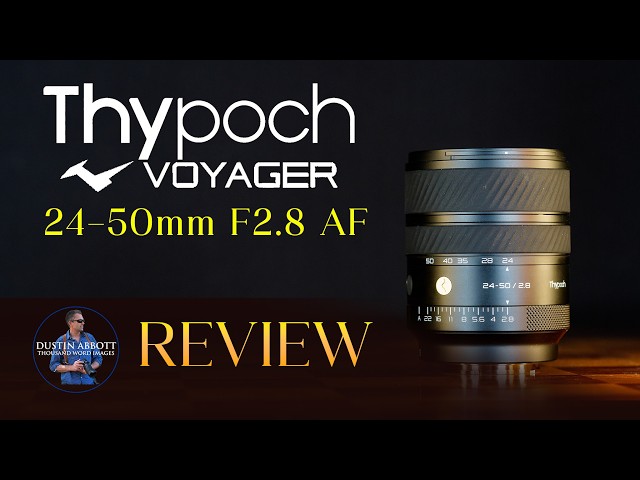
Thypoch Voyager 24-50mm F2.8 Review | China's First AF Zoom Lens!
Apr 22, 2026

Photographer Dustin Abbott takes a deep dive look at China's first autofocus zoom lens - the full-frame Thypoch Voyager 24-50mm F2.8 for Sony E-mount. | Read the Text Review: | Purchase the Thypoch Voyager 24-50 @ B&H | Adorama | Amazon | Amazon Canada | Amazon UK | Amazon Germany
Check out the DA Merch here: https://bit.ly/TWIMerch | Become a Patron: https://www.patreon.com/dustinabbott | On the Web: http://dustinabbott.net/ | Sign up for my Newsletter: http://bit.ly/1RHvUNp | Instagram: http://bit.ly/DLAinsta | Facebook: http://on.fb.me/1nuUUeH | Flickr: http://bit.ly/1UcnC0B | 500px: http://bit.ly/1Sy2Ngu Follow Craig @ https://www.instagram.com/craigstoffersen/
Want to support this channel? Use these affiliate links to shop at:
B&H Photo: http://bhpho.to/1TA0Xge
Adorama: https://howl.link/nt4zdz1goa7ql
Camera Canada: http://bit.ly/DLACameraCan
Sony Canada: https://www.thesonyshop.ca/?ref=abbott
Amazon: https://amzn.to/3HrY64d
Amazon Canada: https://amzn.to/3qG1p18
Ebay: http://bit.ly/DustineBay
Into the AM Clothing: https://bit.ly/intotheAMda and use code DUSTIN10 for 10% off
Fioboc Clothing: https://tinyurl.com/FiobocDA20 and us code DUSTIN20 for 20% off
Make a donation via Paypal: https://www.paypal.com/paypalme/dustinTWI
=============================
Table of Contents:
=============================
0:00 - Intro
2:18 - Disclosure
2:33 - Build and Features
6:58 - Autofocus for Stills
9:42 - Video AF
12:29 - Image Quality
22:57 - Conclusion and Pricing
---------------------------------------------------------
Oben Tabletop Tripod shown in video: https://bhpho.to/3vL8YWy
My Cameras:
Purchase the Sony a7RV @ B&H Photo https://bhpho.to/3ZivNyZ | Adorama https://howl.me/cjNY1LU3gFH | Amazon https://amzn.to/3CRCDlq | Camera Canada https://shrsl.com/3vulf | Sony Canada https://bit.ly/BuyA7R5 | Amazon Canada https://amzn.to/3H8yeNH | Amazon UK https://amzn.to/3kbg5FM
Purchase the Sony Alpha 1 @ Camera Canada https://shrsl.com/2wdk2 | B&H Photo https://bhpho.to/3upRFZd | Adorama https://howl.me/cj2nQpjLBKW | Amazon https://amzn.to/3t1m8MD | Sony Canada https://bit.ly/BuySonyA1 |Amazon Canada https://amzn.to/3cVFrBB | Amazon UK https://amzn.to/2OtrjGe | Amazon Germany https://amzn.to/3d0GtMO | Ebay https://ebay.us/i371Vs
Canon EOS R5: B&H Photo https://bhpho.to/3iMH18x | Amazon https://amzn.to/33L3D53 | Camera Canada https://shrsl.com/2jqth
Purchase the Fujifilm X-H2 @ B&H Photo https://bhpho.to/3KAInTC | Adorama https://howl.me/cjyzbiO5lVp | Amazon https://amzn.to/41zMzKl | Camera Canada https://shrsl.com/4128o | Amazon Canada https://amzn.to/40gY4W7 | Amazon UK https://amzn.to/43Grn7a | Amazon Germany https://amzn.to/3L6hwjR
Get a discount off all Skylum Editing Software (Luminar, Aurora HDR, AirMagic) by using code DUSTINHDR at checkout: http://bit.ly/LuminarDLA
DISCLAIMER: This video and description contains affiliate links, which means that if you click on one of the product links, I’ll receive a small commission. As an Amazon Associate I earn from qualifying purchases.
Keywords: Thypoch, #thypoch, Voyager, #voyager, Thypoch Voyager, 24-50mm, F2.8, Thypoch Voyager 24-50mm F2.8, Thypoch Voyager 24-50mm F2.8, Voyager 24-50, #voyager24_50, Sony a7V, Sony A1 II, α1 II, Sony a7RV, Review, Hands On, Dustin Abbott, Real World, Comparison, Sharpness, Bokeh, Flare Resistance, Autofocus, Image Quality, Sample Images, Video, Photography, let the light in, weathersealing, #letthelightin, DA
Show More Show Less View Video Transcript
0:00
[music]
0:10
>> 2026 [music] is the year that I thought
0:12
we would see the first auto focusing
0:15
zoom lens from a Chinese manufacturer.
0:18
Except for I expected it to be someone
0:20
like Viltrox for example, or maybe
0:23
Sirui.
0:24
But instead, we do have the world's
0:26
first auto focusing zoom lens from a
0:29
Chinese lens maker, but it is from an
0:32
unexpected source. The TTArtisan Voyager
0:35
24-50mm f/2.8 is that first full frame
0:40
auto focus zoom lens from a company that
0:43
hasn't even made auto focus before. So,
0:45
it's a really curious jump for
0:47
TTArtisan, but I'm really glad to see
0:49
that they have had the courage and as
0:52
we're going to see the expertise to pull
0:54
off a zoom lens like this. There's a
0:56
reason why we see most new lens makers
0:59
focus on making prime lenses as opposed
1:01
to zoom lenses because the amount of
1:03
complexity of engineering involved with
1:05
making a zoom lens is well, challenging.
1:08
And it's typically best handled by those
1:10
that have some experience in doing so.
1:13
Outside of the first parties, basically
1:15
we see
1:16
third-party zooms coming from
1:18
well-established companies like Tamron
1:20
and Sigma who know very well how to make
1:23
effective zoom lenses. In this case, it
1:26
is an interesting lens and there is
1:27
really only one direct analog and that
1:30
is the 24-50mm f/2.8 G lens from Sony.
1:34
And when that lens came to market, there
1:35
was some question as to why when there
1:39
was existing lenses on the market
1:41
already that, you know, it covered that
1:43
focal length and more for not a whole
1:45
lot more money. In this case, however,
1:47
the math may add up because the
1:49
TTArtisan lens is an internally zooming
1:51
lens which the Sony was not and maybe
1:54
more importantly, it comes to market
1:56
with an MSRP of $649 US dollars while
1:59
the MSRP for the Sony lens is exactly
2:02
twice that at nearly $1,300.
2:05
And so, if this lens holds up in terms
2:08
of its auto focus and optical
2:10
performance, it's going to be a very
2:12
intriguing option for those of you that
2:14
are looking for a compact zoom,
2:16
particularly I think for video work. So,
2:18
we're going to explore all of that
2:19
today, but first I do want to say thank
2:21
you to TTArtisan for sending me a review
2:23
sample of this lens. They have had no
2:26
input in the review process or my
2:28
findings, however, and my thoughts are
2:30
my own. That aside, let's dive in and
2:32
let's take a look.
2:33
All right, let's take a quick look at
2:35
the build and handling of this new
2:37
TTArtisan lens. MSRP here is $649 US
2:42
dollars. That compares to the Sony
2:44
24-50mm f/2.8. Its MSRP is 1298 or
2:49
literally twice as much exactly. It
2:51
currently retails for right at 1200, so
2:54
it's a $100 off, but still a significant
2:57
difference. The Tamron 28-75
3:00
mm G2 lens cost $899 US dollars and then
3:04
the Sigma 28-70mm is 989.
3:08
Obviously, that puts the TTArtisan lens
3:11
in a really good position.
3:12
What also helps it to stand out against
3:14
these levels of competition is that it
3:16
is the only one here that is an
3:18
internally zooming lens. And as you can
3:21
see, it also has a nice short throw
3:24
there about 70 70° of rotation. And as
3:28
you can see, you're able to
3:30
zoom in and out with nice precision and
3:33
smoothness even while shooting video.
3:34
And so, I really really like that aspect
3:36
of the design.
3:38
Also, compared to the Tamron and the
3:40
Sigma,
3:41
there is obviously much more in terms of
3:44
a feature set, aperture ring, AF/MF
3:47
function button. It just has a more
3:49
thorough degree of control there. Now,
3:51
the Sony has all of this plus the
3:54
ability to de-click the aperture and so,
3:55
it wins on that front. But the TTArtisan
3:57
is doing a great job of delivering a
4:00
fully featured lens here for a minimal
4:02
amount of money. I also appreciate the
4:04
fact that while there are a few, I would
4:07
say Sigma cues here, they've made sure
4:10
to have a unique style. And so, rather
4:12
than Sigma's ribs, we've got a diamond
4:14
pattern here on the aperture ring. We've
4:16
got these this neat unique spiral
4:18
pattern and a rubberized surface here.
4:20
And these do have a nice tactile feel to
4:22
them both of the rings and so, I really
4:24
like that. The size here of the lens is
4:26
just 70 mm in diameter or 2.5 inches and
4:30
92.8
4:32
mm in length or 3.65 inches. Obviously,
4:36
its further advantage here is the fact
4:39
that even at all, you know, zoom
4:41
positions, it is going to be the same
4:43
overall length making this a really nice
4:45
lens for gimbal work not only because
4:47
it's lightweight, but also because it's
4:50
going to keep that maintain that
4:52
consistent balance point. It weighs only
4:54
450 g or 15.87
4:58
oz and that is despite having all metal
5:00
in its construction. Very very nicely
5:02
built. All of that is very very good. Up
5:05
front, we have 67 mm standard filter
5:08
threads that are shared across a lot of
5:10
different lenses. I love that. We also
5:12
have a weather sealing gasket here
5:15
along with some internal seals and when
5:17
I asked TTArtisan, they said that it
5:18
actually has an IP52 level of sealing.
5:22
You put a
5:24
filter on the front and that jumps up to
5:26
an IP53.
5:28
And so, that, you know, means that it's
5:30
dust and moisture sealed. Aperture ring
5:32
here has clicks at the 1/3 stop detents
5:35
and then a firmer detent between f/22
5:39
and automatic. It's I think well
5:41
calibrated there. I don't think you're
5:42
going to get there by accident. I would
5:44
appreciate the ability to de-click the
5:46
aperture because in so many ways this is
5:48
a great video lens and so, that would
5:50
have been a nice additional step there.
5:53
The aperture iris itself is 10 blades
5:56
and and so, that, you know, high blade
5:58
count allows you to maintain a circular
6:00
shape as you can see here as you stop
6:02
the lens down.
6:03
We have an AF/MF switch. We have a
6:05
custom button there
6:07
that you can program to whatever
6:09
function from within the camera. We have
6:11
a manual focus ring that has a nice
6:13
level of damping and it turns smoothly.
6:16
Minimum focus distance here is 30 cm and
6:20
the magnification level is right under
6:21
0.22 times. And so, a very useful level
6:25
of magnification, not quite as high as
6:27
the Sony's, but then that higher level
6:29
of magnification on the Sony is accessed
6:31
at the 24 mm end and you basically have
6:33
to be putting the lens right on top of
6:35
your subject to achieve it. And so, this
6:37
is a useful amount of magnification and
6:39
I like the fact that it is accessed at
6:42
the 50 mm end which is more useful.
6:44
There is no lens-based optical
6:46
stabilization. However, that's true for
6:49
all of the competing lenses here. And
6:51
so, overall a very nice, very compact
6:53
package and a very attractive lens, I
6:55
have to say. So, kudos to
6:57
TTArtisan on that. So, let's talk auto
7:00
focus. In many ways, that may be the
7:02
single biggest consideration considering
7:04
that TTArtisan is a company that hasn't
7:06
made auto focus lenses before and
7:08
they've dived right into the complexity
7:10
of making a zoom lens. While they
7:12
haven't specified the focus system, I'm
7:14
assuming that it's an STM type focus
7:16
motor from the behavior. And again,
7:18
because this is a relatively wide zoom
7:22
all throughout, it reaches a maximum
7:24
focal length of 50 mm, it means that
7:26
there isn't a tremendous amount of
7:28
stress on the focus motor. And focus
7:30
speed, as you can see here, is
7:32
relatively snappy going back and forth.
7:35
It's not that instantaneous that we see
7:37
from some of Sony's own zooms that have
7:40
multiple XD linear motors, but it's fast
7:43
enough to get the job done
7:45
in most situations.
7:47
That being said, I will say that like a
7:50
lot of third-party lenses, things start
7:52
to fall apart from me if the subject is
7:54
moving, particularly moving towards the
7:56
camera. And it seems like there's always
7:58
just a little bit of back focus in those
8:00
situations. Now, the good news is that
8:02
I've seen similar behavior, for example,
8:04
from some Viltrox lenses in the past and
8:06
I've also seen them able to largely
8:08
correct that through firmware. And
8:10
because this lens is equipped with the
8:12
ability to do quick and easy firmware
8:14
updates, I'm hoping we're going to see
8:16
the same from TTArtisan and maybe that
8:17
will become better. It seems to me like
8:19
there's plenty of thrust and basic focus
8:22
speed there to achieve that and so,
8:23
maybe it's just an algorithm/processing
8:26
issue that could be resolved via
8:28
firmware. I also felt like there were a
8:30
few situations where auto focus wasn't
8:33
perfectly calibrated to where I
8:35
questioned sharpness and contrast a bit
8:38
because maybe focus was just a tiny bit
8:40
off. Because in other situations where
8:42
things were more accurately focused, I
8:44
felt like sharpness and contrast were
8:46
better in those situations. And so, I do
8:48
think that there is a little room for
8:50
improvement here, but at the same time,
8:53
all of the eye detect seems to work well
8:55
and and so, I had no problem with, you
8:57
know, nabbing a subject whether it was
8:59
in a church setting, you know, shooting
9:01
group photos with it, you know, just
9:03
kind of using it in a general purpose
9:04
way, shots of animals, be it the, you
9:07
know, the cat or of of sheep when I went
9:10
out to visit a farmer who's got lamb
9:13
doing lambing right now.
9:14
But in all those situations, auto focus
9:16
generally was good and so, I didn't have
9:18
any kind of significant problem with
9:19
auto focus. I just feel like there's
9:21
still a little bit of room for
9:23
improvement just on the margins. But in
9:26
general, I would say that auto focus was
9:28
good and in terms of of quietness, even
9:30
when I put my ear next to the lens
9:32
barrel, I really couldn't hear the focus
9:33
motor at all. And so, it gets good marks
9:35
from me when it comes to focus
9:37
smoothness. So, in general for stills
9:39
work, I felt like that auto focus was
9:42
good, but there is room for improvement.
9:44
Now, on the video side of things, I
9:46
actually felt really positive about what
9:48
I found. You can see in my I focus pull
9:51
test where I'm doing touch to focus that
9:53
pulls back and forth happen with good
9:55
confidence. There's no visible steps.
9:57
There's no pulsing in the wrong
9:59
direction or settling when it arrives on
10:01
the subject. Good confidence in that
10:03
setting. Likewise, when I did my hand
10:05
test, it made those accurate transitions
10:07
from the hand to the eye and back and
10:10
forth.
10:11
Focus breathing isn't as bad as Sony's
10:13
own 24 to 50 mm f/2.8, but at the same
10:17
time, as a third-party lens, Viltrox
10:19
will not have the advantage of having
10:21
access to focus breathing compensation
10:23
that's available in some of Sony's
10:25
cameras. At the same time, however,
10:27
you're also not going to have to deal
10:29
with a crop factor to eliminate that
10:31
focus breathing. And in most situations,
10:33
it isn't bad, but at the same time,
10:35
there is just enough of it that in some
10:37
of those focus pulls, it takes me out of
10:39
the shot a little bit because focus
10:41
feels a little bit abrupt. Now,
10:43
obviously, that's exaggerated when I'm
10:44
just tapping back and forth, back and
10:46
forth. It's going to be a little bit
10:47
less obvious if you're not making quick
10:49
and sudden changes on that.
10:52
There is good focus accuracy as I
10:54
approached the camera, and if I ducked
10:56
in and out of frame. And as you've
10:58
probably noticed in these outdoor
11:00
settings,
11:01
I'm having no problems with it locking
11:03
on and focusing on my face. And when I'm
11:06
moving around in front of the camera, it
11:08
is staying accurately focused on me. In
11:10
fact, I've actually used this lens a
11:11
fair bit over the last month here on my
11:14
YouTube channel because I do consider it
11:15
to be a very, very handy lens for video
11:18
work. That is kind of doubled not only
11:21
by the basic focal range here, which is
11:23
obviously very useful for video, but
11:25
beyond that, that internally zooming
11:27
design is extremely useful. And
11:30
particularly so if you're considering
11:31
doing gimbal work because whatever focal
11:33
length that you choose, the balance is
11:35
going to be the same. And that internal
11:37
zoom also means that I have no problem
11:39
zooming in and out. It's a nice short
11:42
throw, about 70° or so of rotation to go
11:46
from 24 to 50 mm, and the zoom action is
11:49
smooth enough that I'm able to zoom
11:51
while recording, even handheld, without
11:53
any issue.
11:54
And to me, that's very, very useful. And
11:56
while I wouldn't call the lens parfocal,
11:59
it's not, it's it doesn't have major
12:01
focus changes. And the fact that
12:03
autofocus is reactive enough, you can
12:05
see when we zoom back and forth, there
12:07
isn't any obvious moments where things
12:09
are out of focus and focus has to be
12:11
regained. What's more, even when I'm
12:13
zooming like that, I don't really see
12:14
any issues with wobble or warping. And
12:17
so, all of that adds up to a really good
12:19
combination for video work. And in many
12:21
ways, to me, I feel like that is one of
12:24
the best applications for this lens
12:26
outside of maybe having a compact travel
12:28
zoom to bring along. All right, let's
12:30
start by taking a look at the optical
12:32
design here. We have a rather complex
12:34
design of 16 elements in 13 groups. And
12:37
as you can see looking at the MTF chart,
12:39
particularly the 30 lines per, which is
12:41
represented by the blue, we can see that
12:43
we start with a very, very sharp center
12:46
right up around 90%. We can see that
12:48
there is a little astigmatism separation
12:50
between the sagittal and meridial lines
12:53
here at the middle of the frame that
12:54
starts to grow out. And then we can see
12:56
kind of a steady decline into the
12:57
corners. And the corners are averaging
13:00
in the 51, 52% range. And so, not
13:03
fantastic. Moving on to the 50 mm range,
13:06
we can see that the center isn't as
13:08
sharp. And so, we're dropping down into
13:10
like an 83%. However,
13:12
got a nice bounce back here in the
13:14
mid-frame, and then a steadier drop down
13:16
to more like right over 40%. So, don't
13:19
expect a lot of sharpness in the
13:21
corners. So, just out of curiosity, if
13:23
we take a look at the Sony 24 to 50 mm,
13:26
at the 24 mm end, not quite as sharp in
13:29
the center of the frame, a little bit
13:30
stronger in the mid-frame and corners.
13:32
However, at 50 mm, a little bit sharper
13:35
in the, well, basically all across the
13:37
frame. At 50 mm, it has a stronger
13:39
performance. And you can also see taking
13:41
a look at the two different axes that
13:43
they stay a little bit closer together.
13:45
So, a little bit better contrast for the
13:47
Sony lens. Then again, it costs twice as
13:49
much. In some of the other metrics,
13:50
however, the Viltrox actually does
13:53
better. Like when it comes to
13:54
distortion, for example, even at 24 mm,
13:56
you can see that while there is barrel
13:58
distortion, it's relatively minor.
14:01
Unfortunately, it is a little bit
14:02
complex. And so, if I straighten out the
14:04
lines pretty much everywhere here
14:06
manually, you'll see that it stretches
14:08
out those corners into a bit of a
14:09
pincushion distortion look. So, to get
14:11
this result, I dialed in a +14, so about
14:13
half what the Sony has. And as far as
14:16
vignette, again, that's moderate. I
14:17
dialed in a +64, so that's fine other
14:20
than the fact it kind of left a little
14:21
bit of a discoloration after correction.
14:24
The middle of the zoom range is
14:25
basically neutral when it comes to
14:27
distortion. By the telephoto end, you
14:29
can see that it flips to a little bit of
14:31
a pincushion style distortion.
14:33
Fortunately, there's much less of it and
14:35
it's much easier to correct as far as
14:37
the linearity. And so, no problems
14:39
there. I used a -6 to correct the
14:42
distortion and just a +41 to correct the
14:44
vignette, and you see it doesn't have
14:46
that same issue with discoloration. And
14:49
when it comes to longitudinal style
14:50
chromatic aberrations, pretty good marks
14:52
on this front. You can see there's a
14:53
tiny bit of a green fringing after the
14:55
plane of focus, but, you know, you can
14:57
see in some of these results that it's
14:59
not terrible. There's a little bit
15:01
that's showing up there. If you look at
15:03
my dad's old SLR, you can see that
15:05
really on these shiny bits, it's not
15:07
doing too bad, just minor amounts of
15:09
fringing there. If we look up to the
15:11
specular highlights for a moment, you
15:12
can see there's a fairly
15:15
dominant inner line, which I don't love,
15:17
but very mild amounts of fringing around
15:20
them. As we stop down, you can see that
15:22
those 10 blades keep a nice circular
15:24
shape. Just gets more pronounced as you
15:26
stop the lens down here all the way to
15:28
f/5.6. Here's another object that shows
15:32
off a lot of fringing if a lens suffers
15:34
with that. And you can see it really
15:36
does quite good here. Good contrast and
15:38
detail here, and then we can see just
15:40
very mild amounts of fringing that pop
15:42
up. So, a strong performance there. And,
15:44
you know, at this close focus distance,
15:46
a pretty strong defocus of the
15:47
background as well. Here's one other
15:49
place where I often see a lot of
15:50
fringing, and this image really
15:52
impressed me. It did great in terms of
15:55
contrast and detail and minimal fringing
15:57
in that situation. So, nicely done. Now,
16:00
lateral style chromatic aberration,
16:02
there is a bit more of that. As you can
16:04
see here, you can see it on either side
16:06
of the black, you know, lines there. And
16:08
so, I would like to see a little bit
16:09
less of that. However, fortunately, this
16:11
is the one that corrects the most
16:13
easily. So, how about resolution and
16:15
contrast? Well, we're testing on a
16:16
61-megapixel a7R Mark V. I'm going to
16:19
show you these results at 200%. In the
16:21
center of the frame, even at 200%
16:23
magnification, top-notch. Great detail,
16:25
great contrast at 24 mm. Looks
16:27
fantastic. Mid-frame looked good here,
16:31
but you can see it's definitely
16:32
declining by this side. A lot of times,
16:35
I look at this bill here, and you can
16:36
see that it's good up in this corner,
16:39
starting to drop on this side. And then
16:41
as we get on into the actual corners, we
16:43
can see that by the time we get out to
16:44
here, there's not a lot of image quality
16:47
there. Now, while that's not like an
16:49
absolute terrible performance at f/2.8,
16:51
the problem is that it really doesn't
16:53
sharpen up a lot in those far corners,
16:56
even stopped down to f/5.6 and f/8. So,
16:59
you can see that out here, it's
17:00
improved. And if we pan up this way for
17:03
a moment, you can see it's definitely
17:04
improving in this zone. If we pop up and
17:07
take a look in the mid-frame once again,
17:09
you can see the mid-frame looks
17:10
fantastic. But, you know, those corners,
17:12
they only get so sharp. They're
17:14
improved, but there's still definitely
17:17
room for improvement. Here's a
17:19
real-world shot at a more typical 100%
17:21
magnification, and you can see that
17:23
center of the frame, fantastic. Looks
17:25
great. It's looking good out through
17:27
this zone, but as we start to get
17:29
towards the edge of the frame, the
17:31
corners, it's quite a bit mushier, just
17:33
not nearly as good right out towards the
17:35
edge of the frame. You go back in just a
17:37
little bit, starting to get in this
17:38
zone, looks fantastic. Minimum aperture
17:41
is f/22, which is on the right here. And
17:44
you can see at f/11 where diffraction
17:46
starts to set in, the thing still look
17:48
pretty good. By f/22, though, it's
17:50
really been softened by diffraction. And
17:53
so, you're going to want to avoid
17:54
probably f/16 and f/22 as much as
17:57
possible. Moving on in the zoom range,
17:59
the next mark position is 28 mm. I
18:01
almost got it. Um, but you can see that
18:04
the center of the frame looks fantastic.
18:05
Stopping down to f/5.6, more contrast,
18:08
and so just extra fantastic. The
18:10
mid-frame really kind of follows a
18:12
similar pattern. You can see over here
18:14
on at f/2.8, it's sharp on this side,
18:17
dropping on this side. By f/5.6, it's
18:19
nice and sharp there. Once again, we
18:22
find that while the corners do improve,
18:24
they don't get to ever to a pin sharp
18:27
type level, which is kind of the
18:28
weakness of this particular lens. Now,
18:31
at 35 mm, we can see that again, great
18:35
center, just maybe a little bit less
18:36
contrast, but by f/5.6, looking really
18:39
good. Mid-frame is looking good and then
18:43
great by f/5.6. And the corners here,
18:47
they're a little bit better. You can see
18:49
that it at f/5.6 at least, we're getting
18:52
a little bit sharper, but at f/2.8,
18:53
corners are looking really soft. Now,
18:55
near 40 mm, we can see that the corners
18:58
again, wide open, contrast is quite low.
19:02
It actually improves more when stopped
19:03
down to f/5.6. By f/5.6, looking pretty
19:07
decent in the corners. And if you look
19:08
even at a place like the mid-frame
19:10
level, you can see that by f/5.6, it
19:13
looks fantastic. For some real-world
19:14
perspective here at 40 mm, this is
19:17
f/2.8. You can see, I mean, I think
19:19
we're all going to be happy with that
19:21
degree of resolution and contrast.
19:23
Looking really good. Now, at 50 mm, I
19:26
didn't quite get that either, 49 mm, we
19:28
can see that it's a little bit lower
19:30
contrast in the center. And while
19:32
contrast improves when stopped down, I
19:34
didn't actually get a lot of extra
19:36
detail when stopping down in the center
19:38
of the frame. However, mid-frame, which
19:40
tends to be a strength for this lens,
19:42
and you could see that in the MTF curve
19:44
that mid-frame actually is really
19:45
strong. And by f/5.6, even at f/4, it's
19:48
looking really fantastic.
19:50
Often, the corners, again, really,
19:52
really soft at F2.8. By F5.6, it's
19:56
better, but again, never fantastic in
19:59
those corners. And so, I would say my
20:01
biggest kind of optical concern
20:02
resolution and contrast is that when you
20:04
stop the lens down, it doesn't always
20:06
sharpen up every like pin sharp across
20:09
the frame. I always like to supplement
20:11
that with some real world results
20:12
though. So, here if we look at F This is
20:15
50 mm F2.8. You can see that contrast
20:18
isn't off the charts, but you know,
20:20
you're getting a decent amount of detail
20:21
there and a nice transition towards
20:24
defocus. Here again, you can see
20:26
actually in this image, I think the
20:27
contrast and detail looks quite good and
20:30
you can see again a nice transition to
20:31
defocus. Likewise here. And so, here I
20:34
mean depth of field is really tiny
20:36
because I'm getting close to the minimum
20:38
focus distance and I would say at this
20:40
point, you know, contrast is just okay,
20:42
but again, defocus is pretty nice. Now,
20:45
going back to that minimum focus result
20:47
right under 0.22 times, you can see that
20:50
in the kind of area of focus, it looks
20:53
quite good, but it's not a very flat
20:55
plane of focus and so, it gets much
20:57
softer out here as you can see. So, that
20:59
doesn't matter as much with
21:00
three-dimensional objects here at very
21:02
close distances. You know, it's again,
21:04
contrast is not like macro level, but
21:06
that looks nice. I mean, no problems
21:08
with that and overall, the defocus looks
21:11
pretty good. Here, I think that contrast
21:13
actually and detail looks, you know,
21:15
very good. I'm very happy with that and
21:17
again, there's your transition to
21:18
defocus. Here's another image which
21:21
shows you again, contrast not being off
21:23
the charts, but I think perfectly usable
21:25
and nice defocus. Same result here where
21:29
you've got a got a kind of background
21:30
that's further away and you can see how
21:32
nicely to focus that is. And this, I
21:34
think, you know, shows off the lens
21:35
nicely. Again, at 50 mm, good, not
21:39
great, but very good detail there and a
21:41
nicely defocused background. Now, this
21:43
lens has one other flaw and that is that
21:46
on the wide end, flare resistance is
21:48
good, but as you get to the telephoto
21:50
end, you can see here that there is
21:51
places where it just kind of blooms. And
21:54
you can see in this composition here
21:56
that I compose a little bit differently.
21:58
I got good contrast here. It's starting
22:00
to wash out. It's getting that veiling
22:02
across the image. In fact, if you could
22:04
see if I zoom in and out here, you can
22:06
actually see where that side light, you
22:08
know, kind of blooming starts to happen.
22:11
Or in this shot, as I start to pull up,
22:13
you can see where flashing begins. So,
22:15
that's something to watch out for on the
22:17
50 mm end cuz it could produce images
22:20
like this, for example, where I've lost
22:22
contrast entirely because the light is
22:24
hitting it just at the wrong place. You
22:26
can see here but of that flashing effect
22:28
happening right there. On the wide end,
22:30
however, it's much better in terms of
22:32
flare resistance and so, you can see
22:33
here at 24 mm and F11, all you're
22:36
getting is just a little bit of
22:37
prismatic haze. And here at 33 mm, you
22:40
know, the same kind of thing. And
22:41
particularly at 24 mm, I think that that
22:44
sun star, which is 10 bladed, looks
22:46
quite nice, nicely defined and so, you
22:49
know, a nice addition to images. So,
22:50
overall, it's not a flawless optical
22:53
performance. There's some places where I
22:54
would like a little bit more contrast
22:56
and a little less flare, but not bad.
22:58
So, what's my conclusion? Well, first of
23:00
all, I am delighted to see this first of
23:03
the auto focusing zoom lenses come out
23:06
of China and I hope that this is the
23:08
first of many such lenses to come.
23:11
In many ways, I think that this Thypox
23:13
Voyager 24 to 50 mm F2.8 makes more
23:17
sense to me than what Sony's own 24 to
23:20
50 mm does. That lens has having, you
23:23
know, that constrained zoom range at
23:24
such a steep price, I personally would
23:27
be more inclined to reach for something
23:29
like Tamron's 28 to 75 mm F2.8. But in
23:33
the case of the the Thypox lens, it
23:35
gives you that opportunity to have a
23:36
unique zoom in that it's internally
23:39
zooming with more features than what
23:41
either Tamron or Sigma are offering and
23:43
for a a really affordable price point as
23:46
well. And I think when you add all of
23:48
those things up, it makes a lens that is
23:50
going to be an intriguing one for those
23:52
looking for a compact travel zoom. It
23:54
fits really nicely, for example, with
23:56
the Sony a7C series of cameras. I can
23:59
really see it being a nice fit there. I
24:01
can see it being an excellent video lens
24:03
for those that are looking for something
24:04
particularly to use on a gimbal that's
24:06
lightweight and has that easy balance
24:08
point. There's just a lot of factors
24:10
here that make it, I think, a
24:12
interesting proposition even though I
24:14
think all of us would like a little bit
24:16
more zoom range attached to this.
24:19
I also really want to applaud Thypox for
24:22
bringing something unique in terms of
24:24
the visual look of the lens.
24:26
It's not out there where it's going to
24:27
turn people off, but it has enough of
24:30
unique flavor to set it apart from other
24:32
lenses on the market. And so, I think
24:34
they've done a really good job with
24:35
that. And I just like the whole general
24:37
packaging that they have done here. Um,
24:40
you know, the dimensions of the lens and
24:42
it being internally zooming. I've I've
24:44
mentioned that a number of times because
24:45
that really does set the lens apart and
24:48
I do want to emphasize that.
24:50
The optics aren't flawless here. I would
24:52
like a little bit better corner
24:54
performance, maybe a little bit more
24:55
contrast and I wish we didn't have that
24:58
kind of blooming flare issue at 45 to 50
25:01
mm in that range, but at the same time,
25:03
I quite look like the look of images
25:06
coming off of this. And when Thypox
25:08
emphasizes that it's cine inspired
25:11
optics here, I can see kind of that
25:13
signature there. And if you're someone
25:15
that does hybrid work, photo and video,
25:18
you may really like the optical
25:19
performance of this lens. I think the
25:20
colors are nice and accurate and I think
25:22
in many situations, it gives you a nice
25:25
combination of sharpness where it
25:27
matters and then bokeh or rendering in
25:29
the background. And so, in that way, I
25:31
think that it's it's an interesting lens
25:33
and they've done a lot of things well
25:35
with it. I hope that they continue to
25:37
support it through firmware updates and
25:38
maybe make some minor tweaks to auto
25:41
focus stability and precision there, but
25:43
already it's a very effective lens as it
25:45
is and I think it's a very useful lens
25:47
for uh, people that do video work,
25:49
particularly on a gimbal or as I've
25:51
mentioned, those that are looking for a
25:53
compact zoom for travel or just
25:55
something that fits in your bag or on
25:57
your camera. And in that way, I think
25:59
that Thypox has done a really great job
26:02
and hopefully we'll see many more zoom
26:04
lenses out of China in the future. More
26:06
options for us as consumers, the better.
26:09
If you want more information, you can
26:10
check out my full text review, which is
26:12
linked in the description down below. As
26:14
always, thanks for watching. Have a
26:15
great day and let the light in.
Science