

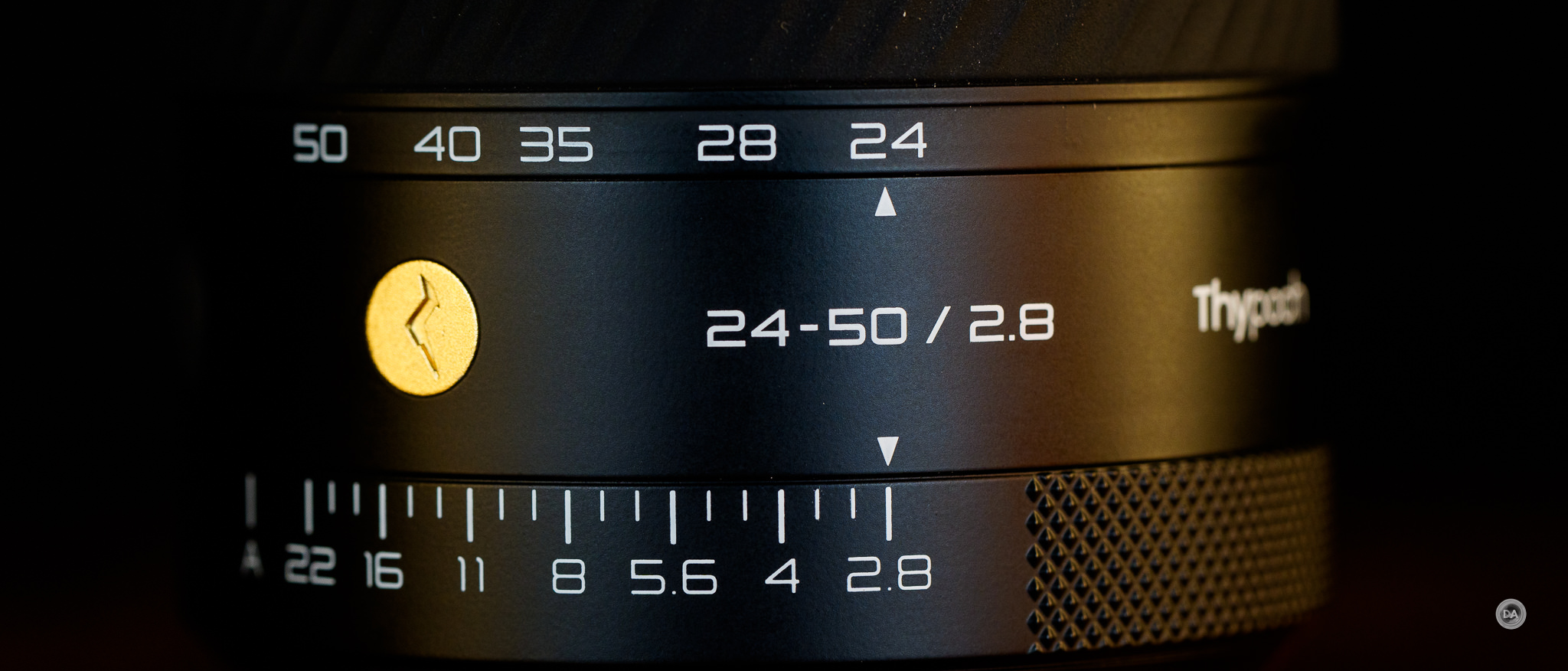
Sometimes companies surprise you. I’ve been waiting for an autofocus zoom lens to come from one of the Chinese lensmakers, fully expecting it to be Viltrox or perhaps Sirui. Instead it comes from a very unexpected source – new lensmaker Thypoch. I was first introduced to Thypoch in 2024 when I reviewed the 28mm F1.4 and 35mm F1.4 lenses from their Simera lineup. These were about as far from autofocusing zooms as you can get, as they were Leica M-mount, manual focus primes. But clearly Thypoch has been aspiring to be something more than a niche, boutique player, as they are back with the industry’s first autofocusing zoom lens out of China – the Thypoch Voyager 24-50mm F2.8. It’s even better that the Voyager is made for full frame rather than the smaller APS-C sensor. This new zoom covers a popular focal length with a compact size, a cine-inspired optical design, internal zoom action, and solid autofocus. It goes right at Sony’s own 24-50mm F2.8 with a similar size and weight, but a price of about half ($649 USD vs $1299 USD). Does that add up to a winning combination? Find out more in either the video review below or by reading on in the text review.
Follow Me @ YouTube | Patreon | Instagram | Facebook | DA Merchandise | Flickr | 500px | X
Thanks to Thypoch for sending me a review sample of this lens. As always, this is a completely independent review. *The tests and most of the photos that I share as a part of my review cycle have been done with the Sony a7RV and the Sony A1 II. You can find the listing for the Thypoch Voyager 24-50mm F2.8 here.
__________________________________________________________________________________________________
AI SUMMARY: The Thypoch Voyager 24-50mm F2.8 marks a significant entry into the autofocus zoom category from a relatively new lensmaker, challenging existing competitors like Sony with a compact and affordable design. With an internal zoom mechanism and cine-inspired optical design, this lens provides good sharpness and features suitable for both photography and video applications. Priced at $649, it undercuts the Sony equivalent while offering attractive details and handling, but it does have some imperfections in autofocus performance and image quality at the edges. Overall, the Voyager impresses as a versatile option for photographers and videographers looking for high performance without the premium price.
Strengths:
- Affordable pricing at $649 compared to competitors like Sony.
- Compact size with an internal zoom mechanism, making it great for video work and gimbal use.
- Solid build quality and attractive design.
- Good sharpness and rendering for most photography and video needs.
Weaknesses:
- Autofocus performance can be inconsistent, particularly with moving subjects.
- Image quality may not match top competitors, especially in the corners.
- Some lens aberrations and flare issues present under specific conditions.
Part of what has allowed Thypoch to dig out a niche quickly in the industry is their attention to detail. They gave us lenses for Leica mounts first, which shows some courage, as the Leica crowd is rather, ahem, elitist. But the Simera primes had really beautiful details to them in both the lens design and the optical design, and I know that they have won some fans. The new Voyager zoom show similar attention to detail, and has an unique design that is really quite attractive.

The optical design is rather tasty, too, delivering often very good sharpness with nice rendering for a zoom lens.

The optical design isn’t flawless, as we’ll see, but there’s a lot to like here. I’ve found the lens perhaps most attractive for filming, as this is a very useful zoom range for video work, and the compact nature (and internally zooming design) makes it a very natural fit.
Let’s explore the details…
Voyager 24-50mm Build and Handling
It is hard to do anything fresh in the lens design space, as companies that do take a bit of a risk (like Laowa and their cobalt-blue finish) tend to get a lot of flack. Too often companies that play it safe end up releasing products that look very derivative of existing lenses. Thypoch has played it smart here, in my opinion, releasing a lens that falls within the “Overton Window ” while also not looking quite like anything on the market. A lot of that comes down to making some unique choices on the rubberized textures of the zoom and focus rings.
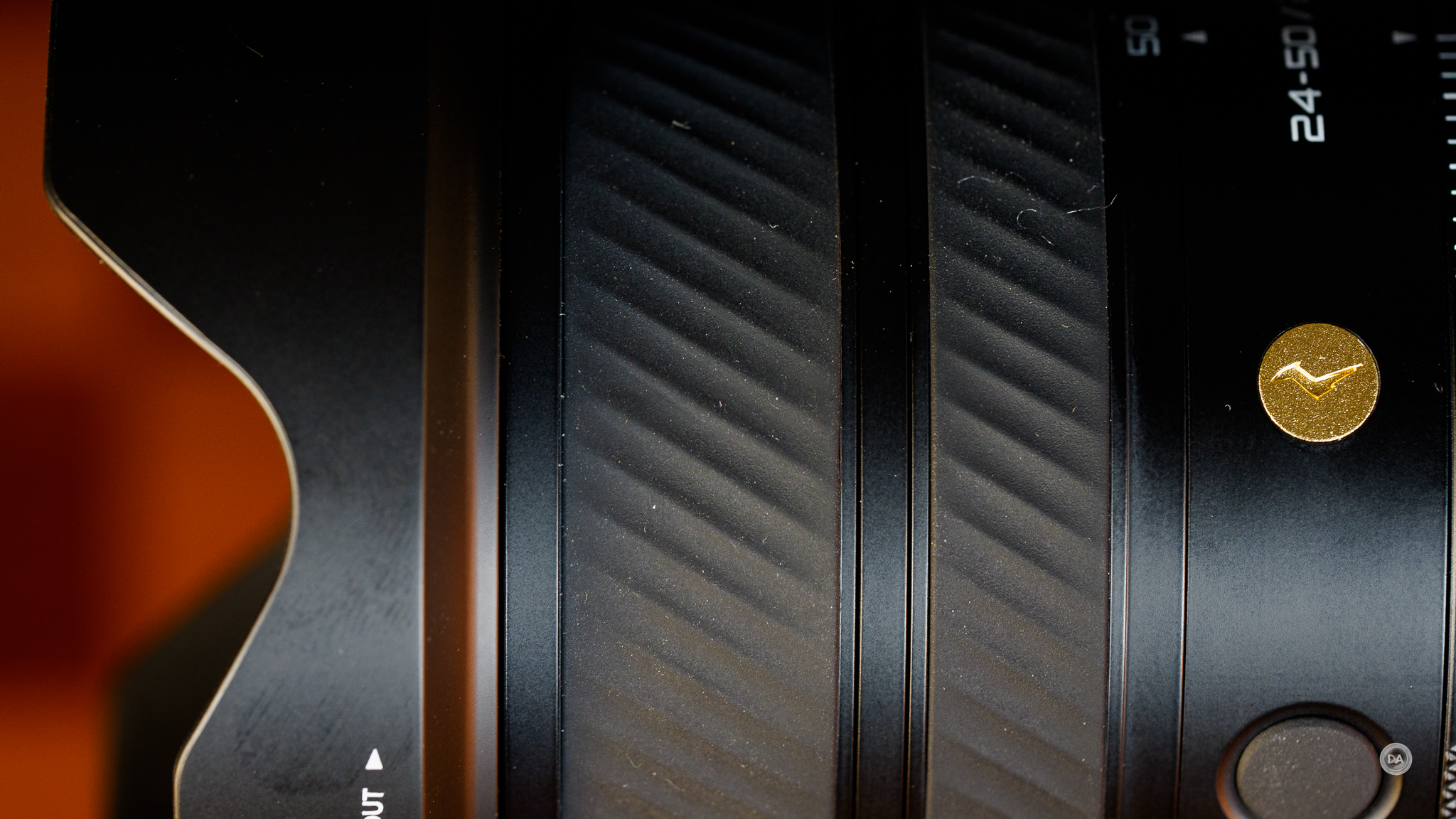
These have diagonal angle to them that almost looks a bit like a spiral, and the textures have a nice tactile feel on your fingers. The only downside is that they do collect lint in a mild way, as these close-up photos show.
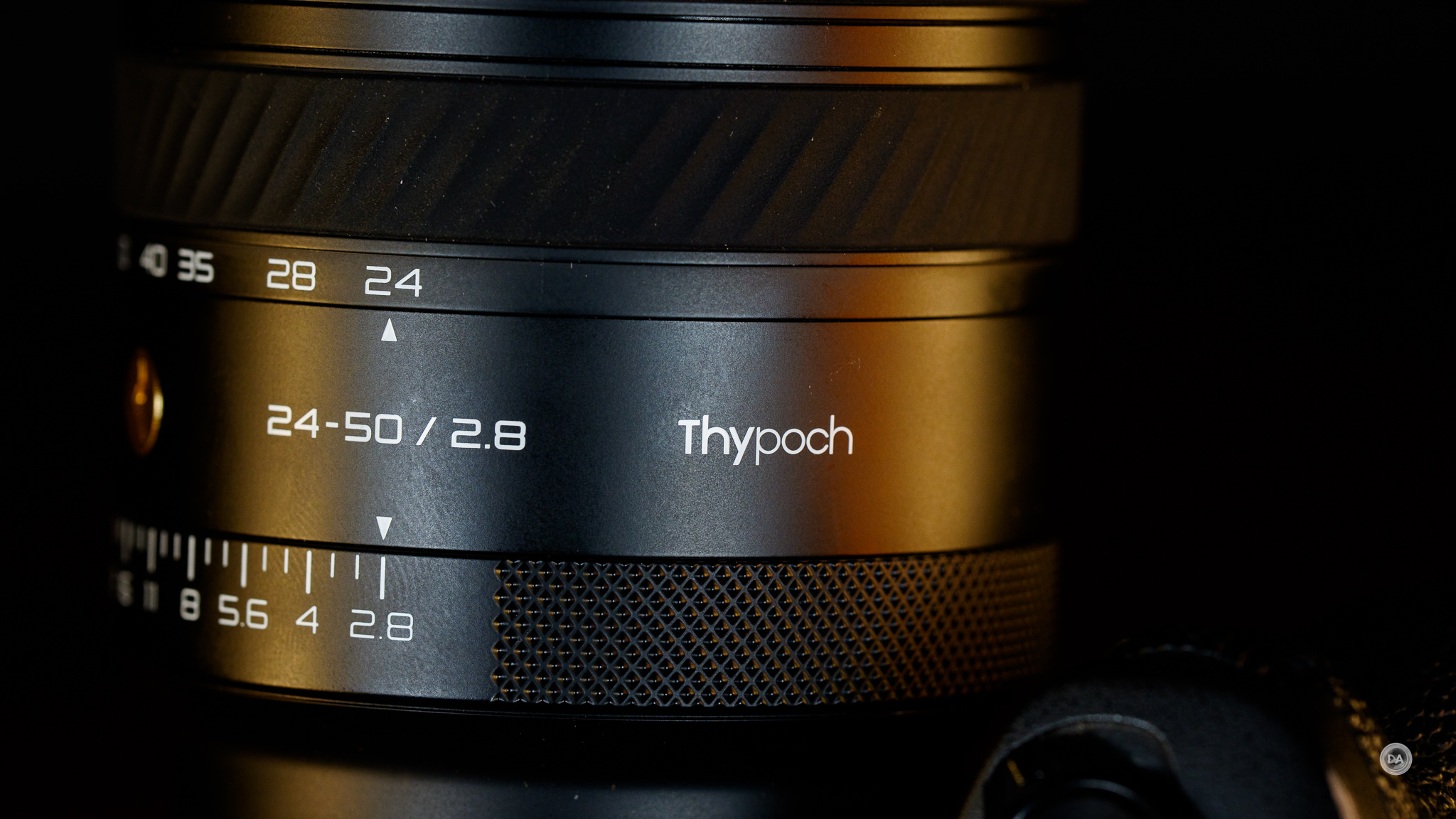
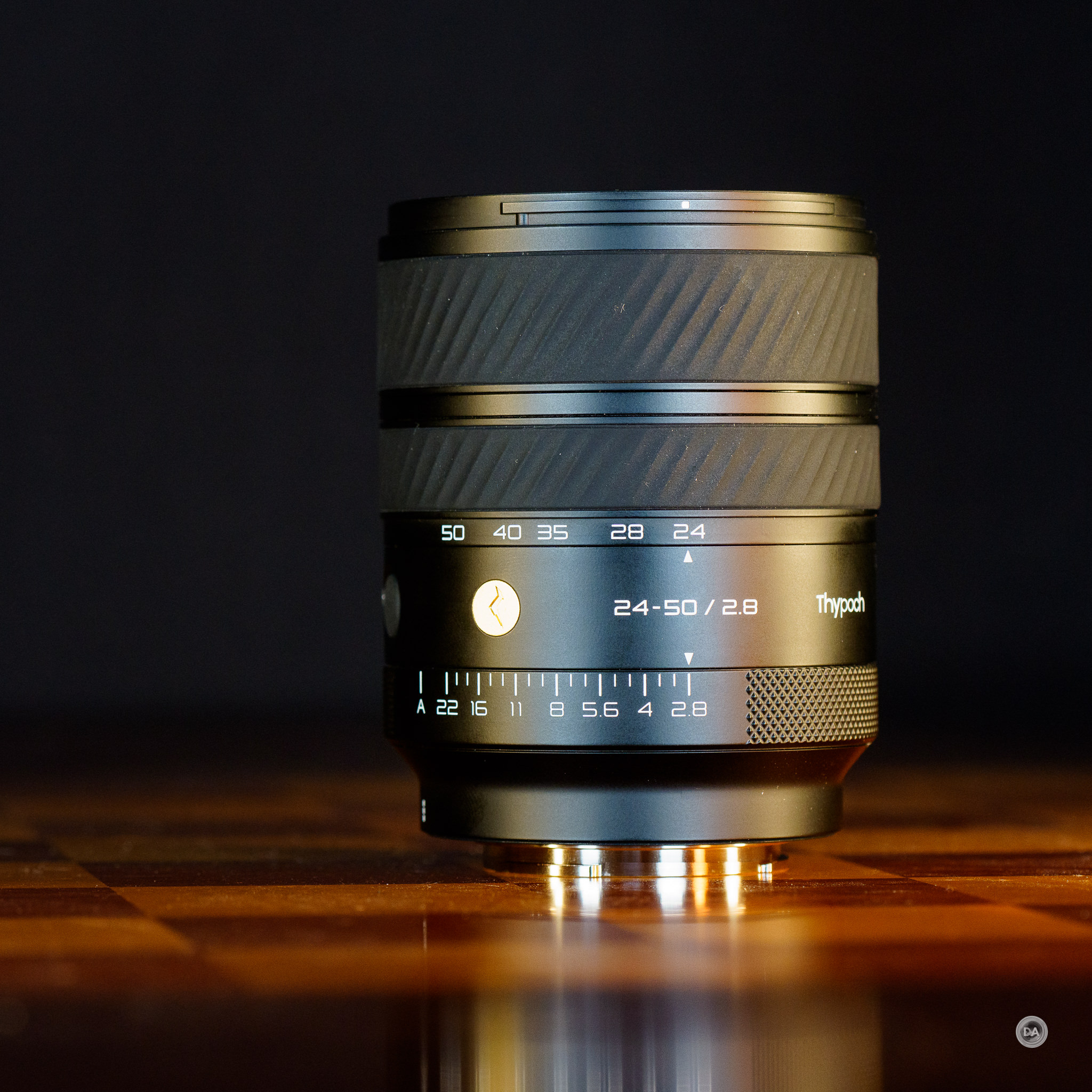
The lens feels substantial and well-made despite its moderate weight. The body materials are all metal, and Thypoch’s choices on branding and fonts feels tasteful and well done. The metal portraits feel most like a Sigma lens, though Thypoch chose a diamond pattern for the aperture ring texture that feels unique from Sigma’s ribbed designs.
The closest analog for the Voyager 24-50mm is one of the rare Sony zooms that I haven’t tested – the FE 24-50mm F2.8 G.
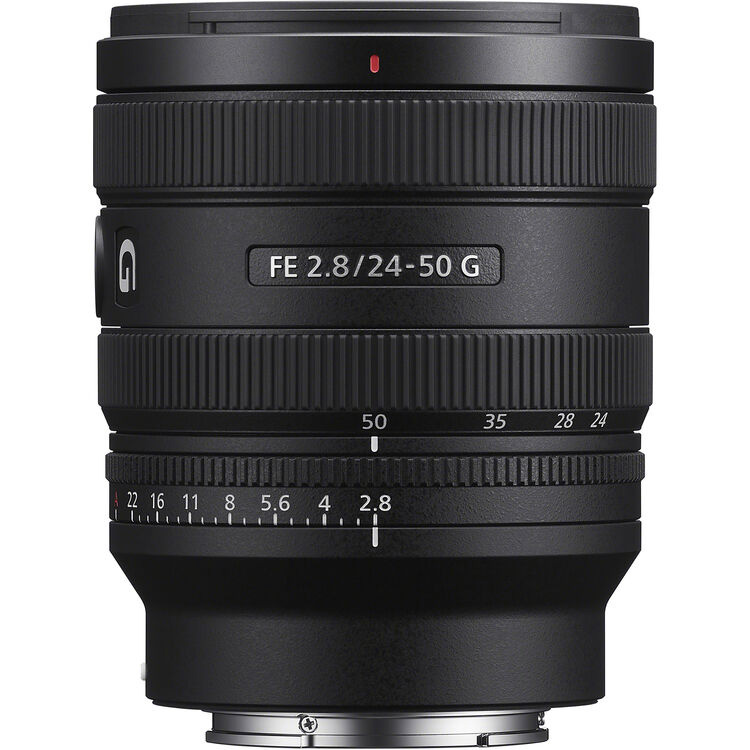
The Sony has an identical focal range and maximum aperture, and is also similar in size. It is 74.8mm in diameter and 92.3 mm in length, which is a little wider than the Thypoch (70mm or 2.5″) but a half millimeter shorter than the Thypoch’s 92.8mm (3.65″) length. The Sony does extend in length (on the wide end), however, while the Thypoch is internally zooming. The Sony weighs in at 440g, while the Thypoch is 450g (15.87oz). Both share a 67mm front filter thread.
The biggest point of separation is in the price. The MSRP of the Sony is $1298 USD, though the current price is $1198 USD due to a sale. The Voyager will come to market with a $649 USD, which is exactly half the MSRP of the Sony.
There are also competitors from Tamron (28-75mm F2.8 G2, a lens I really love) and Sigma (28-70mm, and a lens I’m less enthused about) for $899 and $989, respectively, but these lenses don’t really align in focal length or feature set, making the Sony the most natural competitor.
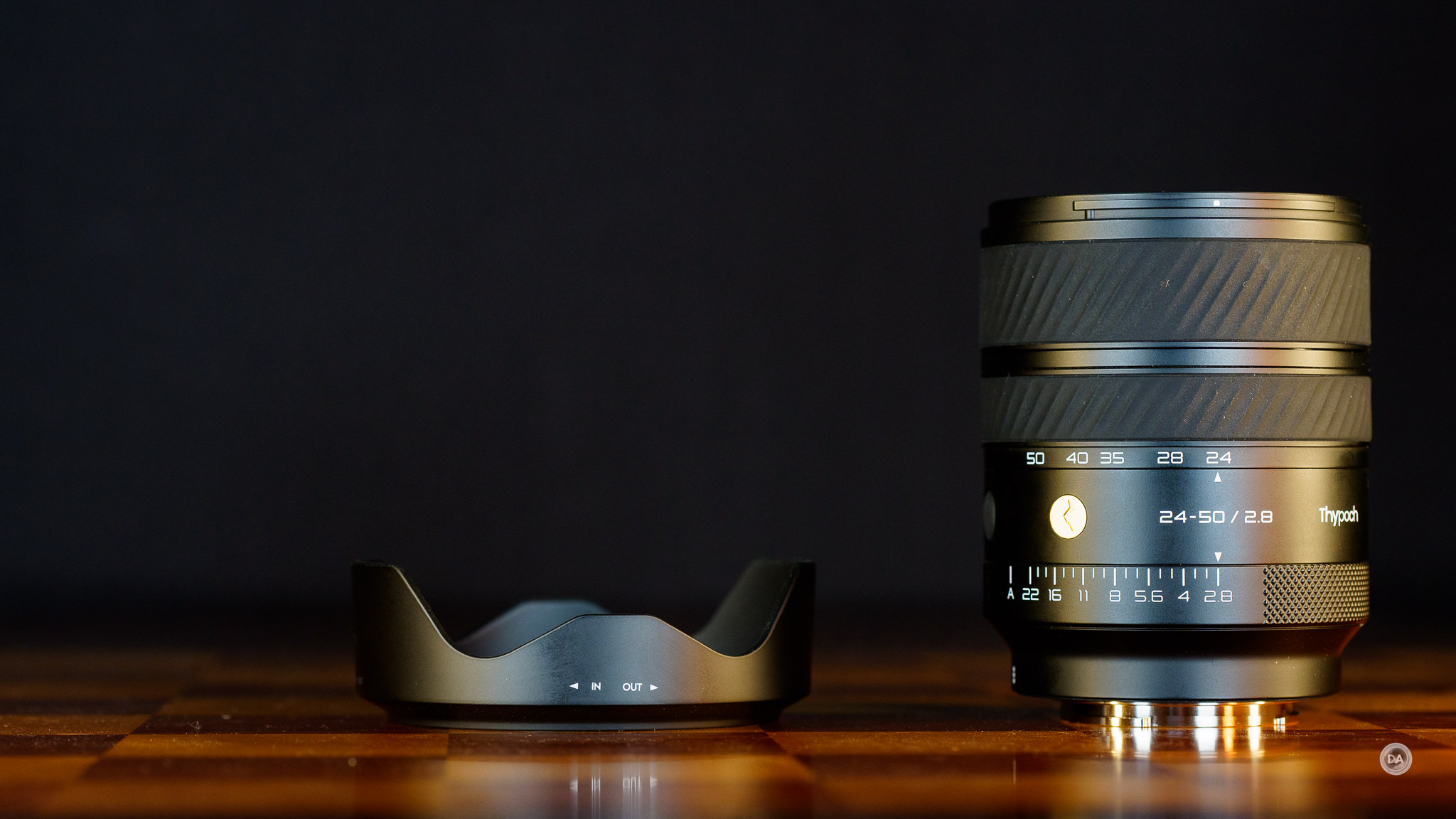
Like the Sony, Thypoch has chosen to equip the Voyager 24-50mm with a thorough feature set. That starts with a clicked aperture ring, with detents at one third stop markings and a firmer separation between F22 (minimum aperture) and the A that represents automatic (in-camera) aperture control. The Sony does have the option to declick the aperture for video work (or personal preference), which is a feature that I do wish the Voyager had.

Neither the Sigma or the Tamron have a dedicated aperture ring.
The aperture ring on the Voyager 24-50mm works nicely, with good precision and alignment on the marked positions.
The aperture iris itself has 10 aperture blades.
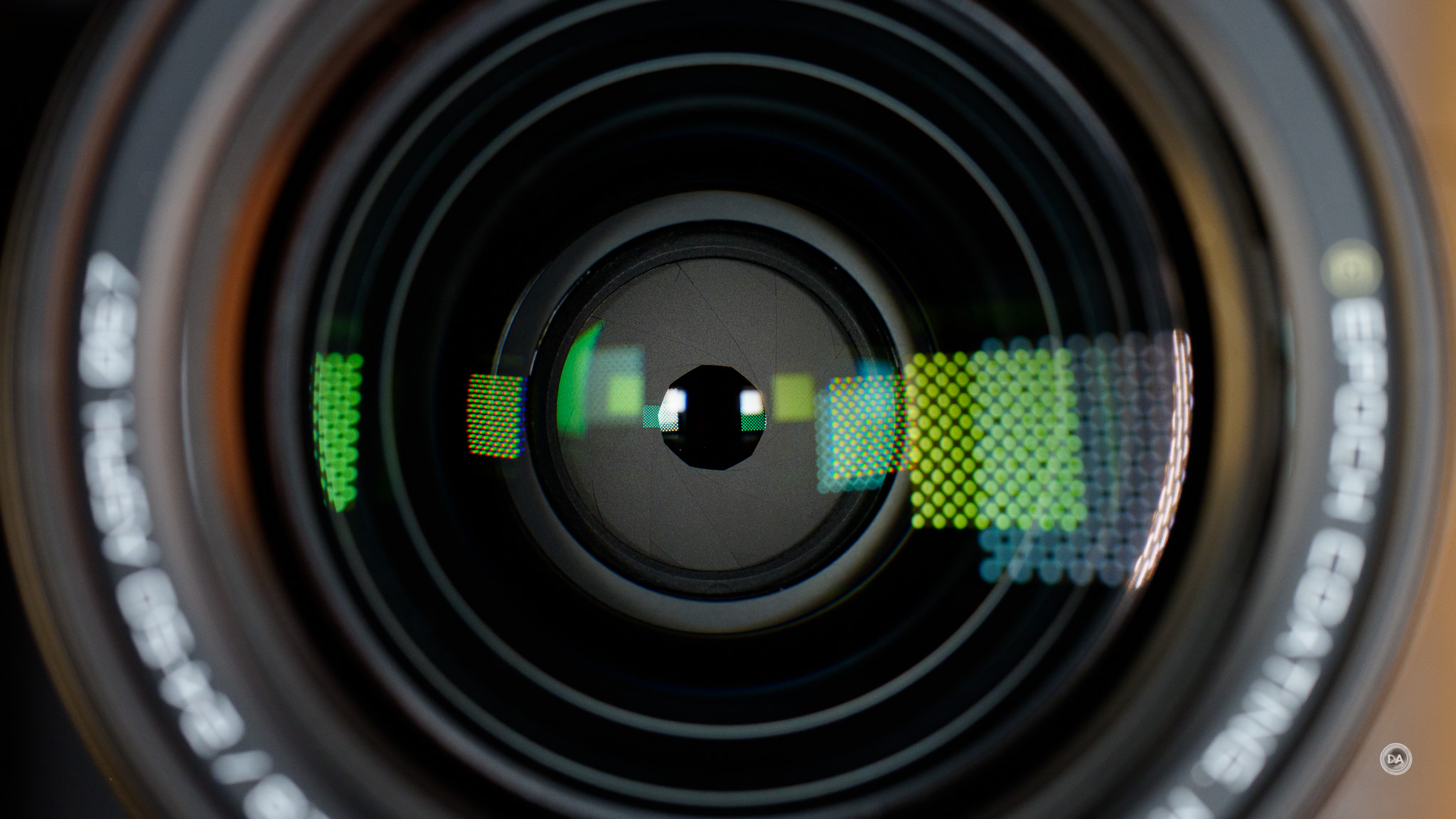
At the small aperture shown above, you can see some straight edges on the blades, but the high blade count makes for a nicely rounded aperture (though with a slight outline of the blades) even when stopped down a fair bit. Here’s what the bokeh geometry looks like at F2.8, F4, and F5.6:
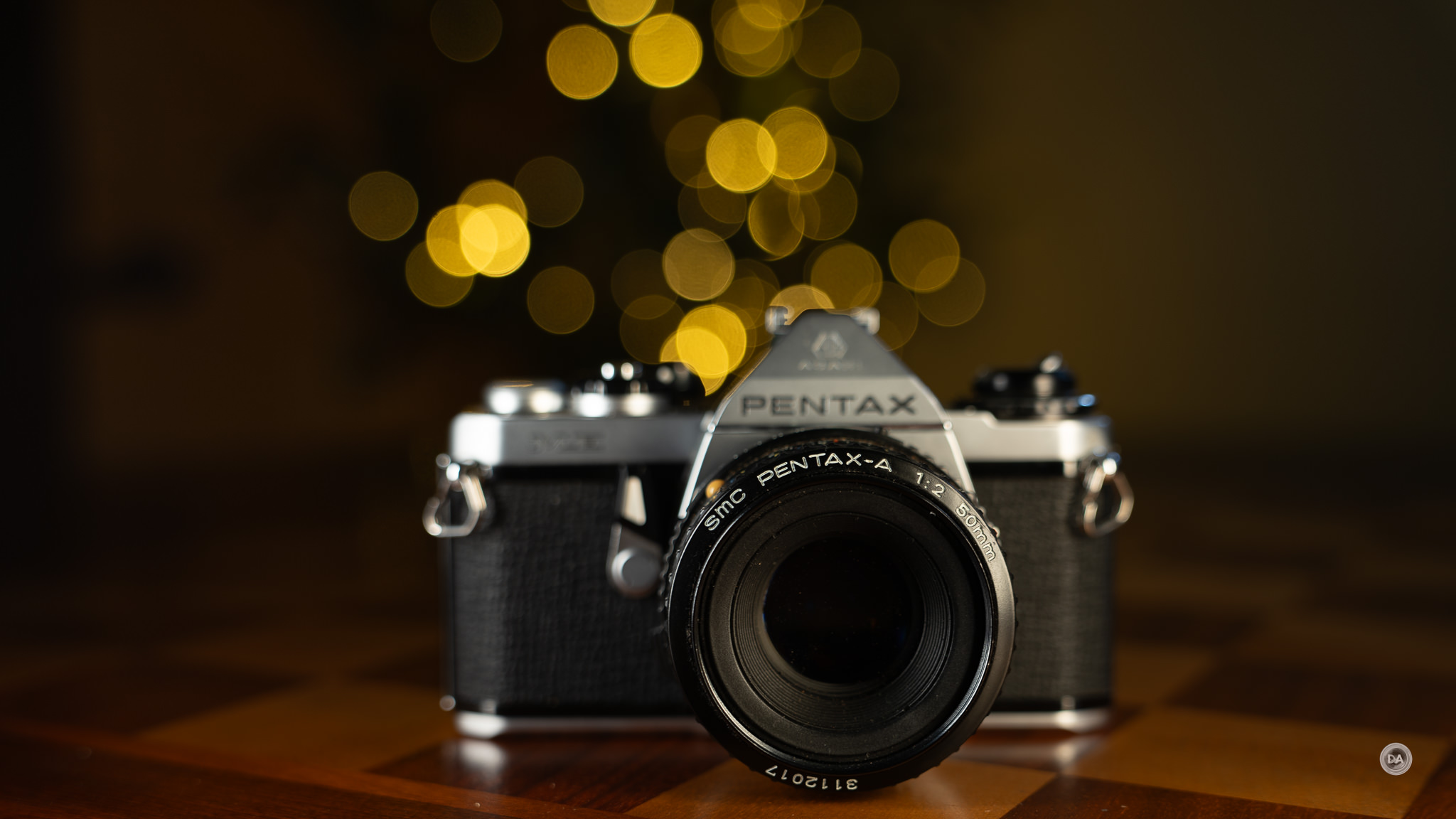
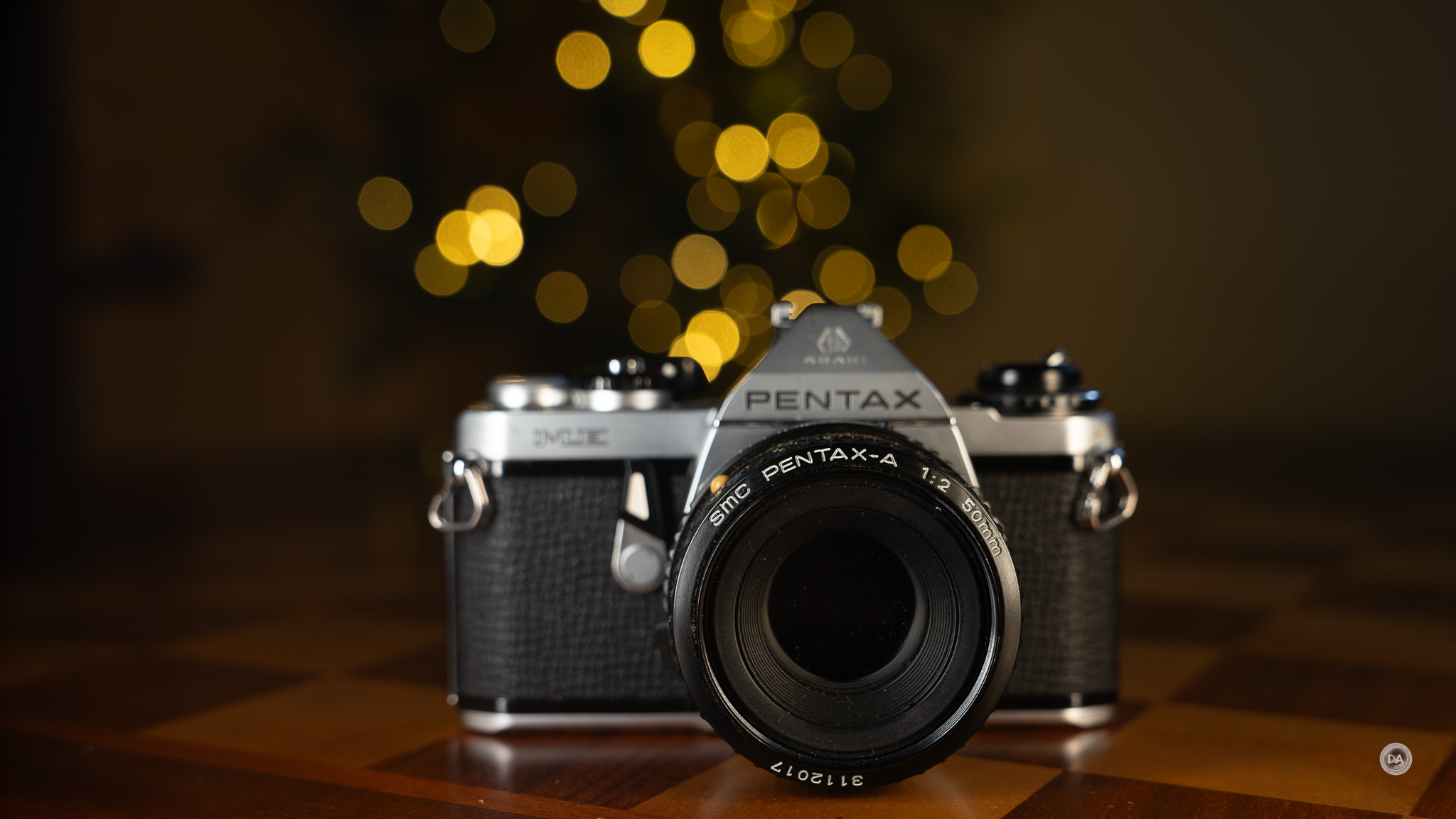

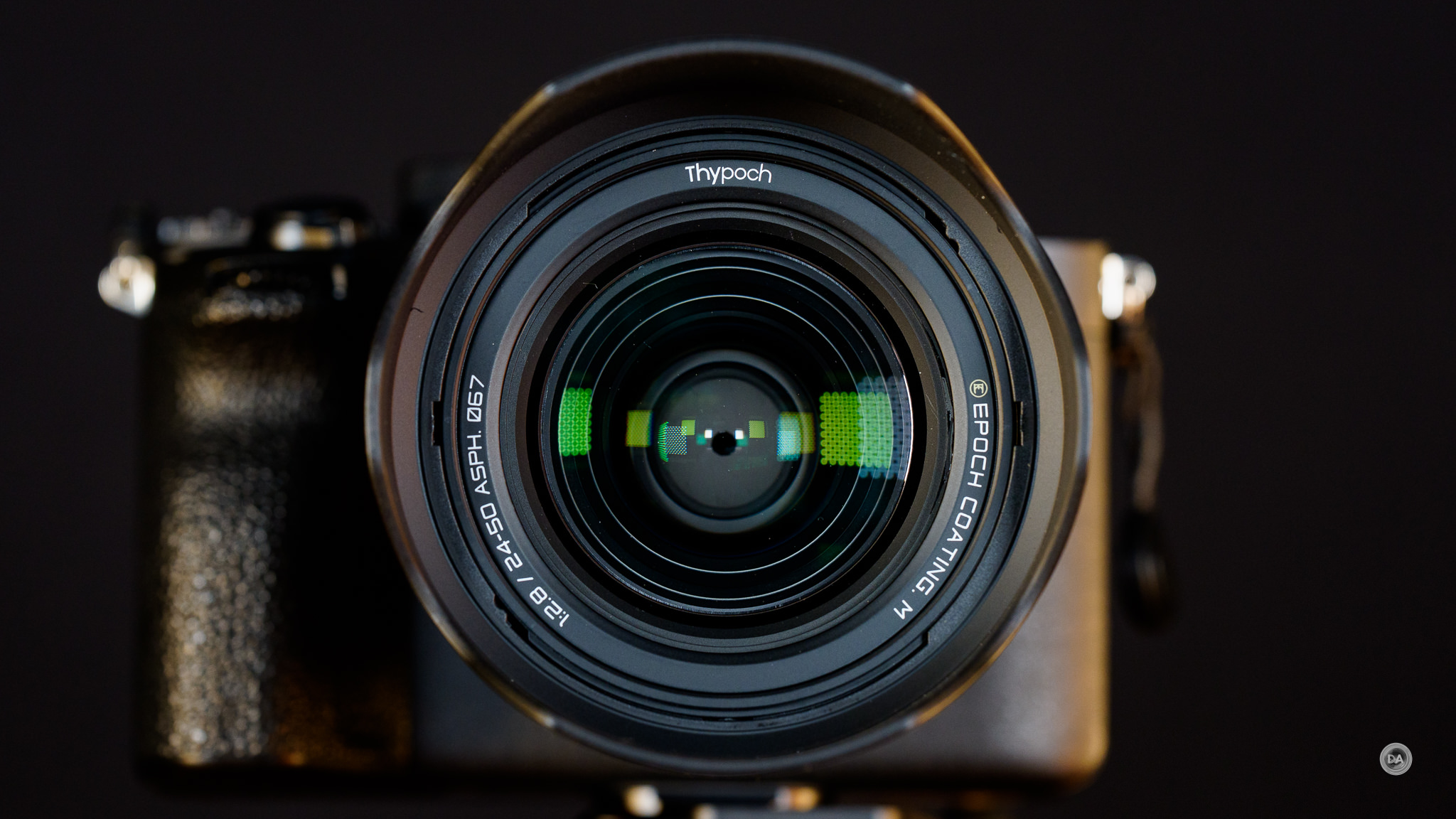
As mentioned previously, there is a very common 67mm front filter size on the front of the lens along with a clean and stylish facade.
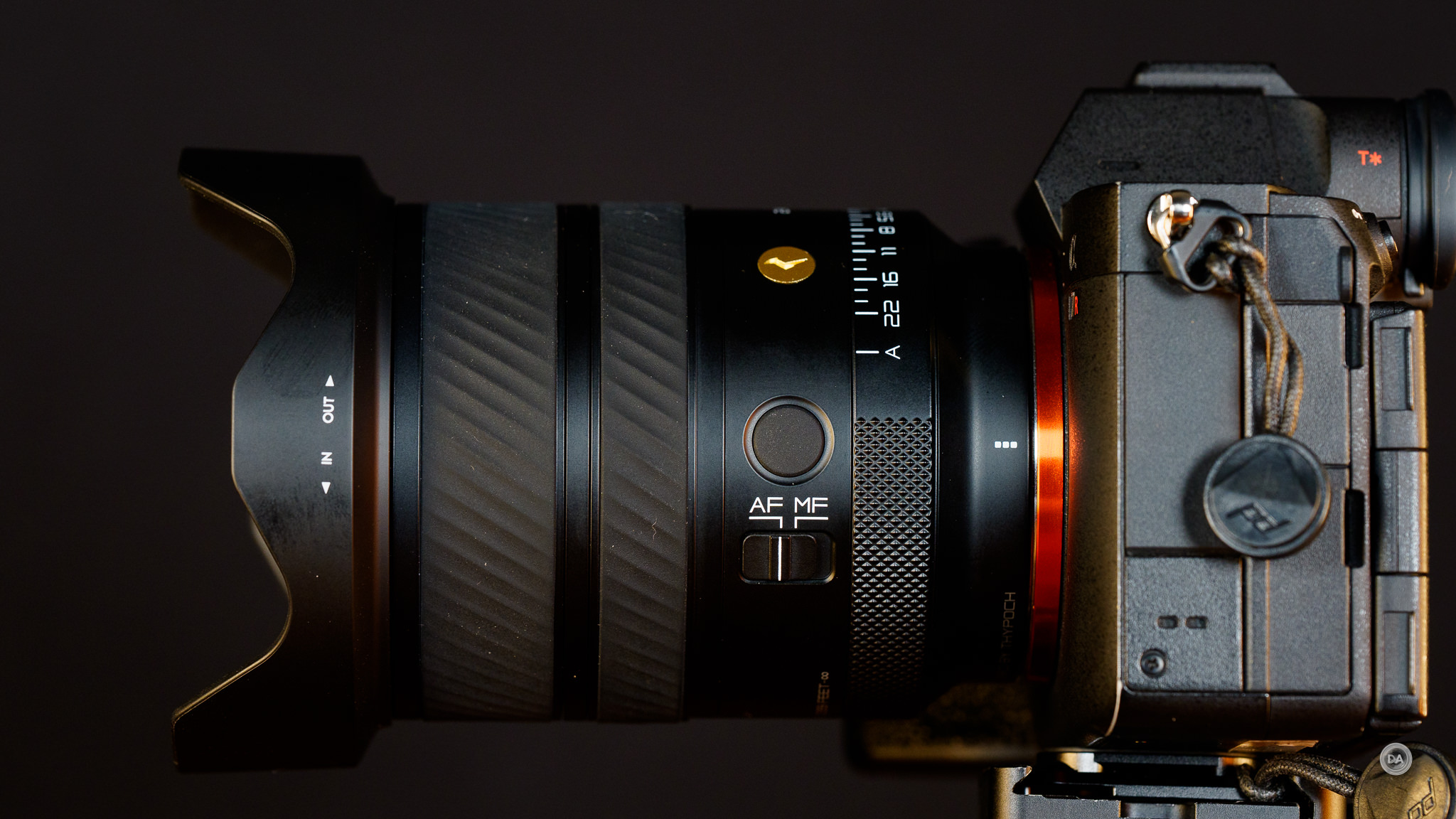
Other features include an AF | MF switch and a custom/Fn button that can be programmed to various functions from within the camera.

These are very welcome additions to the lens, positioning it as a more upscale zoom despite its inexpensive price tag.
A shallow lens hood is included with the lens. There is no lock button, but the hood clicks into place with a definite and satisfying feel. I’ve had no problems with it becoming unintentionally dislodged.
There is a weather sealing gasket at the mount, though I haven’t seen a diagram of internal seal points. When I asked Thypoch, they told me that the Voyager 24-50mm has a IP52 level of sealing without a filter, and using a filter increases that slightly to IP53. An IP52 rating is defined as, “An IP52 rating indicates that a device is protected against limited dust ingress and dripping water, ensuring it remains operational in environments with moderate dust and light, vertical moisture.” That sounds like a fairly typical level of weather sealing for a professional lens.
Also present at the rear mount is a USB-C port for firmware updating.

Future firmware updates will be available through the Thypoch site.
Weather sealing is enhanced by the Voyager 24-50mm being an internally zooming lens. The length does not change regardless of the zoom position, which is not true of the competition from Sony, Tamron, or Sigma.

The zoom action is smooth enough to do zooms during video, and I like the fact that the zoom throw is only about 75° between 24 and 50mm. I’ve been using the 24-50mm a lot as a video lens, and having the ability to do smooth zooms is definitely a bonus. The fact that the weight distribution won’t change as the lens is zoomed is useful for gimbal work as well.
While the 24-50mm zoom range is more constricted than the traditional 24-70mm, this is a useful focal range. Allowing you to go from this at 24mm:

…to this at 50mm:

The manual focus ring has a pleasant tactile feel to the ring and a nice weight to the focus action. It is nicely reactive and doesn’t have any apparent lag. I was able to focus smoothly and with precision. Full time manual override did not seem to be available.
There is no lens based stabilization, so you will need to rely upon the in-camera stabilization if your camera is so equipped. That’s true of competing lenses as well.
The Voyager 24-50mm only focuses as closely as 30cm and produces a useful magnification figure of 0.216x, which is useful but not quite as useful as the Sony’s 0.33x. Here’s how much magnification you can achieve at the MFD:

The plane of focus isn’t perfectly flat, but the detail and contrast within the window of focus is quite good. The amount of magnification is enough to get some close up shots.


I actually really like the packaging here. To get an internally zooming lens this compact is very useful, and I like the design choices and materials. The price of $649 USD undercuts the competition, giving Thypoch claim to being the value leader in this space.
Autofocus for Stills
This is Thypoch’s first autofocus lens, but it’s clear that they have been working on this for a while, as the focus feels fairly mature. I haven’t seen specifics about the focus motor, but it feels like it is a stepping motor (STM). As with many third party lenses with such focus motors, focus is largely very good with some very minor complaints.

Focus speed in my formal tests was actually quite good in AF-C mode, moving back and forth from close to distant subjects in just a split second. Focus is quiet, too, with focus noise being basically undetectable even with my ear right up against the lens barrel.
Focus was effortless for people photos.

When Nala was still, autofocus grabbed her eye and delivered perfectly focused results.


But when she started to move, it was largely the same as what I’ve seen from a lot of third party lenses. There was some obvious backfocus as focus didn’t quite keep up with her.

You can see it here in a wide angle shot, too. I didn’t have much time to start shooting before Nala decided to start moving, but I suspect the Sony 24-50mm G would have nailed this shot.

I also felt at times that focus was close but not perfect, which impacted my perception of sharpness and contrast. I wouldn’t be surprised if subsequent firmware updates tune up that precision a little more. I also feel like firmware updates could help with accurate focus on moving subjects, as the lens seems to have plenty of focus speed available, but as it stands, the Thypoch Voyager 24-50mm F2.8 is better served with still or slow moving subjects (weddings should be fine) but not fast action like sports. *Update: retail firmware is improved, with more precision.
Video AF
The video front largely brings positive things. Focus pulls are smooth, without pulsing, settling, or visible steps. At closer focus distances, focus breathing is low enough to not be apparent, but with bigger pulls there is enough breathing to make the process feel a little less cinematic to me. Currently third party lenses are not supported by Sony’s “Focus Breathing Compensation”, so that’s one area where the native Sony lens will have an advantage (*though because the Sony has even higher focus breathing, that compensation will come at a significant crop).
My hand test went well, with smooth focus transitions from my hand to my face and back.

Autofocus was smooth when tracking me approaching the camera, and picked up fairly quickly when I stepped out of frame and back in.
A major plus for video work is the smooth internal zoom with a relatively short throw. I found it easy to zoom in video clips. I didn’t see any issues with wobble or warping while zooming, and while the lens isn’t parfocal, AF kept focus stable while zooming.
I’ve been using the lens a lot for filming for my channel over the past month because it is compact and covers a lot of useful focal lengths. Autofocus has proven stable and reliable, and I do think that video work is a nice application for this lens.
Voyager 24-50mm Image Quality
The Voyager 24-50mm sports a sophisticated optical design of 16 elements in 13 groups. This includes 3 ED (extra low dispersion) elements, 3 HR (high refractive index) elements, and two Aspherical lenses. The MTF charts look pretty solid. 24mm shows a very sharp center (about 90%), a midframe average at roughly 75%, and a dip to about 55% in the corners. At 50mm, the center (83%) and corners (45%) are less sharp, but the midframe average is a bit higher at roughly 81%.
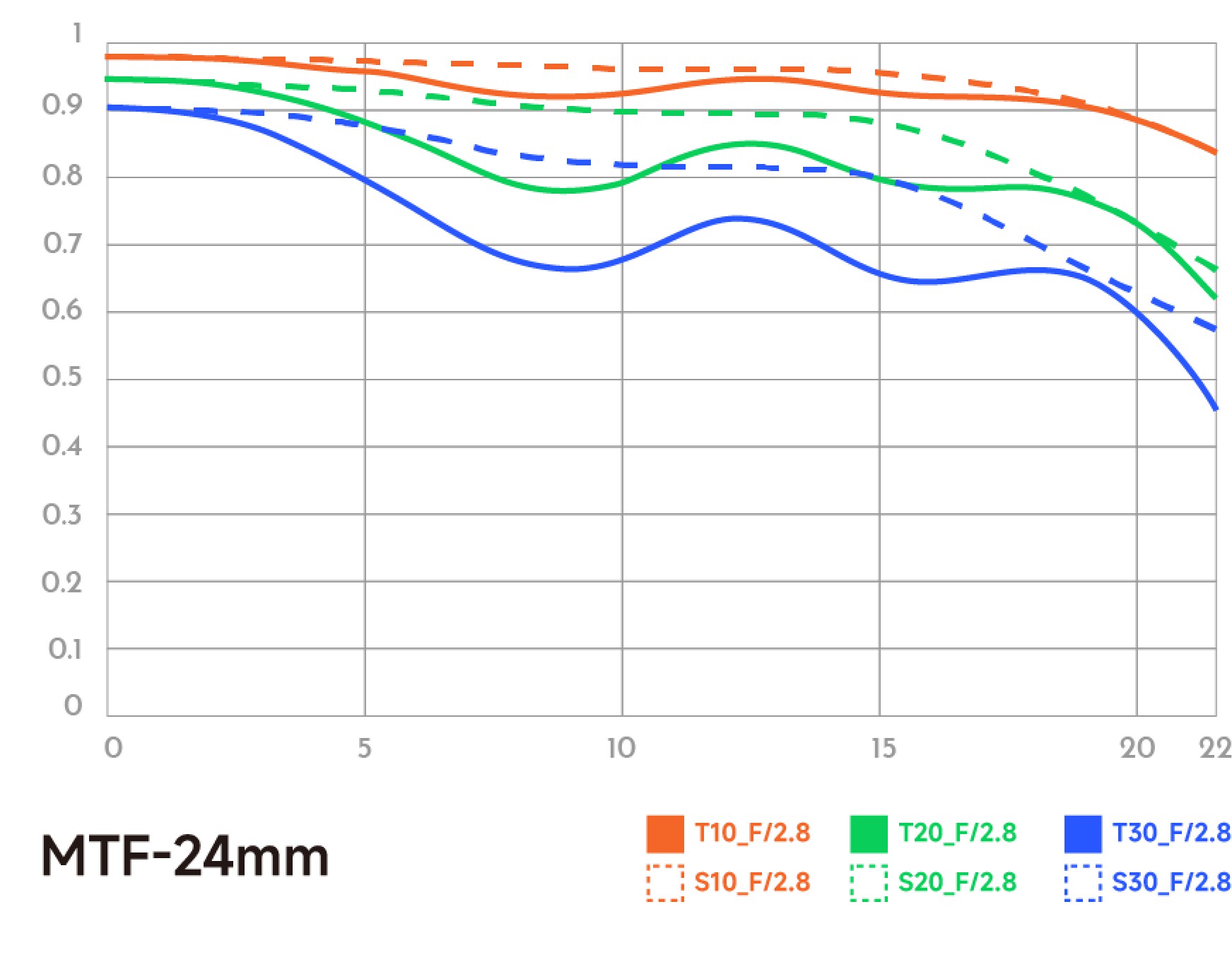
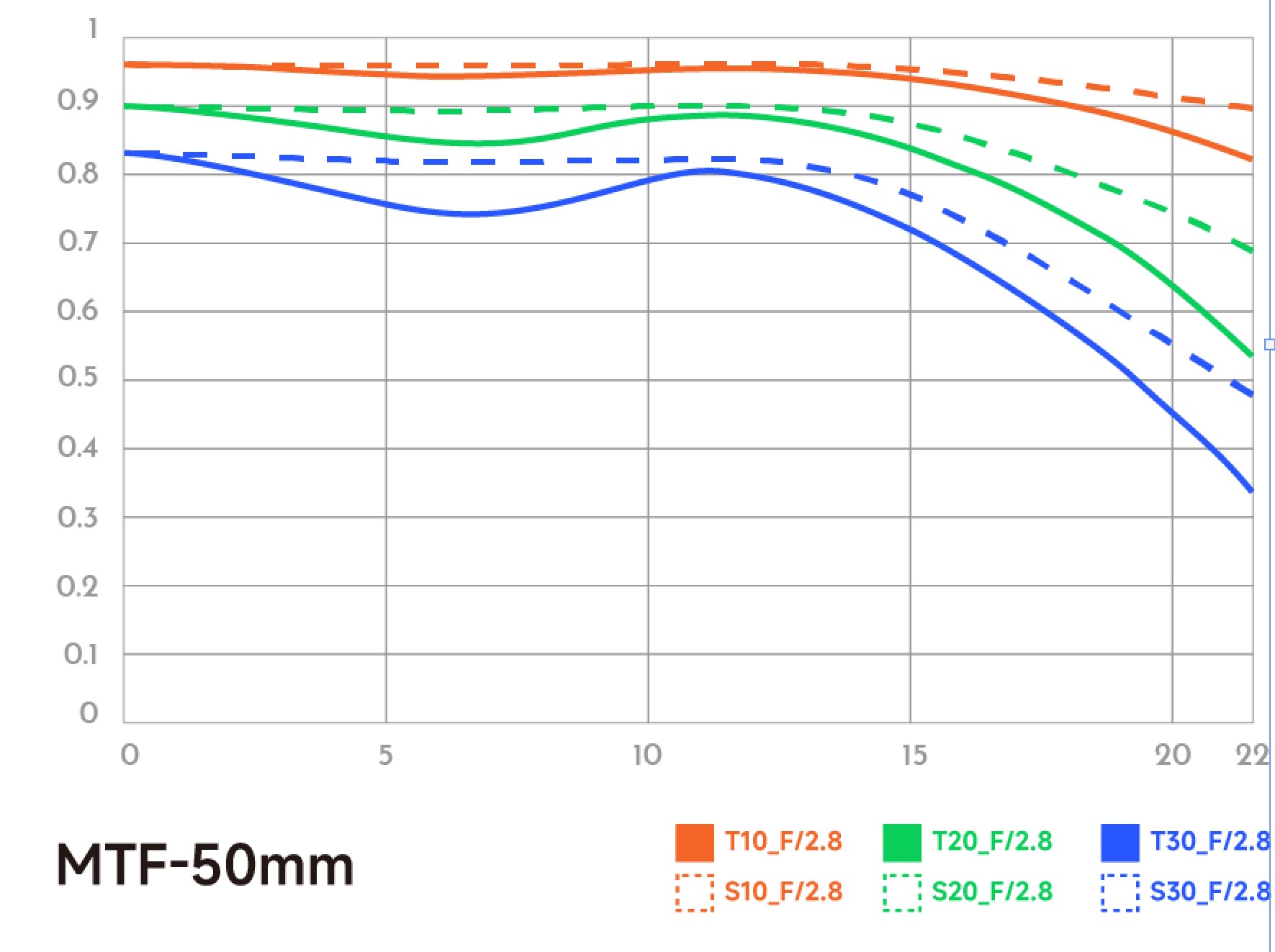
While I haven’t tested the Sony 24-50mm F2.8 G, we can at least compare the MTF charts.
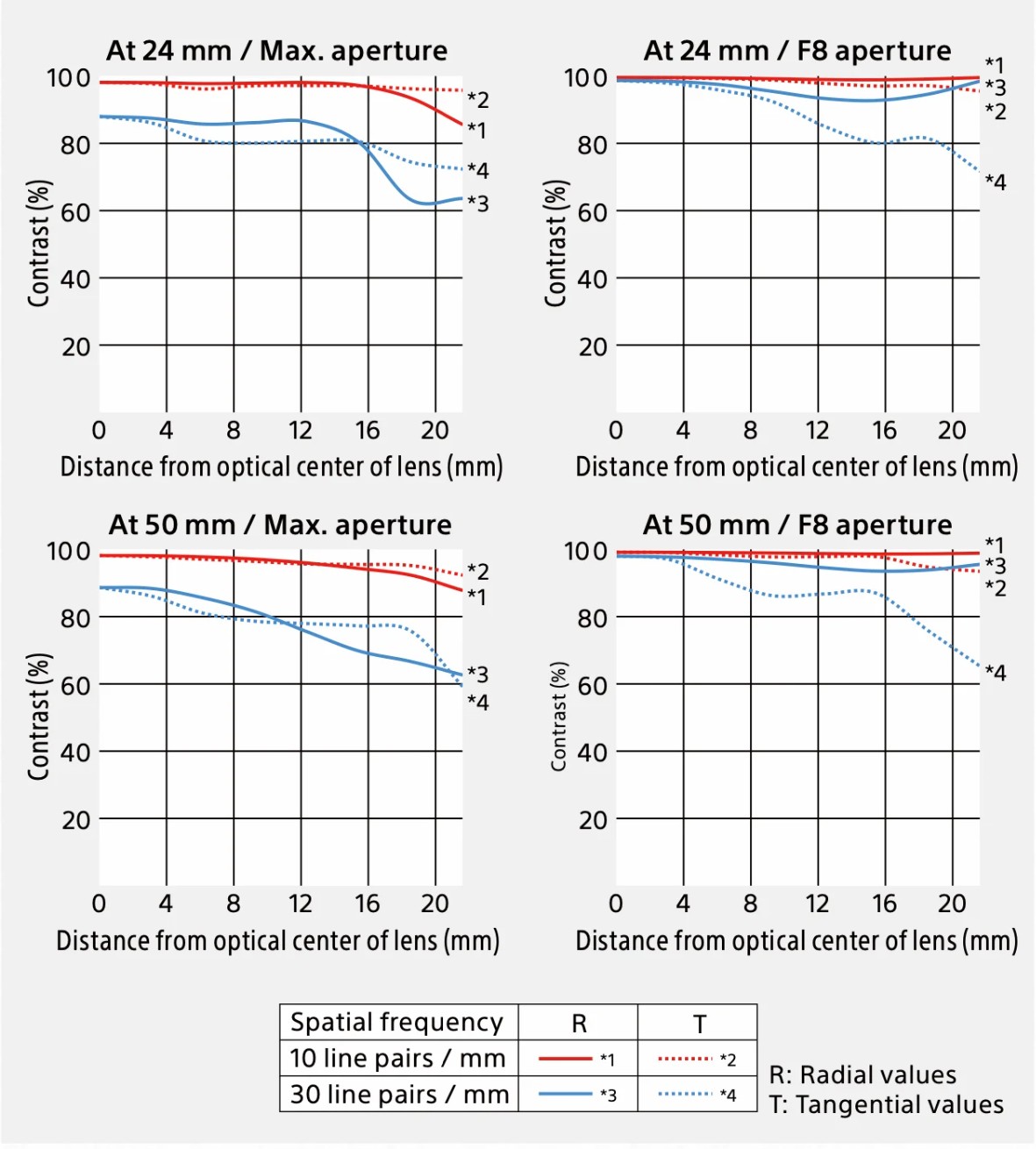
At 24mm, they show slightly less center sharpness (about 88%), better midframe performance (about 83%), and slightly stronger corners (about 65%). Pretty close, on average. At 50mm, the center is better (about 88%), the midframe slightly less sharp (about 78%), and the corners are better at roughly 62% average. Not a significant difference.
What I found is that real-world sharpness results varied according to shooting conditions. Sometimes sharpness looked very impressive, like here (48mm, F2.8):

In a shot like this, for example, contrast was lacking a bit.


As mentioned previously, that could be a matter of needing a minor focus algorithm update (I think there might be a bit of front focus here), but the end result was that my perception of sharpness and contrast varied a bit. We’ll explore that in more detail in a moment.
First, however, what about some of the other optical metrics?
As a third party lens, the Voyager can’t hide behind electronic corrections to solve optical problems. The Sony has very heavy barrel distortion (part of the compromise of going as wide as 24mm in a compact zoom), and while the Voyager isn’t distortion free, the amount of barrel distortion at 24mm is moderate.
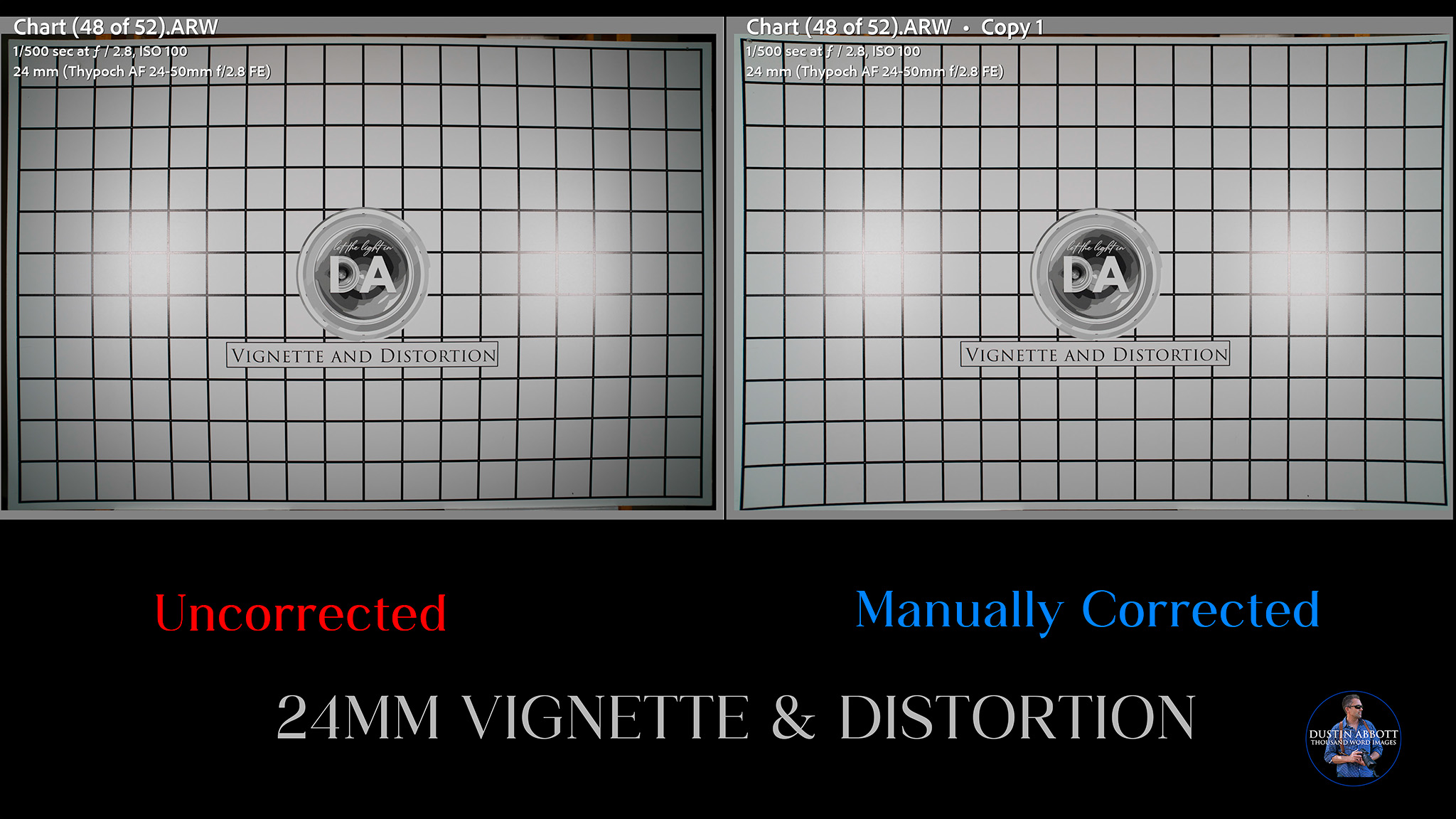
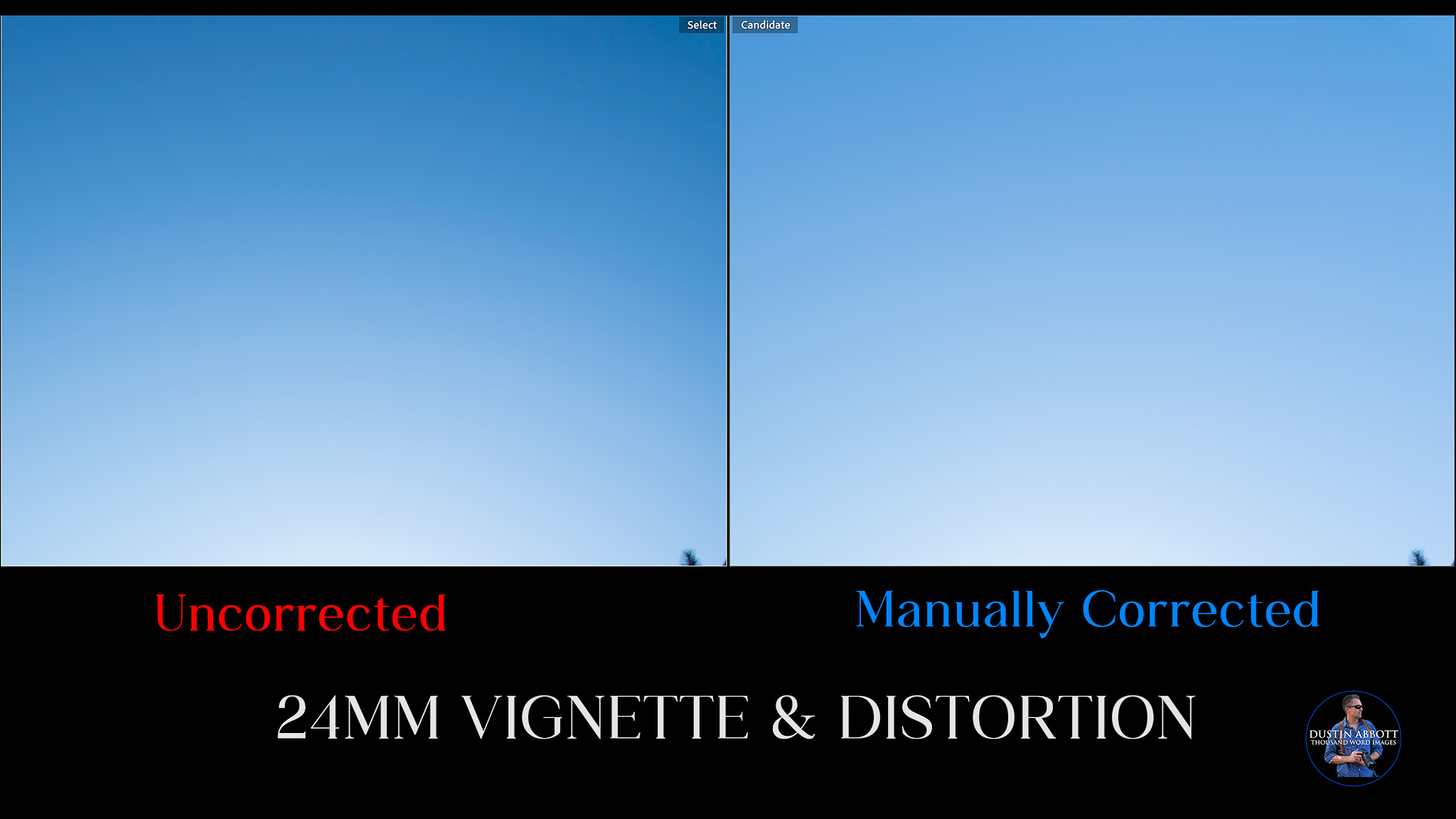
The amount of barrel distortion is moderate, but, as you can, correcting the majority of the frame results in some pincushion distortion near the edges, so the distortion is non-linear and slightly complex. I used a +14 to correct here, but a dedicated correction profile will produce a better result. The vignette is moderate as well, requiring a +64 to correct (a little over two stops), but the correction leaves a bit of a color tint in the corners. This is less of a factor with real-world subjects, however, as they are rarely uniformly white. Correcting vignette in the sky, for example, leaves a natural result.
Results in the middle of the zoom range are fairly neutral in terms of distortion, but by the telephoto end the barrel distortion has inverted to a mild pincushion distortion.
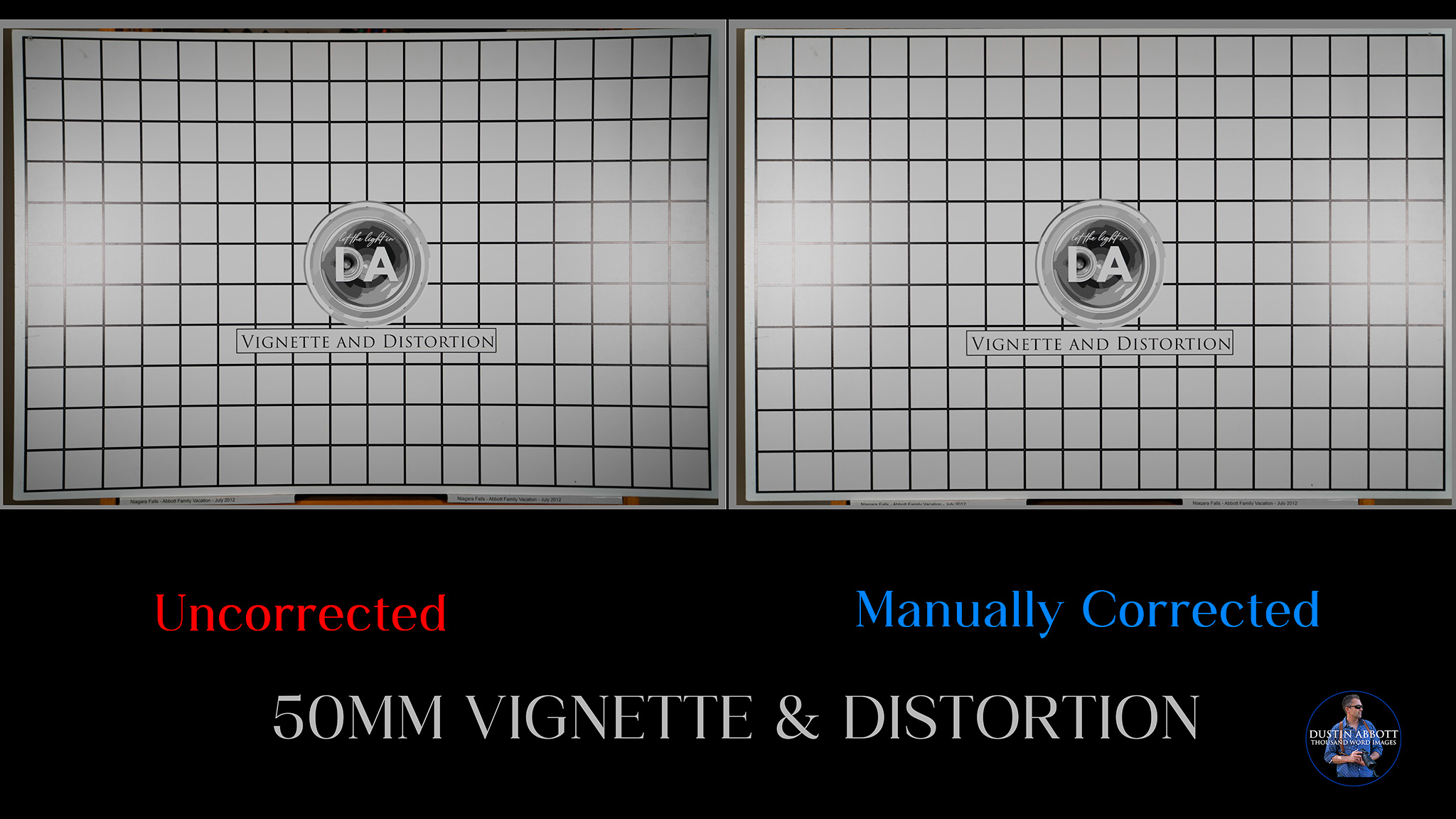
This distortion is both milder (a -6 to correct) and more linear (corrects evenly). Vignette was also milder, requiring just a +41 to correct, which is quite low for an F2.8 zoom.
Nothing too concerning here, and this is one area where the Thypoch lens bests the Sony.
Longitudinal chromatic aberrations (LoCA) show up as fringing before or after the plane of focus. I see a tiny amount of green fringing on my test chart, but nothing significant.

I see minimal fringing on my Dad’s old
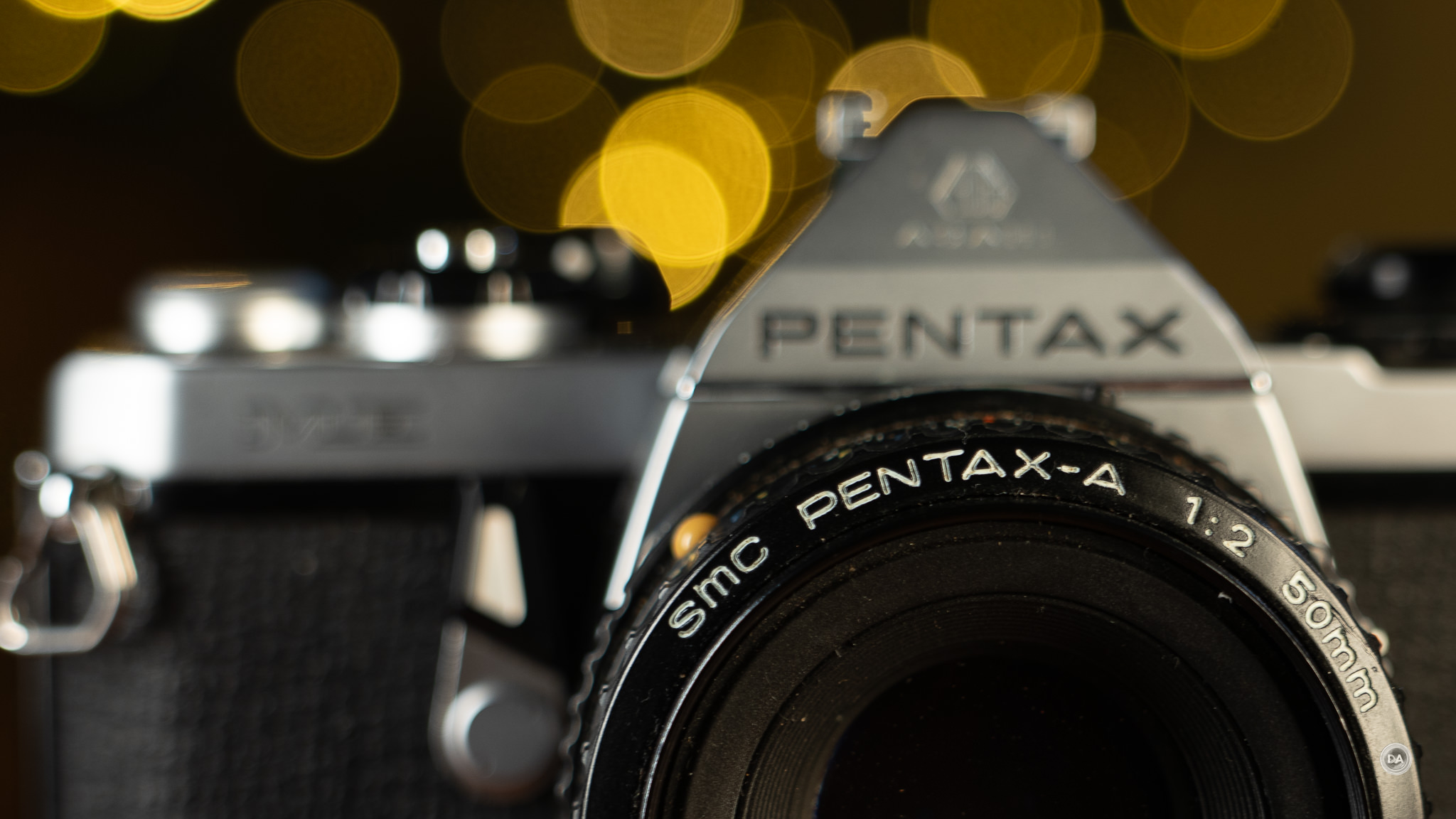
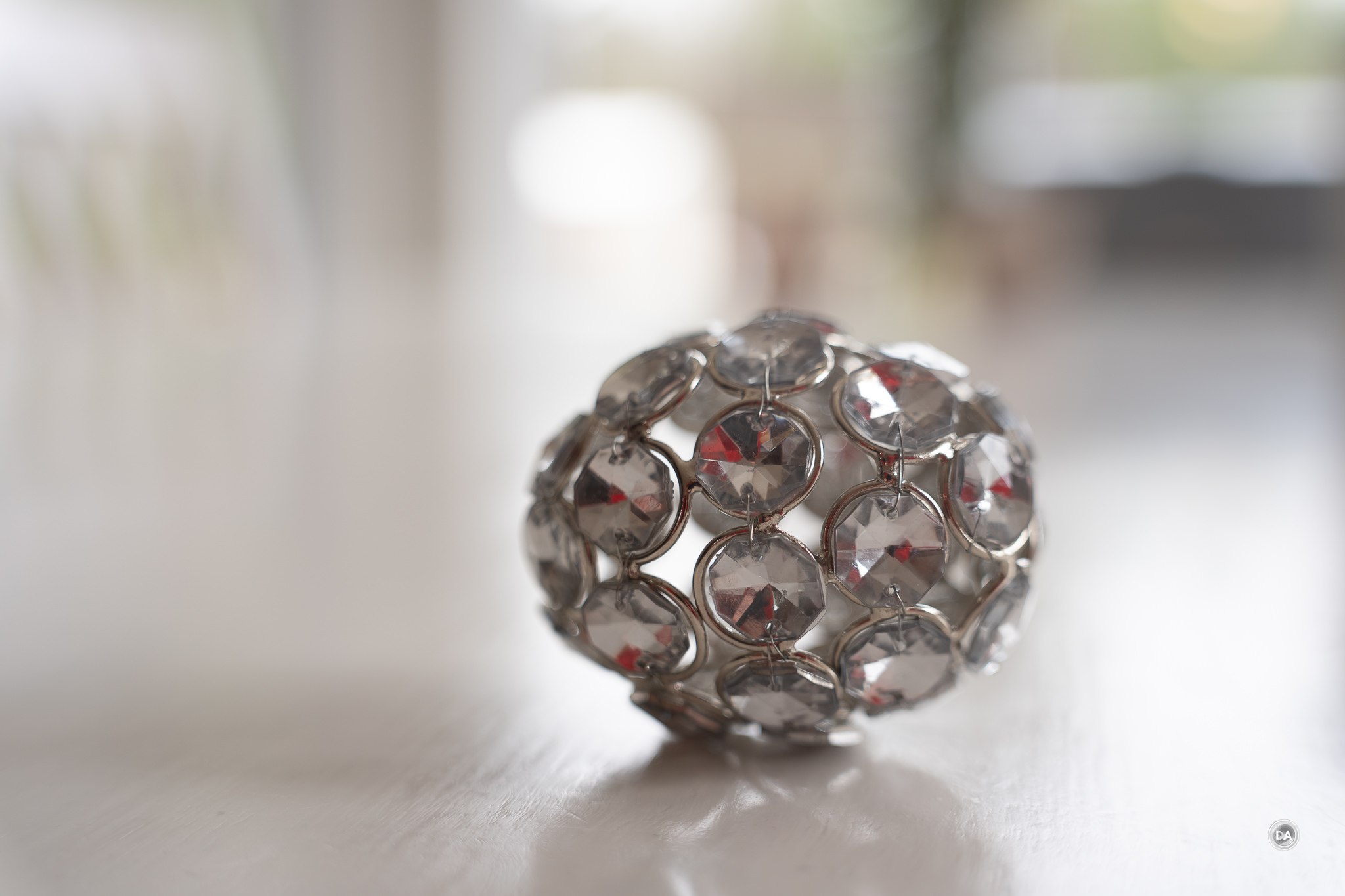
Close up shots of shiny objects showed excellent control of aberrations.

Lateral chromatic aberrations (LaCA) show up in the contrast transitions near the edge of the frame. These aren’t difficult to correct, but sometimes do cost a bit of contrast after correction. The Voyager shows a bit of LaCA near the edge of the frame, though fortunately the one-click “Remove Chromatic Aberration” correction in Lightroom works well here.

In general I would say that the Thypoch Voyager 24-50mm F2.8 has managed to effectively mitigate a lot of the optical flaws inherit to compact zooms.
So how about resolution and contrast? These results are shot on a 61MP Sony a7RV and the crops are shown at roughly 200% magnification level. Here’s a look at the test chart that the crops are taken from.

We’ll start at 24mm. If we zoom in and look at the 200% crops at F2.8 from the center, mid-frame, and lower right, we discover that sharpness and contrast are excellent in the center, drop a bit in the midframe, and look fairly soft in the corners.



The midframe is better at F4 and excellent by F5.6.
Stopping down to F4 and F5.6 helps the corners improve, though there are limits to that improvement. The corners never approach the level of the midframe.
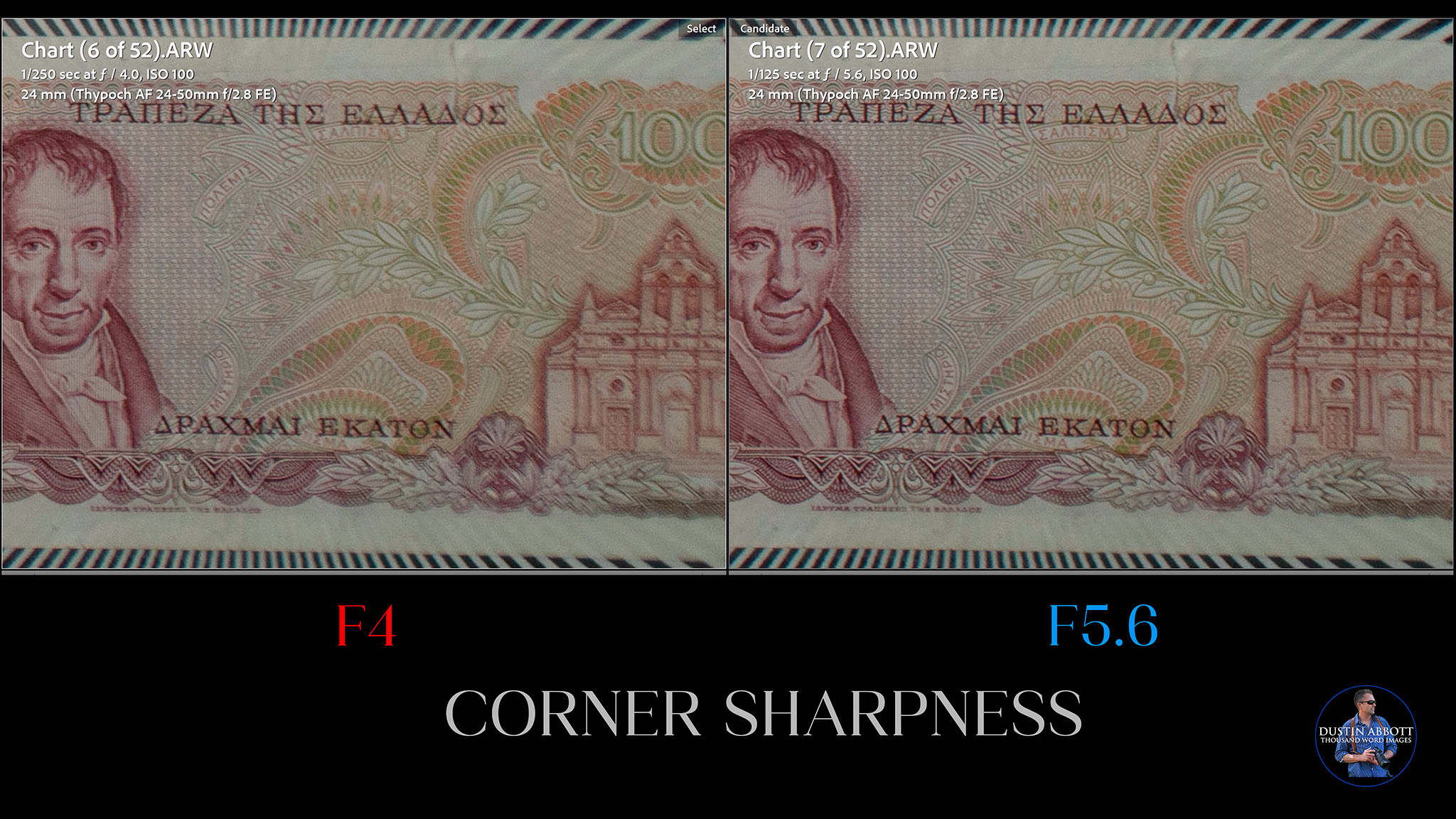
This isn’t just a 2-dimensional depth of field issue, either, as the corners never get incredible sharp in real world shooting, either. (Example below at F5.6).


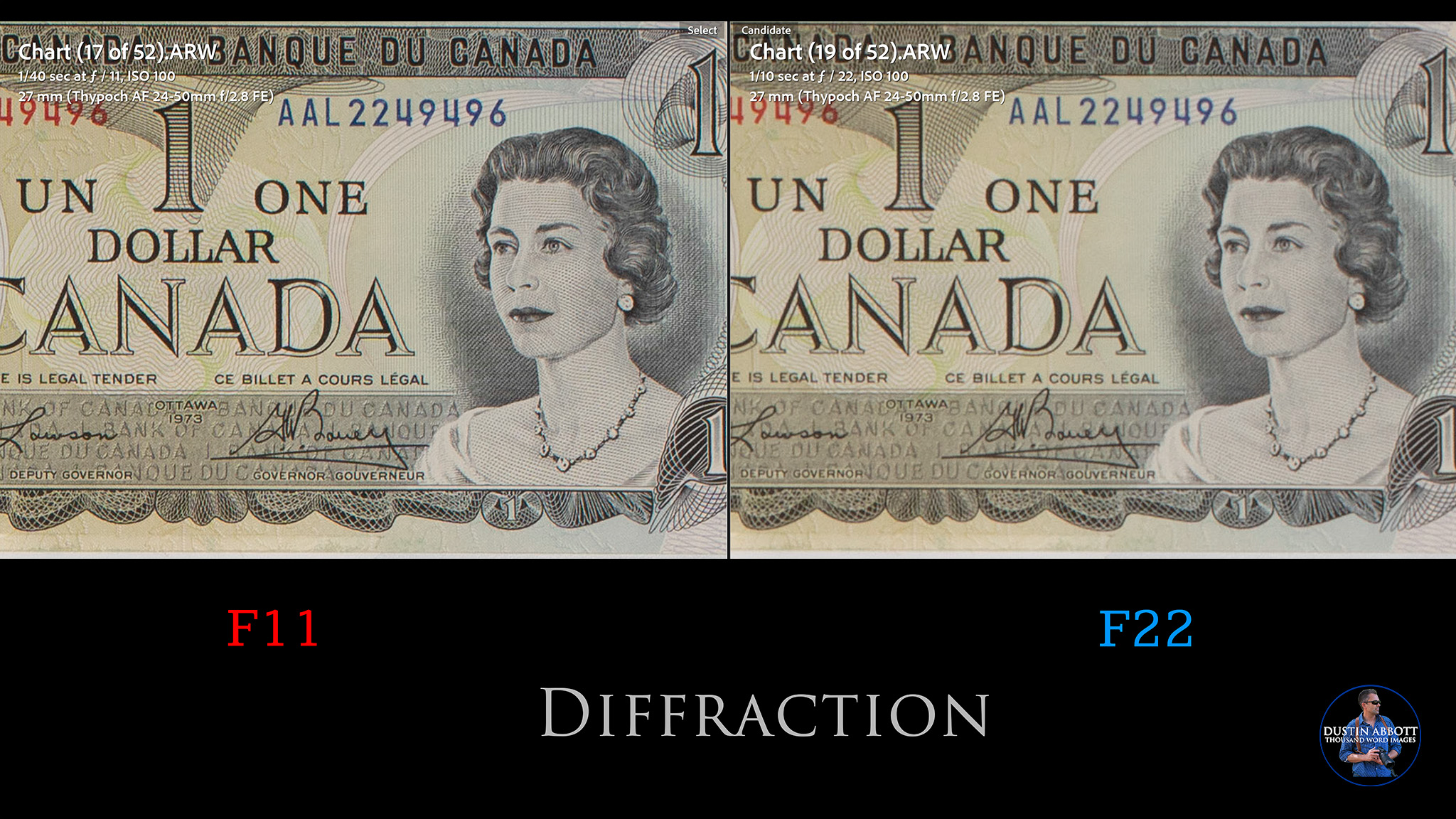
Diffraction is an unfortunate reality on higher resolution cameras, so you will see a faint softening by F11 and a more obvious softening by the minimum aperture of F22.
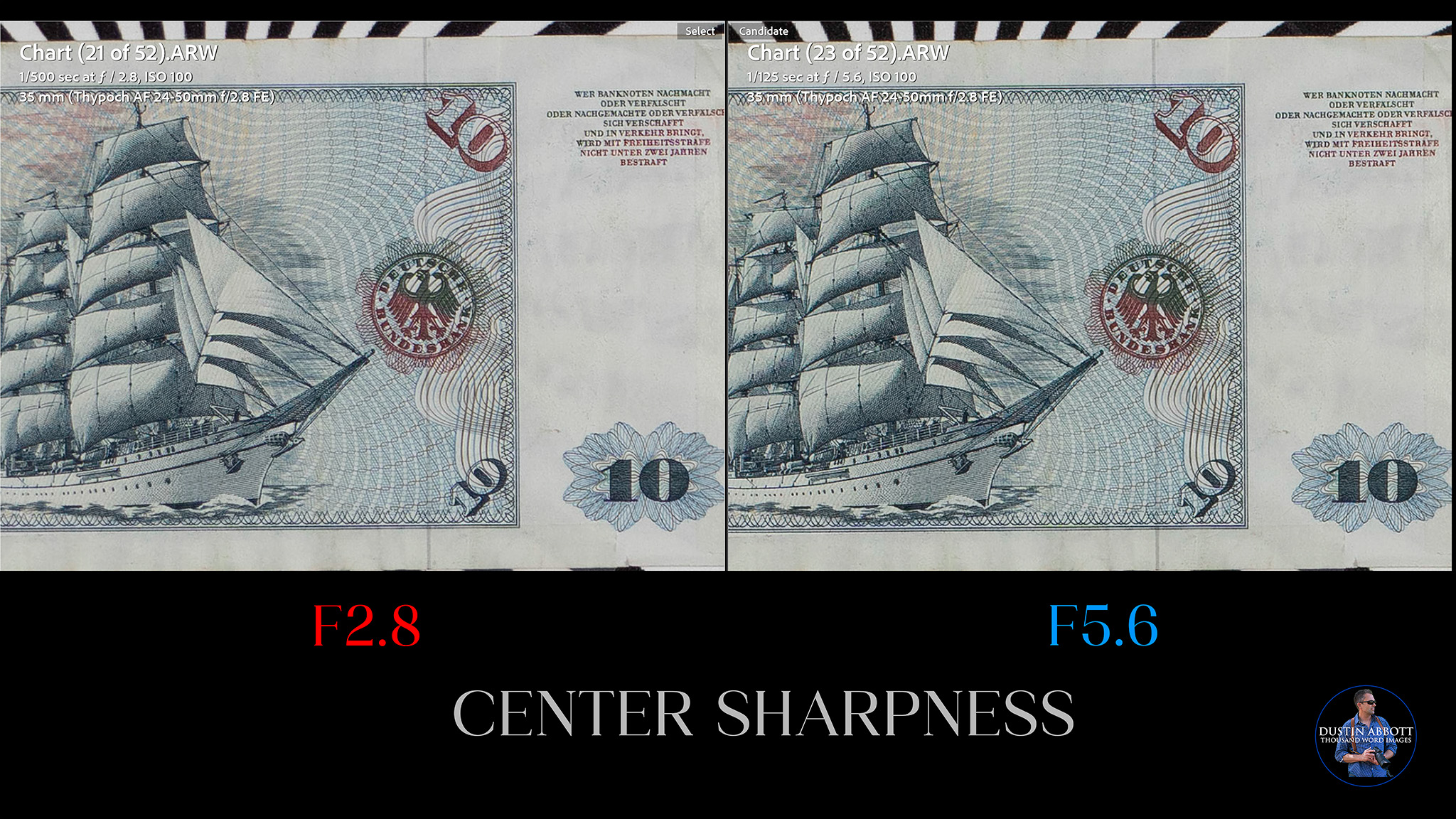
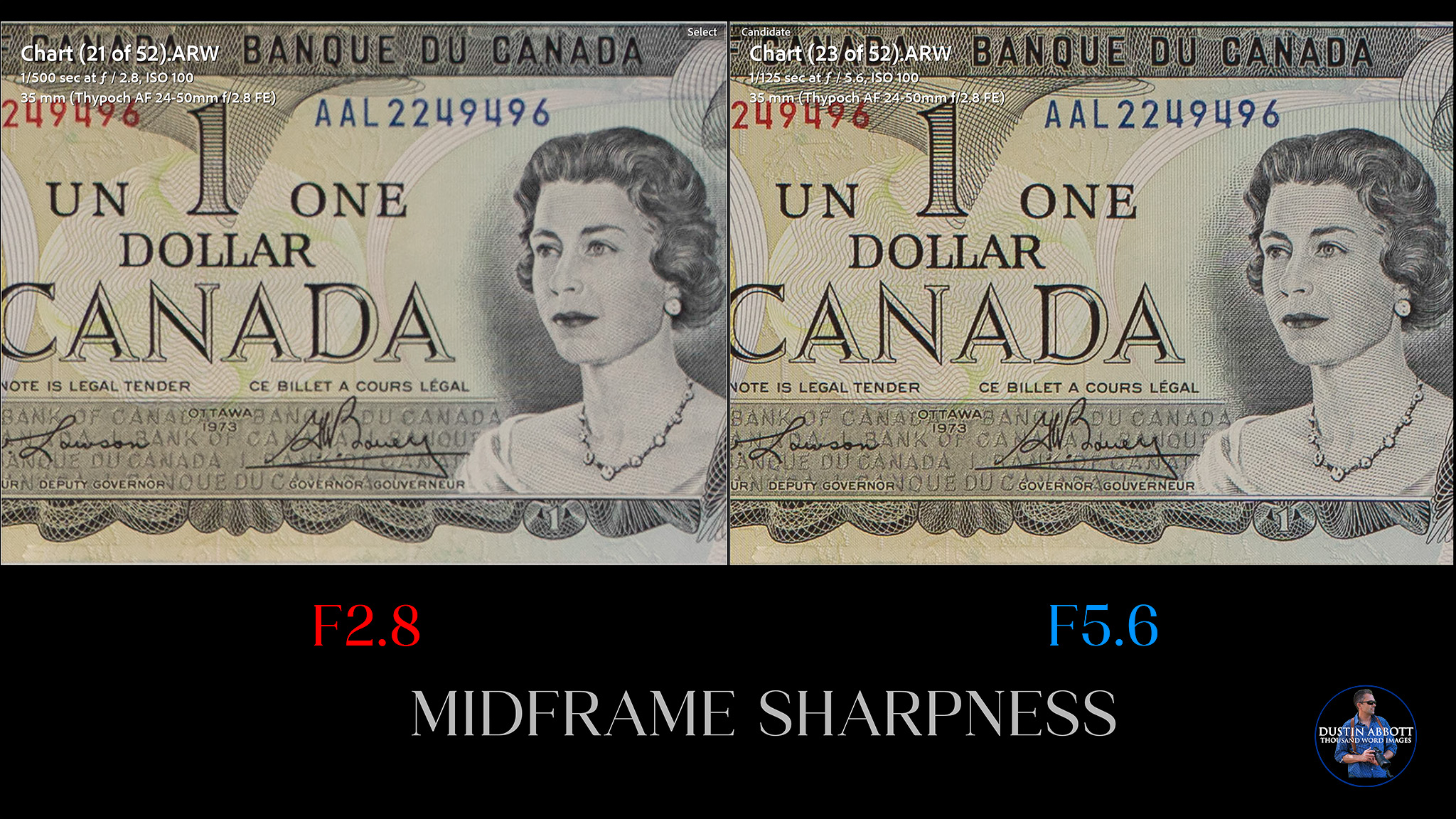
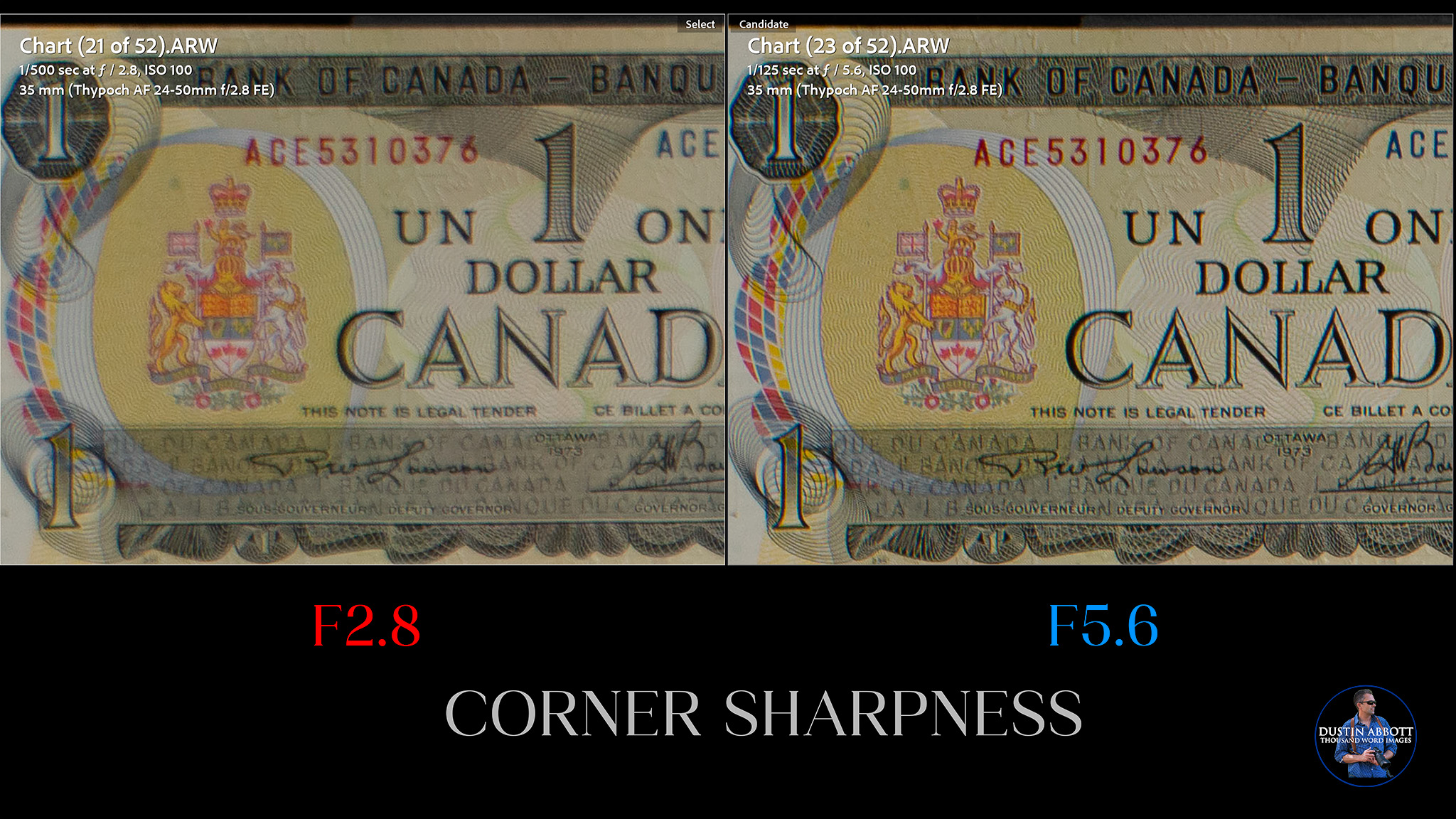
35mm follow a similar pattern, with excellent center results at F2.8, but the midframe results are not excellent until F5.6 (though they are fantastically sharp by that point), while corner results only reach good levels at any aperture.
Results at 40mm are so similar to those at 35mm that I won’t bother to show them here.
At 50mm, the pattern is largely the same, though the results in the center aren’t quite as fantastic.
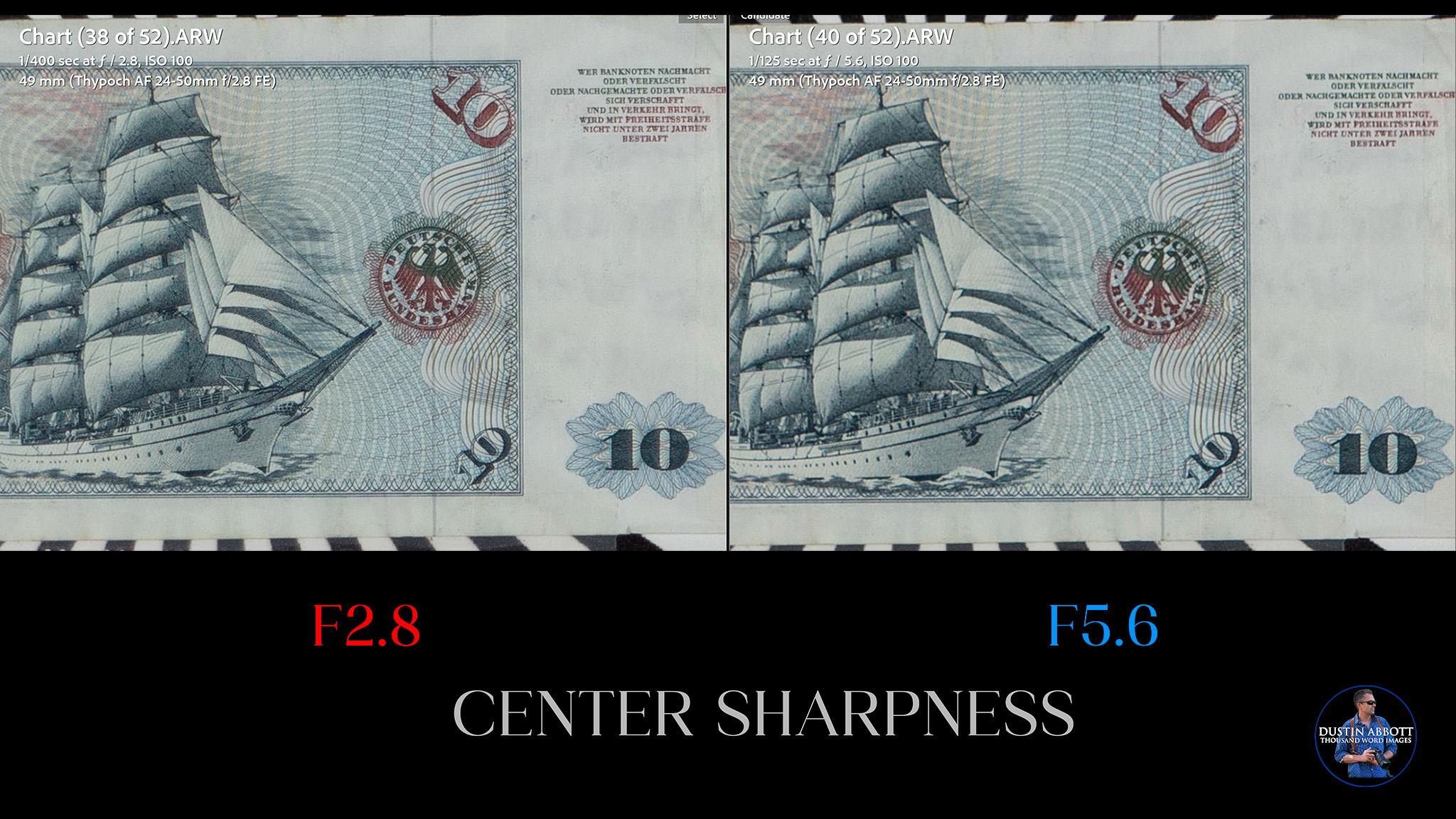
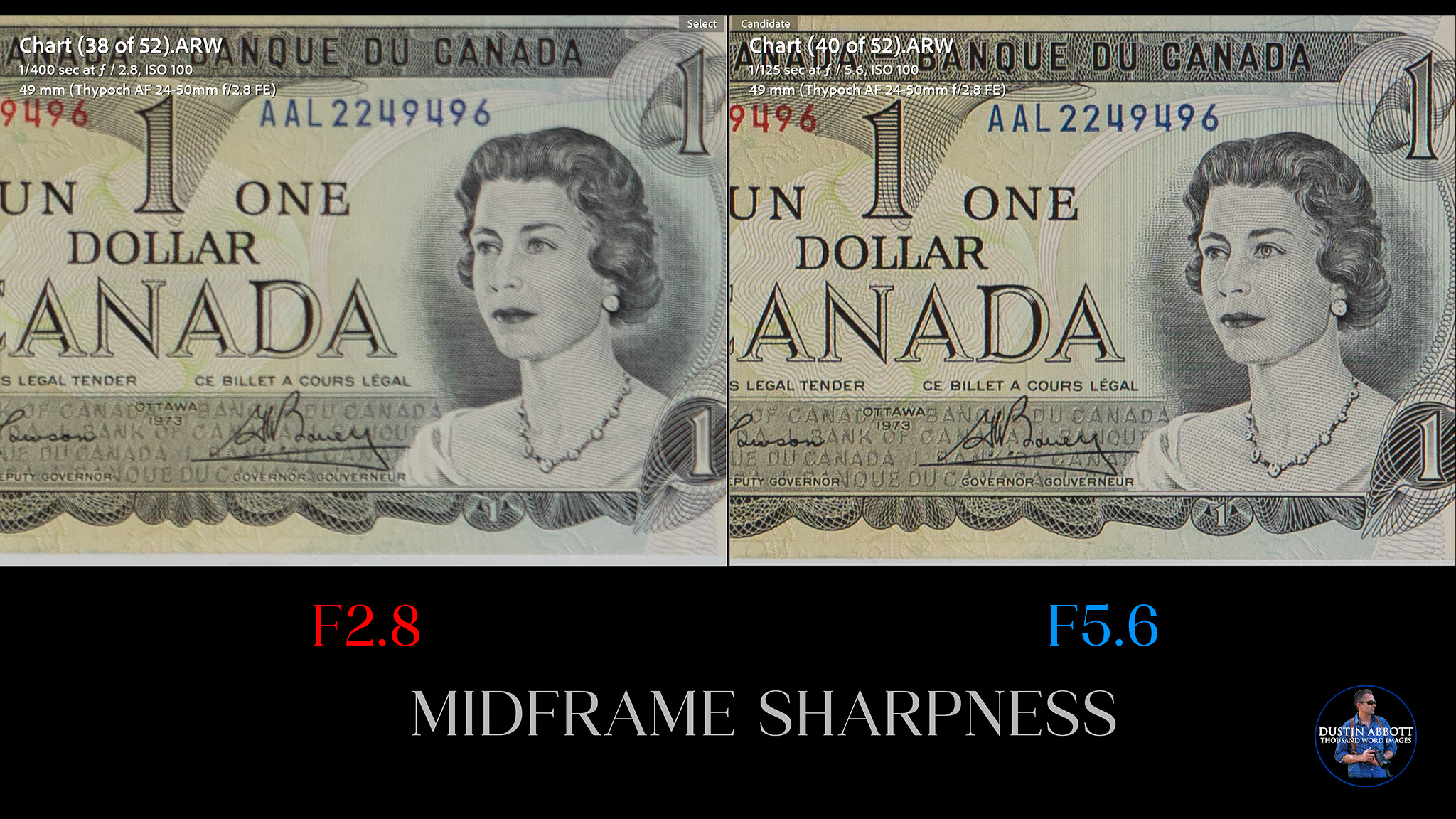
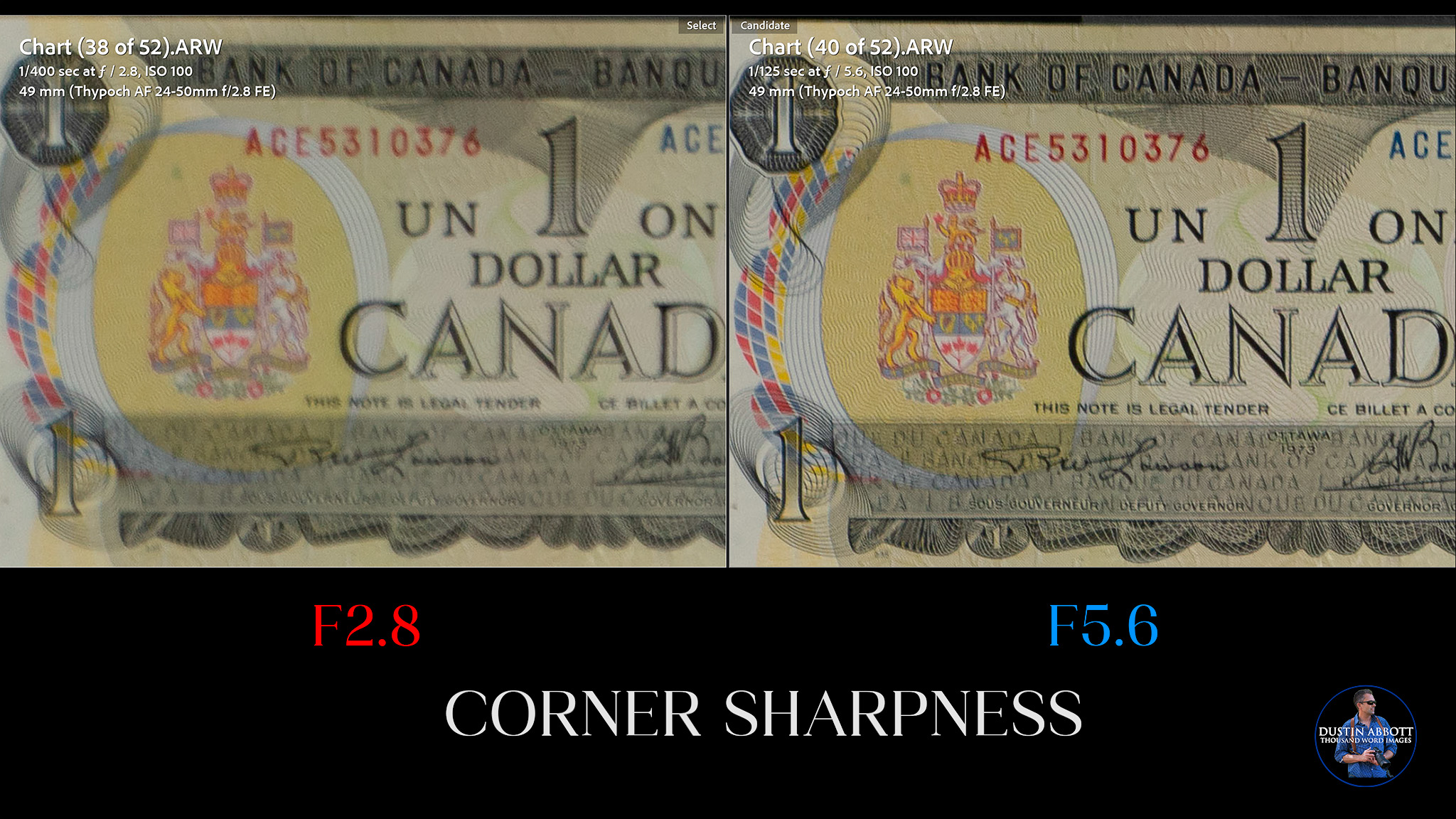
The corner performance may be less of a hindrance on the telephoto end, as you probably more likely to shoot with the focus on a single object rather than looking for sharpness across the frame.

This shot doesn’t have mind-blowing contrast, but the tradeoff is that the rendering is soft and creamy.

At its best, the rendering is quite nice for a zoom lens.

In less ideal situations, however, the bokeh can show more hard lines and busyness than what an equivalent prime lens would show.

This shot shows a nice mix of good contrast on the subject and fairly soft defocus.

Thypoch stresses that the optics are “cinema-informed”, claiming that this is a professional cinema optical design in a compact autofocus package. I’m willing to accept that, to some degree, as it feels like the focus on the center two thirds of the frame in terms of raw sharpness is more of a cine-lens priority, and the contrast fall-off also feels more like a cine lens. As I’ve mentioned, I’ve liked this lens for video work (probably the primary place it would get use from me), though it is appealing as a compact travel zoom as well (this would pair nicely with an a7C-series body).
I’ve seen sharper zooms (Tamron’s 28-75mm F2.8 G2 comes to mind), but while I wouldn’t mind a bit more contrast here (and better corner performance), the Voyager 24-50mm generally produces nice looking images for a zoom.

Flare resistance is a bit of a mixed bag. Flare resistance is good through most of the range, with good contrast and only a small amount of prismatic spatter at small apertures.


Another positive is that the ten-bladed aperture does produce nice looking sunstars (particularly at 24mm), with nice, long clean blades.
But around 45-50mm there is an issue that emerges with a vulnerability to side lighting and blooming. You can see a loss of contrast either in the shot generally, or a bloom in certain areas.



Even a mild composition change can pretty radically change the contrast in an image. In the comparison below, all other settings are equal; I just made a slight change to the angle of the camera.
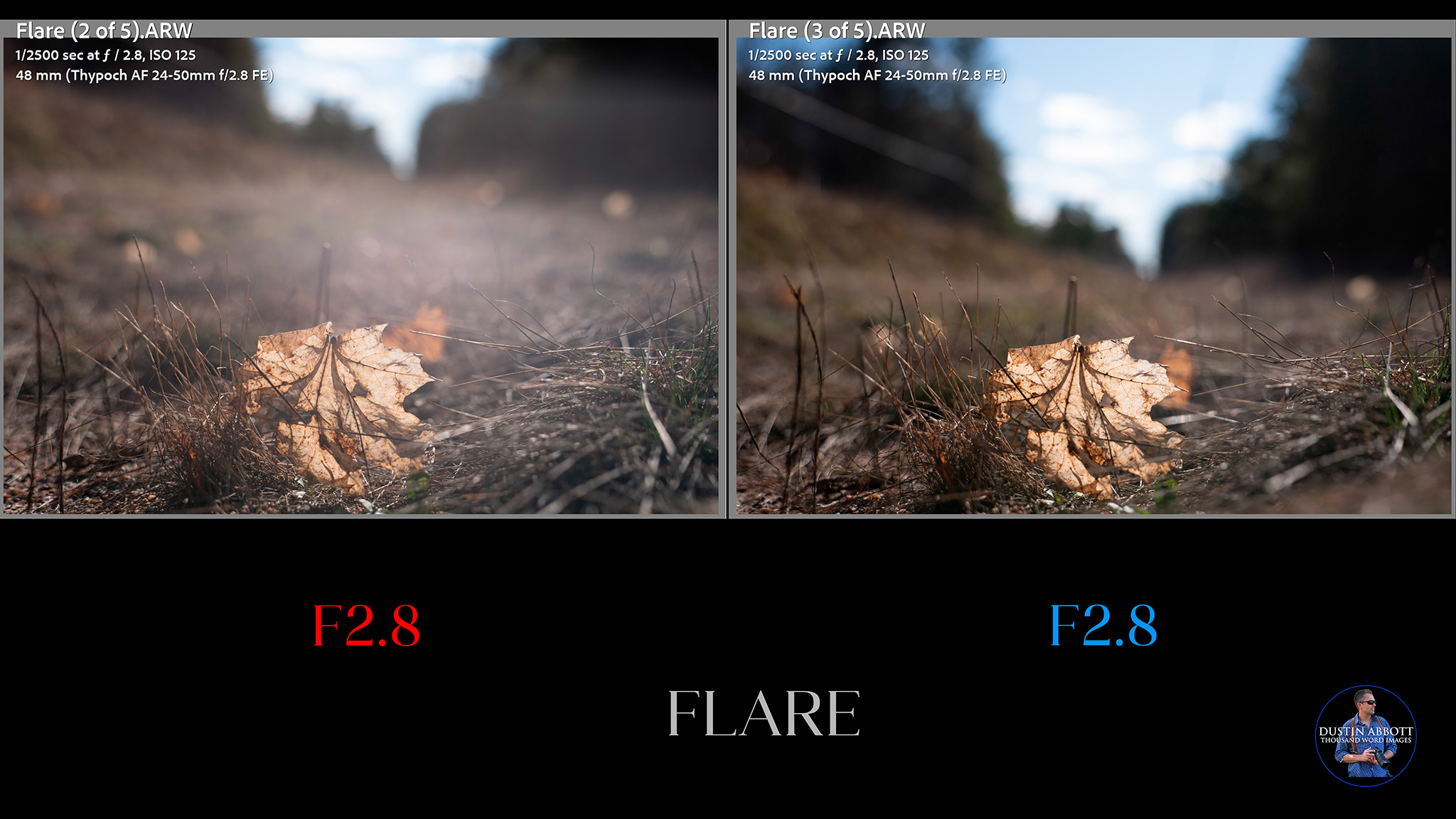
Definitely something to bear in mind.
I wouldn’t call the optical performance a “slam dunk” here, but overall the optics are solid. I generally liked images for photos, though I think I like the Voyager 24-50mm most for video work. Here’s a mini-gallery of images for you to evaluate.




















Conclusion
When Sony released their own compact 24-50mm F2.8 G, the collective question was, “why?” What purpose did this constrained focal length make, particularly when that lens was still fairly expensive. I would say that the Thypoch Voyager 24-50mm F2.8 is a little easier to contemplate, as it brings the uniqueness of an internal zoom to the equation (very useful!) along with a much smaller price tag of just $650. It is genuinely smaller than competing lenses, and, unlike the zooms from Tamron and Sigma, goes all the way to 24mm on the wide end. Want to move up to a 24-70mm F2.8 instead? The Sigma 24-70mm F2.8 ART II is the most likely third party option, and you’ll pay over $1300 for it and end up with a lens that weighs 735g and is 122mm long (retracted). That’s a radically different lens in terms of size, weight, and price, and for those that need a zoom that goes as wide as 24mm but doesn’t want the size, bulk, and cost of a 24-70mm lens, the Voyager 24-50mm might just make a lot of sense.

I wouldn’t say that the image quality is quite at the level of some of the competitors, but it is generally quite good, and the distortion at 24mm is much less than competing options.

As mentioned, I also really like it as a video option, and those who do gimbal work for weddings or the like might really enjoy this lens because of the compact size, light weight, and consistent balance provided by the internal zoom. I also view it as a potentially attractive travel zoom for both photos and videos. Colors seem nice, the bokeh is pretty good for a zoom, and the detail and contrast are sufficient to satisfy most. Combine that with a reasonable price, and China’s first autofocus zoom makes a pretty compelling case for itself.

Pros:
- Competitive Pricing: at $659, this is the cheapest full frame F2.8 zoom
- Compact and Lightweight Design: The internal zoom mechanism contributes to a smaller profile, making it easier to handle and more portable for travel and gimbal work.
- Cine-Inspired Optical Design: Designed with video work in mind, offering a useful focal range (24-50mm) and smooth zooming action, which is beneficial for dynamic shooting.
- Build Quality: Features a metal body, rubberized textures on the zoom and focus rings, and a well-designed aperture ring, lending a premium feel and durability.
- Decent Autofocus Performance: Offers responsive and quiet autofocus suitable for still photography in controlled environments.
- Good Optical Performance: Generally good sharpness in the center and decent rendering, particularly attractive for video footage.
- Weather Sealing: IP52 rating provides reasonable protection against dust and moisture, enhancing its usability in various conditions.
- Customizable Functions: Includes a custom button that can be programmed for different camera functions, adding convenience during shooting.
Cons:
- Inconsistent Autofocus: Struggles with fast-moving subjects, resulting in missed focus occasionally, particularly in continuous autofocus mode.
- Corner Sharpness: Image quality can fall short in the corners, especially at wider apertures, which might affect overall composition in some shots.
- Minor Flare Issues: Susceptible to flare and blooming under harsh lighting conditions, which can reduce contrast in certain shots.
- Firmware Updates Needed: Potential for autofocus improvements and other performance tweaks, indicating the need for ongoing
_________________________________________________________________________
GEAR USED:
Purchase the Thypoch Voyager 24-50 @ Thypoch Store | B&H | Adorama | Amazon | Amazon Canada | Amazon UK | Amazon Germany
_________________________________________________________________________
Purchase the Sony a7RV @ B&H Photo | Adorama | Amazon | Camera Canada | Sony Canada | Amazon Canada | Amazon UK | Amazon Germany
__________________________________________________________________
Purchase the Sony a7IV @ B&H Photo | Adorama | Amazon | Camera Canada | Sony Canada | Amazon Canada | Amazon UK | Amazon Germany
_________________________________________________________________
Purchase the Sony Alpha 1 @ Camera Canada | B&H Photo | Adorama | Amazon | Sony Canada | Amazon Canada | Amazon UK | Amazon Germany | Ebay
_________________________________________________________________
Want to support this channel? Use these affiliate links to shop at: B&H Photo | Amazon | Adorama | Camera Canada | Amazon Canada | Amazon UK | Ebay | Make a donation via Paypal
Buy DA Merchandise https://bit.ly/TWIMerch

Keywords: Thypoch, #thypoch, Voyager, #voyager, Thypoch Voyager, 24-50mm, F2.8, Thypoch Voyager 24-50mm F2.8, Thypoch Voyager 24-50mm F2.8, Voyager 24-50, #voyager24_50, Sony a7V, Sony A1 II, α1 II, Sony a7RV, Review, Hands On, Dustin Abbott, Real World, Comparison, Sharpness, Bokeh, Flare Resistance, Autofocus, Image Quality, Sample Images, Video, Photography, let the light in, weathersealing, #letthelightin, DA
Related posts:
 Tamron 35-100mm F2.8 Di III VXD Review
 Viltrox AF 35mm F1.8 II EVO E-Mount Review
 AstrHori 25mm F2.8 2-5x Macro Review
 AstrHori 25mm F2.8 2-5x Macro Gallery
 Meike MIX 24mm F1.4 FE Review
 Thypoch Simera 35mm F1.4 M-Mount Review
 Laowa AF 10mm F2.8 Zero D Gallery
 Sigma 28-105mm F2.8 DG DN | ART Review
 Yongnuo YN 35mm F1.8 ART Gallery
 Sony FE 100mm F2.8 Macro GM OSS Review