Up next in 10

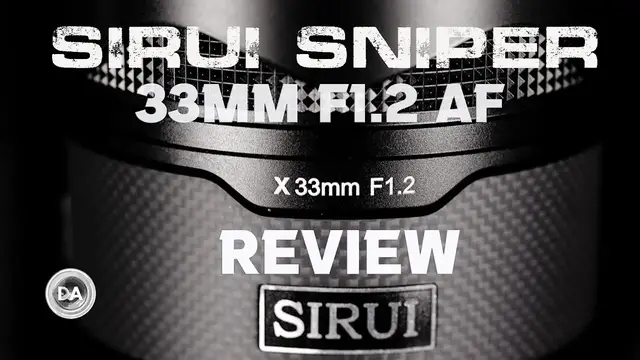
Sirui Sniper AF 33mm F1.2 Review | Modern Build, Vintage Aesthetic
Dec 12, 2023

Photographer Dustin Abbott shares a review of the Sirui Sniper 33mm F1.2 autofocus lens for Sony E, Fuji X (reviewed here) and Nikon Z. | Read the Text Review: | Visit the Image Gallery: | Purchase the Sirui Sniper Lenses @ Sirui https://bit.ly/41cbS6t (use code DustinA for 5% off) | B&H Photo https://bhpho.to/47pA875 | Adorama https://howl.me/ck3c6eLTjxp | Amazon https://amzn.to/3uoluhY | Amazon Canada https://amzn.to/3SOi6qH | Amazon UK https://amzn.to/3sCy4K6 | Amazon Germany https://amzn.to/49JAFT9
Check out the DA Merch here: https://bit.ly/TWIMerch | Become a Patron: https://www.patreon.com/dustinabbott | On the Web: http://dustinabbott.net/ | Sign up for my Newsletter: http://bit.ly/1RHvUNp | Instagram: http://bit.ly/DLAinsta | Facebook: http://on.fb.me/1nuUUeH | Flickr: http://bit.ly/1UcnC0B | 500px: http://bit.ly/1Sy2Ngu Follow Craig @ https://www.instagram.com/craigstoffersen/
Want to support this channel? Use these affiliate links to shop at:
B&H Photo: http://bhpho.to/1TA0Xge
Adorama: https://howl.me/cjU0LKdp3LN
Camera Canada: http://bit.ly/DLACameraCan
Sony Canada: https://www.thesonyshop.ca/?ref=abbott
Amazon: https://amzn.to/3HrY64d
Amazon Canada: https://amzn.to/3qG1p18
Ebay: http://bit.ly/DustineBay
Into the AM Clothing: https://bit.ly/intotheAMda and use code DUSTIN10 for 10% off
Make a donation via Paypal: https://www.paypal.com/paypalme/dustinTWI
=============================
Table of Contents:
=============================
0:00 - Intro and Concept
0:52 - Build and Design
5:38 - Autofocus
6:40 - Video
8:00 - Image Quality
18:04 - Conclusion and Pricing
---------------------------------------------------------
Oben Tabletop Tripod shown in video: https://bhpho.to/3vL8YWy
My Cameras:
Purchase the Sony a7RV @ B&H Photo https://bhpho.to/3ZivNyZ | Adorama https://howl.me/cjNY1LU3gFH | Amazon https://amzn.to/3CRCDlq | Camera Canada https://shrsl.com/3vulf | Sony Canada https://bit.ly/BuyA7R5 | Amazon Canada https://amzn.to/3H8yeNH | Amazon UK https://amzn.to/3kbg5FM
Purchase the Sony Alpha 1 @ Camera Canada https://shrsl.com/2wdk2 | B&H Photo https://bhpho.to/3upRFZd | Adorama https://howl.me/cj2nQpjLBKW | Amazon https://amzn.to/3t1m8MD | Sony Canada https://bit.ly/BuySonyA1 |Amazon Canada https://amzn.to/3cVFrBB | Amazon UK https://amzn.to/2OtrjGe | Amazon Germany https://amzn.to/3d0GtMO | Ebay https://ebay.us/i371Vs
Canon EOS R5: B&H Photo https://bhpho.to/3iMH18x | Amazon https://amzn.to/33L3D53 | Camera Canada https://shrsl.com/2jqth
Purchase the Fujifilm X-H2 @ B&H Photo https://bhpho.to/3KAInTC | Adorama https://howl.me/cjyzbiO5lVp | Amazon https://amzn.to/41zMzKl | Camera Canada https://shrsl.com/4128o | Amazon Canada https://amzn.to/40gY4W7 | Amazon UK https://amzn.to/43Grn7a | Amazon Germany https://amzn.to/3L6hwjR
Get a discount off all Skylum Editing Software (Luminar, Aurora HDR, AirMagic) by using code DUSTINHDR at checkout: http://bit.ly/LuminarDLA
DISCLAIMER: This video and description contains affiliate links, which means that if you click on one of the product links, I’ll receive a small commission. As an Amazon Associate I earn from qualifying purchases.
Keywords: Sirui, Sniper, Sirui Sniper, 23mm, 33mm 56mm, F1.2, STM, Carbon Fiber, Review, Fuji X, Sony E, Review, Telephoto, Action, Tracking, Hands On, Dustin Abbott, Real World, Comparison, Sharpness, Bokeh, Flare Resistance, Autofocus, Image Quality, Sample Images, Video, Photography, Sony a6700, Sony a6600, Fujifilm X-T5, Fujifilm X-H2, let the light in, #letthelightin, DA
Show More Show Less View Video Transcript
0:00
Hi, I'm Dustin Abbott and I'm here today to give you my individual review of the Steel
0:15
Eyes Sniper 33mm f1.2. This is an autofocusing lens, it is a part of a series of lenses that debuted with a
0:24
23mm, then this 33mm, and finally a 56mm f1.2. I have taken a look at the series as a whole if you want to check out the kind of overview
0:33
and how they all work together. And I've also released previously the review of the 23mm with the 56mm review to follow
0:42
This lens and the series of lenses, they debut at a quality price under $350 US dollars and
0:49
available for even less with some discounts. And you can also get them as a series in a case, all prepared to kind of coordinate together
0:58
They have identical builds, they're set up to where you can easily swap on a gimbal or
1:03
something similar, and they have a similar color tone throughout so that the footage
1:07
or the photos are going to match nicely. So some nice thoughts when it comes to using them as a series
1:13
In a nutshell, this is a lens that is very nicely built, it uses premium materials, it
1:20
has average autofocus for stills and below average autofocus for video. It has extremely nice bokeh and it does soften up when it stops down, but it also has a lot
1:30
of chromatic aberration and it has low contrast at large apertures. It's a modern lens when it comes to the build and the design, but the optics are kind of
1:40
a retro aesthetic, and that is both good and bad depending on what you're looking for in
1:45
the lens. What we'll do in today's review is that I will go through and give you the broad strokes
1:50
and then those of you that want a deeper dive into optical performance can look at that
1:54
at the end of the review. And there of course is a shortcut to that in the timestamp below
1:59
First, however, a word from our sponsors. Today's episode is brought to you by Fam Wallet, the minimalist, modern wallet that is now
2:07
even better with the new Fam X, that is crafted from aluminum right here in Canada
2:12
It is 22% smaller and 35% lighter, while still making it easy to access your cards and money
2:19
when you need them, thanks to their unique fanning mechanism. You can even customize your wallet, either with modular design, with accessories like
2:27
a money clip, cash holder, ID display, and even Chipolo and AirTag tracking integration
2:33
Visit store.fantomwallet.com to check out their unique sizes, styles, and finishes that
2:39
span from aluminum to wood to carbon fiber, and use code Dustin15 for 15% off when you're
2:45
ready to check out. So 33mm when applied to the various APS-C crop factors that it's applied for, it's available
2:56
in a Nikon Z mount, Sony E mount, and then also Fuji X mount, but it is only an APS-C lens
3:04
So in all these cases, I've tested it on Fuji here, you apply that 1.5x crop factor, you
3:09
have essentially a 50mm equivalent lens. Obviously a very, very popular focal length for a lot of reasons
3:16
Now with this series, they have three different, very distinctive looks that you can opt from
3:22
There is the black that has carbon fiber, real carbon fiber accents here
3:26
There is the silver look that has aluminum alloy accents, and then there is the white
3:32
look that has a ceramic-based paint as a part of the design
3:36
The lens is 72mm in diameter by 92mm in length, that's 2.8 by 3.6 inches, and it weighs in
3:45
at right under 400 grams or 14 ounces. I give really high marks to this series as a whole when it comes to the design
3:53
This is actually unique. This is rare in the market. There are so many lenses out there, and a lot of them look, you know, fairly similar
4:01
But that's not really true of this Sniper series. There is a distinct look to them, an aesthetic that is all series, and so I appreciate that
4:09
I appreciate the quality materials that are here. The focus ring is a little bit on the light side, but it works okay, although I will note
4:17
there is 360 degrees of intended rotation. On Fuji, if you try to get down to minimum focus, a lot of times it's additional rotation
4:24
to get it all the way there. It's just kind of a fuzzy quirk, which is probably not the case on other platforms
4:31
Very nice materials, as noted, but outside of that, there's not really a lot of features
4:35
There's no AF-MF switch, there's no aperture ring. On Fuji, that tends to be missed because some of the competitors will have it
4:42
It does have a USB-C port on the metal lens mount, and that is great because it allows
4:47
you to do firmware updates and to make sure that the lens stays current, and also, you
4:52
know, maybe we'll see an improvement to the autofocus performance via firmware in the future
4:58
It does come with this pedal-shaped lens hood. This is made out of plastic. Nothing particularly special, though I do appreciate the fact that we have got a glitch
5:05
surface that makes it easier to mount and unmount. Inside, there are 11 aperture blades, and I do appreciate that because it helps to maintain
5:13
a nice, circular shape as you stop the lens down. The lens is a maximum aperture of f1.2, so a lot of potential for stopping down, so a
5:21
high blade count is welcome in this, and a little bit more of a better touch that is included
5:27
Not so positive is the minimum focus distance. It is 40 centimeters, and as you can see, the resulting magnification is quite low
5:35
0.10 times. You can still create a lot of background blur, but that has much more to do with the f1.2
5:42
aperture than what it does to the ability to focus close. You're not going to mistake this for a macro lens in any way, shape, or form
5:49
So, overall, it is a little bit on the larger and heavier side compared to some competitors
5:55
However, it doesn't have a lot going on in terms of features, other than a price, which
6:02
is quite reasonable, particularly for an autofocusing f1.2 lens. Now, on the note of autofocus, this has an STM, or a stepping focus motor
6:11
You can see from the focus pull test that focus speed is not bad
6:15
I would say it's slightly below average, but of course, average has improved over time
6:20
and I'm used to really, really fast autofocus at this point. So, slightly before average, but I think adequate and speed for a lot of different applications
6:29
Overall focus noise is fairly low. If you put your ear next to it, or if you're filming, you can hear some light clicks and
6:36
whirs, but what you will hear is, if you're at a larger aperture, in between holding down
6:42
either depressing the shutter or half-pressing it down, the aperture blades actually close
6:47
down and then not in use, and they open up whenever you're actually focusing for the photo
6:53
And so, as a byproduct, you will hear a little bit of clicking noise as those aperture blades
6:58
close and open back up. And so, that's actually the primary sound that you hear during focus
7:03
I actually found that the quality of focus is generally good. Now, as you're going to see, this lens is really low contrast right over here
7:10
As a byproduct, it can be a little bit hard to tell that images are well focused until
7:15
you really look in at a pixel level and distinguish that, even though something is not amazingly
7:19
sharp, it is absolutely in focus. But as I did that, I realized that focus actually was actually quite good
7:26
You can see here that it's tracking the eye of my dead-eyed model there quite well
7:32
No issues there, and as I move around, the box is getting locked in on the eye
7:36
So, all of those are good results, and I would say that for stills, I had no complaints about autofocus
7:44
I was able to shoot everything that I wanted without any kind of issue. When it comes to the video AF side of things, this actually is the best of the series, but
7:53
unfortunately, that's not saying a lot, because this is not a great series when it comes to
7:58
video AF. As you can see from the focus tools, the focus tools are not fast, and they're not always
8:04
particularly confident. There are some setting issues, but you can see the positive is that it is a smooth transition
8:11
without visible steps. We did see some visible stepping on the 23mm, and the 56mm is a whole other can of worms
8:19
which we'll get to later. But overall, it's not bad. Also, I found that when I did the hand test, it was the most reactive of the three lenses
8:27
and that. But you do see that there is some hesitation before focus transitions are made
8:33
There's a little bit of lag there before actual focus shift begins to take place
8:39
On a positive note, focus breathing was quite low, and what I will say about the focus tools
8:45
is they're slow and they're deliberate, but they're smooth enough that combined with the
8:49
low focus breathing, they have a slightly cinematic look to them, which is not bad
8:56
At the same time, though, this is certainly not a top video choice, and the focus is also
9:01
not reactive enough. If your goal is to capture fast action, you need to look elsewhere
9:08
When it comes to the image quality, I'll give you a quick overview of performance, and then
9:12
if you want to hang around for the deep dive, you're welcome to do so. This lens has 12 elements in 11 groups, including one EV element, one HR element
9:21
This is a lens with what I would call an extreme dual personality
9:25
Wide open, it has very high chromatic aberrations, and so as a byproduct, it is quite dreamy
9:31
wide open, without a lot of contrast, and so sharpness at wide apertures is not great
9:37
Bokeh, on the other hand, is extremely nice. Much softer and creamier than what you're going to see from some competing lenses, and
9:44
so very good in that regard. The lens will sharpen up when it is stopped down, and starting at about F4 to F5.6, it
9:53
gets sharp enough that I would say that I was satisfied with the sharpness results
9:58
They're more typical and modern looking, whereas the lens has kind of a vintage look
10:03
to it, wide open. Positive things for various aspects of that is that it does have low distortion, almost
10:09
no distortion. It has fairly low vignette, no ISI there, but chromatic aberrations, particularly of
10:16
the longitudinal type, are really, really obvious and persistent, probably even to F2
10:21
and a little bit beyond, and so they don't clear up particularly fast
10:26
So that would be one of the negative issues there. The lens also does exhibit quite a lot of flare artifacts, a variety of things
10:33
Some of them can be artistic, and if you use them wisely, you might look like them, but
10:38
very, very likely, most people will be put off by them. And so, in an overall conclusion, I would say that the 33mm is maybe my least favorite
10:47
of the series. There are too many aberrations, the contrast is just a little bit too low, and the autofocus
10:53
is not amazingly sophisticated. I think it's good enough for photos, and good enough for most people, but not a great option
11:00
for video. The lens is competitively priced for an autofocusing F1.2 lens, and I would say that it fits best
11:07
for those that really like more of a vintage kind of look
11:11
You like lower contrast, maybe find it flattering for portraits or for your general purpose
11:16
shot, and you prefer kind of the look of images rather than pixel peeping at a detail
11:22
And so, if you like the ability to have different kinds of looks wide open, and then a different
11:27
look when stopped down, the lens might suit your purposes there. For me, I would say that on Fuji, the 33mm F1.4 Fujinon lens is worth the extra money
11:37
or as a compromise, the Viltrox Pro AF 27mm F1.2 just does a lot of things really, really
11:44
well, and would probably be my top budget pick there. Now, if you want more information, you can either look at the description down below
11:52
and catch my full text review or the image gallery there. There's buying links there
11:57
And if you want more information, stay tuned right after this, and we'll do our deep dive
12:01
into the optical performance of the lens. Our examination of the 33mm starts with a definite win when it comes to gamut and distortion
12:15
You can see the distortion is pretty close to non-existent. Those lines are straight enough that they really need no actual correction
12:23
And also, vignette, while present, is really quite low for an F1.2 lens
12:28
Now, there is actually a correction profile available in Lightroom already, which surprised
12:33
me, but if you turn that off and just look at the manual correction, you can see I've
12:37
dialed in a minus one to correct what little bit of pincushion distortion was there, and
12:43
the vignette is about two stops, a plus 53, and then sliding the midpoint over
12:49
For an F1.2 lens, this is low vignette, and obviously that's a really desirable distortion
12:54
level there. Now, unfortunately, our next test is much less rosy. You can see that there are very significant levels of longitudinal chromatic aberrations
13:04
so both fringing before and major fringing after the point of focus
13:10
That is going to show up in real-world results. You can see here that contrast is definitely reduced due to fringing in various places
13:18
and then also in bokeh highlights, you're going to see that fringing
13:22
Likewise here, you can see that as we transition away from the point of focus, so before you've
13:28
got some of the, you know, the magenta fringing is a little bit lighter, so it's obviously
13:33
present, and then as you transition away, there's definitely a lot of that green-blue
13:38
fringing that is present. Now, lateral chromatic aberrations are a simple and non-issue
13:43
You can see that even if correction is turned off, we have very little in terms of any kind
13:48
of fringing on either side of the black and white transitions there, so no problem there
13:53
Now, taking a look at our resolution and contrast, obviously this is a tremendous torture test
13:59
for a lens like this, in that 40 megapixels on APS-C is an extremely dense pixel resolution
14:07
and I examine these, and I do these reviews, I examine at 200% magnification, so any and
14:13
all flaws will be on display, and there are definitely some flaws here
14:18
You can see that there is very low contrast, and thus the inability to really sharply define
14:24
the details here in the text, the various textures that are there, the mid-frame also
14:30
is continuing that trend. You can just see as we kind of pan down over these various builds, it's almost like a smear
14:36
of Vaseline over it. Going into the corners, you can see that that low contrast is there, and then you can see
14:42
the detail drops off even further towards the edge of the frame
14:46
That low contrast does affect real-world images. Now, this is actually a stopgap to F2 for depth of field, so you can see that while
14:54
it is accurately focused on the first face here, overall contrast makes it seem like
15:01
the image is not really holding focus. Now, I'll also note that some people prefer that lower contrast in that it just is a little
15:09
more flattering to any kind of skin imperfections. We can see here from one of my test shots when I was doing the testing for autofocus
15:17
that, again, focus is accurate here, but you can also see that because of that lower contrast
15:24
it can be a little bit hard to tell. At the same time, also, you can see looking ahead that the bokeh is really nice from the lens
15:31
Another shot. Here, we can see that it doesn't look like it's in focus
15:35
Now, if you go into a pixel level, you can see that it actually is accurately focused
15:40
on the iris of Nala there, but because, you know, it's focused outwards at the field and
15:45
then also contrast is low, it's hard to see without going into a pixel level if anything
15:50
is actually in focus. Stopping down a little bit to f1.6 does slightly improve contrast
15:57
You can see here we're actually focused on the far eye there. You can see that in the textures of the fur around the eyes, there's just nothing that's
16:05
really, really crisp that is there. Now, stopping down to f1.4 on the right, you can see that contrast does improve a little
16:13
bit, but not enough to make kind of a massive difference when it comes to our textures
16:19
In the mid-frame, there's a little bit darker. You can see that so that contrast has improved the shadows, but not necessarily enough to
16:27
where the details are really visible and present. Likewise, down here into the corners
16:32
Again, it's mostly that the dark areas have become a little bit darker, but not that the
16:37
ability to resolve the fine details has improved yet. Now, price-wise, it may be an unfair comparison, but the lens that I have on hand, well, not
16:48
on hand, but that I've tested at the same resolution level, that is exactly a 33-millimeter
16:53
lens, is Huion X-Staff 33-millimeter f1.4. And so you can see that on that 40-megapixel sensor, it is a radical difference in terms
17:03
of the performance at f1.4. This is both lenses at f1.4 in the mid-frame and then down into the corner
17:11
And so the Shure Eye lens is definitely at a disadvantage when it comes to the ability
17:16
to have good resolution at a large aperture. Stopping down another stop to f2 there on the right, again, it does give us a little
17:25
bit of boost in contrast. You can see the text is starting to resolve a little bit better, but we're still a far
17:30
cry off from where that 2D lens was even at f1.4. Most of what we're seeing still is just a slight improvement of that contrast, but not enough
17:40
to where it makes a radical difference yet. From f2 to f2.8 shows a similar level of improvement to where, again, it's starting to get better
17:50
This is getting to where it might be an acceptable wide-open performance if you're, you know
17:54
evaluating detail and contrast. Mid-frame is starting to look fairly competent now
17:59
Corners are improving, but still not super sharp yet. Now, by f4, the corners are starting to sharpen up, and we're starting to look more like a
18:08
modern lens in terms of the resolution and detail. By f5.6, we're now looking pretty competent there
18:15
Resolution is looking nice and crisp, so you definitely have very much a dual personality
18:20
of this lens where it is softer and dreamy wide-open, and then sharpens down and improves
18:26
contrast at smaller apertures. Now, in many ways, sharpness and contrast peaks at f8, and then after that, diffraction
18:34
is going to start softening the image. However, because the lens is fairly soft to begin with, I find that diffraction doesn't
18:42
impact things quite as much as usual because the contrast is low at large apertures anyway
18:48
and so I would say that you could probably use this lens throughout the zoom range, or
18:52
shoot this lens throughout the after range without taking too big of a hit, as you can
18:57
see here. I mean, it is reduced somewhat, but it's not terrible
19:01
It's still very usable and actually better than what we saw at large apertures
19:05
Now, despite, you know, the kind of dreamy look wide-open, this image is actually currently
19:10
in my desktop background because I really liked it, and as you can see at a pixel level
19:16
it actually looks quite good all across the frame. There's good detail that is involved there
19:21
It's an intriguing image to me, and so it shows, again, that dual personality
19:25
Now, what's also interesting to me is that at smaller apertures, when I compared this
19:31
lens with the Sigma 18-50mm f2.8, a lens that I actually think is really competent for a
19:37
zoom lens on this high-resolution sensor, I sort of instinctively preferred the images
19:42
off of the prime lens when it came to various details. They were just a little bit crisper
19:48
You can see in this zone here, it's just a little bit better, a little bit better contrast
19:53
and also I found, like, the color rendition was just slightly better
19:57
Here's another shot here, and if you actually pop in and look, now, obviously, this is not
20:02
a shot of the same focal length. Looking in this zone, however, you can see, if you compare the two, that the kind of micro
20:08
contrast, the contrast in that general area, is actually a little bit better, and thus
20:13
the details are a little bit crisper, looking at the 33mm versus the zoom lens
20:19
Now, up-close performance is, you know, at this, at f1.2, it's just about what you'd expect
20:25
It's really not that fantastic. It kind of bears out, but the trade-off is that the lower contrast from this lens allows
20:32
it to really have a very, very soft out-of-focus rendering. Sharper, higher contrast lenses, you know, which like the stigma approach, a lot of times
20:41
the bokeh, I mean, is only okay from them because it does tend to have a little bit
20:46
more outline, a little too much contrast in those areas. Now, of course, the downside here is if you have, like, specular highlights, it doesn't
20:53
do so great in that. You can see just lots of fringing here, and, of course, fringing in the specular highlights
20:59
The shape of them, the geometry is not too bad, and so, and you can see looking into
21:04
the bokeh circles, there's none of those concentric rings or any kind of busyness like that, but
21:09
that fringing is going to be a factor. But if you look beyond that, the ability to just kind of blur out backgrounds is really
21:17
quite nice. So the strength of this lens is going to be in those that really prefer the ability to
21:23
really blur out backgrounds and to have a more pleasing bokeh than what a lot of the
21:28
more modern, more corrected lenses can produce. Now, flare resistance is also pretty vintage in its performance in that this lens will
21:37
produce a lot of different flare artifacts. As you can see here, you can see there's, you know, there's some blobs of color here
21:45
but if you see that larger aperture, you'll just get kind of flooded with light and also
21:51
it will exhibit some flashing. And if we pan back and forth, you can see that there's just a wide variety of different
21:58
flare effects that are quite vintage in the performance there. It can be used for artistic effect if you are very careful or if you like that look
22:08
but for some people that are just looking for the ability to shoot into bright lights
22:12
and outing the kind of flare artifacts, this is not going to be your lens
22:16
So those of you that have stuck to the end, thanks for watching. Have a great day and let the light in
Science