


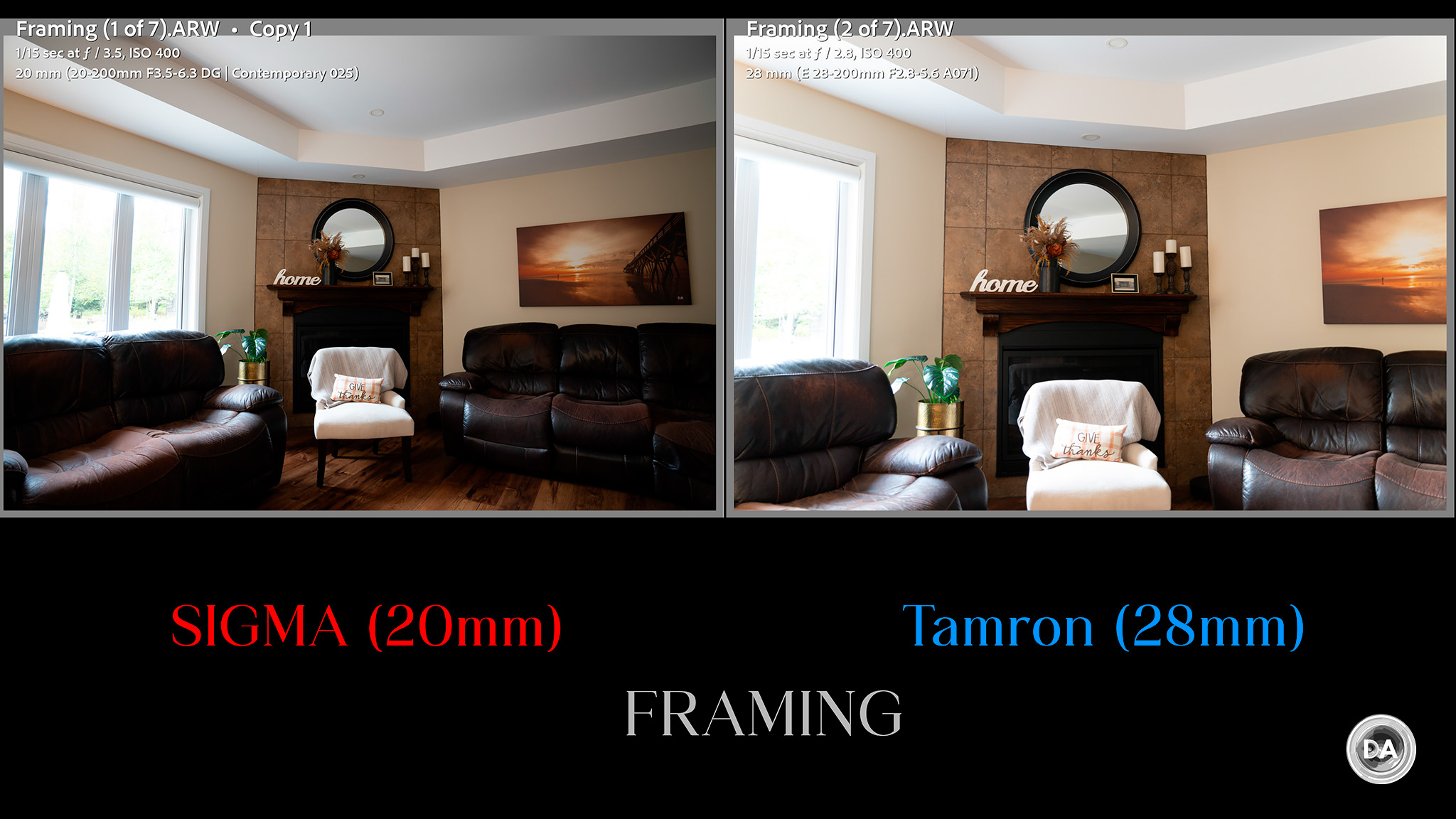
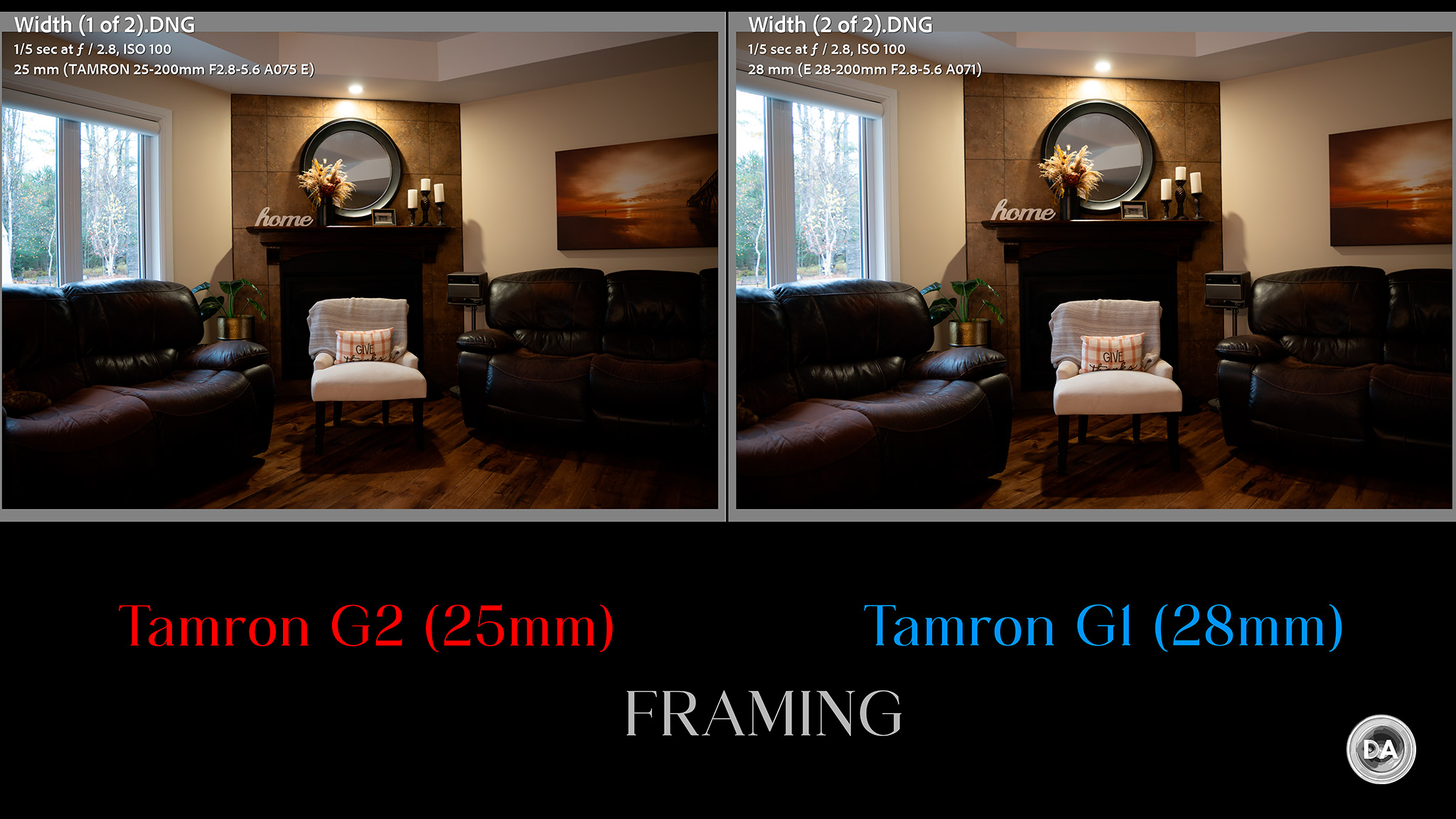
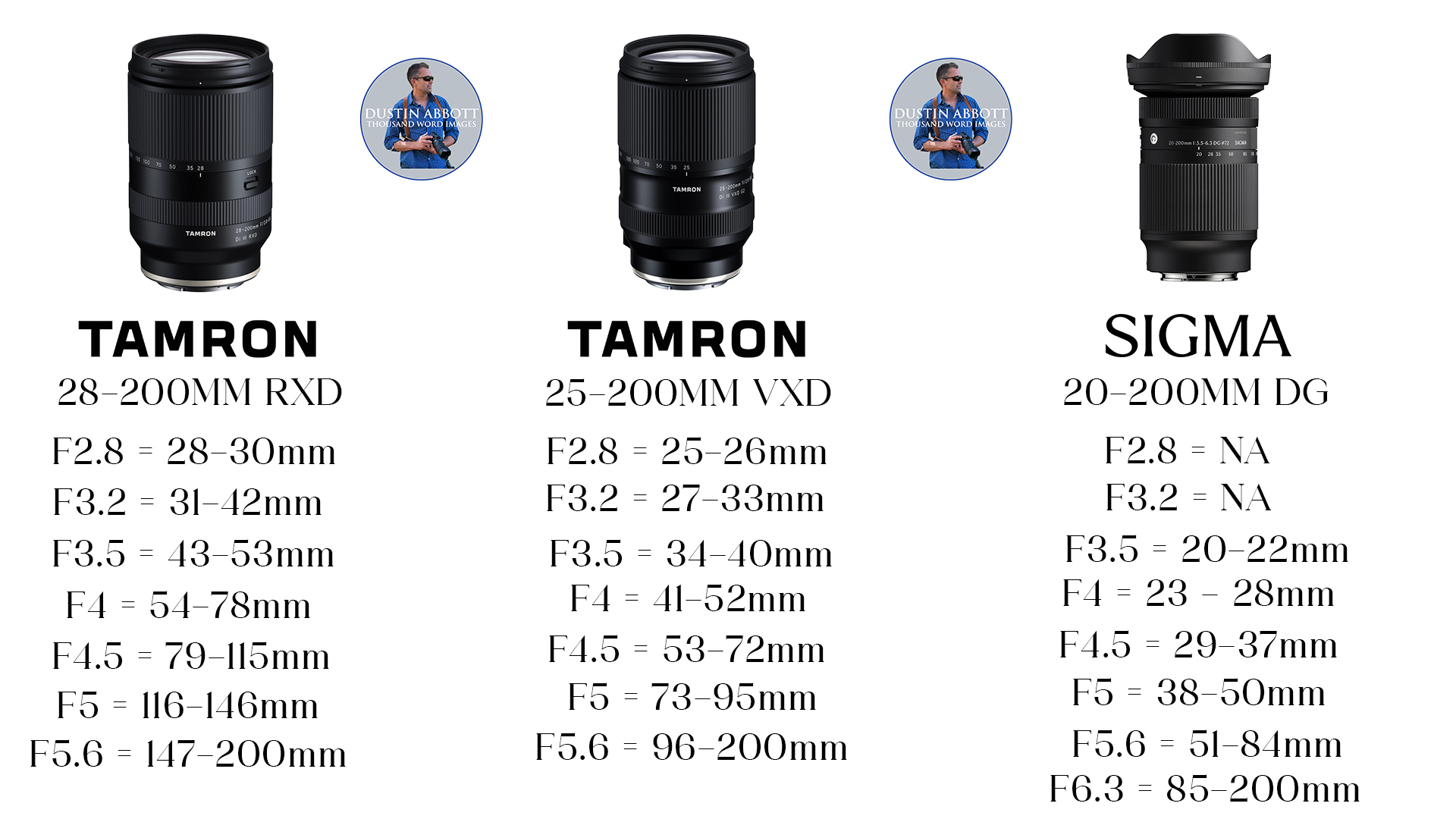
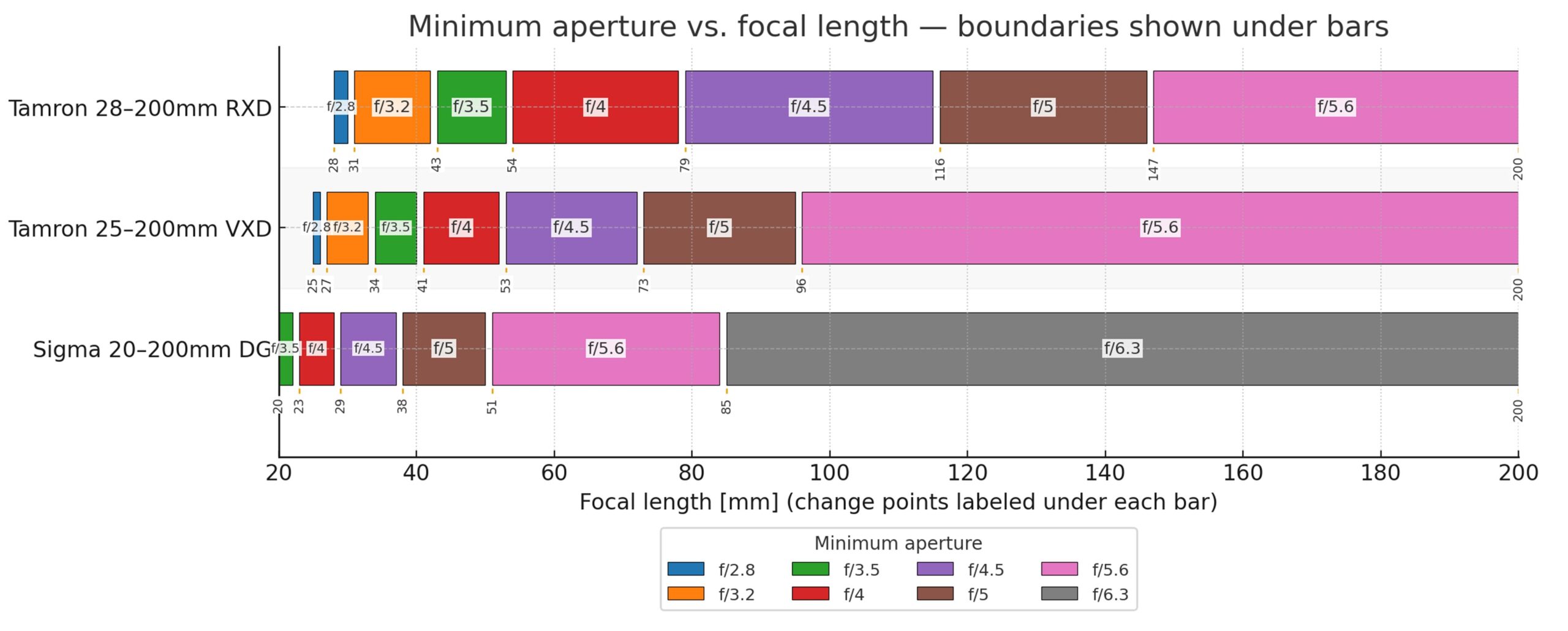
A member of my audience put the information together in a more visual way, which I’ll share here.


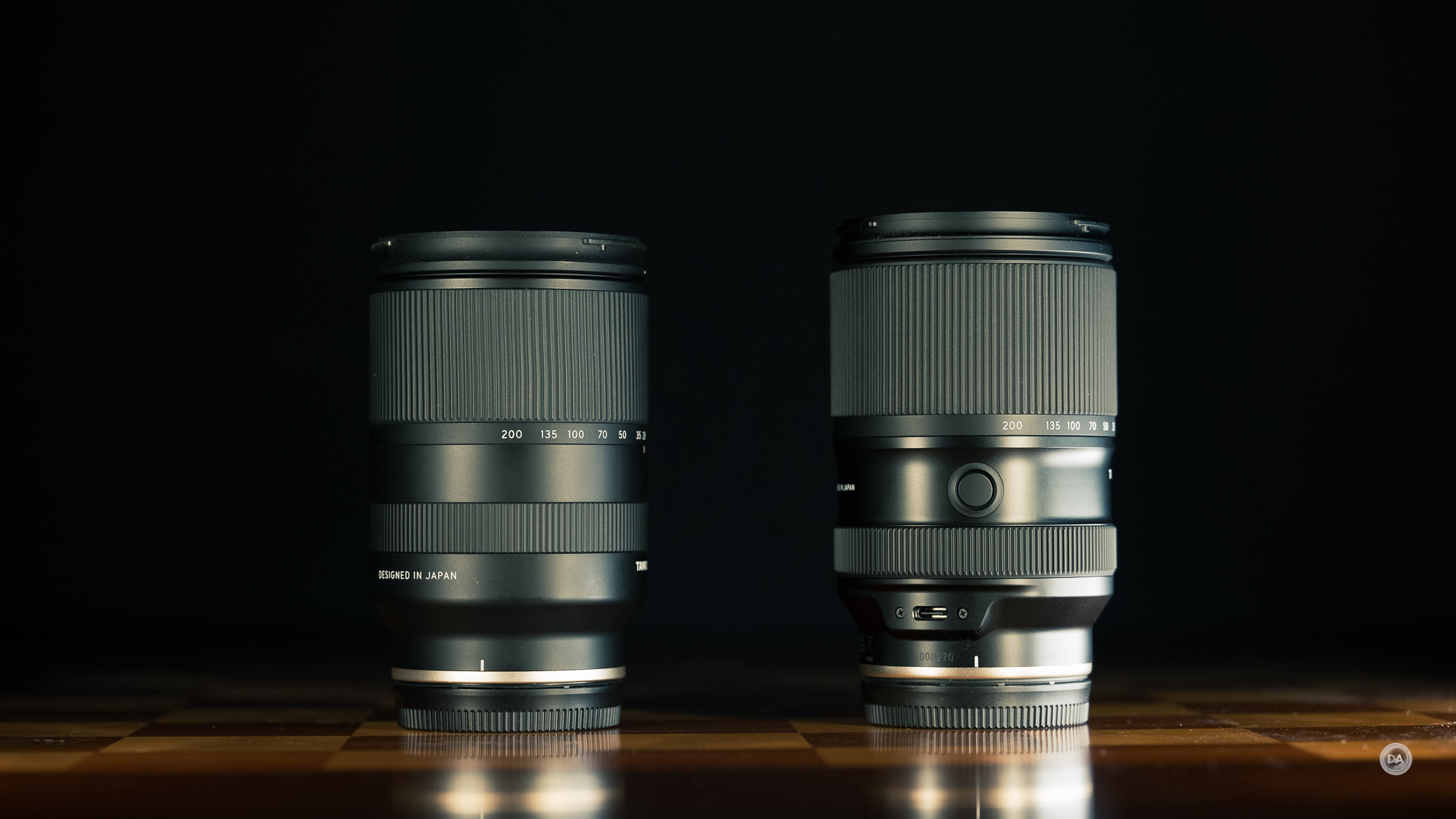
Build and Handling










Autofocus








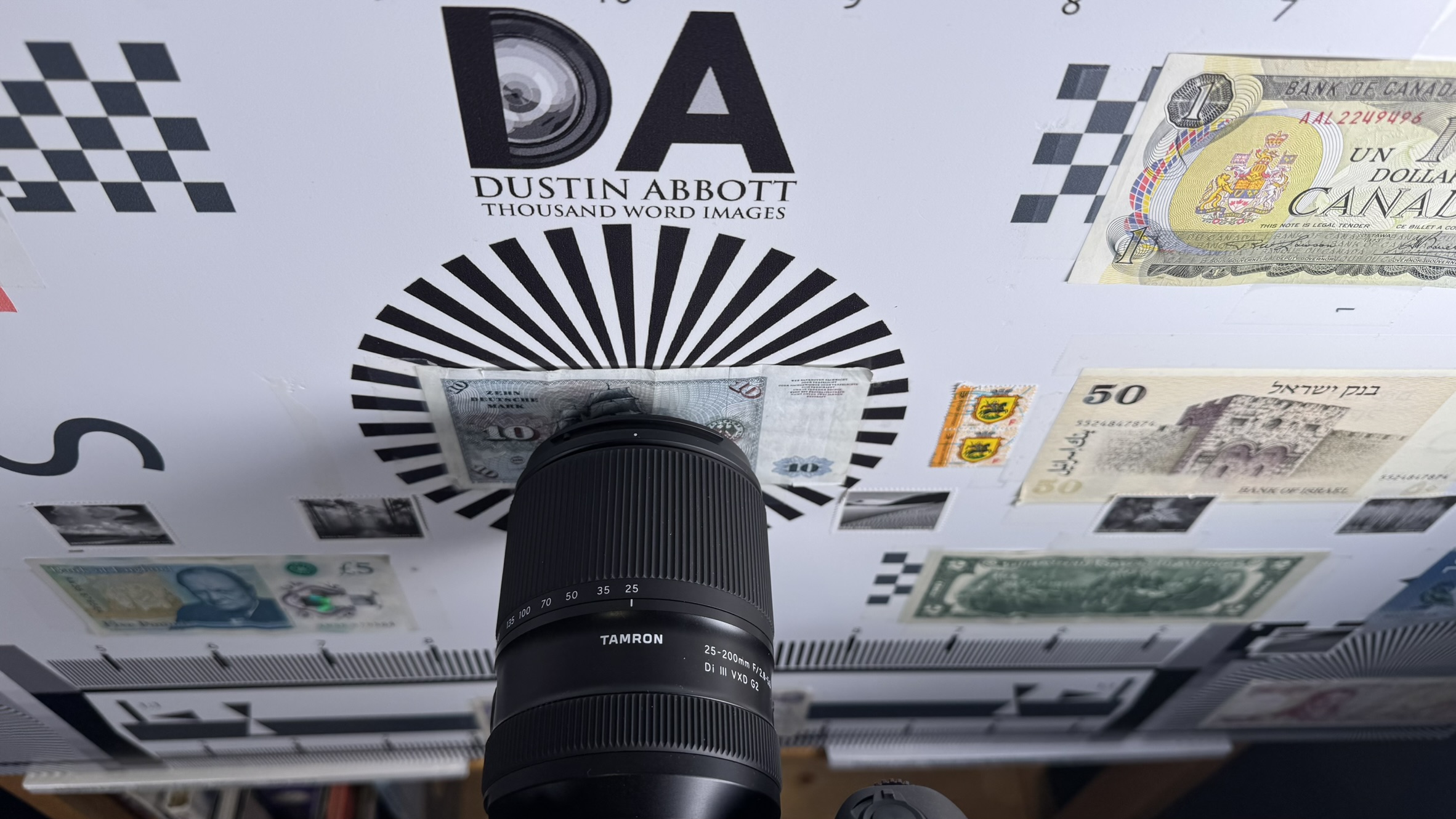
In my controlled focus tests, moving back and forth from a near to distant subject, I found the focus speed to excellent. The telephoto end was a bit slower indoors than the wide end, but out-of-doors, in better lighting, focus was nearly instant even on the telephoto end.
Focus precision was also excellent, allowing me to focus on very narrow subjects effortlessly.

I will also note that Tamron’s full time manual override is great for the moments when the autofocus wants to grab a background rather than foreground subject (something I find common with all modern cameras and lenses), allowing you to get focus in the proper “zone” where AF can take over and make sure that focus is accurate.
I would say that the Tamron 25-200mm is equally good as Sigma’s excellent 20-200mm for autofocus.
Video AF
I also saw good results for video work. Autofocus pulls were fast and confident, and focus breathing is extremely low, allowing for smooth looking pulls back and forth.
My hand test (where I alternately block the camera’s view of my face with my hand and then remove it to allow focus to move to my face) went extremely well, with confident transitions back and forth.
I had good success when approaching the camera, with good tracking of this movement, and quick recovery if I ducked or stepped out of frame and then back.
While the lens isn’t parfocal (I can see a minor focus change), it reacts quickly and smoothly enough that I didn’t really see focus loss and readjustment along the way.

The biggest advantage over the Sigma for video work is that the zoom action on the Tamron is much smoother than the Sigma, allowing for smoother zooms. Autofocus also seems to keep up a bit better during zooms.
In general, however, this is going to be a nice travel zoom for video. The great zoom range combined with stable autofocus is a winning combination.
Image Quality Breakdown
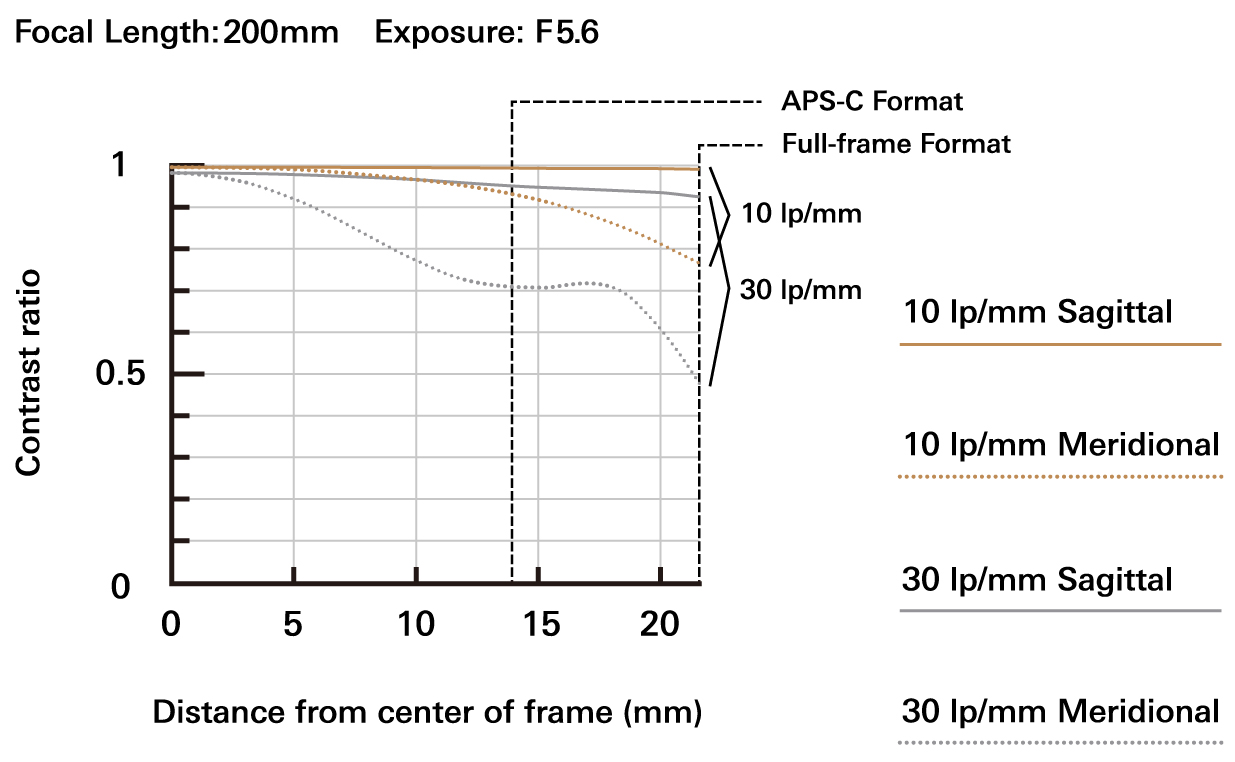
The Tamron 25-200mm VXD features an optical design of 18 elements in 14 groups. While I haven’t see a specific element breakdown, I do know that includes GM (Glass Molded Aspherical), LD (Low Dispersion), and XLD (eXtra Low Dispersion) elements. As with the 28-200mm, the MTF shows a surprisingly strong performance on both ends of the zoom range.
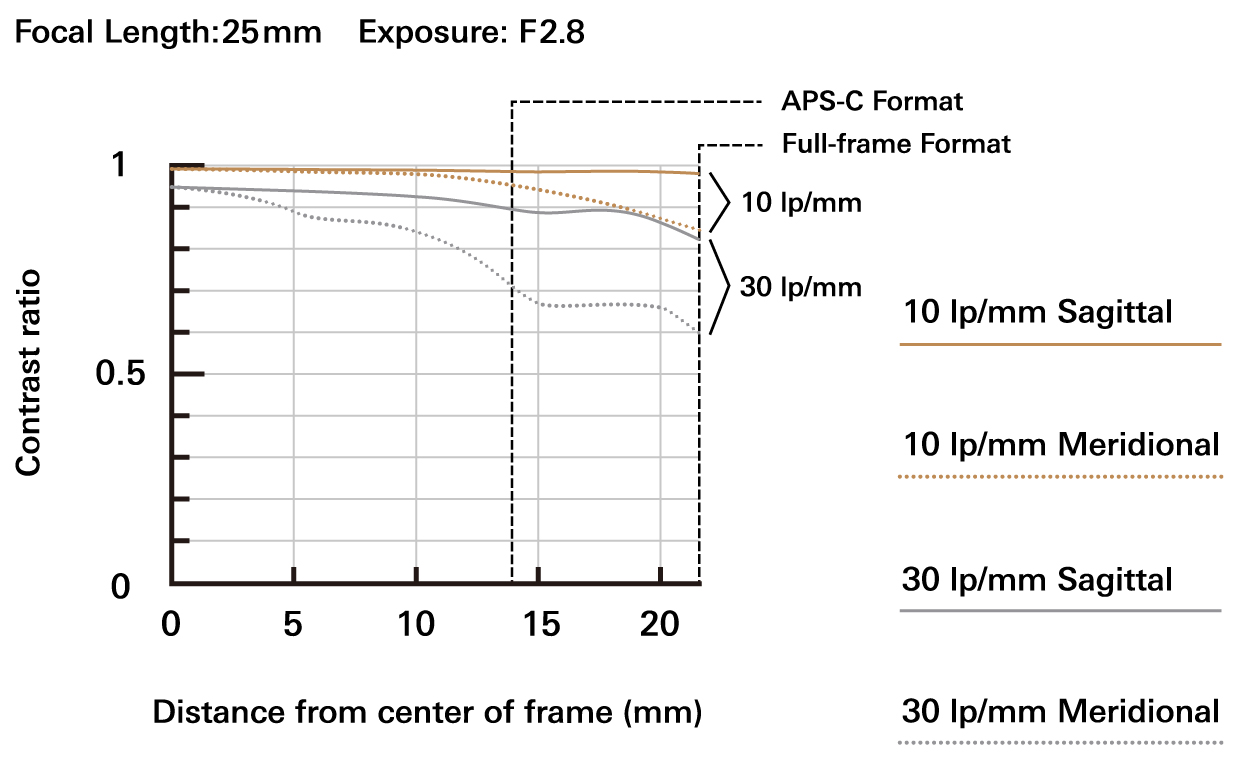
At 25mm, we see a very sharp center and midframe with mild astigmatism, and even the corners still look relatively strong, though the game between the sagittal axis (very strong) and the meridional axis (weaker) grows, indicating stronger astigmatism in the corners. It isn’t difficult to get strong landscape style images at 25mm even when shooting at F2.8.

At 200mm the center is absolutely amazingly sharp, though astigmatism grows across the frame. If the meridional axis was as sharp as the sagittal axis, this lens would be epically sharp.
As it stands, however, the lens is still very impressively sharp even wide open at F5.6 at 200mm everywhere but the corners.


In terms of pure MTF performance, the Sigma isn’t quite as sharp as the Tamron at either end of the zoom range.


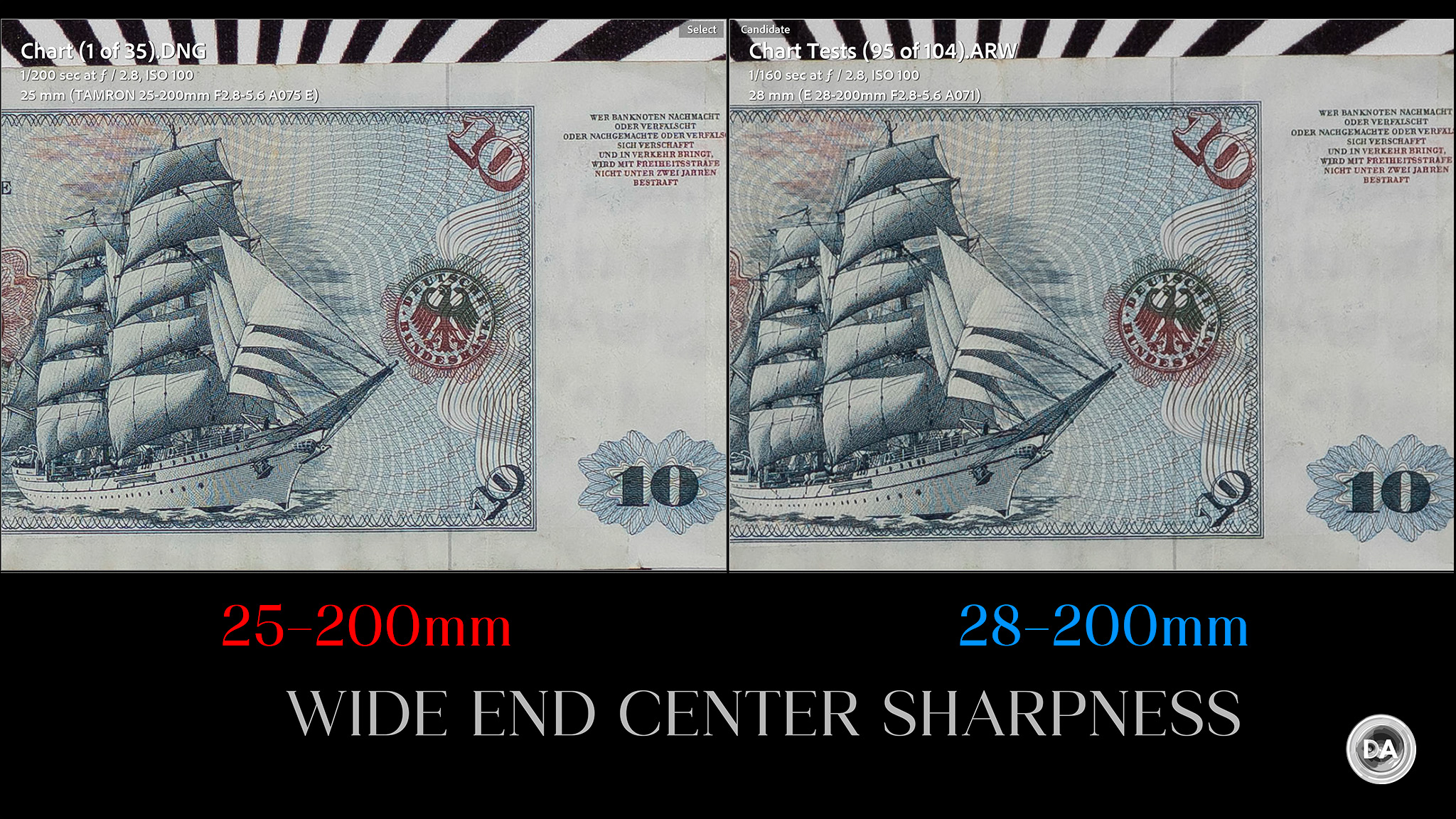
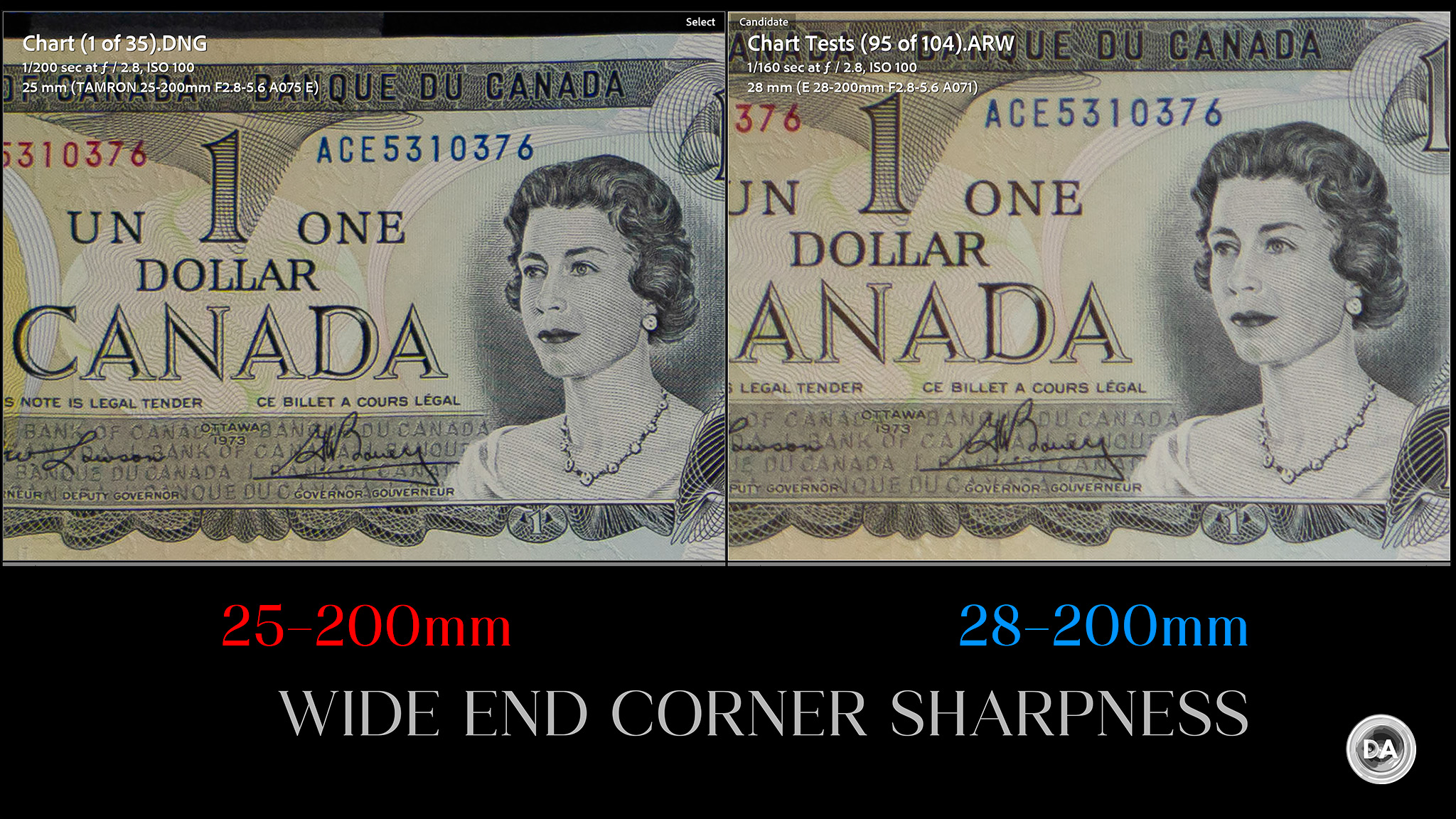
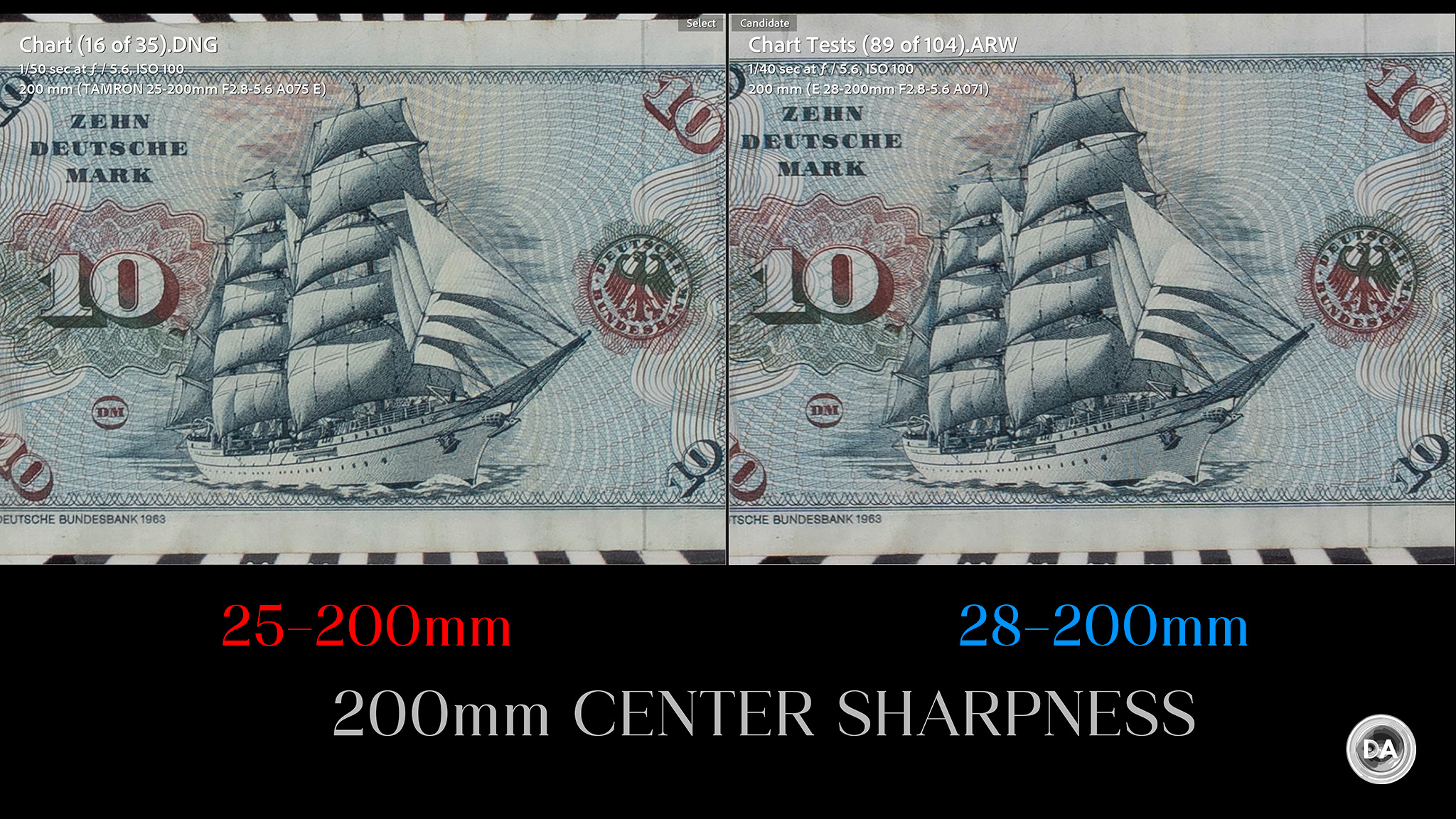
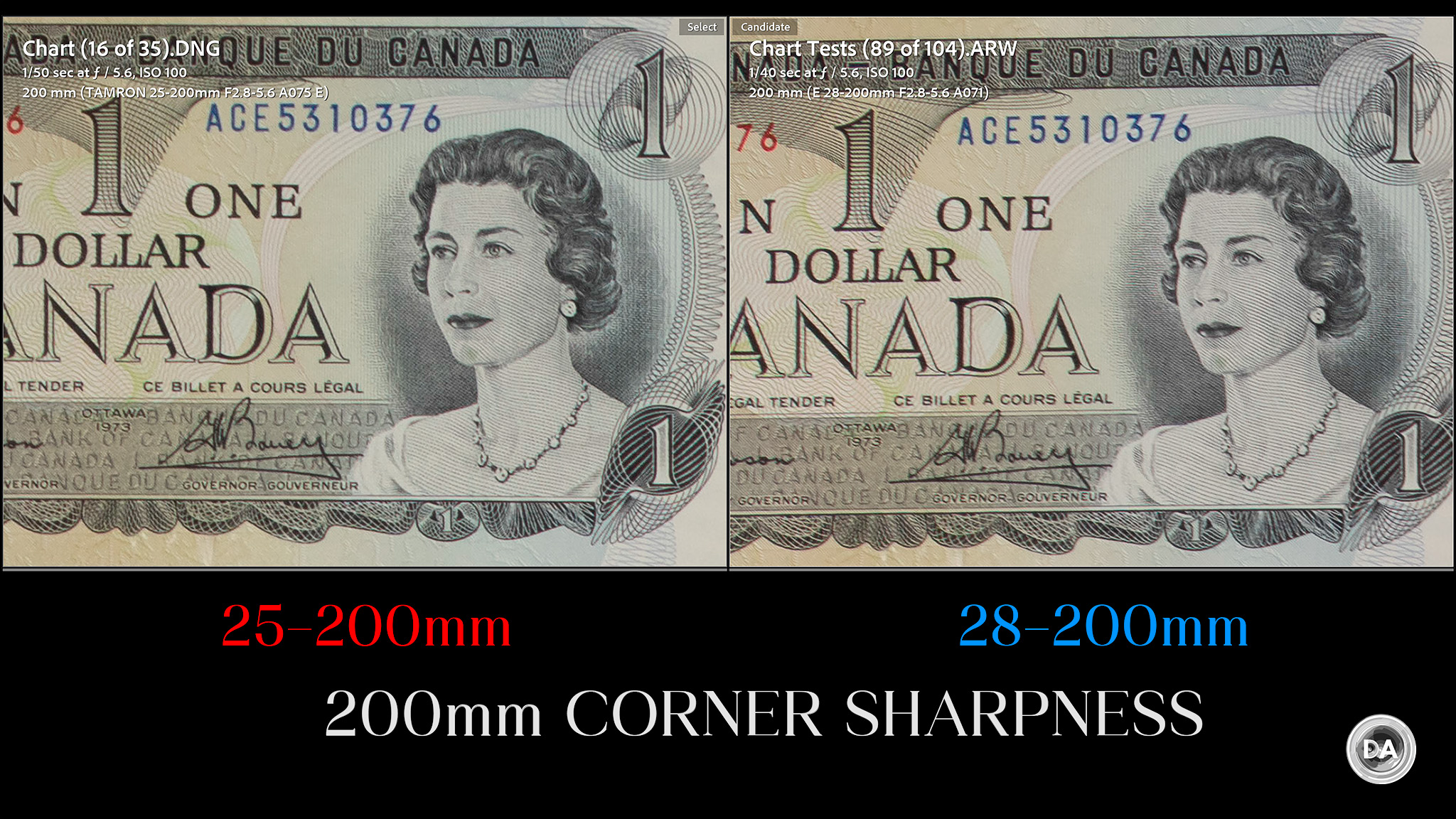
The Tamron is sharper in the center, midframe, and corners. That’s part of the payoff for constraining the zoom range a bit. In my own comparisons, I found the differences to be more subtle. The Tamron was consistently a bit better, but by differences mostly so subtle as to be unnoticeable without the two side by side. Here’s a center and corner comparison at the wide and then telephoto ends.


I was also interesting in comparing to the original 28-200mm, which was a lens that always impressed me in terms of sharpness. I found that the newer 25-200mm took the win on the wide end but the two lenses were pretty indistinguishable on the telephoto end.
The Sigma lens cut some serious corners when it came to distortion and vignette on the wide, with an extremely heavy and complex distortion pattern that still looked liked a mess after manual correction.
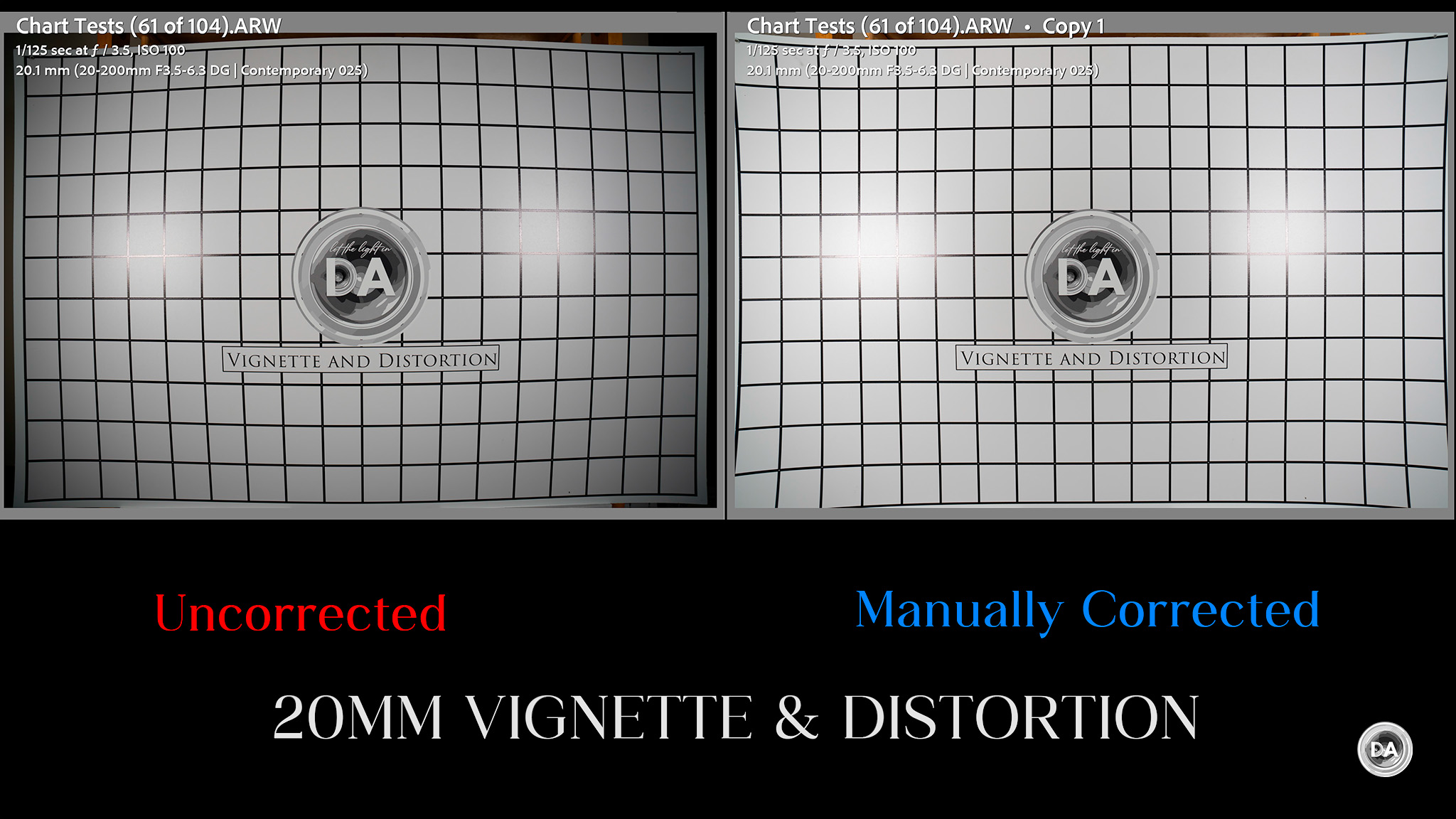
The Tamron has some barrel distortion, too, but to a far less degree. I had to use a +39 to correct the Sigma at 20mm, but the Tamron at 25mm needed a much lower +19, and, what’s more, you can see below that it actually corrects in a nice, linear fashion. Vignette was another story, however, requiring a +96 (nearly maxing out the slider) to correct. The Sigma was even worse, however, requiring me to max out the slider…and still leaving some vignette behind.

I don’t love the heavy vignette, but the manageable distortion here is a huge improvement over the Sigma.
As you begin to move through the zoom you’ll find the distortion pattern flip to a pincushion style distortion. At 100mm there is a moderate amount of pincushion distortion, though it remains very linear and easily correctable.

I needed a -7 to correct the distortion, and vignette has reduced to a much more moderate +42.
By 200mm the distortion pattern is the same (-7 to correct), as is the vignette. I needed a +45 to correct.

In all cases I could get a clean manual correction, which helps immensely. Distortion and vignette are far less of an issue on the Tamron than the Sigma. That’s due to Tamron taking the more conservative route. The 20mm end of the Sigma is very attractive on paper, but it required a LOT of compromises to make that happen.
Testing for longitudinal chromatic aberrations (LoCA) showed no issues at the various focal lengths I tested at. Here’s a look at 125mm on my test chart.

Even in extremely high contrast backlighting I didn’t see apparent fringing.

I also saw minimal issues with LaCA (lateral chromatic aberrations), which shows up along the edges of the frame. All of the transitions here are fairly neutral.

So how about resolution and contrast? My formal tests are done on the 61MP Sony a7RV.
Here’s a look at the test chart from which the crops will come.

Here are crops from across the 25mm frame at F2.8 and shown at a 200% magnification.


We have already seen from the comparisons that (for this class of lens) this performance is top of the heap. Performance is generally excellent across the frame.
Stopping down to F4 brings contrast and detail up to intensely good levels in the center and mid-frame, and the corners are looking both brighter and more contrasty as vignette lifts.
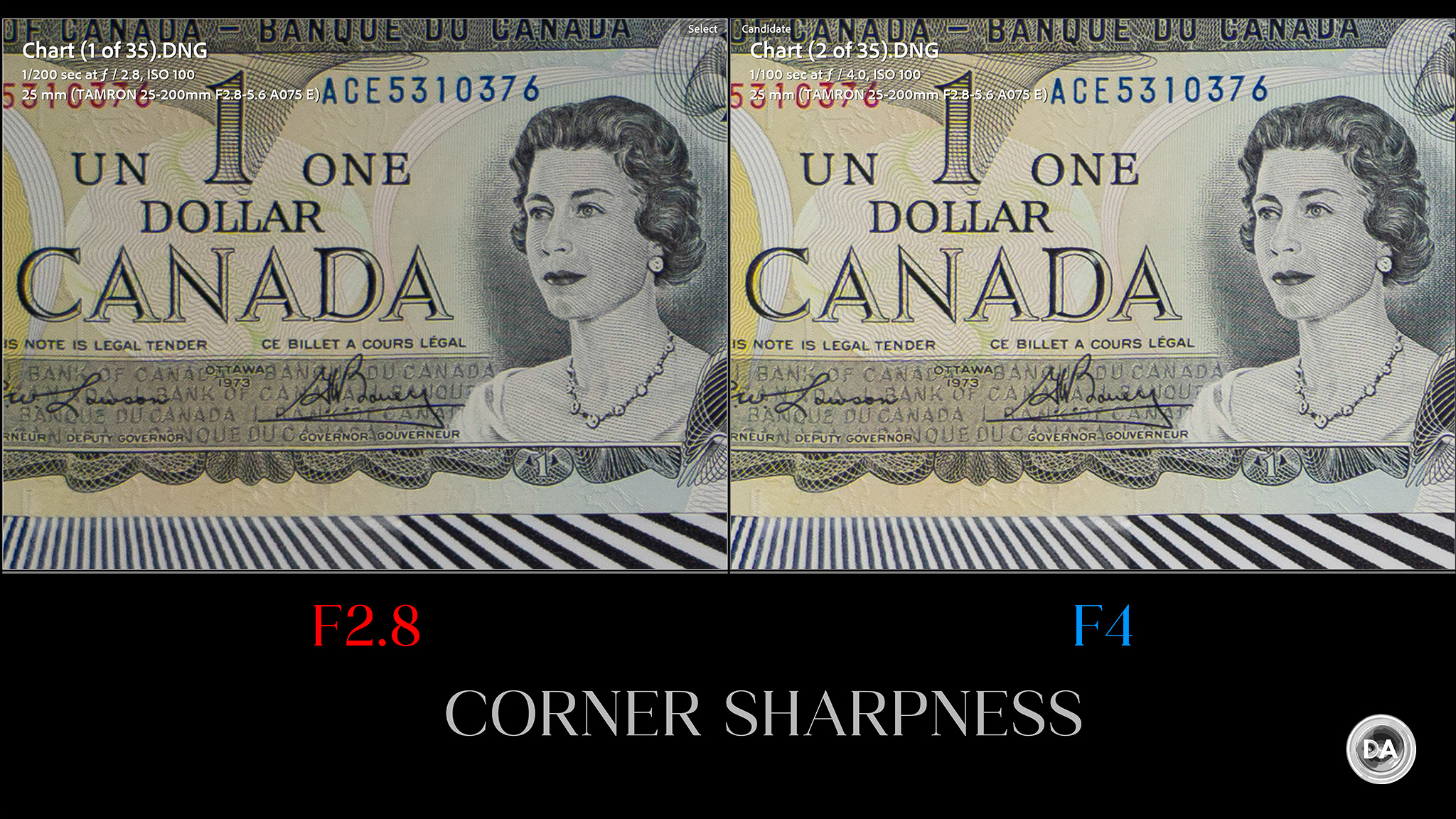
You can expect very crisp landscape results.

This helps in an area of weakness for the Sigma. I found that corners didn’t really sharpen up to good levels when stopping it down on the wide end. You can see a pretty obvious difference between the Tamron and Sigma at F8:
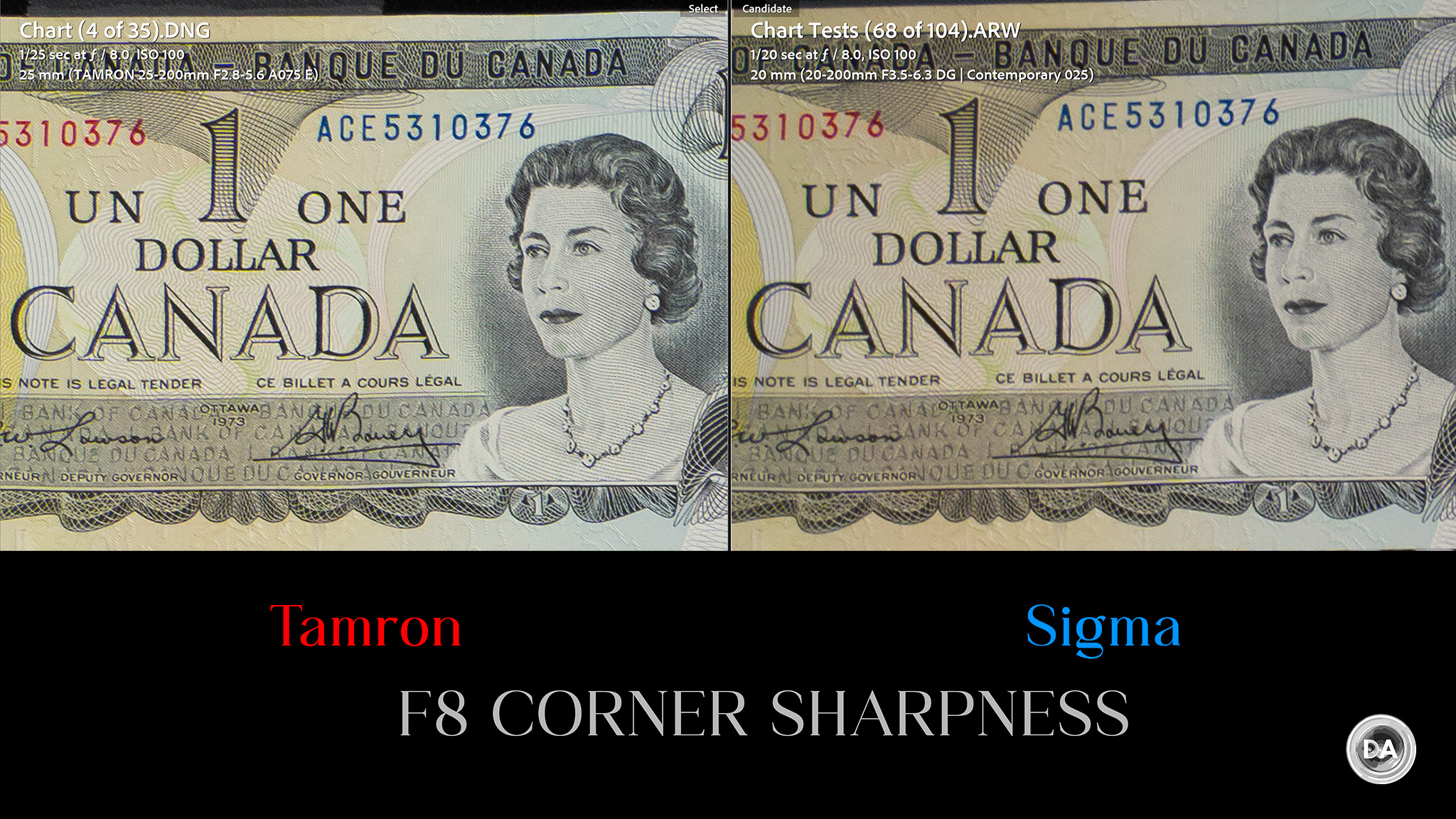
The Tamron is the better choice if corner sharpness matters to you.
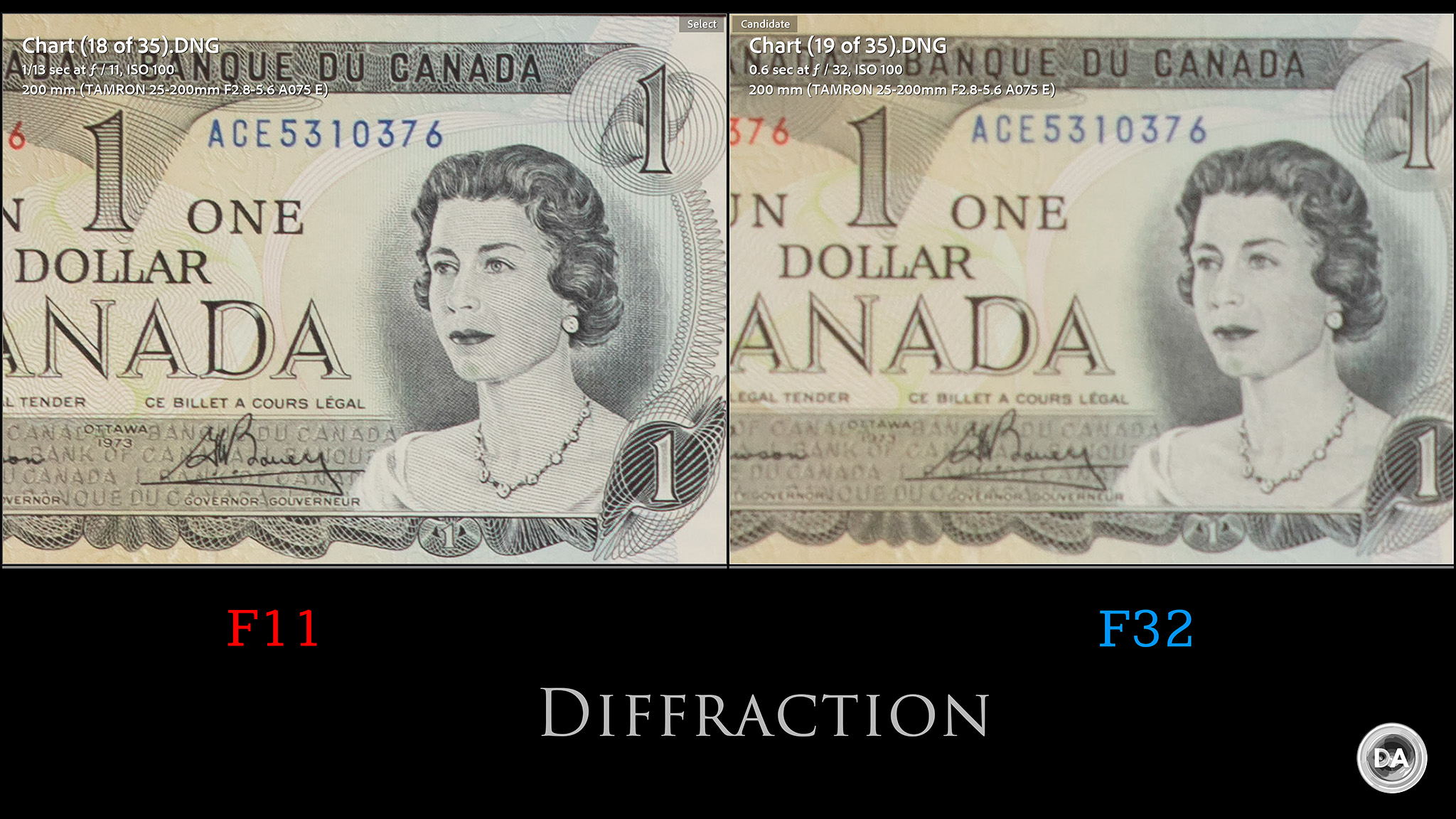
Variable aperture zooms like this can have pretty small minimum apertures. At 25mm the minimum aperture is an ordinary F16, but by the telephoto end that becomes F32. Diffraction is going to be a factor at any of those minimum apertures, but even more pronounced on the telephoto end where the minimum aperture is a couple of stops smaller. You can see that while F11 (in the corners, here) looks pretty decent, F32 is simply unusable due to diffraction.
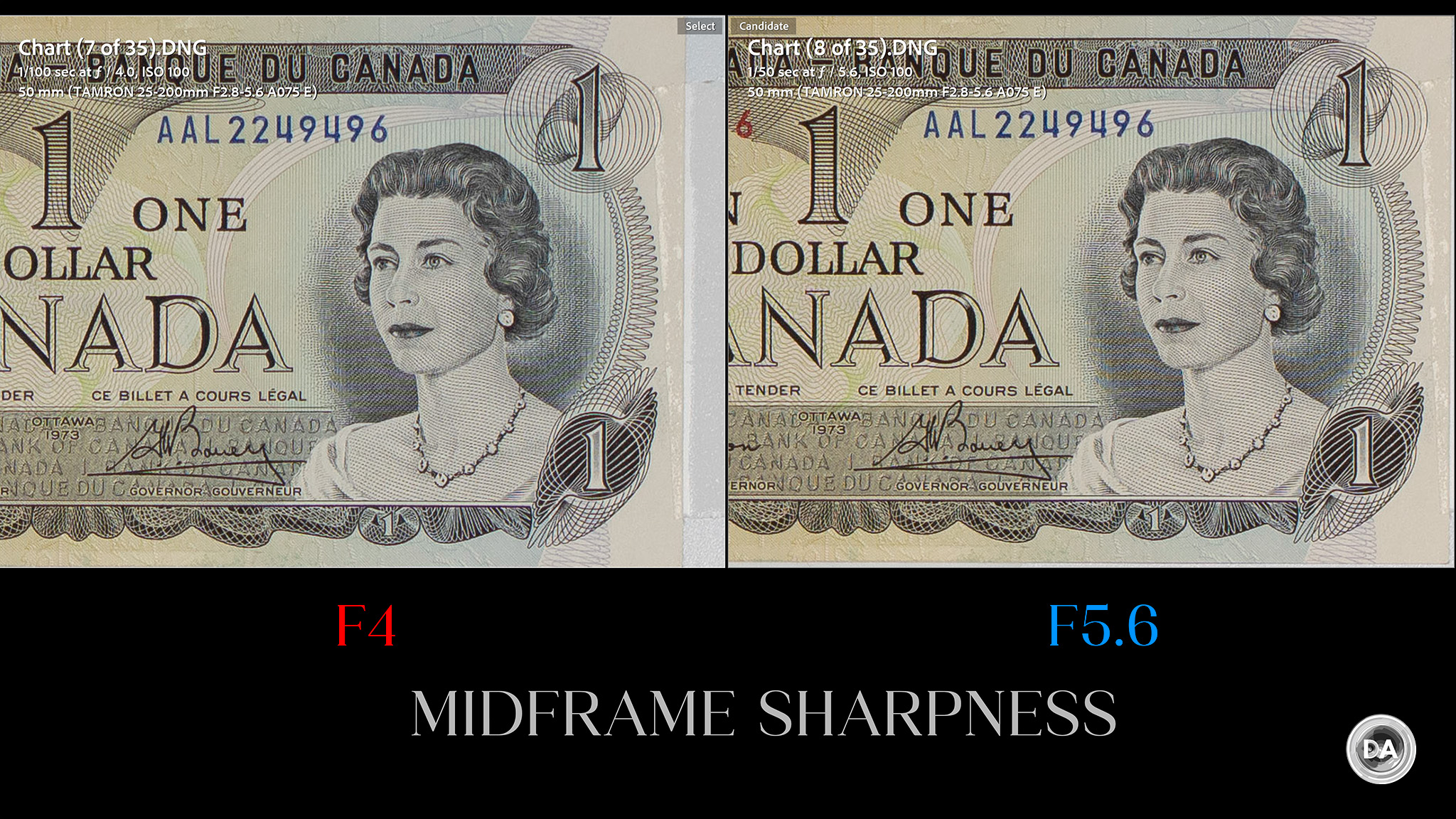
Moving on to 50mm finds the maximum aperture at F4 (much better than the Sigma’s F5), and results look pretty great all across the frame.


Stopping down to F5.6 raises contrast levels up to fantastic levels in most spots.
I’ve got zero complaints about the look of real world landscape images at 50mm:

At 100mm we’ve reached the smallest maximum aperture of F5.6. The results aren’t as sharp as at 50mm anywhere in the frame.



I can see that edge performance isn’t as good in real world results, though the rule of thirds zone is still very strong.

200mm has a slight rebound, with a bit more clarity and contrast than 100mm. It doesn’t have a lot of room for improvement, however, with F8 mostly looking similar to F5.6.
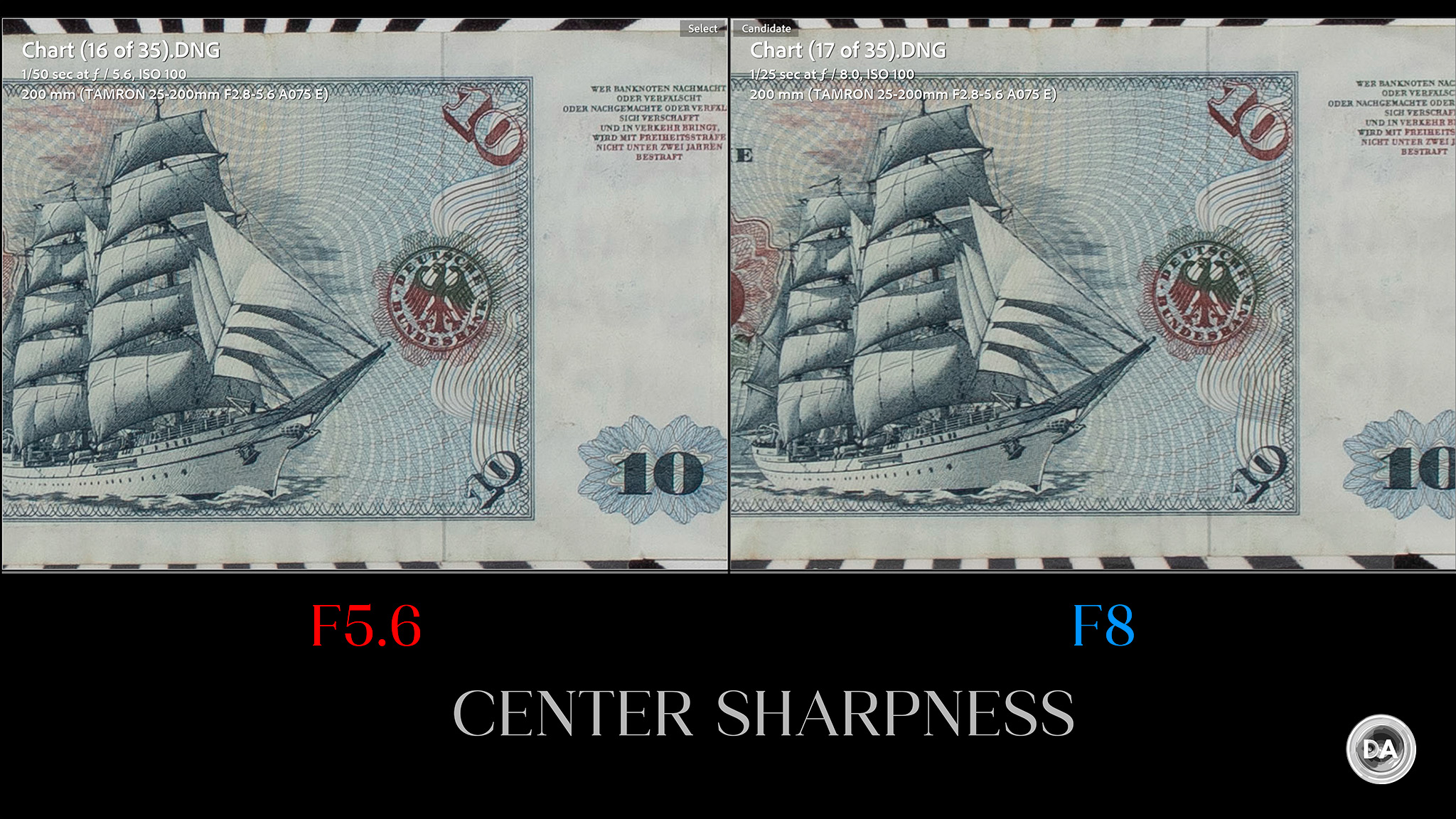
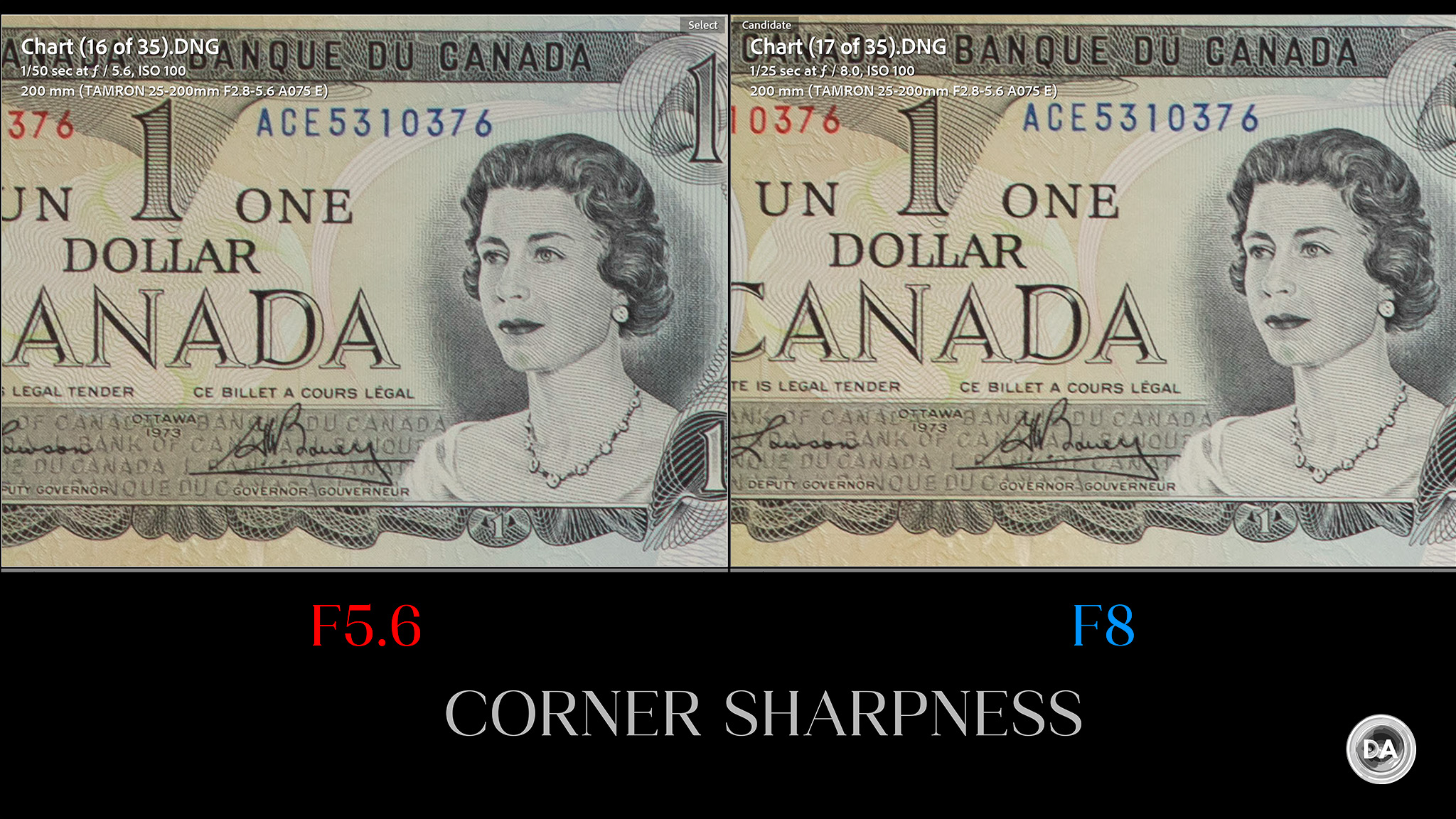
I generally felt that 200mm real world results looked quite good, however, with very decent detail and contrast.


Bokeh is a complicated subject for superzoom lenses. At close focus distances you have the capacity to blur out backgrounds fairly well.

That obviously looks nice and creamy, and definitely sets the lens apart from anything one might get from a phone camera while traveling.
I was generally pretty happy with shots at medium distances, too, as while there’s a bit of outlining here, the image generally looks pretty good.

Here’s a shot with a busier background, and I still feel like it looks fairly good.

Specular highlights look better than what I saw from the Sigma, but not great. There’s a little less outlining, but also some general busyness inside the “Bokeh balls”.

This certainly isn’t going to replace a nice prime for bokeh rendering, but I would say the 25-200 VXD is better than most equivalent superzooms.

Tamron’s BBAR 2 coatings seem to be doing what they need to do, as the 25-200 VXD seems to be fairly flair resistant. I tried shooting with window light, through leaves, and against my set lights, and I never really saw any ghosting or veiling.



Colors were also good, leading to images with nice saturation.



In general, I remained more impressed with the optical performance of the Tamron 25-200mm F2.8-5.6 Di III VXD G2 than I did with the Sigma 20-200mm. I felt that the Sigma was more compromised than the Tamron. Here’s a mini gallery of extra images for you to enjoy.
Conclusion
The Tamron 25-200mm F2.8-5.6 Di III VXD G2 hits a nice balance between the safe, reliable performance of the older Tamron 28-200mm RXD and the new, more extreme Sigma 20-200mm Contemporary. The Sigma 20-200mm simply tries to do too much and, I believe, suffers for it. I appreciate the extra bit of width on the 25-200mm VXD, and, while it isn’t penalty free, I think that the compromises to get that extra 3mm on the wide end are more palatable.

I’m not sure I would recommend an upgrade from the older 28-200mm RXD from a purely optical standpoint, as the optical areas of improvement are fairly minimal, but the improved focal length, autofocus, and feature set might be a more compelling reason to upgrade. If you are just choosing a superzoom/travel type lens, however, the Tamron 25-200mm would get my vote.

People buy lenses like the Tamron 25-200mm VXD because they provide an all-in-one solution that allows you to travel or backpack with just one lens while still getting much better image quality than a camera phone can provide. The Tamron gives you a lot of versatility, with enough width to capture interior spaces (though not as much as the Sigma), still decent light gathering for this type of lens, good magnification, and a top-of-the-class optical performance. The new VXD focus motor allowed me to even track action effortlessly, leading me to the conclusion that the $899 USD Tamron 25-200mm VXD is now the lens to buy in this class. This is a solid evolution on a lens that I’ve found pretty invaluable over the past five years.

Pros:
- Stretches the zoom range on the wide end
- 8x zoom range
- Compact and lightweight
- Thorough weather sealing
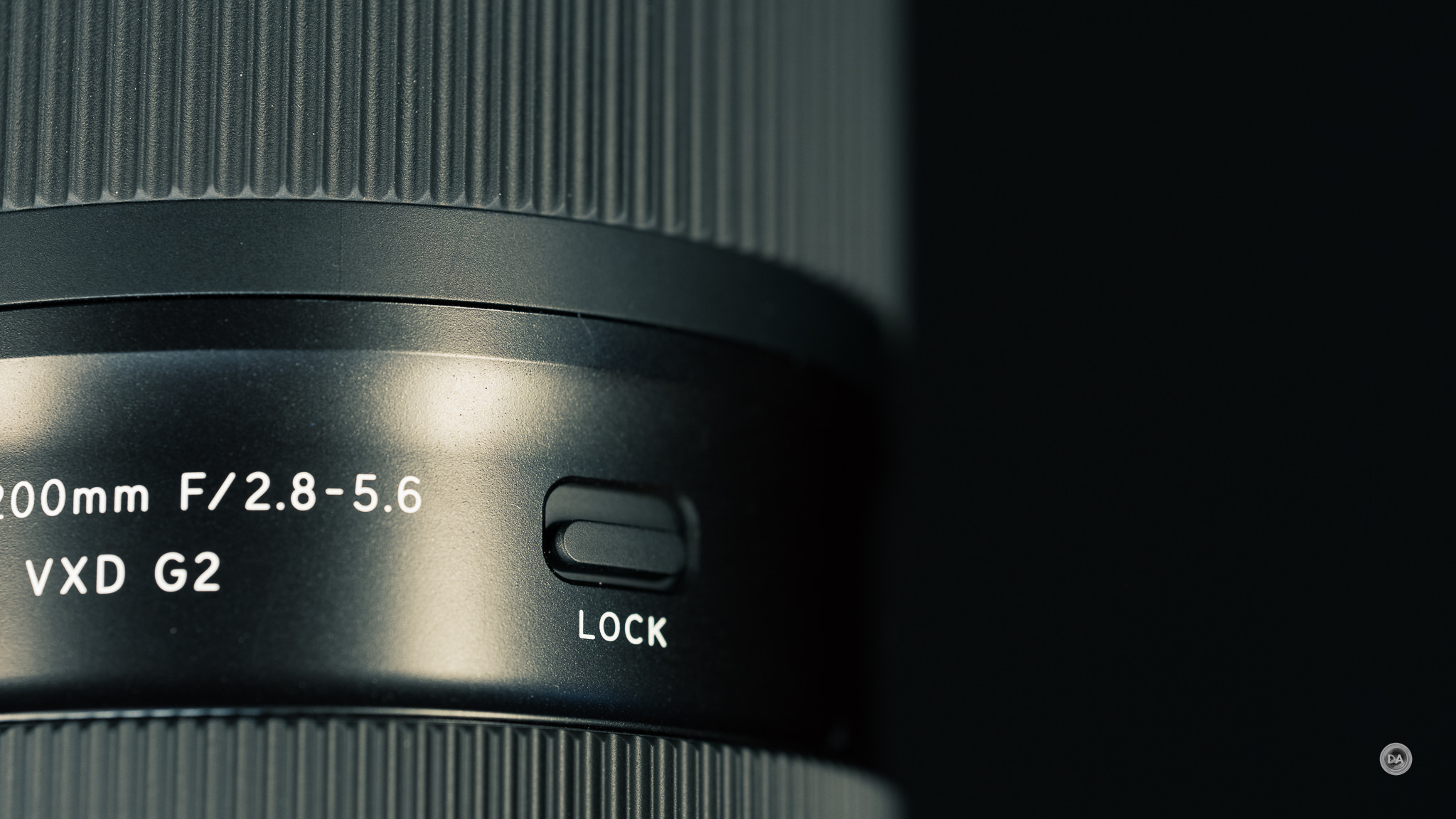
- Improved features
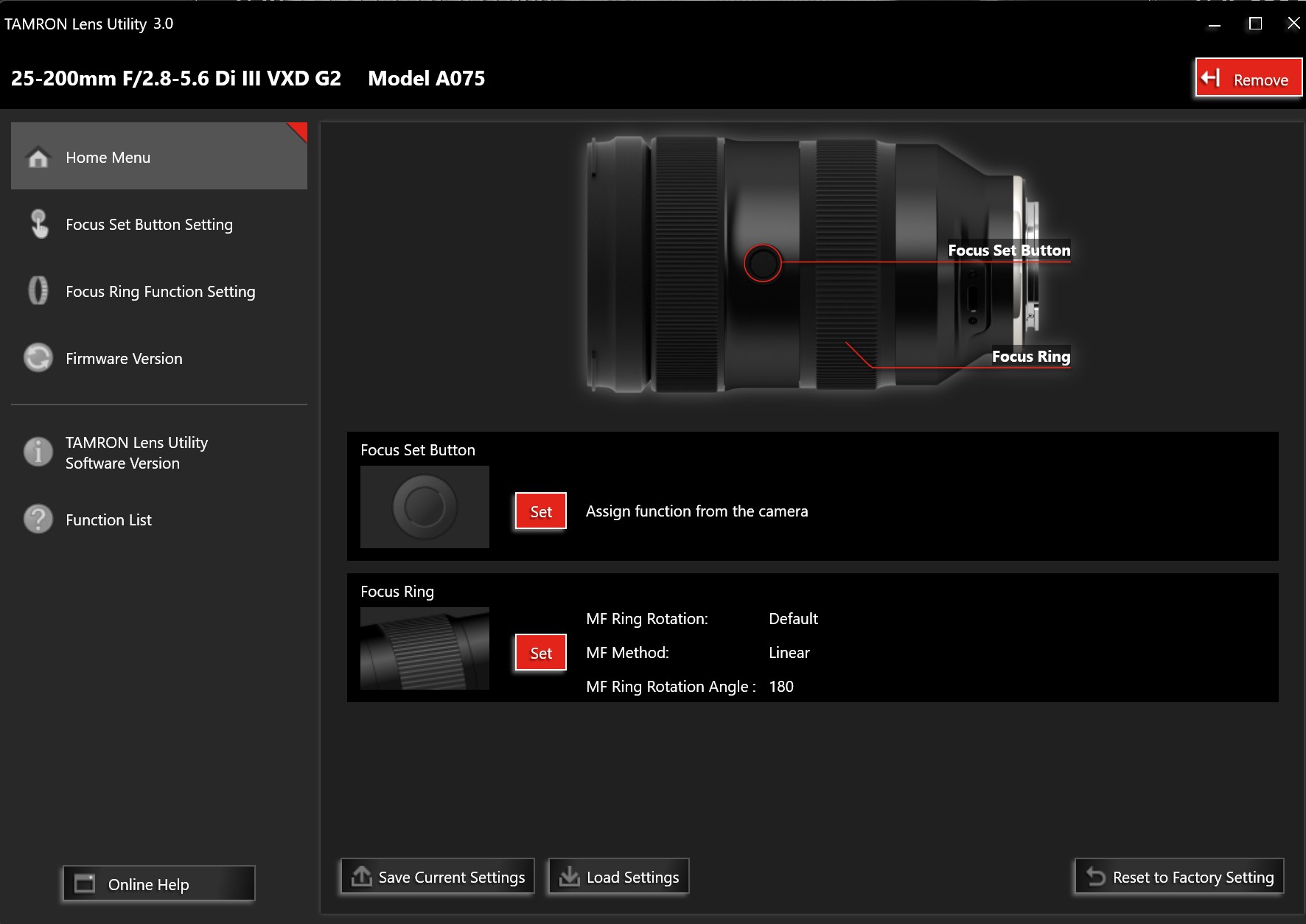
- Some customization options
- VXD focus motor provides quick, quiet focus
- Very high magnification level
- Lower distortion and vignette than Sigma
- Near perfect control of aberrations
- Very sharp on the wide end, sharper in standard range
- Reasonably consistent performance across zoom range
- Beautiful colors
- Good flare resistance
Cons:
- Not quite as bright as the 28-200mm
- Maximum magnification isn’t as easy to access as Sigma
_________________________________________________________________________
GEAR USED:
Purchase the Tamron 25-200mm F2.8-5.6 VXD G2 @ B&H Photo | Adorama | Amazon | Camera Canada | Amazon Canada | Amazon UK | Amazon Germany
Purchase the Sigma 20-200mm DG @ B&H Photo | Adorama | Amazon | Camera Canada | Amazon Canada | Amazon UK | Amazon Germany
___________________________________________________________________
Purchase the Sony a7RV @ B&H Photo | Adorama | Amazon | Camera Canada | Sony Canada | Amazon Canada | Amazon UK | Amazon Germany
__________________________________________________________________
Purchase the Sony a7IV @ B&H Photo | Adorama | Amazon | Camera Canada | Sony Canada | Amazon Canada | Amazon UK | Amazon Germany
_________________________________________________________________
Purchase the Sony Alpha 1 @ Camera Canada | B&H Photo | Adorama | Amazon | Sony Canada | Amazon Canada | Amazon UK | Amazon Germany | Ebay
_________________________________________________________________
Want to support this channel? Use these affiliate links to shop at: B&H Photo | Amazon | Adorama | Camera Canada | Amazon Canada | Amazon UK | Ebay | Make a donation via Paypal
Buy DA Merchandise https://bit.ly/TWIMerch

Keywords: Tamron 25-200mm, 25-200mm, F2.8-5.6, f/2.8-5.6, Di III, VXD, G2, Tamron 25-200mm G2 Review, Travel, All-in-One, Sigma 20-200mm, 28-200mm, Full Frame, Review, Sony A1 II, Sony a7RV, Review, Hands On, Dustin Abbott, Real World, Comparison, Sharpness, Bokeh, Flare Resistance, Autofocus, Image Quality, Sample Images, Video, Photography, let the light in, weathersealing, #letthelightin, DA
Related posts:
 Tamron 28-300mm F4-7.1 Di III VC VXD Review
 Tamron 28-300mm F4-7.1 VC VXD Gallery
 Tamron 90mm F2.8 Di III Macro VXD Review
 Tamron 50-300mm F4.5-6.3 VC VXD Review
 Tamron 90mm F2.8 Macro VXD Gallery
 Tamron 16-30mm F2.8 Di III VXD G2 Review
 Tamron 17-50mm F4 Di III VXD Review
 Tamron 50-300mm F4.5-6.3 VC VXD Gallery
 Tamron 70-180mm F2.8 VC VXD G2 Review
 Viltrox EVO 85mm F2 FE Review