0:10
Hi, I'm Dustin Abbott and I'm here today
0:12
to take a look at a fairly unique kind
0:15
of lens. Taipok is an interesting
0:17
company because while they have some
0:20
modern lenses like the Explorer series
0:23
which have autofocus even zooms they
0:26
also are very rooted in photography's
0:29
past and they have at least a big part
0:32
of what I have reviewed from them at
0:33
this point have been lenses that really
0:35
either evoke a Leicaesque type quality
0:38
or in this case are actually replicas of
0:41
an old Ilford rangefinder type lens and
0:44
I'm talking about the Eureka
0:46
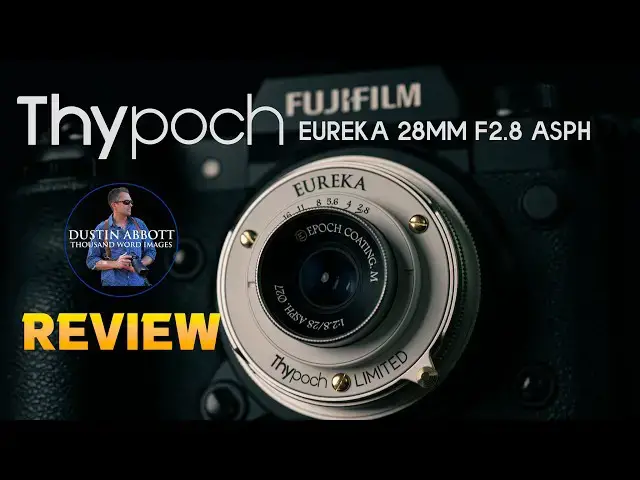
28mm f/2.8 aspherical lens. This is a
0:50
little lens that is basically a piece of
0:52
art. And the original version of it came
0:55
out for mm-mount, but also there was a
0:58
Fuji Xmount version that essentially
1:00
came with a Fuji adapter. This new
1:03
version of the lens, however, is the
1:06
adapter and instead goes for an
1:08
integrated body style that essentially
1:10
has in one piece that adapter built into
1:13
it. adapter being necessary primarily to
1:16
just space out the optics far enough and
1:18
so that the flange distance is proper
1:20
for Fuji as compared to like a rangefire
1:23
finder style cameras. It is beautiful to
1:26
look at. Comes in a couple of finishes.
1:28
One is a black and then I have the the
1:32
kind of pearl white finish here. that is
1:35
a really really beautiful thing to look
1:37
at and it has a lot of retro aesthetics
1:40
to it but also retro controls as we're
1:43
going to see for good and ill. So today
1:46
we're going to look at this little lens
1:48
and determine whether or not it's just a
1:50
photography based piece of art or a real
1:53
optical instrument and whether or not it
1:55
is a lens that you should consider for
1:57
your Fuji Xmount body. So before we dive
2:00
in, I do want to first say a big thank
2:02
you to Taipok for sending me a review
2:04
sample of the lens. As always, however,
2:06
they've had zero input in this review.
2:08
It is completely independent and my
2:10
thoughts and findings are my own. All of
2:12
that aside, let's dive in. Let's take a
2:14
look. All right, let's take a closer
2:16
look at this little beauty. So, I mean,
2:19
the biggest thing that stands out is
2:20
this is a really, really gorgeous lens.
2:23
It actually is um visually it evokes the
2:27
Dalmire AIGMAT 35mm f4.5
2:31
that was on a rangefinder I think an
2:33
Ilford camera back in the 1940s and I
2:35
believe it was a fixed lens in that
2:37
application. So it's unique to have this
2:39
as an interchangeable lens style.
2:41
Obviously they have modernized a lot of
2:43
things on here. They've actually
2:44
launched their Epic coatings here. So
2:47
that's interesting to see. But there is
2:49
a lot of really beautiful things here.
2:51
Now, as I mentioned already,
2:54
this uh new version of the lens is a one
2:56
piece all incorporated. And so, it's got
2:58
this, you know, spacer essentially that
3:01
is there to get the optical path far
3:03
enough away from the sensor to where you
3:05
have proper focus and proper infinity
3:07
focus, but it does mean that a lot it's
3:09
it's a bigger lens than what a lot of
3:11
the existing measurements would imply.
3:13
Those measurements obviously are
3:14
measuring a narrower diameter. This was
3:17
essentially like the adapter before. And
3:19
so now the widest point of the lens,
3:21
which is this kind of adapter portion,
3:23
is 55 millimeters or 2.16 inches. And
3:26
we've got some additional depth as well.
3:28
And so the now the lens is 1.18 in or 30
3:32
mm deep. Still very shallow as you can
3:35
see, but a little bit longer than what
3:37
qualifies as a pancake style lens. On my
3:40
scale, this weighs in at 161 gram or
3:43
5.67 ounces. And really, it only weighs
3:46
that much because it is all high-end
3:48
materials. Some aluminum alloy here, but
3:51
then also a lot of brass in the design.
3:54
And this particular coating, there are
3:56
two finishes. This is the pearl white.
3:58
There's also a a nice black finish that
4:01
will marry well with the black cameras.
4:04
In this case, this pearl white actually
4:06
has some pure gold powder in the
4:08
lacquering process. And obviously these
4:11
brass bits, you know, it looks it's
4:13
really really great looking and and so
4:16
it is it's beautifully made. I love the
4:18
attention to detail. That's something
4:19
that Taipok has done really well and I
4:22
think that's what what has allowed them
4:23
to have somewhat of a breakthrough
4:25
presence into Leica Mount is that they
4:27
do really pay attention to those details
4:29
that matter to people who are into the
4:32
aesthetics of photography as much as
4:34
they are as the actual photos
4:36
themselves. Now this lens because it
4:38
evokes this kind of classic design, it
4:40
has some quirky elements to it. So first
4:42
of all, focus is achieved by this lever
4:45
at the front. Now at the top here,
4:48
you'll see that as I rotate that, there
4:50
actually is uh distance markings that
4:53
will move through there. So all of that
4:55
looks really beautiful. There's also a
4:57
hyperfocus scale. All of this is etched
4:59
into there. It's not just painted on. So
5:01
again, very nice attention to detail.
5:03
However, this is not an overly precise
5:08
focus process. You're reaching around
5:10
the front of the lens. Um, you are, you
5:13
know, and obviously you're making a
5:14
rotation right past the the lens itself.
5:17
I find it a little hard to use that
5:19
fingertip to do precise focusing as
5:22
compared to an actual ring. And so, you
5:24
know, that's a little bit complicated
5:26
there. You will notice that the barrel
5:28
does extend a little bit as you focus.
5:31
And so it's at its shortest uh near
5:33
infinity and at its longest near minimum
5:37
focus. Now that leads us to aperture
5:39
control. Aperture control is even more
5:41
complicated because you're rotating this
5:43
front barrel here. The the challenges
5:46
are number one, you're reaching around
5:48
to the front of the lens. If you happen
5:50
to be focused towards infinity, there's
5:51
not a lot to grab onto here. And so
5:54
you're just grabbing basically a little
5:56
knurling along the front of that to try
5:58
to grab and rotate. So it's weird
6:00
already. It's also a decllicked aperture
6:02
that rotates in the opposite direction
6:03
as normal. So, that's going to throw
6:05
some people. And beyond that, because
6:08
there's no electronics, you can't see
6:10
any kind of aperture change you're
6:12
making unless you're looking at the
6:13
front of the lens. And I don't know
6:15
about you, that's not the typical way
6:16
that I'm taking photos. And so, in many
6:19
ways, you're going to have to kind of
6:19
preset your aperture, then go to your
6:22
focus process behind the camera uh to do
6:25
all of that. So, in real world, it's
6:27
it's kind of clunky. The Aperture Iris
6:30
has eight blades and stopped down it
6:32
produces an interesting sun star.
6:35
Rangefinder lenses are never known for
6:37
great minimum focus distance. In this
6:39
case, it's a little better than some.
6:41
So, you can focus as close as 40 cmters,
6:43
but the resulting magnification is
6:45
fairly low and so that's not all that
6:50
is the price tag. So, it is a pricey
6:52
thing, but it is it's beautiful and it's
6:54
very very wellmade. At the back of the
6:56
lens there are everything is metal here
6:58
and wellm made but there are no
7:00
electronics so it will not communicate
7:02
any kind of XF data from the lens
7:04
itself. Now one nice thing on Fuji is
7:06
that you can actually manually input the
7:09
name and focal length a maximum aperture
7:13
value of the lens and so it will
7:14
communicate that which is useful if
7:16
you've designated that lens and you
7:18
communicate that data which helps with
7:20
sorting somewhat. But in the actual
7:22
capture process, it means you're going
7:24
to have to manually activate any manual
7:26
focus aids because there are no
7:27
electronics that will just let let the
7:29
camera know that, you know, focus is
7:31
taking place. And so, just be aware that
7:33
it is a little bit more complicated to
7:35
use. And so, it is absolutely beautiful
7:39
to look at. However, it comes with some
7:43
complications in using it. We have a
7:45
fairly simple optical design here of
7:47
seven elements in just four groups. So
7:50
for those of you that are fans of old
7:52
school optical designs, this one should
7:54
delight you. As a part of that design,
7:57
you can see we have both some HRI glass
8:00
elements and then one Serical lens. And
8:03
so uh you know over half of those
8:05
elements are exotic style. If we look
8:07
down here towards the MTF and
8:08
particularly towards the pink, that's
8:11
the one that is really the most
8:13
applicable to uh current modern cameras.
8:16
We're going to find that wide open that
8:18
in the center of the frame quite sharp,
8:20
but we've already got a pretty steep
8:22
drop by we by the time we get to the
8:23
mid-frame. And then you can see that in
8:26
the corners there's quite a bit of a
8:27
stigmatism particularly at this zone
8:29
just a little bit out from the end where
8:31
there's a big gap. And if we're
8:33
averaging out, it's averaging probably
8:34
somewhere around the 40% range. And so
8:37
pretty soft. If we look at f5.6, six. We
8:40
can see that the lens does sharpen up,
8:42
but there remains a big big difference
8:44
between the um between the two axises
8:48
here. The meridial and sagittal planes
8:50
are quite a bit separate. So, it's going
8:52
to be a fair bit of a stigmatism there.
8:54
So, don't expect topnotches when it
8:56
comes to contrast from the lens. Now,
8:59
one thing that it does very well is it
9:00
is basically distortionfree even without
9:03
any kind of correction. There definitely
9:04
is some vignette, but you can see that
9:07
with about a plus 47, I was able to
9:09
correct for the vignette there. There is
9:12
a little bit of kind of discoloration
9:14
where that vignette was, but I actually
9:16
found that in most images, this vignette
9:18
is low enough that I didn't feel like I
9:19
need to do any corrections. Anyway, also
9:22
surprising is how well corrected this
9:24
lens is for fringing, longitudinal style
9:26
chromatic aberration. really well
9:28
controlled both here on my test chart.
9:30
And then if we look here, you can see
9:32
that on the shiny bits here, there's
9:34
very very little fringing there at all.
9:36
And so really, really well controlled
9:38
there. Likewise, when it comes to
9:40
lateral style chromatic aberrations,
9:42
they're they are there, but it's just
9:44
the tiniest amount, not enough to spot
9:46
at normal magnifications and in real
9:49
world images. Now, if we move on to
9:50
resolution and contrast, again, I'll
9:52
just give you the quick caveat. I'm
9:54
going to be showing you results from a
9:56
40 megapixel XH2 and at 200%
9:59
magnification. This is the most
10:01
demanding that of any of the platforms
10:03
because of the pixel density. So, it
10:05
really pun punishes any kind of
10:08
So, here you can see at 100%
10:10
magnification looking pretty good, but
10:12
at 200% magnification, it's much more
10:14
demanding. And so, first of all, we can
10:16
see in the center of the frame, yeah,
10:17
resolution and contrast, it looks quite
10:20
good. But as the MTS suggest, by the
10:23
time we get into this mid-frame frame
10:25
zone, we're really starting to drop
10:28
contrast and just detail altogether. And
10:30
there's definitely a difference even
10:32
from here to here. And as we pan on
10:34
down, we can see that the further we get
10:36
away from the center, the softer the
10:38
results become. At 100% magnification on
10:41
a real world subject here in the center
10:42
of the frame, detail and contrast is
10:45
looking quite good. If we pan off even
10:47
just to the side, you can see it's
10:49
definitely dropping on the sides and
10:51
just getting softer towards the edges.
10:53
And of course, the further we get away
10:55
from the center, the softer the image
10:57
looks. However, in a lot of shooting,
11:00
you don't really need the corners to
11:01
look super sharp. And so, in this case,
11:03
for example, we can see that detail and
11:05
contrast, even on this 40 megapixel
11:07
sensor, looks really quite good here
11:09
towards the center of the frame.
11:11
Likewise on a Acros monochrome here, we
11:14
can see that on the area that I'm
11:15
focused on here, detail and contrast I
11:18
think really looks quite good. And fall
11:19
off in this image is pretty decent. Now,
11:22
if I stop on down to f4, and by the way,
11:25
because there is no XF data, you'll see
11:27
it always is showing here. And um it's
11:29
always showing a maximum aperture of f1.
11:31
And so, you'll just have to look at the
11:33
actual shutter speed. You can see that
11:34
the aperture is changing based on the
11:36
shutter speed. But if we look in the
11:38
center of the frame again at 200 200%
11:40
magnification, we can see that contrast
11:42
and detail have improved somewhat moving
11:45
down to f4. And while it is better in
11:48
the midframe, it's not good yet. It's
11:52
improving, but it's not good yet. From
11:54
f4 to f5.6 there is further improvement
11:57
to where now the midframe is starting to
11:59
look pretty good. If we pop up into the
12:02
corners, we can see that again it's
12:05
similar truth there that the corners are
12:07
starting to look much better by f5.6.
12:09
Not great, but much better. We take a
12:11
look at another real world shot here at
12:14
about f5.6. We can see as I pan through
12:16
the image that the detail and the
12:19
contrast is looking quite good. This
12:21
image is somewhat impacted by depth of
12:23
field, but I mean, you know, our
12:24
corners, while not fantastic, are
12:27
certainly acceptable at this point.
12:29
There's actually a little bit more
12:30
improvement from f5.6 to f8. This is one
12:34
of those lenses that continues to
12:35
sharpen up as you stop the lens down.
12:38
It's just getting better as it goes.
12:40
Because of that, I found that at f11
12:42
here on the left, defraction is
12:44
obviously setting in on the XH2 body,
12:48
but because the lens keeps getting
12:49
sharper, there's actually not much of a
12:51
penalty due to defraction because the
12:52
lens is sharpened up so much more. by
12:54
f-16, which is the minimum aperture.
12:57
We're starting to lose that and the
12:58
image is starting to soften somewhat,
13:00
but still this is far from the worst
13:02
that I've seen in terms of defraction.
13:04
This is a lens that definitely does get
13:06
better as you stop it down. Now, here
13:08
again is our uplose performance. And if
13:12
we look at the image, you know, it
13:13
actually looks quite good. And so up
13:15
close performance, there's nothing wrong
13:17
with the actual detail. It's just not a
13:19
very high level of magnification. Here's
13:22
another real world shot. Close to the
13:23
minimum focus here. And you can see that
13:25
really the detail is looking quite good.
13:27
Contrast is good. And we've already
13:28
noted fringing is low. And so that
13:31
certainly helps. Now that does allow us
13:33
to transition towards a look at bokeh.
13:35
You can see in this case where it's not
13:37
a favorable ratio. That bokeh gets a
13:40
little bit busy to my eye. This shot,
13:43
you know, shows, I think, a nice
13:45
contrast about the difference it makes
13:47
how close you are to your subject. So,
13:48
if I pan back and forth here, I was a
13:51
little bit further away, you can see
13:52
that the background, it looks decent.
13:54
There's definitely some outlining there.
13:56
But if I come in closer to the subject
13:58
and I have a more favorable ratio from
14:00
the subject to the background,
14:01
everything gets a little bit softer
14:04
in this shot here. Again, another
14:06
monochrome. You know, detail is good on
14:08
the subject and the fall-off is good. I
14:11
wouldn't say exceptionally good.
14:12
Remember, this is only f2.8 8 on a crop
14:15
sensor. And so that's not particularly
14:16
shallow depth of field, but overall the
14:18
rendering looks pretty decent. Now, this
14:21
is the first lens that I've seen with
14:23
their new Epic coating. And I think it's
14:26
actually doing quite a good job for a
14:27
little lens like this with no lens hood.
14:29
You can see that there what flare
14:32
artifact is there is actually
14:34
interesting, but there's not really
14:35
issues with ghosting. And so here you
14:37
can see in the morning sun contrast is
14:39
holding up well. No ghosting artifacts
14:42
here. Again, you know, there is this
14:44
kind of flare prism type pattern which I
14:47
find actually to be really visually
14:48
attractive, but what we aren't seeing is
14:51
other ghosting impact. And here's
14:53
another shot here. And if I zoom in
14:55
here, one thing I really love is this
14:58
lens is holding up really well when it
14:59
comes to these these edges. There's not
15:01
any kind of bleeding or blooming on
15:04
those textures. So, great job on that
15:05
front. And here, this is, you know, this
15:07
is probably the strongest flare that I
15:10
got out of the lens, but actually love
15:12
the image itself. This really actually
15:14
has a lot of retro charm to me. And so,
15:16
if they can make modern coatings that
15:18
resist a lot of ghosting while
15:19
maintaining some charm, I'm all for
15:22
that. So, at the end of the day, it's a
15:23
little bit of a nuanced optical
15:25
performance, but for such a tiny little
15:26
optic, it can produce some real images.
15:29
So, what's my conclusion? Well, as we've
15:31
just seen, this is a real optical
15:34
instrument. You can make some beautiful
15:35
photos with it, but the retro aesthetic,
15:39
particularly when it comes to focus and
15:40
aperture control, means that it's a
15:43
little bit more, in my opinion, of a
15:45
clunky process of getting there. At the
15:47
very least, those defenders, the purists
15:49
might say it's a more thoughtful process
15:51
because you have to really be
15:53
considerate about the actual control of
15:55
focus, but also the control of aperture
15:58
here, which I find a little bit more
16:00
difficult to do because of that design.
16:02
At the same time, it is a really
16:04
beautiful lens. And if you're someone
16:06
for whom the whole photography process
16:08
is, you know, in one part aesthetic
16:11
along with the actual capture of images
16:14
and you love to be more deliberate, you
16:16
like your gear to be minimalistic, well,
16:19
this is a lens that probably might
16:20
appeal to you. I certainly think that it
16:22
will have a cult following. At a price
16:24
point of about $450, if you're coming at
16:28
it from a Leica perspective, it's a
16:30
reasonable bargain. For most people that
16:32
are looking at it as just a 28mm f/2.8
16:35
lens, they're going to conclude that
16:36
there are cheaper ways to get to a
16:38
similar destination. And that is also
16:41
just as true. This is probably going to
16:44
be more of a niche lens for many people.
16:46
But at the same time, I'm glad that we
16:48
have companies like Taipok that care
16:50
about photography's past and want to
16:52
keep some of that retro aesthetic alive.
16:55
And that is at the very least
16:57
interesting. If you want more
16:59
information, you can check out my full
17:00
text review which is linked in the
17:02
description down below. As always,
17:03
thanks for watching. Have a great day
17:05
and let the light in.