0:00
Hi, I'm Dustin Abbott and I'm here today to give you a first look at the brand new
0:18
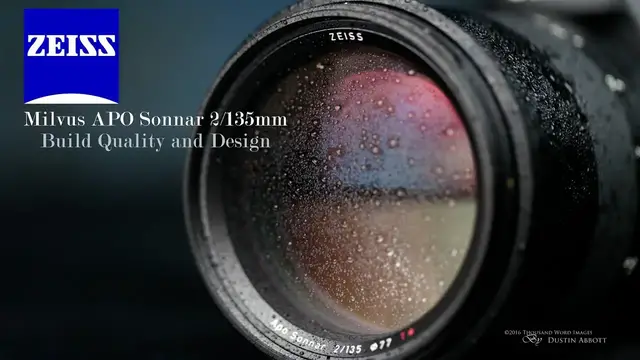
just announced Zeiss Milvus 135mm F2 lens. I was really excited when Zeiss, when they were sending me the Milvis 100mm F2 lens to review
0:33
They asked if I would like to take an advanced look at a brand new lens
0:38
And of course, you know what my response was. Absolutely. When I opened the box and saw that it was a Milvis version of one of my absolute favorite Zeiss lenses that I've reviewed
0:49
the APO Sonar 135mm f2. I was really happy to see that. The APR Sonar was actually
0:58
it's really one of the most recent lenses announced in what is now the Classic Series
1:03
And shortly thereafter, Zeiss came out with the Otis series and all the attention shifted
1:08
to the first the Otis 55 and then the Otis 85mm f1.4 lenses. And in between the Otis 85 and then
1:16
later 28 millimeter Zeiss introduced the Milvis line and so also attention focused towards the
1:22
Milvis lenses. As a result I felt like the APO Sonar 135 millimeter f2 never really got the
1:29
attention that it deserved because it is one of Zeiss's absolute best lenses and those of us that
1:35
have used it really kind of felt that it was an unnamed version of the Otis series because of that incredible optical series Of course in the Milvis line both the 50 millimeter and the 85 millimeter are also
1:47
very close to Otis performance. And so perhaps in the Milvis line is where it belongs
1:53
but I'm really happy to see it get the Milvis treatment. Now, Zeiss tells me that there are a
1:59
few other improvements that came with the Milvis design, some barrel optimization to help a little
2:05
bit there and then also some improved coatings. But overall, expect the optical performance to be
2:10
pretty similar to the previous version. The actual optical formula hasn't changed, but it was already
2:16
one of the best lenses in the world. But of course, the big upgrade here is going to the
2:21
Milva's design language, which looks a lot like a notice lens. But beyond that, it adopts the
2:26
Milva's fully weather sealed design, which adds not just a gasket, but internal seals and makes it
2:34
one of the best built lenses really that's available for SLR cameras, but also one of the
2:39
better weather sealed versions. And so I was really happy for that because it's just one other area
2:44
where it differentiates it from say the Canon 135L. I own the 135L. It's been kind of my standard
2:52
135 millimeter lens for years, but the Milvis 135, it destroys the Canon 135L optically. And if you
3:03
don't believe me, just check back in in about a week when I give you my final review, maybe
3:08
two weeks from now. But I've already done head-to-head test with the APO Sonar, and I've
3:14
done more over the last few weeks with the Milvus 135 and comparing it to the Canon 135L and it just blows it out of the water Beyond that however it now offers weather sealing which is one other thing that the Canon 135L doesn have
3:31
And so if you're shooting portraits or weddings or whatever it is that you're having to shoot and
3:36
the weather turns sour, you don't have to worry about it in this lens because of the Milvus
3:41
redesign. So to give you a little bit of an idea of the overall changes to the lens, as I said
3:47
it has the same optical formula and so it still focuses down to 2.62 inch or feet or 80 centimeters
3:54
same as the last and it has a very useful one to four reproduction ratio or a 0.25 times
4:00
magnification which is significantly higher than what the Canon 135L offers and to me is a very
4:07
very useful spec. You throw an extension tube on this baby and you can very quickly get to
4:12
macro type levels of magnification, of course, with a great working distance on top of that
4:19
It's 11 elements in eight groups. It has a 77 millimeter front filter thread, very accessible
4:25
very common. And it has, however, grown a little bit thicker around going from 3.31 inches or 84
4:34
24 millimeters to 3.53 inches or 89.7 millimeters. It's also a hair longer. And instead of being four
4:44
and a quarter inches, it's now 4.53 inches or going from 108 millimeters to 115 millimeters
4:52
As has been typical, unfortunately, for the Milvis lenses, it's also grown pretty significantly in
4:58
weight The old version was 930 grams That just a little over two pounds The new version is 1123 grams which is closer to two and a half pounds One bit of good news however is that the price has remained the same It not cheap
5:14
but it retails at $2,199 for the new version, which right now there's a little bit of a sale
5:21
on the older version. And so it seems a bit cheaper, but the MSRP is actually the same on
5:27
both lenses. So that makes this in Zeiss terms, a pretty excellent value considering that it gives
5:33
performance that really is, it's just as good as what the Otis series has. Plus of course it has
5:39
weather sealing now. And so if 135 millimeter focal length floats your boat, this would be a
5:46
pretty serious competitor in my mind to the 85 millimeter F1.4 lens from Zeiss. And so just
5:54
something to consider and I have been shooting with it for a few weeks and so I've got an
5:59
extensive image gallery going with all kinds of different subjects. You can look at that in the
6:04
link down below. On top of that, I'll throw a link to shopping and looking at the specifications of
6:10
the new lens from B&H Photo and then of course you can always follow me on social media as well
6:16
Tell you what, I'll also throw in a link to my review of the original APO Sonar 135mm
6:23
if you're not familiar with the previous version of this lens because that will give you a pretty fair idea
6:28
of what the optical performance is like for the new one and it'll keep tied you over
6:32
until I release my final verdict in a couple of weeks. I'm Dustin Abbott and if you haven't already
6:38
please click that subscribe button. Thanks for watching. Have a great day