


All of Nikon’s Z-mount F1.2 S lenses are extreme instruments. They are big, heavy, and expensive…not for the faint of heart. The Nikkor Z 50mm F1.2 S is the cheapest of this trio of extreme instruments, but will still carries an MSRP of $2250, is 150mm long, and weighs nearly 1100g. This is not a lens for the faint of heart! But, at the moment, it is only way to get a native autofocusing 50mm lens with an ultra-bright F1.2 aperture. This is not a new lens (it was released at the end of 2020), but because I was late to the Nikon party, I’ve been working through their back catalog of lenses to get familiar with them so that I can be more informed as new lenses release. So, the big question is whether or not the big 50 is still worth the big money in 2026. I’ll attempt to answer that question in the video review below or in this text review.
Follow Me @ YouTube | Patreon | Instagram | Facebook | DA Merchandise | Flickr | 500px | X
__________________________________________________________________________________________________
Thanks to Chris at Nikon Canada for sending me a review loaner of this lens. As always, this is a completely independent review. All opinions and conclusions are my own. *The tests and most of the photos that I share as a part of my review cycle have been done with the 45MP Nikon Z8, which I reviewed here. You can find the product listing page for the Nikkor Z 50mm F1.2 S here.
__________________________________________________________________________________________________
AI Summary: The Nikkor Z 50mm F1.2 S is a premium lens priced at $2,250, notable for its ultra-bright F1.2 aperture, making it currently the only native autofocusing option of its kind for Nikon’s Z-mount. While it offers exceptional build quality and performance, especially for portrait photography, its hefty weight and price may deter casual users. The lens excels in creating a beautiful shallow depth of field, but it faces stiff competition from newer models potentially offering better optical performance. Ultimately, while the 50mm F1.2 S is an outstanding tool for serious photographers, it’s not the go-to choice for everyone.
Strengths:
- Ultra-bright F1.2 aperture allows for stunning shallow depth of field.
- Excellent build quality with weather sealing.
- Reliable autofocus performance for portraits and wedding photography.
- Produces beautiful image rendering with appealing background bokeh.
Weaknesses:
- Hefty weight (around 1100g) can be cumbersome for prolonged use.
- High price point may not justify the performance for casual users.
- Average autofocus speed compared to other premium lenses.
- Some optical issues, including heavy vignette and longitudinal chromatic aberrations.
__________________________________________________________________________________________________
I love fast 50mm lenses – they are pretty much my favorite lenses to review. I love the beautifully shallow depth of field you can create while retaining that natural, “normal” field of view. There are just so many amazing opportunities to create uniquely beautiful photos in otherwise ordinary situations.

The primary audience for a fast 50mm F1.2 lens is for portrait photographers, as you can shoot three-quarters or even full-length and get remarkably good separation from the background. In fact, you may want to stop down at times to make sure a whole face is in focus (this shot at F2.5).


But one could argue that you could get this same portrait result using the far less expensive 50mm F1.8 S…and you’d be correct. The magic of the 50mm F1.2 S will be shooting at faster apertures where you can that shallow depth-of-field look you can’t quite get with the slower lenses.

Let’s take a closer look…
Nikkor 50mm F1.2 S Build and Handling
Nikon’s lineup of Z-mount premium lenses – the S-Line lenses – is known for many things, but being small is not one of them. Nikon has taken the old Zeiss Otus philosophy where performance is by the greatest object and size and weight are not really significant considerations. I think they can get away with it, too, when they often have a Small | Medium | Large option at that given focal length. It’s true now of a 35mm, 50mm, and 85mm, where F1.8, F1.4, and F1.2 options all exist or surely will in the near future. (though ironically the F1.4 options are often the smallest!). I thought Nikon was brilliant for giving the 135mm F1.8 Plena (which I reviewed here) a name (Plena). I think every lens this big, expensive, and high performing should have a name! Maybe the second generation of big F1.2 S-Line lenses will take my suggestion.

This is a BIG lens. A “nifty-fifty” this is not! That is the first thing that you notice about it. It is 89.5mm (3.6″) in diameter and a whopping 150mm (6″) in length. It weighs 1090g (38.5 oz). This is easily the biggest and heaviest of all of the current 50mm F1.2 autofocus lenses available for different platforms. The Canon RF 50mm F1.2L is the next heaviest, at 950g, though that lens is a whopping 42mm shorter. The Sony G-Master 50mm F1.2 weighs just 778g, while the Sigma 50mm F1.2 ART weighs 740g.
This lens is big enough to make the bulky Viltrox PRO 50mm F1.4 for Z-mount (my review here) look, well, rather diminutive.
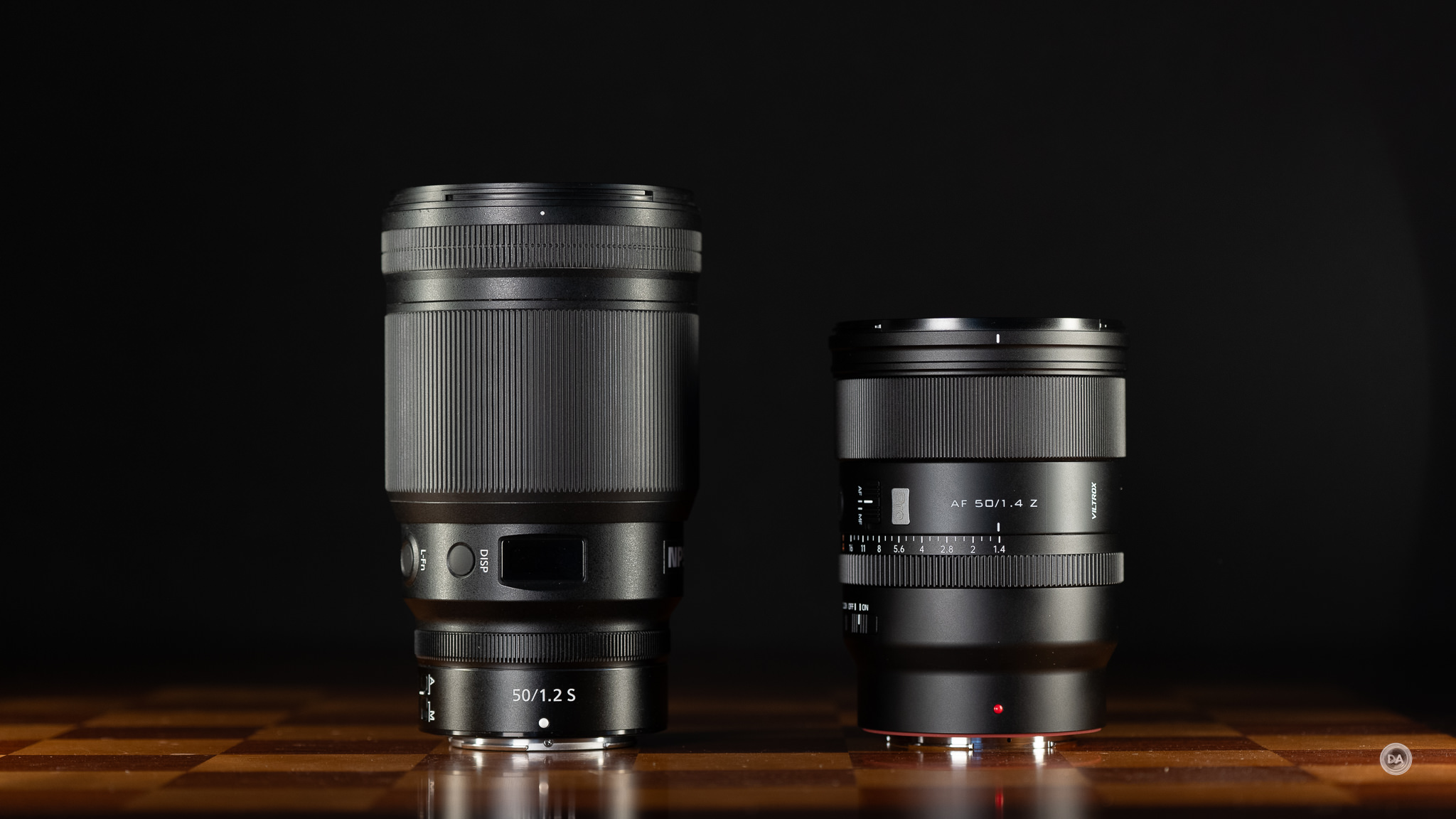
For now, the Viltrox is probably the closest competition in native Z-mount, combining a robust feature set with strong optics, even if if the maximum aperture isn’t quite as bright. It weighs about 830g, which is a lot, but still lags behind the 50mm F1.2 S by a solid 260g. Viltrox has a 50mm F1.2 from their LAB series on their roadmap for both Sony FE and Nikon Z, but there is no firm timeline attached to that release yet. New lensmaker SongRaw is releasing a 50mm F1.2 in Z-mount, though it is still in the pre-order stage. I reviewed the lens in E-mount, so I can’t really comment on how well it performs on Z-mount. I can tell you that it weighs 900g, which is 190g less than the 50mm F1.2 S.
You will feel that weight. If I combine the 50mm F1.2 S with my Z8, I’m suddenly toting around 2kg (nearly 4.5 lbs), which is going to get heavy over a long day.
What makes this a big, heavy lens is that there is a massive amount of glass inside right past those 82mm front filter threads.
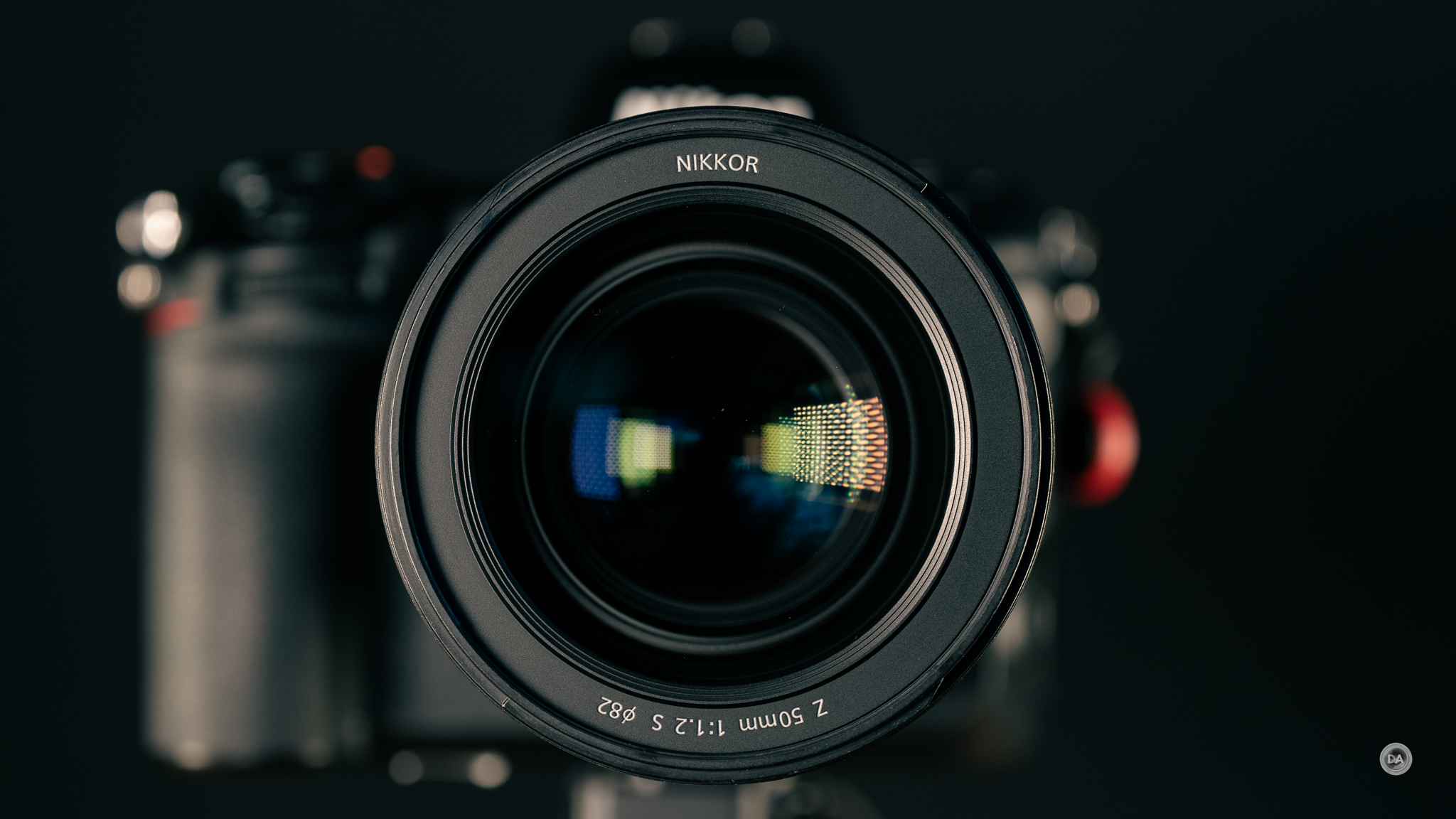
It should be noted that the 82mm filter threads are the largest of any of the competing lenses, with most at 77mm and one (the Sony GM) at just 72mm. 82mm remains a common size for filters, though you might pay a bit more for the larger size.
The 50mm F1.2 S is a premium lens with an excellent build. It has a tough outer shell of metal alloys and engineered plastics, and a thorough degree of weather sealing, though I couldn’t locate a diagram of the seal points. According to Nikon, however, there is a gasket at the mount, at the focus and control rings, at the Fn button and AF | MF switch, at the OLED panel, and at the barrel joints. A look at the diagram from the newer 35mm F1.2 S will give you a good idea of what that looks like:
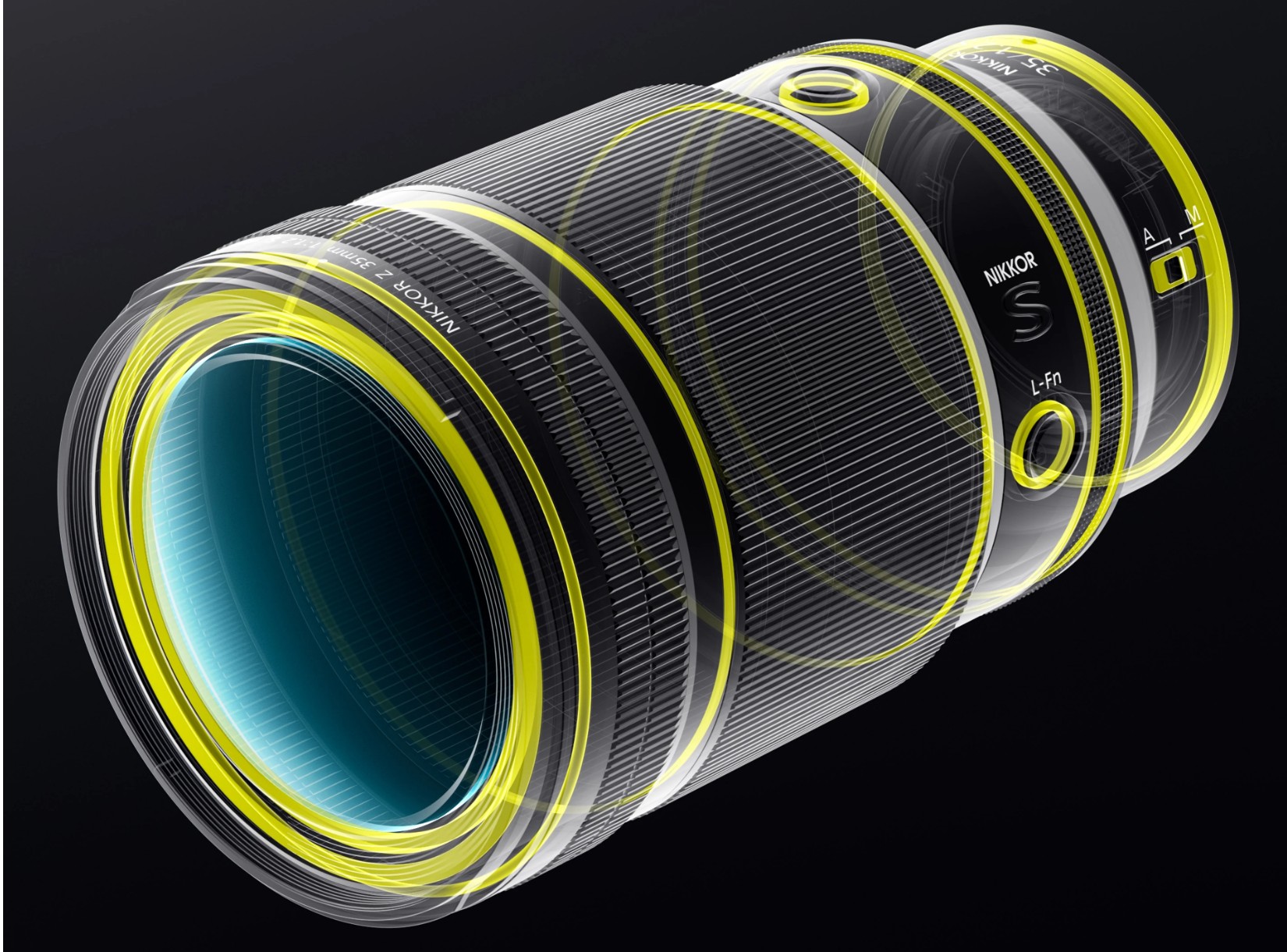
There is a fluorine coating on the front element, and Nikon also stresses that the internally focusing design helps complete sealing.
The feature set is essentially the customizable control ring, an AF | MF switch, and a c.Fn (custom function) button. The 50mm F1.2 S was released in September of 2020, and Nikon was still all-in on OLED screens on their premium lenses.
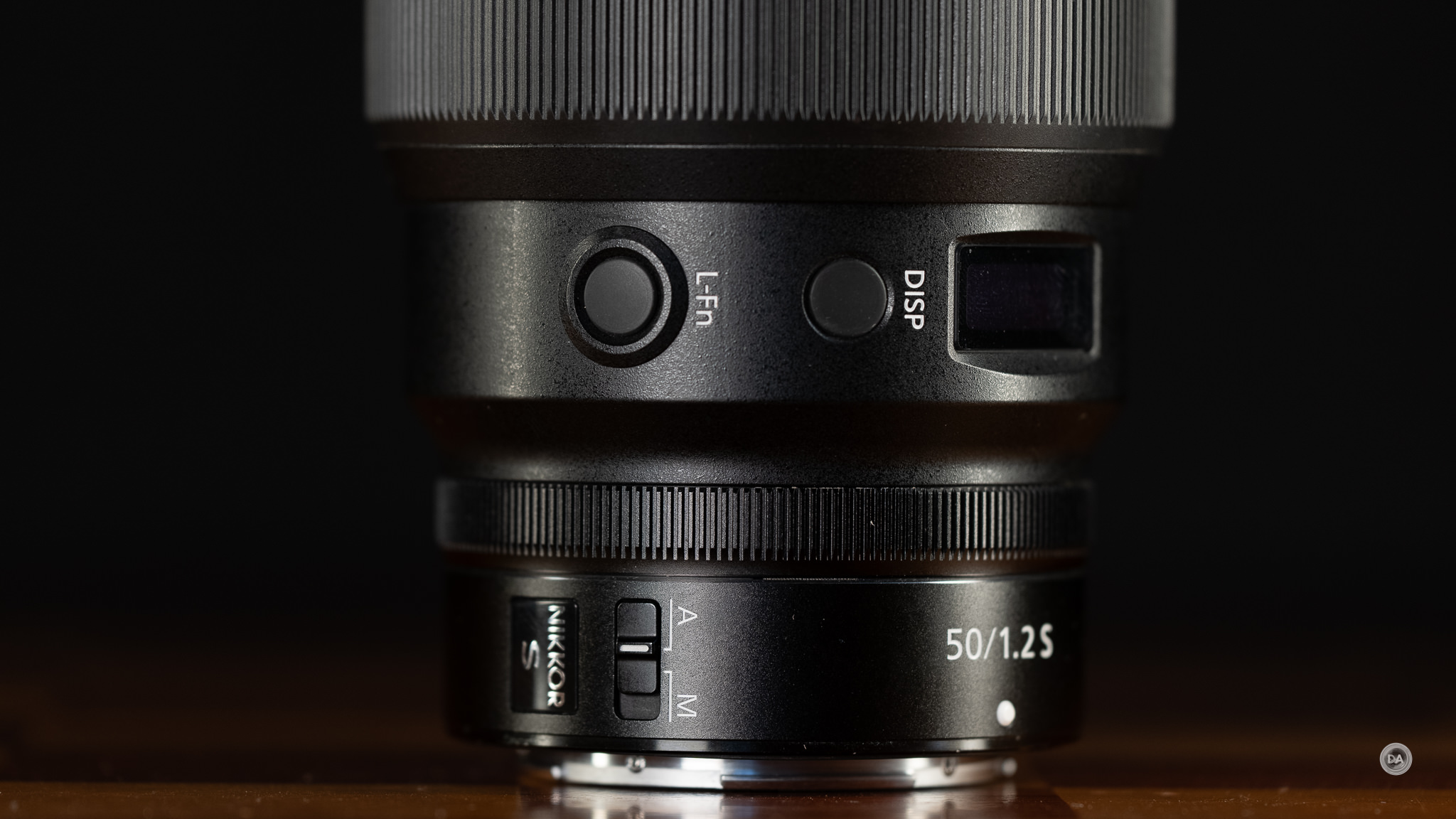
That starts very early on the lens with an AF | MF switch that is located very close to the lens mount.

A little too close, in my opinon. I’ve complained about this placement on a number of lenses. On my Z8, there are two controls located way too close to this area. There is a flash sync port behind a rubber cover along with the camera release button. That means if I’m reaching around with my left thumb to operate the switch, I’m having to thread the needle through a couple of obstacles. Perhaps placing it on the same tier with the Fn buttons would have made more sense.
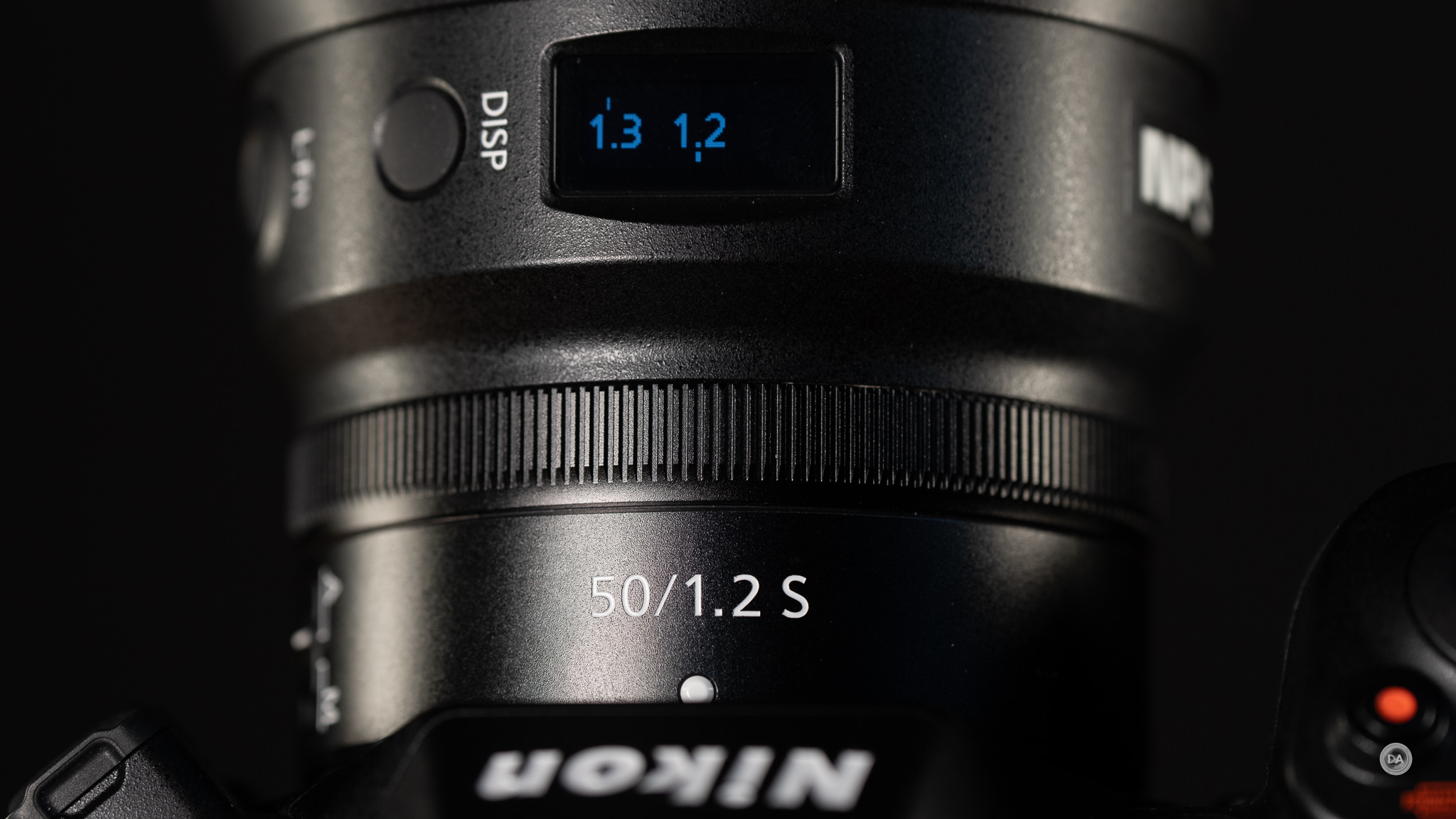
Next comes Nikon’s clickless “customizable control ring”, which could serve as a manual aperture ring but could also function to control ISO, exposure compensation, or a few other functions – whatever you’ve set up the ring to do in the menus. Those controls can be found in the Custom Settings menu, then by selecting group F (Controls), and finally choosing custom setting F2 (Custom Controls Shooting) to change the function of the ring.
As an aside, I will note that I was able to do smooth aperture racks through the control ring without any visible steps. I like it fine for that purpose for video.
There’s no click/declick option, and the ring would actually be more useful with clicks in stills mode because you could more easily use with precision for aperture control. The OLED will give you feedback on the current aperture setting. You can choose either aperture reporting or distance scale. I was a bit disappointed to find that the OLED really wasn’t bright enough to be useful in sunny conditions, and I ended up just looking at my Z8’s top mounted LCD for the current aperture setting anyway.
The aperture iris has nine rounded blades, and the aperture iris definitely does a nice job of keeping the specular highlights round. Here’s a look at F1.2, F2, and and F2.8:


Here’s what that aperture iris looks like from the inside.

I’m not sure what dictates whether the front or back of the aperture blades are facing out. The Plena was the opposite of this, with the back of the blades showing. I much prefer the look of the 50mm F1.2 S, which gives you a nice “James Bond” type view.
The next tier has the Fn button (you assign the value from within the camera) along with a “DISP” (display) button next to the OLED to allow you to tweak what information is shown there.
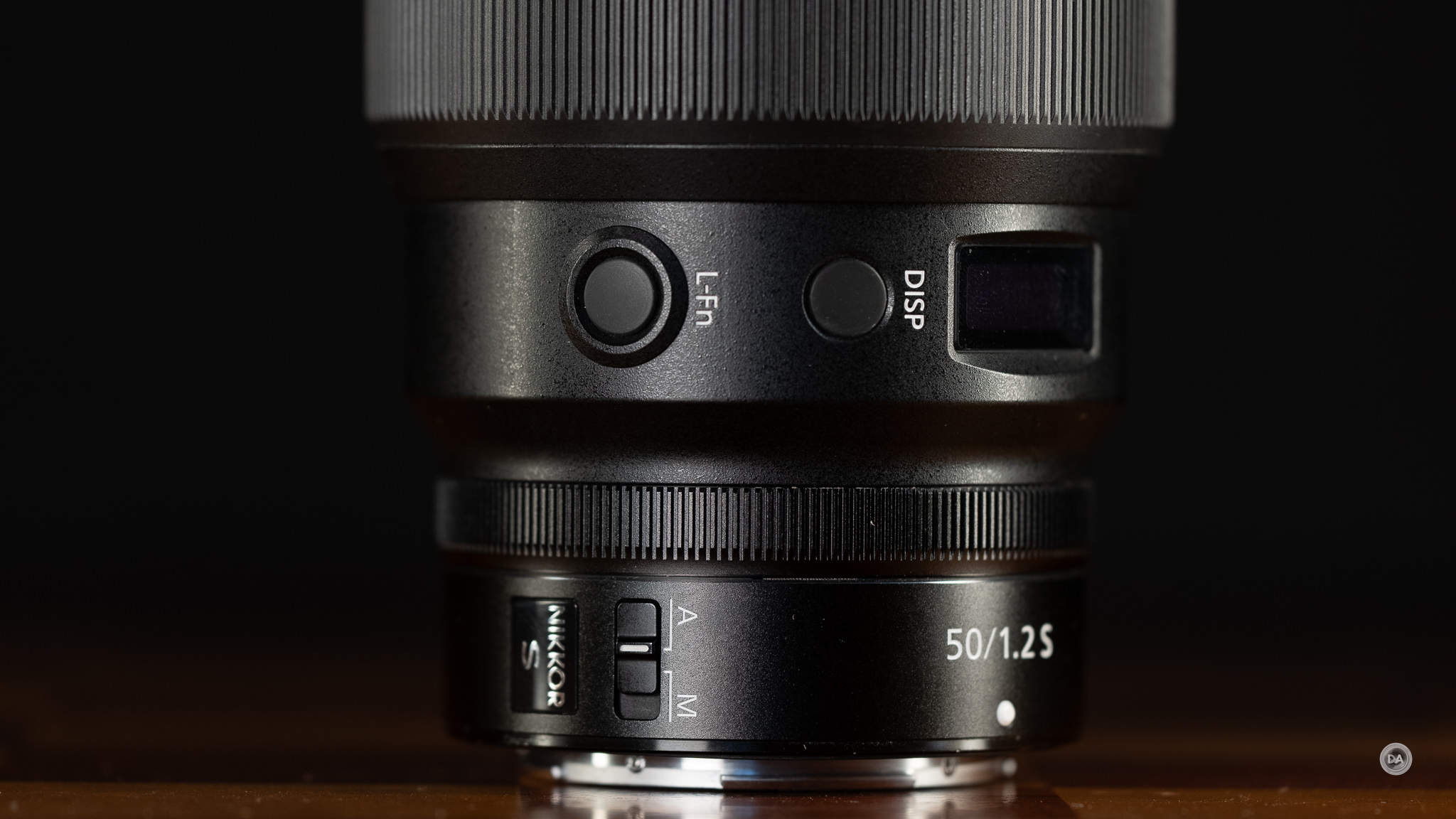
The manual focus ring is slightly raised and has a rubberized, ribbed texture. It moves very smoothly and has a nice amount of weight to it. I was able to pull off really smooth manual focus pulls and focus with very nice precision. I also love the fact that I can do full time manual overrides even when in AF-C mode.
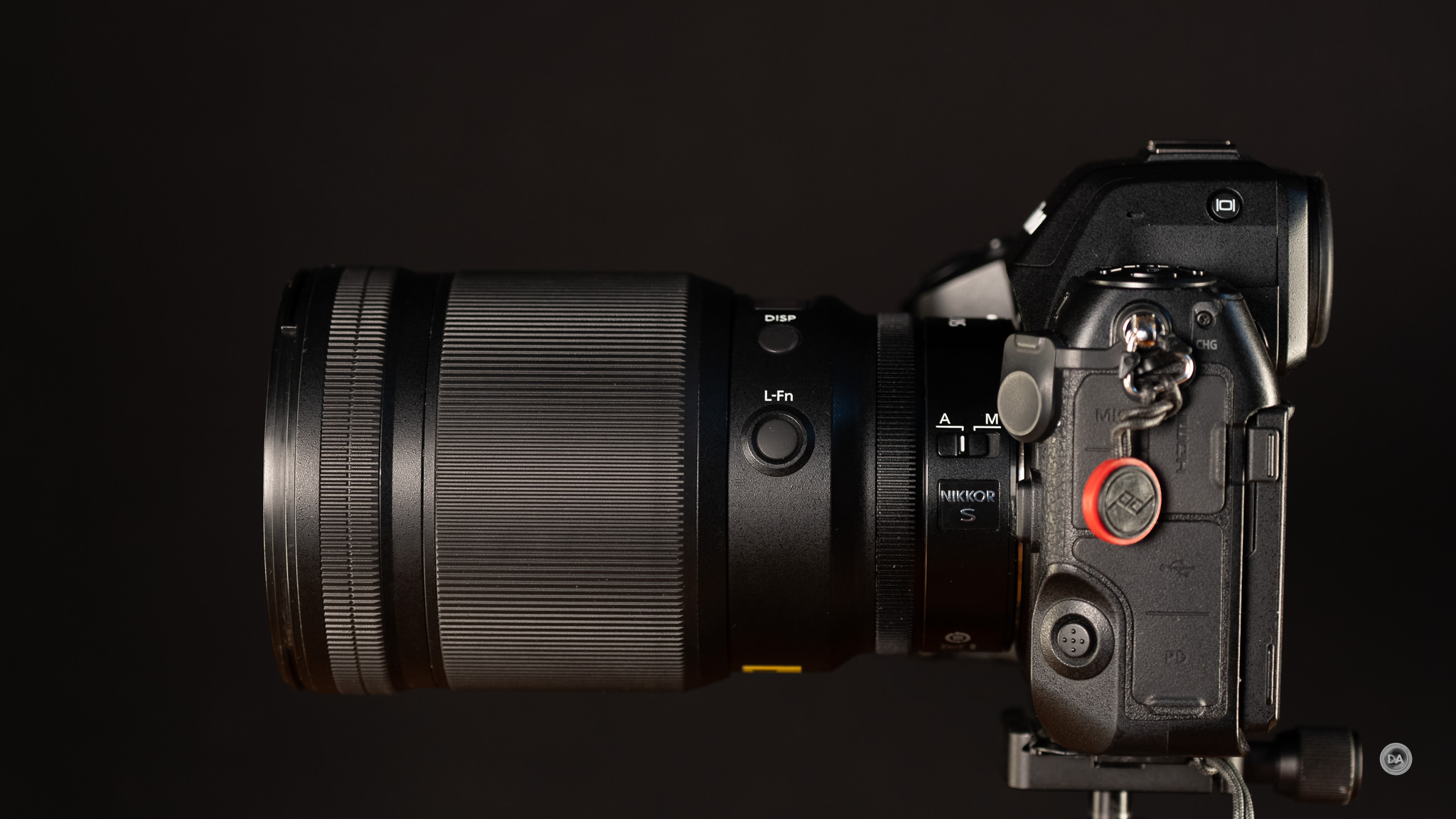
You’ll note that there is a third rubberized section near the front of the lens that looks like another ring but is actually just a section with extra grip for either aesthetic purposes or to provide a section to grab when mounting/unmounting the lens.
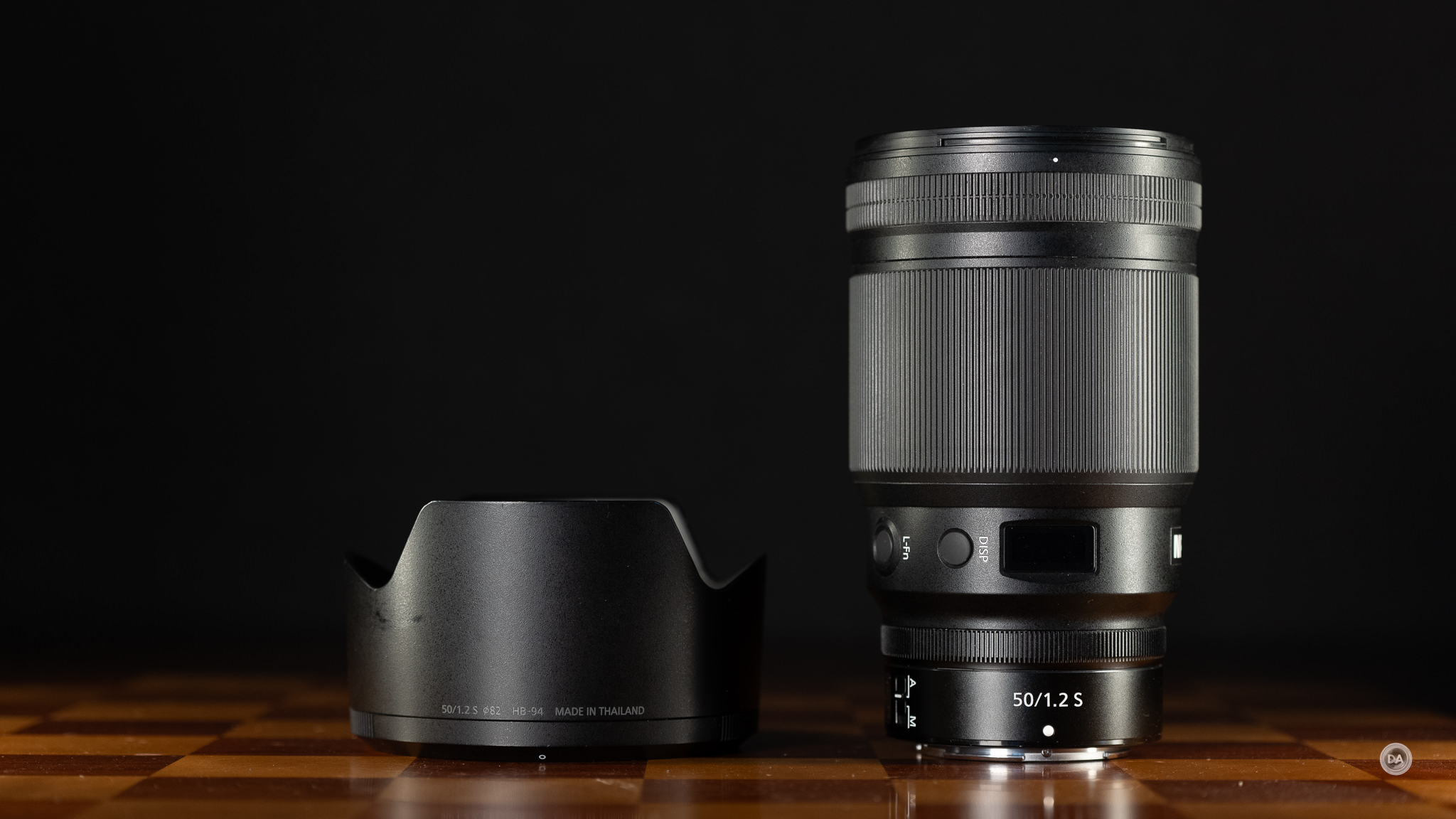

The lens hood is petal-shaped and does have a small lock on the right side. It is made of plastics and feels fairly ordinary.
Minimum focus distance is 45cm, giving a maximum magnification figure of 0.15x, which is about average for a 50mm lens.

Close focus contrast and detail are good, though stopping down a bit will add more contrast. Here’s an F1.2 shot.

There is no VR (vibration reduction, or optical stabilization) built into the lens. That’s not a problem on a body like my Z8, which has good camera based stabilization, but could be a problem for those of you shooting on a camera without VR. That’s not unusual, however, as there are essentially not fast 50mm lenses with VR.
At roughly $2250 USD (on sale for $2000 at the moment), this is the cheapest of Nikon’s big F1.2 lenses and thus the most accessible. It undercuts both the Sony and Canon equivalents in price. This is a big, heavy, expensive lens, but it is also beautifully made and is a nice match for a beefier camera like my Z8.
50mm F1.2 S Autofocus Performance for Stills
At the time of release, it was fairly revolutionary in the Nikon world to use dual focus motors. This was the first time that Nikon was experimenting with using lighter motors working in tandem rather than a bigger, heavier single ultrasonic motors. More recently they have started to shift to new VCM (voice coil motor) designs, but the dual STM motors still work fairly well here. I was shocked, for example, that this shot was actually properly focused, as I was thinking about taking a photo, started lifting the camera, and Nala immediately got up and move quickly towards me, moving almost within minimum focus distance. I had little time to squeeze the shutter, and yet I got a properly focused result with an absolutely tiny depth of field.

You can also see that the lighting was challenging, with her stepping out of brighter light into the shadow where I was. I fully expected that shot to be a throw-away, and was shocked when I reviewed it and found it perfectly usable.
Focus speed in my formal tests is only average. Not slow, but not with that instant snap we’ve come to expect from some excellent modern lenses. It’s fast enough for most situations, but won’t match the speed you might expect if you have some of Nikon’s other premium lenses. Neither is focus silent, as there is some obvious whirring as focus goes back and forth.
Because the speed is unexceptional, I didn’t expect great results in certain situations, but I was once again reminded of the value of a first party lens with first party access to proprietary focus algorithms. Whereas some lenses (like Viltrox lenses) may have fast focus speed but have less focus confidence (in some instances), the 50mm F1.2 S has a bit less focus speed but makes more of it due to having first party focus confidence. This shot is from a series with Nala rolling around.


Portrait results were flawless whether facing or looking away from the camera.



Shooting shallow depth of field shots was no problem.

Focus was generally good. I’m not sure this lens is sports ready, but I do think AF will handle anything you might encounter in a portrait or wedding shoot…which is probably a more likely application for this lens, anyway.
Autofocus (Video)
Video autofocus is a little more of a mixed bag. On a positive note, focus breathing is fairly well controlled. There’s a minimal amount of shift in the size of objects whether in or out of focus.
Touch to focus for my focus pull test produced mixed results. Occasionally focus would rack in the wrong direction (an unfortunate Nikon tendency), and focus pulls are fairly gradual.
In other situations, however, focus was very good. My hand test, for example, went well, with good transitions from my hand to my face and back.

I had no problems with static settings either. Focus does a good job of staying locked on a subject on camera without hunting or pulsing, and that was true whether I was shooting at F1.2 or F8.
Video AF still isn’t quite as sophisticated on Nikon as Sony or Canon, generally, but for the most part I feel like the 50mm F1.2 S makes the most of what it has.
Nikkor Z 50mm F1.2 S Image Quality Breakdown
Here’s where this lens needs to shine. Large aperture lenses are actually often at a disadvantage when it comes to autofocus because they have much larger glass elements to move, and they are almost always at a disadvantage when it comes to size, weight, and cost. This is a big, heavy, expensive lens, but that is in the service of exceptional performance. The 35mm F1.2 S needs to deliver. This is an optical design of 17 elements in 15 groups, which includes three ED elements, three aspherical elements, and one aspherical ED element.
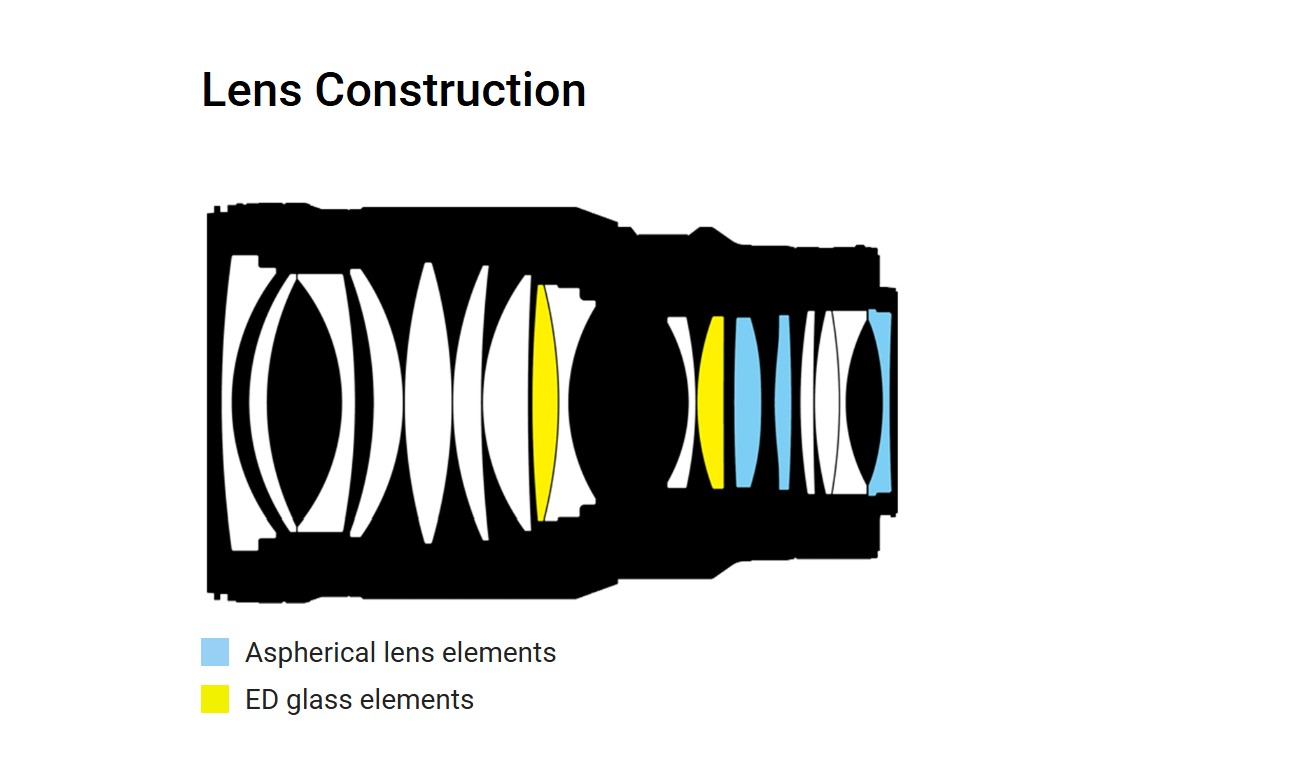
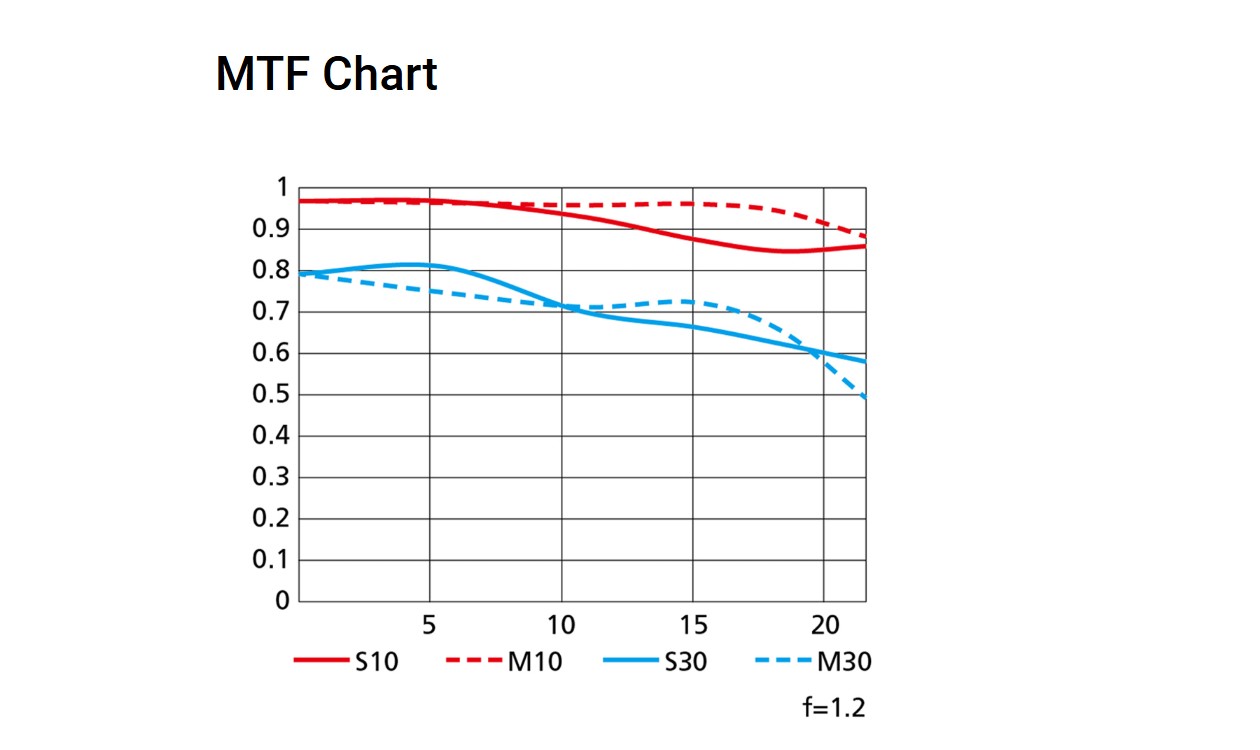
The MTF chart looks good at F1.2, but not exceptionally good. It doesn’t look as good as the Viltrox PRO 50mm F1.4 on paper. The problem for the 50mm F1.2 S is that the standard has changed since 2020, and there are some really competitive alternatives in 2026. I suspect that if/when the Viltrox LAB 50mm F1.2 arrives, it will definitely be the sharper of the two lenses, considering that typically the LAB lenses are even sharper than Viltrox’s PRO series.
Let’s move on to the actual performance. The Plena was designed to provide very even illumination to the whole frame, including the periphery, but that’s not nearly as true here.
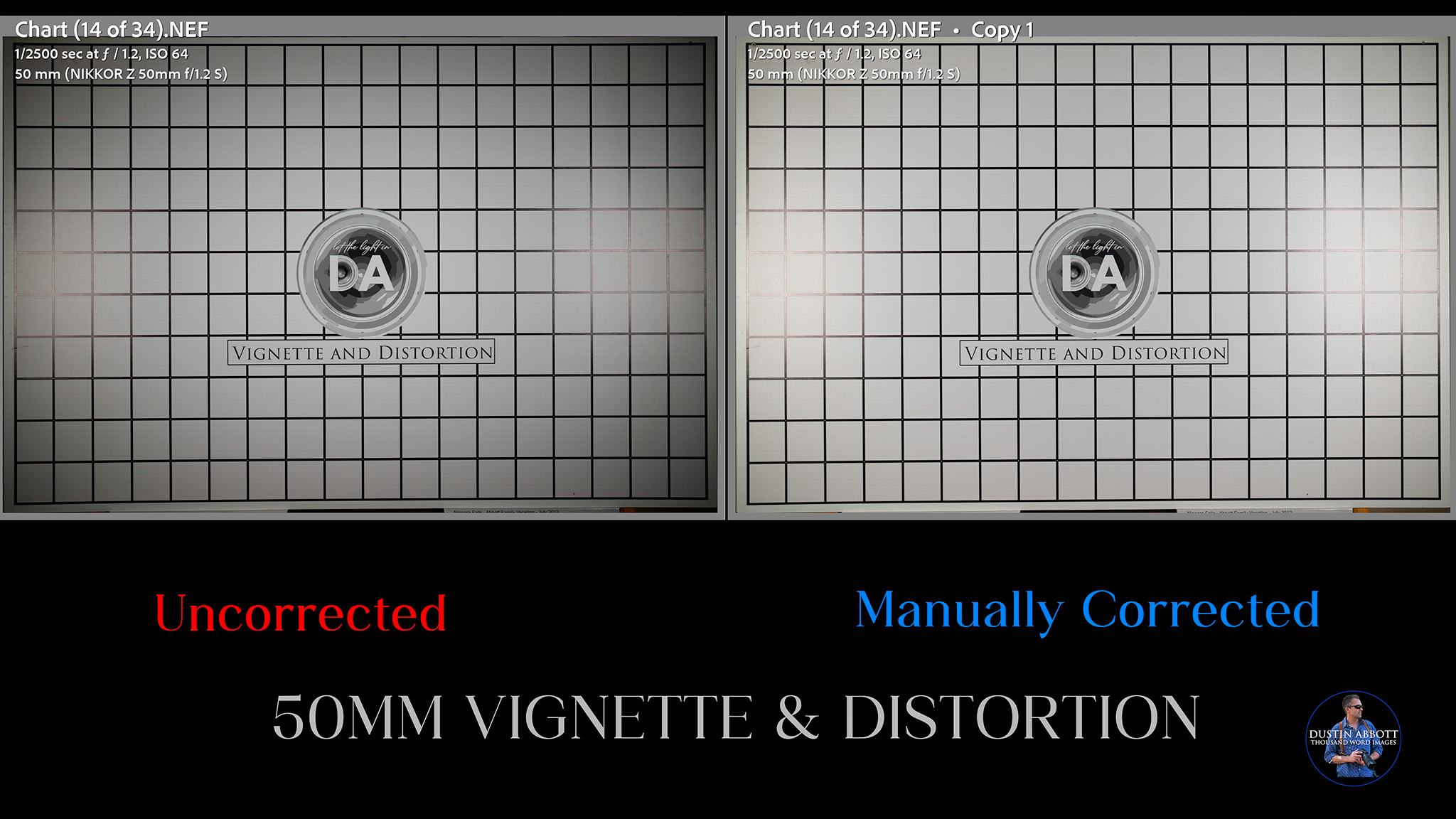
Distortion is well controlled, with just a tiny amount of very linear pincushion distortion (probably doesn’t need correction). Vignette is another matter, however, and is very heavy. I had to max out the vignette slider at +100 to achieve the result on the right, which means a full 4+ stops of shading in the corners.
The correction profile in camera or editing software works great, though, and so this isn’t a real world problem unless you are shooting at high ISOs (you will probably get some additional noise in the corners, then). Here’s a look at an F1.4 shot in the kitchen that has received profile corrections – it looks nice and bright.

You’ll notice that there’s a lot of shots of Nala in this review, and that’s largely because we are having some spring melt after a VERY snowy winter, and everywhere outside is an absolute mess right now.
I was surprised by the amount of LoCA (longitudinal chromatic aberrations) before and after the plane of focus in such a big, premium lens.

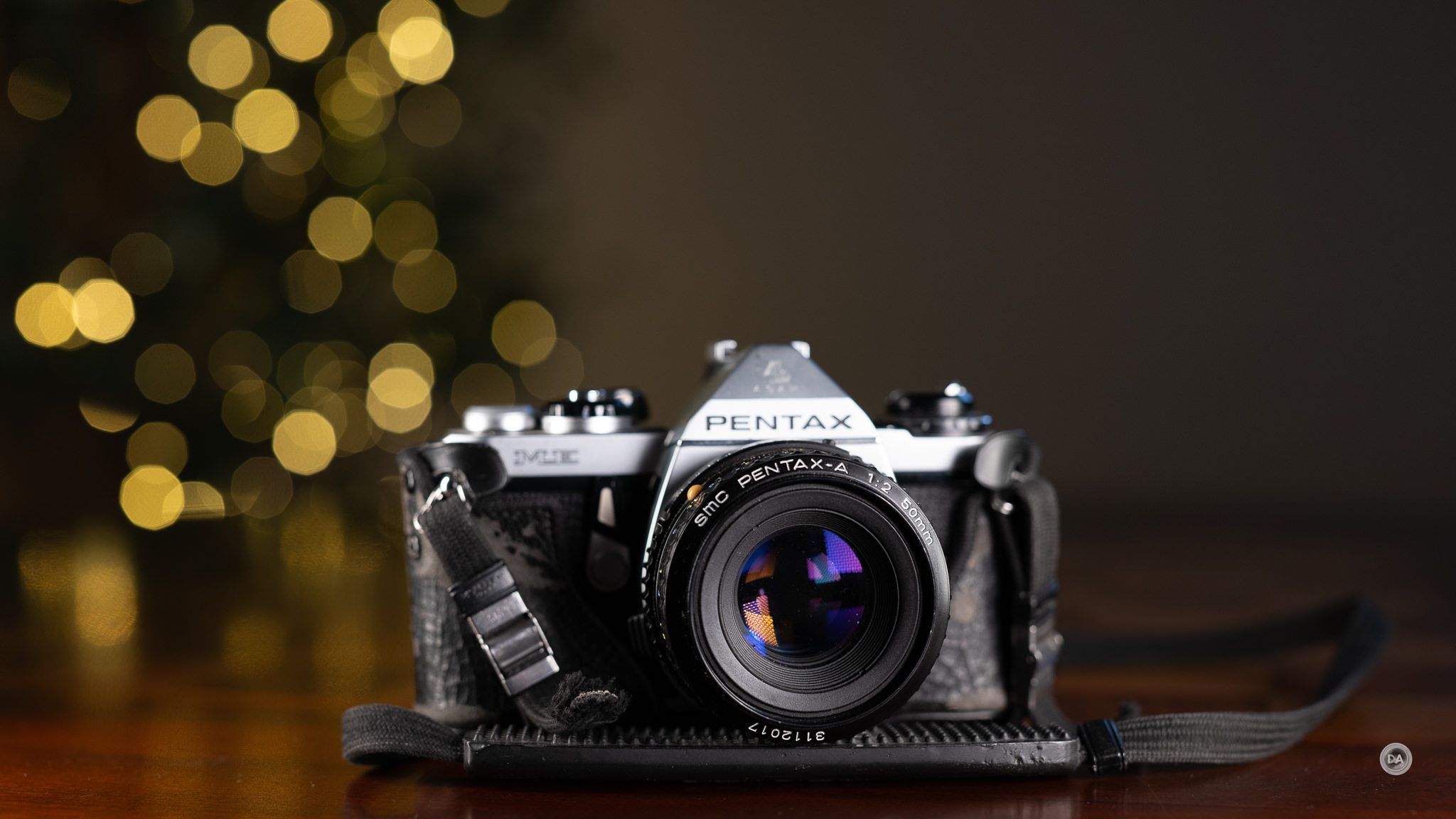
I like to use my Dad’s old SLR as a real world test, and I saw some obvious fringing on some of the shiny bits.

A high contrast shot of a guitar showed both purple and green fringing.

A lens this big and expensive should optically correct things like this. I’m disappointed by this showing, as I definitely noticed fringing on real-world images.
LaCA (lateral chromatic aberrations) typically show up along the edges of the frame with high contrast transition points. I saw nothing but clean transitions on either side of the black and white transitions.

Whew! At least one of my tests was passed with flying colors.
We’ll move on to inspecting our test chart. This test has been done on a 45MP Nikon Z8 sensor. I use a high end tripod and two second camera delay (or slower) to ensure vibration doesn’t affect images. Here’s a look at the test chart that we will examine at high magnification:

If we take a look at crops (at 200%) at F1.2 from the center, mid-frame, and lower right corner, we find that center and mid-frame performance is sharp (though contrast isn’t exceptional), and that the corners are a bit dark (even after the correction profile, which doesn’t correct as thoroughly as my manual correction above). Corner sharpness is just okay.



As the respective MTF charts suggest, the far more expensive 50mm F1.2 S can’t match the Viltrox PRO AF 50mm F1.4 in sharpness and contrast even when stopped down to F1.4. The midframe difference in particular is rather stunning.
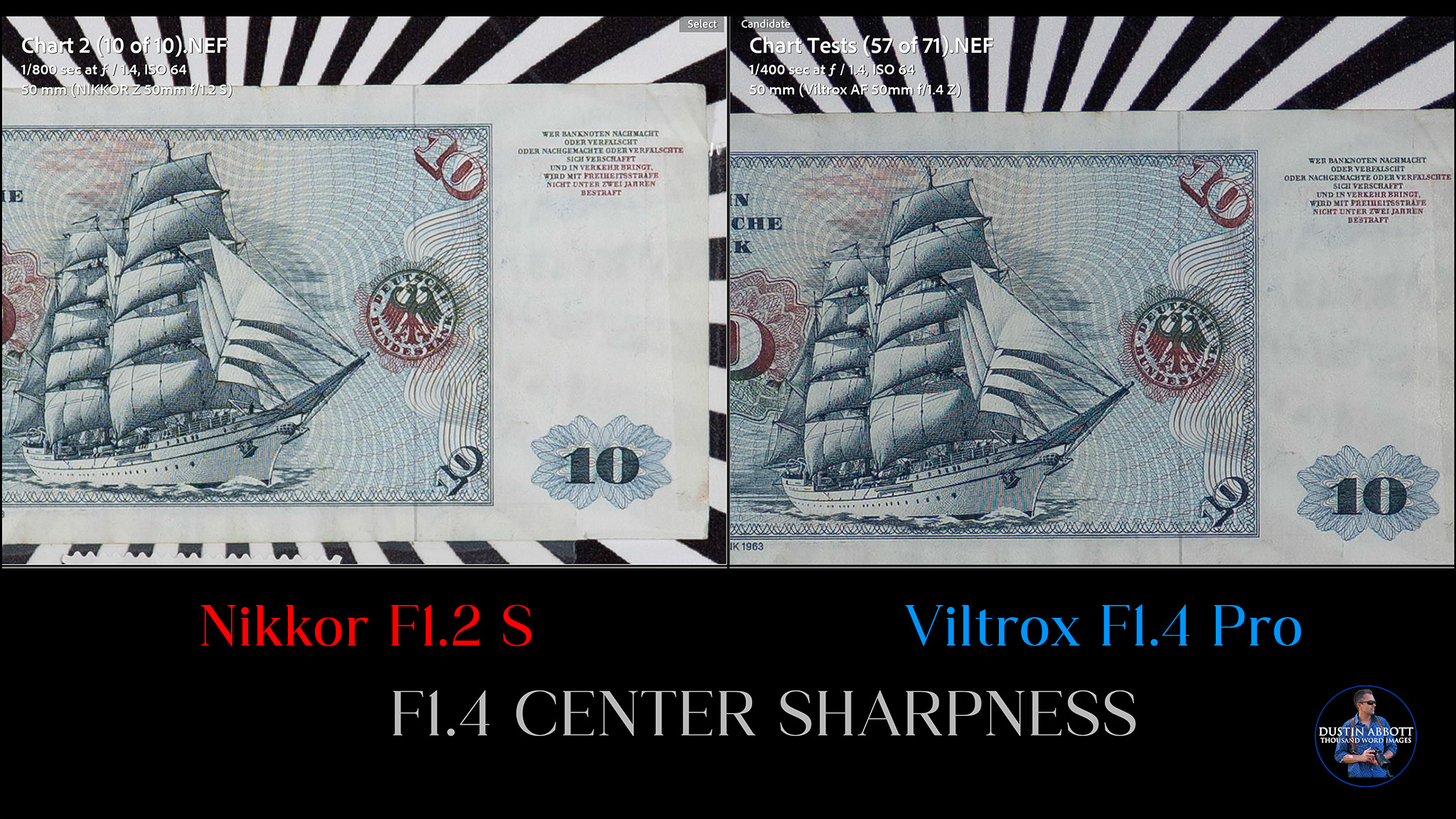
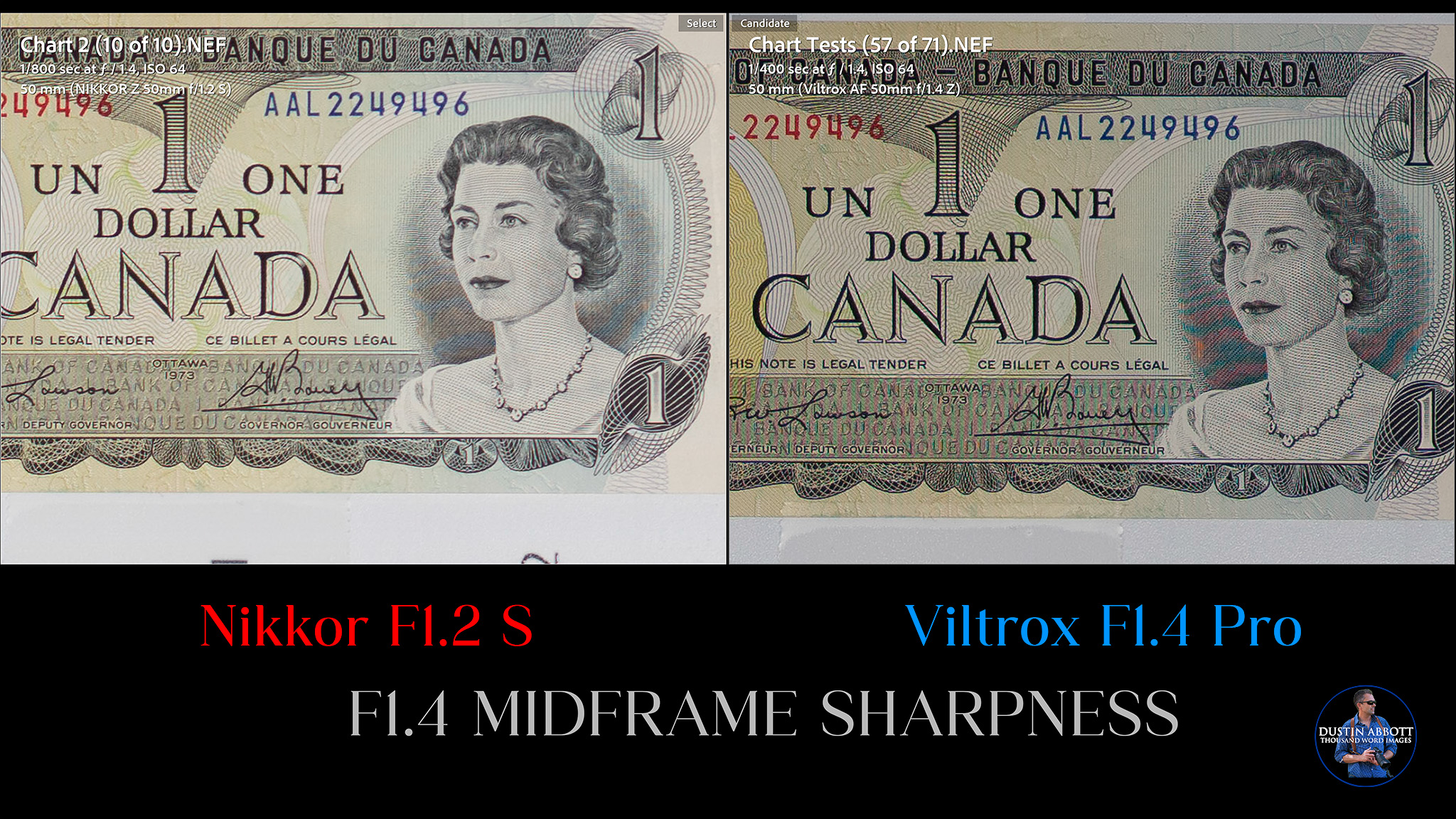
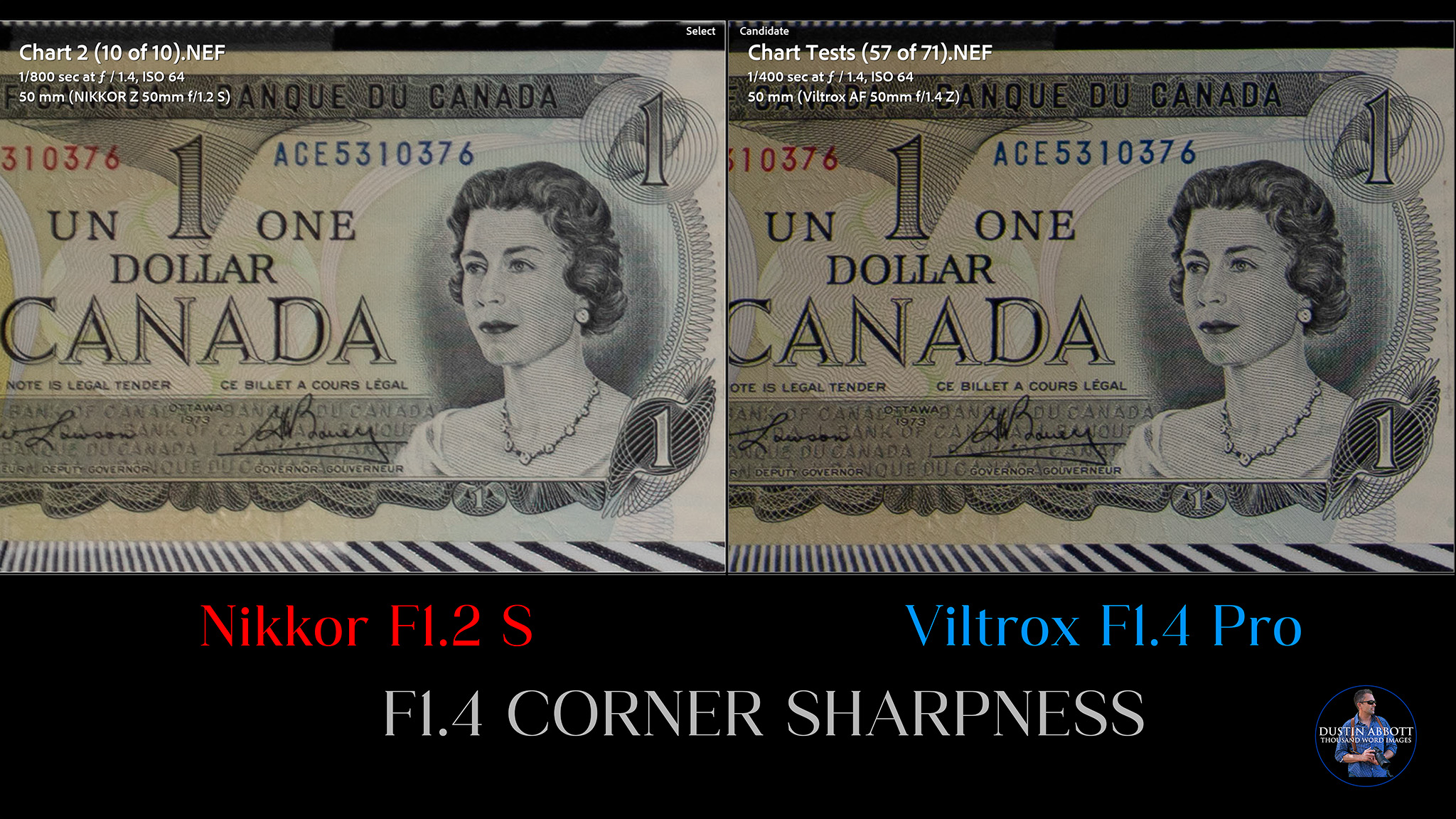
That’s not to say this lens isn’t still an exceptional optical instrument (it is), as it can give you gorgeous results with great subject isolation.

A closer look shows that the detail and contrast even at higher levels of magnification looks great.

But what it does mean is that the optical bar has been raised, and that a lens like this isn’t quite as exceptional as it once was.
Stopping down to F1.4 produces slightly more contrast and detail, with a bit more available by F2. The biggest improvement is in the corners, which are brighter and more detailed.

By F2.8 the image quality is pristine all across the frame.

Like the 35mm F1.2 S, this is the rare lens that achieves this level of corner performance at any aperture. You can expect landscape images at F2.8-F8 to be crisp all across the frame.

If we compare the real-world landscape shot at F1.2, then at F5.6, we’ll find that there’s an obvious improvement in contrast in the center that becomes more pronounced out at the edges.
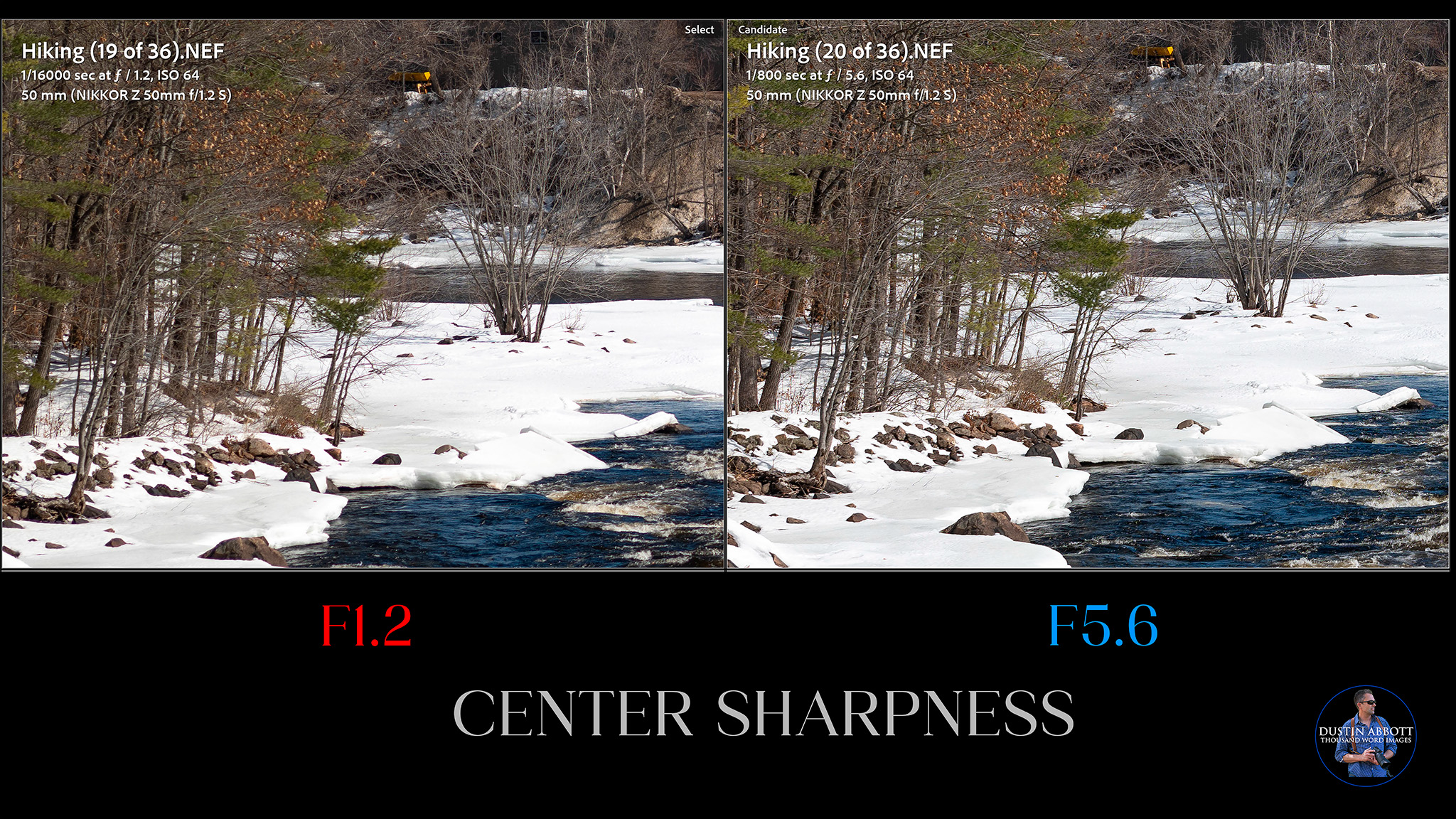
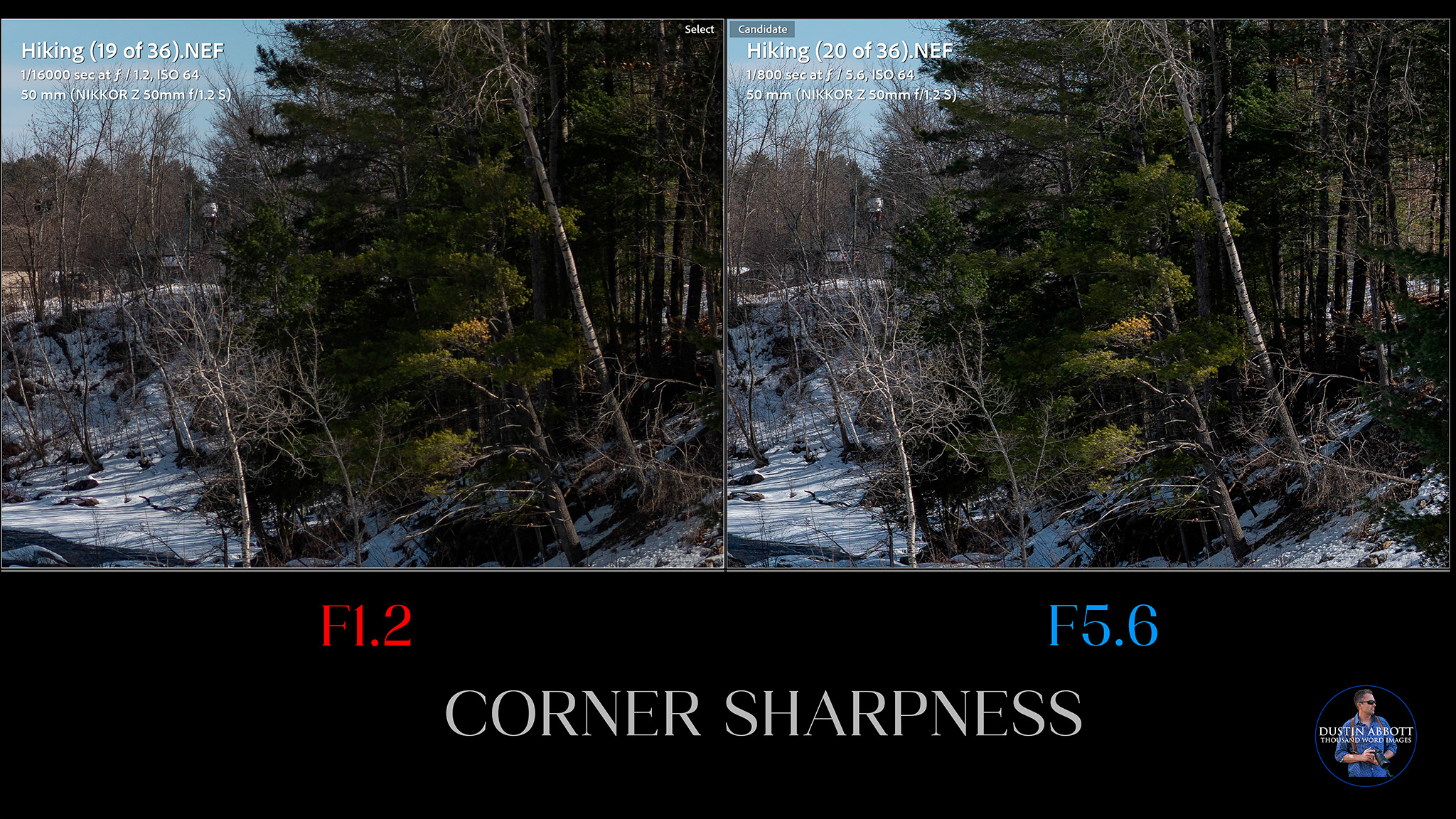
Few people are going to buy the 50mm F1.2 S to use it purely for landscapes, however, and I feel its great value will be the ability to shoot at F1.2 and get unique results due to the shallow depth of field.

Physics will affect even the mightiest of lenses, however, so expect diffraction to start to soften the image by F11 and more obviously by F16, which is minimum aperture (though this lens is still sharper than many lenses at its weakest!) I actually felt like the 50mm F1.2 S held up to diffraction quite well, though, and even at F16 (and 200% magnification), contrast and detail look fairly good.

While we’ve determined that this may no longer be the “sharpest” option available, the magic of the 50mm F1.2 S is in its rendering. It can turn backgrounds to cream, with a nice, soft rendering.

Even the dials of the stove can make for a “bokehlicious” image.

My wife’s cup of tea? Absolutely!

Specular highlights are generally clean, and the “cat-eye” effect in the corners is minimal.

Portraits at F1.2 show a beautifully defocused background and nice overall “pop” to the rendering.

I don’t find that the micro-contrast (on fine textures at high magnification) is necessarily as impressive as the F1.8 S, but images overall will look a bit more special because of that shallow depth of field.
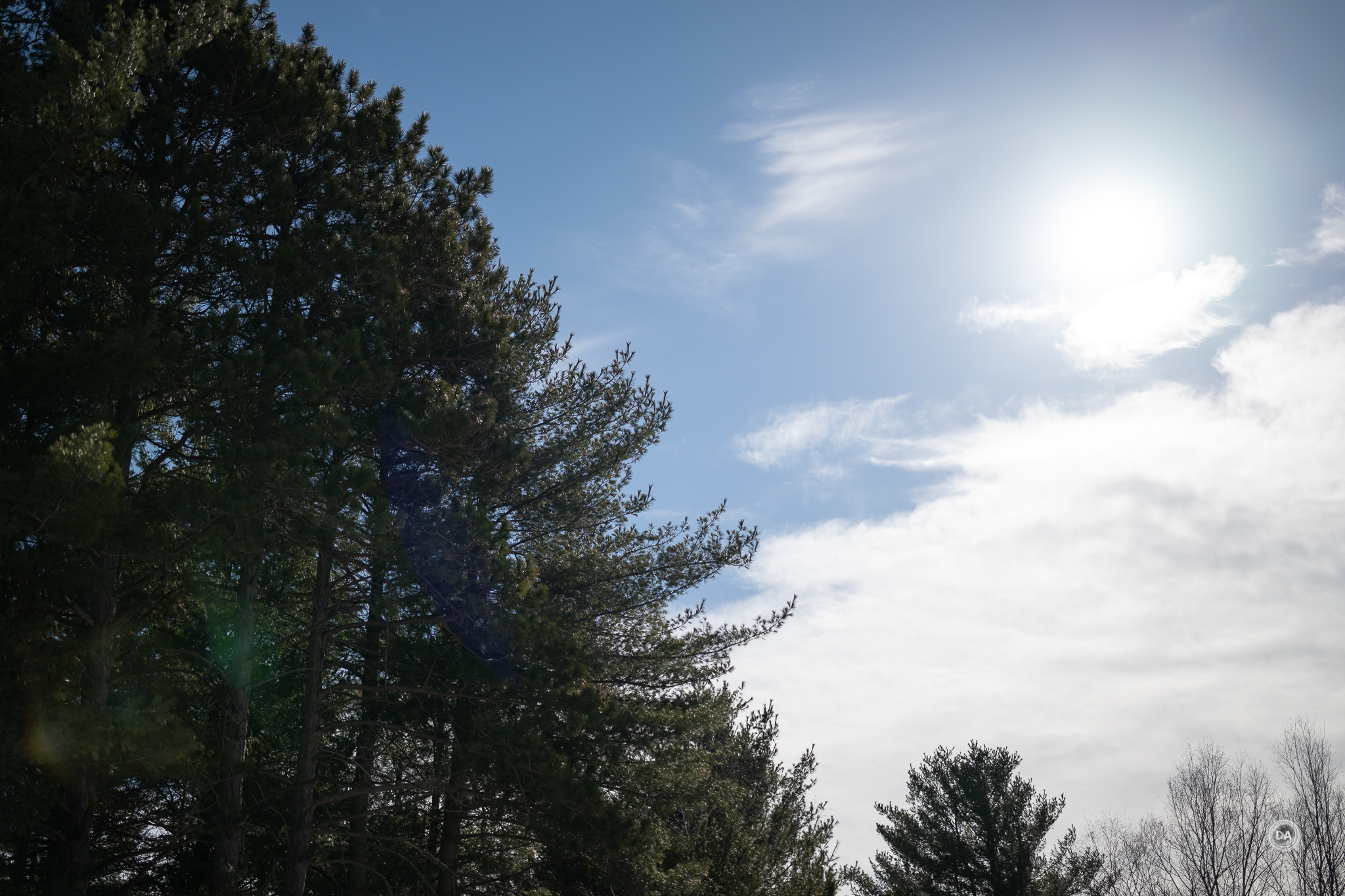
I also found that flare resistance in many situations was good. When the sun is barely in (or right out of) frame at bright apertures, all you can is a nice glow without anything destructive.

More direct shots into the sun hold up fairly well, though there are some minor ghosting artifacts at some angles that get a little more pronounced at smaller apertures. Nikor used their Nano Crystal Coating on this lens, but they have a few newer coating technologies that came after this lens, so the 50mm F1.2 S isn’t as good as the newer 35mm F1.2 S.


There is both good and bad when it comes to astro performance. The heavy vignette does negatively impact images a bit at F1.2. Star points are nice and crisp, though I do see some fringing on really bright points, and you will see some coma towards the edge where stars look more like birds flying out of frame.



This isn’t a bad lens for astro, but neither is it exceptional.
You pay the big bucks to get something exceptional, and while it may not measure quite as masterfully as it did when first released, the Nikkor Z 50mm F1.2 S is still pretty exceptional.

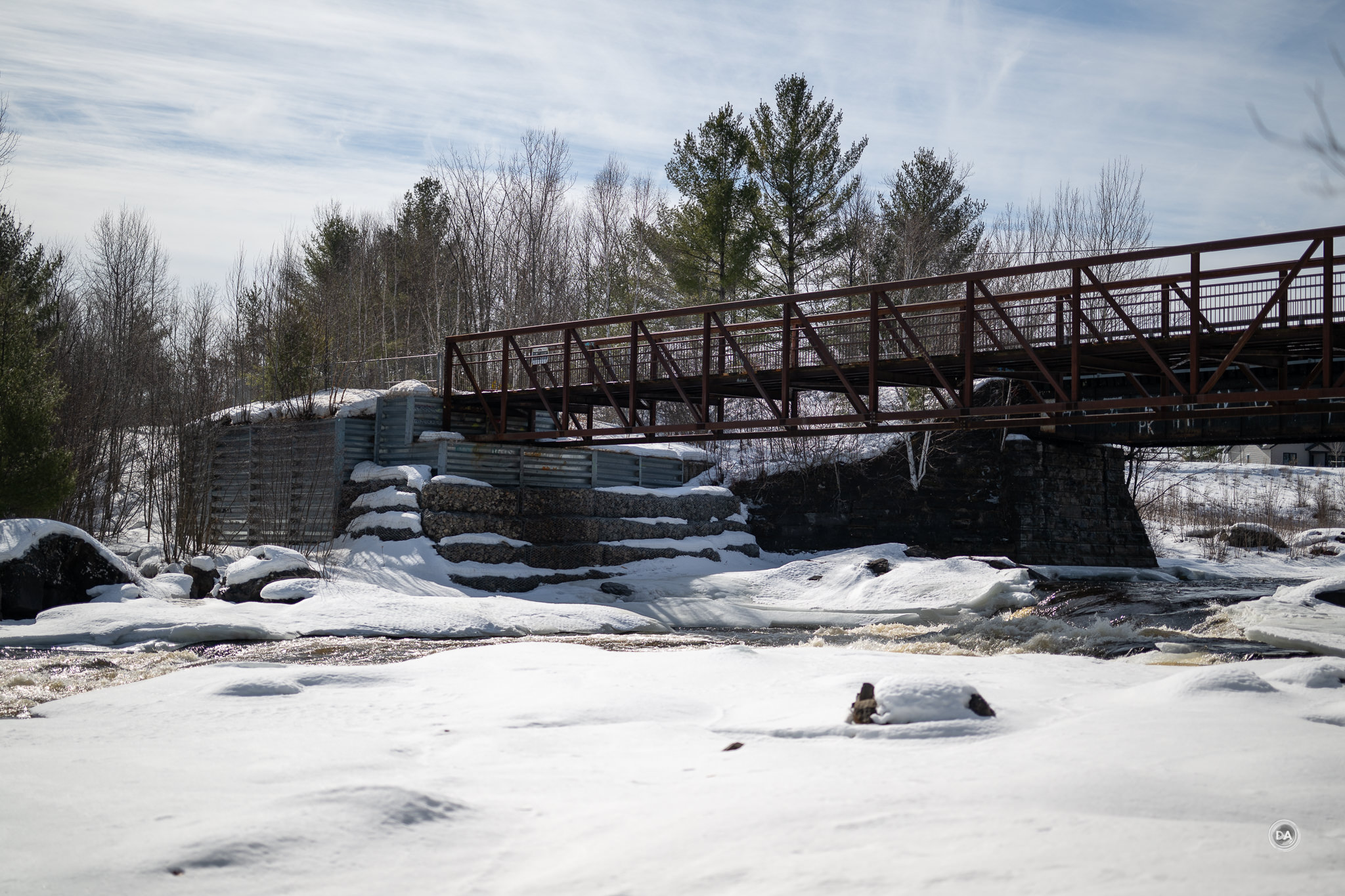
If you’d like to see more images, out the mini-gallery here.







Conclusion
Like all of the Nikon’s F1.2 lenses, the Nikkor Z 50mm F1.2 S is an extreme instrument. It is bigger and heavier than basically all competing lenses, and, while it doesn’t claim the dubious prize of being the most expensive 50mm F1.2, it isn’t particularly cheap, either. But on Nikon there is a bit of an odd separation, as the two premium options are the rather “slow” (though excellent) 50mm F1.8 S, and then the jump to the big F1.2 lens. The Nikkor Z 50mm F1.4 is the “cheap” option of the bunch. One either has to accept a less “sexy” maximum aperture or go all-in with the big 50mm F1.2 S.

Those who routinely do wedding and portrait work will often want the best tools possible for their work, as it allows them more flexibility to play with depth of field and to create high end images that will delight their customers. Lenses like the 50mm F1.2 S will allow people to do that.

This is anything but a “nifty-fifty”. It takes true intention to buy it and use it, so I don’t think it is the lens for everyone. In fact, you probably already know whether or not it is a lens that you actually need…or would even use. And if you know, you know…

Pros:
- Ultra-bright F1.2 Aperture: The lens allows for excellent low-light performance and the ability to create a shallow depth of field that is ideal for portraits and creative shots.
- Stunning Image Rendering: Produces beautiful bokeh and soft backgrounds, enhancing subject isolation and adding a professional touch to images.
- Build Quality: Constructed with a tough outer shell of metal alloys and engineered plastics, ensuring durability and resilience.
- Weather Sealing: Offers protection against the elements, making it suitable for outdoor and challenging shooting conditions.
- Customizable Control Ring: Provides versatility in controlling various functions like ISO and exposure compensation, allowing photographers to adapt the lens to their shooting preferences.
- Smooth Manual Focus: Features a well-textured, smooth manual focus ring that allows for precise adjustments and overrides while in autofocus mode.
- Good Autofocus Performance: While average speedwise, the focus is generally reliable and confident, especially in portraiture, benefiting from first-party proprietary algorithms.
- Quality of Construction: No visible gaps or flex in the lens body, indicating high manufacturing standards and reliability.
- Reduced Focus Breathing: Minimal focus breathing in video shooting makes it a good option for filmmakers looking for smooth focus transitions.
Cons:
- High Price Point: At approximately $2,250, the lens is expensive, primarily appealing to professionals rather than hobbyists.
- Weight and Size: Heavier than many competing 50mm lenses, which can make prolonged usage uncomfortable, especially during long shooting days.
- Average Autofocus Speed: While the autofocus is reliable, it doesn’t deliver the fast response times seen in newer premium lenses, which may limit its use in fast-paced shooting situations.
- Optical Performance: Despite being a premium lens, it shows issues with heavy vignetting and noticeable longitudinal chromatic aberrations, which may detract from overall image quality in certain conditions.
- OLED Display Limitations: The OLED panel on the lens, while functional, may not provide adequate visibility in bright sunlight, requiring reliance on the camera’s LCD for aperture settings.
_________________________________________________________________________
GEAR USED:
Purchase the Nikkor Z 50mm F1.2 S @ B&H Photo https://bhpho.to/3UL0psf | Adorama https://prf.hn/l/Oq2Pgly/ | Amazon https://amzn.to/4syW3Dg | Camera Canada https://tidd.ly/4rSTZ92 | Amazon Canada https://amzn.to/47jxzWe | Amazon UK https://tidd.ly/4rSTZ92 | Amazon Germany https://amzn.to/3N7wo5u
Purchase the Nikkor Z 35mm F1.2 S @ B&H Photo https://tinyurl.com/1235bhphoto | Adorama https://prf.hn/l/AJY4gqV/ | Amazon https://tinyurl.com/1235Samazon | Camera Canada https://shrsl.com/4wxfa | Amazon Canada https://tinyurl.com/1235Samazcan | Amazon UK https://amzn.to/3G2VI9c | Amazon Germany https://amzn.to/3I4pnzh
Purchase the Nikkor Z 135mm F1.8 S Plena @ The Camera Store | B&H Photo | Adorama | Amazon | Camera Canada | Amazon Canada | Amazon UK | Amazon Germany
Purchase the Viltrox AF 135mm F1.8 LAB @ Viltrox (use code DUSTINABBOTT for 5% off) | B&H | Adorama | Amazon | Amazon Canada | Amazon UK | Amazon Germany
_______________________________________________________________
Purchase the Nikon Z8 @ B&H Photo | Adorama | Amazon | Camera Canada | Amazon Canada | Amazon UK | Amazon Germany
_________________________________________________________________
Want to support this channel? Use these affiliate links to shop at: B&H Photo | Amazon | Adorama | Camera Canada | Amazon Canada | Amazon UK | Ebay | Make a donation via Paypal
Buy DA Merchandise https://bit.ly/TWIMerch

Keywords: Nikkor, Nikkor Z 50mm, F1.2, F1.2 S, Nikkor Z, Nikkor Z 50mm F1.2 S review, Nikon 35mm, Nikon Z 50mm, Viltrox, LAB, Viltrox AF 50mm F1.2 LAB Z, Nikon, Nikon Z8, Z, Z-mount, Z8, Review, mirrorless, Full Frame, Sports, Tracking, Dustin Abbott, Real World, Comparison, Handling, Focus, Portraits, Resolution, High ISO, Image Quality, Sample Images, Photography, 45MP, #letthelightin, #DA, #NIKON, #Z8, #NIKONZ8, #NikonZ50mmF1_2S, #NikonLens, #PrimeLens, #PortraitPhotography, #WeddingPhotography, #Astrophotography, #FastAperture, #ProfessionalPhotography, #CameraGear, #NikonZmount, #PhotographyGear, #LensReview, #UltimatePortraitLens, #NikonPhotographers
Related posts:
 Nikkor Z 35mm F1.2 S Review
 Nikkor Z 24-70mm F2.8 S II Review
 Nikkor Z 24-120mm F4 S Review
 Nikkor Z 135mm F1.8 S Plena Review
 LAB vs PLENA: Nikon 135mm Showdown
 Nikkor Z 135mm F1.8 S Plena Gallery
 Viltrox LAB 35mm F1.2 Z-Mount Review
 Nikkor Z 40mm F2 Review
 Viltrox AF 20mm F2.8 Z Review
 Nikkor Z 50mm F1.8 S Review