

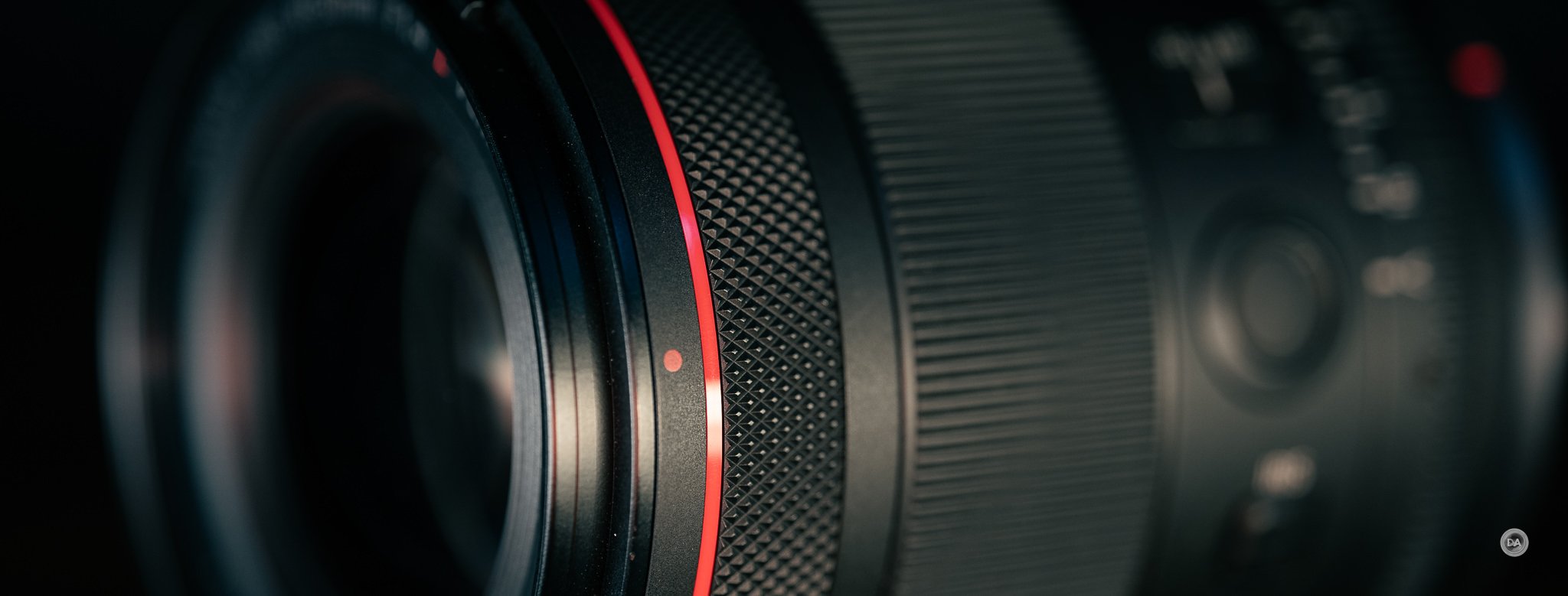
Canon’s 50mm lineup had perhaps the biggest gap in modern camera systems, with the RF 50mm F1.8 STM (my review here) clocking in at roughly $200 MSRP and with the high-end RF 50mm F1.2L (my review here) carrying a price tag of roughly $2600. Yes, you could buy more than 12 of the F1.8 lenses for the price of the one F1.2 lens! Typically the “in-between” would be filled with third party options from Sigma, Viltrox, and more, but because Canon continues to block any full-frame third-party development for the RF mount, we’ve had…nothing. Until now. The Canon RF 50mm F1.4L VCM effectively fills the hole of a high performing 50mm option that doesn’t weigh nearly a kilogram and doesn’t cost more than your camera. Canon’s new lineup of F1.4 VCM lenses includes 20mm, 24mm, 35mm (my review here), 50mm, and 85mm options, all priced from $1500-1900. Not cheap, but under $2000. The RF 50mm VCM is the cheapest of the bunch, currently retailing for under $1500 due to holiday pricing. The VCM lenses are true hybrid lenses, with some video-centric features and a focus system designed to get you the quietest and smoothest focus experience possible. My feelings on the 35mm VCM were a bit mixed…did this 50mm VCM strike me better? Find out by watching the video review or reading on.
Follow Me @ YouTube | Patreon | Instagram | Facebook | DA Merchandise | Flickr | 500px | X
Thanks to Canon Canada for sending me a review loaner of this camera. As always, this is a completely independent review, and the thoughts and opinions expressed here are my own. Visit the product page for the lens here.
___________________________________________________________________________________________
AI SUMMARY: The Canon RF 50mm F1.4L VCM is the first-ever L-series 50mm f/1.4 lens from Canon, filling a long-standing gap between the inexpensive RF 50mm f/1.8 and the massive, expensive RF 50mm f/1.2L by delivering high-end build quality and performance in a much lighter (580g) and more affordable package under $1,500. Designed explicitly as a hybrid photo/video lens, it uses a cutting-edge Voice Coil Motor + Nano USM focus system that delivers extremely fast, accurate, and silent autofocus for both stills and video, making it especially appealing to hybrid shooters and gimbal users. Image quality is very strong with excellent center-to-corner sharpness at f/1.4, pleasing color rendition, and generally smooth bokeh, though it relies heavily on digital corrections for heavy vignetting and shows some busy/onion-ring specular highlights. Overall, the reviewer finds it a clear winner and the most practical 50mm choice for most RF users.
Strengths:
- Significantly lighter and more compact than the RF 50mm f/1.2L while still delivering L-series build, weather sealing, and performance
- Outstanding hybrid autofocus: fast, accurate, and exceptionally smooth/quiet for both stills and video work
- Very sharp across the frame even wide open, with strong contrast, good color, and nice rendering in most scenarios
- Thoughtful video-centric features (declicked aperture ring, standardized 67mm filters across the VCM lineup, gimbal-friendly size)
- Best-in-class weather sealing and durable L-series construction at a more realistic price point than the f/1.2L
Weaknesses:
- Heavy reliance on digital corrections, especially extreme vignetting that can introduce noise and reduce effective dynamic range in shadows
- Aperture ring implementation remains convoluted and camera-body dependent (still doesn’t work for stills on older bodies like the R5 even with latest firmware)
- Somewhat busy/onion-ring bokeh in specular highlights and only average 0.15x maximum magnification
- No optical image stabilization (relies entirely on IBIS)
- Noticeable “clunk” from floating elements when the lens is unpowered (though explained as normal for high-end designs)
___________________________________________________________________________________________________
Part of why I was underwhelmed with the 35mm VCM was that I liked the EF 35mm F1.4L II so much (perhaps my favorite Canon prime from the EF era), but there really isn’t an EF analog to the 50mm VCM. The EF 50mm F1.4 is very much a consumer grade lens and far from an L series lens in both build and performance. I owned one for years and found it okay but unexceptional. This is the first time Canon has given us an “L” (Luxury) 50mm with a F1.4 aperture.

The RF 50mm VCM is a capable stills lens, with very fast autofocus, good sharpness, and (as you can see above), nice, soft bokeh. It is perhaps even more capable as a video lens, however, and those within the intended audience of hybrid shooters (people who do both photo and video) will almost certainly benefit from this lens the most.

Let’s dive and take a closer look.
Key Specs
- Full-Frame Format | F1.4-16
- Extremely Fast Design, Advanced Optics
- Voice Coil Motor (VCM) for Rear Focus
- Nano USM for Fast Floating Autofocus
- Manual Iris/Full-Time Focus Rings
- Air Sphere (ASC) Coating
- Two Aspherical Elements, One UD Element
- Rounded 11-Blade Diaphragm
- Weather-Sealed Design
Build and Features
Not only is the RF 50mm F1.4L VCM more than $1000 cheaper than the RF 50mm F1.2L, it is considerably smaller and lighter. The 1.2 lens is a bit of a beast. It is nearly 90mm in diameter, nearly 110mm long, and weighs right under a kilogram (950g). By contrast, the RF 50mm F1.4L VCM is 76.2mm (3″) in diameter and is 99.1mm (3.9″) in length. That diameter figure in particular is startingly different. The weight is 580g (1.3lb). This is a completely different weight class, and makes this lens far more accessible not only to those who dread carrying a lens as heavy as the F1.2 all day but also those that might be doing video work from a gimbal.
We can see that the RF lens (middle) is a bit slimmer than the Sony 50mm F1.4 GM lens (left), but is also roughly 3mm longer. It weighs about 64g more than the GM lens, however, so Sony wins there. The Viltrox Pro AF 50mm F1.4 (also Sony E-mount) is considerably bigger and heavier than both.
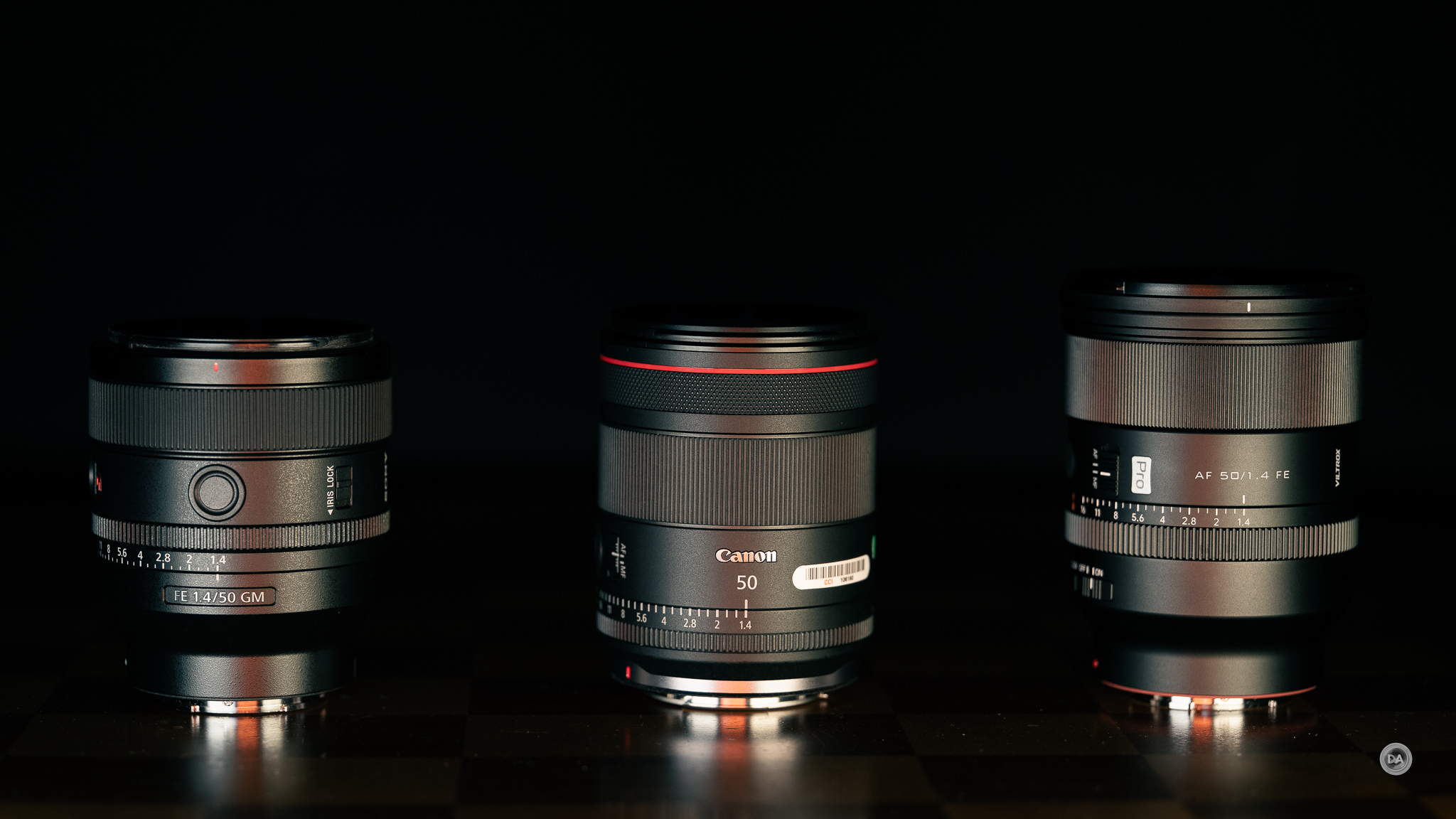
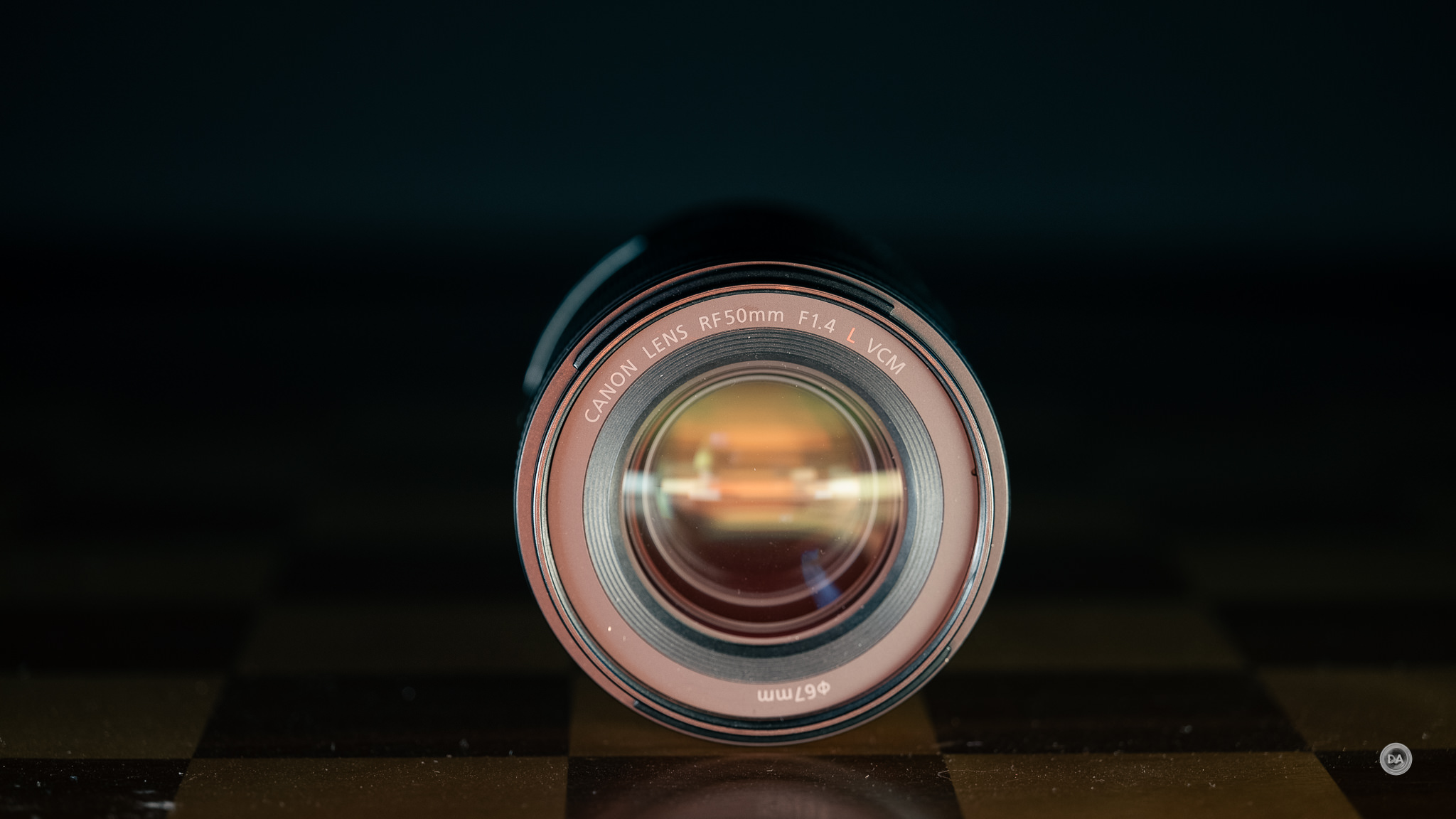
Canon has standardized the size and shape of the F1.4 VCM lineup to allow them to be easily swapped in gimbal situations, and the filter threads are also standardized at 67mm, allowing you to share filters across the whole lineup. I always appreciate when companies do this, as it makes using multiple lenses from a series much simpler.
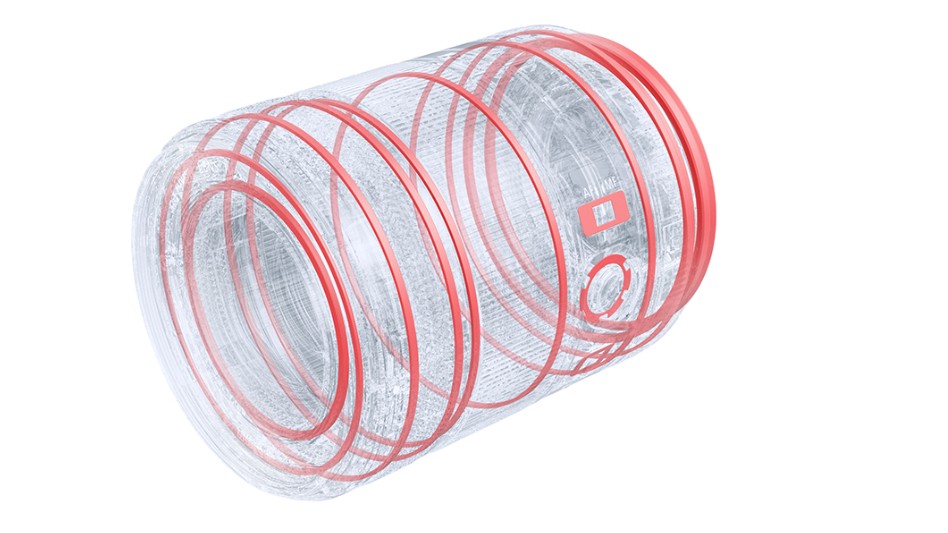
The RF 50mm F1.4L VCM comes with a very thorough weather sealing, with a whopping 13 seal points by my count.
There are also fluorine coatings on both the front and rear elements to help to protect those elements and make them easier to clean. The rear gasket is nice and thick, which always feels a bit reassuring to me.
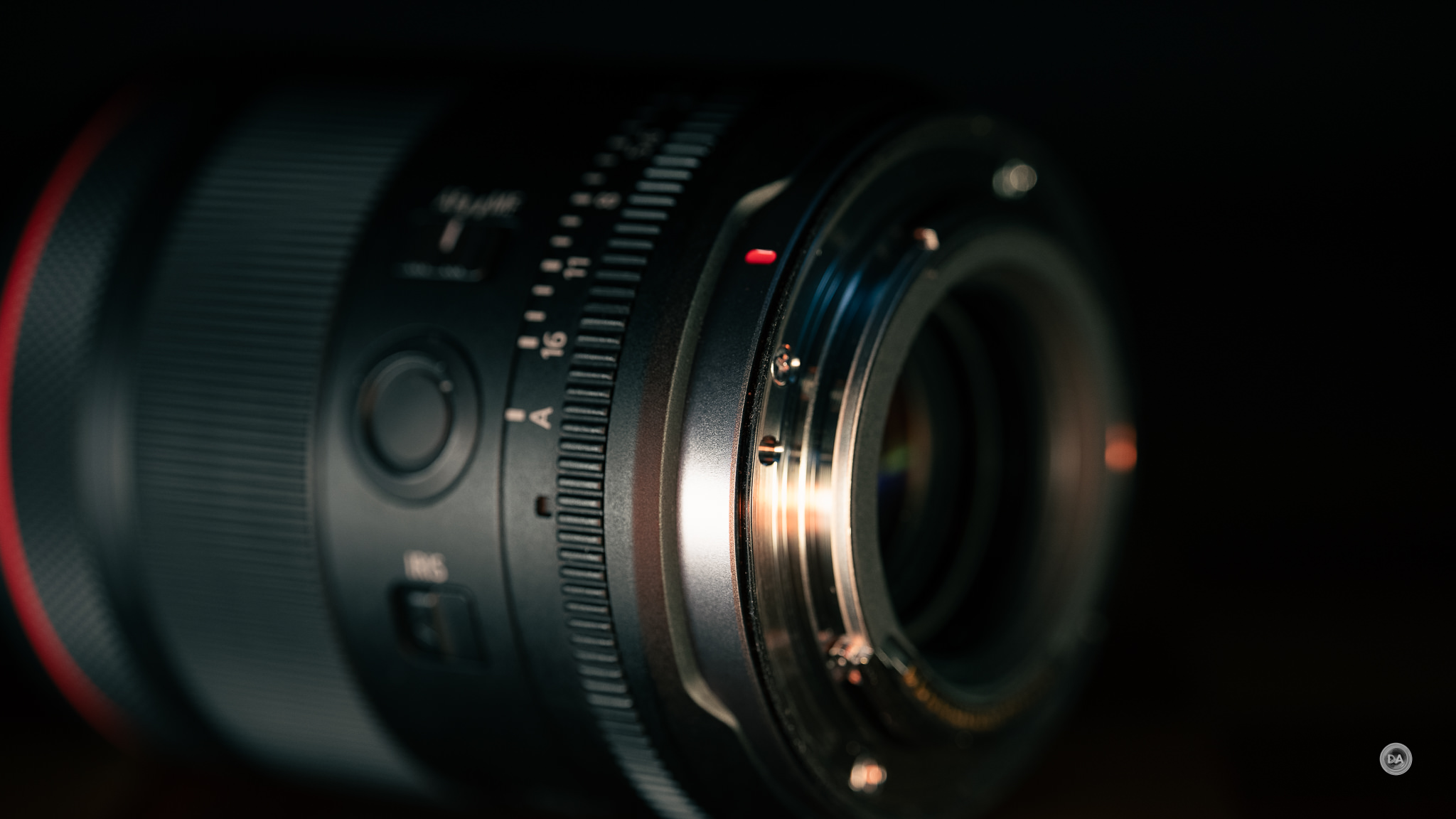
I’ve seen some angst over some “clunking” in the lens if you tip it up and down, but this is nothing to worry about. I’ve reviewed (and owned) a number of lenses with floating elements, and they actually tend to be employed in higher end, more expensive lenses because this design isn’t cheap. Floating elements allow for better performance, particularly up close. You’ll find that the “clunking” or sense of movement in the lens immediately goes away when the lens is attached to the camera and the camera is powered on. Those elements become energized and ready for use. This is nothing new, by the way, as floating elements were first used in the late 1960s and have already been used in the acclaimed RF 50mm F1.2L and 85mm F1.2L lenses amongst other EF and RF lenses. I find a lot of third party brands like Sigma and Viltrox are jumping into the floating element design as well, so I suspect in the future people will feel more comfortable with them due to greater familiarity.

Canon was a bit slow to the idea of including aperture rings on their lenses, but the VCM lenses introduced Canon’s “take” on aperture rings. First of all, I do love having a manual aperture ring. I do find it the most intuitive way to control aperture, and while I don’t take full advantage of all lens features on a regular basis, I do use aperture rings constantly. I still don’t love where things stand with their implementation here. Depending on what camera you use, you may or may not be able to use the aperture ring during photo capture. Despite implementing the most recent firmware update on my Canon EOS R5 (as of late November, 2025), the aperture ring on the 50mm VCM will only work during video capture on the R5. I happened to be reviewing the EOS R6 Mark III at the same time, however, and I could use the aperture ring in both photo and video capture. I simply don’t understand the limitation here, as from the beginning of RF one of the functions you could assign to Canon’s control ring was aperture control. But with these VCM lenses you cannot use the aperture ring when shooting photos unless you have a camera from 2024 or later. On my R5 you can turn the ring all day and it does nothing.
Regardless of the camera, however, the ring is always declicked, with no fixed markings for aperture stops (though these are marked on the lens barrel). There is an iris lock which allows you to lock into the manual ring or out of it if you prefer to control aperture from within the camera itself.

I was able to do fairly smooth aperture racks when in video mode.

The aperture iris itself has 11 rounded blades (like the Sony GM lens) and maintains a nicely circular shape.
I still remain unsure as to why aperture control needs to be so convoluted when it is far more straightforward in literally every other lens with an aperture ring I’ve tested.

The control ring itself remains a strong Canon RF feature, and this multipurpose ring can be programmed to a variety of different functions from the within the camera body. It has the typical diamond pattern grip on it that gives it a different tactile feel from other rings.

The manual focus ring is the largest of the three rings, and occupies a good portion of the central housing. An AF | MF switch is to the right of the ring and allows you direct control between the two options. The manual focus ring itself moves smoothly and has decent weight. Focus input is non-linear, which means that it will be speed dependent. Turn the ring fast, and focus will move further; move it slowly, and focus will take a larger rotation to travel the same distance.
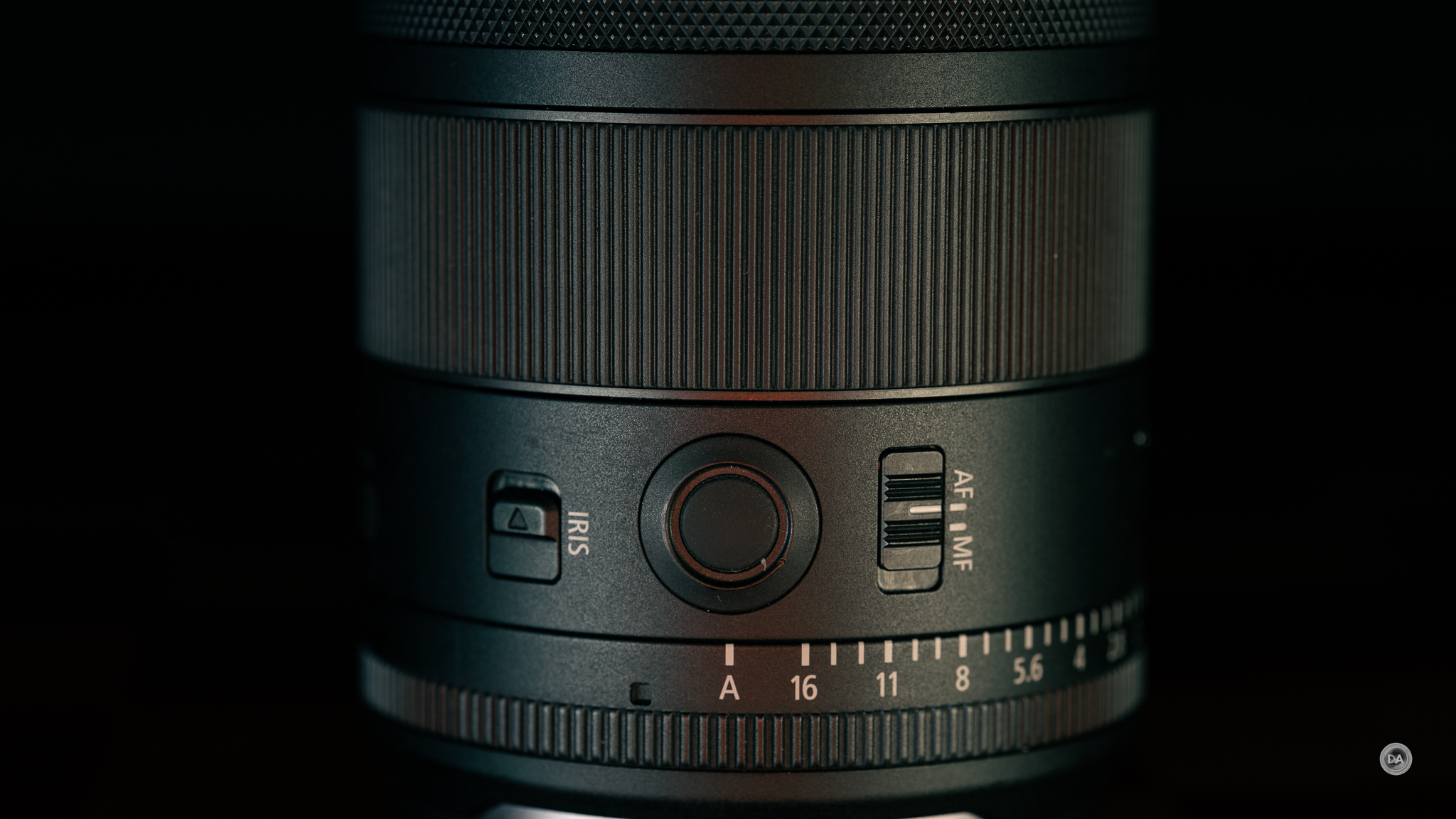
The 50mm VCM does have a custom/programmable button that can be assigned a value from within the camera. There’s a broad range of functions you can choose from.
While my loaner copy did not include it (non retail packaging), the lens does ship with a hood. The hood is fairly large and deep.
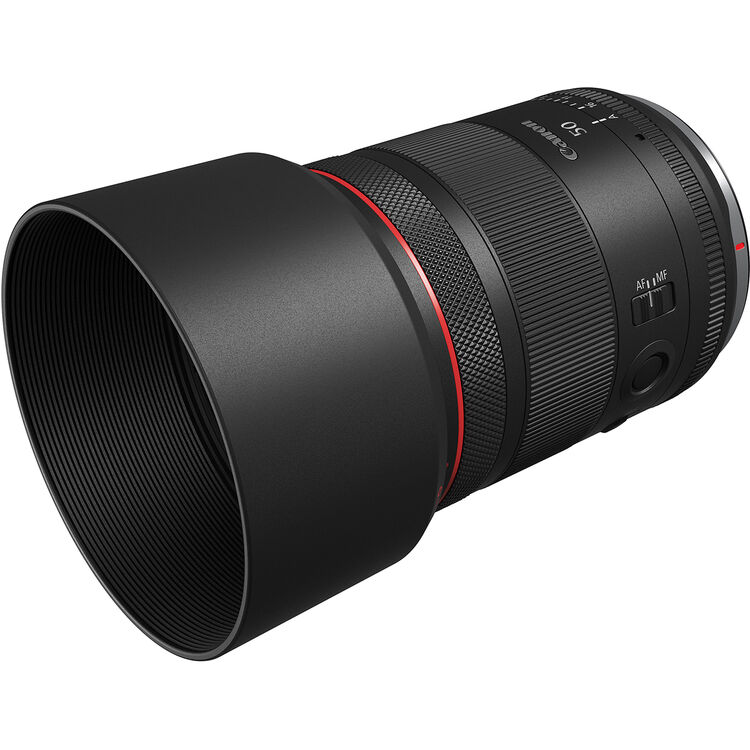
A typical L-series leatherette pouch is included. I prefer the nylon padded cases included with some other brands lenses, as I don’t feel like the L-series pouches have much protection value for transport.
The build quality feels pretty much like a standard L-series lens. There’s an engineered plastic housing over metal internal parts. It has a matte finish with fine flocking with a few platinum colored accent rings that marry nicely to the similar color on the lens mount of the camera, (and, of course that all important red ring near the front!). My experience is that this finish is resistant to scratches and marks. It feels tough and durable, and I’ve personally had Canon L-series lenses that I’ve used for a decade without issues.
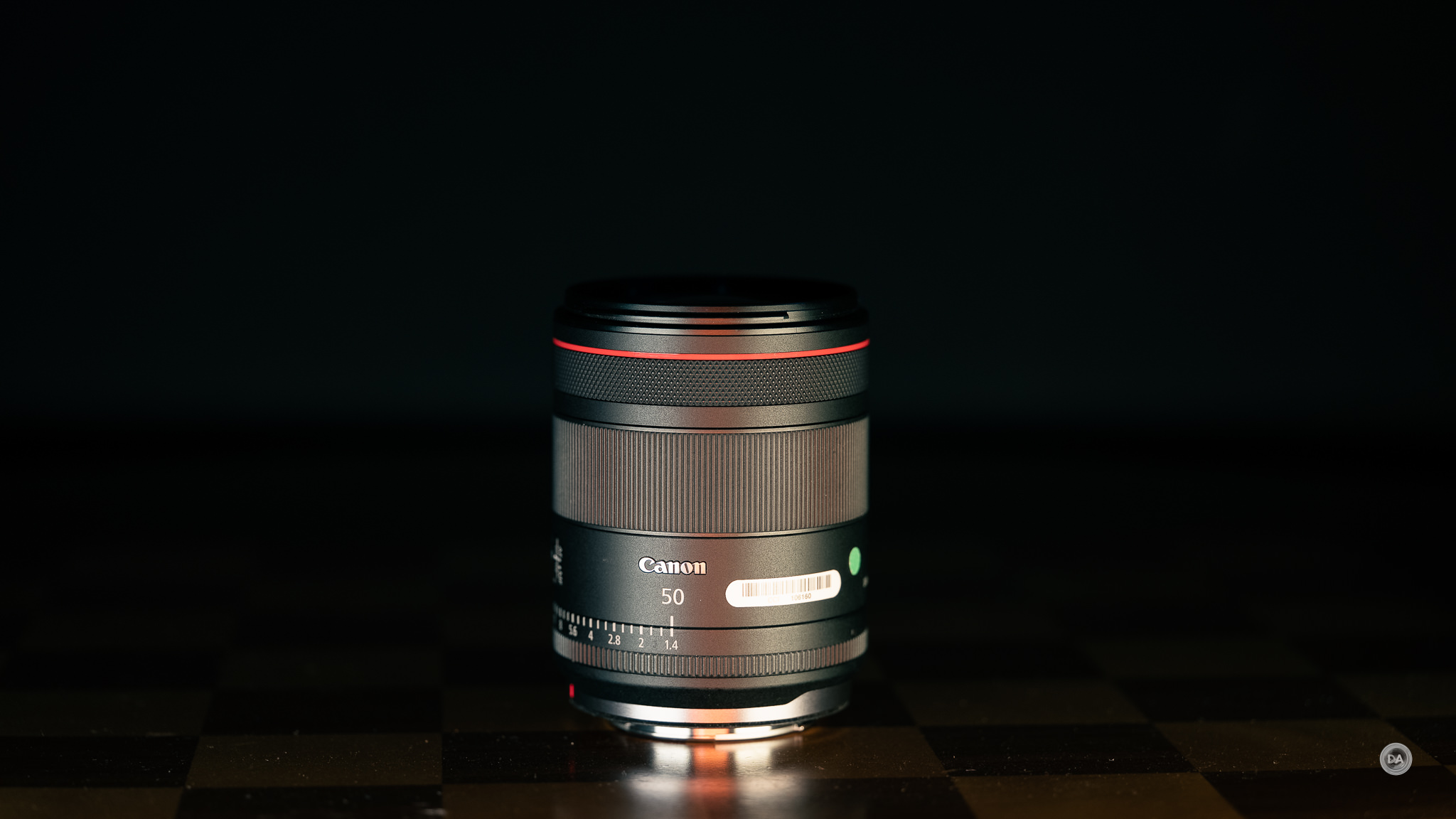
As noted earlier, there is no lens-based stabilization so you’ll have to rely on camera based stabilization if your camera is so equipped. This is why it was a mistake for Canon to not put stabilization in cine-focused cameras like the R5C.
Interestingly, while the minimum focus distance is 40cm (15.7″) like the 50mm F1.2L lens, the magnification is much lower. The F1.2 lens achieves a very nice 0.19x figure, but the maximum magnification figure here is a rather average 0.15x. That’s very slightly less than the 0.26x figure that the Sony GM can achieve. Here’s what the magnification looks like:

The figure isn’t impressive, but fortunately the up close performance is good. You can produce some useful and interesting close shots.

While I remain puzzled by a few odd design decisions Canon made on these lenses, the reality is that this is a nicely built, highly functional lens that is light enough to be attractive to those put off by the bulk of the big 50mm F1.2L. The price of roughly $1500 isn’t cheap, but it is in line with similar first-party lenses like the Sony 50mm F1.4 GM.
Autofocus Performance for Stills
Voice Coil Motors, or VCM, are all the rage at the moment. Viltrox stepped up to VCM with their “Hyper VCM” motors in their higher end lenses, and Tamron calls them VXD motors in their better lenses. In the case of Canon, they employ a hybrid system where the VCM is paired with a Nano USM motor at the front of the focus group to allow for very quick, very quiet autofocus.

Canon’s earlier L series primes like the 50mm F1.2L and 85mm F1.2L actually employed older Ring USM type focus systems. This was a DSLR era technology that works fine for stills but doesn’t work as well for video, and Canon is clearly all in on this being a “hybrid” lens that focuses equally if not more on the video side of things. No complaints from me, however, as this hybrid focus system works equally well for stills and video. It’s much closer to what Sony is achieving with its GM lenses than what the early Canon RF lenses were like. Focus changes from close to distant subjects is near instant, with no drama in the process.
Fast focus is still nice when your subject isn’t moving…

…but a fast, responsive focus motor is hugely important for those who want to shoot weddings, events, or other situations where the subject is moving. I found the lens great for shooting quick “people shots” during setup for a drama.

Even when the light was fading fast (winter days are short here in Canada!), I could accurately focus in dim conditions.

Focus will be flawless for portrait work, as Canon has pretty much perfected eye tracking.
I also had good results in a church setting as well, with good accuracy on the speaker.
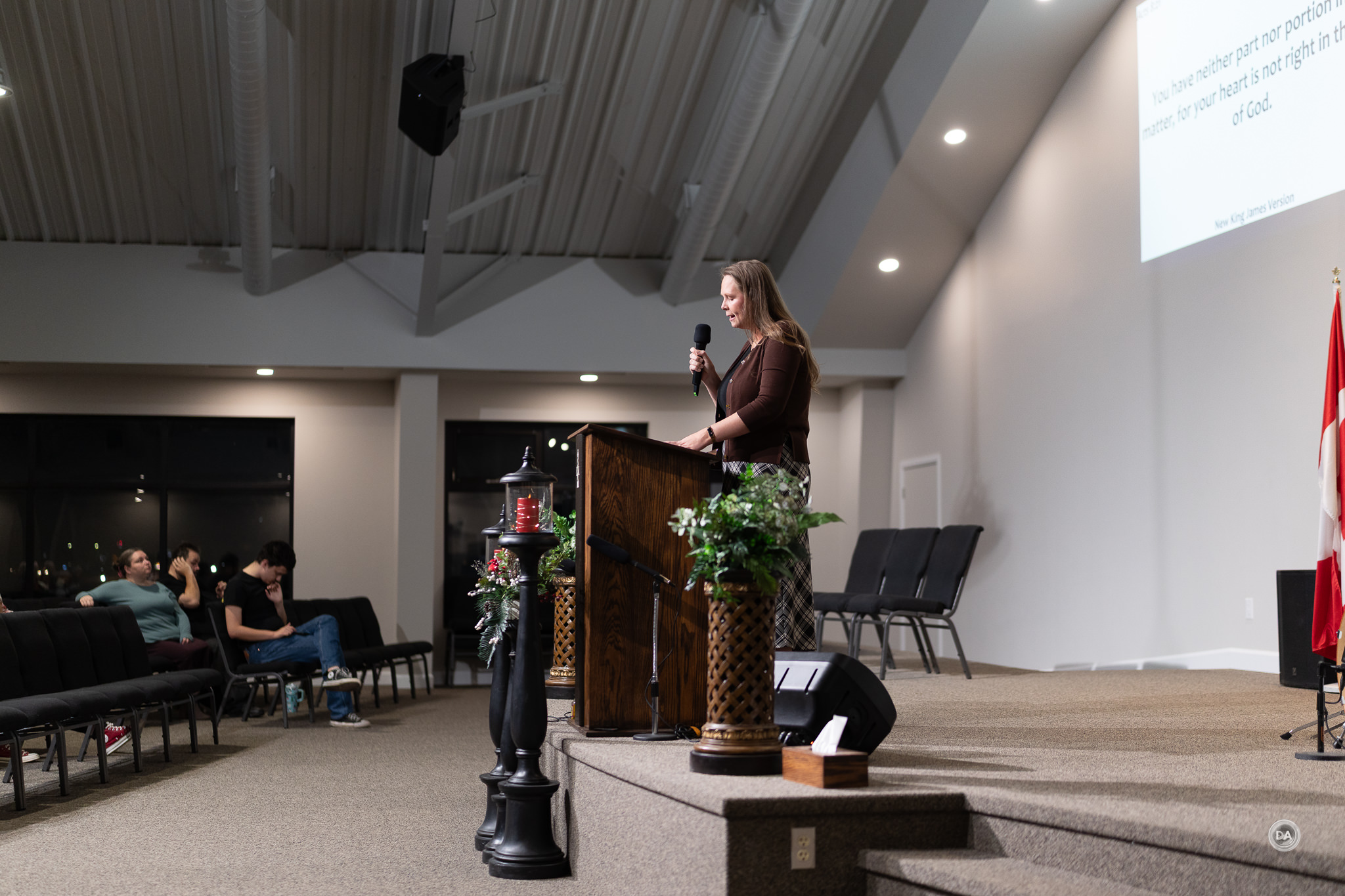
The only focus related complaint I can come up with is one common to basically all platforms I test. Sometimes focus is reluctant to move to a foreground subject and remains stuck on the background. It’s a common frustration of mine, and I did run into it a bit while testing this lens. But it’s hard to knock this specific lens for that behavior when I see it with pretty much everything. Autofocus is a definite strength for this lens.
Video AF
This of course is designed to be a hybrid lens, so the autofocus performance during video is equally important. One of the great advantages of a focus system like this as compared to STM (stepping motors) is that STM motors will often show those visible steps during focus pulls. USM lens have a tendency to be jumpy and not smooth during video AF. The VCM motor is perfect, allowing for very smooth, well damped pulls that move steadily from point A to point B in a linear, consistent fashion.
I particularly want to praise the responsiveness of the focus here. When I tested approaching the camera and then stepping in and out of frame, not only did the focus motor track me perfectly during the approach, but picked me back up nearly instantly when I stepped back in frame even though focus had moved to the distant background.
My focus pull test showed very good confidence in moving from one subject to another, and likewise responsiveness in my hand test was excellent as focus moved from my hand back to my face with good precision.
Focus was nice and “sticky” during my various video clips. Here’s a look at a frame from one of my video clips.

I found that footage also looks very crisp and detailed, even at F1.4. This is a fun video lens.
When gliding along during video capture from one subject to another, I got mostly smooth results with logical transitions. All in all, focus is solid here. That’s a definite strength for the lens.
Image Quality
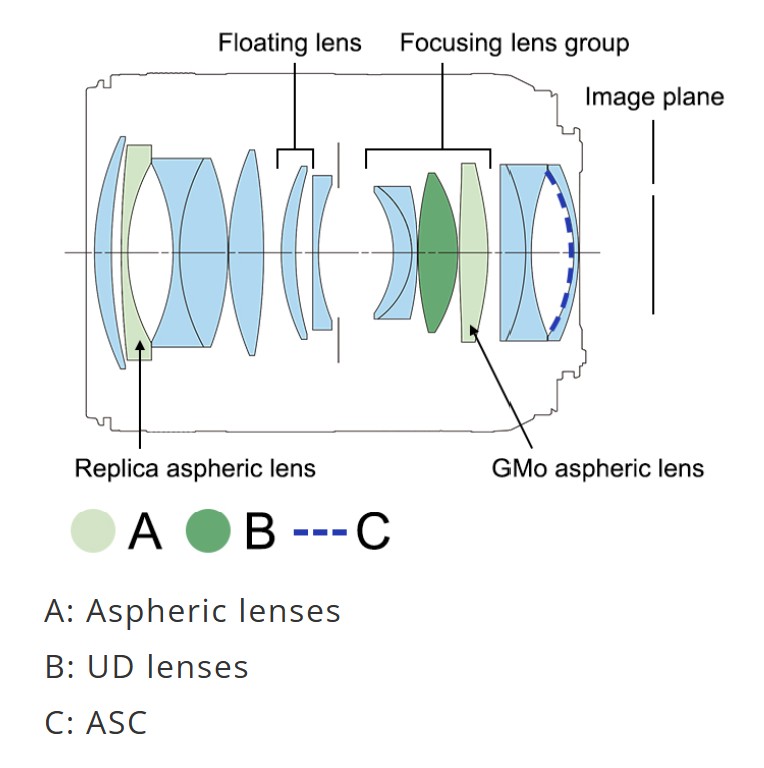
The RF 50mm F1.4L VCM sports an optical design of 14 elements in 11 groups. This includes a variety of exotic elements, including some unique aspherical lenses, a UD element, and Canon’s proprietary ASC (Air Sphere Coating).
The MTF chart looks very good, but not quite as good at that for the Sony GM lens (shown second here).
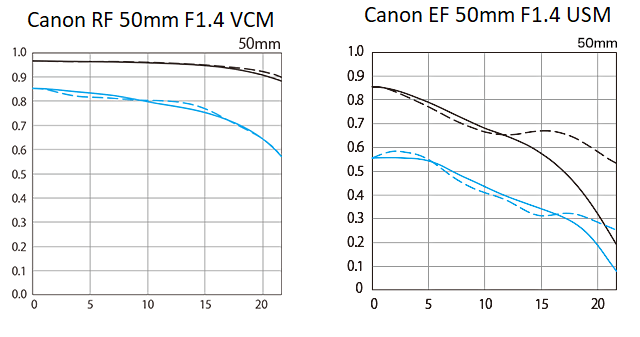
We can see that the MTF chart is radically different from the old EF lens, though that should be the case for a lens that costs 3x as much. It starts out very sharp in the center of the frame and gradually drops to the corners, though what stands out to me is how low astigmatism is even in the corners (the sagittal and meridional planes are very close together). That bodes well for good sharpness. At the same time, however, I do have to point out that on other platforms (like Sony), we have lenses like the Viltrox Pro AF 50mm F1.4 that costs under $600 and has an MTF every bit as good as this…if not better. Canon is making some excellent lenses, but they are also “competing” in a very closed market.
Rant aside, this is a very sharp lens, though it does have a few flaws.


It’s always a little concerning when the B&H listing for the lens includes this caveat:

Canon has proven to be far too reliant on digital corrections in the modern era, and while this lens isn’t nearly as compromised as the RF 35mm F1.4L VCM, it definitely needs a digital assist. The 35mm displayed a massive amount of distortion along with very heavy vignette, but fortunately here it is only the vignette that is a major problem.
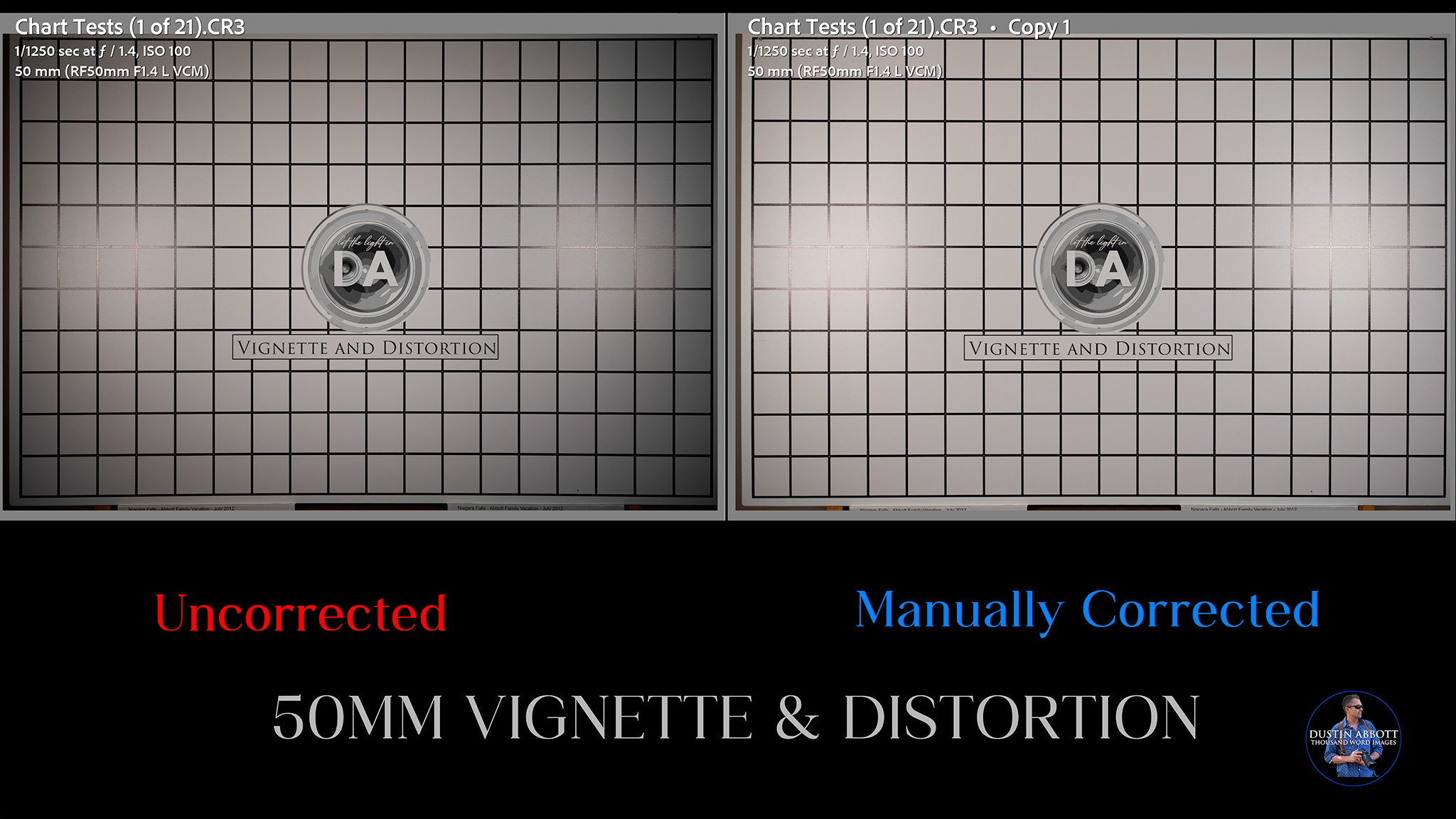
I used just a minor -2 to correct a tiny amount of pincushion distortion, but I had to crank the vignette slider all the way up to +90 to deal with the vignette…and I probably could have gone further.
That will produce radically different results in real world shots if you have corrections off. That quantity of vignette darkens almost the whole image at F1.4.
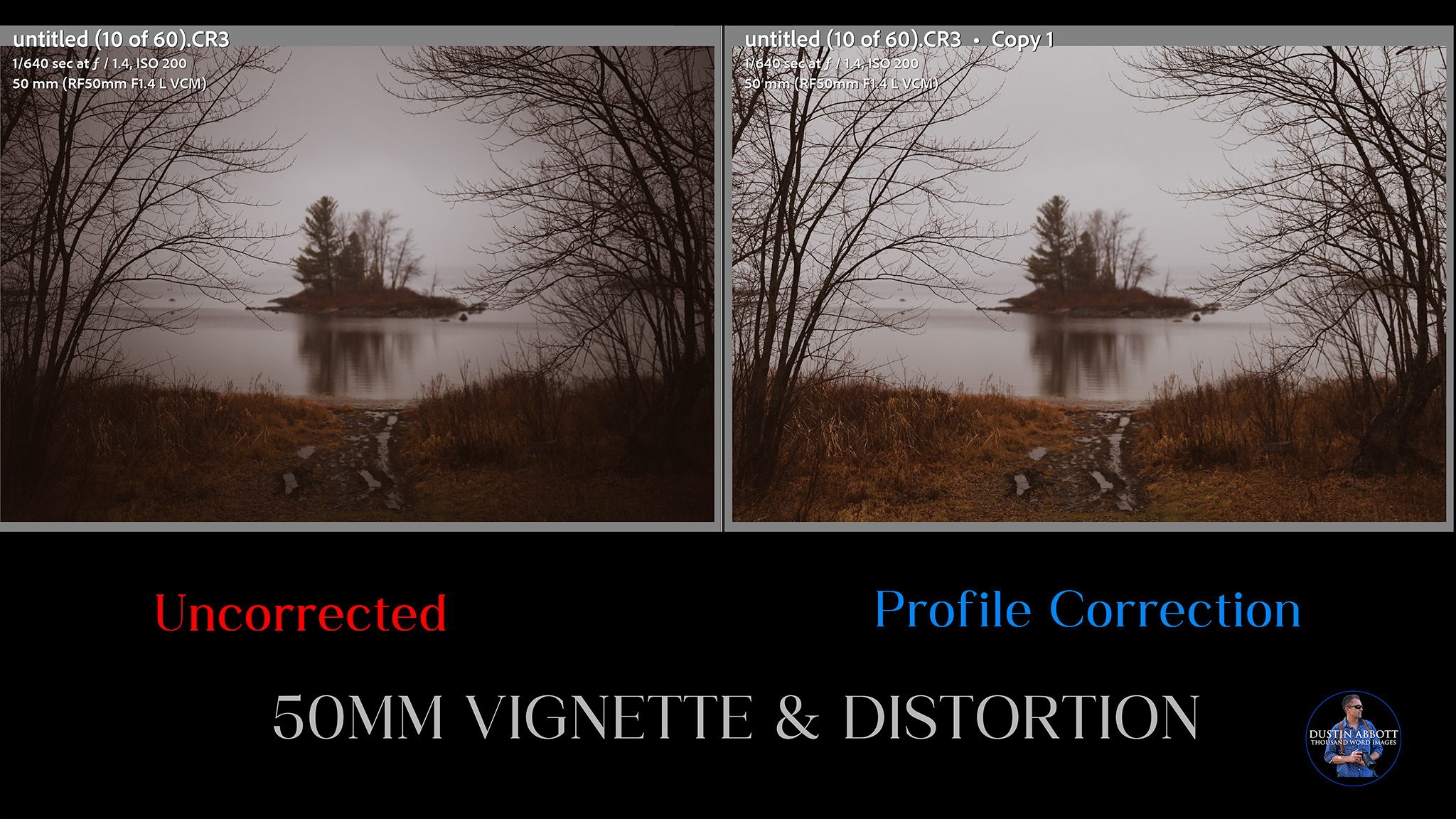
But what’s the big deal? As long as things look fine after correction, no harm done, right?
The problem is that all electronic corrections come with a penalty. Correcting distortion has a negative impact on sharpness (and sometimes geometry, if the distortion is complex). Correcting vignette is like recovering shadows in that it often comes at the cost of additional noise and even some color banding. You can get away with more at lower ISO values, but take at look at this shot of a guitar in lower light (ISO 6400, taken from my review of the 35mm VCM). In the crops below I’ve sampled the evenly colored wall behind the guitar from the center and then the lower left area above where the natural shadow begins. Look at how much rougher the noise pattern is in the area that has had to receive vignette correction.


That noise is nearly four stops worse due to the vignette correction. Put simply, that wouldn’t be the case if the lens was optically corrected rather than relying on so much electronic correction. It’s certainly not just Canon that is guilty of this, but I personally don’t like the trend of relying on digital corrections rather than producing optically corrected lenses.
Things are a little better in the fringing department. Longitudinal chromatic aberrations (LoCA) occur before and after the plane of focus, and while I see some fringing, it isn’t severe.
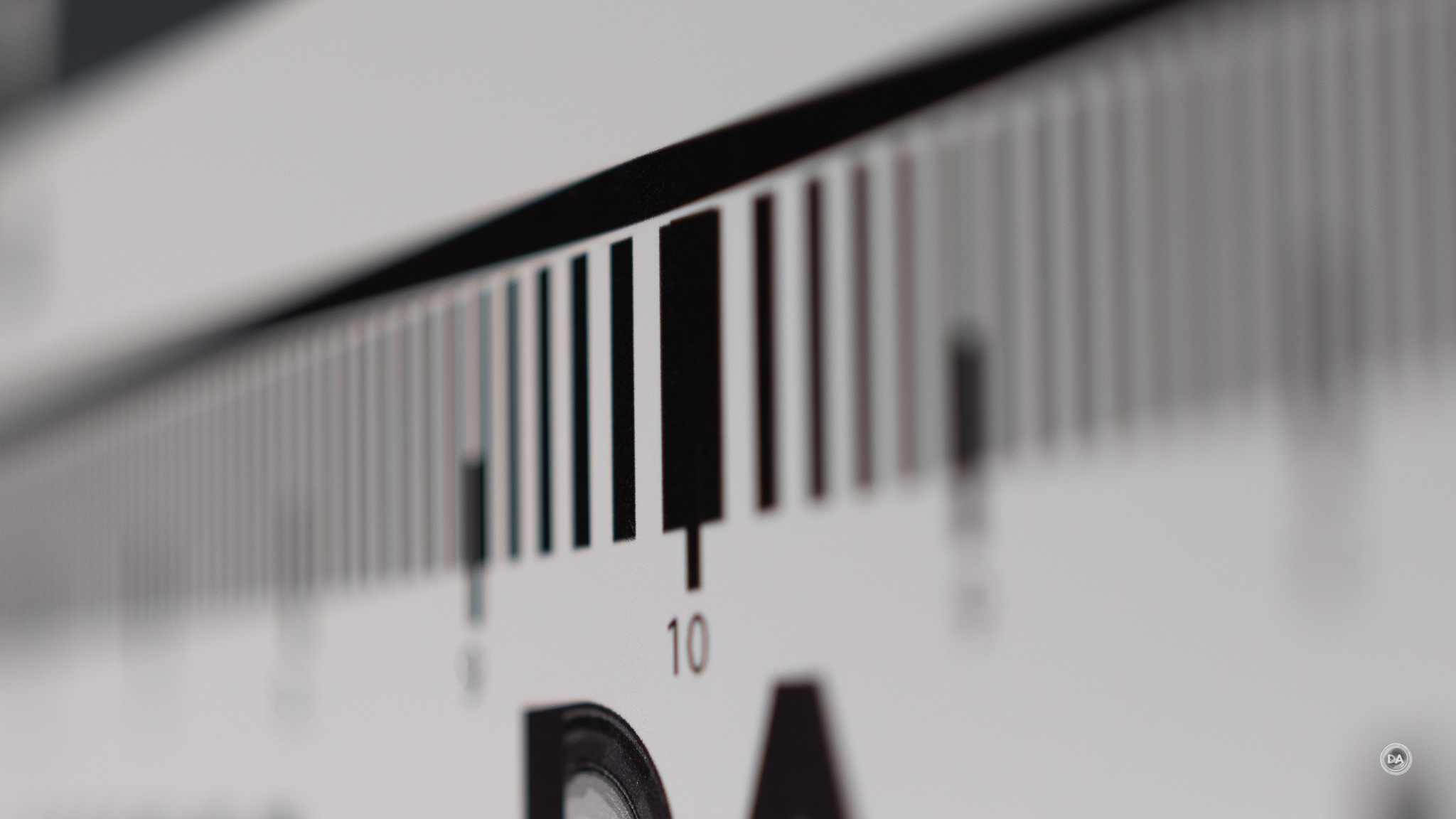
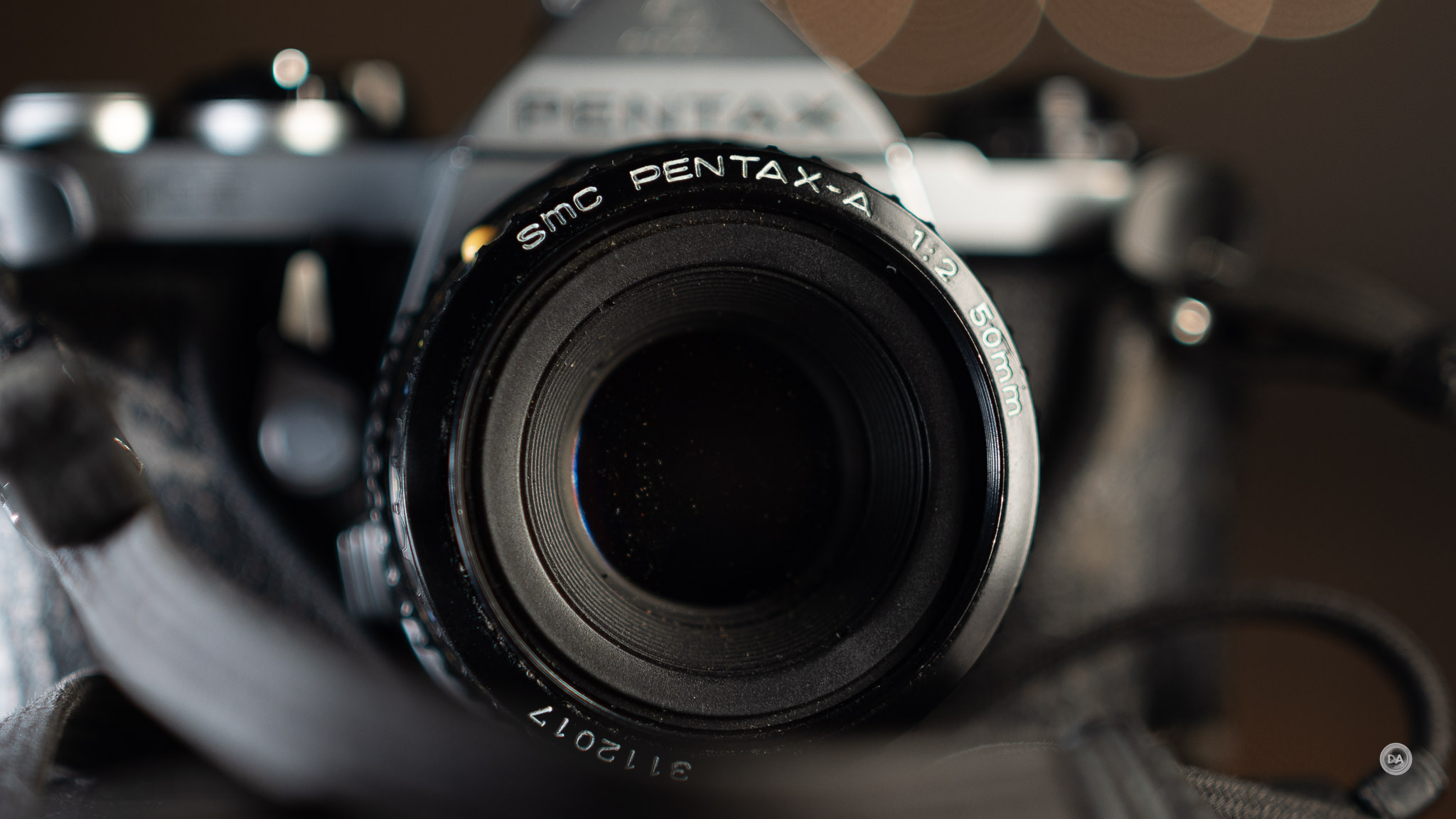
If we look at my Dad’s old SLR, we will see some fringing on the shiny bits and a bit of fringing around specular highlights, but neither is strong enough to really impact things on a global level.
There is only the tiniest amount of lateral chromatic aberrations (LaCA) near the edge of the frame, certainly not enough to be noticed in real world situations.

But all is not lost. Things are about to get better. The Canon RF 35mm F1.4L VCM is a very sharp lens. Here’s a look at my test chart that the crops will come from.

Here are the roughly 200% F1.4 crops from across the frame. This is on the 45MP Canon EOS R5:



That’s pretty great. Even the extreme corners look fairly good. Even landscape shots at F1.4 look crisp and high detail, and in this crop from the plane of focus you can see that the resolution is consistently good right off to the edge of the frame.



I liked the contrast, too, with fine details holding up well at F1.4.


Obviously there is no lack of contrast and detail for portrait work even at F1.4, which is clearly going to be one of the major strengths of this lens.
Stopping down to F2 produces a bit more contrast and detail.
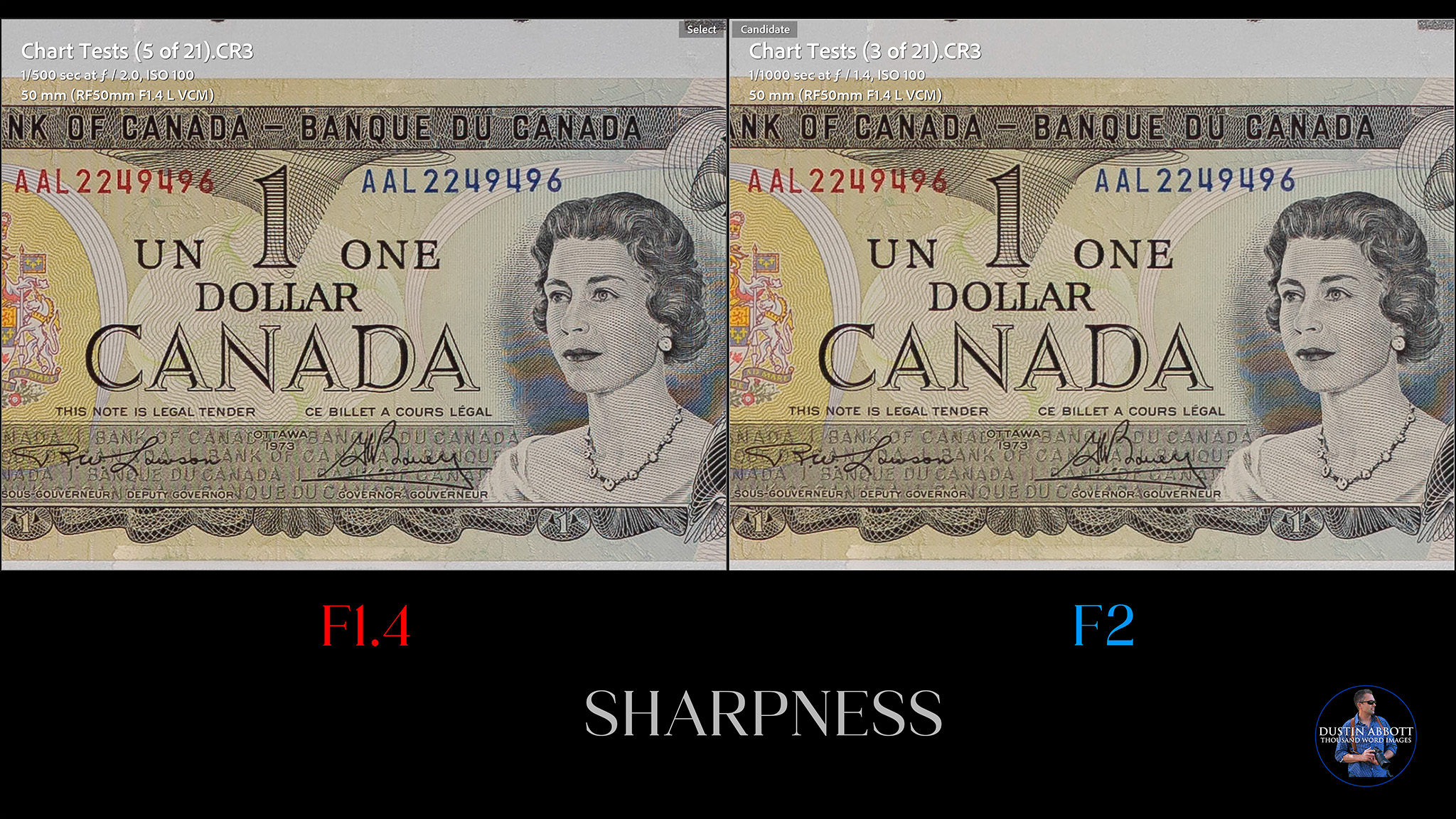
Peak corner performance arrives around F5.6.
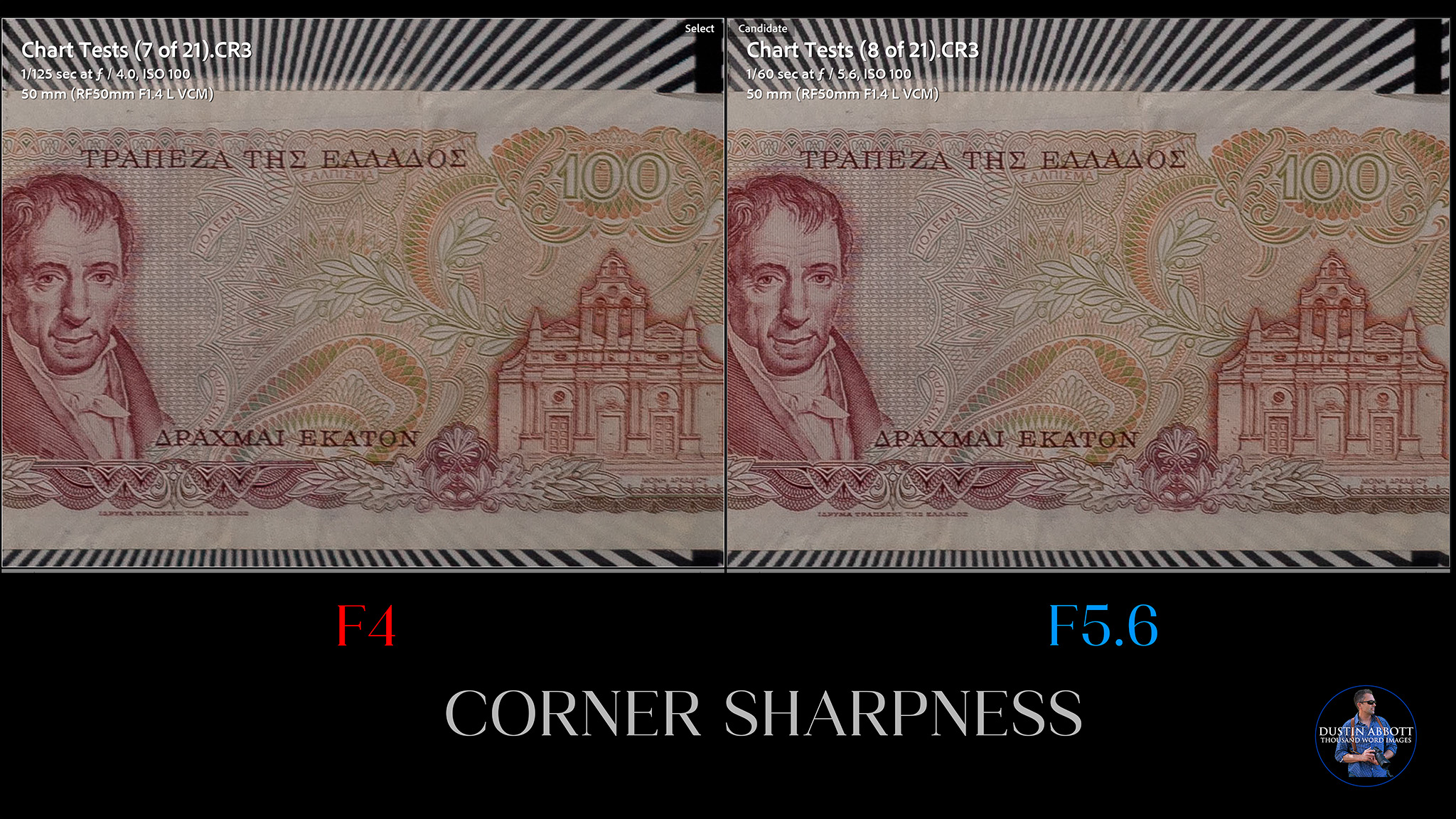
At landscape apertures (F4-F8), the lens is sharp from corners to corners.


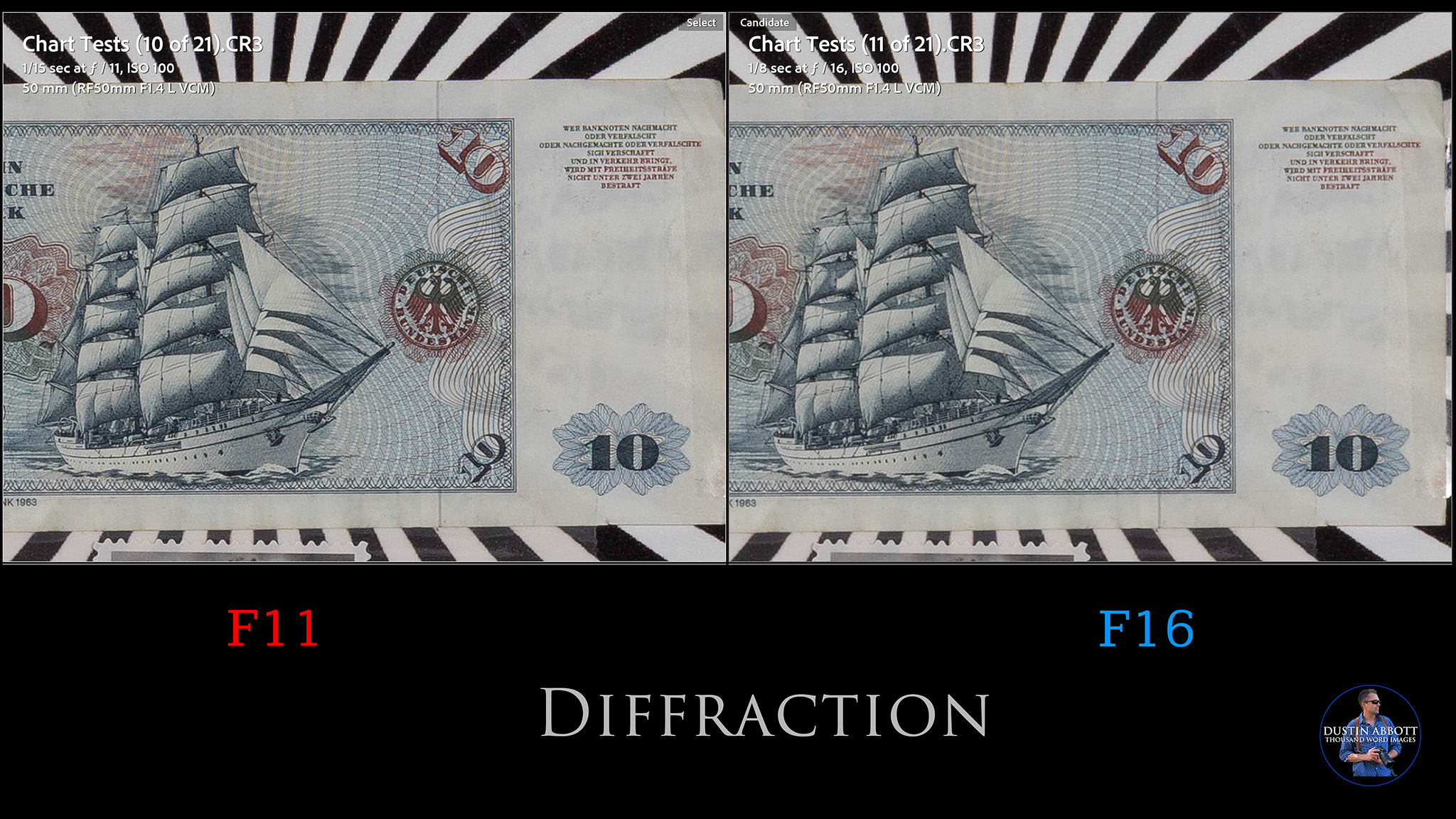
Things stay that sharp through F8, with a little drop-off at F11, and more obvious softening due to diffraction at F16, which is minimum aperture.
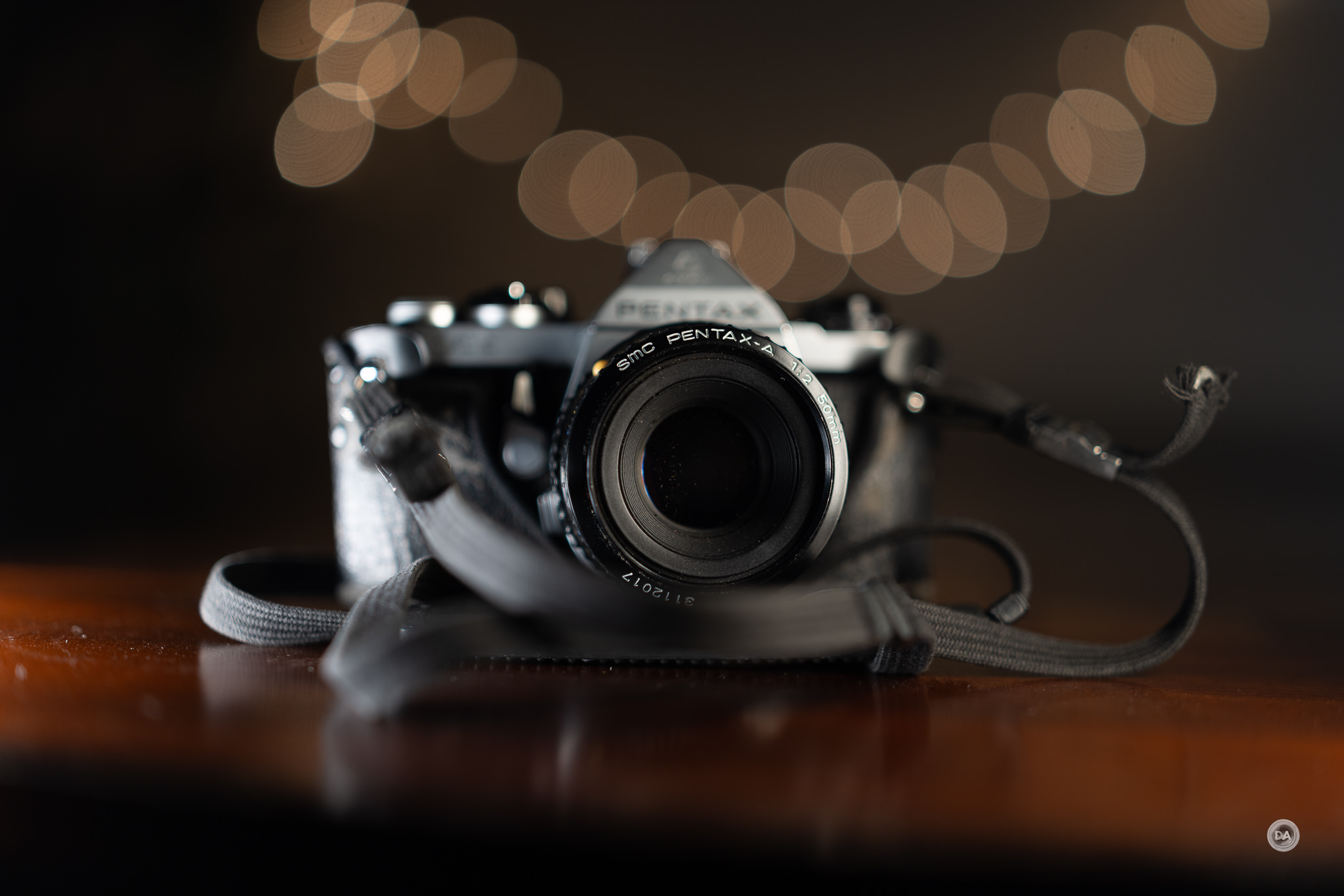
I also generally like the rendering from the RF 50mm F1.4L VCM with one exception – I find the specular highlights a bit “busy”. You’ll find the typical “cat-eye” shape in the corners at F1.4:
Though that geometry improves at F2 and becomes near perfect at F2.8:

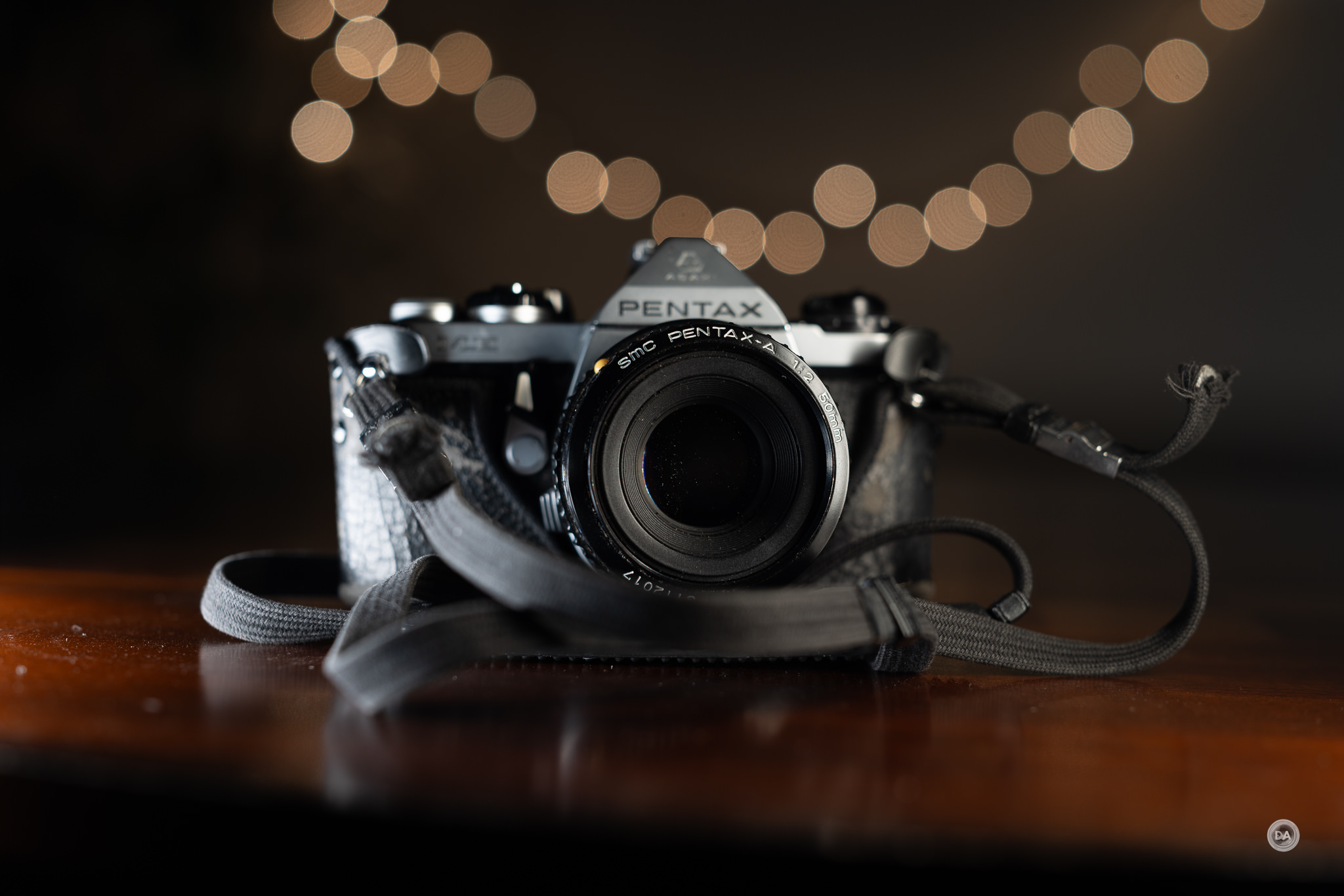
But if you look closer at those specular highlights, there is quite a lot going on in them. There is definitely a bit of the “onion bokeh” look that I dislike.
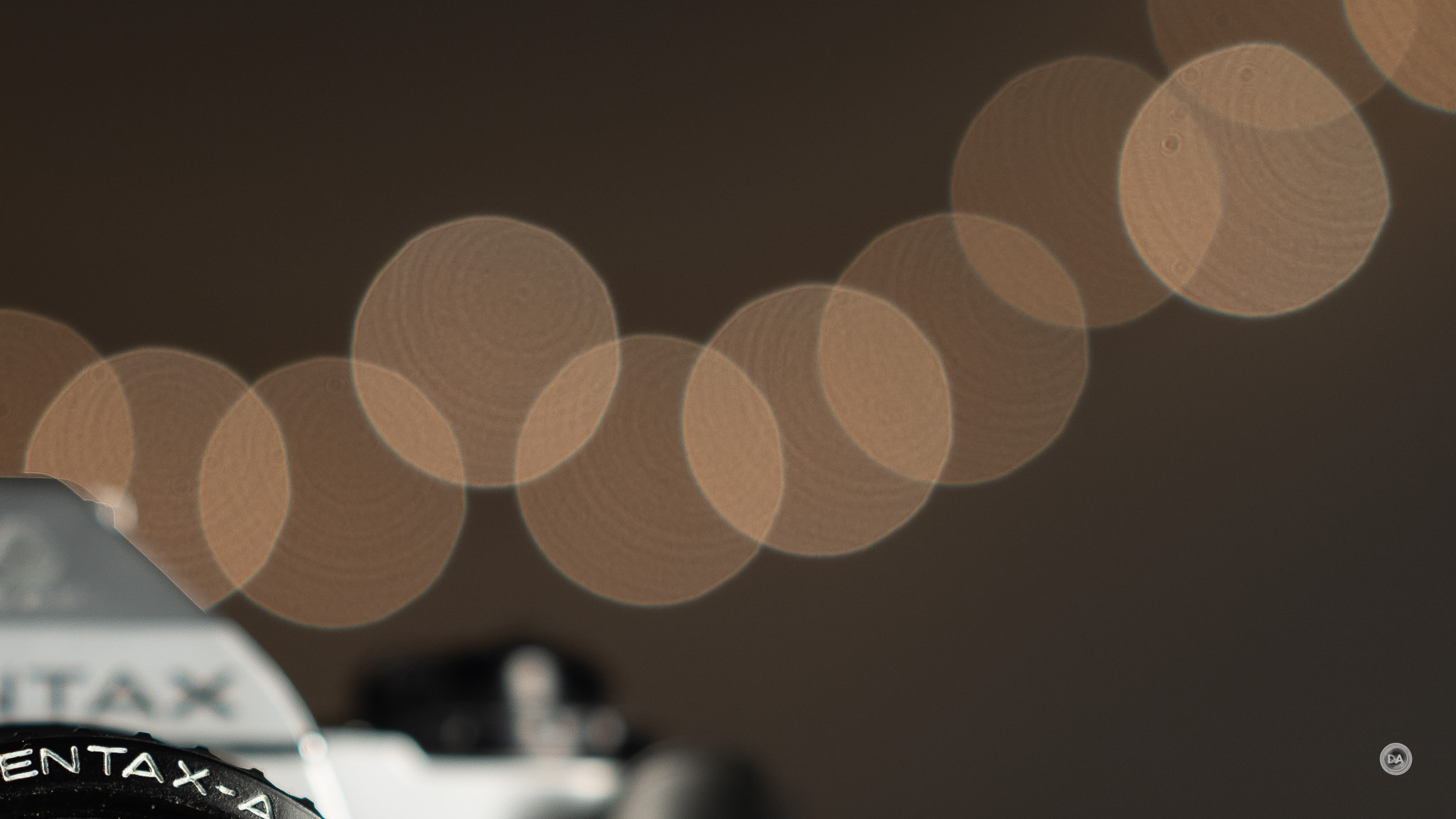
Fortunately it isn’t strong enough for me to notice much in ordinary images that I’m not closely scrutinizing.
At close focus distances or in advantageous ratios where the background is further away the bokeh looks nice and creamy.

Move into an unfavorable situation (more of the background in the transition zone) and the results still aren’t bad, however.

Move a little further away and the lens shows a decent (if not exceptional) 3-dimensional quality at F1.4:

I would say that I’m generally happy with the rendering from the lens other than the somewhat busy specular highlights.
Unfortunately my six-day review period with the lens did not coincide with much sunshine, making flare tests more difficult. I was mostly stuck with testing window light at various angles, but the lens did do fine with those. The lens has Canon’s Air Sphere (ASC) Coatings, and at least in this limited test, they seemed to do their job.



One final area of strength is a common one for a Canon lens – great color. I liked the colors produced by the 50mm VCM in the various scenarios I shot it in.
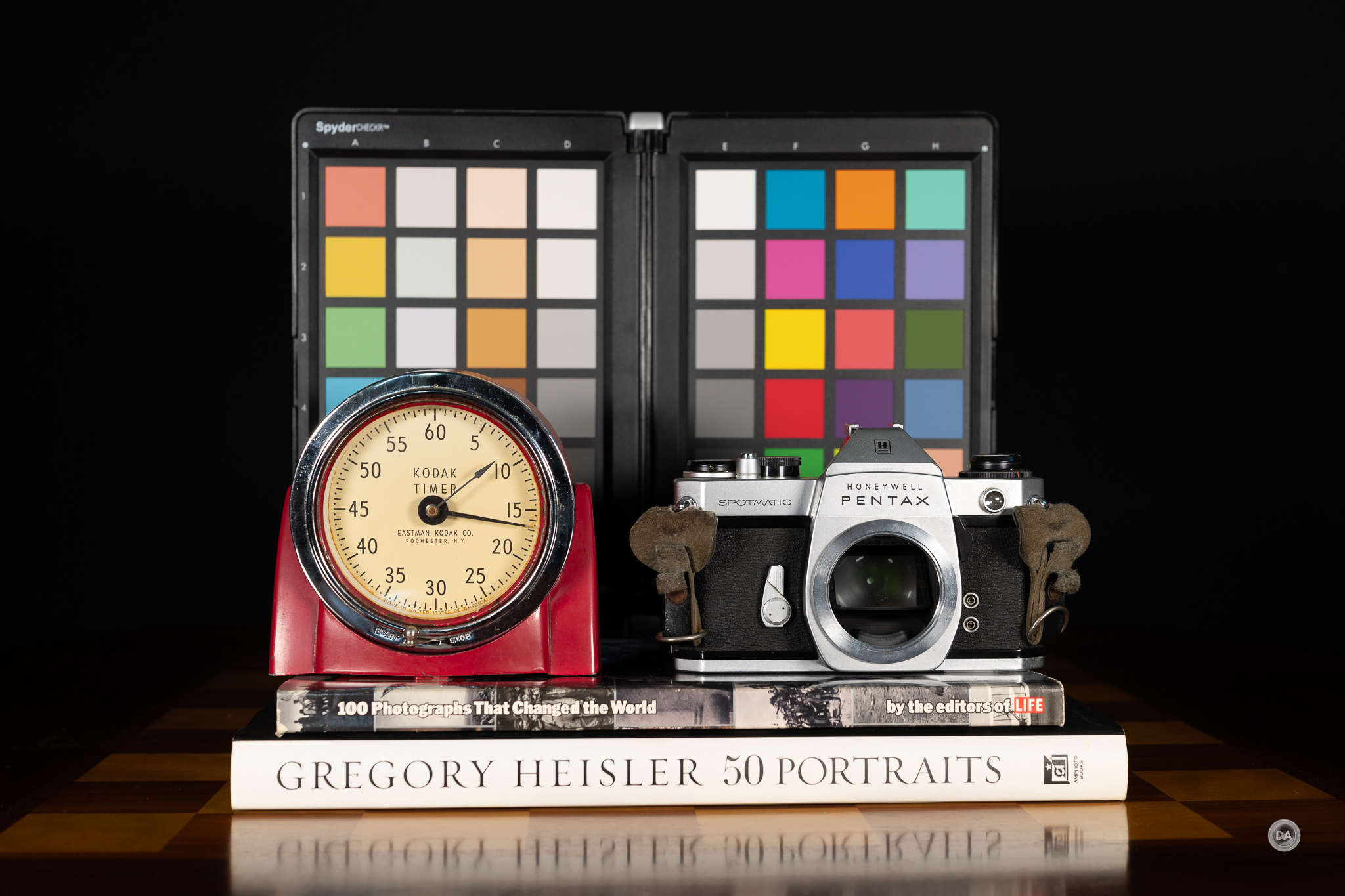
Colors are nicely saturated but without being garish. It’s nice optical glass.


I was underwhelmed by the 35mm F1.4L VCM, but I’m happier with the 50mm VCM. I feel like it is far less compromised optically and does the job of fitting in between the two other 50mm options with an appropriate level of performance. The lens is sharp, has good color, and generally has nice rendering. That vignette is ridiculous, but at least we do get first-rate profile corrections for the lens. Here’s a mini-gallery of images for you to enjoy.
Conclusion
In conclusion, the Canon RF 50mm F1.4L VCM slots nicely into a hole the previously existed in Canon’s lineup. It is relatively compact and light while also being high performing. The autofocus system in particular stands out as being equally well suited to either photo or video work. The price, while expensive, is much more in line with what people might expect to pay for a lens like this, and you can easily produce beautiful images with the lens.

There are a few odd quirks with the aperture ring, and I don’t like the overreliance on digital corrections when it comes to things like vignette, but I don’t think either thing should be considered a deal-breaker here.

If I were in the market for a 50mm lens on my Canon RF system, this is probably the route that I’d go. I made a similar choice on Sony when I chose the 50mm F1.4 GM over the 50mm F1.2 GM. The Canon RF 50mm F1.4L VCM is a very versatile lens for both stills and video, making it a great match for cameras like the new EOS R6 Mark III that I primarily used for this review. It has great autofocus, great weather sealing, and very strong optics. Looks like a winner to me…

Pros:
- Much cheaper and lighter than the premium 50mm F1.2L
- Great build with additional features
- Advanced weather sealing
- Very fast and confident autofocus
- Exceptional video AF performance
- Extremely sharp
- Good contrast
- Good color
- Solid rendering
Cons:
- Very heavy vignette
- Odd implementation of an aperture ring
- “Bokeh balls” can be a little busy
_________________________________________________________________________
GEAR USED:
Purchase the Canon RF 50mm F1.4L VCM @ Camera Canada | B&H Photo | Adorama | Amazon | Amazon Canada | Amazon UK | Amazon Germany
Purchase the Canon RF 35mm F1.4L VCM @ Camera Canada | B&H Photo | Adorama | Amazon | Amazon Canada | Amazon UK | Amazon Germany
Purchase a Canon EOS R6 MKIII @ B&H Photo | Amazon | Camera Canada | Amazon Canada | Amazon UK | Amazon Germany
Purchase a Canon EOS R5 @ B&H Photo | Amazon | Camera Canada | Amazon Canada | Amazon UK | Amazon Germany | Ebay
_________________________________________________________________
Want to support this channel? Use these affiliate links to shop at: B&H Photo | Amazon | Adorama | Camera Canada | Amazon Canada | Amazon UK | Ebay | Make a donation via Paypal
Buy DA Merchandise https://bit.ly/TWIMerch

Keywords: Canon RF 50mm F1.4L VCM, VCM, 50mm, F1.4, f/1.4, 1.4L, Canon R6III, Canon R6 Mark III, Canon EOS R6 Mark III, #eosr6iii, Canon, Canon EOS R5, EOS, R, R5, Review, Canon EOS R6 MK III, Canon EOS R6 II, EOS R6 III Review, RF, mirrorless, Canon EOS R7 Review, Sports, Tracking, Dustin Abbott, Real World, Comparison, Handling, Focus, Portraits, Resolution, High ISO, Image Quality, Sample Images, Photography, 45MP, 24MP, 32MP, Canon, #letthelightin, #DA, #EOSR5, #Canon
Related posts:
 Canon EOS R6 Mark III Review
 Canon RF 35mm F1.4L VCM Review
 Tamron 11-20mm F2.8 RXD for Canon RF Review
 Canon RF 35mm F1.4L VCM Gallery
 Tamron RF 11-20mm F2.8 RXD Gallery
 Canon RF 24-50mm F4.5-6.3 IS STM Review
 Canon RF 24-50mm F4.5-6.3 IS Gallery
 Canon EOS R8 Review
 Canon RF-S 18-45mm F4.5-6.3 IS STM Review
 Canon RF-S 18-45mm F4.5-6.3 IS Gallery