


The buzz over Viltrox and Nikon is that the latter is currently suing the former, and while this has generated a fair bit of angst amongst Nikon Z-mount shooters, Viltrox is clearly fairly positive over the outcome, as they told Petapixel that their release roadmap on Nikon remains unchanged. That suggests that one way or another, Viltrox feels like they will be able to continue to produce Z-mount lenses, which is good news for us all. Exhibit A is their newest lens for Z-mount, which is the Z-mount version of their excellent Pro AF 50mm F1.4. I really liked this lens when I reviewed it on Sony, bit I may just like it better on Nikon. This is an intriguing alternative for those who want an F1.4 aperture and a more optically sophisticated lens than the Nikkor Z 50mm F1.4 that I reviewed here. Can this $600 (less with the discount code DUSTINABBOTT at the Viltrox store) shake up the market on Nikon? Find out more in either the video review below or by reading on in the text review.
Follow Me @ YouTube | Patreon | Instagram | Facebook | DA Merchandise | Flickr | 500px | X
Thanks to Viltrox for sending me a review copy of this lens. As always, this is a completely independent review. *The tests and most of the photos that I share as a part of my review cycle have been done with the 45MP Nikon Z8, which I reviewed here. You can find the product listing for the 50mm F1.4 Z here.
__________________________________________________________________________________________________
Viltrox Pro Series Lens Reviews
APS-C
Full Frame
___________________________________________________________________________________________
AI SUMMARY:
Strengths:
Weaknesses:
__________________________________________________________________________________________________
I have a lot of fun reviewing a fast 50mm lens. They are good for many things and can make some beautiful images.

Viltrox’s PRO seris has been an utter force to be reckoned with, as they combine a high-end feature set, beautiful build quality, good autofocus, and a ridiculously competitive price. This is a lens that will feel in many ways more premium than the $2200 Nikon 50mm F1.2 S, but costs under $600. It uses Viltrox’s VCM (voice coil motor) technology for more thrust and smoother focus action and has a full set of features, including an aperture ring that be clicked or declicked, a custom/function button, an AF | MF switch, weather sealing, and a USB-C port for easy firmware updates. This is a lens with an S-line level of build and features.
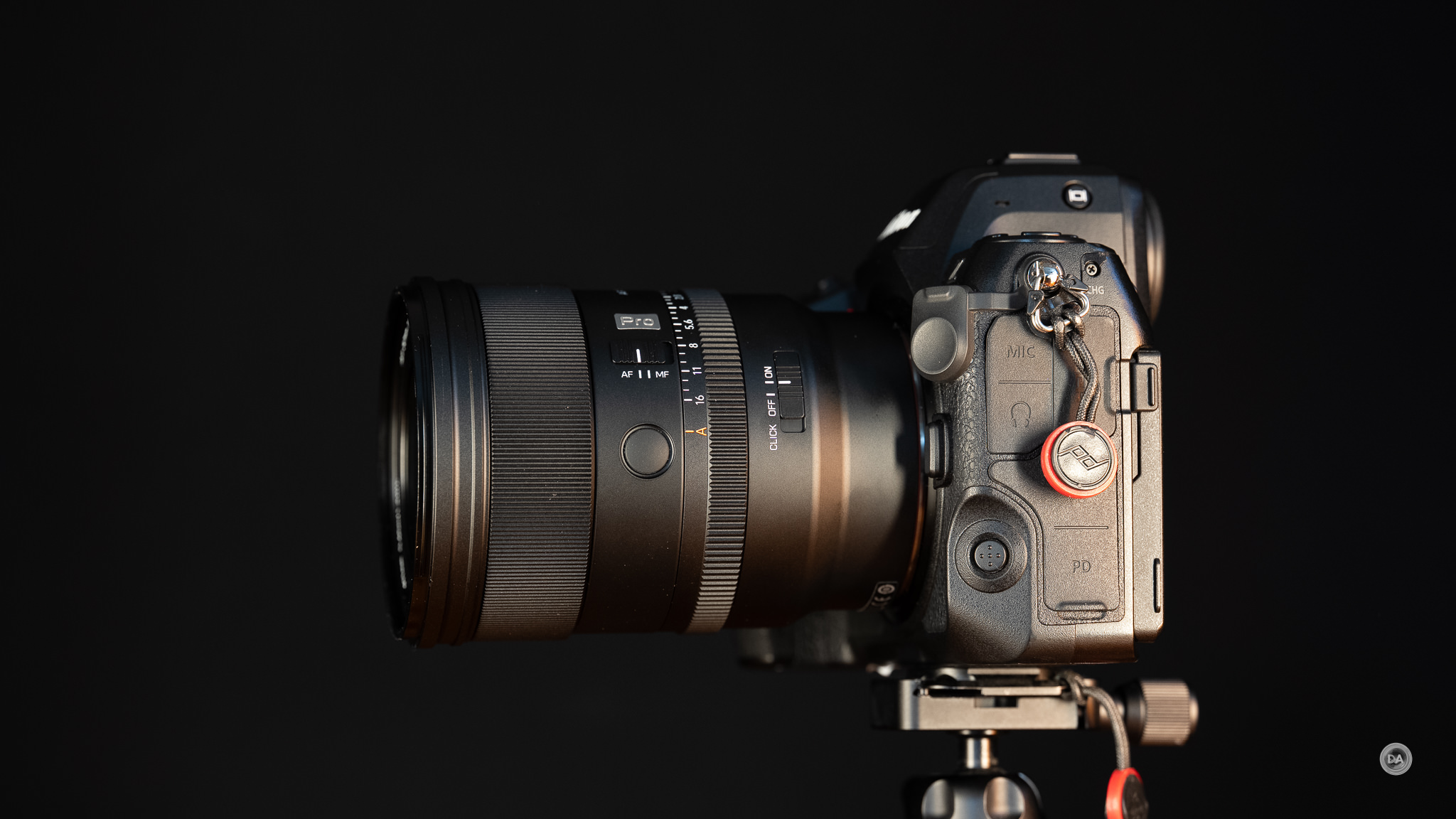
Something about this lens just works on Nikon Z, and we’ll explore why in today’s review. As I have previously thoroughly reviewed this lens, there will be some minor overlap with the E-mount version, though everything will be updated to reflect the unique realities on Z-mount.

Viltrox Pro 50Z Build and Handling
The first thing to note is that this is definitely a pro-level build quality that will feel more upscale than either the 50mm F1.8 S or the 50mm F1.4 Z. This is a metal bodied lens with an upscale features and pro-level build. The Nikon Z-mount version is mostly similar to the E-mount version, though the larger diameter of the Nikon’s Z-mount necessitates a wider diameter near the lens mount, and the difference in the flange distance (the proper distance between the sensor and the optical path) is slightly longer on Z-mount as well, making for a slightly longer lens.

This area around the lens mount is not the widest part of the lens, so the overall diameter remains the same, but you can see that the length is roughly 2mm longer. The Pro 50Z is 84.5mm (3.3”) in diameter and a fairly long 113mm (4.38”). The combination of extra girth and length adds up to additional weight, too. The Pro 50Z weighs in at 830g (29.2oz) on my scale, which compares to 800g (28oz) for the E-mount on my same scale. It is worth noting that this is significantly bigger and heavier than the Nikkor Z 50mm F1.4.
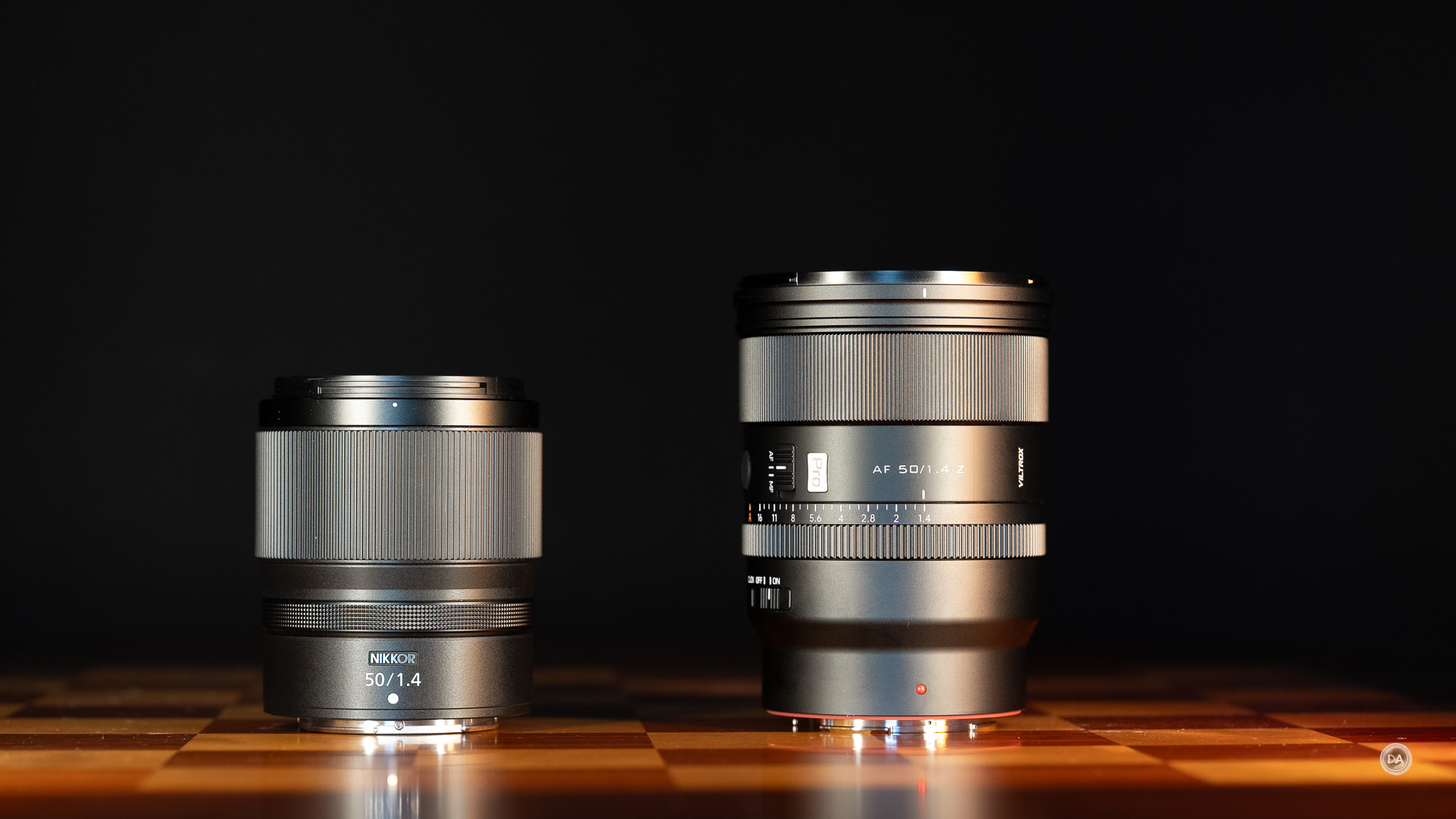
The Nikkor is just 76.2mm in diameter and 88.9 mm in length. Most noticeable is the weight difference: the Nikkor is just 422g. If your priority is traveling small and light, the Viltrox won’t be for you.
In basically every other way, however, the Viltrox is a more sophisticated lens. It has a more flexible approach to aperture, as rather than the declicked customizable control ring, we have a more robust approach to aperture control, including a dedicated (and marked) aperture ring.
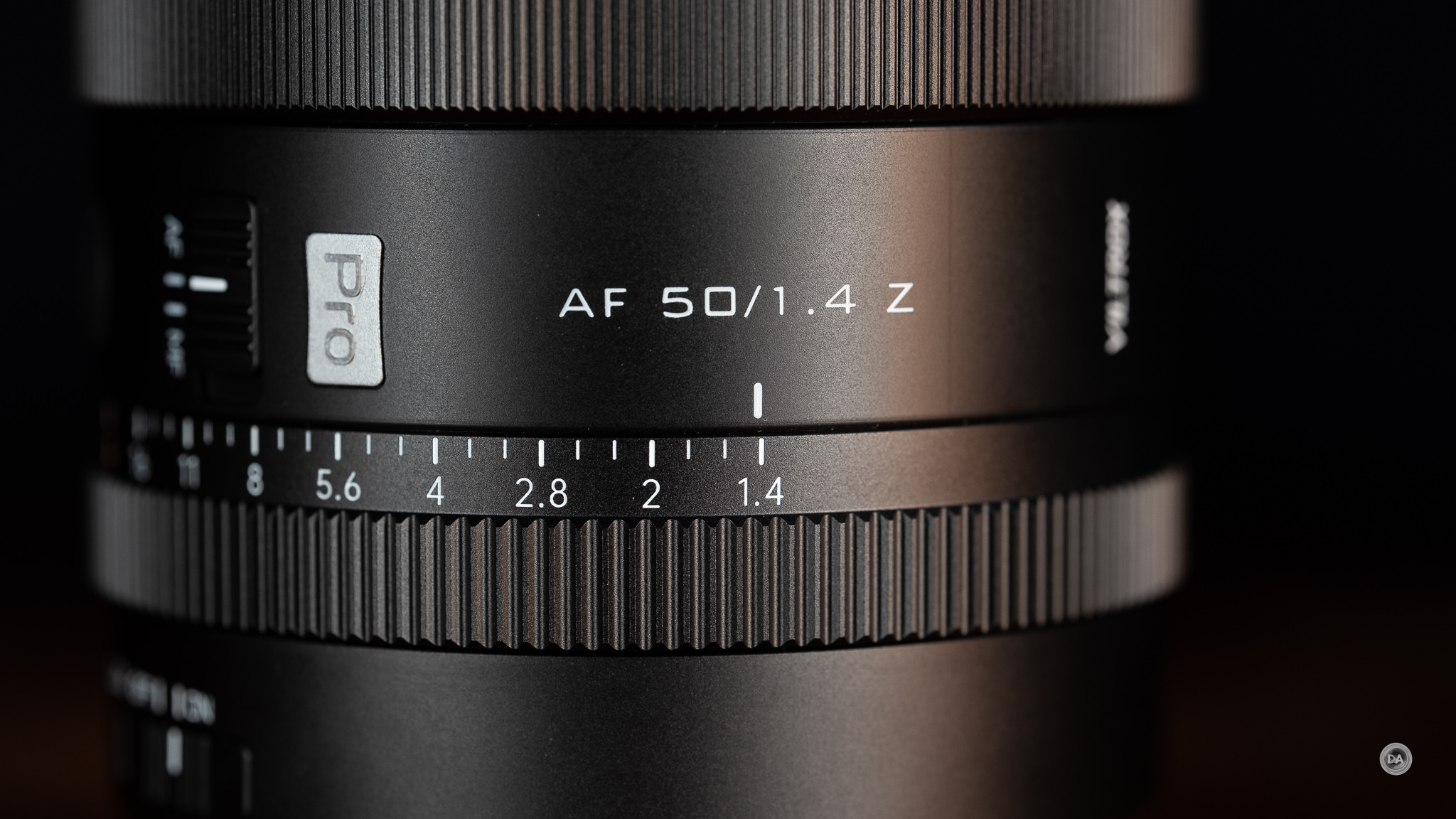
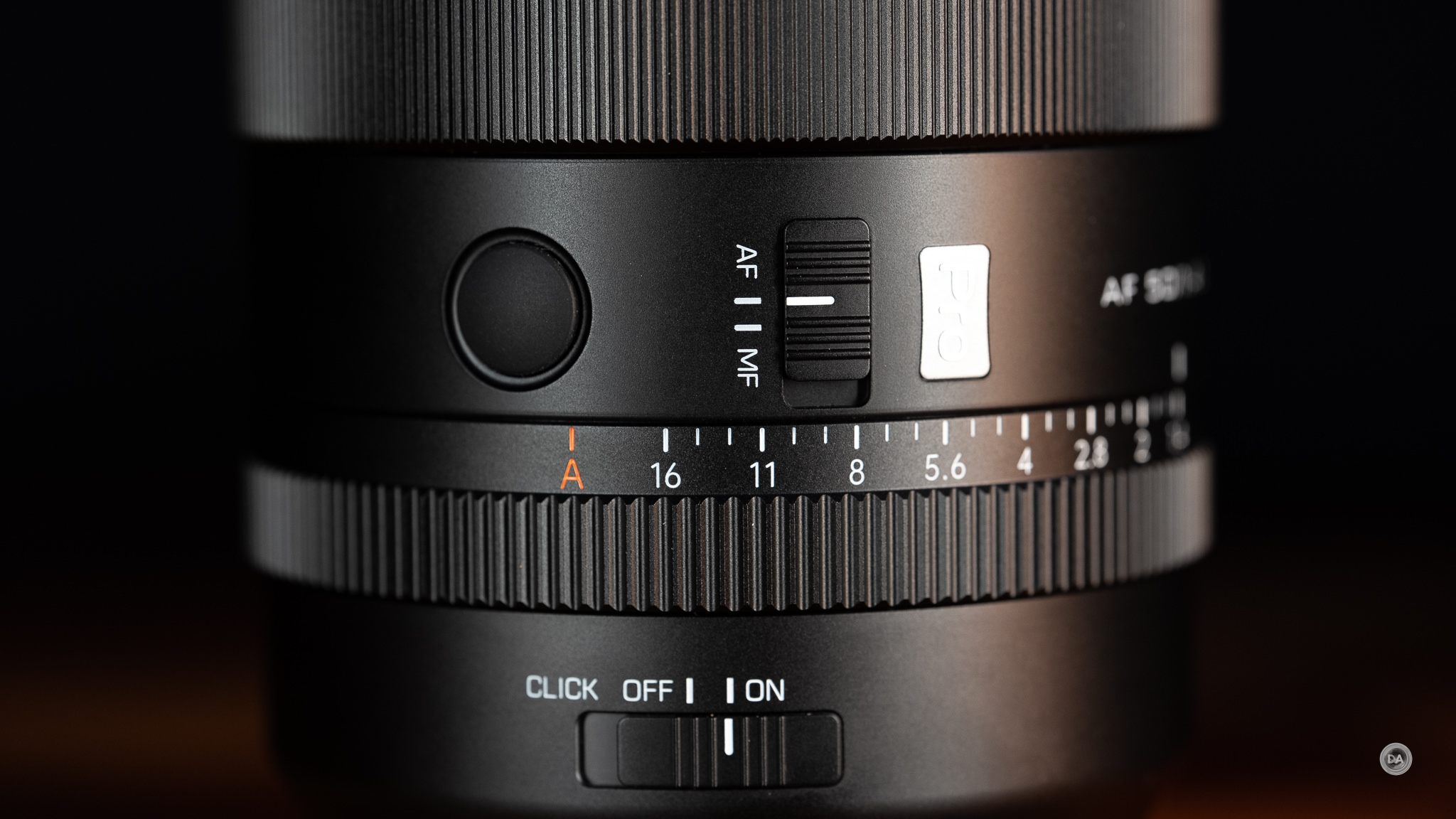
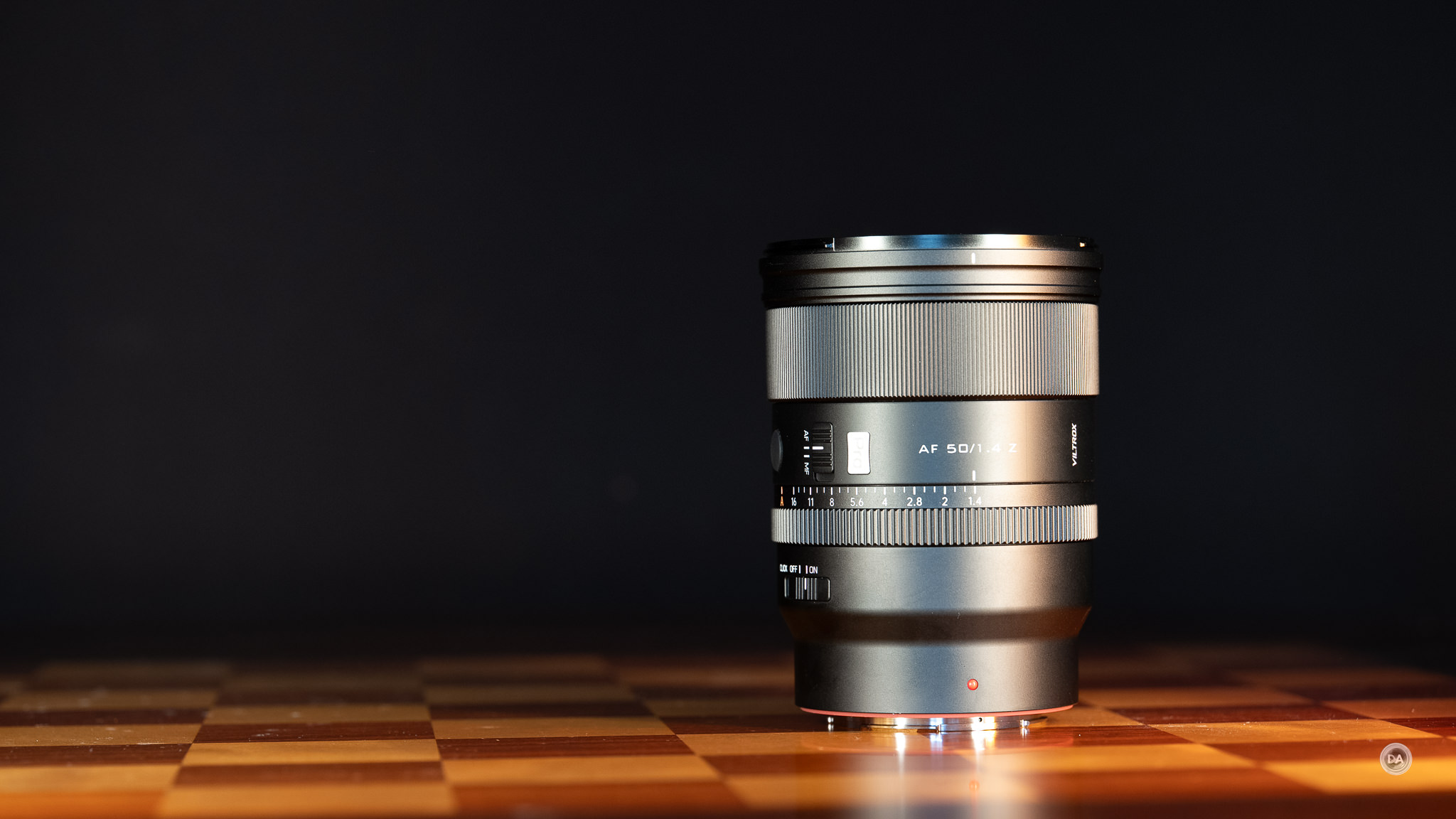
The aperture ring works perfectly here, with markings at the one third stop positions and light detents at those places if you have the “clicks” on. You also have a declick option where you can smoothly rack from F1.4 to F16. There is a firmer detent between F16 and the A (automatic) option which will allow aperture to be controlled from within the camera. The one aperture feature that is missing is an iris lock which would allow you to either lock into or out of the aperture ring.
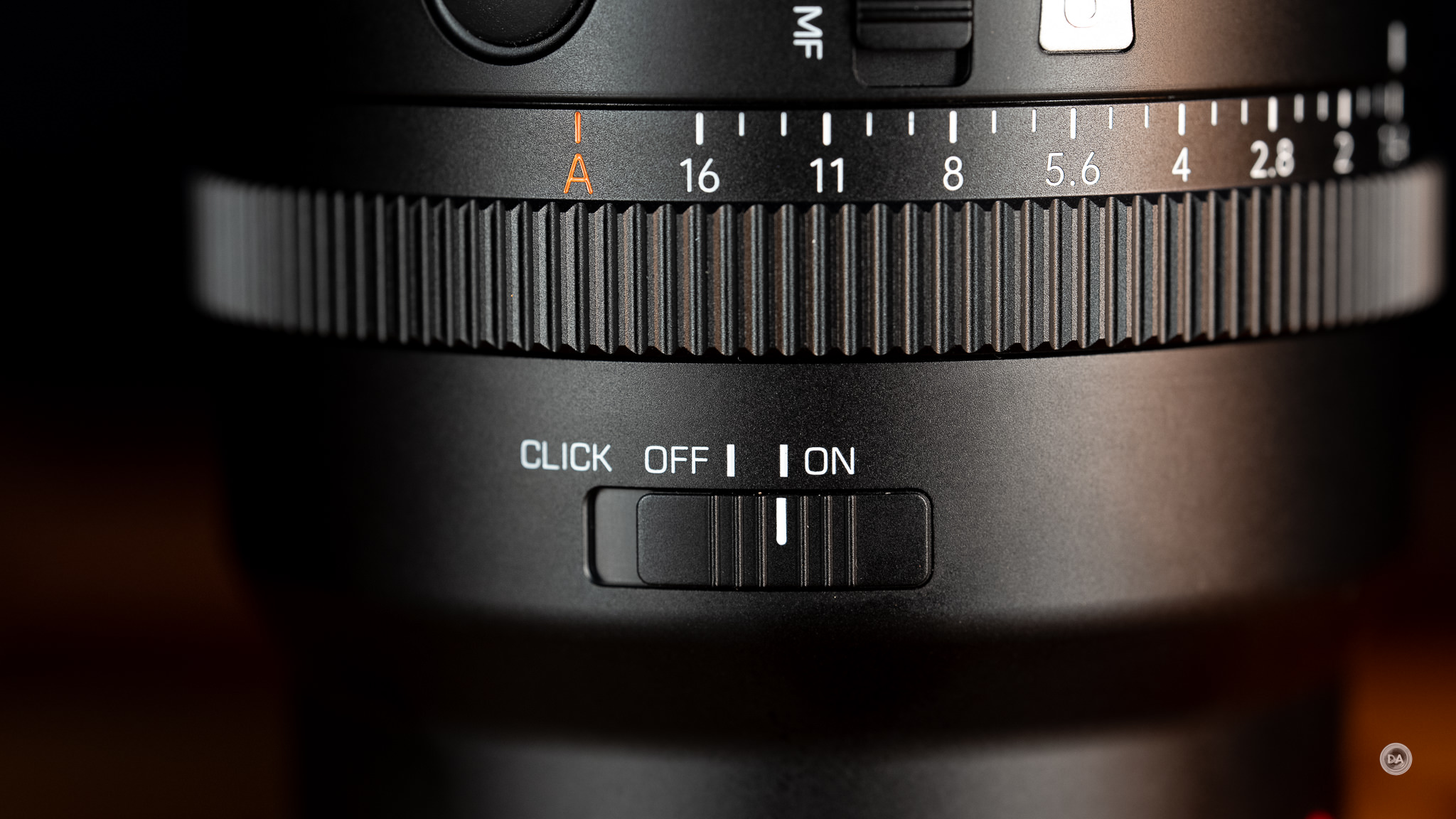
I was able to perform aperture racks in the declicked mode without visible steps.
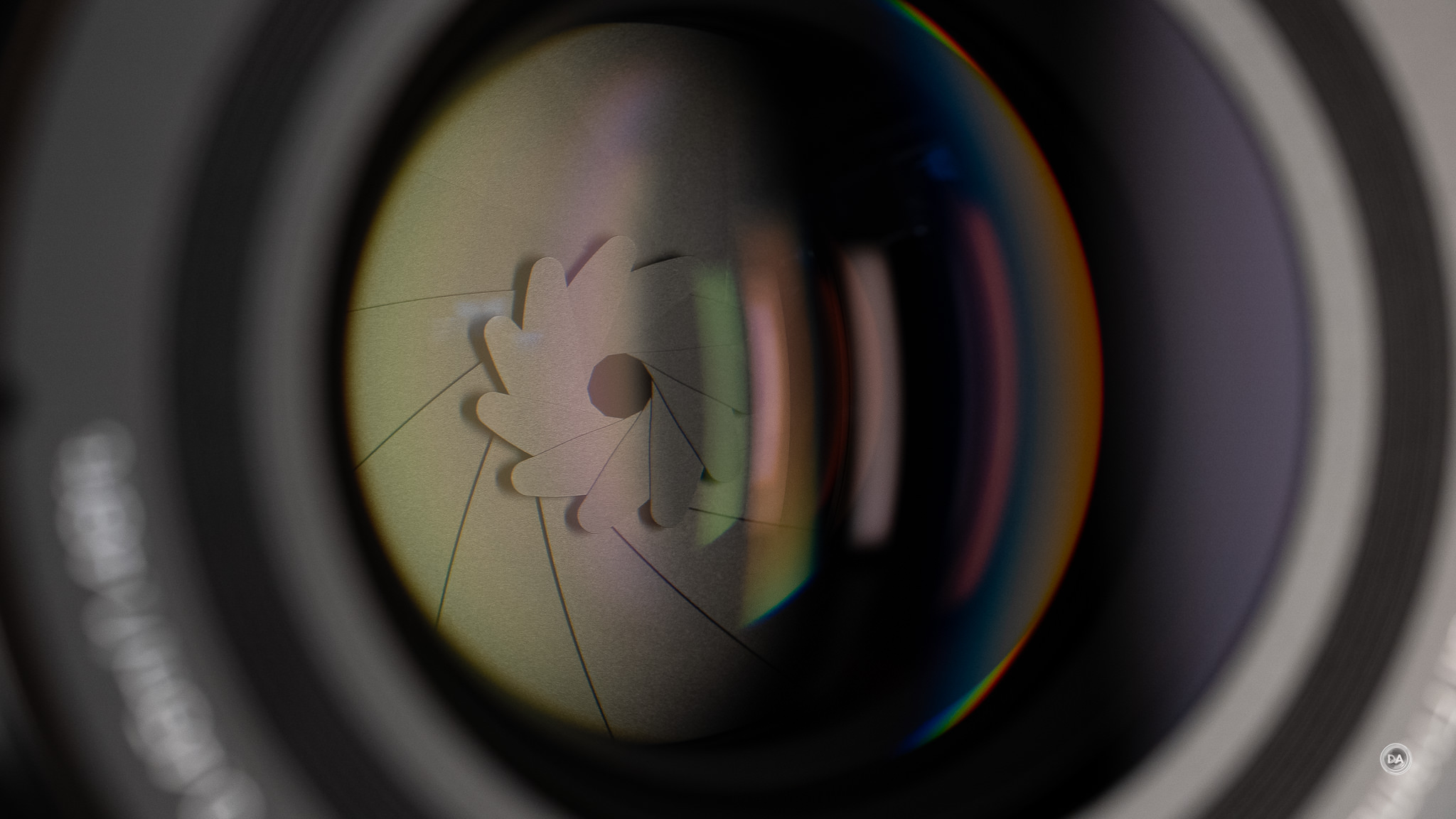
The iris itself has 11 aperture blades, and these make for a nicely rounded aperture even when stopped down a fair bit. Here’s F1.4, F2, and F2.8.



Here is the aperture iris itself, stopped down.
Other features include an AF | MF switch (always welcome) along with a custom or Function button whose value can be set from within the camera body.
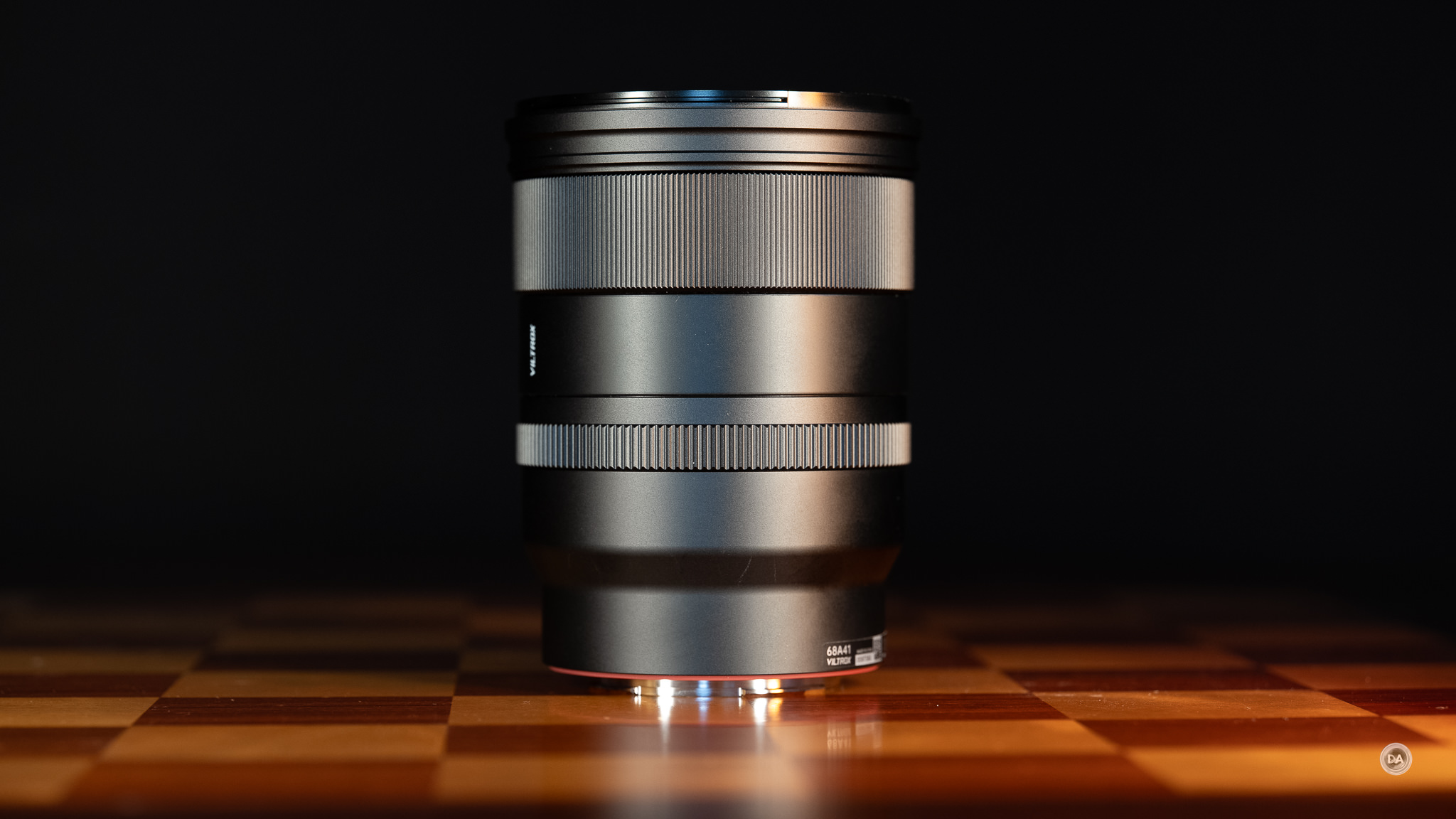
The Pro 50Z utilizes a 77mm front filter thread.

The body of the Pro 50Z is very robust, utilizing an aviation-grade magnesium-aluminum alloy blend. This is similar to the materials used in camera bodies and ensures that the lens will be tough and durable for years of use. It has a black anodized finish that looks classic and and elegant. The lens is understated but attractive, with no loud accent colors or attempts to demand your attention.
Like the 85mm, the Pro 50Z sports floating elements in its design. This has a very positive benefit that we’ll detail momentarily, but those unfamiliar with this design element may be thrown by the fact that something seems to move (and clunk) a bit inside the lens when you tip it up and down. Floating element groups do in fact move forward and backward when the lens is powered off, though as soon as the lens is powered on, those elements are energized and no longer move. You can then tip the lens up and down and nothing happens.
The primary reason for employing floating elements is that it allows the lens to function better at close focus distances. The Pro 50mm can focus as closely as 45cm but only produces an average 0.145x magnification.

This definitely falls short of the 0.17x of the Nikkor 50mm F1.4, though the Viltrox is sharper, has better contrast, and lower fringing at close focus distances.
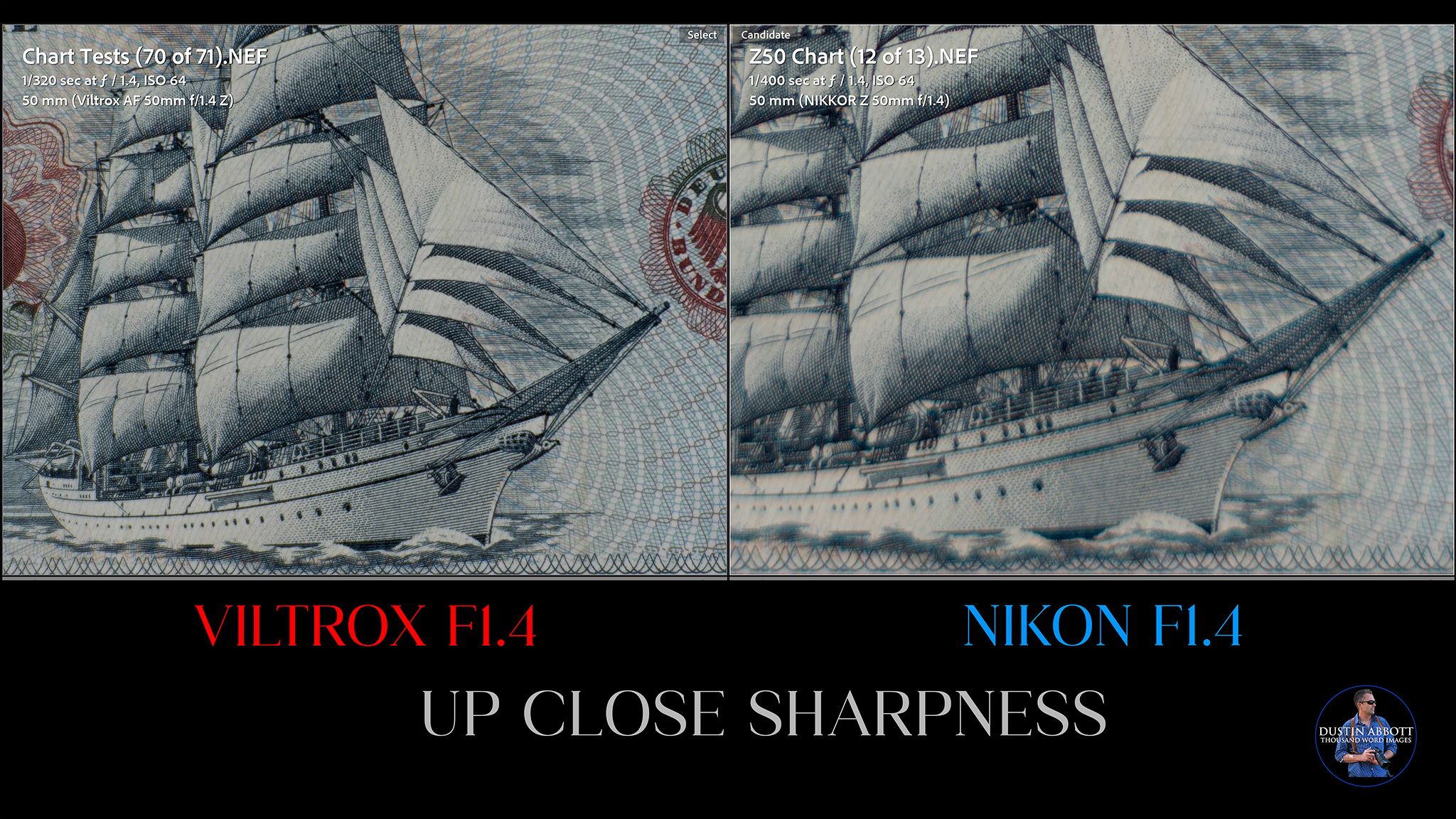
I suspect that most photographers would prefer the image on the left above, even the magnification level isn’t as high.
Real world close detail isn’t epically sharp but very good.

Part of the Pro design philosophy is the inclusion of thorough weather sealing. This includes a HD Nano coating on the front element that resists fingerprints and moisture.

There is also a bright red/orange gasket at the lens mount (which I think is very stylish), internal seals at the switches, rings, and near the front element. While I haven’t seen a diagram of the 50mm F1.4 Pro lens, here’s a look at the 85mm cutout. The 50mm should be similar.

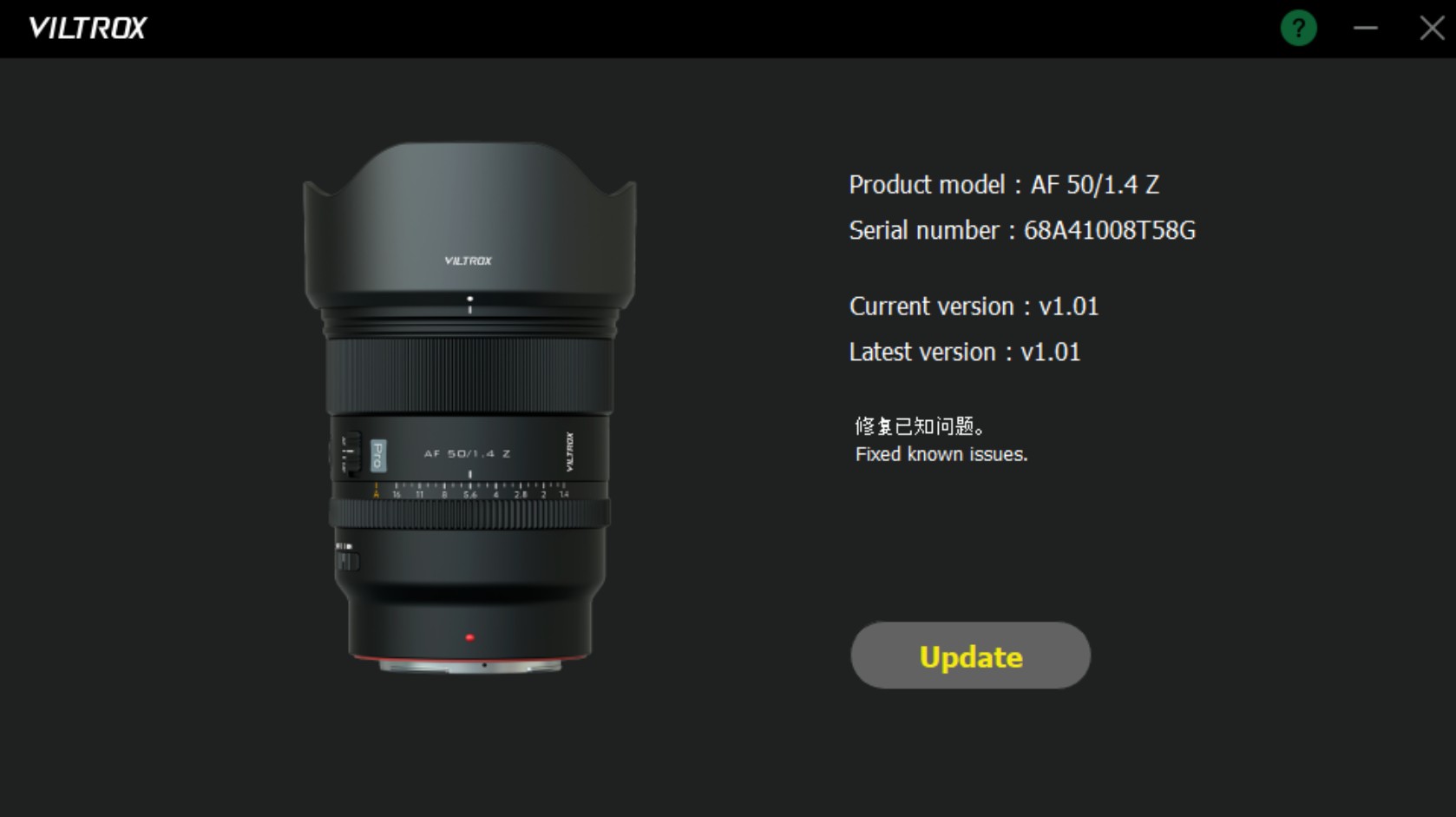
You’ll also have noticed the USB-C port, which allows for quick and simple firmware updates.
The manual focus ring is wide, very nicely damped, and provides a great manual focus experience, with good precision, no lag in the focus (as sometimes experienced on mirrorless lenses with their focus-by-wire systems), and a nice amount of focus throw.
There is no lens based stabilization, so you will need to rely upon the in-camera stabilization if your camera is so equipped.
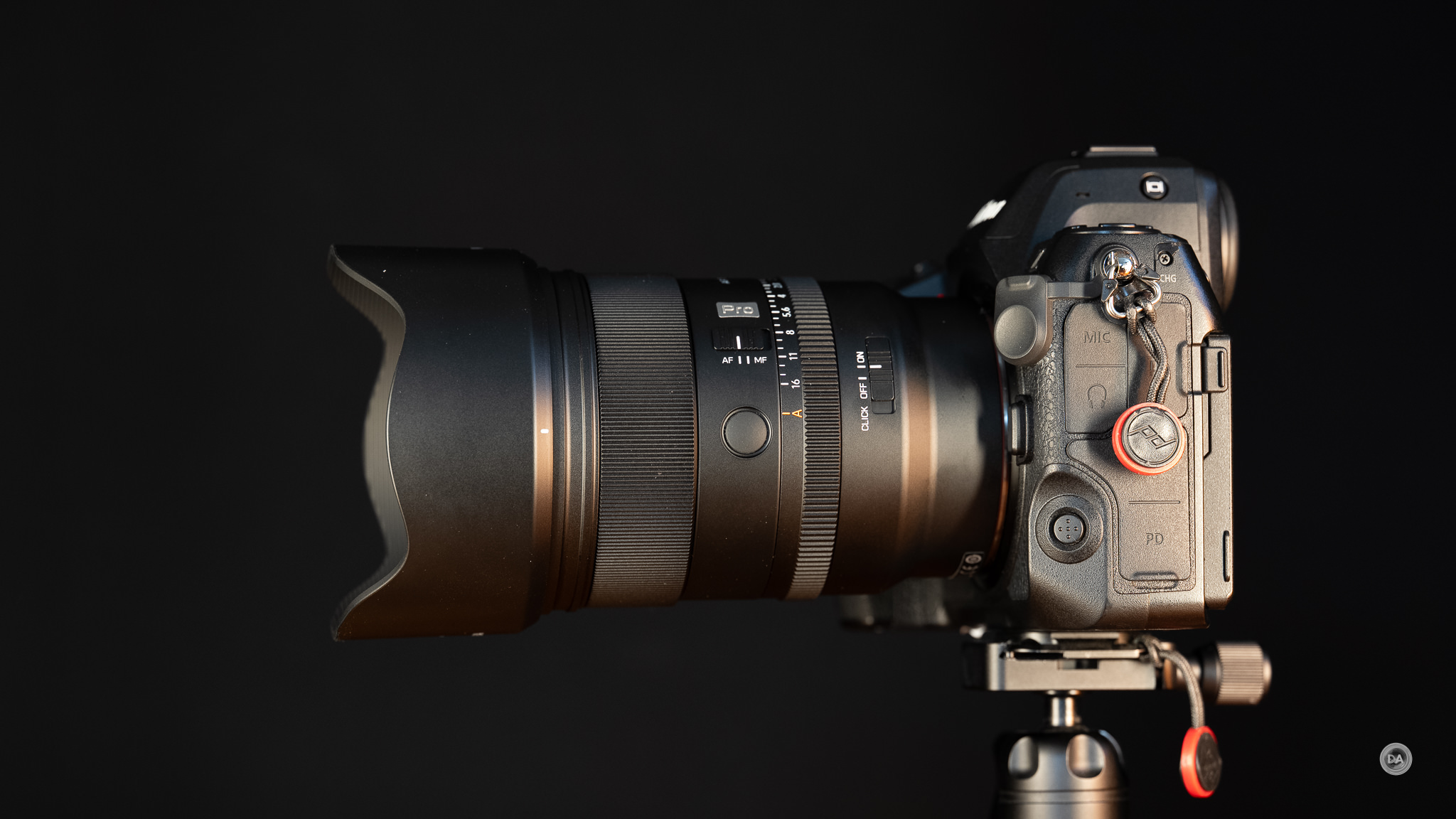
The lens also comes with the hood and a leather pouch (similar to Canon L-series lenses). There is some cushion on the bottom, but I don’t find these pouches nearly as useful as a good padded nylon case like what Sigma provides. The lens petal-shaped hood itself is fine, though it lacks either a lock or a really strong “click” into place, so it doesn’t latch quite as tightly as I would prefer.
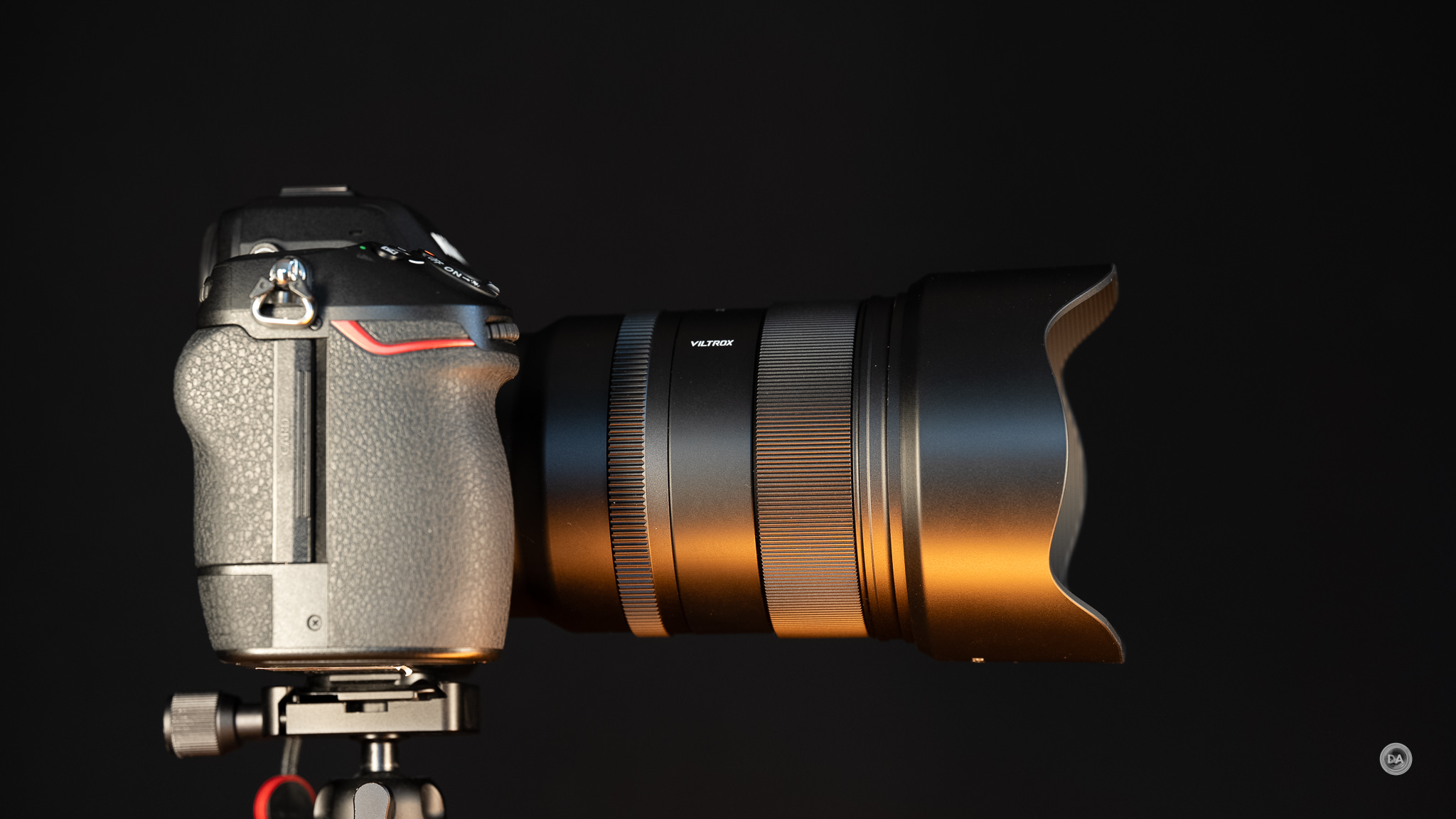
The Viltrox Pro AF 50mm F1.4 Z is a beautifully made lens with an excellent feature set, but it is significantly bigger and heavier than either the Nikkor Z 50mm F1.8 S or 50mm F1.4 lenses. That’s worthy of consideration, though I will say that these big Viltrox lenses feel more natural on the beefier Nikon bodies than they do on the smaller Sony bodies.
Autofocus for Stills
One of the improvements I’m most delighted about is the quality of focus for Viltrox lenses on Nikon Z-mount. It feels like they are gaining confidence in coding for the mounts and performance keeps getting better and better. Viltrox has now moved to higher end HyperVCM (voice-coil motor) focus in their premium lenses. Nikon has started to employ some VCM motors as well, as they are quick, smooth, and quiet. In some cases Viltrox utilizes multiple HyperVCM motors to give more thrust, but they seem to primarily be reserving those arrangements for the higher end LAB series. We’ve got a single HyperVCM focus motor here, which delivers smooth, quiet results with good but not exceptional speed.

In my formal focus tests I saw quick, confident moves from close to distant subjects, though not quite at the instant level that the fastest lenses focus at. It is very slightly faster than the Nikkor 50mm F1.4.
Focus is perfectly silent, without any accompanying noise or drama. I can put the lens right next to my ear and focus and not hear anything.
Focus for portraits was excellent, delivering perfectly focused results (and the lens delivers high detail even at F1.4.


I was able to accurately focus on narrow subjects without difficulty.

I didn’t have an opportunity to shoot sports or a high-speed subject, but I suspect that might be a bit more challenging for this lens based on past experience. Subjects moving side to side are typically fine, but fast action towards will often produce backfocused results.
I was able to shoot in a strongly backlit situation (window light was pouring through very directionally and intensely in this shot), but you can see from the crop that the result is perfectly focused.


I’ve felt like the last few Viltrox releases felt pretty much like native lenses on Z-mount, and that’s true here as well. It’s great to see Viltrox growing in confidence with their focus systems.
Video AF
One of the chief advantages of the move to VCM from STM is that VCM moves in a linear fashion as opposed the steps involved with an STM (stepping motor), which means that the likelihood of smooth focus transitions in video is higher. Such proves to be the case here, as focus transitions are mostly nice and smooth. When testing for video focus pulls using touch to focus, I got mixed results. Sometimes focus pulls were smooth and confident, but other times there’s a bit of pulsing and settling.
There is some minimal focus breathing, but it is fairly well controlled.
My hand test was much more confident, with smooth transitions from my hand to my eye. The low focus breathing helps those transitions to feel cinematic.

When approaching the camera, focus moved in a nice linear way towards me, and when I dropped out of frame and stepped back in, focus picked me up quickly. There were a few micropulses there that take me out of the shot a bit. There’s plenty of thrust for video autofocus, but it feels like the lens is a firmware update away from being perfectly stable in all situations.
I shot a few other clips, including one of Nala where I moved around a lot along with movement in and out. Focus was good other than it being fairly easy to dip within the minimum focus distance and not being able to get focus where you want.
All of my static outdoor clips using the lens for segments on my YouTube channel were nice and stable, so any pulses are related to focus changes.
Viltrox Pro AF 50mm F1.4 Z Image Quality
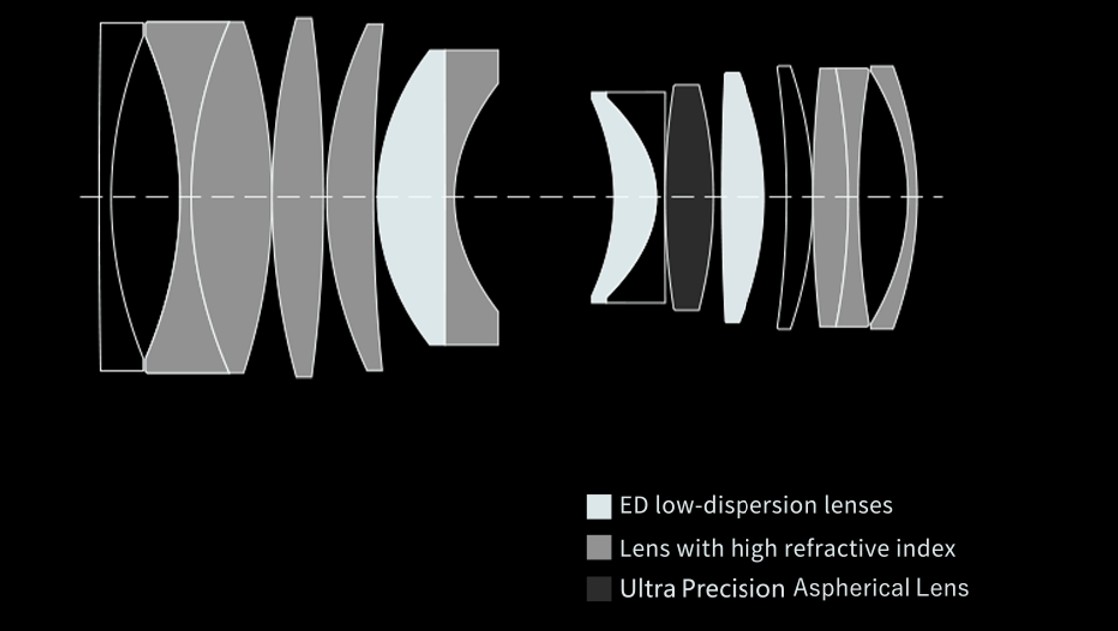
The Z-mount version of the lens has an identical optical design as the E-mount version, sporting an optical design of 15 elements in 11 groups. This includes 3 ED (extra low dispersion) elements, a whopping 8 HR (high refractive index) elements, and one UA (ultra-aspherical) lens. That latter is a new element for Viltrox that first popped up in 2025.. That leaves only three “normal” elements in the optical design.! The result MTF shows a strong center and midframe (all above 80%) and a mild dip in the corners at F1.4, with a little lower center sharpness at F8 but a remarkably consistent performance all across the frame. The sagittal axis at F8 is literally a straight line!
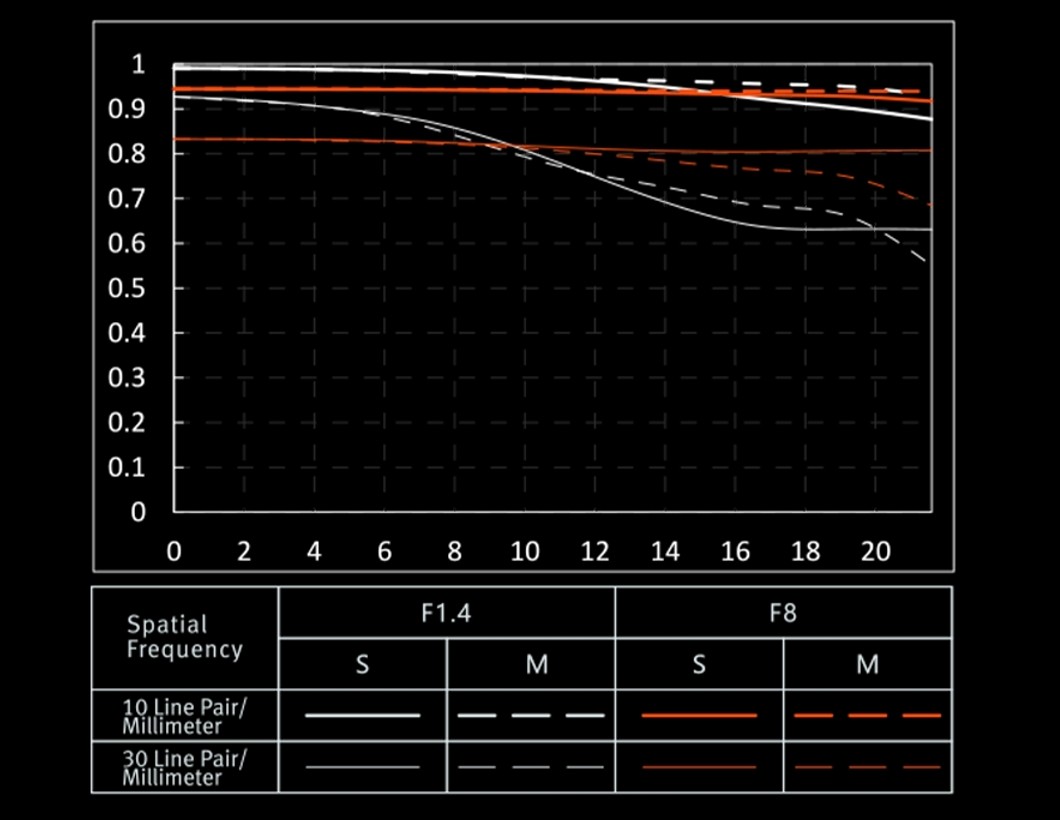
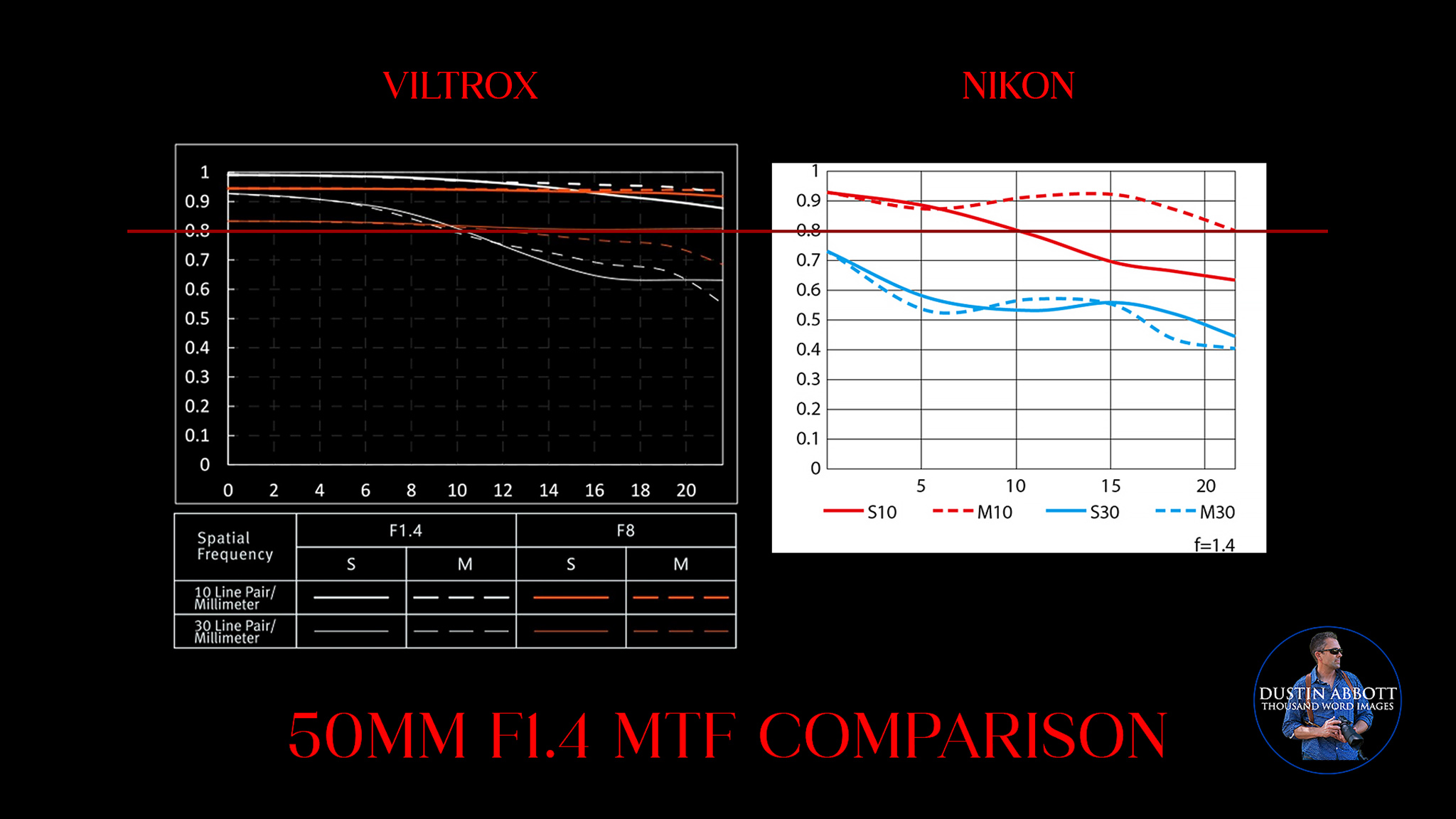
So, on paper, how does this compare to the Nikkor Z 50mm F1.4 ART? On paper, the Viltrox is definitely sharper across the frame at F1.4, with its weakest point in the corners being only slightly less sharp than the Nikon at its best in the center. In the center of the frame the Viltrox ranks about 20 points higher, and the midframe (10) is more like 25 points higher.
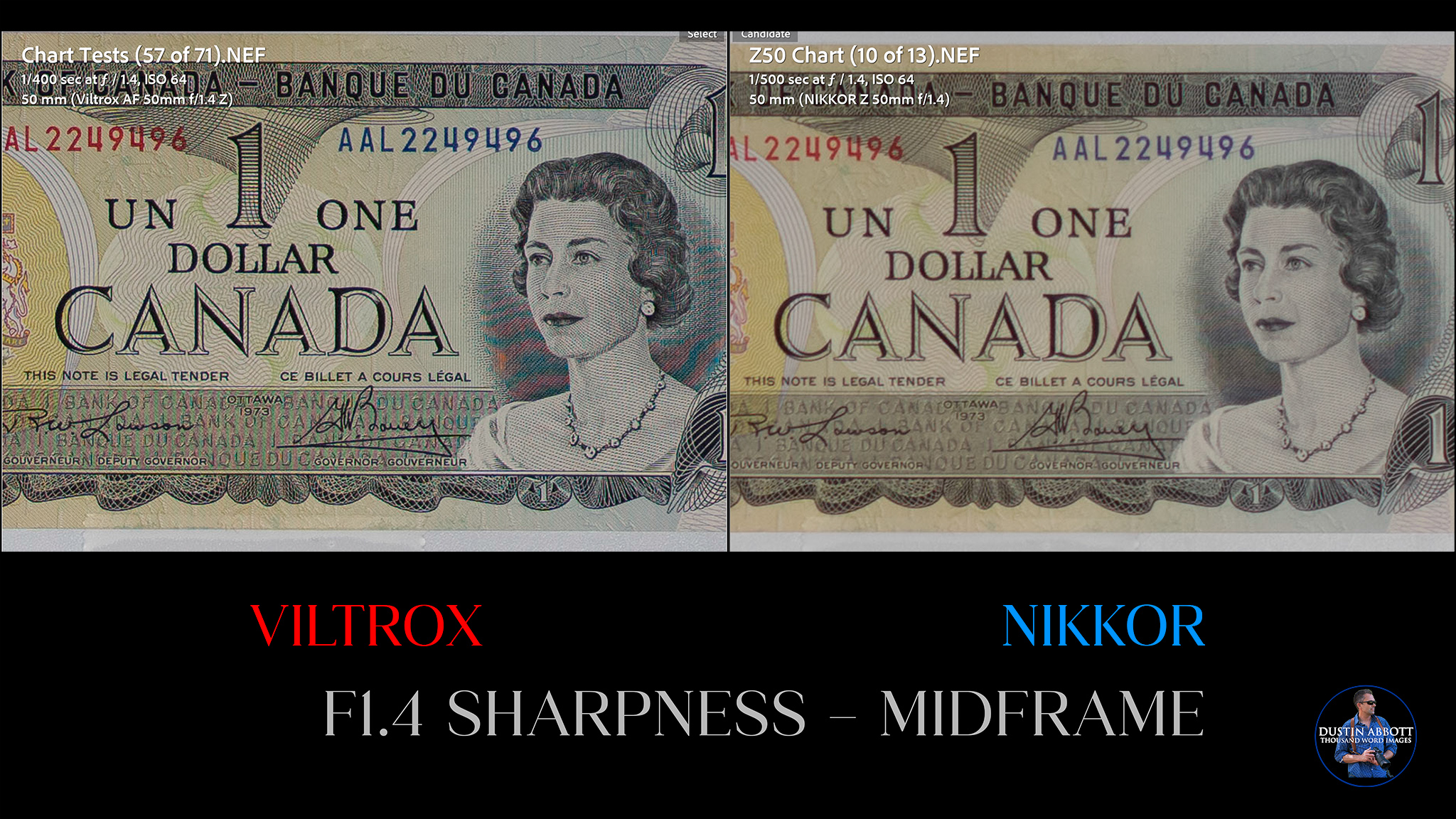
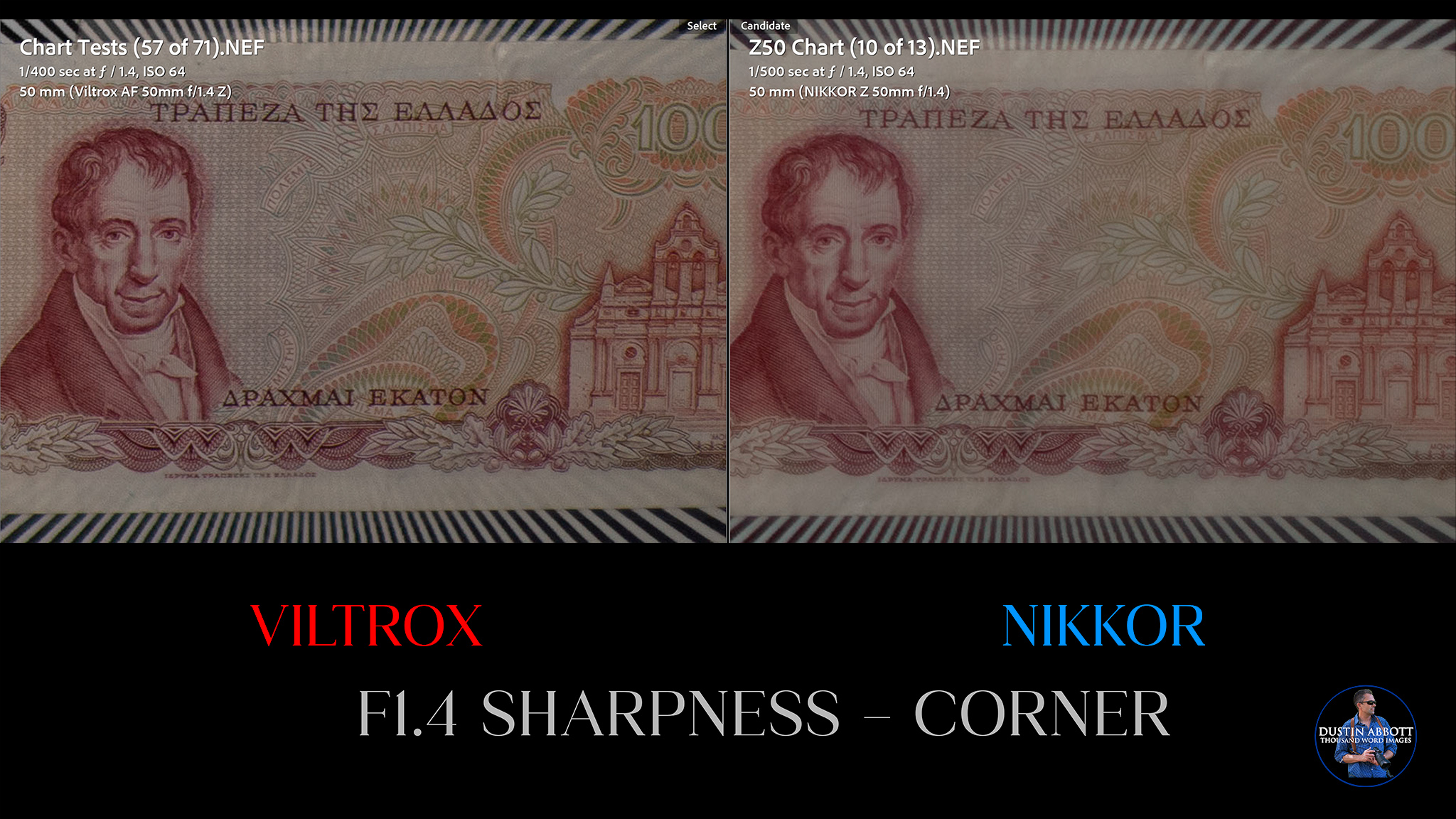
The “big and heavy” of the Viltrox pays off in terms of pure optical prowess. In my comparisons I found a clear advantage all across the frame when compared with the Nikkor, with the most obvious area being the midframe (image two).

As with the E-mount version, there is minimal distortion. There is the tiniest amount of barrel distortion (hardly worth correcting), and as usual, there is significant vignette.
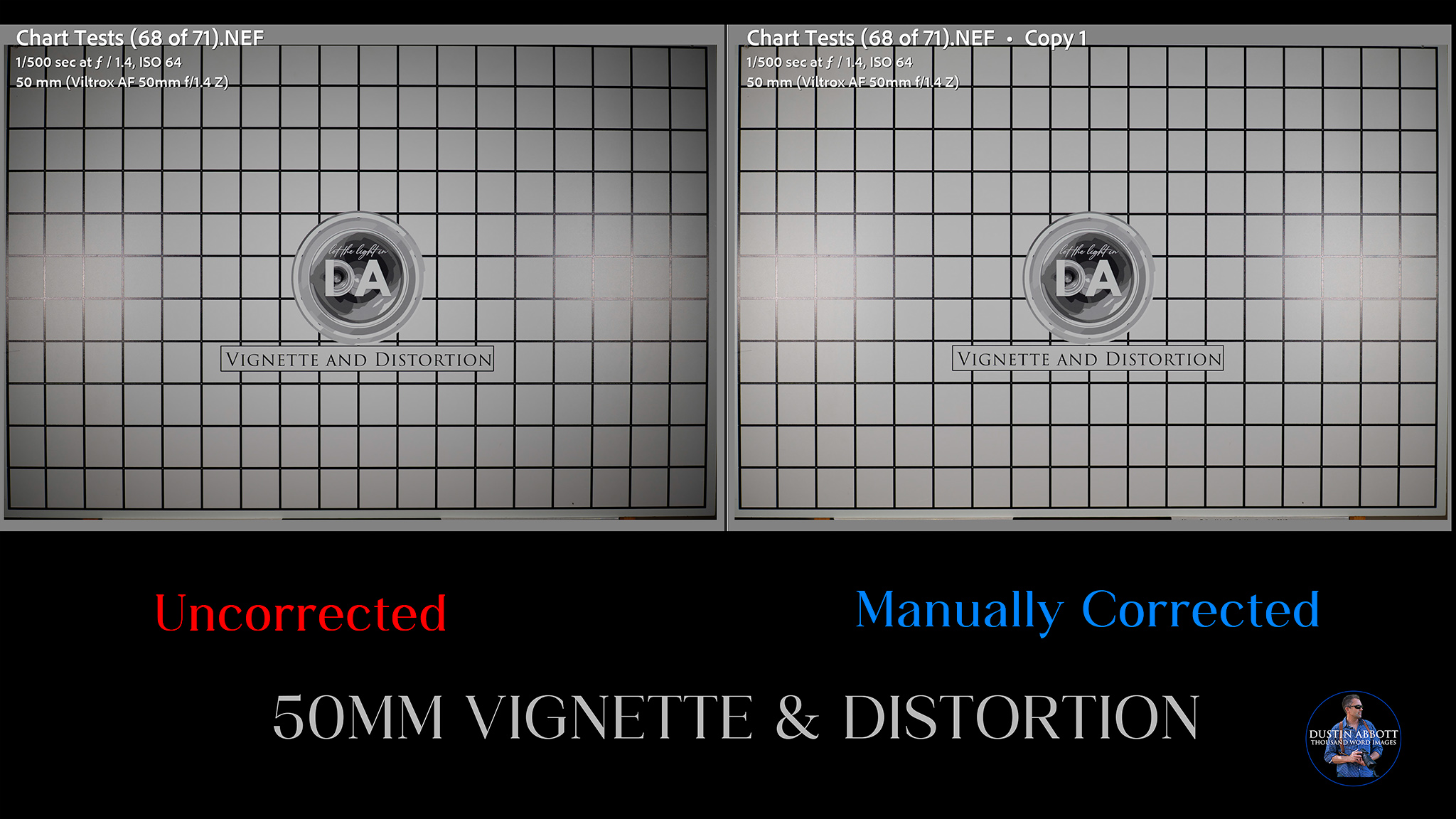
I used a +60 to correct the vignette, which is about the same as I saw on E-mount. I’ve been relieved by this, as earlier Viltrox lenses often had much higher vignette on Nikon.
The defining quality of this lens is that it provides a wonderful balance between sharpness and contrast on one hand, and then soft, creamy, visually pleasing rendering on the other.

This is the kind of lens that I’m happy to shoot at F1.4 all day, as the sharpness and contrast are good while the overall rendering is lovely.
I see very little fringing either on my test chart:

Or with my Dad’s old SLR. Everything looks very clean.

The difference in the amount of fringing is very noticeable when directly comparing to the Nikkor lens.
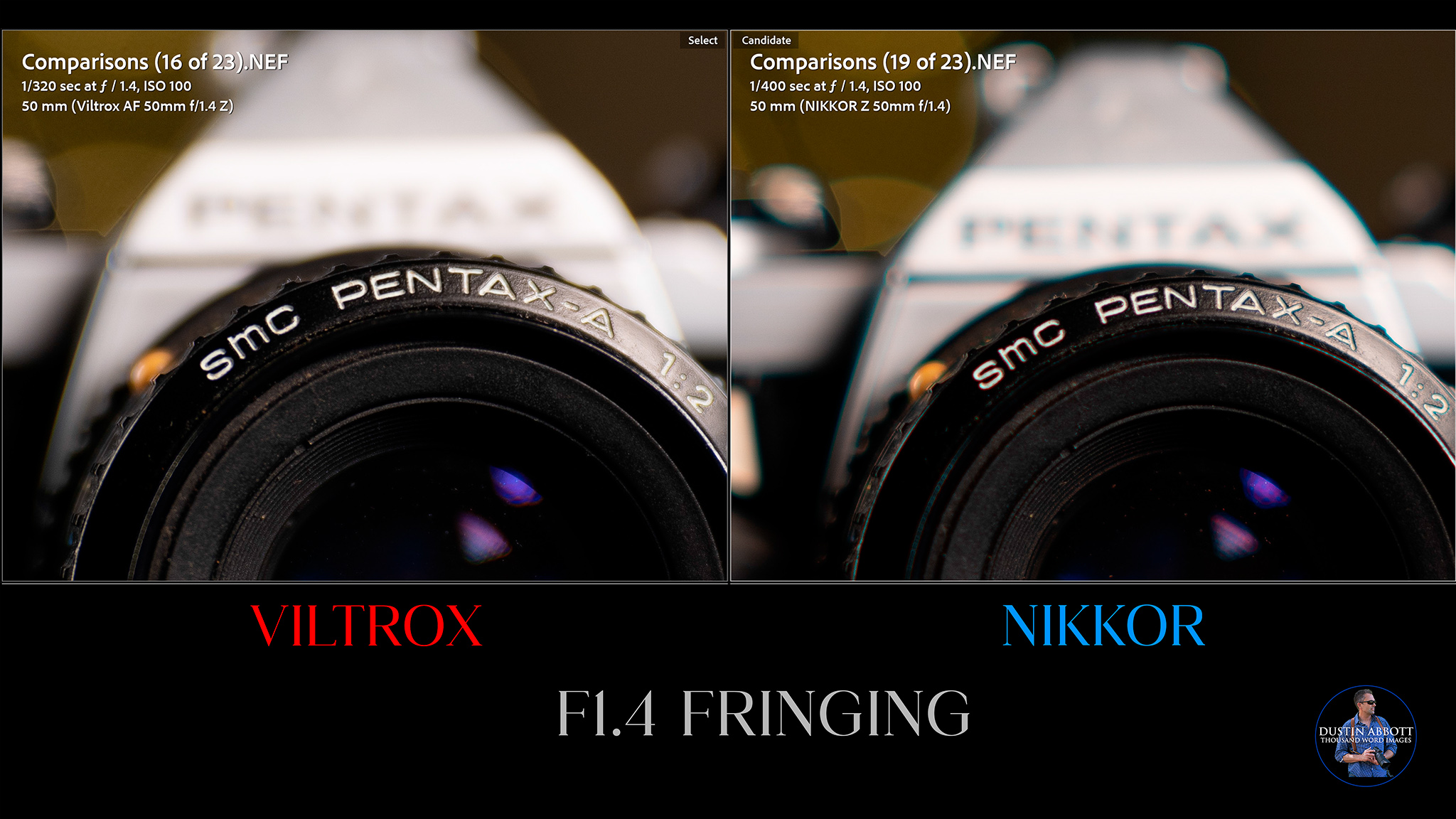
There are next to no lateral style chromatic aberrations (LaCA) found in the contrast transitions near the edge of the frame.

I saw no problems in real world results, however, with the edges of the frame looking nice and clean even at 100%:

Overall this is another Viltrox lens that takes care of almost all the necessary corrections optically (save the vignette).
So let’s return to focus on resolution. These results are shot on a 45MP Sony a7RV and the crops are shown at roughly 200% magnification level. Here’s a look at the test chart that the crops are taken from.

If we zoom in and look at the 200% crops from the center, mid-frame, and lower right, we discover that sharpness and contrast are excellent in the center and mid-frame, with a fade into the corners (though they are far from bad).



A tight crop from a portrait shot (courtesy of the E-mount review when things were greener!) shows a beautiful mix of sharpness and contrast on the subject’s face and a lovely degree of defocus beyond.

You can see great sharpness and draw distance even with this F1.4 landscape shot.
Bottom line is that there is plenty of sharpness on tap here for any and all applications.
By F2 the center sharpness is at epic levels.

On the lower resolution standard on Nikon, I find the corners looking pretty great even by F2.

At F2.8 and (even more by) F4, they look absolutely fantastic.

For landscapes, it is worth stopping down, as while the center holds up reasonably well at F1.4 when compared to F4:

…the corners are very obviously better at the smaller aperture.

I had the misfortunate of shooting in a less-colorful season with the Nikon version, but going back to the Sony version (early autumn), I was able to get some stunning landscapes.

Here’s another landscape result for you.

Diffraction is an unfortunate reality on higher resolution cameras, so you will see a faint softening by F11 and a more obvious softening by the minimum aperture of F16, though frankly results at 100% will still look fine. The lower resolution of my Nikon Z8 (45MP) vs the the higher of the Sony (61MP) means that diffraction is a little less obvious on Nikon.

But, as mentioned previously, the magic here is that the Viltrox Pro AF 50mm F1.4 Z is both well corrected and still has extremely nice rendering. I like the classic rendering from the Nikkor, but I’m not sure it has anything in the rendering department that the Viltrox doesn’t have, but the Viltrox provides much more in terms of sharpness and contrast.

The rendering between the two lenses looks pretty similar.
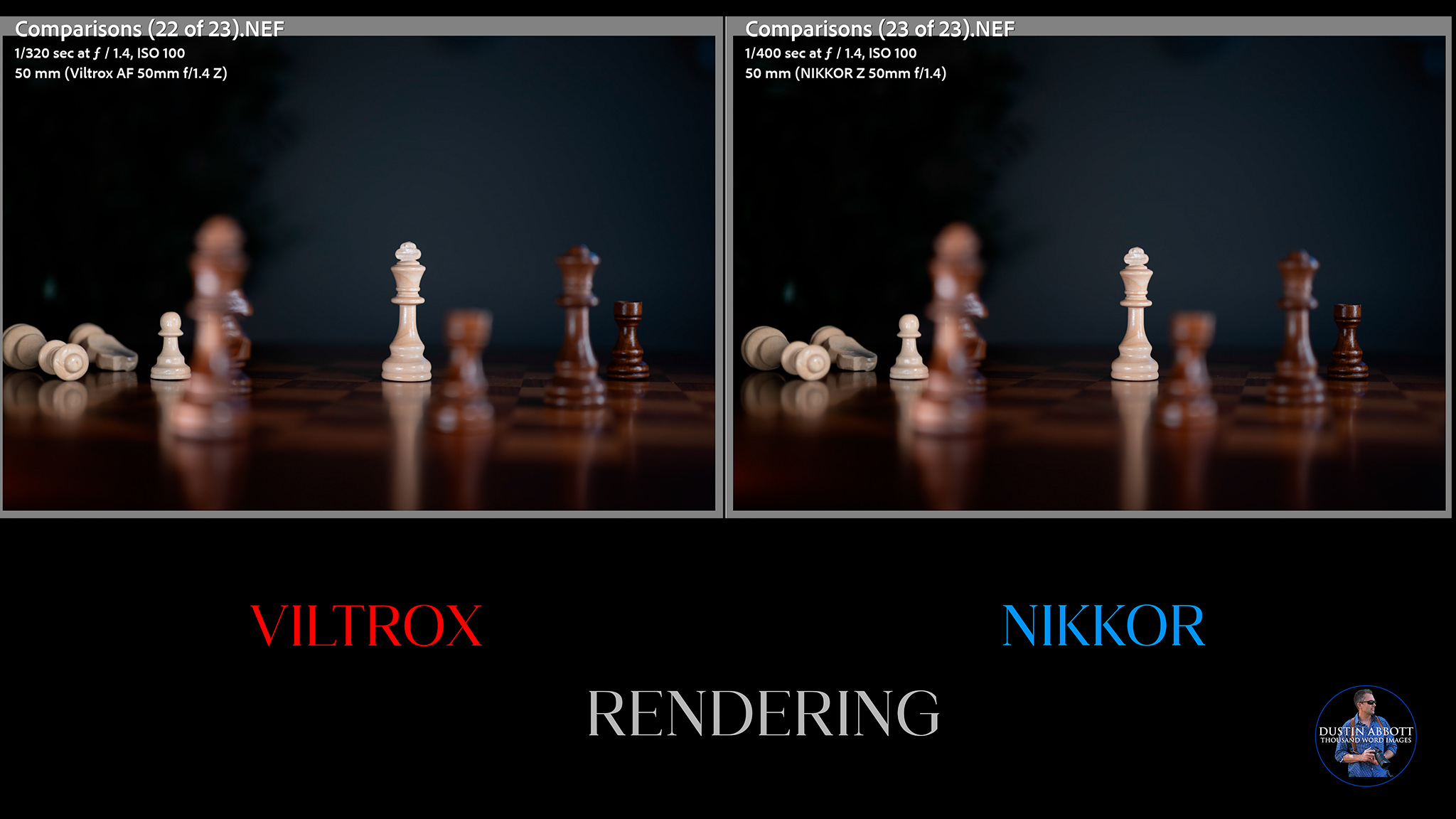
One area where I do give the Nikkor lens a slight edge, however, is in light transmission. I noticed in all my test shots the Nikkor metered about one-third stop brighter.
In other areas, however, I prefer the Viltrox. Here’s a look at why:
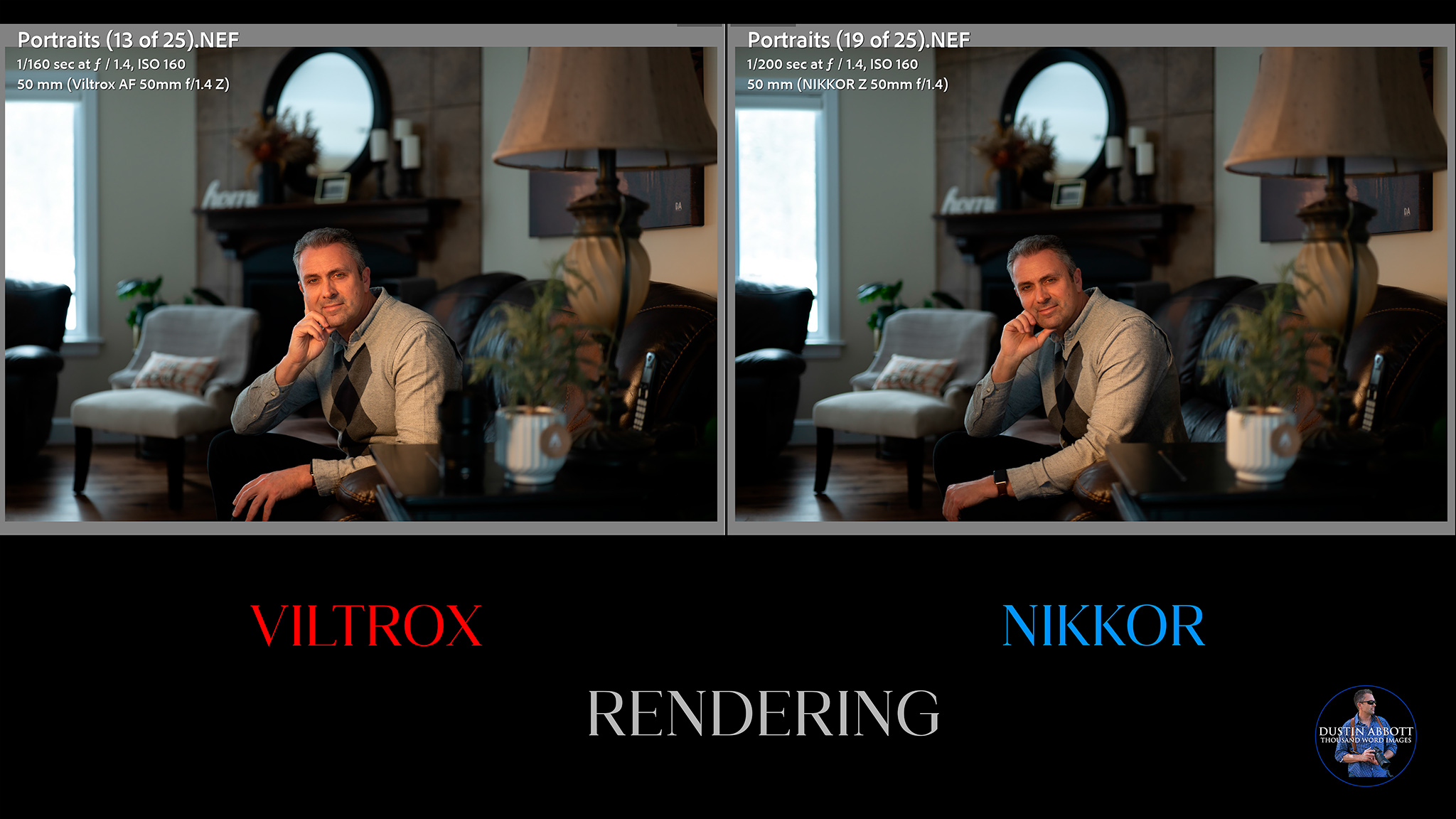
At first glance, they look pretty similar.
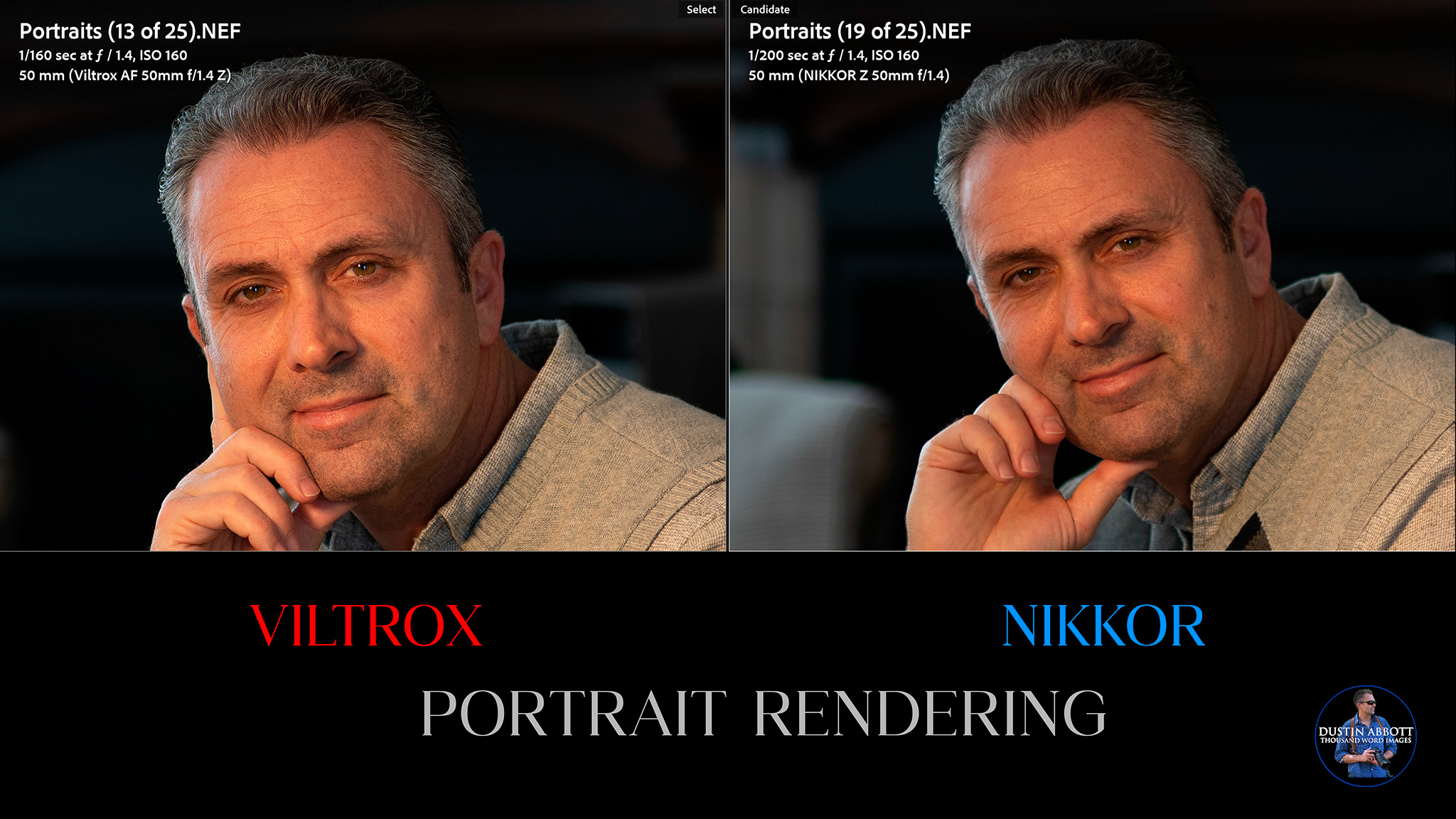
Take a closer look, however, and you can see how dull the textures look on my face in the portrait comparison. The better contrast allows the face to light up, the eyes to sparkle, and there is more texture information in both the hair and beard. You can selectively softer some areas if you want, but I always prefer more pop in those details.
But not only is the Viltrox sharper, it is softer, too.
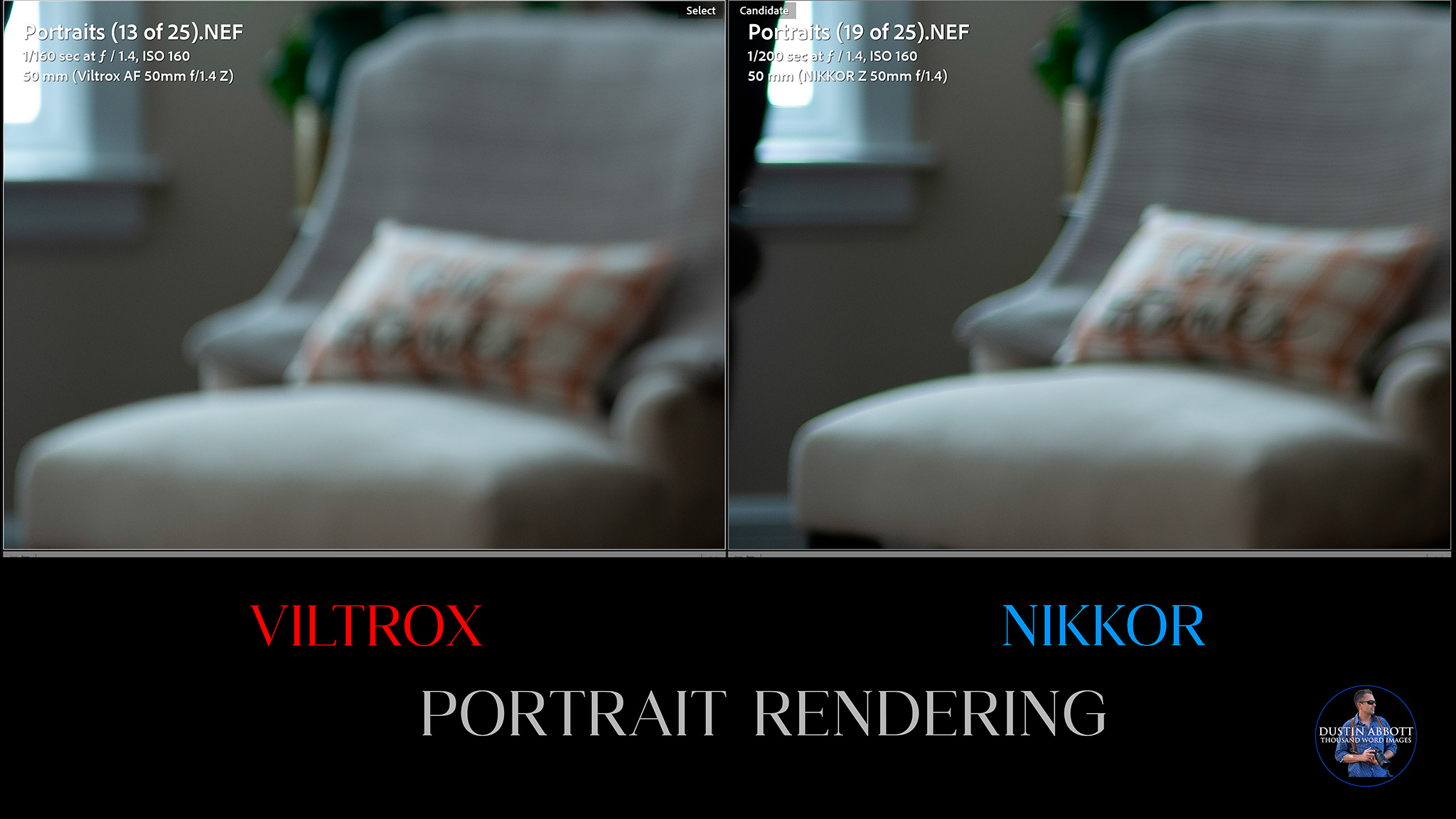
Notice how much softer the “Give Thanks” pillow is. There’s also some issues with green fringing on the Nikkor image in the contrast transitions.
There’s no question the Viltrox is giving a more sophisticated (and premium) optical performance.
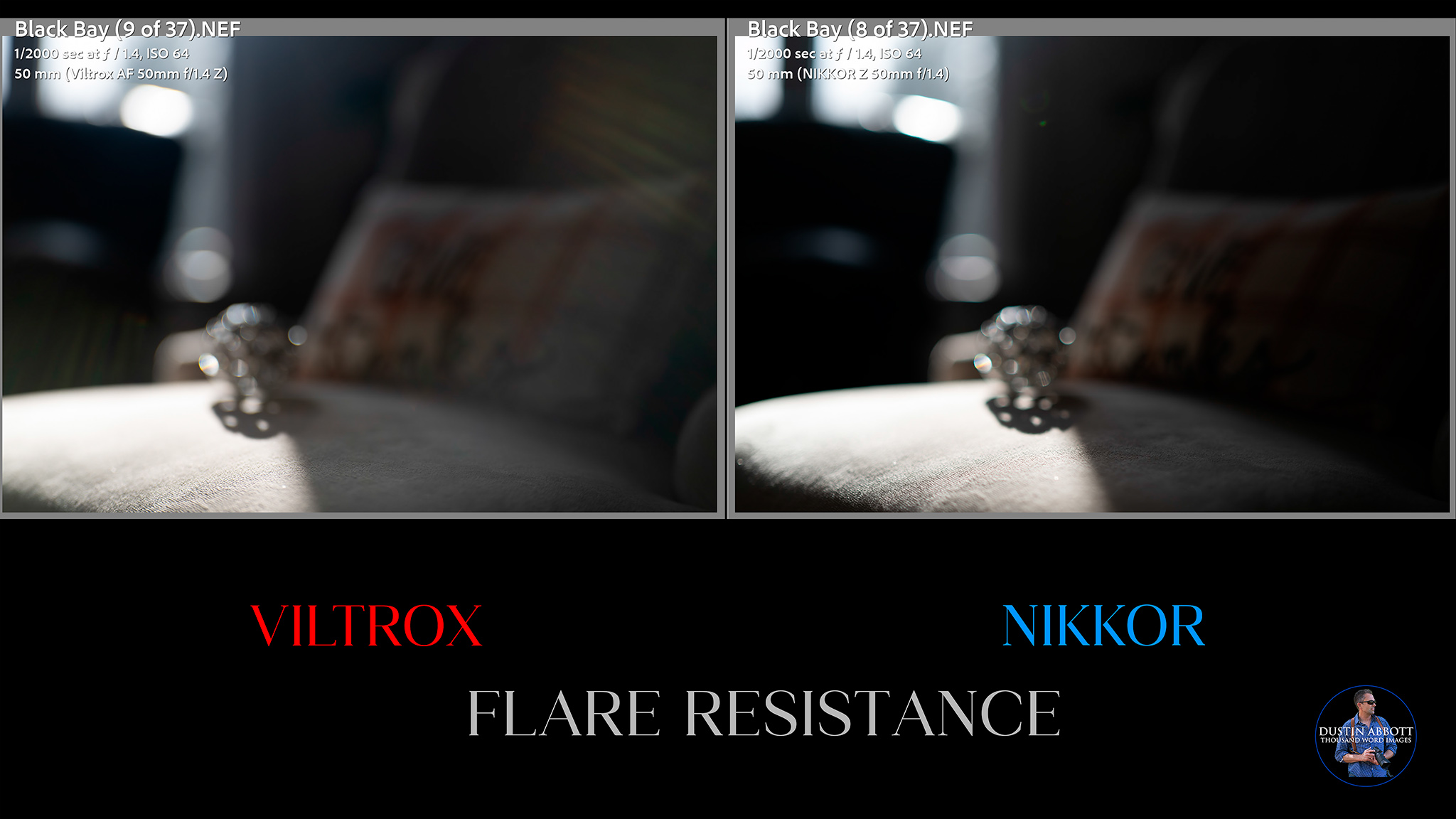
Flare resistance is also pretty decent…in most situations. This is the one test where the Nikkor took a win, as in this setup with bright window light, the Nikkor stays neutral, while the Viltrox shows some flare artifacts.
I do find that particular kind of flare effect stylish in some situations. I took this image with the E-mount version, and I quite love the flare effect in this “straight-out-of-camera” image.

In general, though, for a fast 50mm prime, I felt like flare resistance was pretty decent.



You can see from the last shot that you can get a decent 22-bladed sunstar effect at smaller apertures.
I really love the bokeh from this lens, and feel like it handles even busier situations very nicely.

The bottom line is that the Viltrox Pro AF 50mm F1.4 Z is a optically ready to go head-to-head with the very best lenses on the platform. It feels like a great match for my full frame Nikon body, and I’m delighted it is now available.
Enjoy the images in the mini-gallery here.



















Conclusion
I liked the Viltrox Pro AF 50mm F1.4 on Sony, but I already own the excellent Sony FE 50mm F1.4 G Master there. On Nikon, however, the Z-mount version is a clear upgrade over the Nikkor Z 50mm F1.4 that I own, so I’ll probably move the Nikkor and invest in another Nikon lens instead. I really loved the lens on my Z8, finding the performance and optics a great fit for the Nikon sensor.

Like the 85mm F1.4 Pro, the biggest shortcoming for the Viltrox Pro AF 50mm F1.4 Z is its weight, though that feels like less of an issue on Nikon for a couple of reasons. First of all is that the Nikon bodies tend to be beefier (my Z8 is bigger than any of my other cameras from Sony, Canon, or Fujifilm), making bigger lenses a more natural fit. I feel like Viltrox is starting to really get a handle on Nikon autofocus as well, making the lenses work better (and faster) than before, where it felt like they needed 2-3 firmware updates before they really started focusing well.

I find the sharpness at 45MP to be nearly perfect, and feel like this resolution is a really good fit for the lens. Just look at the crop from the image below. at F1.4!


Getting that kind of performance
Pros:
- Beautiful built lens
- Feature rich
- Very good weather sealing
- USB port for firmware updates
- Clean and elegant design
- VCM motor delivers fast, quiet, and accurate autofocus
- Focus pulls are nicely damped
- Comparatively low focus breathing.
- Exceptionally sharp lens that competes with the very best in the center and mid-frame
- Extremely sharp across the frame by F2.8
- Little distortion
- Vignette isn’t bad
- Colors look great
- Gorgeous bokeh
- Amazing price to performance ratio
Cons:
- Some minor issues with fringing
- Some might be put off from the “clunk” of the floating elements
- Can be a bit flare prone in certain situations
_________________________________________________________________________
GEAR USED:
Purchase the Viltrox Pro AF 50mm F1.4 @ Viltrox (use code “DUSTINABBOTT” for 5% off) | B&H Photo | Adorama | Amazon | Amazon Canada | Amazon UK | Amazon Germany
_________________________________________________________________________
Purchase the Nikon Z8 @ B&H Photo | Adorama | Amazon | Camera Canada | Amazon Canada | Amazon UK | Amazon Germany
_________________________________________________________________
Want to support this channel? Use these affiliate links to shop at: B&H Photo | Amazon | Adorama | Camera Canada | Amazon Canada | Amazon UK | Ebay | Make a donation via Paypal
Buy DA Merchandise https://bit.ly/TWIMerch

Keywords: Viltrox AF 50mm F1.4 Pro Z, Viltrox AF, Pro, Viltrox Pro, #PRO, #PRO50, #PRO50Z #explorebeyond, Viltrox 50mm, Normal, Full Frame, F1.4, f/1.4, VCM, HyperVCM, Viltrox Pro 50mm F1.4 Z, Viltrox PRO 50mm Review, Viltrox AF 50mm F1.4 Z Review, Nikon Z8, Z5II, Z6III, ZF, Review, Hands On, Dustin Abbott, Real World, Comparison, Sharpness, Bokeh, Flare Resistance, Autofocus, Image Quality, Sample Images, Video, Photography, let the light in, weathersealing, #letthelightin, DA
Related posts:
 Viltrox Pro AF 85mm F1.4 Z-mount Review
 Viltrox Pro AF 50mm F1.4 FE Review
 Viltrox AF 85mm F1.4 PRO FE Review
 Viltrox Pro AF 85mm F1.4 FE Gallery
 Viltrox AF 135mm F1.8 LAB Z Review
 Viltrox AF 28mm F4.5 VCM “Chip” Review
 Viltrox LAB 135mm F1.8 VCM Review
 Viltrox LAB vs Samyang AF – 135mm Battle!
 Viltrox AF 28mm F4.5 “Chip” X-mount Review
 Viltrox AF 135mm F1.8 LAB Z-mount Gallery