

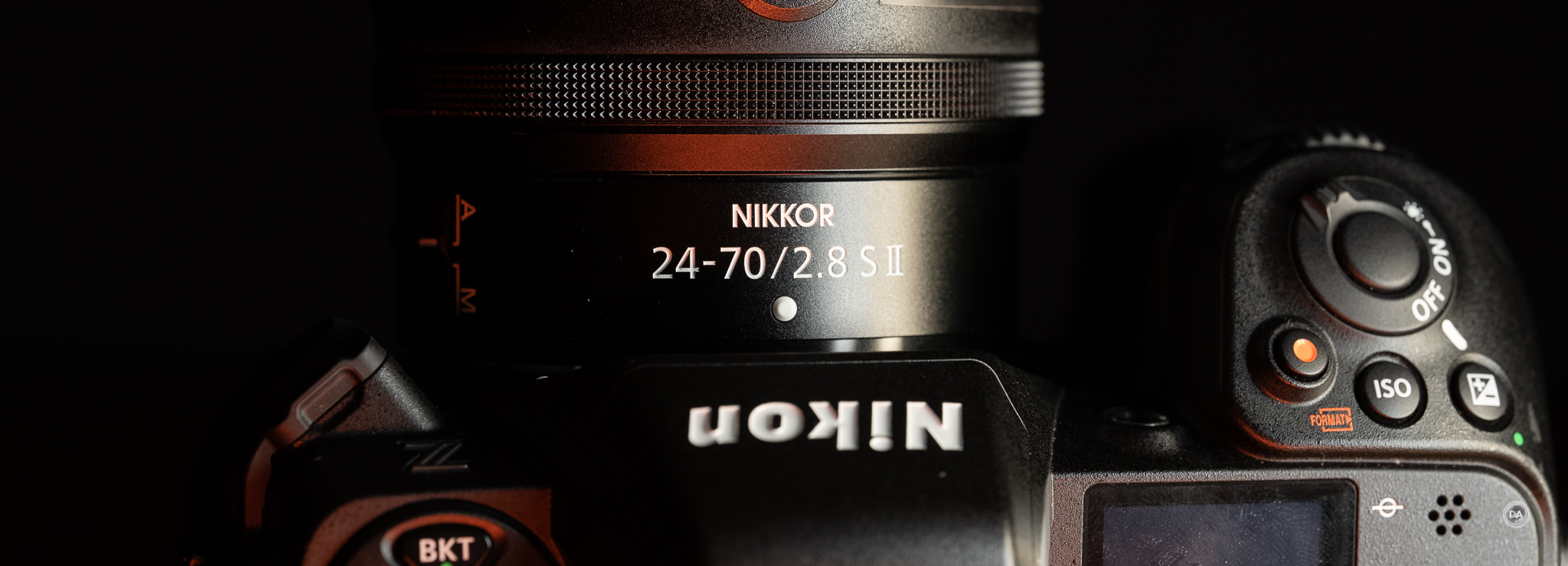
It is rare that we see true innovation in camera lenses, but the Nikkor Z 24-70mm F2.8 S II is more than just a second generation professional standard zoom for Nikon Z-mount cameras, but is instead a significant departure from previous designs. This is the first internally zooming 24-70mm F2.8 lens, the first Nikkor Z lens to have an option to declick the aperture, and the first to pioneer a new focus system, which they call SSVCM, and also manages to be one of the lightest 24-70mm F2.8 lenses we’ve ever seen. In pretty common fashion for Nikkor’s premium S-line lenses, however, it is also very expensive, with an MSRP of roughly $2800 USD or $3500 here in Canada. Are the innovations worth it? We’ll explore all those details in either the video review below or in this text review.
Follow Me @ YouTube | Patreon | Instagram | Facebook | DA Merchandise | Flickr | 500px | X
__________________________________________________________________________________________________
Thanks to Chris at Nikon Canada for sending me a review loaner of this lens. As always, this is a completely independent review. All opinions and conclusions are my own. *The tests and most of the photos that I share as a part of my review cycle have been done with the 45MP Nikon Z8, which I reviewed here. You can find the product listing page for the Nikkor Z 24-70mm F2.8 S II here.
__________________________________________________________________________________________________
__________________________________________________________________________________________________
AI Summary: The Nikkor Z 24-70mm F2.8 S II represents a bold redesign of Nikon’s professional standard zoom, introducing the first internal-zoom mechanism in its class, a declickable control ring, and the new Silky Swift VCM (SSVCM) multi-focus system while achieving a remarkable 16% weight reduction to just 675g. Build quality is robust with enhanced weather sealing and improved close-focus capabilities (up to 0.32x magnification), paired with exceptional autofocus performance that is fast, silent, and smooth for both stills and video, with minimal breathing. Optically, the lens delivers prime-like sharpness across the zoom range, excellent aberration control, linear distortion that’s easily correctable, and outstanding flare resistance thanks to advanced coatings. While the high price and lack of in-lens VR are notable drawbacks, the innovations make it a top-tier option for professional wedding, portrait, and event photographers.
Strengths:
- Genuine innovation with internal zoom, declickable control ring, and SSVCM autofocus system, markedly improving video usability and performance over the predecessor.
- Extremely sharp across the frame at f/2.8 with strong contrast, low aberrations, and excellent flare resistance—performing like a “bag of primes.”
- Significantly lighter than competitors and the original, with better weather sealing, close-focus magnification, and ergonomic additions like dual Fn buttons and an 11-blade aperture.
- Outstanding autofocus speed, quietness, and tracking, making it highly competitive with Sony and Canon equivalents.
Weaknesses:
- Premium pricing at ~$2800 USD positions it as the most expensive in class, potentially pushing buyers toward cheaper alternatives like Tamron.
- Stiffer-than-ideal zoom action despite internal design; removal of the useful OLED display in favor of a redundant second Fn button feels like a downgrade.
- No in-lens VR, relying entirely on body stabilization; slightly plasticky feel compared to the heavier but more premium-feeling original.
- Focus limiter switch has limited practical value, and control placement can be awkward on some bodies like the Z8.
__________________________________________________________________________________________________
24-70mm F2.8 lenses are the bread and butter of many professional photographers. They combine a faster maximum aperture of F2.8 with a genuinely useful zoom range range that covers from moderately wide angle to short telephoto. You can shoot portraits that look like this:

Or ones looking like this:

…all without moving.
What’s more, the close focus abilities of the Nikkor 24-70S II means that you can also get unique close focus shots to augment portrait or wedding shoots.

There’s no denying the versatility of a lens like this, but does the performance warrant the high price? Let’s dive in and find out.
Features
- Full-Frame | f/2.8 to f/22
- Versatile, Fast Standard Zoom
- First Internal Zoom 24-70mm f/2.8
- 16% Lighter + Upgraded Weather-Sealing
- Silky Swift VCM Multi-Focus AF System
- Two ED and Three Aspherical Elements
- Meso Amorphous and ARNEO Coatings
- Control Ring with Click/De-Click Switch
- Dual L-Fn Buttons, Focus Limiter Switch
- Rounded 11-Blade Diaphragm
Build and Handling
*My test loaner comes through Nikon Canada’s Professional Services, so there is some additional stickers on it that aren’t “stock”.
Nikon’s lineup of Z-mount premium lenses – the S-Line lenses – is known for many things, but being small is not one of them. While the 24-70S II is 16% lighter than its predecessor, it is actually a fair bit longer because it is an internally zooming design. The first generation lens was 126mm in length, but this new lens is a whopping 142mm long.
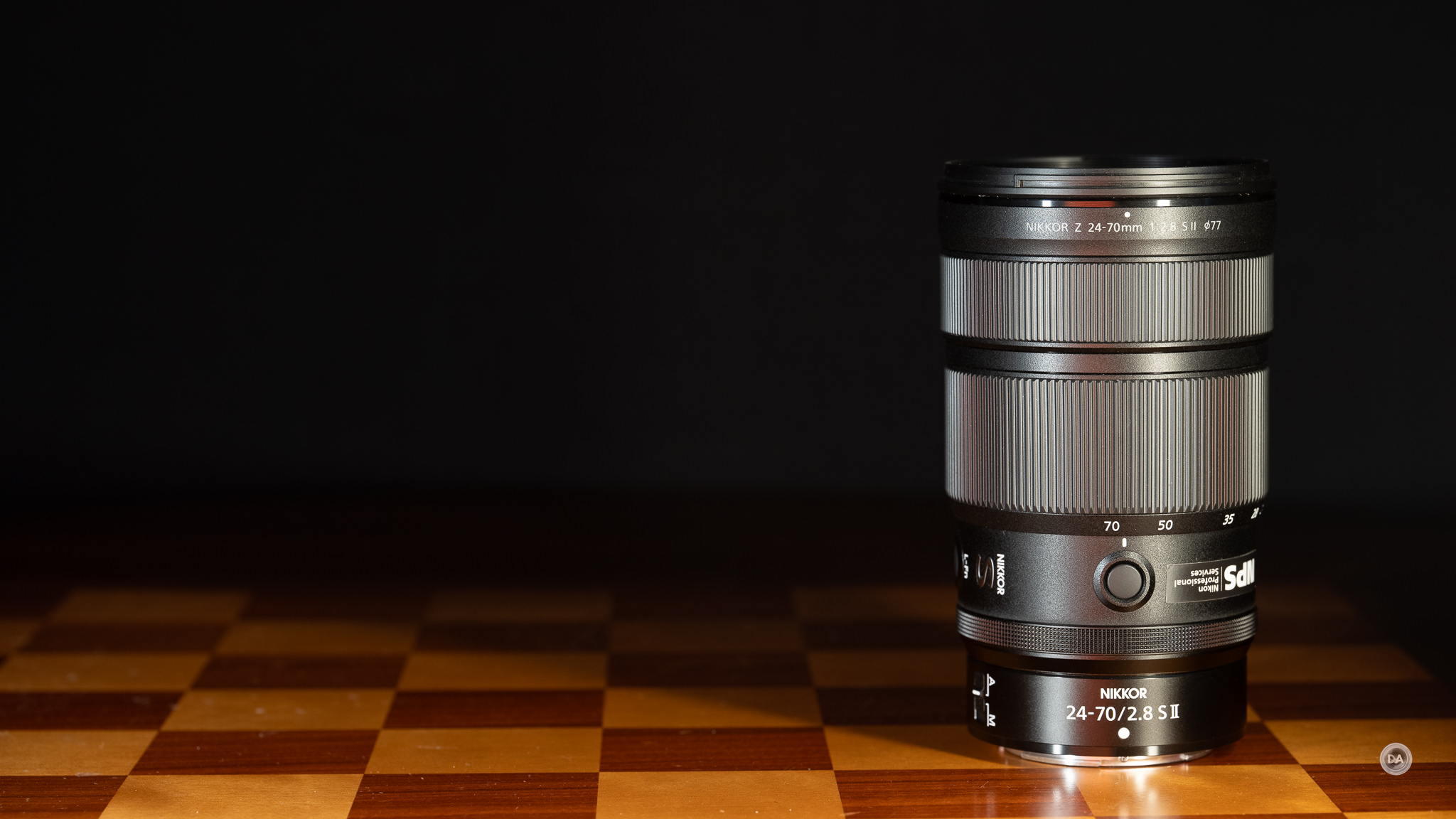
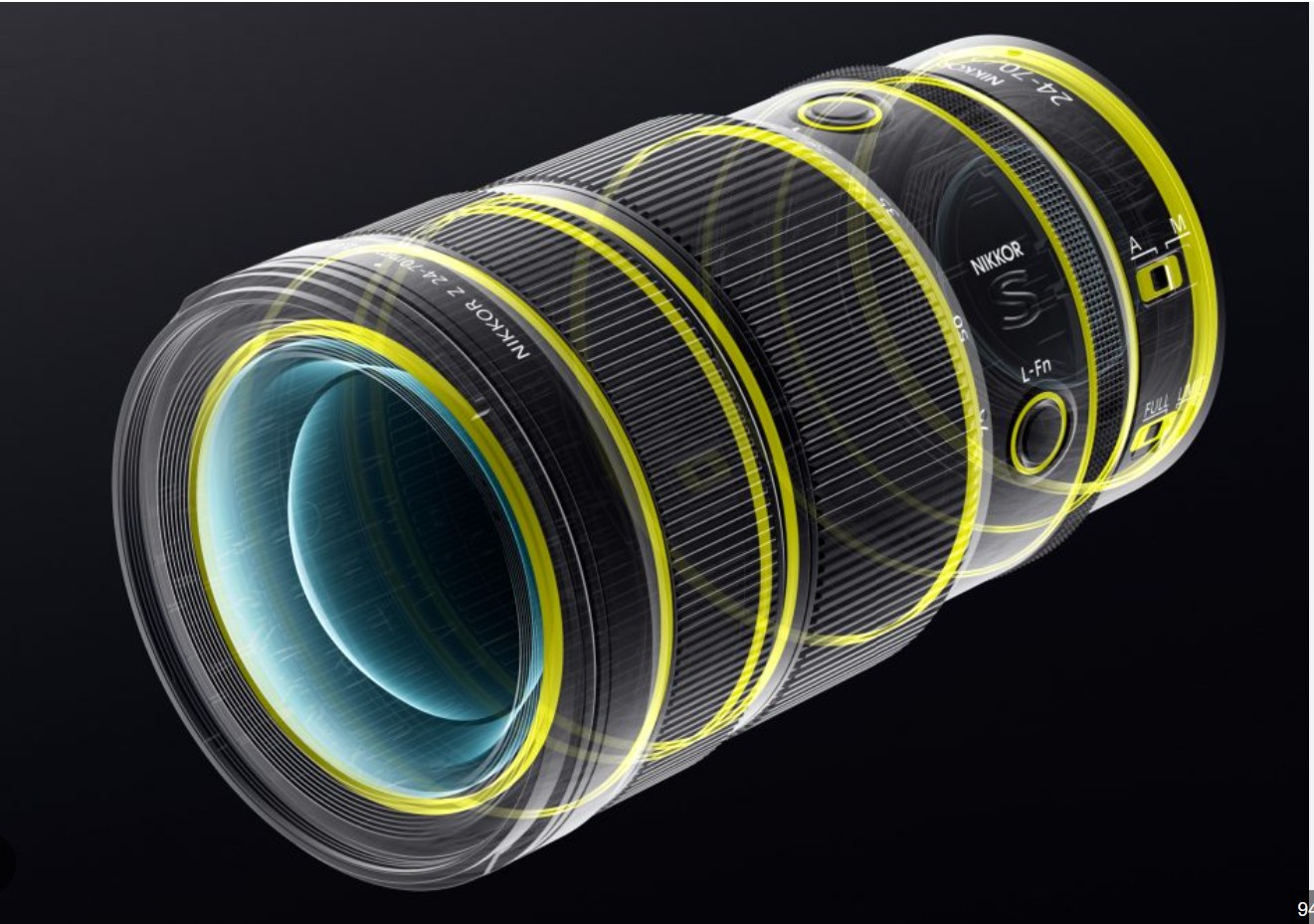
The difference, though, is that the Mark II lens stays the same length whether it is used at 24 or 70mm and doesn’t extend. The previous generation lens is longer by 10+mm when zoomed to 70mm. Internally zooming lenses are better for gimbal use (the balance stays the same regardless of the focal length because the length doesn’t change) and has the fringe benefit of being easier to weatherseal because nothing extends in and out of the lens. Nikon touts “…with no extending or retracting parts, dust and moisture have less chance of entering the sealed lens…”, though, ironically, companies also want to convince us that extending zooms are equally well sealed. It seems logical to me that lenses without extending parts are more likely to have a tight seal. The 24-70S II has roughly 13 seal points according to this diagram along with a fluorine coating up front.
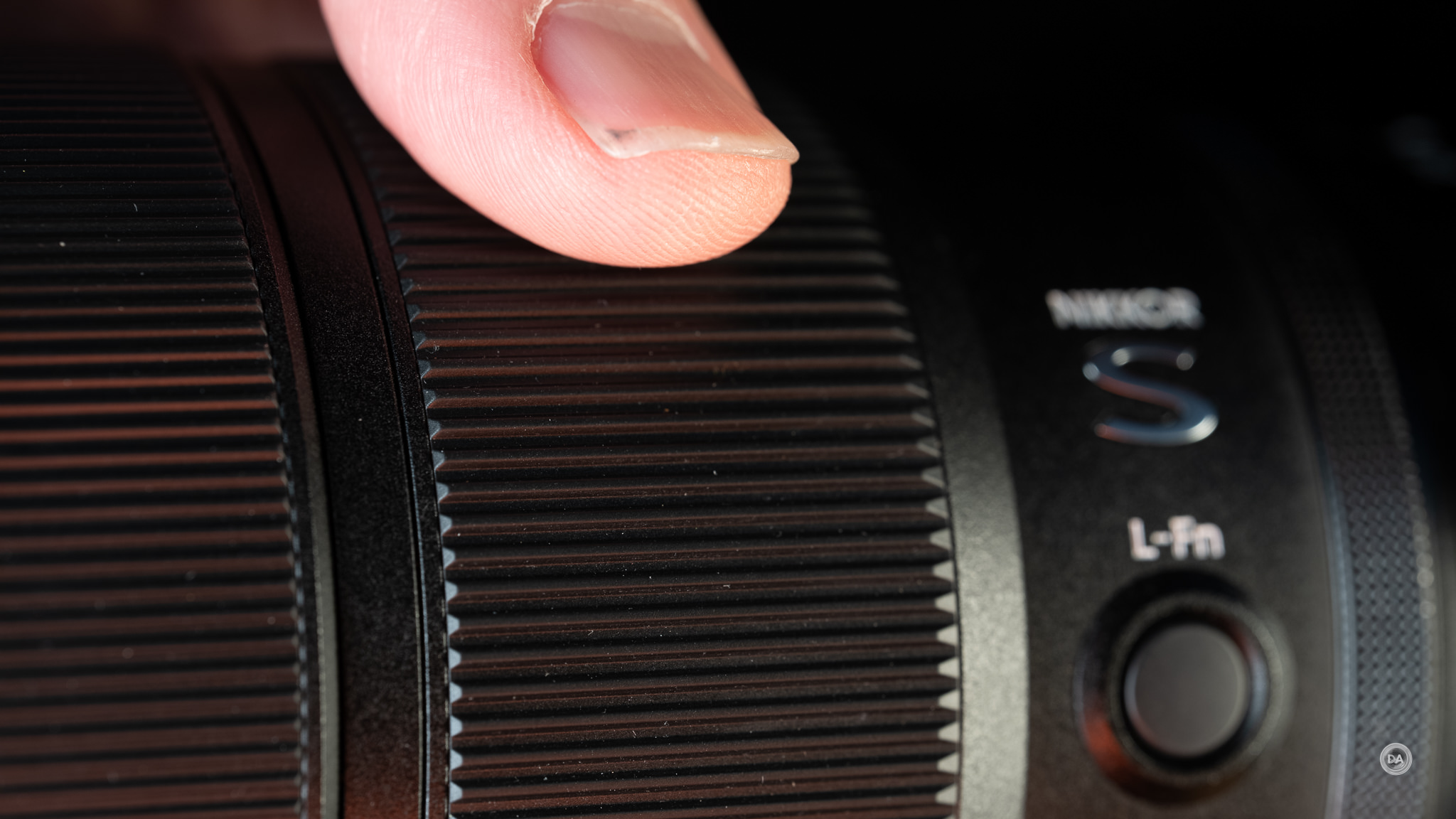
The zoom ring is the middle of the three rings on the lens and is easily the largest. I was a little disappointed at the zoom action, however, as theoretically one of the big advantages of internally zooming lenses is that they can zoom faster and smoother than externally zooming lenses. I found the zoom action tighter that I would have liked, however, and struggled to get really smooth zooms during video work.
The lens is 84mm (3.4″) in diameter and a whopping 142mm (5.6″) in length, making it slimmer but longer than the first generation 24-70 S. It weighs just 675g (1.5lb), which is a lot lighter than the 805g of the previous generation lens. Some may find that the efforts to reduce the size makes the lens feel a bit more plasticky than the previous generation option.
Interestingly the filter size has also reduced from 82mm to a 77mm size, smaller than most competing zooms in this class.

One physical difference easy to note is that while the first generation sported an OLED screen on the top of the lens, Nikon seems to be moving away from that design (right about the time that Viltrox starts using them!) We have a second Fn button in the place where the OLED screen rested on the top of the first generation lens.

It could be effectively argued that this is a downgrade, as the OLED does serve a purpose, while the second Fn button is redundant as far as function (it has the same function as the other Fn button) and is there to allow a button to be close to hand when shooting in vertical (portrait) orientation. The other Fn button is in the original spot on the left side of the lens.

The function for these buttons can be chosen from within the camera body. Also present in this area are a AF | MF switch, and, interestingly, a Focus Limiter.
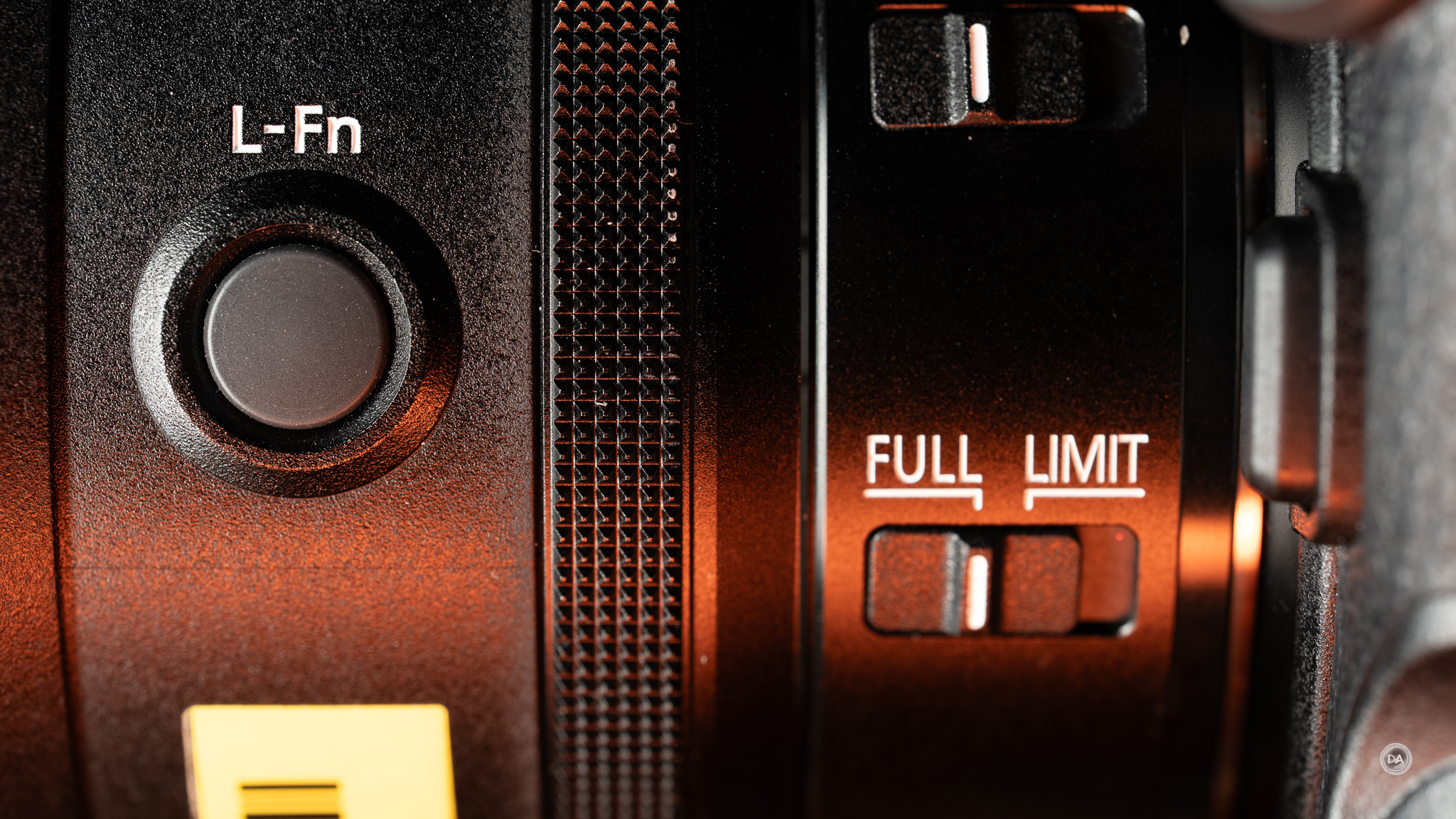
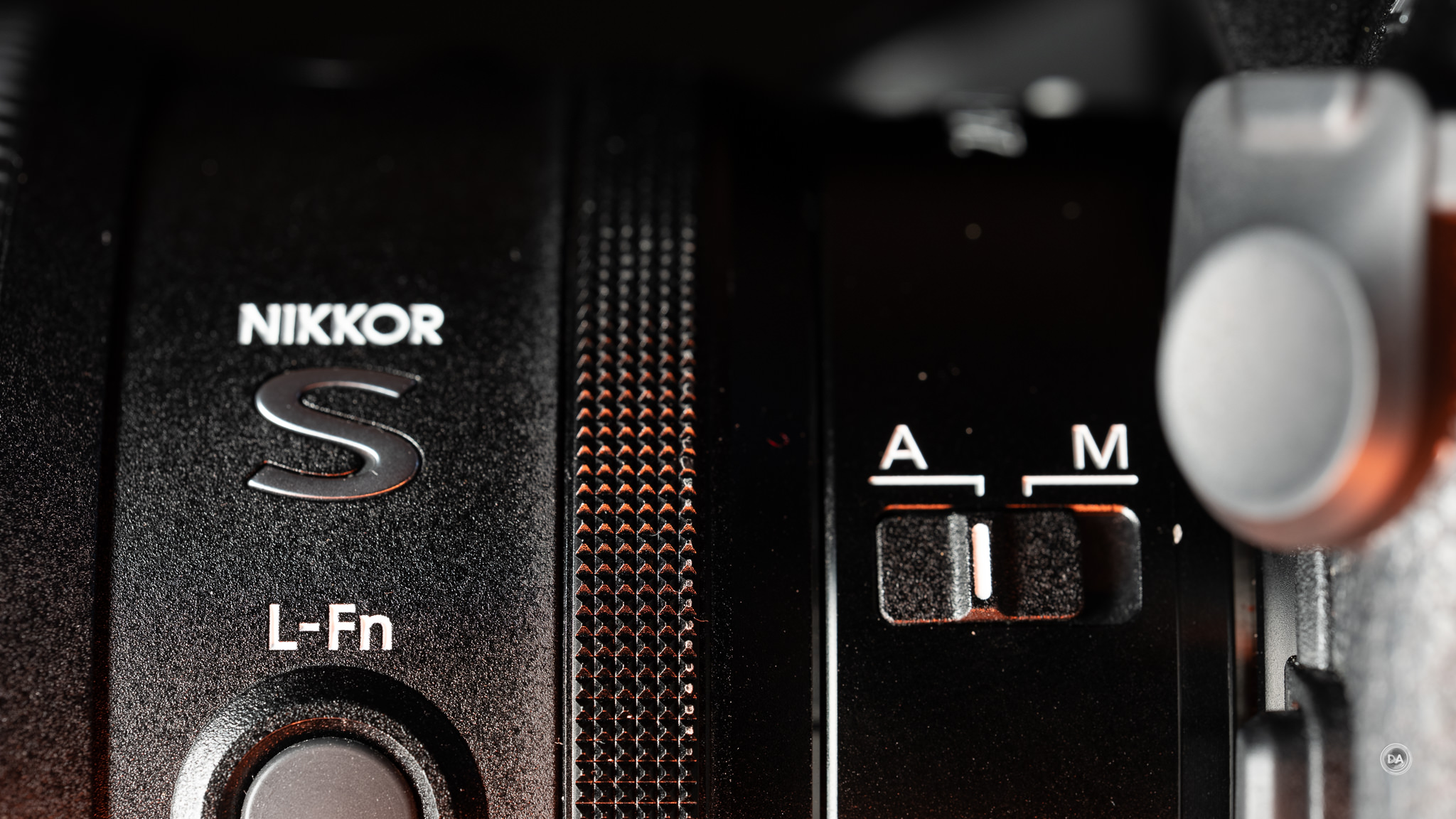
I rarely see focus limiters on non-telephoto lenses. In this case, it is a two-position switch, allowing for the full range or to eliminate the close focus capabilities. I’m not sure how valuable this will be in most cases, however, as it seems to just eliminate the closer focus abilities of the lens on the wide end (as close as 24cm) and keep it consistent with the 70mm minimum focus distance of 33cm.
As per usual, I don’t love the placement of these switches because on my Z8, there are two controls located way too close to this area. There is a flash sync port behind a rubber cover along with the camera release button. That means if I’m reaching around with my left thumb to operate the switch, I’m having to thread the needle through a couple of obstacles. Perhaps placing it on the same tier with the Fn buttons would have made more sense.
A very welcome feature addition comes in the form of Nikon’s first Click/Declick switch. This allows you to change the behavior of the customizable control ring to operate with or without clicks. I prefer clicks for aperture stops when shooting photos, but often prefer to a clickless ring when shooting video for incorporating smooth aperture racks into my shots.
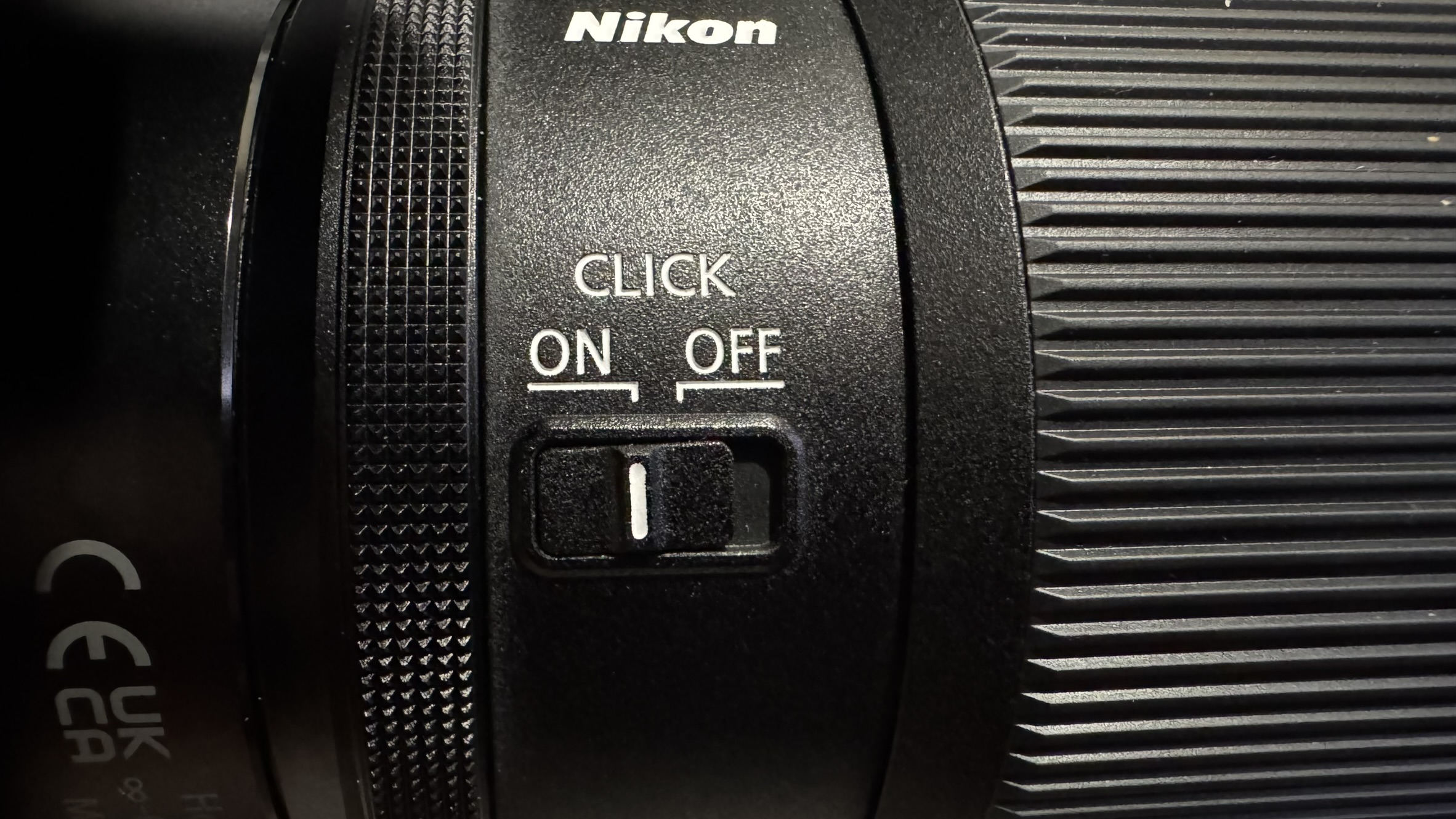
I was able to perform smooth aperture racks in the declicked mode for video work. The “customizable control ring” can serve as manual aperture ring in the way I’ve described but could also function to control ISO, exposure compensation, or a few other functions – whatever you’ve set up the ring to do in the menus. Those controls can be found in the Custom Settings menu, then by selecting group F (Controls), and finally choosing custom setting F2 (Custom Controls Shooting) to change the function of the ring.
The aperture iris has been upgraded to 11 rather than nine blades, allowing for a more consistently circular aperture shape when stopped down.
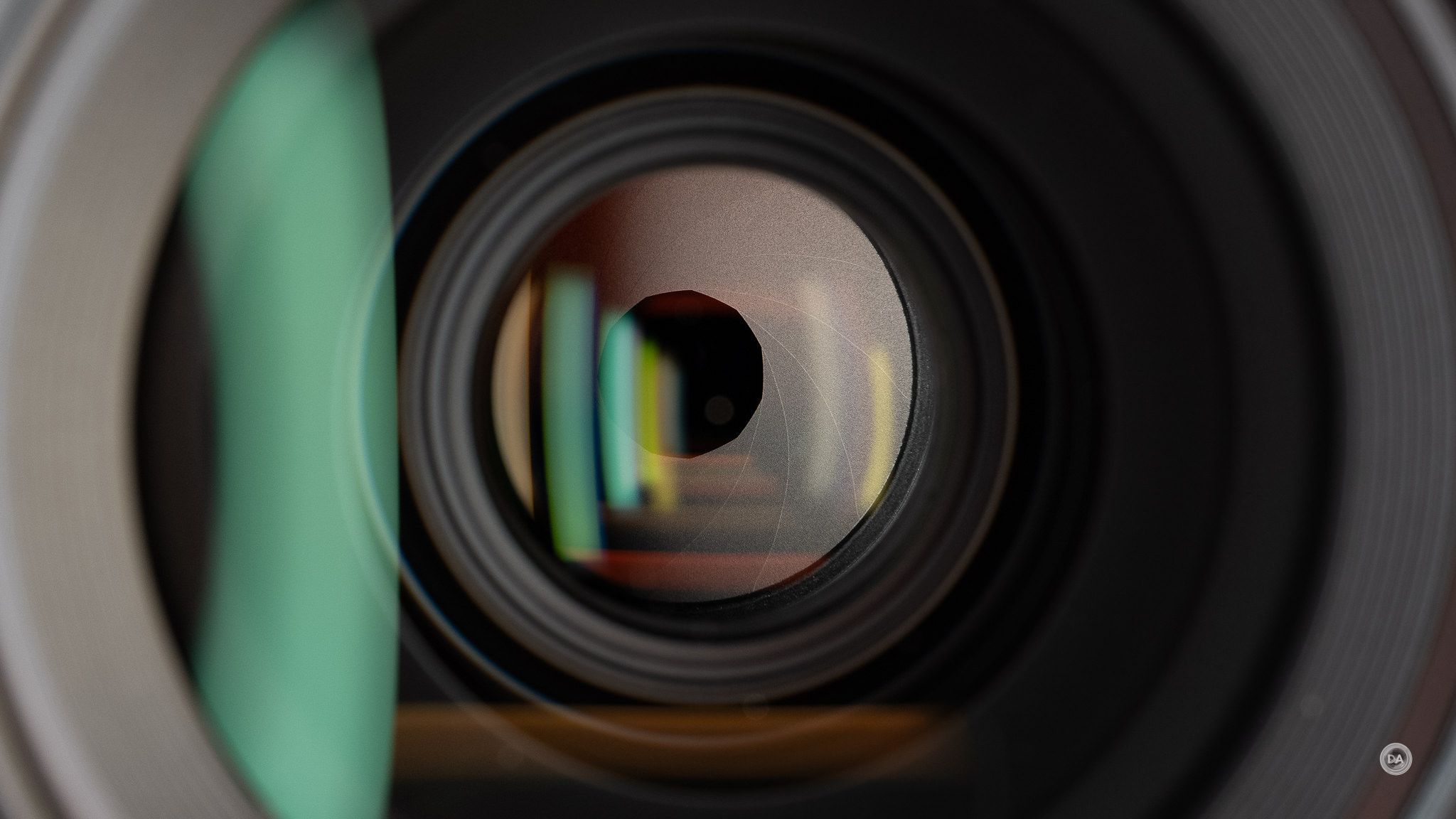
Here’s a look at the geometry of specular highlights as the lens is stopped down a bit.



The manual focus ring is slightly raised and has a rubberized, ribbed texture. It moves very smoothly and has a nice amount of weight to it. I was able to pull off really smooth manual focus pulls and focus with very nice precision. I also love the fact that I can do full time manual overrides even when in AF-C mode.

Another tweak to the design comes on the lens hood, which now has a window for accessing (rotating) filters even with the hood attached.
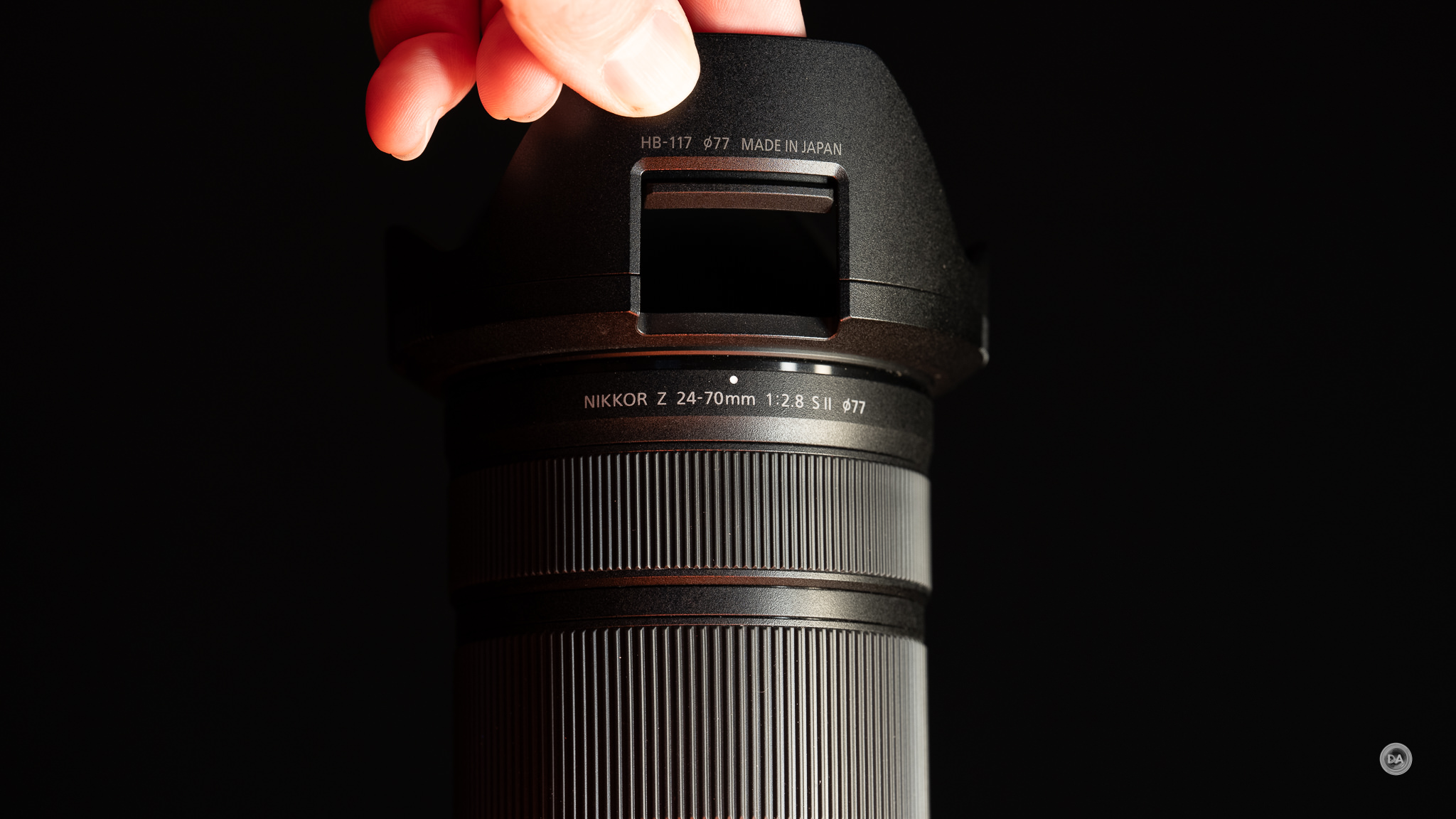
The lens hood is petal-shaped and does have a small lock on the right side. It is made of plastics and feels fairly ordinary.
As noted previously, the minimum focus distance varies by focal length unless you set the focus limiter, and while you can focus closer on the 24mm end (24cm), the highest magnification is found at the 70mm end, where you can focus as closely as 33cm and get an impressive 0.32x level of magnification, which looks like this.

Contrast feels little lower at close focus distances.
There is no VR (vibration reduction, or optical stabilization) built into the lens. That’s not a problem on a body like my Z8, which has good camera based stabilization, but could be a problem for those of you shooting on a camera without VR.
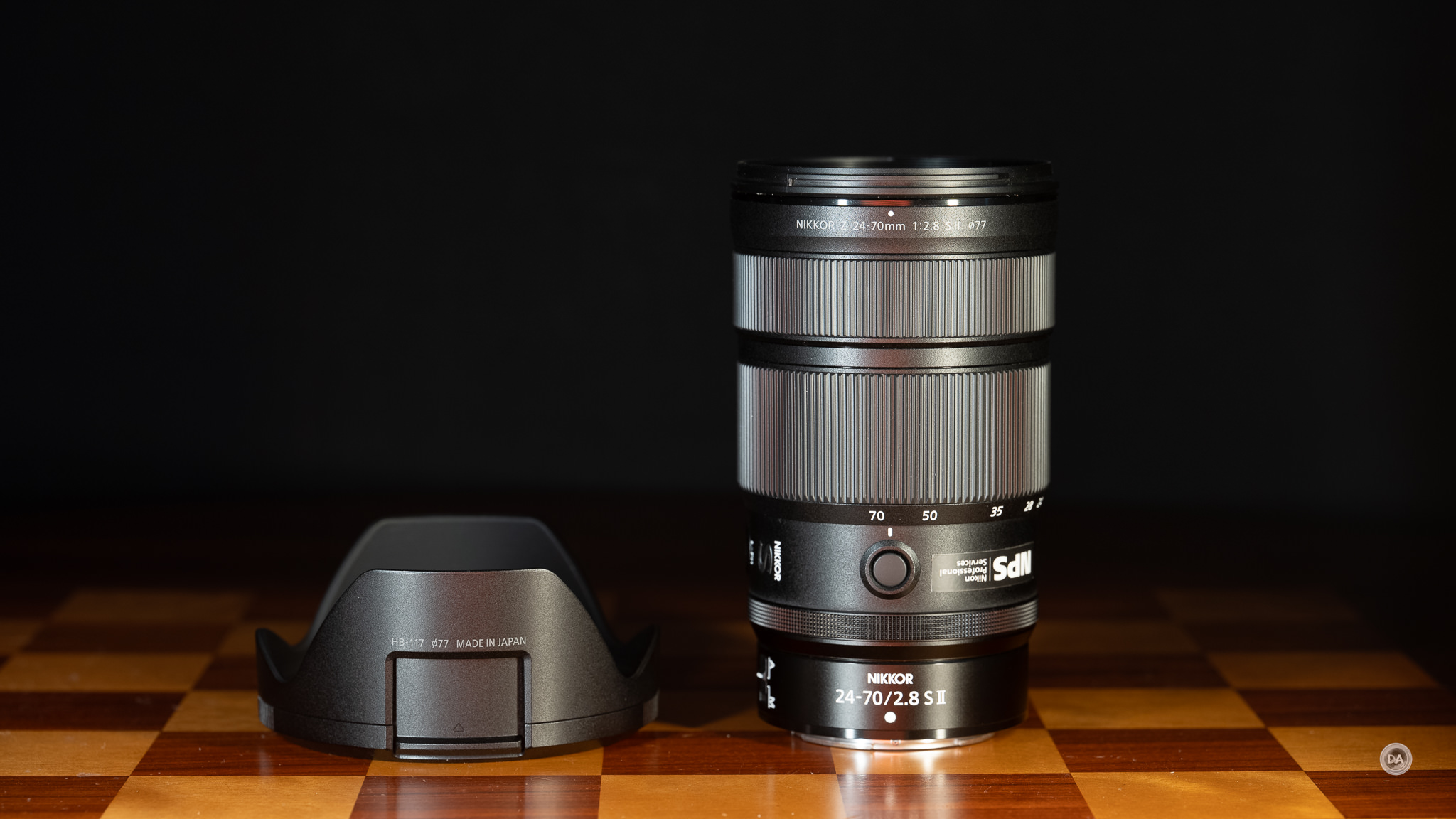
There are some very positive steps forward in design with 24-70S II, though you are going to pay for it. The $2799 MSRP is easily the highest in the class, exceeding that of the Canon ($2300) or Sony ($2450) premium options. And, while this is the lightest lens in the class, it also feels a little less premium than some of the other options I’ve tested, so it isn’t perhaps a perfect home run for Nikon.
Autofocus Performance for Stills
The 24-70S II is Nikon’s first non-super-telephoto to use their higher end SSVCM motor rather than the STM (stepping motor) used in the older lens. SSVCM (unfortunately) stands for “Silky Swift Voice-Coil Motor”. Perhaps “silky swift” sounds better in Japanese. Jesting aside, I love VCM focus motors, as they are fast, quiet, and very smooth in operation. I’ve been a little critical in times past of Nikon’s premium lenses having just STM focus motors, which I often associate with less expensive lenses, so the move to a more sophisticated focus system is welcome. Focus speed is much improved, with essentially instant transitions from close to distant subjects, and with more focus confidence than what I’ve previously seen.

Nikon claims that the SSVCM provides 5x faster autofocus, and while it is hard to verify that kind of claim (that’s marketing kind of language), the reality is that this is clearly a step up from the STM motor in quickness, smoothness, and quietness. Nikon also claims a 50% reduction in focus noise and vibration.
I used the 24-70S II for a few events (church) and for a quick portrait session (common applications for a lens like this), and found that the focus was quick and confident. I had no problem nailing focus on a speaker even they were in profile.


Clearly focusing on something simple like the cats will be zero problem.

It feels like the improved focus speed would make this a more viable option to see shoot sports and action when 70mm is sufficient reach.
I got great portrait results even while shooting in a snowstorm (with the distracting flakes falling constantly).


I’ll also note that the more responsive motor also improved the manual focus experience, making the focus simulation more lag-free and smoother.
Bottom line is that focus is much improved and is certainly now more competitive with what I’ve seen from a lens like, say, the Sony 24-70mm F2.8 GM II, which has similarly excellent focus.
Autofocus (Video)
Video autofocus is also vastly improved. VCM motors have the advantage of not having any visible steps, enabling them to do smoother focus pulls where focus moves in a more consistent linear fashion from Point A to Point B. Focus breathing is well controlled, and with the help of the focus breathing compensation in camera, it is essentially mathematically eliminated altogether.
My hand test went well, with good transitions from my hand to my face and back, and when I approached the camera and ducked in and out of frame, focus responsiveness was excellent. It picked me up quickly and resumed focus on my face in no more than a second.

The quality of focus is a definite step up. I certainly hope that the SSVCM will be the standard focus system for Nikkor’s better lenses moving ahead.
Optical Quality
This is a rare case where a second generation lens design actually gets simpler than the lens it replaces. This is an optical design of 14 elements in 10 groups, which includes two ED (Extra-low Dispersion) elements, and three aspherical lenses.
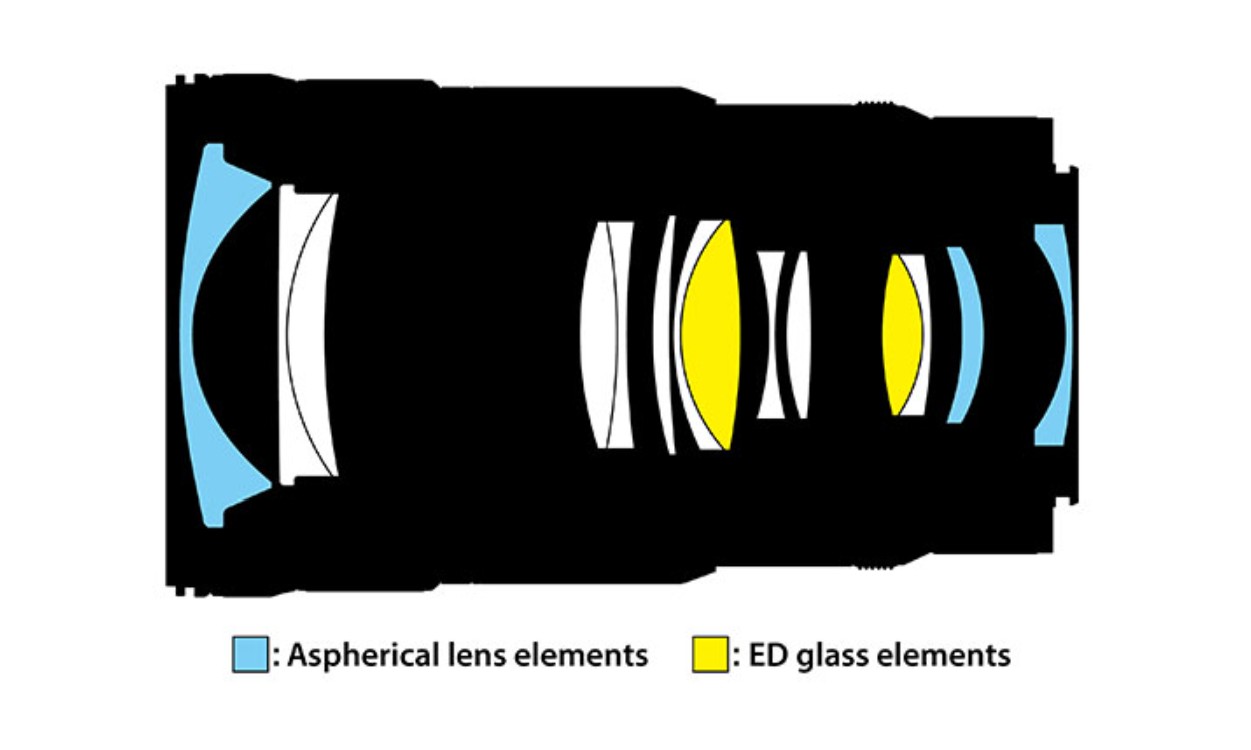
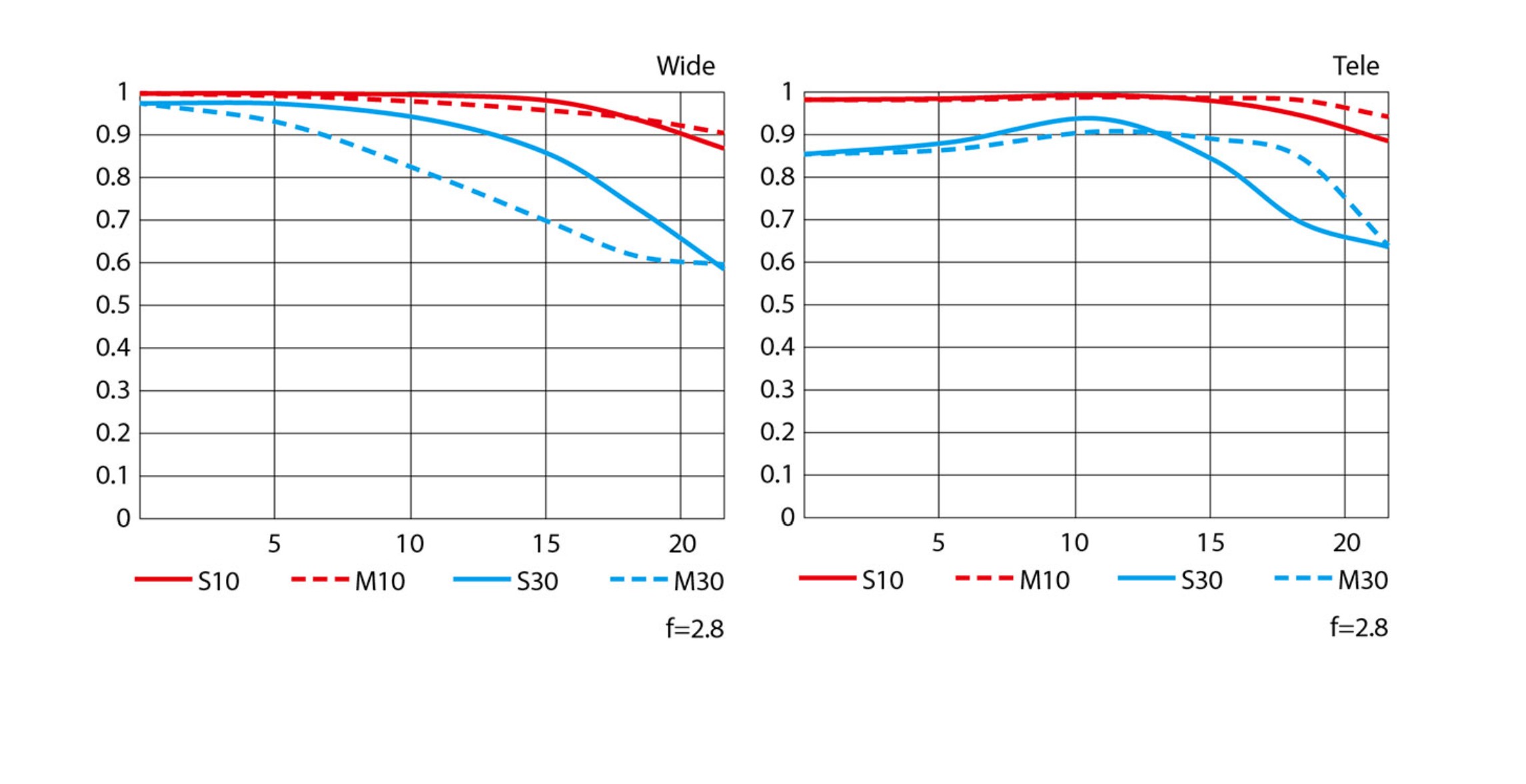
The MTF chart looks excellent (particularly at 24mm), with a wide open performance that is near perfect in the center of the frame and still well above 90% in the mid frame. The outer third of the image drops off somewhat, but still at good levels. The 70mm end is interesting, as while it is very good in the center, it is excellent in the midframe zone. The corners have a typical amount of decline. I don’t mind this optical design, actually, as arguably for portrait work the rule of thirds (midframe) is more important place to have peak sharpness than even the center…and this is a very sharp lens.

Let’s take a look at vignette and distortion, starting on the 24mm end. Here’s a look at an uncorrected 24mm RAW image (left), and my manual correction on the right.
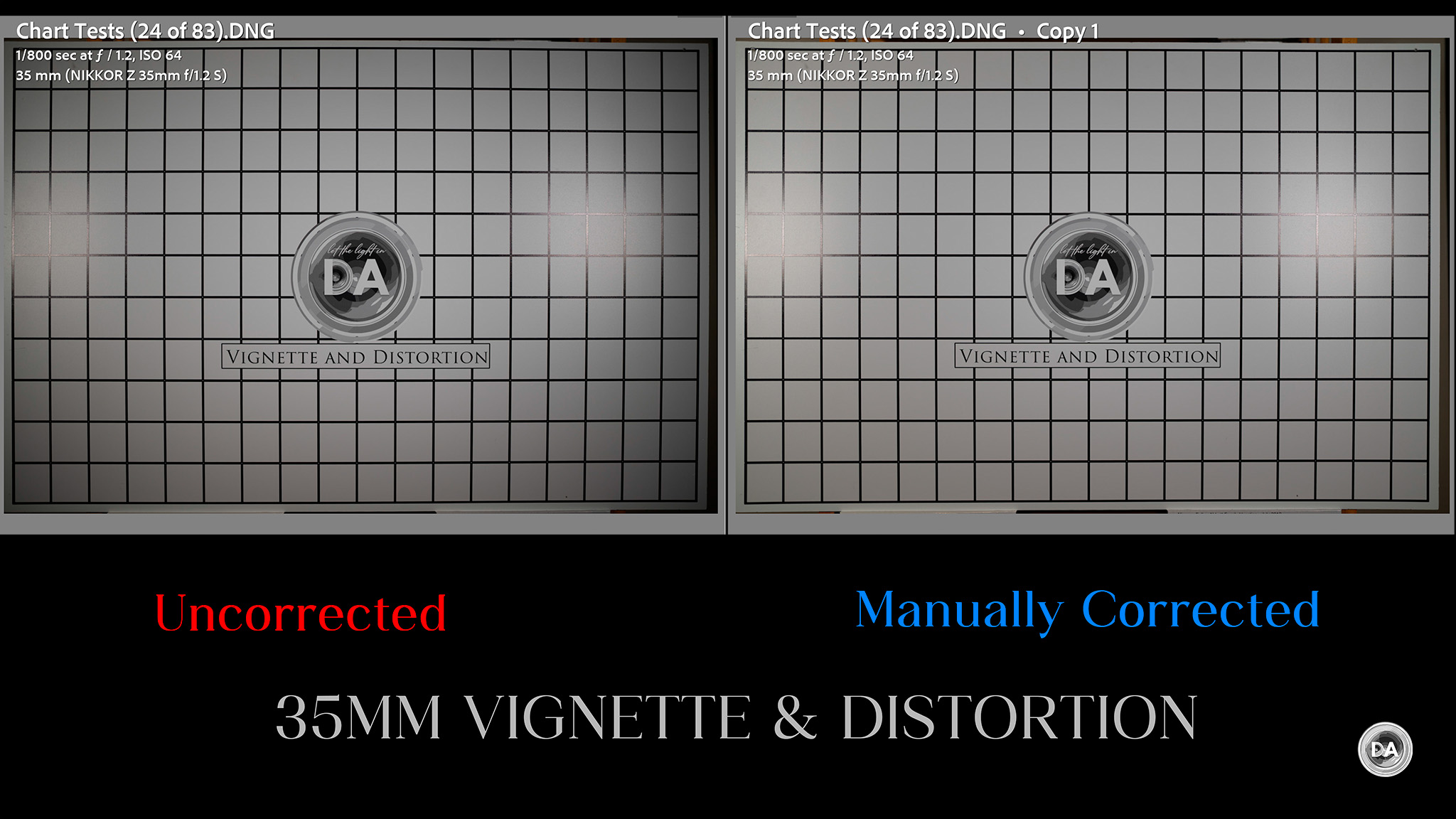
I’m actually delighted with this result. I’ve tired of first party lenses relying on electronics to deal with things like distortion, but Nikon has done most of the heavy lifting in the actual optical design. There is a minor amount of barrel distortion, but it isn’t so extreme that it would show up in most real world images, and is nicely linear and manually correctible with just a +10 – far below what I needed for the Sigma II or Canon RF 24-70mm, though Sony has a slight bit less distortion (though more complex) in their 24-70 GM II lens. Vignette is moderately heavy, requiring a +67 to achieve the correction shown here.
The distortion pattern will invert to a pincushion style distortion as you zoom out. By 70mm it looks like this:
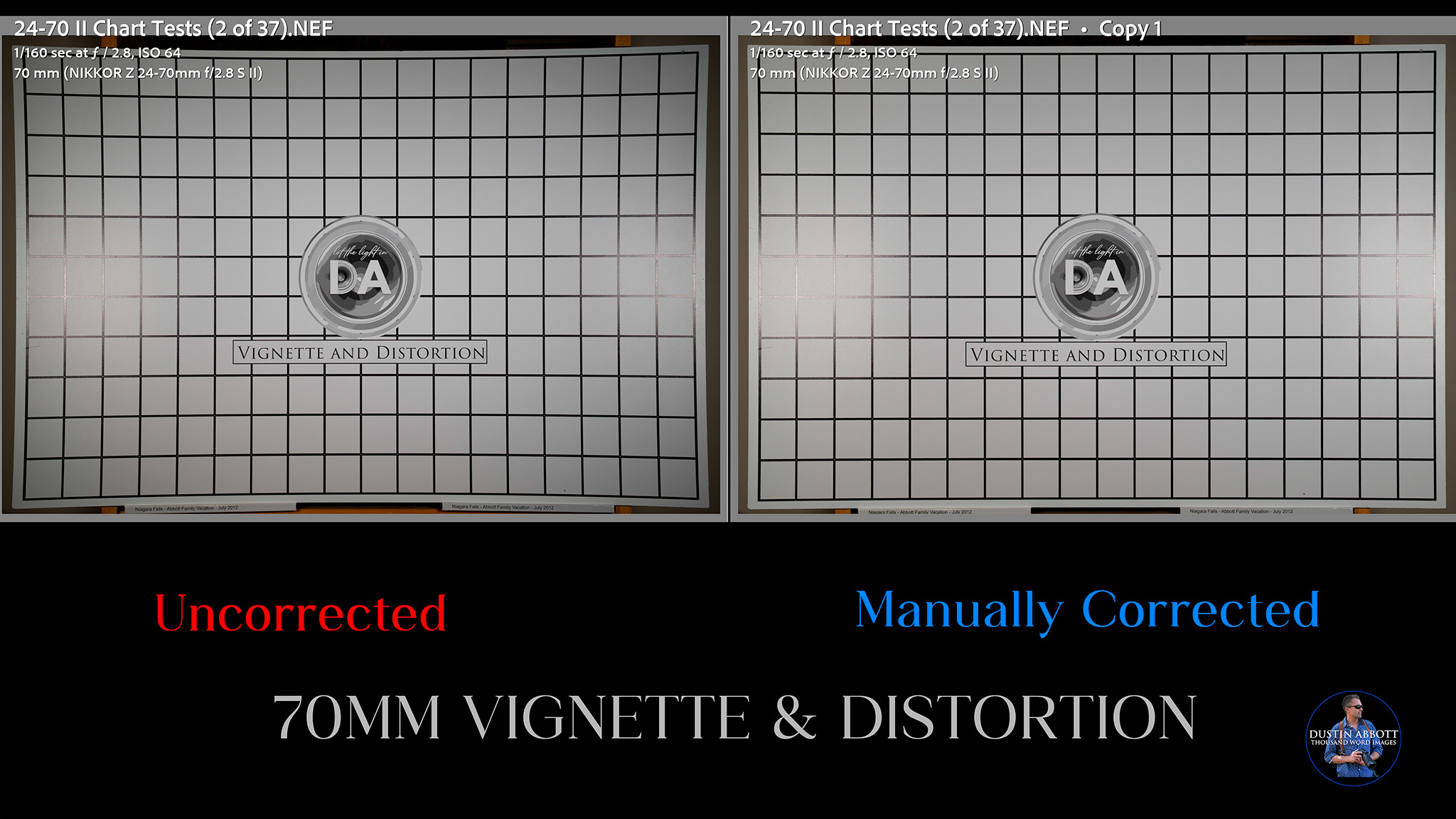
A -6 eliminates the distortion, which is once again very linear and easily correctible. The vignette is a bit lighter on the telephoto end, requiring a +52 to correct. I’m happy with all of this, as it shows that Nikon’s engineers did most of the heavy lifting in the actual optics of the lens.
There is basically no LoCA (longitudinal chromatic aberrations) before and after the plane of focus.

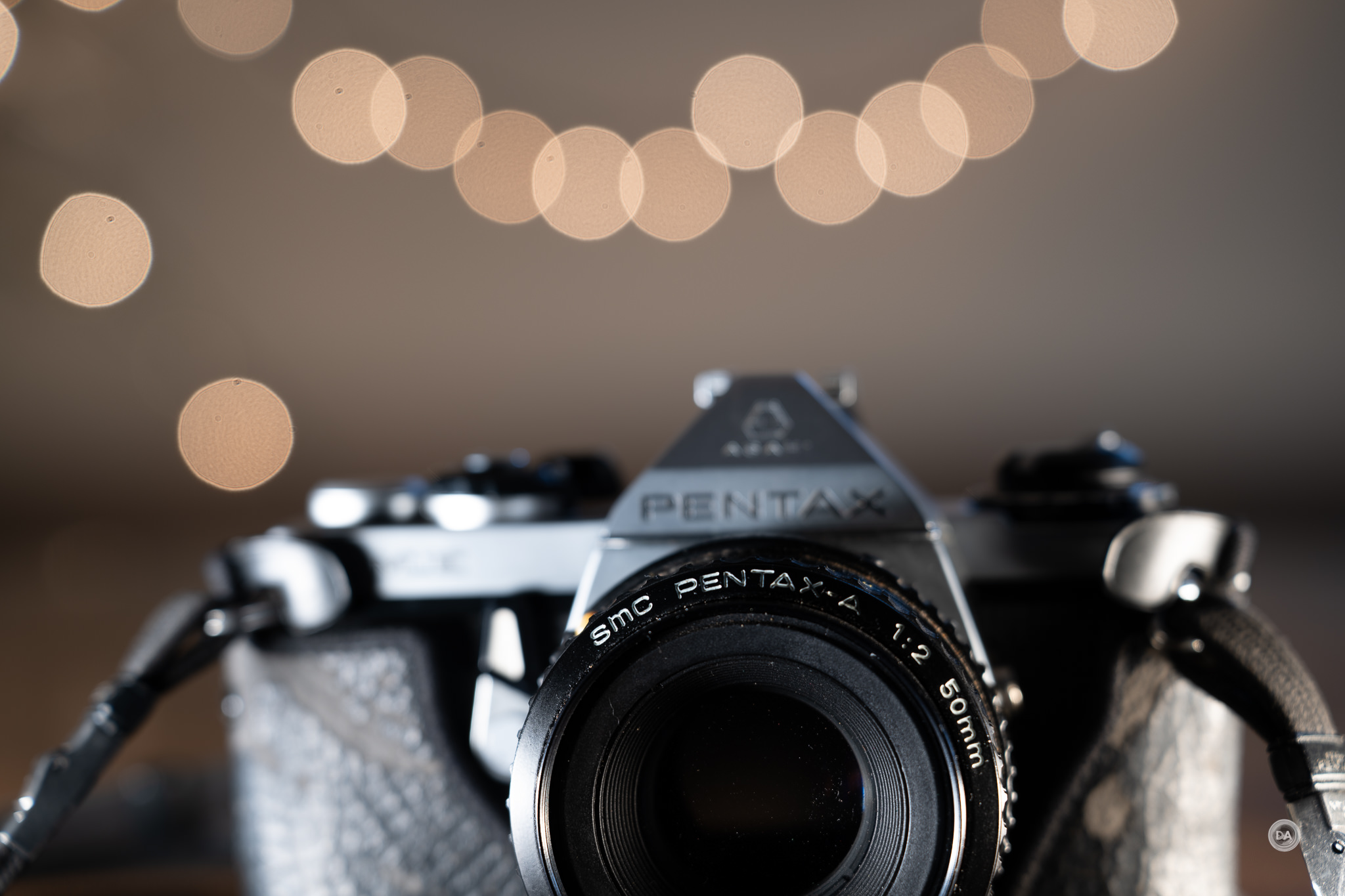
I like to use my Dad’s old SLR as a real world test, and I saw basically no fringing either on the shiny bits here or in the specular highlights (bokeh balls) beyond.
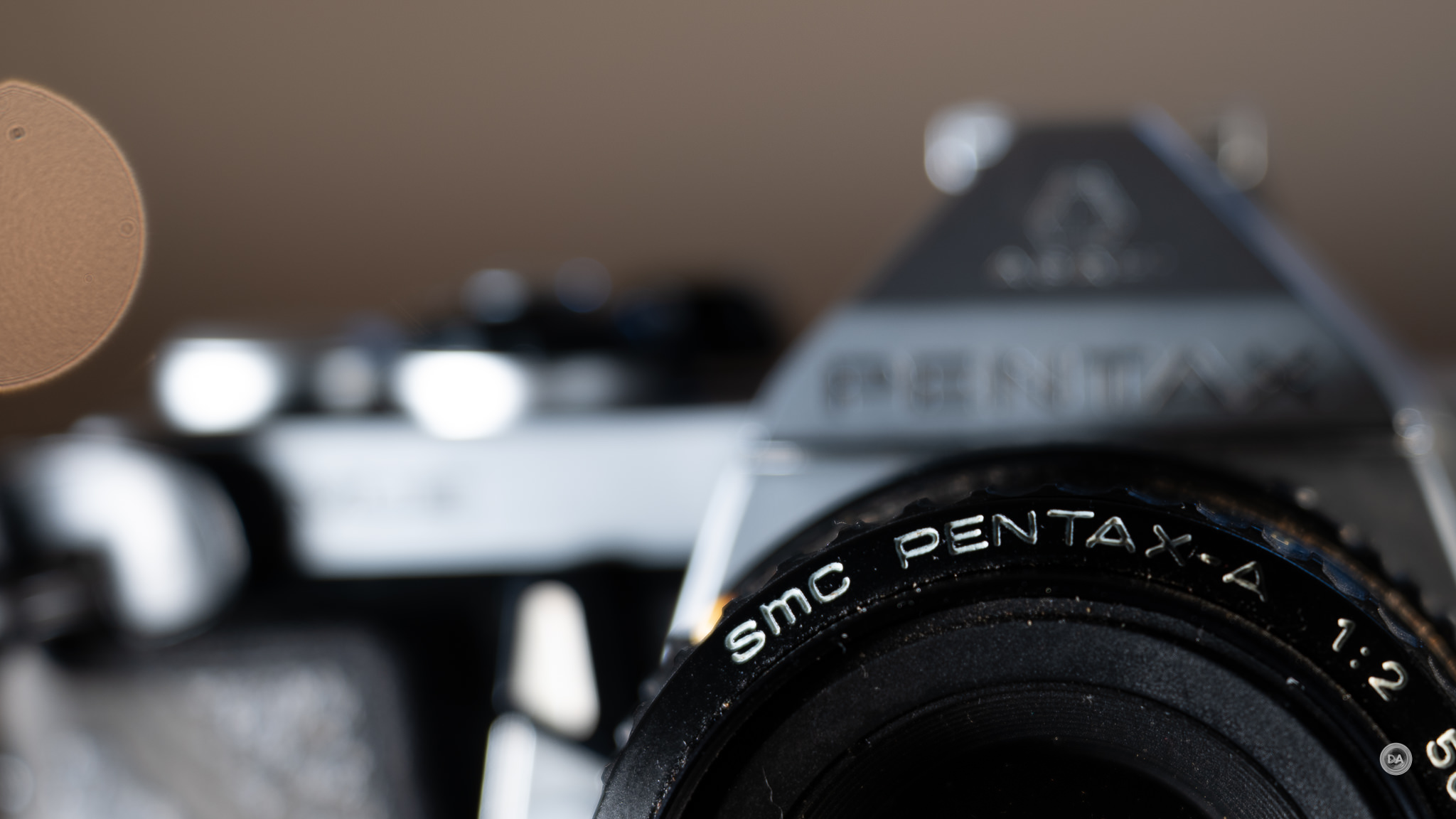
No problems there.
LaCA (lateral chromatic aberrations) typically show up along the edges of the frame with high contrast transition points. I saw nothing but clean transitions on either side of the black and white transitions.

The 24-70S II is checking all the boxes thus far.
We’ll move on to inspecting our test chart. This test has been done on a 45MP Nikon Z8 sensor. I use a high end tripod and two second camera delay to ensure vibration doesn’t affect images. Here’s a look at the test chart that we will examine at high magnification:

Starting at 24mm, if we take a look at crops (at 200%) at F2.8 from the center, midframe, and lower right corner, we find a consistently good looking result across the frame.



Out in the real world this equals to pin sharp results with great contrast, even at F2.8. There’s great detail and contrast in this portrait shot.


There’s a bit more in the tank, too. Stopping down to F4 doesn’t make a huge difference in the center (which starts off pretty much perfect), but the midframe and corner show better contrast and a bit more detail.

If I shift to the upper left corner, I find that sharpness looks impressively good at landscape apertures (F4-F8) right into the corners.

Physics will affect even the mightiest of lenses, however, so while the impact at F11 is minimum, by F22 (which is minimum aperture), you can see a much more obviously softening.

Moving on in the zoom range we find good results at 28mm, though not quite as strong as 24mm in the corners. The center and midframe look great, though, particularly at F4.
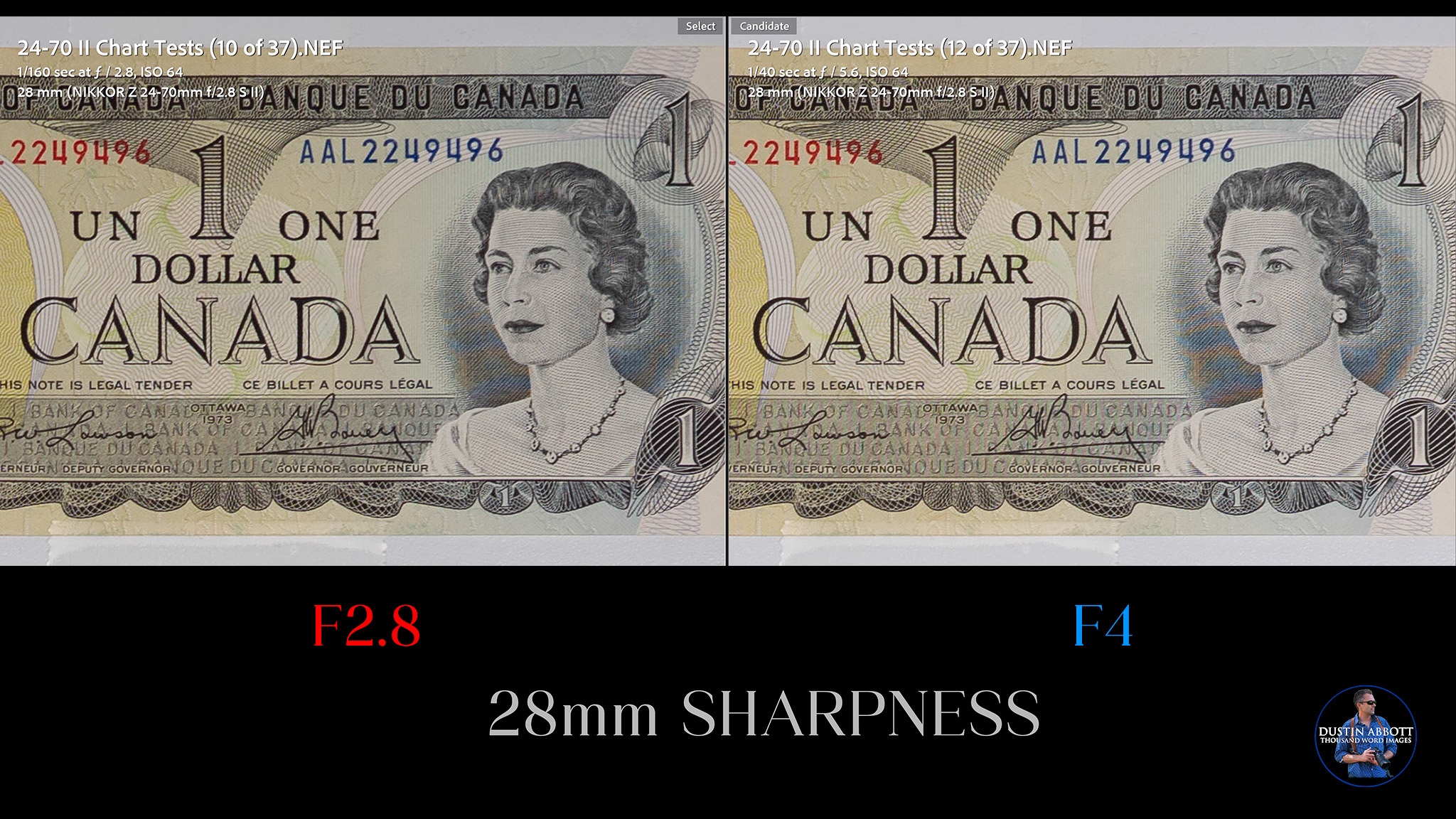
Real world results at 28mm are excellent. I captured beautiful details here at F4.5:

35mm looks excellent at F2.8 across the frame, and better still by F4. Here’s the very edge:
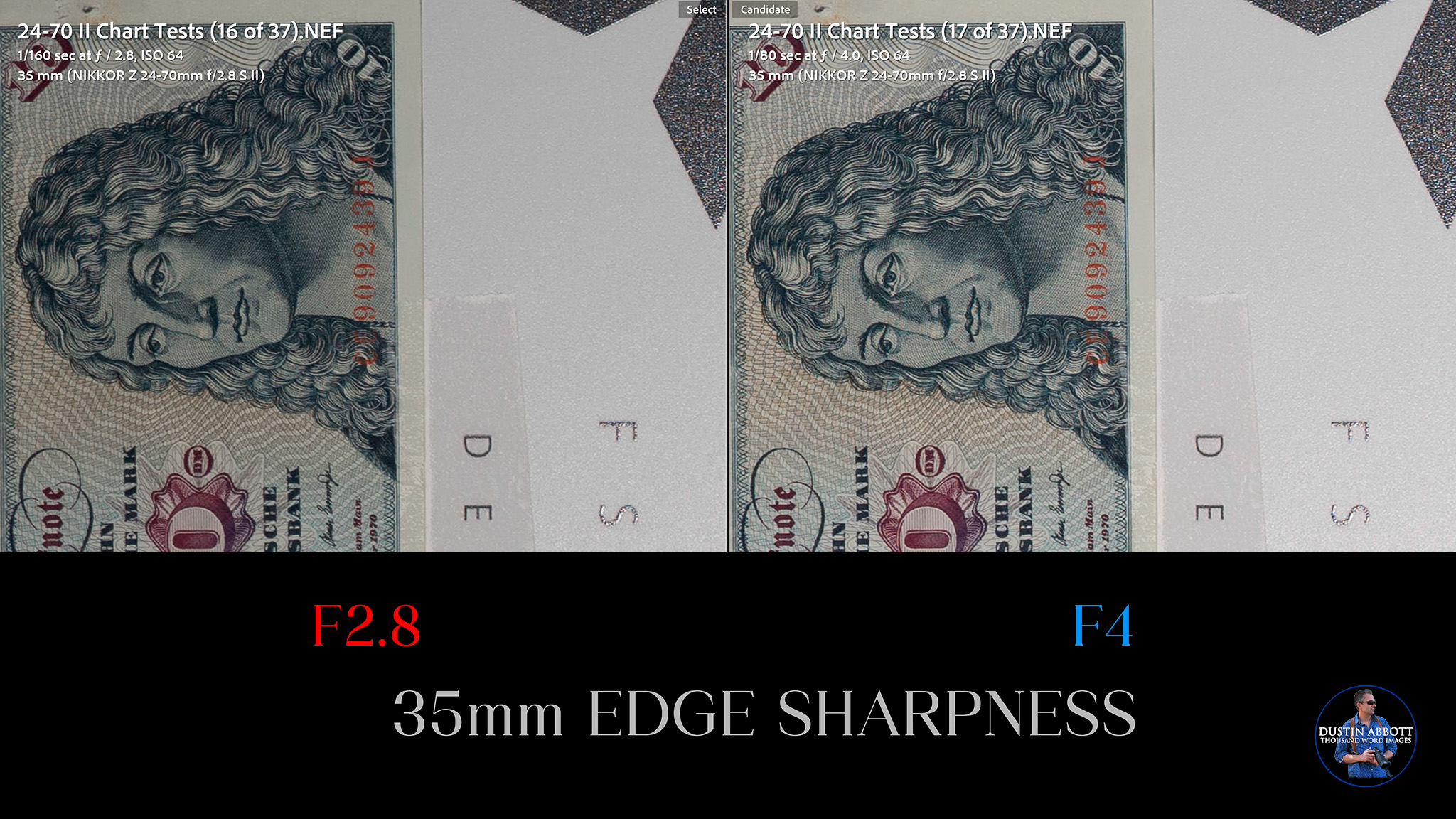
At 50mm the lens is very slightly less sharp on my chart, but still very sharp in real world use…even at F2.8.


As the MTF suggests, a close examination of the 70mm result shows a good looking center performance, but an excellent midframe result. Corners also look good to me.



Stop down to F4 for even more contrast punch in your images.

Look at the fine detail in these pine needles at F2.8:


Sharpness is not a problem with the 24-70S II. This is definitely a “bag of primes” type zoom that can provide equivalent sharpness to good prime lenses across its zoom range.
But how about overall rendering? I often find that standard zooms are capable of producing similar levels of sharpness as prime lenses, but the smaller maximum aperture of F2.8 (which is two full stops smaller than F1.4) and the reality of engineering for multiple focal lengths often results in images that are less “magical” than those taken with a prime lens at that same focal length.
I looked back through my portrait results where I shot both the new Viltrox LAB 35mm F1.2 in Z-mount alongside the 24-70S II (what a treat that was!), but I found something comparable with the zoom closer to 50mm (gives a little “advantage” to the zoom due to more compression), but no big deal. First of all, the Viltrox is sharp enough to match the zoom even at F1.2, which is crazy.
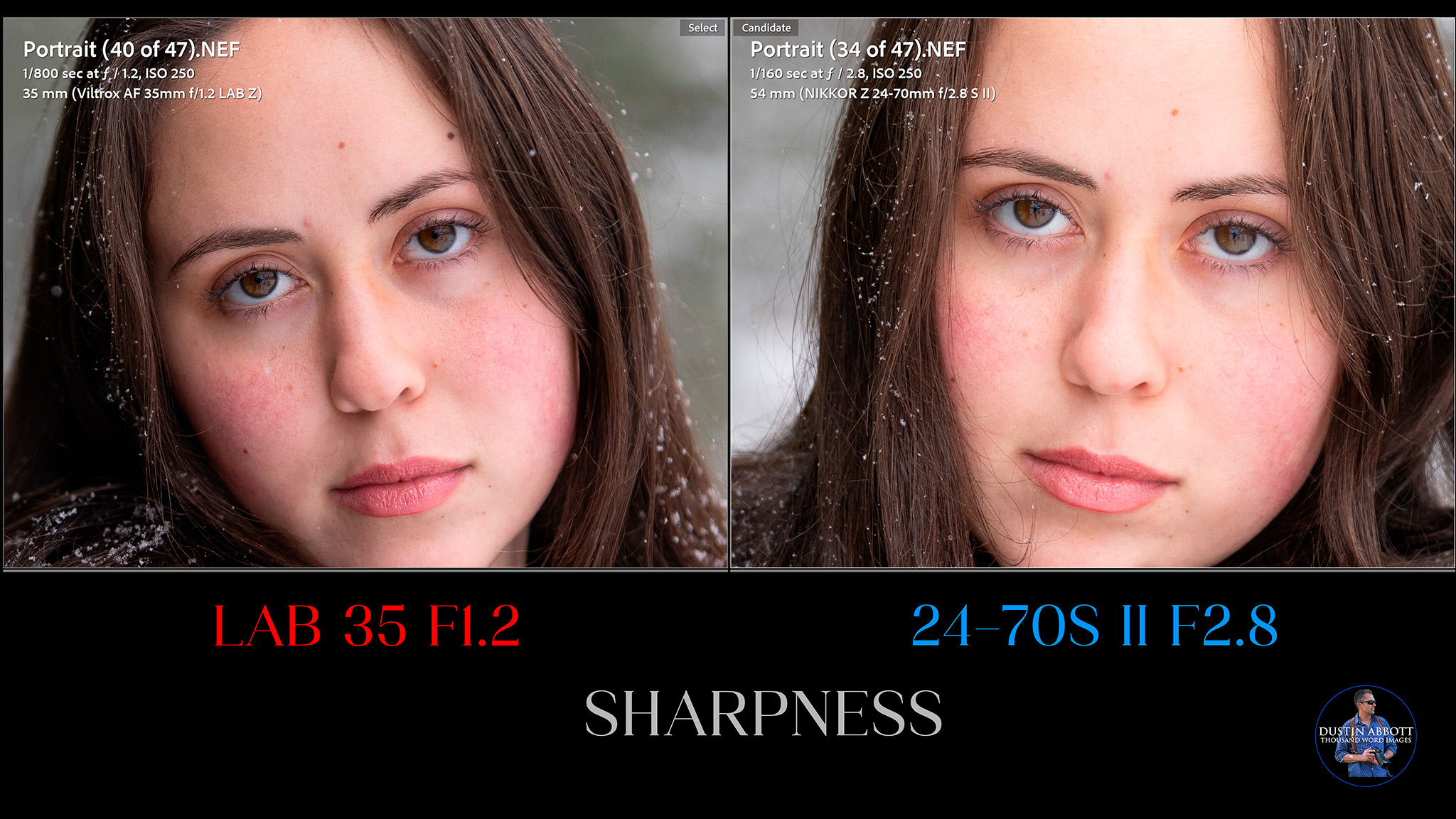
But even though the ratio of distance-to-subject-to-background (plus focal length) favors the zoom lens (tighter framing + longer focal = the background will be more out-of-focus), you can see that the prime lens is capable of achieving a more dreamy background.
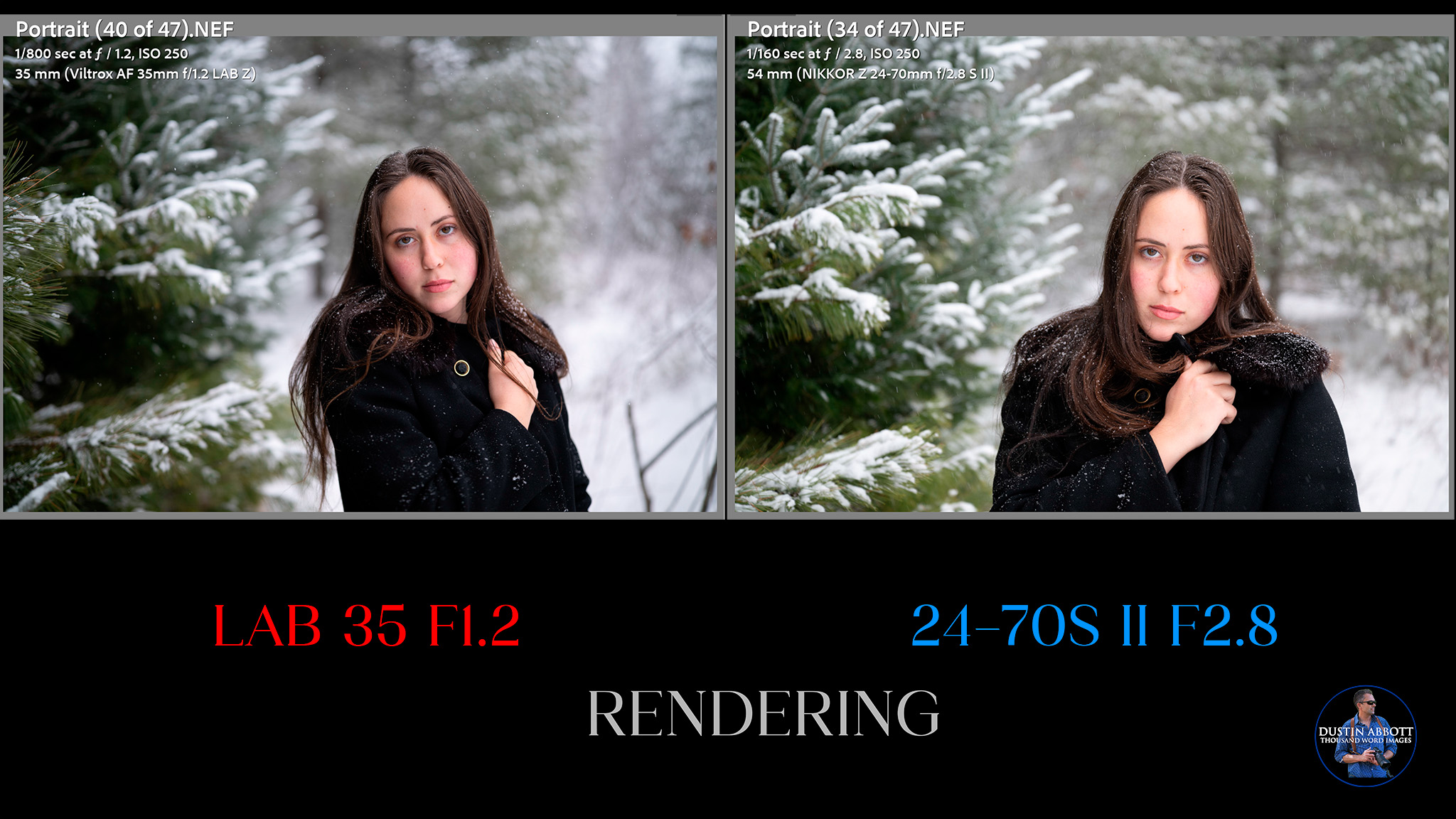
That being said, you are talking about a single 35mm lens that easily outweighs the zoom…and the zoom gives you many more framing options and produced a great looking image.
At its best (shooting at 70mm with a good ratio of camera to subject to background), you can get beautifully blurred out backgrounds.

There’s some typical cat-eye effect on specular highlights near the edges of the frame, but by F4 the geometry is mostly completely circular, and by F5.6 it is perfectly so (though obviously the “bokeh balls” are getting smaller by then). Here’s what F4 looks like:
In less favorable scenarios, the backgrounds looks busier but without obvious hard edges.

This shot of Nala was taken during a family game night, and there is a lot of clutter in the background, but it is mostly soft.

This is one area, however, where I feel like the Tamron 28-75mm F2.8 G2 competes favorably. It is isn’t as comprehensively sharp as the Nikkor (as is more flare prone), but it does produce quite nice bokeh for a standard zoom.
Speaking of flare, Nikkor has used their proprietary Meso Amorphous Coat and ARNEO coatings on this lens, and it shows. I found flare resistance at a variety of angles and aperture values to be consistently excellent.



These premium S-Line lenses are expensive, but they are also exceptionally good. This lens in particular brings some welcome innovation into what is one of the most traditional zoom ranges of all, which is welcome. I would say that Nikon users have no reason to covet something like the Sony 24-70mm F2.8 GM II, though the 28-70mm F2 GM might be another story.
You pay the big bucks to get something exceptional, and that’s what this lens is optically. Here’s a mini gallery of images for you to enjoy.
Conclusion
For many wedding or portrait photographers, a good 24-70mm F2.8 is their “if I had just one lens” lens. It is an indispensable tool because it effectively covers a lot of the most important focal lengths, allowing you to shoot wide scenes in a wedding ceremony while also zooming in a reasonable amount for tighter framing. And, these days, higher resolution cameras allow you to pop into APS-C mode and get more “reach” while still retaining a similar amount of pixels to what cameras had in the DSLR era.

I appreciate the fact there this a lot of genuine innovation for Nikon here, from developing the first internal zoom for a 24-70mm, decreasing the weight, and adding the ability to click/declick the control ring. I found the focus limiter of (ahem) limited use personally, but your mileage may vary. The move to the SSVCM is extremely welcome as well, as autofocus is top notch here.

Probably the greatest hurdle for many people will be the price. The $2800 USD price tag will be prohibitively expensive for many people, making Tamron alternatives like the 28-75mm F2.8 G2 ($849 USD) or even the exceptional 35-150mm F2-2.8 VXD ($1700 USD) attractive. But there’s no question that the 24-70S II is a clear upgrade over the first generation S-Line lens, and for those who use a 24-70mm to make their living, the Nikkor Z 24-70mm F2.8S II will be well worth it as a your daily workhorse. I suspect Nikon will have no problem selling many of these excellent lenses for years to come.

Pros:
- Beautiful built lens
- Very good weather sealing
- Good up close performance and magnification
- Aperture racking and manual focus work well
- STM focus motors work quickly
- Low distortion
- Exceptional control of fringing
- Extremely sharp
- Amazing contrast
- Gorgeous bokeh
- Great flare resistance
- Nice three dimensional rendering
Cons:
- Big and heavy
- Don’t love the control ring integration
- The AF | MF switch’s position is not convenient when mounted on my Z8
- Video AF can be a little rough
- Some strong focus breathing
- Lens hood doesn’t feel premium
_________________________________________________________________________
GEAR USED:
Purchase the Nikkor Z 24-70mm F2.8S II @ B&H Photo | Amazon | Camera Canada | Amazon Canada | Amazon UK | Amazon Germany
Purchase the Nikkor Z 135mm F1.8 S Plena @ The Camera Store | B&H Photo | Amazon | Camera Canada | Amazon Canada | Amazon UK | Amazon Germany
Purchase the Viltrox AF 135mm F1.8 LAB @ Viltrox (use code DUSTINABBOTT for 5% off) | B&H | Adorama | Amazon | Amazon Canada | Amazon UK | Amazon Germany
_______________________________________________________________
Purchase the Nikon Z8 @ B&H Photo | Adorama | Amazon | Camera Canada | Amazon Canada | Amazon UK | Amazon Germany
_________________________________________________________________
Want to support this channel? Use these affiliate links to shop at: B&H Photo | Amazon | Adorama | Camera Canada | Amazon Canada | Amazon UK | Ebay | Make a donation via Paypal
Buy DA Merchandise https://bit.ly/TWIMerch

Keywords: Nikkor, Nikkor 24-70 II, Nikkor Z 24-70mm F2.8 S II, Nikkor Z 24-70mm, F2.8, F2.8 S, Nikkor Z, Nikkor Z 24-70mm S review, Nikon 24-70mm, II, Mark 2, Nikon Z 24-70mm, Nikon, Nikon Z8, Z, Z-mount, Z8, Review, mirrorless, Full Frame, Sports, Tracking, Dustin Abbott, Real World, Comparison, Handling, Focus, Portraits, Resolution, High ISO, Image Quality, Sample Images, Photography, 45MP, #letthelightin, #DA, #NIKON, #Z8, #NIKONZ8, #NikonZ24-70SII, #NikonLens, #ZoomLens, #PortraitPhotography, #WeddingPhotography, #Astrophotography, #FastAperture, #ProfessionalPhotography, #CameraGear, #NikonZmount, #PhotographyGear, #LensReview, #UltimatePortraitLens, #NikonPhotographers
Related posts:
 Nikkor Z 35mm F1.2 S Review
 Nikkor Z 135mm F1.8 S Plena Review
 LAB vs PLENA: Nikon 135mm Showdown
 Nikkor Z 40mm F2 Review
 Viltrox AF 20mm F2.8 Z Review
 Nikkor Z 50mm F1.4 Review
 Nikkor Z 135mm F1.8 S Plena Gallery
 Nikkor Z 50mm F1.8 S Review
 Laowa AF 12mm F2.8 Zero D Review (Z-Mount)
 Nikkor Z 40mm F2 Image Gallery