

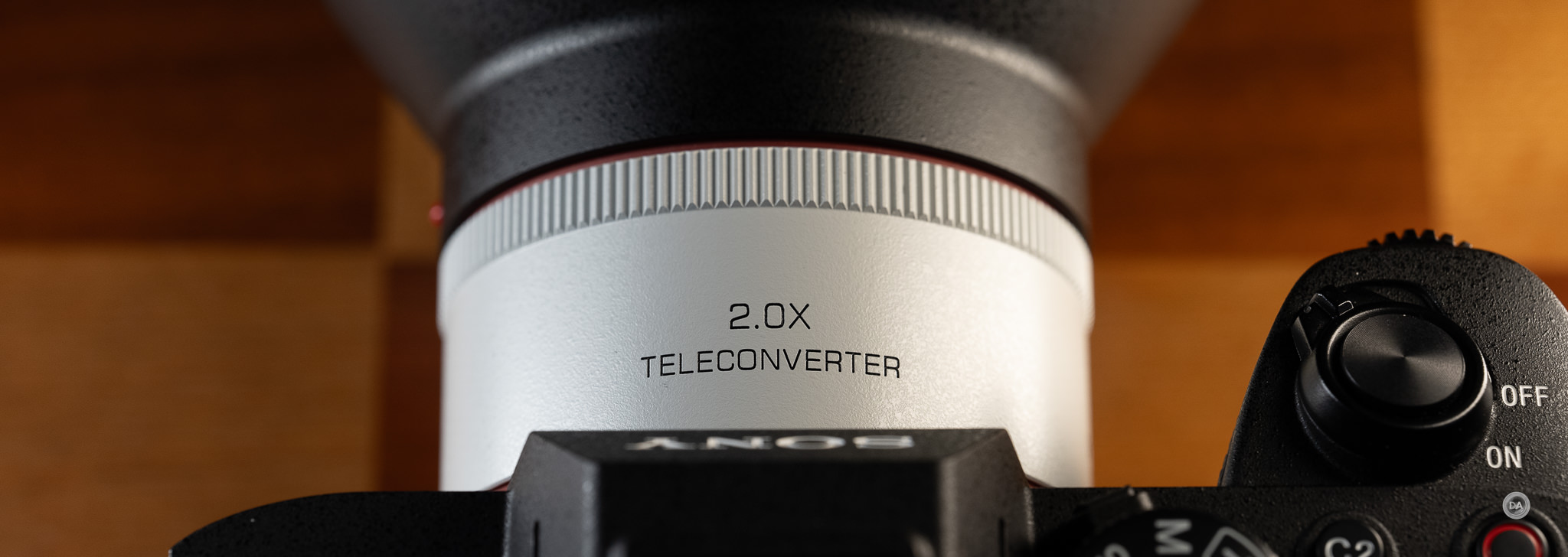
Sony’s relationship with teleconverters on their mirrorless E-mount platform has been, well, difficult. While in many ways Sony E-mount has been the most open platform in the history of photography, Sony essentially chose two primary areas to “put a thumb” on the scale to benefit their own Sony branded lenses. The first is that the maximum burst rate (with autofocus) on their sports cameras is reserved for first party Sony lenses. Their a1 and a9 series cameras (and even the new a7V) can shoot in burst speeds anywhere from 20-120 frames-per-second, but if you are using a third-party lens (one from Viltrox, Sigma, Tamron, etc…), that burst rate is capped at 15FPS. Teleconverters have been the other area where Sony has been restrictive, only allowing for Sony branded lenses to be used with teleconverters. There are a number of Sigma lenses, for example, that have teleconverter support on L-mount but not on Sony E-mount. Viltrox is breaking the monopoly, however, though probably without Sony’s official blessing. The new Viltrox TC-2.0x claims to work like a native Sony teleconverter, though with a price of $280 USD, it is less than half the cost of Sony’s own 2.0x TC. Today’s quick review will break down how well the TC-2.0x really works and whether or not it is worth investing in.
Follow Me @ YouTube | Patreon | Instagram | Facebook | DA Merchandise | Flickr | 500px | X
As always, this is a completely independent review. *The tests and most of the photos that I share as a part of my review cycle have been done with the Sony a7RV along with the Sony a1 II that serve as my benchmark cameras for Sony lenses. You can find the product page for the lens here. Most of the links included are affiliate links from I earn a small percentage when you purchase from them.
__________________________________________________________________________________________________
AI SUMMARY:
Strengths:
Weaknesses:
________________________________________________________________________________________________
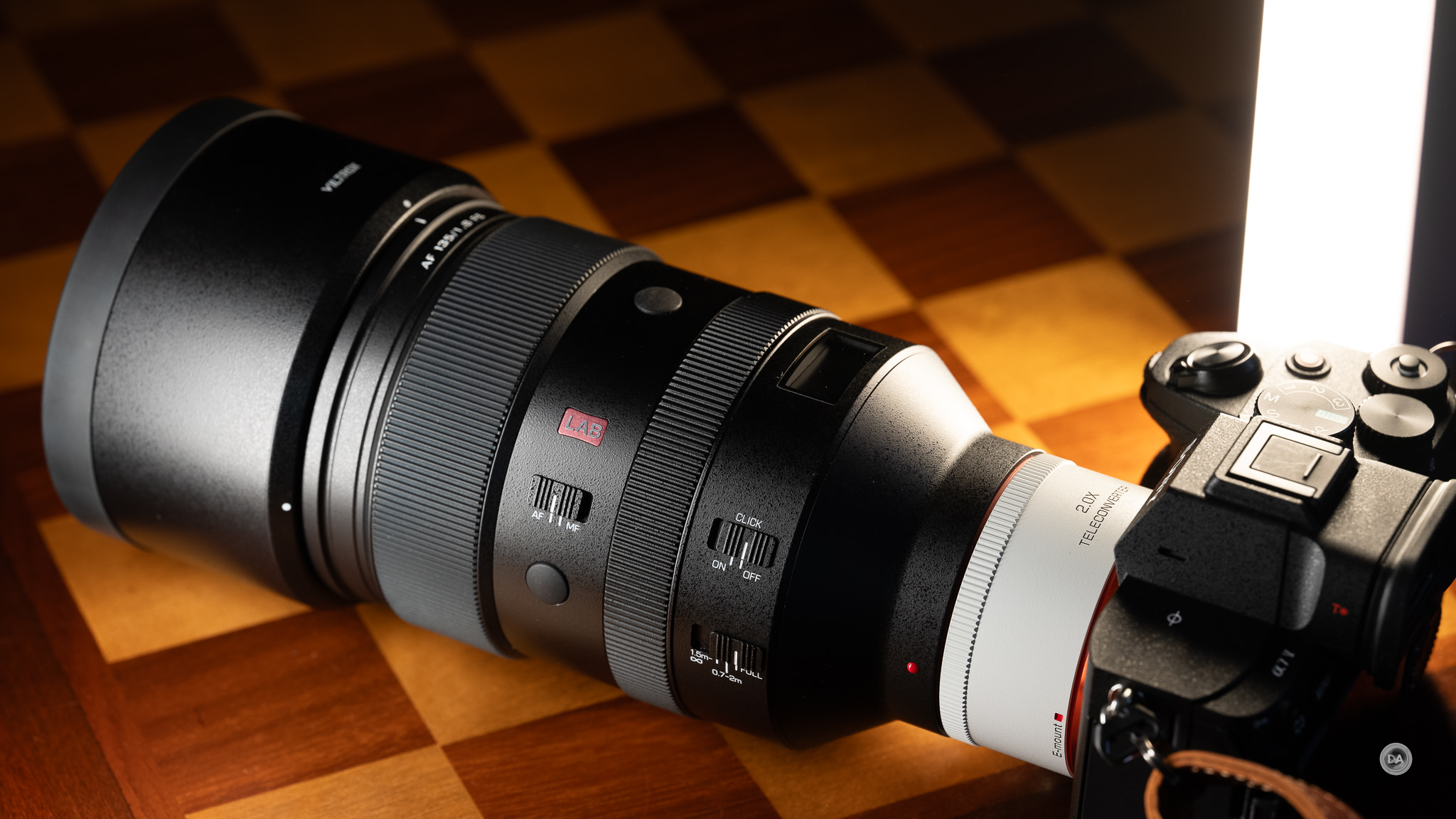
The ramifications of this teleconverter could be, well, complicated, depending on Sony’s reaction. This is almost certainly not an officially “sanctioned” product as it elminates one of the major barriers that Sony erected. While at the moment this TC only changes the status of one Viltrox lens – the LAB 135mm F1.8 – one can’t help but think that this is a preemptive salvo ahead of more telephoto lenses from Viltrox, which is an area that has been underserved by them in the past.
Key Features
- E-Mount Teleconverter
- 2.0x Magnification Factor
- Communication between Lens and Camera
- Compatible with Select Sony Lenses
- Weathersealed design
- USB-C Port for Firmware Upgrades
How Teleconverters Work
First, a bit on teleconverters for the unitiated. Teleconverters are particularly valued by those who have invested in big, expensive telephoto prime lenses, as a teleconverter allows that image to be magnified (as opposed to cropped) by introducing additional optical elements that take the image that your main lens has already formed and enlarges (magnifies) the central portion of that image before it reaches the sensor. That way the sensor records the full array of pixels, allowing one to either retain the full resolution or further crop afterwards. The common teleconverters (or extenders) are either 1.4x or 2.0x. The 1.4x magnifies the image by 1.4x (a 200mm lens becomes a 280mm lens) while the 2.0x magnifies the image by 2x (that same 200mm lens becomes a 400mm lens). An additional benefit is that because the teleconverter magnifies the existing image before it hits the sensor, the focus range of the lens doesn’t change. It doesn’t affect minimum focus distance or infinity, which means that the magnification level at that same close focus distance dramatically increases. In my recent review of the Sony 100mm F2.8 GM Macro lens (which this TC is now compatible with after the v1.03 firmware update), I noted that the 1.4x magnification of the native lens becomes 2.0x with a 1.4x TC attached and a whopping 2.8x with the 2.0x TC attached. In the case of the Viltrox LAB 135mm F1.8, the native 0.25x magnification grows to 0.50x.

My 70-200mm F4 G OSS II Macro lens has a native 0.50x, which is already very useful, but if I throw the TC-2.0x on there, that magnification jumps up to a full 1:1 level.
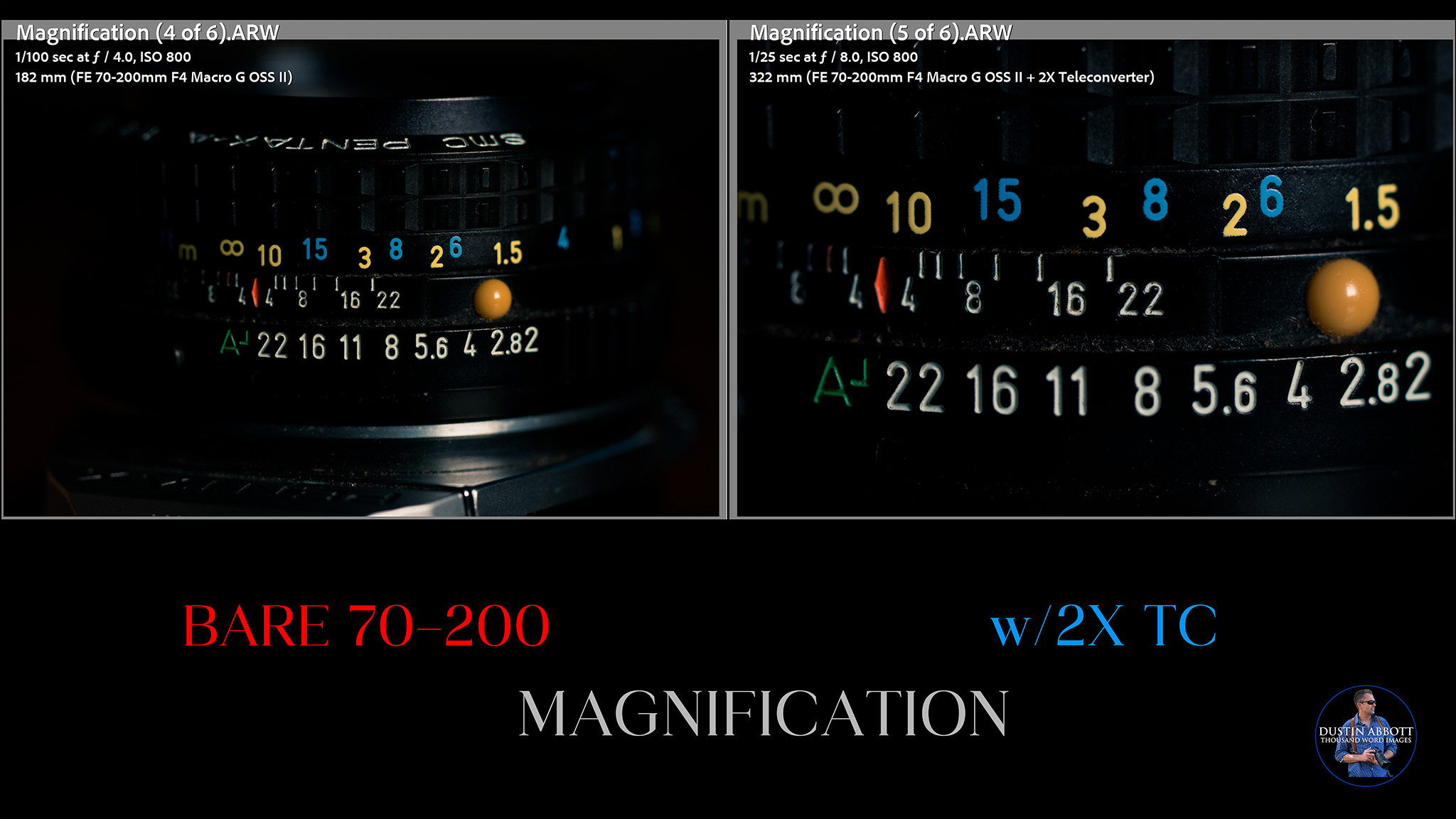
Now that is useful!
But all of these benefits come with costs, too. First of all, there are additional optical elements being introduced by the TC, and those cut down the amount of light that reaches the sensor. In the case of the TC-2.0x, that is 9 additional glass elements, which is more than some lenses! A 1.4x TC comes with a one stop penalty (an 200mm F2.8 lens becomes a 280mm F4 lens), while a 2.0x TC adds a two stop penalty (that same 200mm F2.8 lens becomes a 400mm F5.6 lens).

In theory, combining the LAB 135mm F1.8 with a 2.0x TC should result in a 270mm lens with a maximum aperture of F3.6 (round it up to F4), but due to a quirk in which the TC was designed around lenses with a maximum aperture of F2.8, the largest maximum aperture available with the combo is actually F5.6, which is unfortunate. I wondered if this would actually be the case, and discovered that yes, when I compared chart tested results under identical lighting, I got an exposure penalty of exactly three stops. When mounting my Sony 200-600mm F5-6.3 G lens, however, I got the expected F11-F13 range, which equals a two-stop penalty. Here is a 1200mm!! F13 shot from the Viltrox TC-2.0x and the Sony 200-600mm G lens.

The second potential liability of teleconverters is that the addition of glass elements brings the potential for degraded image quality. That could come in the form of more fringing, distortion, vignette, and less sharpness. In other words, you don’t want to put a cheap or poor-performing teleconverter in front of a good lens. I’ve often used the rule of thumb that a 1.4x provides some additional reach but with tolerable tradeoffs, while I’ve largely avoided 2.0x teleconverters because I feel like they come with too many compromises. For this reason I own Sony’s own 1.4x TC but not their 2.0x.
The third potential cost is that the teleconverter is reducing the amount of light that reaches the sensor, which means that the autofocus system has less to work with. In times past that could prove an insurmountable obstacle, but mirrorless cameras utilize a completely different approach to focus that seems more resilient to working with less light.
We’ll see how well Viltrox has done at mitigating these challenges.
Build and Features
Viltrox’s 2.0x TC doesn’t look much different than an equivalent Sony. It has a similar white(ish) finish, though I like the stylish splash of color that the weather sealing gasket provides at the mount of the Viltrox.

This is a weather sealed design, making it a good match for the professional lenses that it will mount on.
The TC-2.0x is significantly shorter than Sony’s own 2.0x TC at 29mm (1.1″) vs 42.7mm (1.67″). It is very slightly wider in diameter (66.3mm or 2.6″ vs 63.5mm or 2.5″) and weighs a bit more at 225g (7.9oz) vs 207mm (7.3oz).
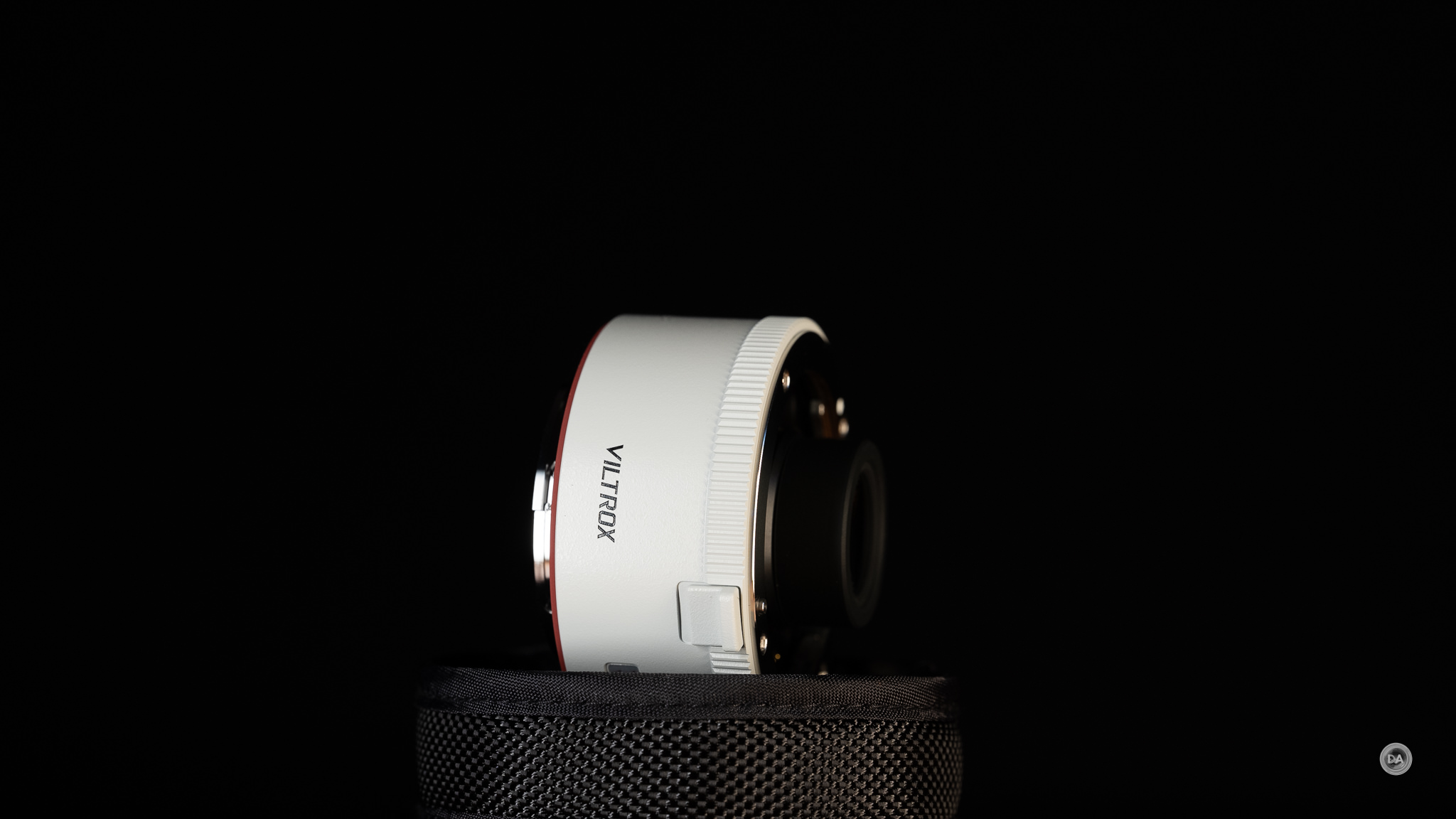
There is little on the barrel save the lens release lever and a ridged grip section to help with mounting and unmounting the lens.
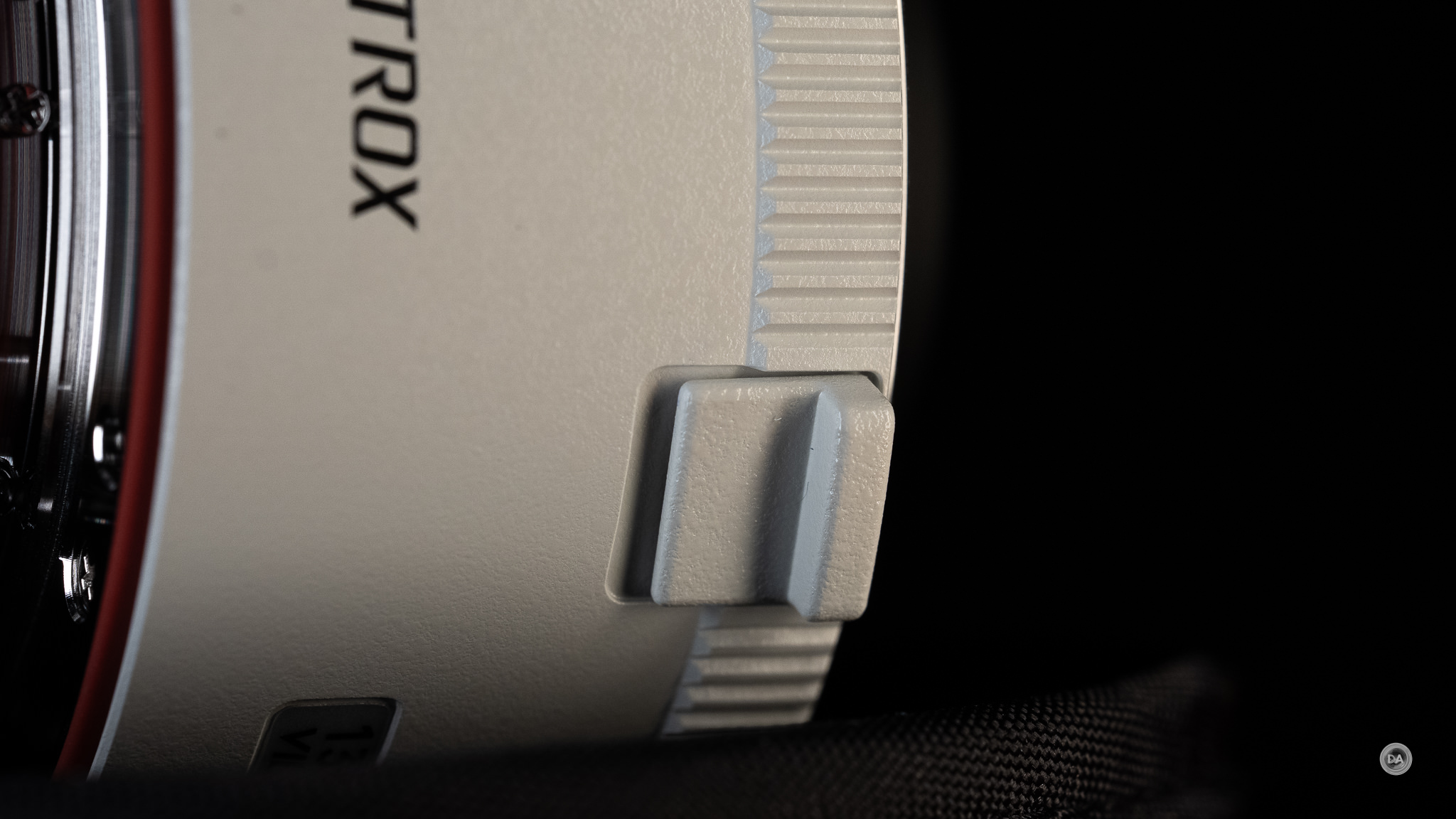
Overall it is very clean looking design that in no way looks or feels cheaper than my own Sony 1.4x.
It comes with a nice little zippered case for storage.
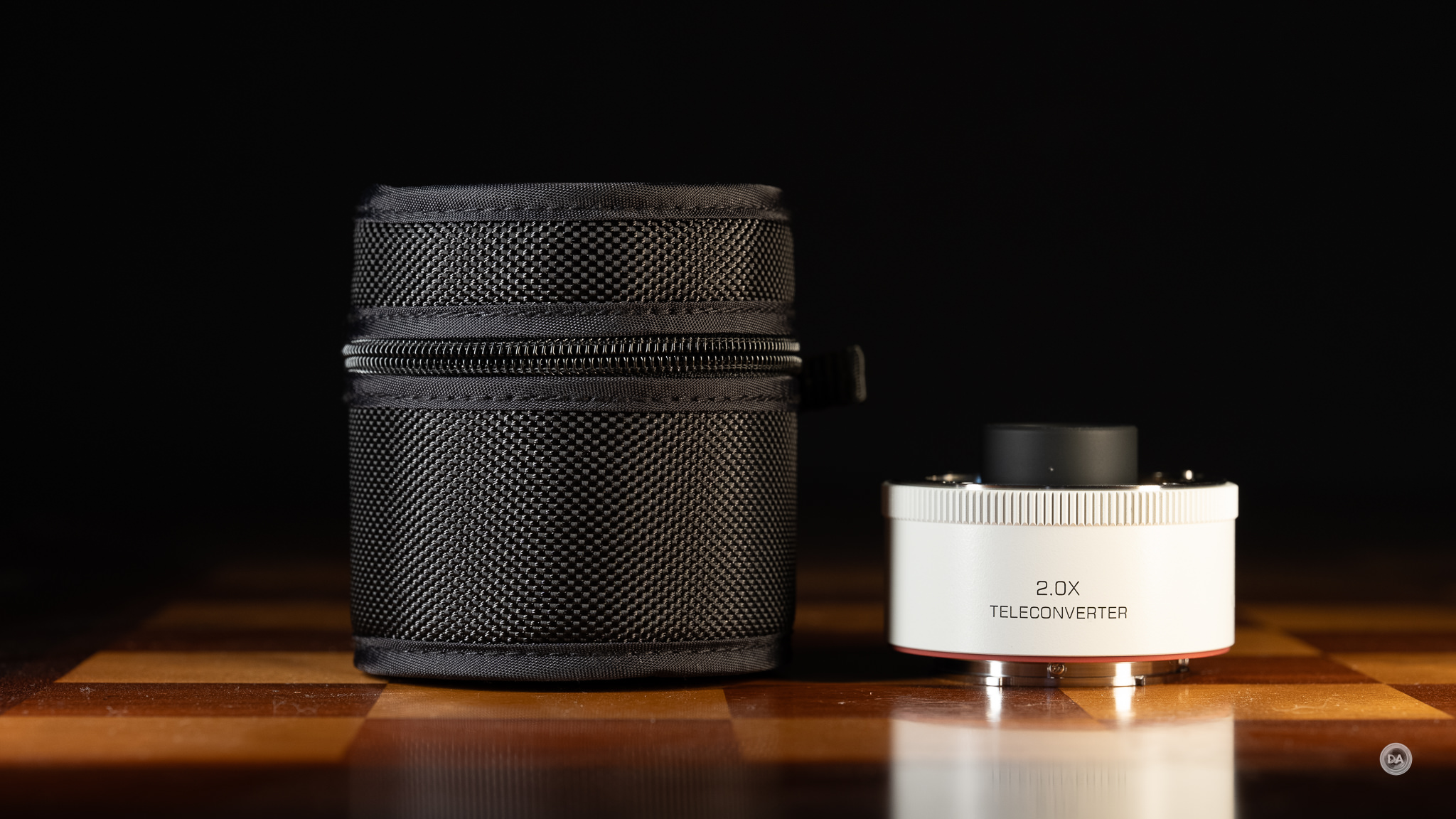
It does feature a USB-C port to allow for easy firmware updates, though it has been moved from the lens mount to the front of the TC.

Firmware updates are as simple and straightforward as updating Viltrox’s lenses.
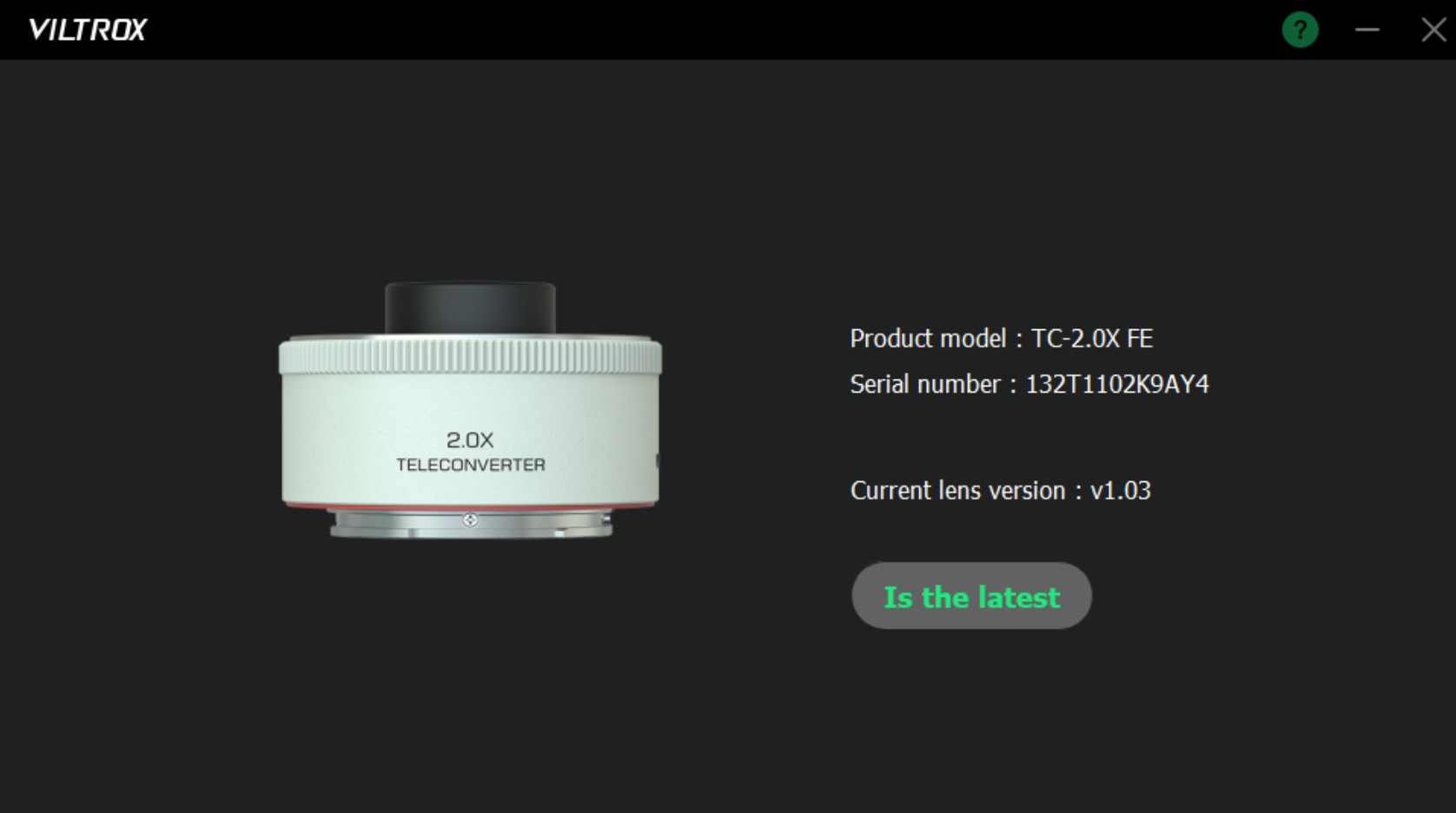
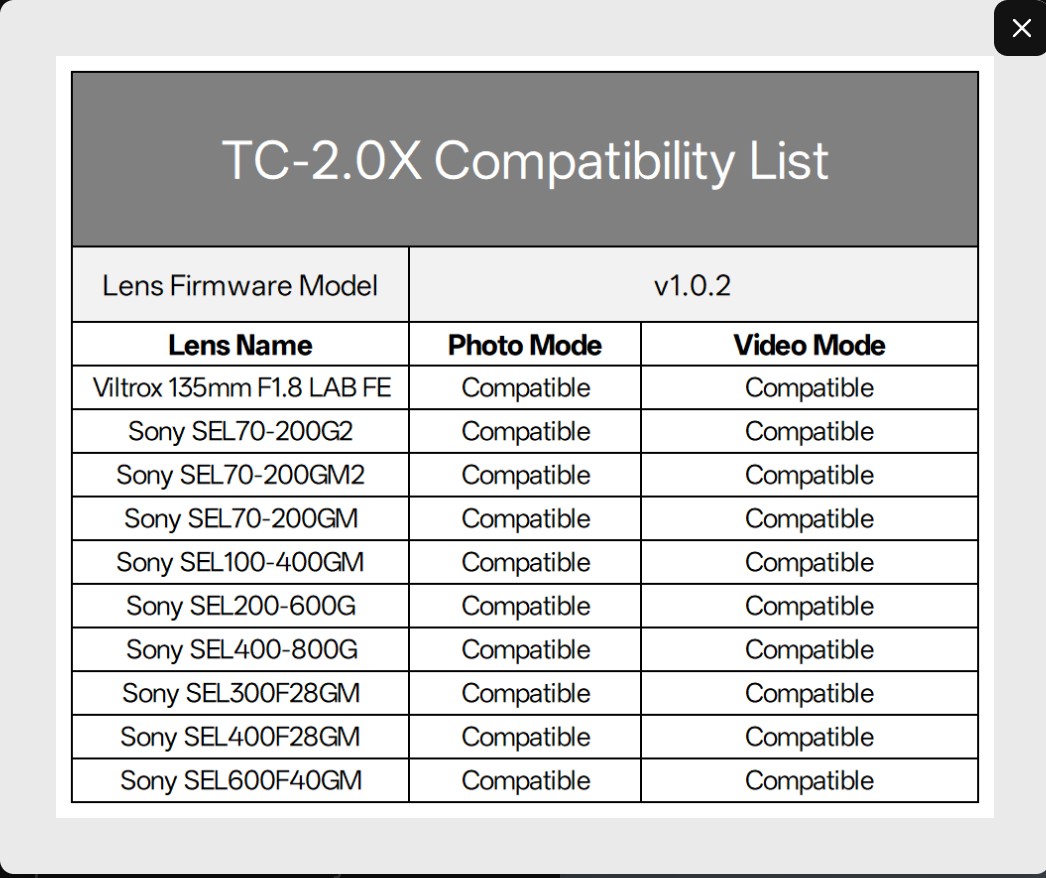
I consider this feature to be particularly important for this teleconverter, as since it isn’t an officially sanctioned product, it may need firmware updates to increase its compatibility with newly released lenses. The most recent update, for example, was targeted at adding the Sony 100mm F2.8 GM Macro to the list of compatible lenses. Here’s what the current list looks like (you can add the SEL100GM to the list with V1.0.3).
I had an opportunity to test it with the amazing new Sony FE 100-400mm F4.5 GM, and it worked just fine, creating a 200-800mm F9 lens. Here’s a shot from that combo.

I’ve heard reports from my audience that unofficial lenses like the Sigma 135mm F1.4 and 300-600mm F4 Sport do work, though with some reporting quirks. Your mileage may vary with lenses off the official list.
Autofocus Performance
Much like autofocus with adapters, the speed and quality of focus with a teleconverter is going to vary according to the combination of lens and camera. Unfortunately I only have two lenses on hand from this list, and I’m not sure that either reflects the optimal use of the TC-2.0x. I suspect that autofocus with the super-teles from Sony will be great, and I’m hoping performance will be excellent with both the Sony 70-200mm F4 G II and 100mm F2.8 GM Macro lenses, as those are both lenses I plan to acquire in 2026 (*I’ve now added the 70-200mm, and it works great!) Adding a 2x teleconverter can result in extremely long focal lengths combined with small maximum apertures, which brings some challenges.
Those caveats aside, however, autofocus is really pretty good with both those options. I was able to get fairly quick, well focused results with both lenses. Here’s a shot of Nala from the Viltrox combo:

If we zoom in close, we find that autofocus is accurate and the detail remains excellent.

Basic autofocus speed isn’t as fast as the native lens, but not far off, either. I feel like there is a bit more “spool up” of momentum and then the actual autofocus adjustment happens very quickly. You can see this demonstrated in my video review.
Results were better with a brighter lens like the new 100-400mm F4.5 GM, and shooting with the combo on my α1 II delivered results not quite as good as with the Sony 1.4x extender, but still easily good enough to get a lot of great results.


It is worth noting that when using a Sony lens with the Viltrox TC, the 15FPS restriction on third-party lenses does NOT apply, and I could get the full burst speed on my α1 II.
Autofocus speed when mounted on my 70-200mm F4 G OSS II lens is very good, and delivered good results.


Bottom line is that autofocus works fine, though you’ll get diminishing returns if you shoot with lenses that have smaller apertures to begin with.
Video AF
The Viltrox LAB/2.0TX does work for video work, too, providing stable results when I worked in front of the camera and moved towards it. It was effective at picking me back up if I stepped out of frame. Focus breathing is no more exaggerated because the teleconverter just magnifies the middle of the image. Here’s a screen grab from one of those clips as I lean in towards the camera:

Doing touch to focus pulls depended on the situation and how much contrast I had on my subjects. In some cases, touch to focus pulls were pretty decent, but in others I got some pulsing. I would say that you will get your best results using Sony lenses, and particularly those without insanely long focal lengths.
Thee biggest takeaway is that video AF works better than expected, but not as good as using the bare lens.
Optical Performance
The optical design is 9 elements in 5 groups, including 3 HR (High Refractive Index) elements.
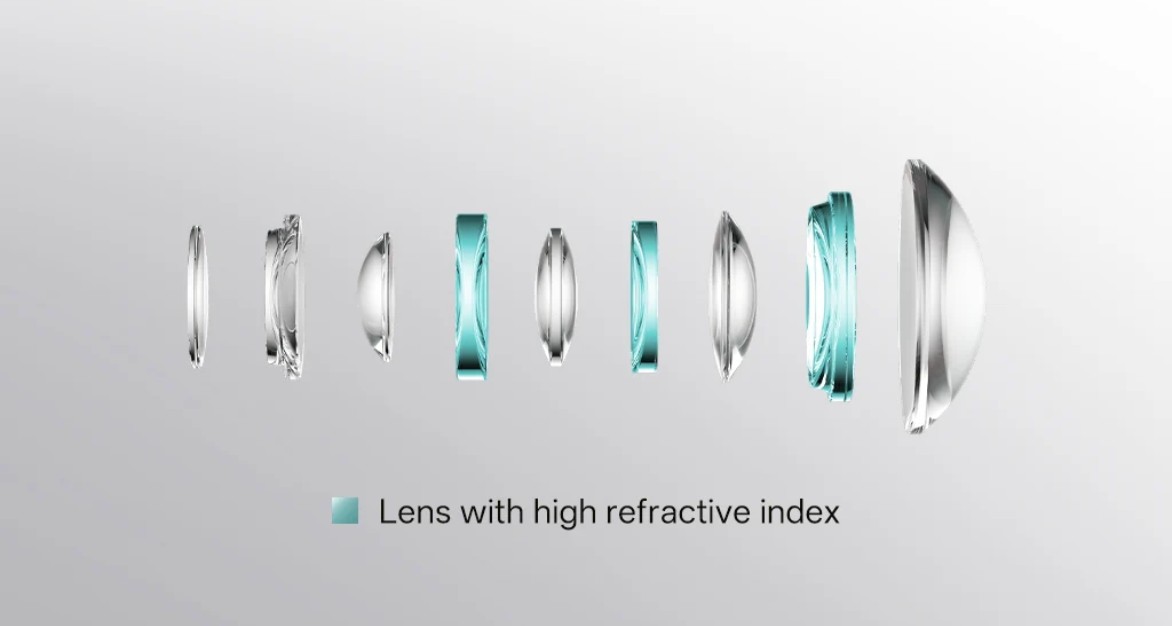
The big questions for any teleconverter involve how much negative optical impact using the TC will have. First, we’ll look at sharpness:

The great news is that even on a high resolution body (α1 II), I am getting very good sharpness on 50MP even when viewed at 200% magnification. Here’s the F5.6 crops from the center, mid-frame, and upper left corner.



It helps to start with a really, really sharp lens. How does that compare to the bare lens? Well, we can see that the TC version is a bit less sharp, but not by much. That’s true in the center…

…but also elsewhere in the frame.
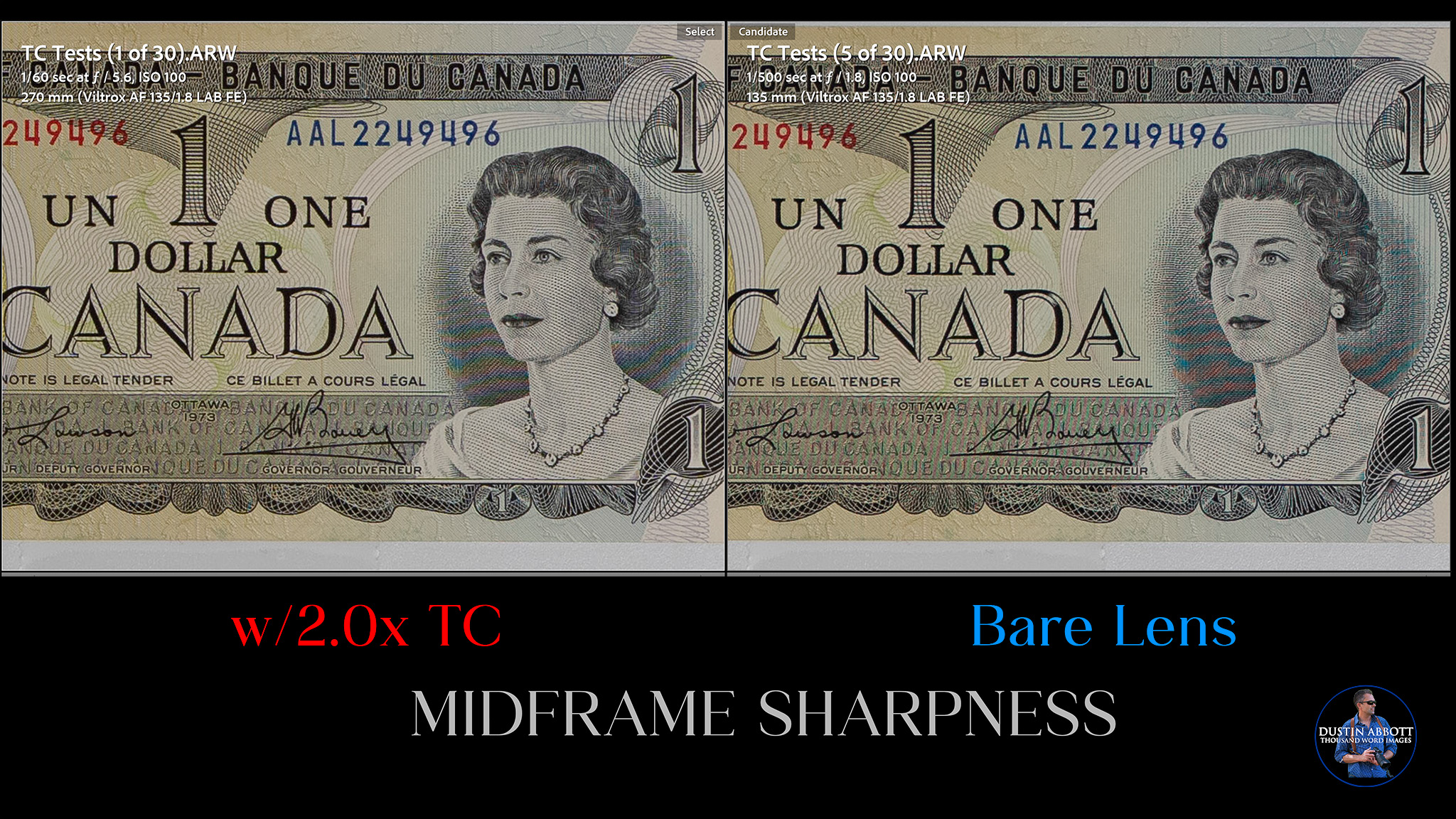
That’s not much of a penalty!
Neither did I find that I saw much in terms of additional distortion or vignette…at least with the 135mm LAB.

There was nothing to correct…just like the bare lens.
When I added the TC to a lens like the 100-400mm F4.5 GM, which has a bit of pincushion distortion, it introduced a bit of barrel distortion that basically cancelled out the pincushion distortion. No problem.
I also saw no additional issues with fringing with the LAB/TC combo, with transition areas remaining nicely neutral.

Every lens will react a little differently to the introduction of a teleconverter, so your mileage may vary, but I would say in general that the optics of the Viltrox TC-2.0x seem to be excellent.
Here’s a mini-gallery of further images taken with the camera for you to enjoy

























Conclusion
The Viltrox TC-2.0x comes with the typical caveats associated with teleconverters generally, but not much else. It seems to work effectively in everything from communication to autofocus to optical performance. Ironically it is most glitchy when used with Viltrox’s own lens, but, to be fair, that lens won’t work at all with Sony’s TCs. Sony lenses seem to work pretty seamlessly, and the fact that you can get the Viltrox TC-2.0x for less than half the investment makes it an attractive option for those who just wouldn’t be interested in spending the full amount for a Sony branded TC.
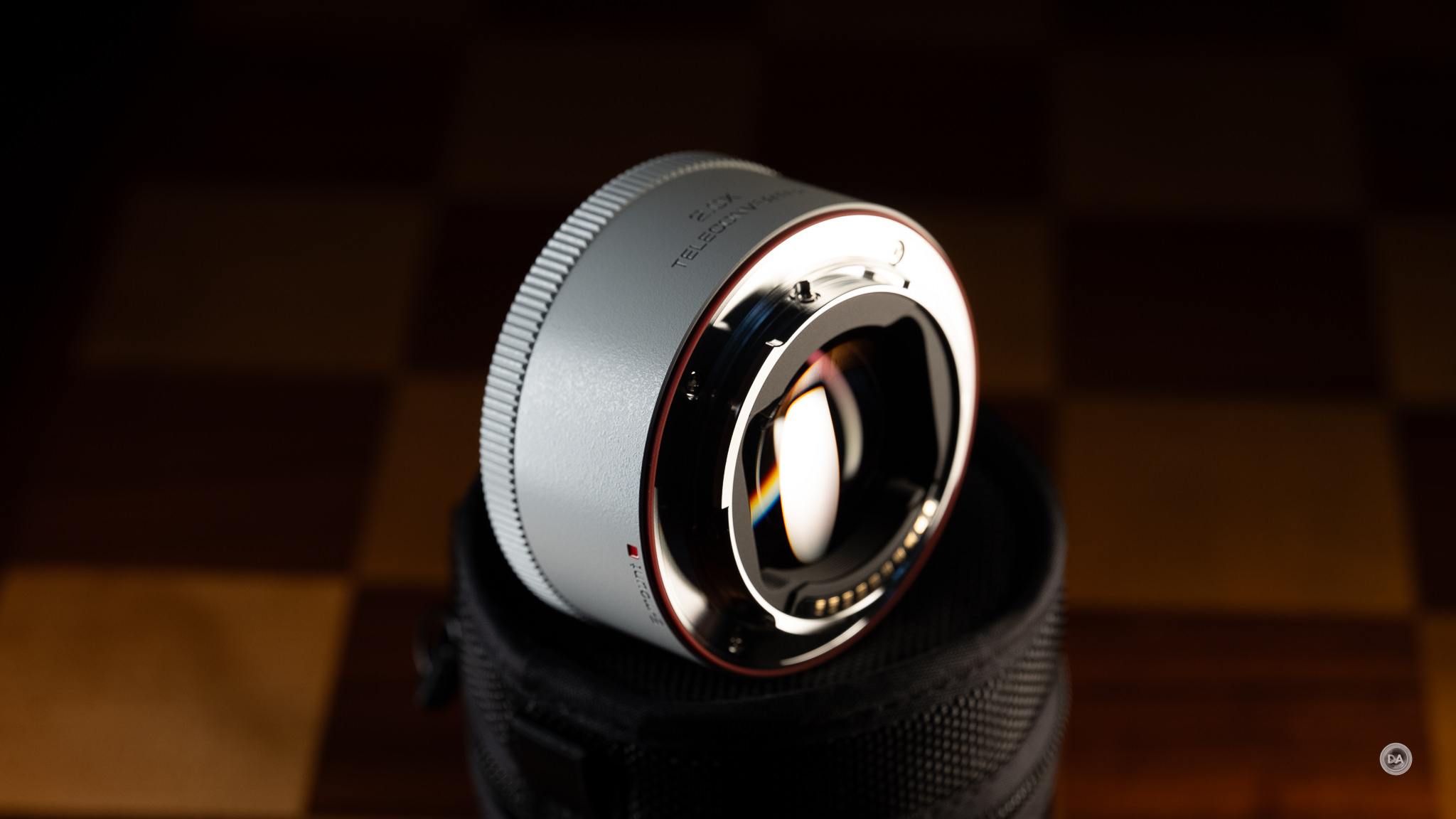
There’s not much downside to the product itself, though I’m hoping it doesn’t stir up Sony’s ire in some way. At the same time, however, this could be an opening for Sony to walk back what has become an increasingly contentious limitation on its platform. I’m sure a brand like Sigma would really love that!
And what we all want to know is what future lens Viltrox has in mind that will play nicely with this teleconverter. It certainly wasn’t the 135mm LAB, as it wasn’t even designed around a lens with this fast of an aperture. Here’s hoping some Viltrox zooms and telephoto primes are headed our way soon!
Pros:
- Beautiful design that feels just as “Pro” as Sony
- Weather sealed design
- Shorter than the Sony 2.0x TC
- Comes with a nice case
- Has USB-C port for easy firmware updates
- Broad compatibility
- Less than half the price of the Sony 2.0x TC
Cons:
- Viltrox’s one compatible lens (LAB 135mm) is a bit glitchy with it
- Sony may not be happy about this
_________________________________________________________________________
GEAR USED:
Purchase the Viltrox TC-2.0x @ Viltrox | B&H | Adorama | Amazon | Amazon Canada | Amazon UK | Amazon Germany
___________________________________________________________________
Purchase the Sony a7RV @ B&H Photo | Adorama | Amazon | Camera Canada | Sony Canada | Amazon Canada | Amazon UK | Amazon Germany
__________________________________________________________________
Purchase the Sony a7IV @ B&H Photo | Adorama | Amazon | Camera Canada | Sony Canada | Amazon Canada | Amazon UK | Amazon Germany
_________________________________________________________________
Purchase the Sony Alpha 1 @ Camera Canada | B&H Photo | Adorama | Amazon | Sony Canada | Amazon Canada | Amazon UK | Amazon Germany | Ebay
_________________________________________________________________
Want to support this channel? Use these affiliate links to shop at: B&H Photo | Amazon | Adorama | Camera Canada | Amazon Canada | Amazon UK | Ebay | Make a donation via Paypal
Buy DA Merchandise https://bit.ly/TWIMerch

Keywords: Teleconverter, TC, TC-2.0x, 2.0x, 2x, Viltrox TC-2.0x, Review, Viltrox, Hands On, Dustin Abbott, Real World, Comparison, Sharpness, Autofocus, Image Quality, Sample Images, Video, Photography, let the light in, weathersealing, #letthelightin, DA, #viltrox, #viltroxlens, #carrylessshootmore, #AIR, #EVO, #PRO, #LAB, #a7rV, #a1II, #tc-2x
Related posts:
 Viltrox LAB 135mm F1.8 VCM Review
 Viltrox LAB vs Samyang AF – 135mm Battle!
 Viltrox AF 135mm F1.8 LAB Z Review
 Viltrox Pro AF 27mm F1.2 E-Mount Review
 Viltrox AF 28mm F4.5 “Chip” X-mount Review
 Viltrox AF 85mm F1.4 PRO FE Review
 Viltrox Pro AF 50mm F1.4 FE Review
 Sony FE 100mm F2.8 Macro GM OSS Review
 Viltrox Pro AF 85mm F1.4 Z-mount Review
 Sony FE 100-400mm F4.5 GM OSS Review