

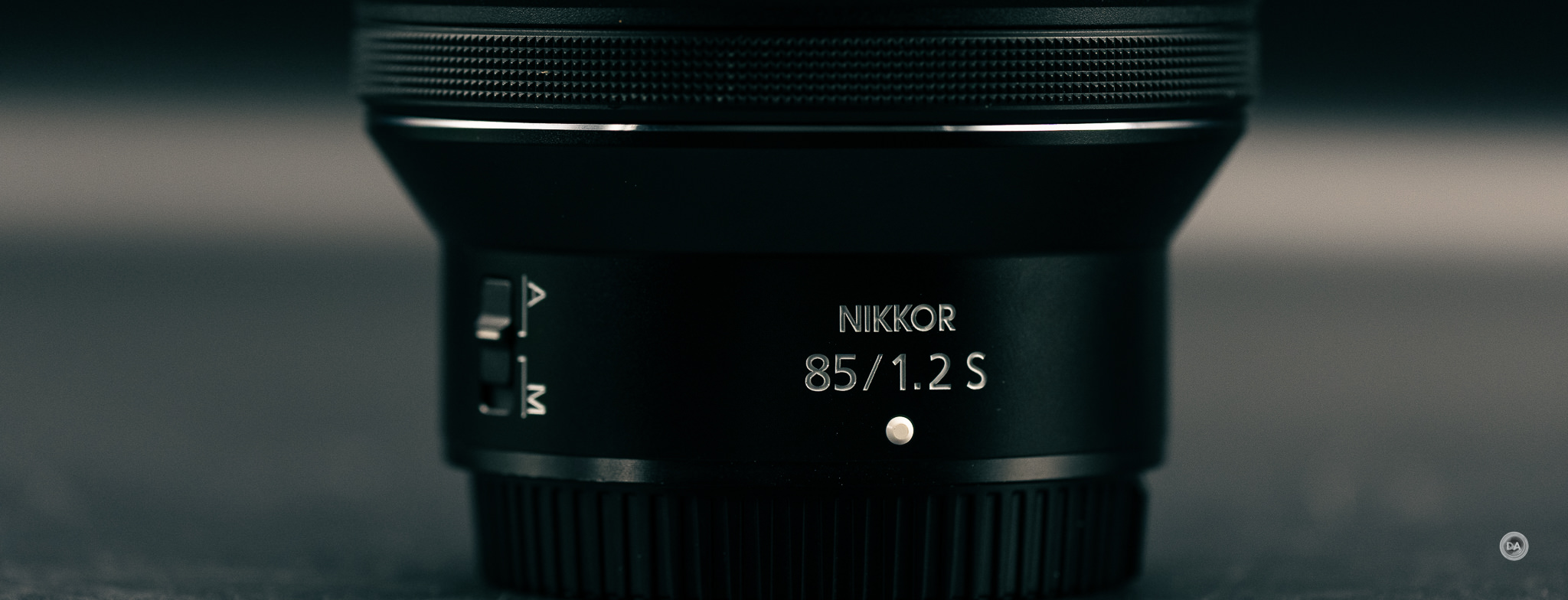
All of Nikon’s Z-mount F1.2 S lenses are extreme instruments. They are big, heavy, and expensive…not for the faint of heart. I’ve worked my way through out all of them and the 135mm F1.8 Plena to boot. The Nikkor Z 85mm F1.2 S is a nearly $3000 USD lens that weighs 1160g and is a whopping 141.5mm in length, but it is also an incredible instrument for making very special portraits. The Nikkor Z 85mm F1.2 S was released in the spring of 2023, and for the first three years of its existence, it was the only Z-mount autofocus lens with the combination of 85mm and a maximum aperture of F1.2. That has changed with the release of the impressive SongRaw 85mm F1.2 MS (my review here) and the rumored 85mm F1.2 LAB from Viltrox. Is the big Nikkor still the king of Z-mount portrait lenses? We’ll explore all those details in either the video review below or in this text review.
Follow Me @ YouTube | Patreon | Instagram | Facebook | DA Merchandise | Flickr | 500px | X
__________________________________________________________________________________________________
Thanks to Chris at Nikon Canada for sending me a review loaner of this lens. As always, this is a completely independent review. All opinions and conclusions are my own. *The tests and most of the photos that I share as a part of my review cycle have been done with the 45MP Nikon Z8, which I reviewed here. You can find the product listing page for the Nikkor Z 85mm F1.2 S here.
__________________________________________________________________________________________________
Nikkor Premium Fast Aperture Comparison
__________________________________________________________________________________________________
Summary: The Nikkor Z 85mm F1.2 S lens is a premium, heavy, and expensive option designed for serious portrait photographers, delivering exceptional image quality with a bright maximum aperture. Since its release in spring 2023, it has been recognized for its stunning detail and bokeh, but it faces competition from newer lenses like the SongRaw 85mm F1.2 MS and the upcoming Viltrox LAB 85mm F1.2. While the lens excels in build quality and optical performance, its size and weight, along with a limited feature set, may deter casual photographers. Overall, the Nikkor Z 85mm F1.2 S remains a top choice for professionals seeking unrivaled performance in flattering portraiture.
Strengths:
- Image Quality: Exceptional sharpness, contrast, and pleasing bokeh.
- Build Quality: Sturdy construction with extensive weather sealing.
- Portrait Performance: Ideal for subject isolation and backlit conditions.
Weaknesses:
- Size and Weight: Heavy and cumbersome, making it less portable.
- Limited Features: Lacks additional user controls compared to competitors.
- Autofocus Performance: While good, it does not match the speed and smoothness of some rival lenses.
__________________________________________________________________________________________________
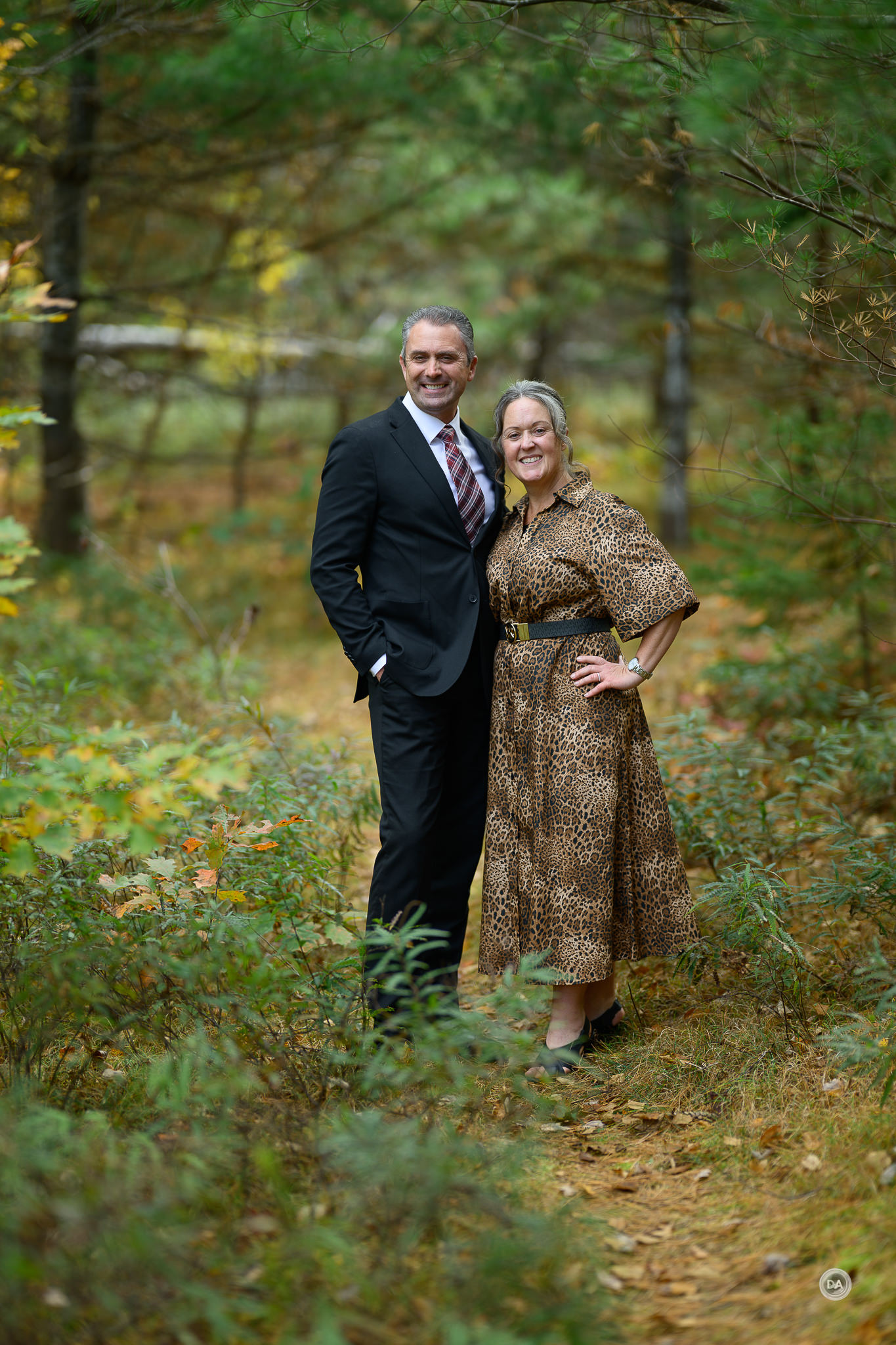
F1.2 lenses are incredibly for isolating subjects due to having that bright maximum aperture, and when you combine that with a longer focal length like 85mm you have the potential for very narrow depth of field. I love the ability to frame a subject with foreground objects while still have a nicely blurred background. Here’s one of me and my lovely wife of nearly 30 years.
This will also be a big lens (in every way) for wedding photographers and anyone else who just loves extremely bright lenses. These F1.2 S-Line lenses are extremely big and heavy, but what they give is extremely levels of detail and contrast even at F1.2 while still provide nice bokeh, too.


The 85mm F1.2 S is excellent at F4 and F5.6, but so are a lot of smaller, lighter, and cheaper lenses, so a lot of the images I share will be at very large apertures.

This is an extreme instrument – is it worth buying? Let’s dive in.
Nikkor 85mm F1.2 S Build and Handling
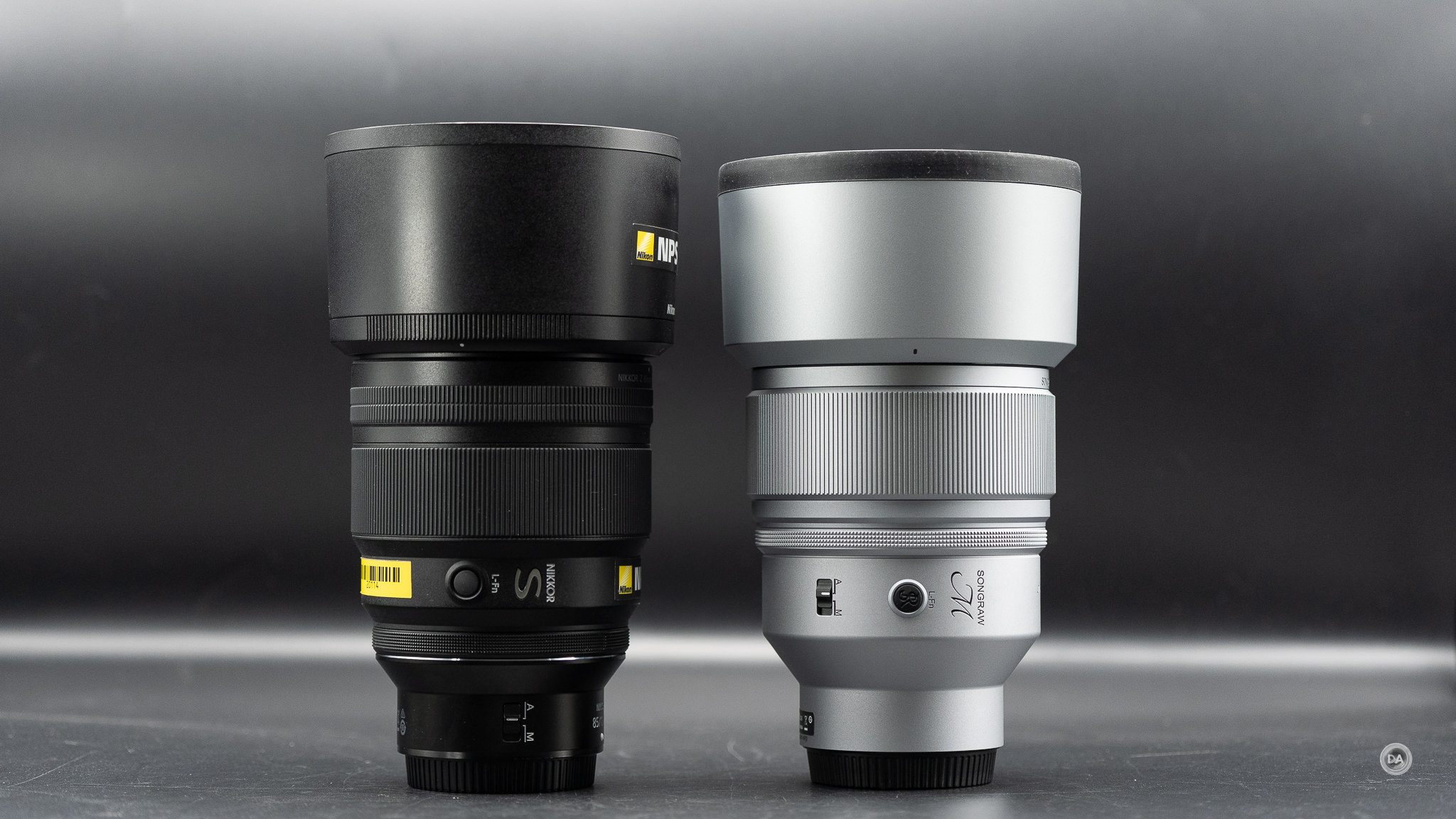
Nikon’s lineup of Z-mount premium lenses – the S-Line lenses – is known for many things, but being small is not one of them. I found the SongRaw 85mm F1.2 ridiculously big in my recent review, but when the S-Line arrived, it was longer and heavier, though a hair slimmer.
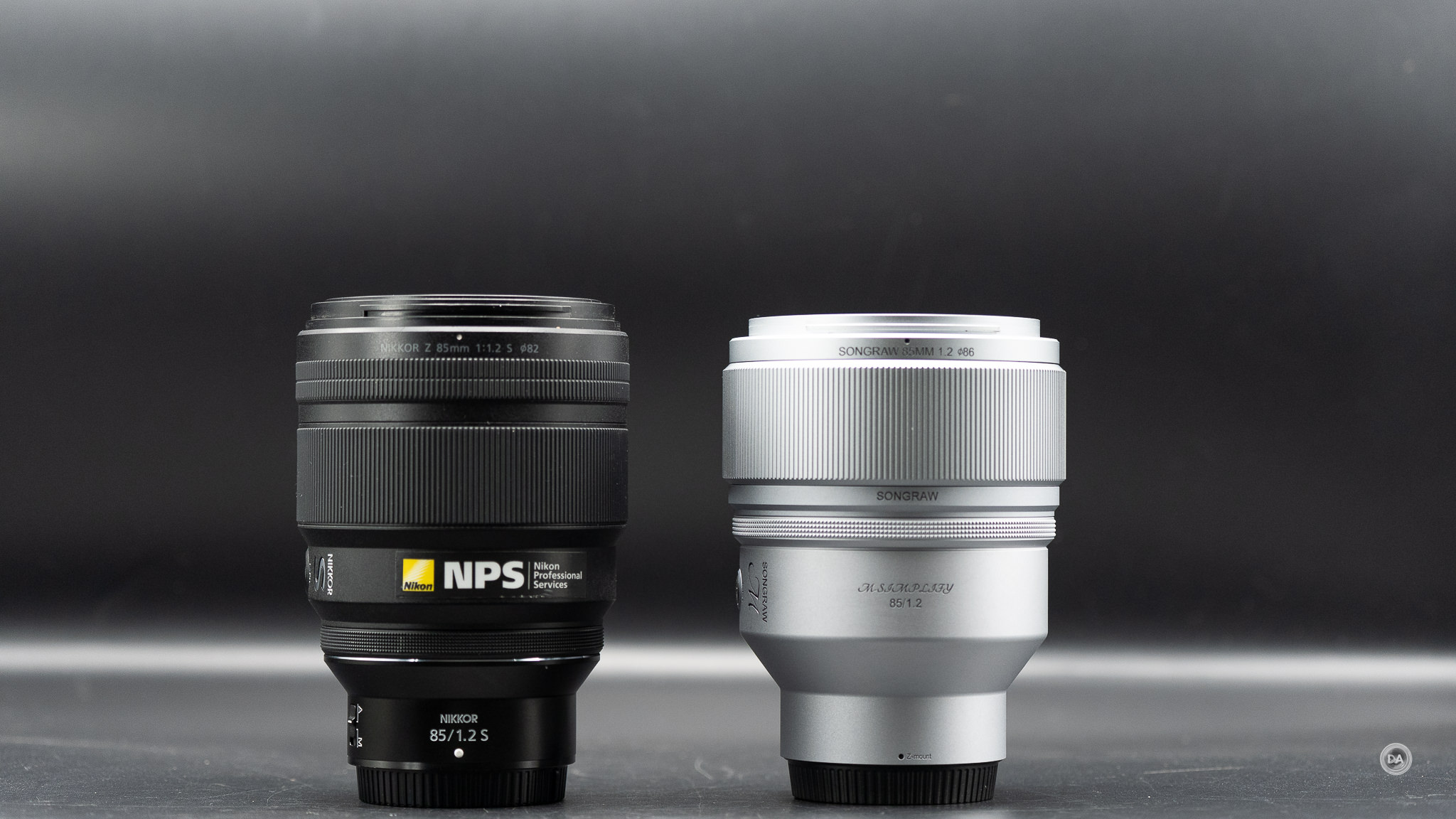
*My test loaner comes through Nikon Canada’s Professional Services, so there is some additional stickers on it that aren’t “stock”.
This is a BIG lens. That is the first thing that you notice about it. It is 102.5mm (4″) in diameter and a whopping 141.5mm (5.6″) in length. It weighs 1160g (2.6lb). Just yesterday I was shooting at a scenic overlook and the family there looked at the lens mounted on my Z8 and immediately said (out loud), “there’s a professional photographer”. It happened to be true, but prepare for everyone to assume that of you, too, whether you are or not. By the time you have the lens mounted on your camera with the deep lens hood in place, it looks like you have a significant telephoto lens on your camera.
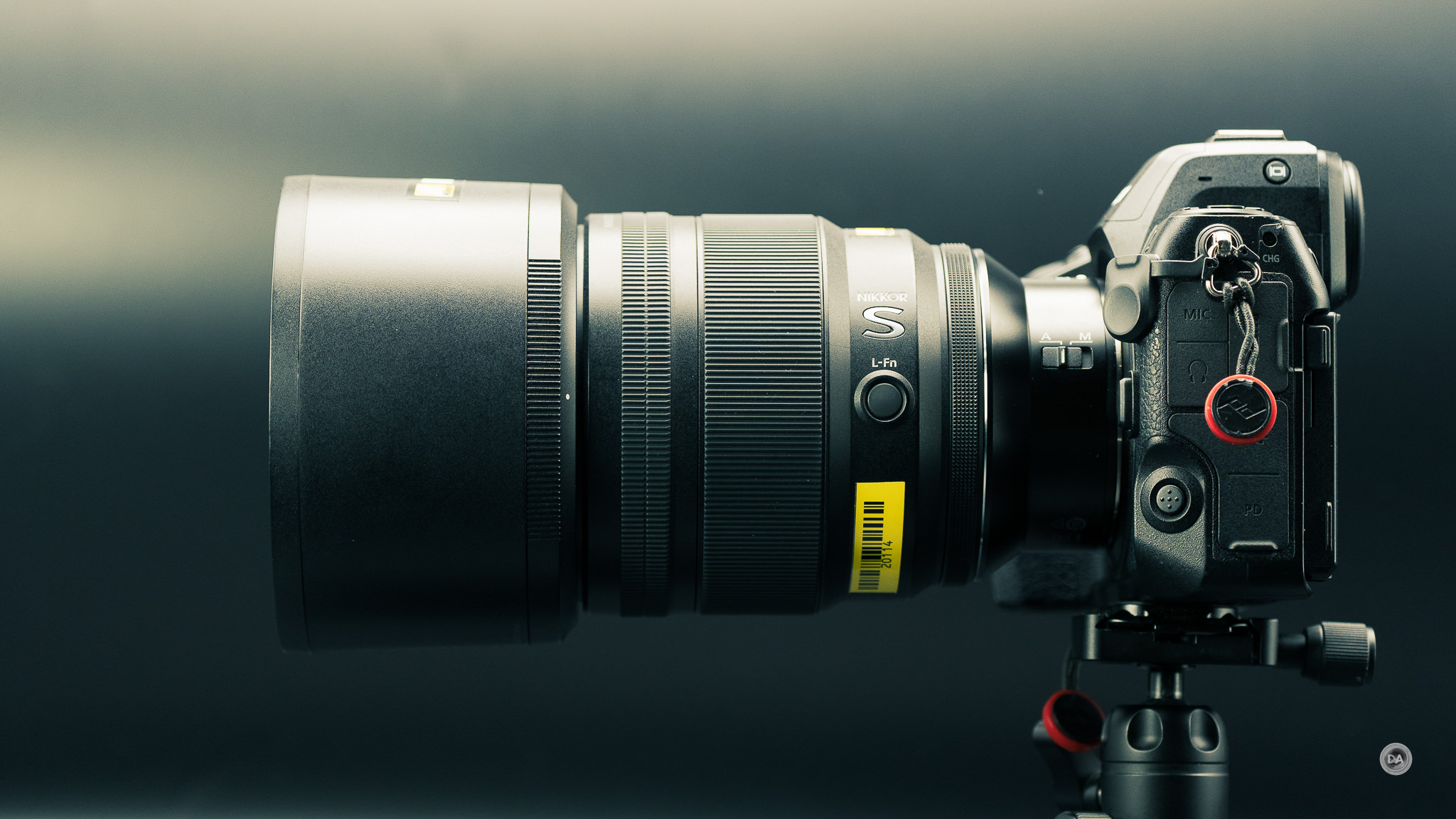
Ironically, though the lens is actually very long, when you remove the lens hood the profile actually looks surprisingly squat because the diameter is so much bigger than the average lens.
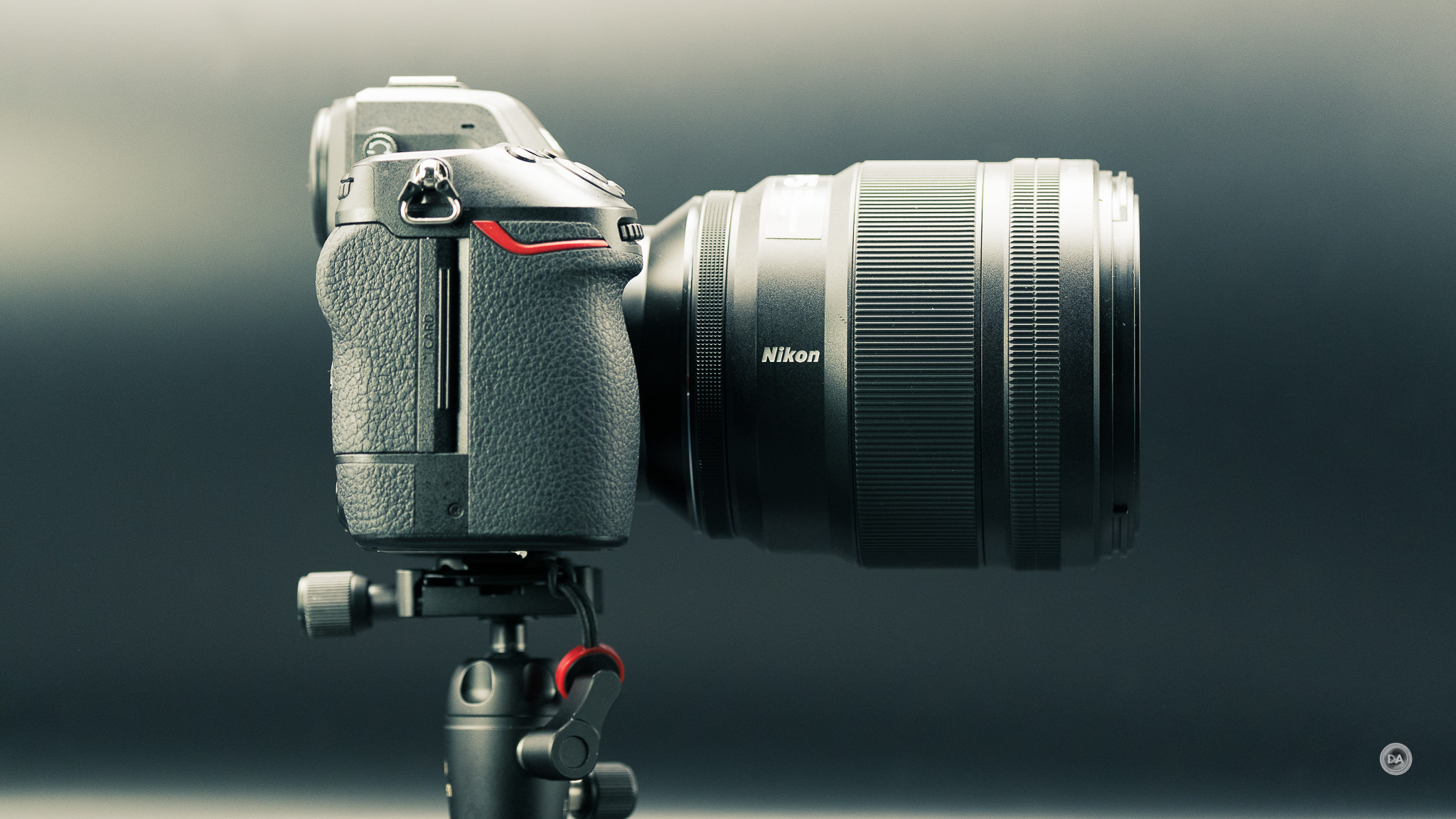
For many people this lens will be better suited for a studio or shooting portraiture in an environment where you can carry the lens to location in a backpack or a roller bag, as it probably won’t be comfortable to carry on a standard strap for an extended period of time.
What makes this a big, heavy lens is that there is a massive amount of glass inside right past those 82mm front filter threads.

The 85mm F1.2 S is a premium lens with an excellent build. It has a tough outer shell of metal alloys and engineered plastics, and a thorough degree of weather sealing.
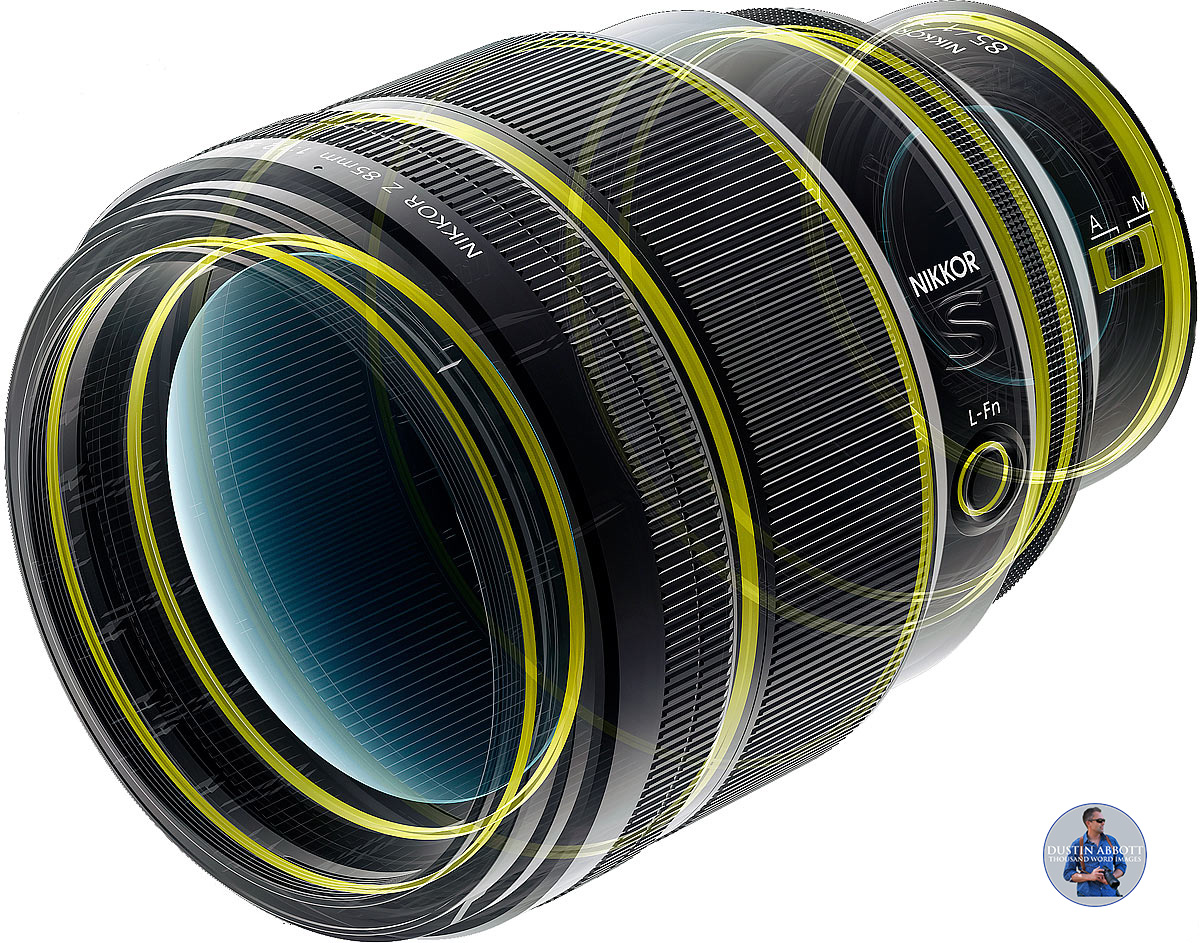
There is a protective coating on the front and rear elements and then roughly 9 (by my count) internal seals at the rings, buttons, and switches. That allows you to have confidence when shooting in the elements.
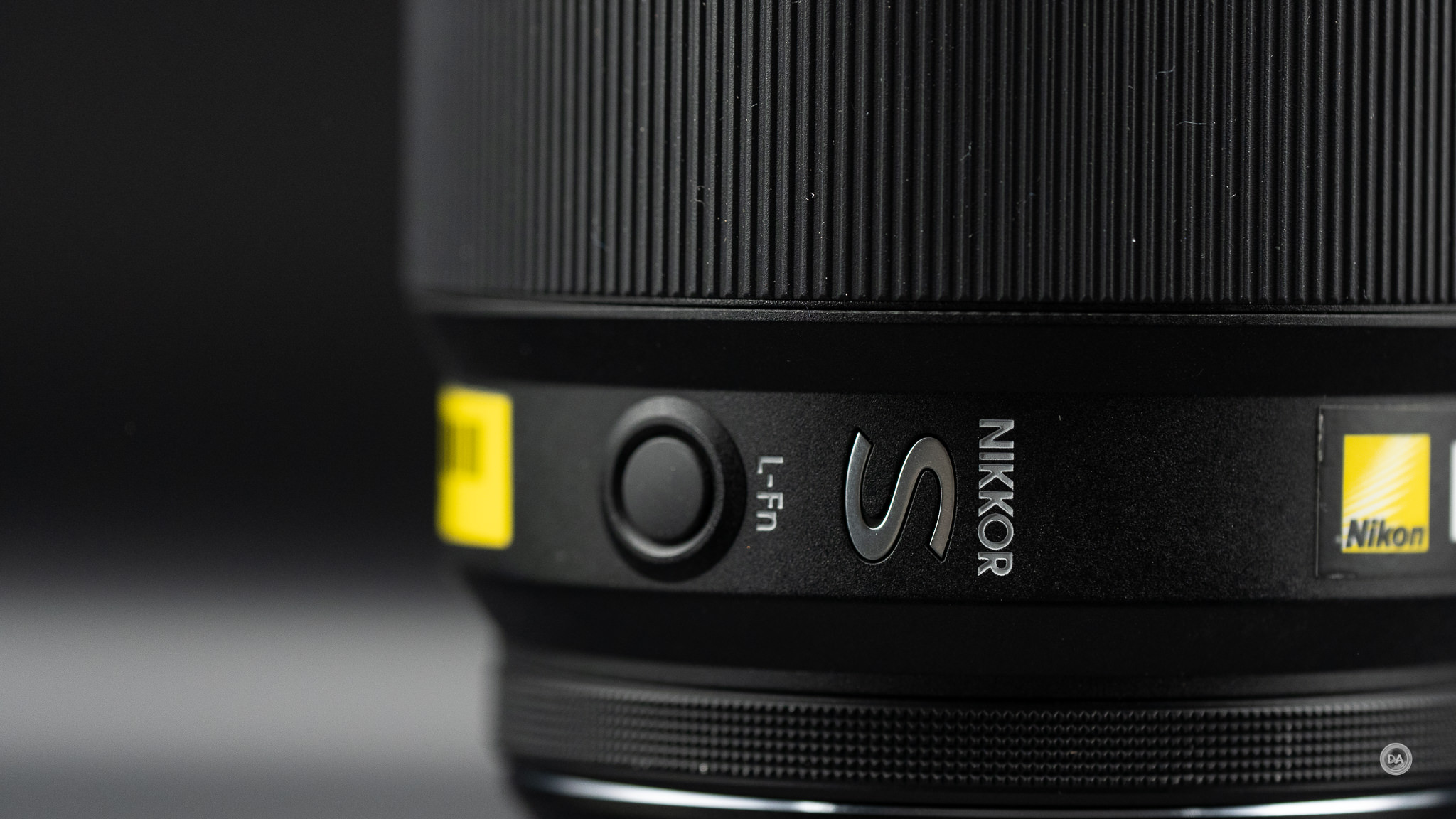
I’m a little underwhelmed by the feature set of Nikon’s premium lenses. The feature set is essentially the customizable control ring, an AF | MF switch, and one Function (Custom) button. Brands like Sony give you far more physical controls on their lenses. We essentially have no more controls than the inexpensive SongRaw lens, and while the cheaper MS version shown here lacks the control ring, the Moonlit version arriving soon will have an aperture ring that has the option of being declicked.
One other critique I have across many of Nikon’s lenses is that the AF | MF switch is located in an ergonomically difficult spot. It sits close to the lens mount, and on a body like my Z8, it is sandwiched between the sync port above and the lens release button below, making it less than ideal to access.
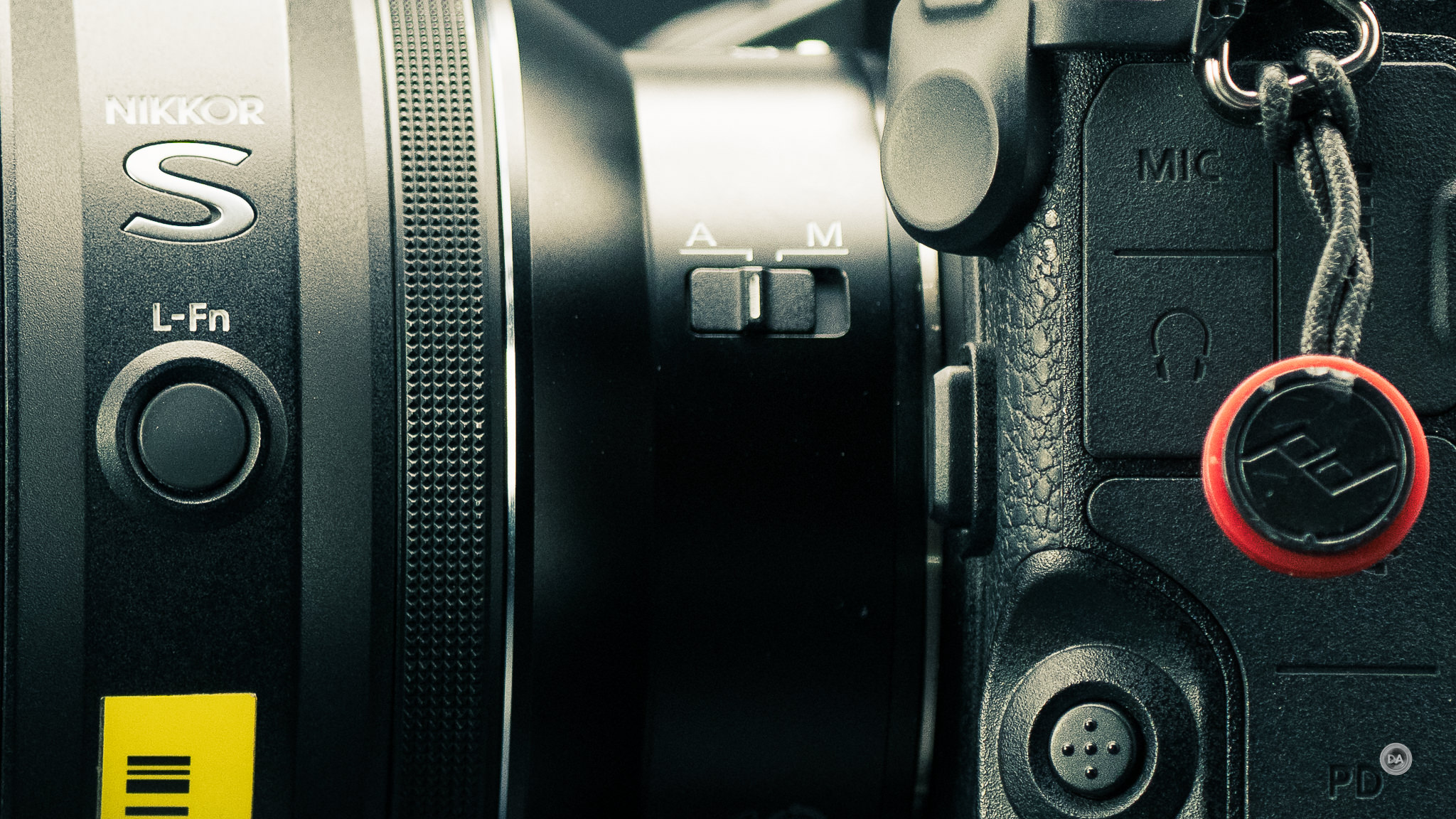
Perhaps placing it on the same tier with the Fn buttons would have made more sense.
Next comes Nikon’s clickless “customizable control ring”, which could serve as a manual aperture ring but could also function to control ISO, exposure compensation, or a few other functions – whatever you’ve set up the ring to do in the menus. Those controls can be found in the Custom Settings menu, then by selecting group F (Controls), and finally choosing custom setting F2 (Custom Controls Shooting) to change the function of the ring.
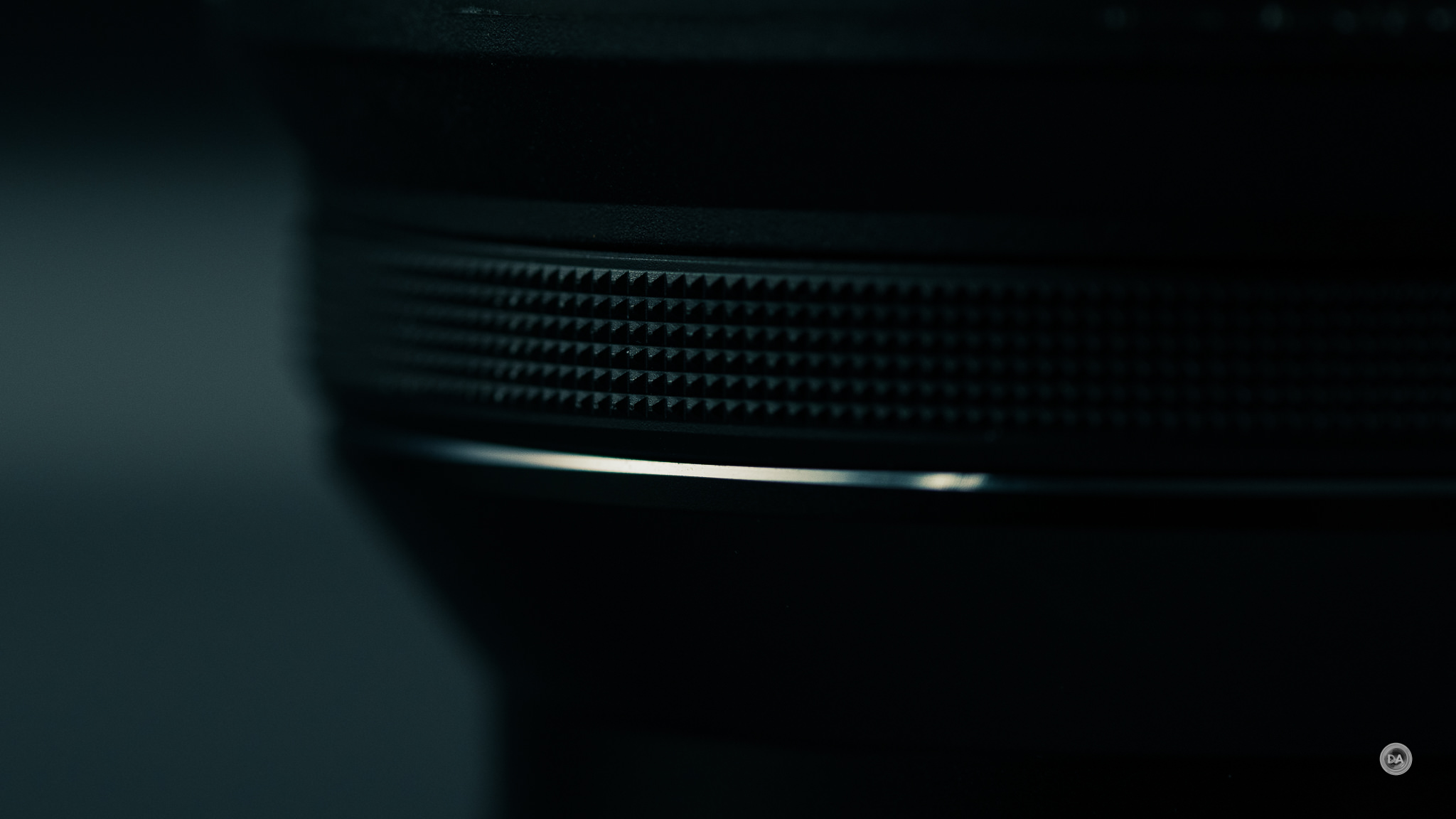
As an aside, I will note that I was able to do smooth aperture racks through the control ring without any visible steps, though there is some obvious lag in that the lens will continue to open or close the aperture for about a stop after you stop twisting the aperture ring if you are making significant changes.
There’s no click/declick option, and the ring would actually be more useful with clicks in stills mode because you could more easily use with precision for aperture control. Nikkor moved away from having OLED screens on their premium lenses, and I think it would be fairly easy to argue that this makes the control ring less useful. I personally would prefer a traditional aperture ring, but your mileage may vary.
The aperture iris has eleven rounded blades, and the aperture iris definitely does a nice job of keeping the specular highlights round. Here’s a look at F1.2, F2, and and F2.8:


Here’s what that aperture iris looks like from the inside.
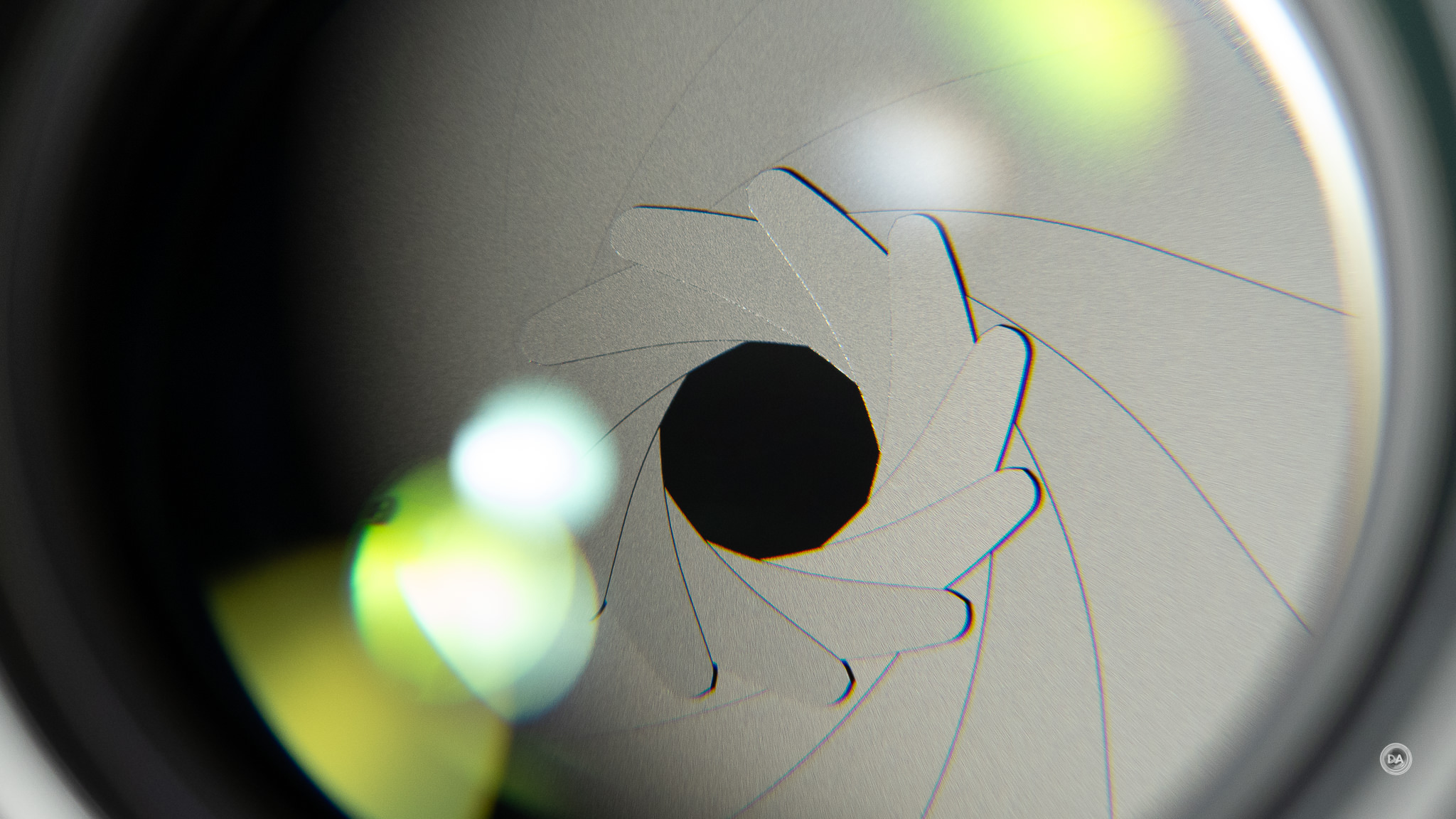
I’m not sure what dictates whether the front or back of the aperture blades are facing out. The 35mm F1.2 S showed the back of the aperture blades, which I personally prefer as it gives more a “James Bond” look.
The manual focus ring is slightly raised and has a rubberized, ribbed texture. It moves relatively smoothly, though I did experience some drag from the focus motor if making a bigger focus change. It’s in a moment like this that I realize that the STM focus motors in Nikon’s lenses aren’t nearly as polished as their new SSVCM (Silky Smooth VoiceCoil Motor).
Full time manual override is available.
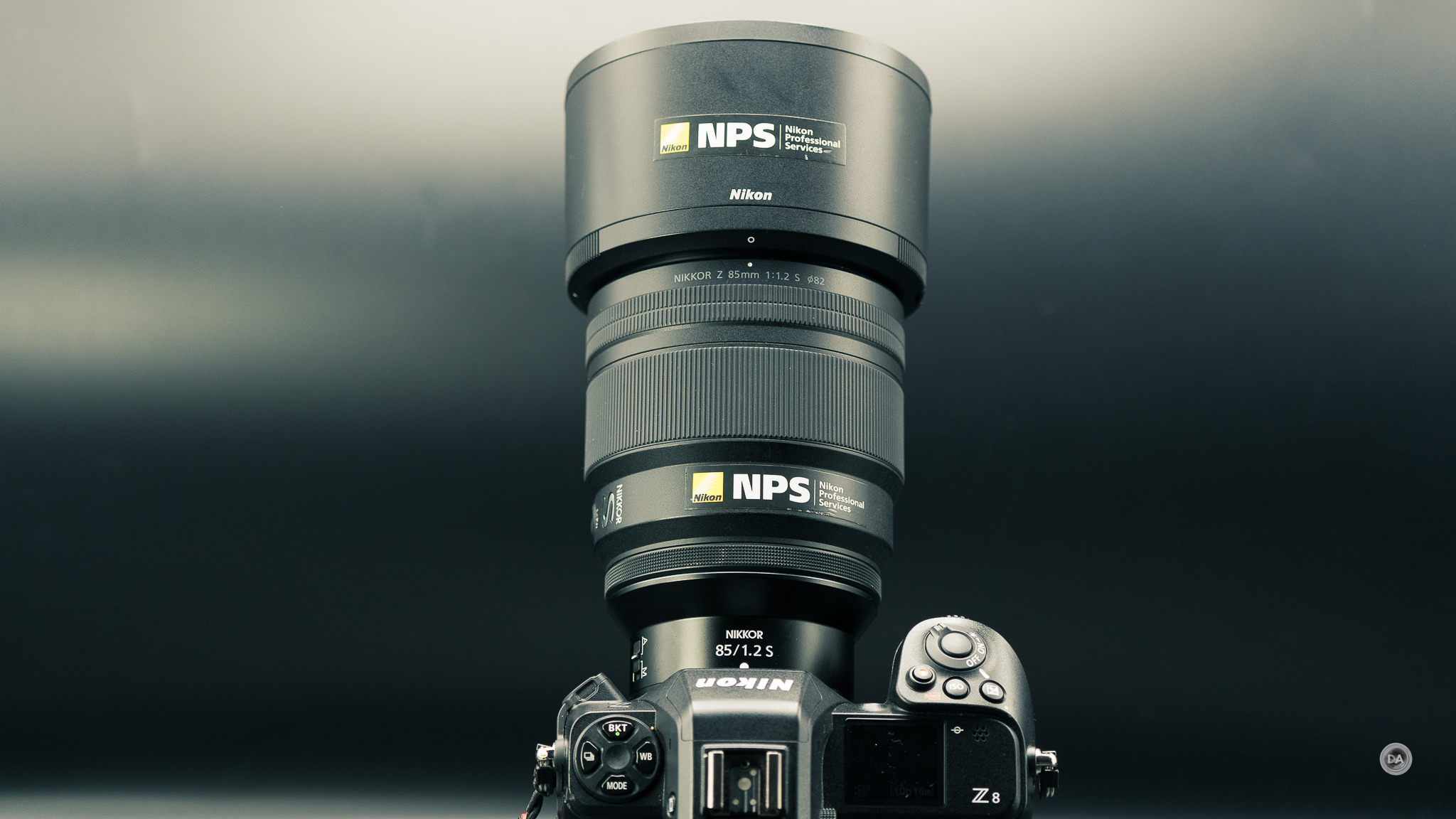
You’ll note that there is a third rubberized section near the front of the lens that looks like another ring but is actually just a section with extra grip for either aesthetic purposes or to provide a section to grab when mounting/unmounting the lens. This is a common Nikon design element.
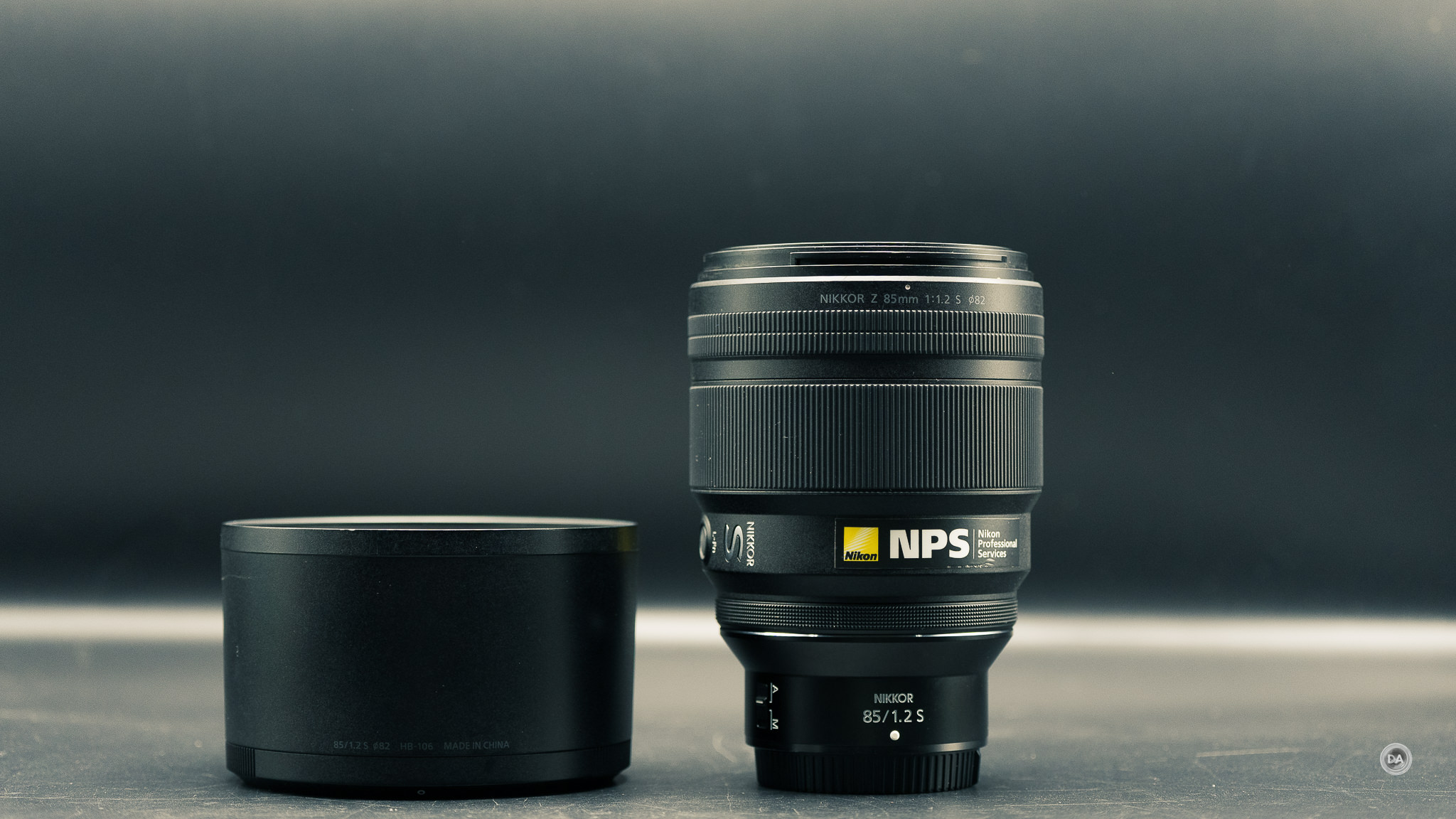
The deep lens does have a small lock on the right side. It is made of plastics and feels fairly ordinary.
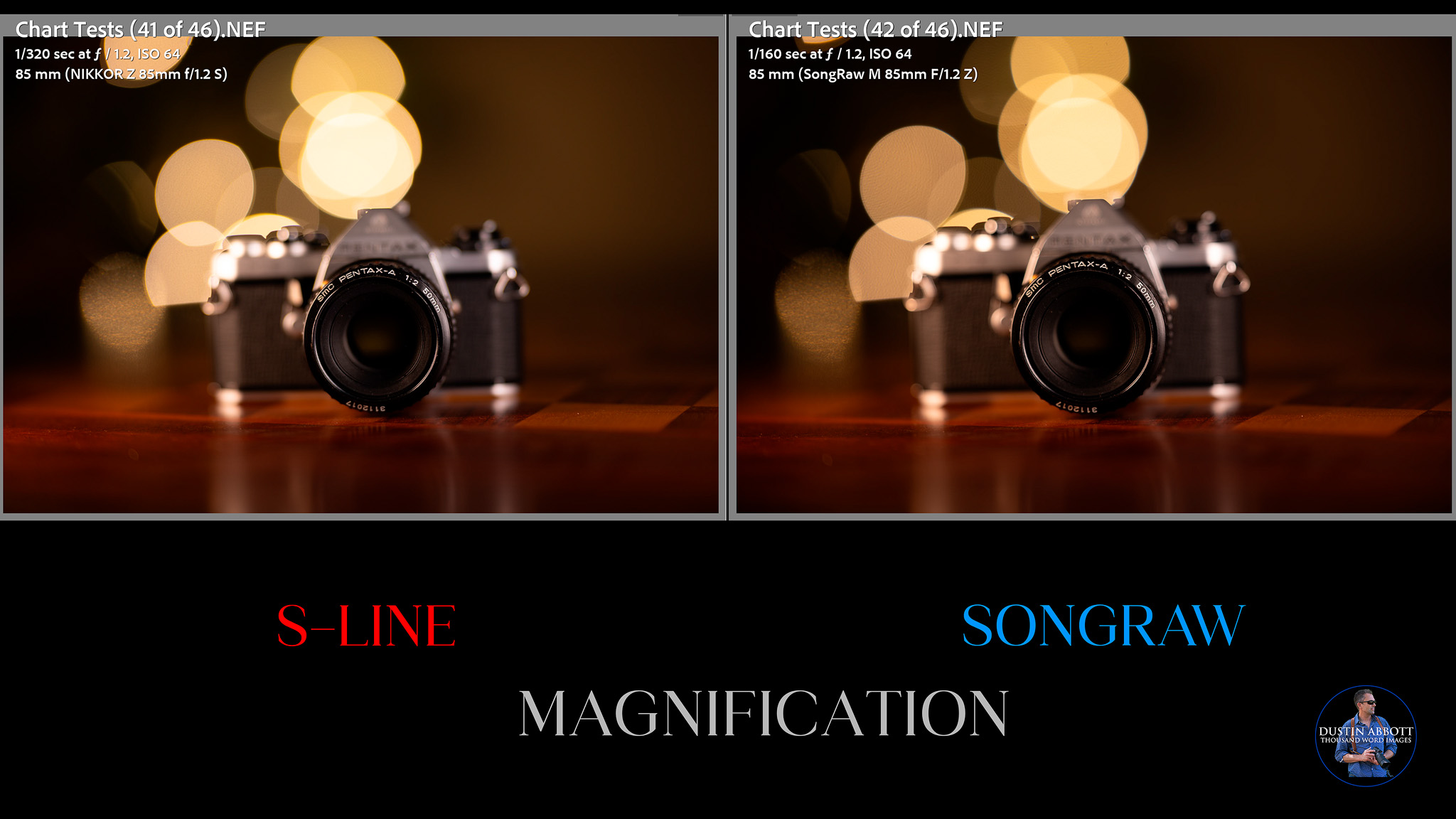
Minimum focus distance is 85cm, giving a maximum magnification figure of 1:9.09, or 0.11x. This, unfortunately, is on the low side of performance for an 85mm lens. Here’s what the magnification looks like:

Close focus contrast and detail are good, with good clarity and detail. You can see from above that the plane of focus is nice and flat, and you can see below that the lens handles shiny objects with the potential for fringing well.

The recently released SongRaw gives a very slightly higher level of magnification (you can see the camera at the right is slightly more magnified), but I suspect most would conclude that this isn’t a meaningful difference.
There is no VR (vibration reduction, or optical stabilization) built into the lens. That’s not a problem on a body like my Z8, which has good camera based stabilization, but could be a problem for those of you shooting on a camera without VR. That’s particularly true for video, as while F1.2 will often allow you to achieve the fast shutter speeds necessary to offset camera shake, that makes less of a difference when recording video.
This is a big, heavy, expensive lens just like every other F1.2 S-Line lens. These lenses are not for people who want to travel light or feel overwhelmed by handling heavy lenses. This is for people who care more about image quality than anything else. The Canon RF 85mm F1.2L is just as expensive and even a bit heavier. The SongRaw is only 40g lighter, and the Moonlit version will be even heavier. Only the new Sigma 85mm F1.2 ART (not available on Z-mount) is meaningfully smaller and lighter, weighing just 905g.
85mm F1.2 S Autofocus Performance for Stills
Until recently, Nikon continued to use STM focus motors even in their premium lenses. They have started putting SSVCM voicecoil motors in their some of their ultra-telephoto primes and a few high-end zooms, but for the most part their use of the higher-end focus motor is actually fairly rare. In this case, we have dual STM focus motors which give us good but not excellent autofocus. The Sigma 85mm F1.2 that I reviewed here definitely has superior autofocus dual to employing dual HLA focus motors (similar to Nikon’s SSVCM). The Sigma focuses faster, smoother, and quieter. The recently released SongRaw employs a single STM focus motor, and its autofocus feels less sophisticated than the Nikkor’s. Nikon had already deployed SSVCM before the release of the 85mm F1.2 S, so I assume their thinking was that this wasn’t going to be a lens used for sports anyway, and that the dual-STM setup was fine for the primary purpose of portraiture…and they are probably right.


Focus was extremely accurate and capable for portrait work, delivering well focused results even at F1.2. Focus was also accurate in other settings, delivering excellent results.


One of the things that Nikon stresses in their marketing is the performance against bright lights. This is key for a high end portrait lens, as you might be shooting backlit sessions. I found that autofocus did fine against intense sunlight (and is also much better than average in its flare resistance).

In my formal tests I found focus speed typically good when going from a close to a distant subject. I do find that occasionally Nikon cameras will rack in the wrong direction, which will slow that particular focus pull.
That is rare, fortunately, and I found my autofocus results were generally excellent.

So autofocus for stills was generally good. I would say that autofocus is – at the least – equal to the performance from the Canon RF 85mm F1.2L. The likely greatest threat to this performance on the Z-mount platform will come from the Viltrox LAB 85mm F1.2 when it arrives, as Viltrox tends to equip the LAB lenses with fairly sophisticated autofocus systems.
Video Performance
Video autofocus is a more nuanced discussion. The focus motors aren’t particularly reactive (though you could tune them through the camera to be more reactive), making focus pulls fairly slow. There isn’t visible steps, per se, but neither does it quite feel like a smooth linear sweep from point A to B. This definitely impacted my “hand test” as the lens didn’t quickly react to my hand either being in place or being removed, leading to either no focus change taking place, or some obvious steps where focus might take a “step” halfway up my arm.

Either way it isn’t particularly cinematic.
There will be some obvious focus breathing, particularly if you are making a major focus change. Smaller focus changes aren’t bad, but just be aware that this might be a factor for longer pulls.
The footage itself looks great, however, and pulling a still from the middle of a focus pull shows crisp detail, great contrast, and lovely bokeh.

Lenses like this are extreme instruments, and those who use them for video will tolerate a few idiosyncrasies for the unmatched quality of the footage that you can achieve.
Optical Breakdown
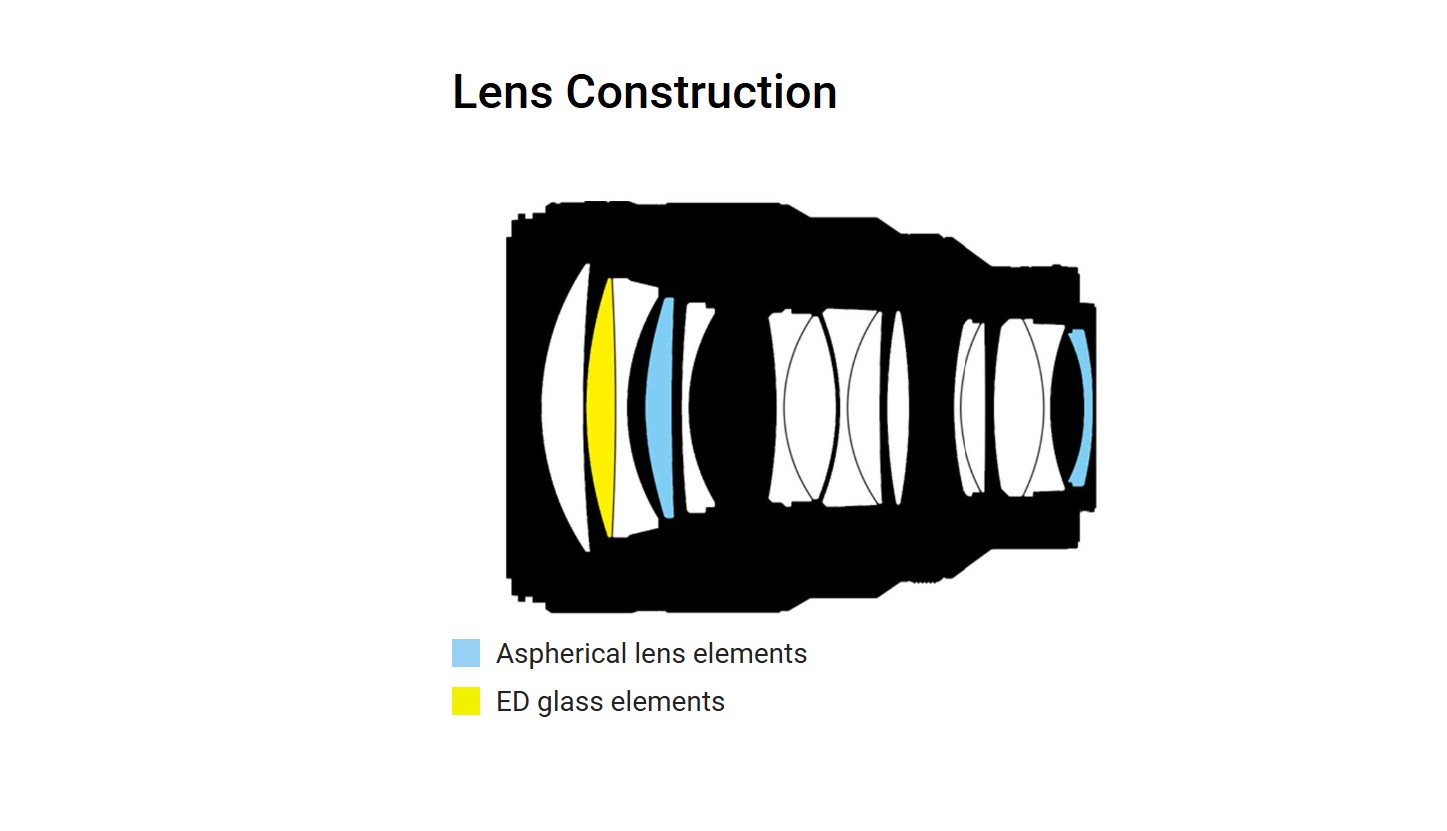
Here’s where this lens needs to shine. Large aperture lenses are actually often at a disadvantage when it comes to autofocus because they have much larger glass elements to move, and they are almost always at a disadvantage when it comes to size, weight, and cost. This is a big, heavy, expensive lens, but that is in the service of exceptional performance. The 35mm F1.2 S needs to deliver. This is an optical design of 17 elements in 15 groups, which includes three ED elements, three aspherical elements, and one aspherical ED element.
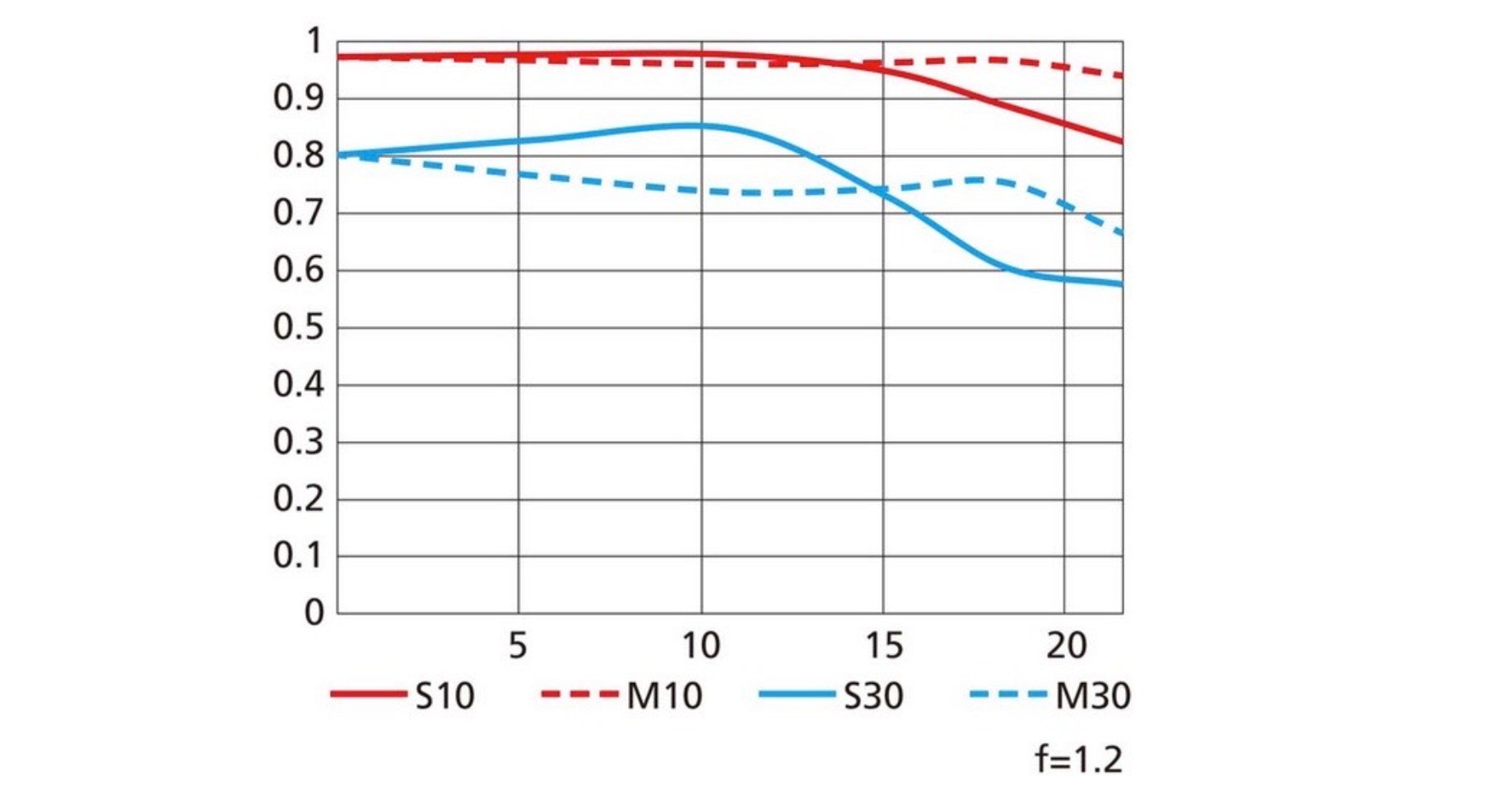
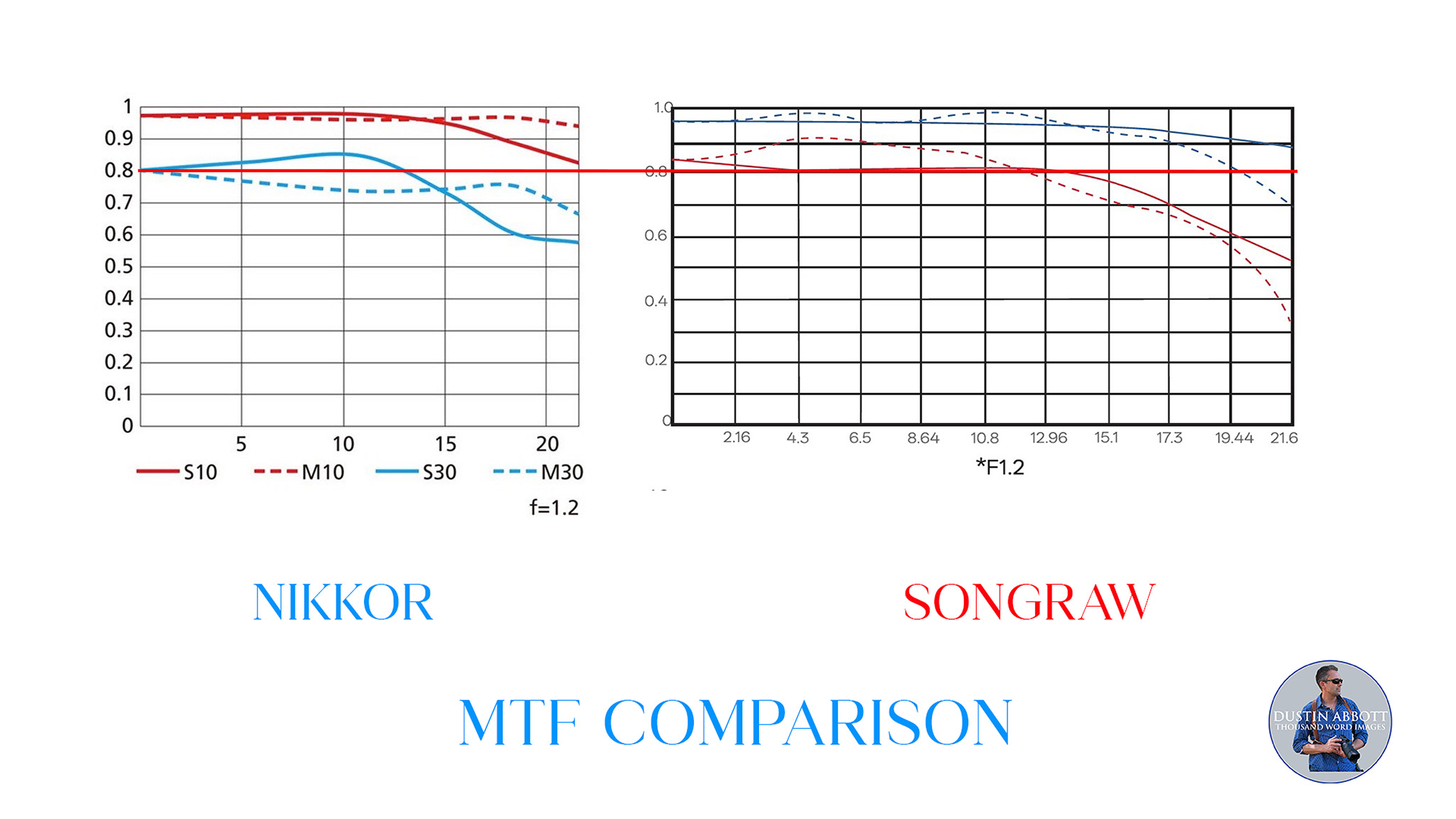
Recent third party alternatives are very capable, and the relatively inexpensive SongRaw 85mm F1.2 actually outperforms the S-Line at certain points in the frame, though the S-Line is stronger in the corners. We will examine real world results to see if this holds true.
It is a significant challenge to first-party lenses that the third-party alternatives have gotten so good optically. That being said, there’s no question that the 85mm F1.2 S is a heady blend of great sharpness and lovely rendering. Here’s a deep F1.2 crop that makes the point.

Let’s move on to the actual performance. The Plena was designed to provide very even illumination to the whole frame, including the periphery, but I haven’t found that to be the case with other bright S-Line primes.
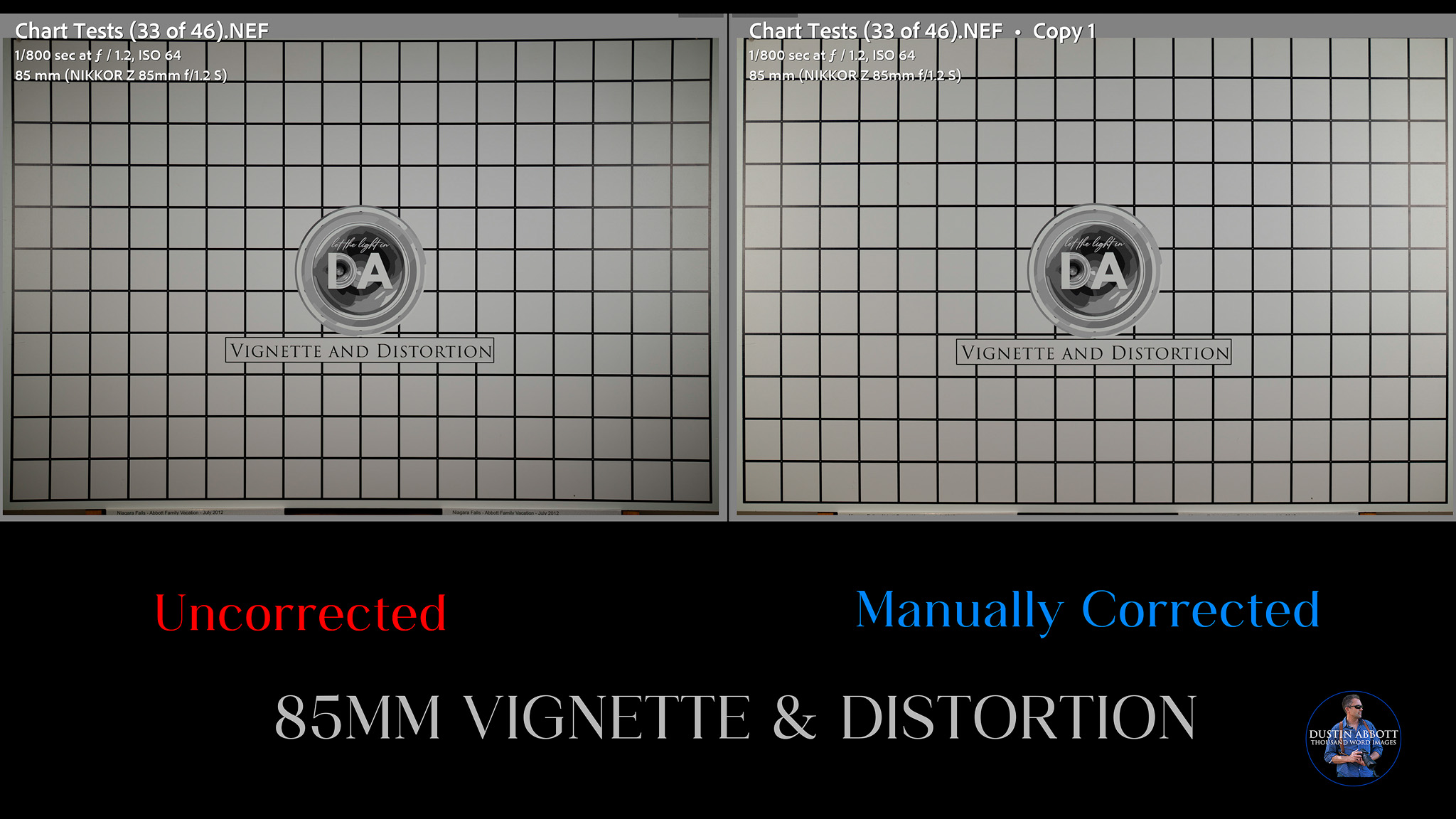
There is some mild pincushion distortion (just enough to be flattering for portraits). I used a -5 to correct for the distortion. There is also a moderate amount of vignette, requiring a +62 to correct for.
I actually found that turning off corrections made for a natural portrait look that is both slimming and has a nice amount of vignette to help draw the eye to the subject.

There are minimal amounts of LoCA (longitudinal chromatic aberrations) before and after the plane of focus.

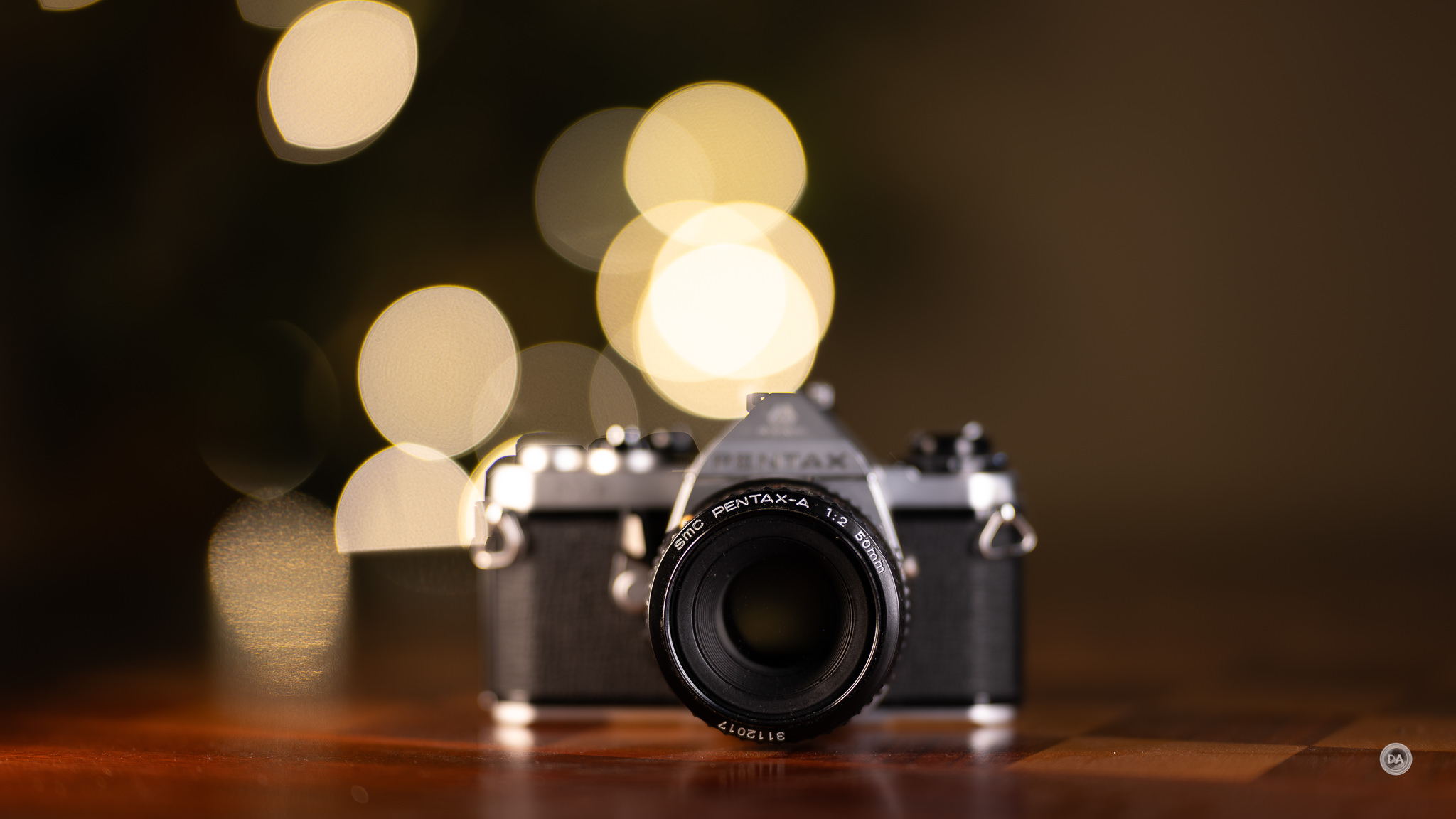
I like to use my Dad’s old SLR as a real world test, and what I found is that the Nikkor has just as low (if not lower) levels of LoCA than the SongRaw, which features an APO (Apochromatic) optical design.
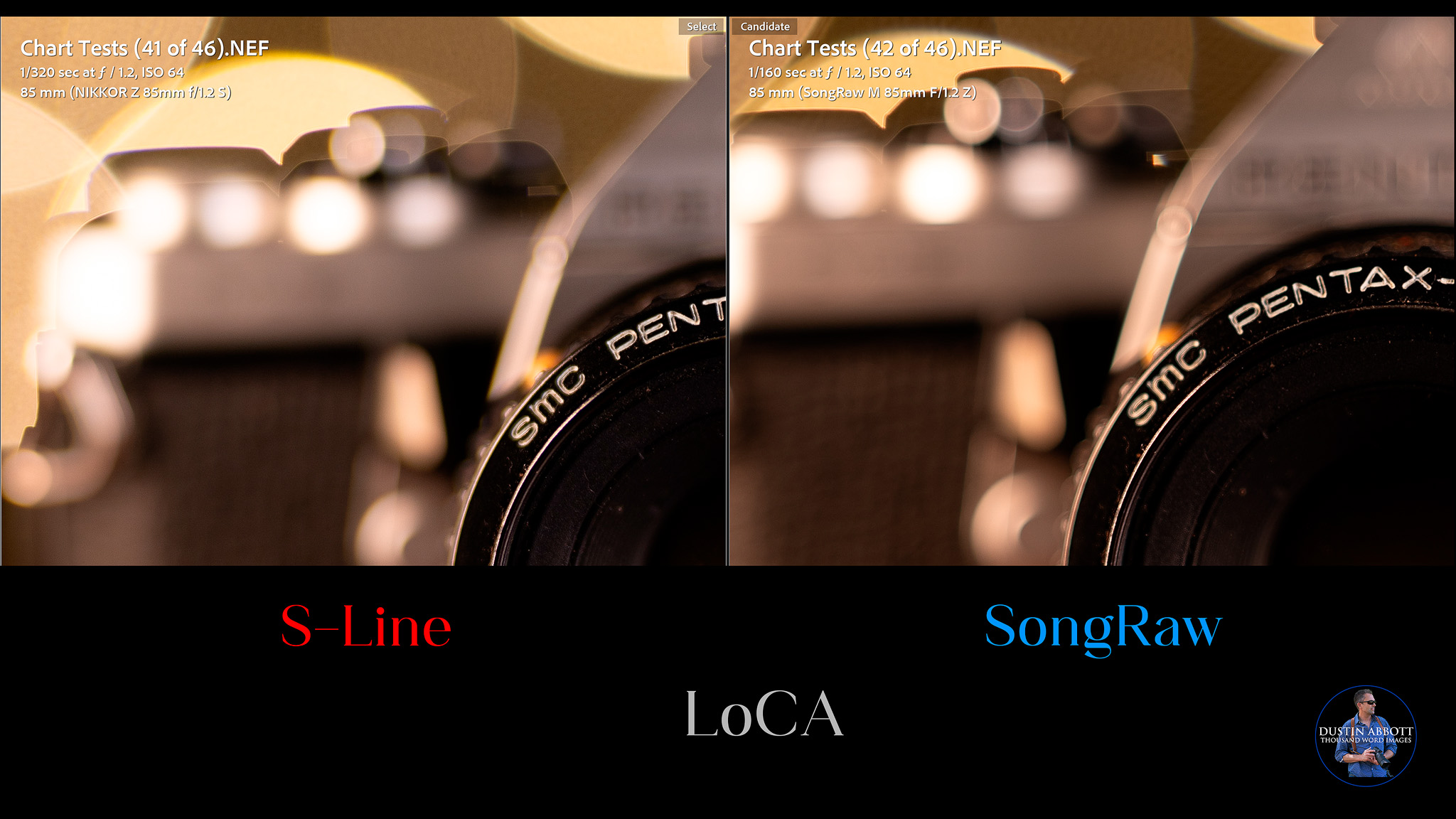
No problems there.
LaCA (lateral chromatic aberrations) typically show up along the edges of the frame with high contrast transition points. I saw nothing but clean transitions on either side of the black and white transitions.
Nothing concerning to this point.
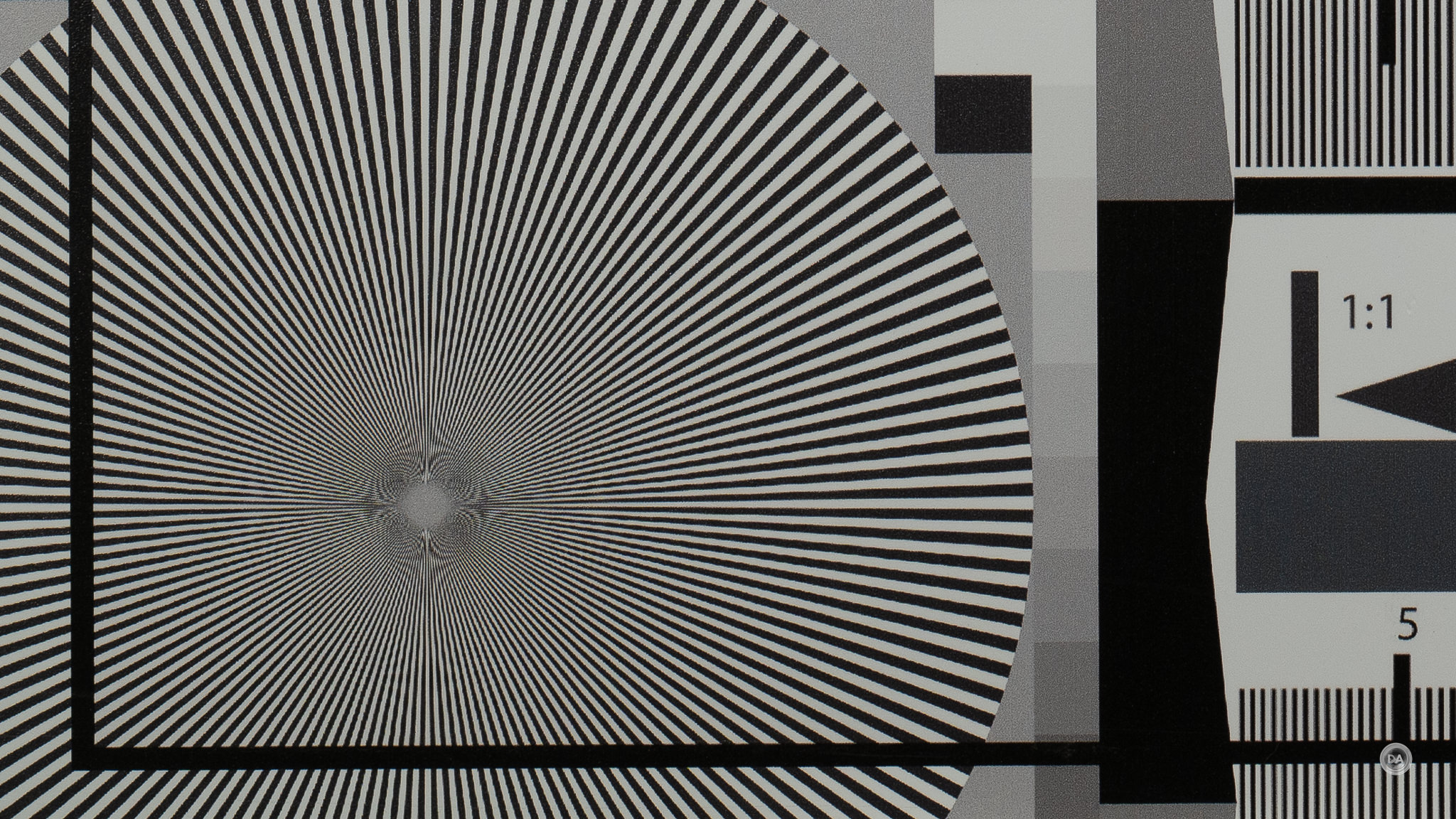
We’ll move on to inspecting our test chart. This test has been done on a 45MP Nikon Z8 sensor. I use a high end tripod and two second camera delay to ensure vibration doesn’t affect images. Here’s a look at the test chart that we will examine at high magnification:

If we take a look at crops (at 200%) at F1.2 from the center, mid-frame, and lower right corner, we find that center and mid-frame performance is exceptionally good, and that even the corners are holding on pretty nicely.



So how does that compare to the newer competition? In the two copies I tested, the SongRaw is sharper and higher contrast in the center of the frame and the midframe, but the corners belong to the Nikkor, which is essentially what the MTF suggested.
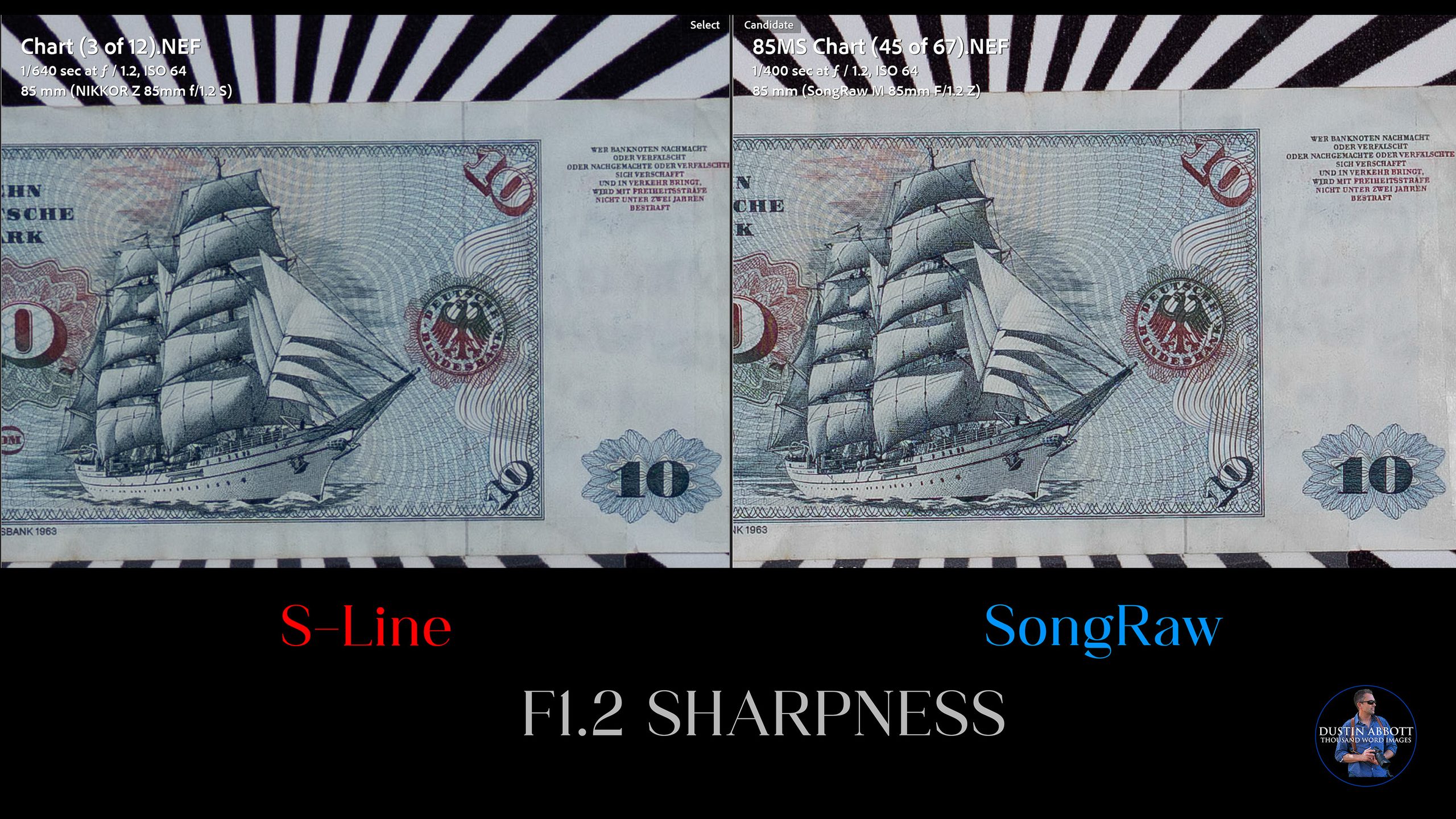
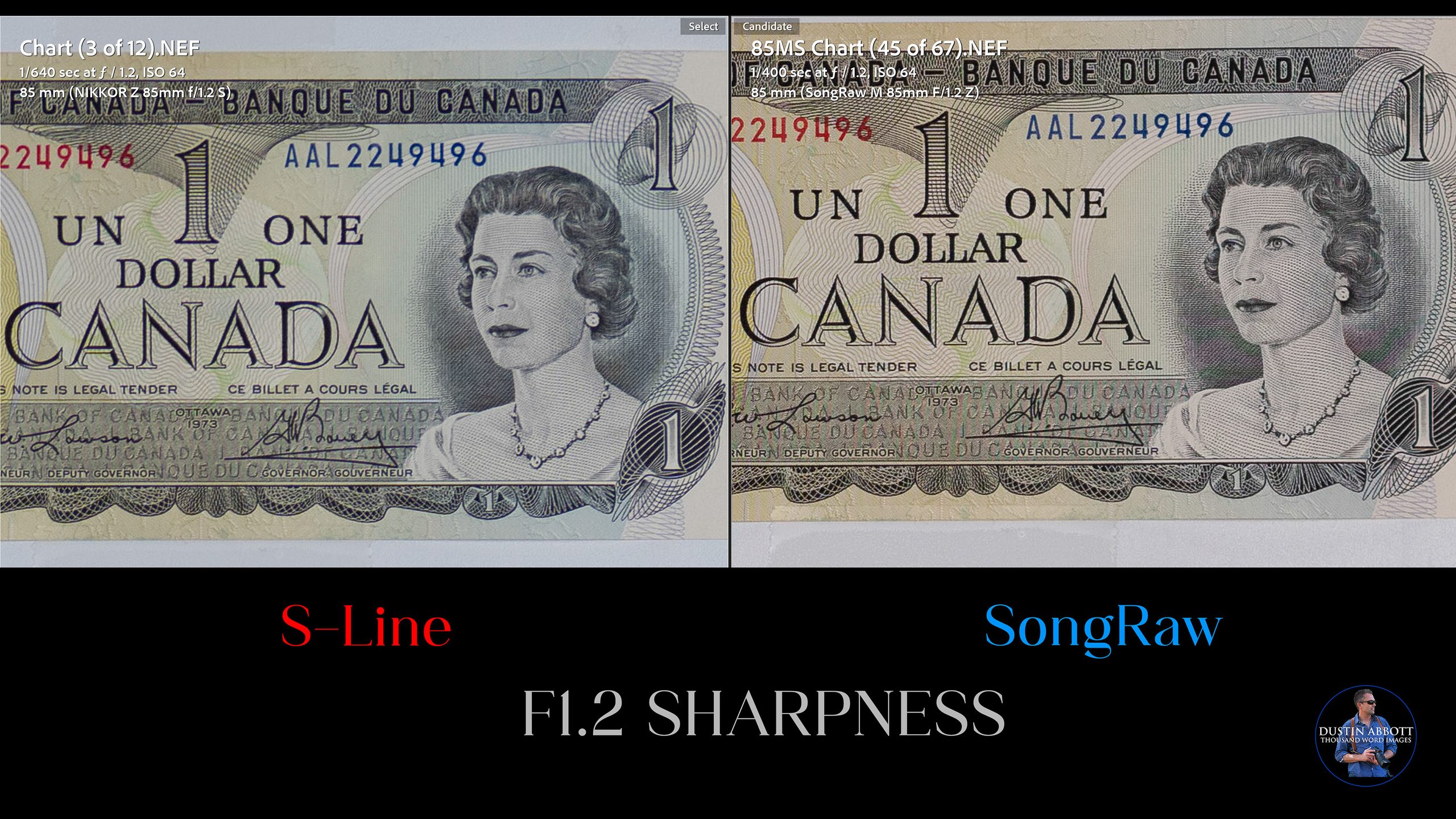
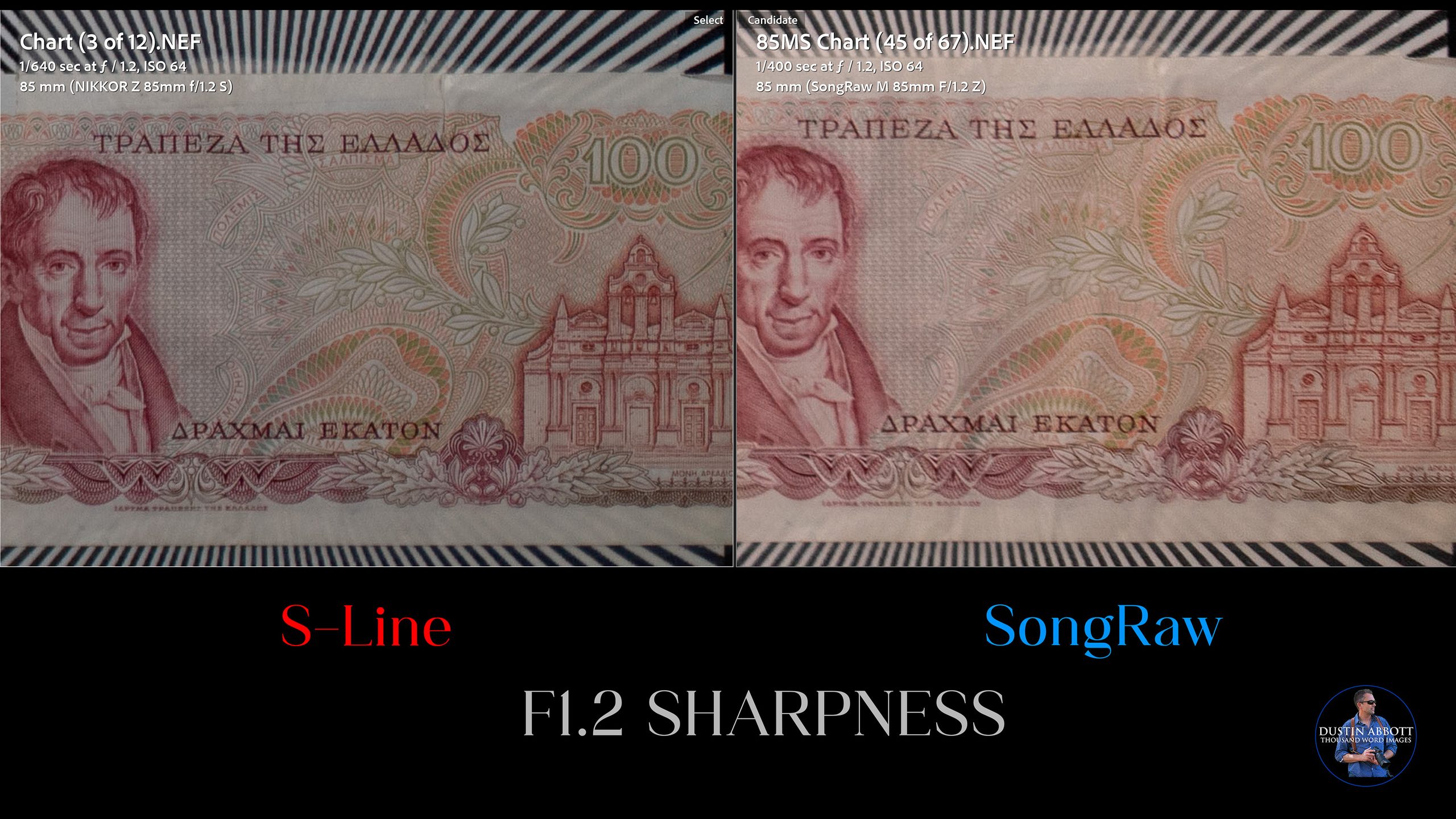
Those trends remained true even the lenses were stopped down a few stops.
At F1.4 there is more contrast, though detail remains roughly the same.
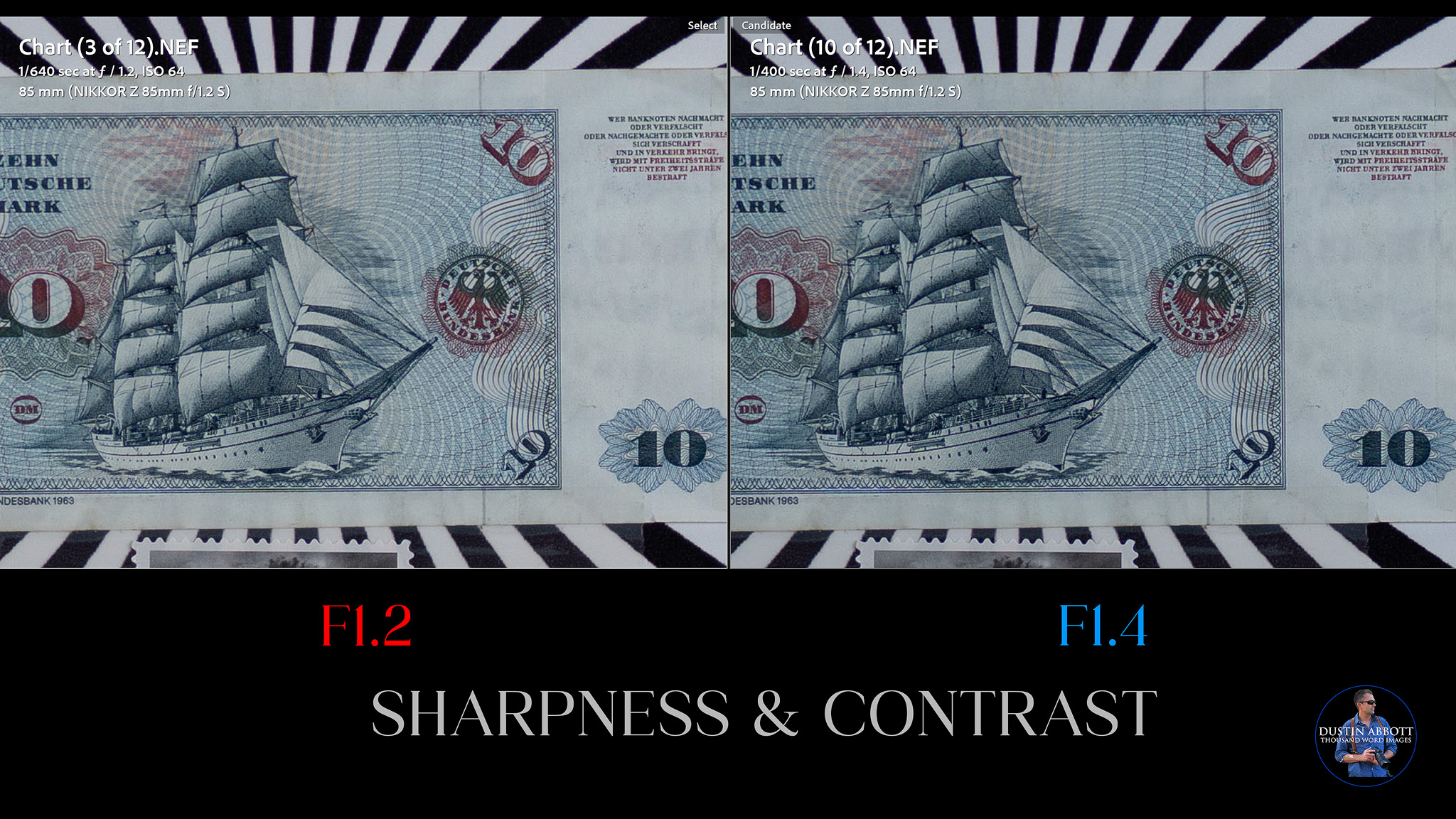
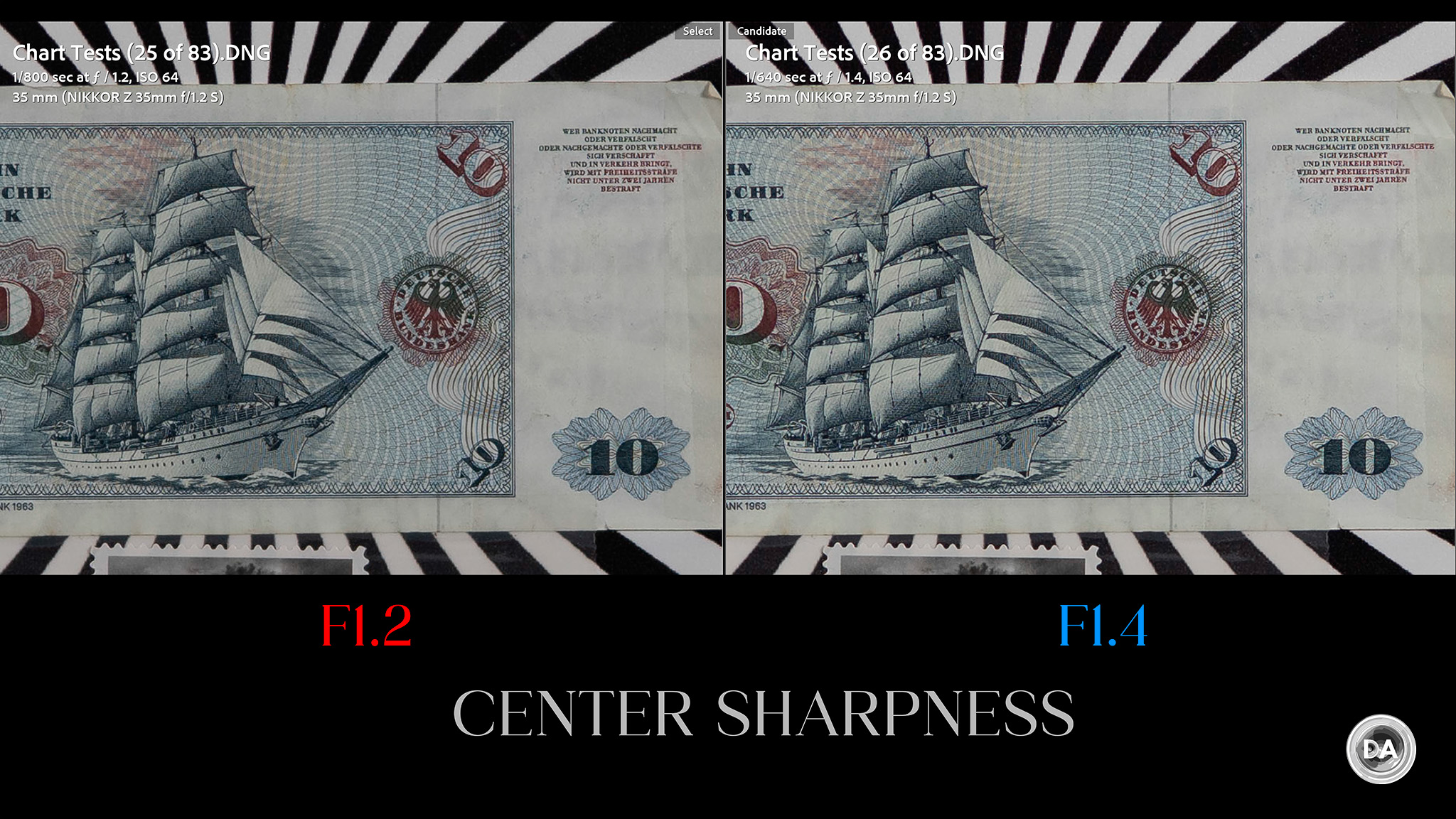
Stopping down even to F1.4 provides a surprising amount of additional contrast in the center and the mid-frame.
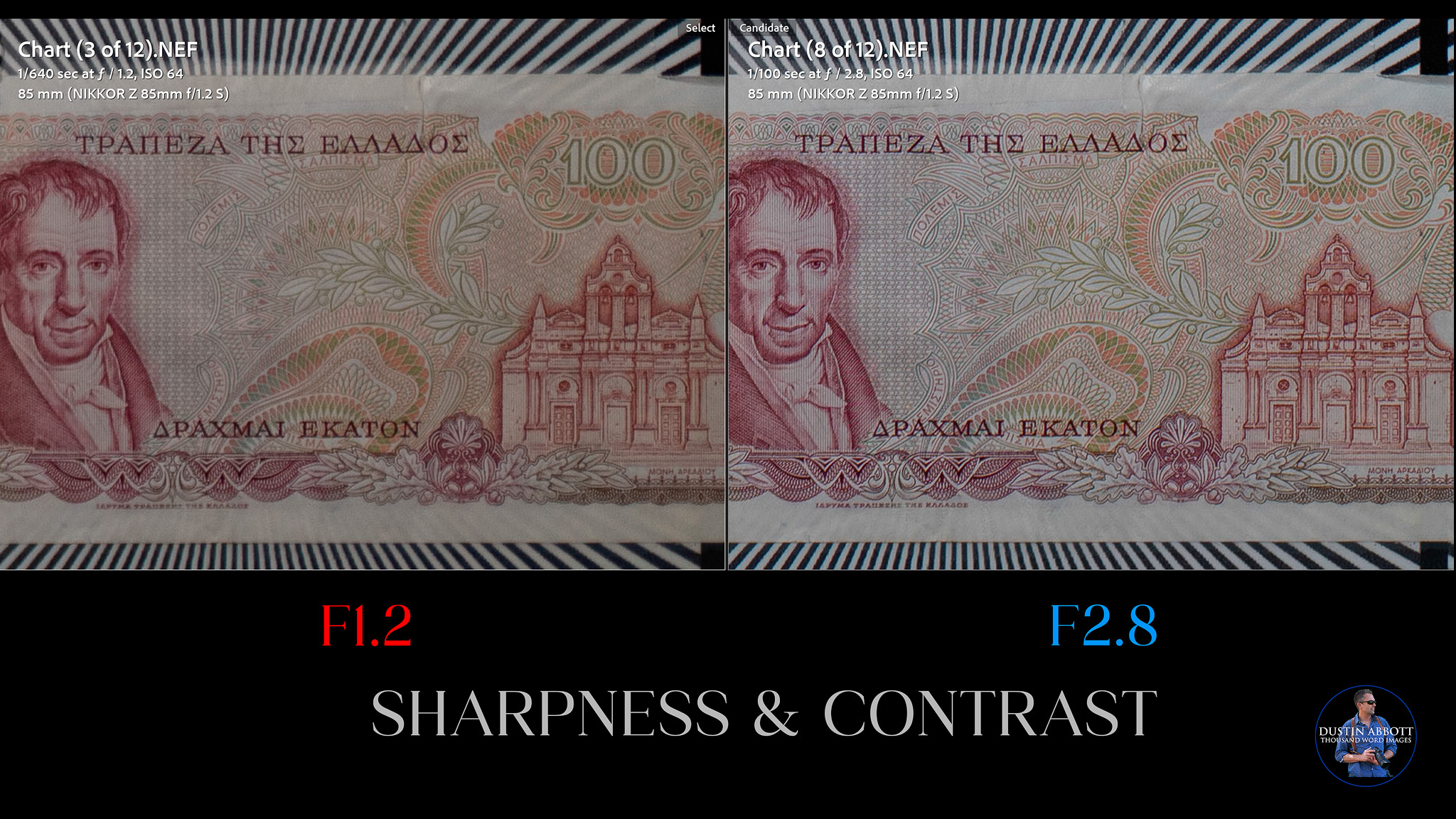
I don’t see a big gain at F2, but at F2.8 there is a surge across the frame. Most notable is the improvement in the corners, which go from good to extremely great.
This means that landscape images are pin sharp all the way to the edge of the frame.



Physics will affect even the mightiest of lenses, however, so expect diffraction to start to soften the image by F11 and more obviously by F16, which is minimum aperture (though this lens is still sharper than many lenses at its weakest!)
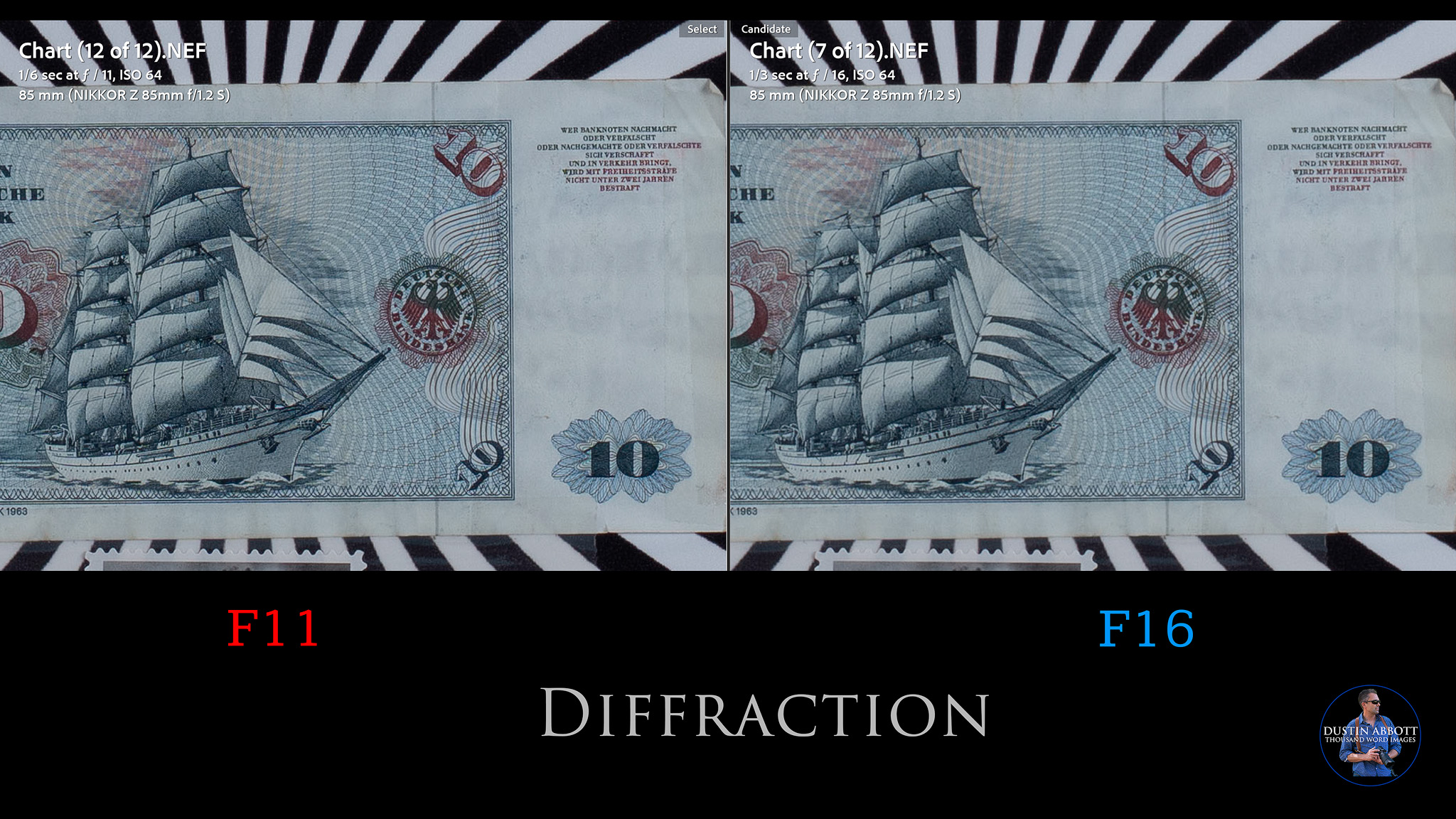
Nikon’s maximum resolution of 45MP means that diffraction isn’t as pronounced here as it might be on other platforms, so I suspect most photographers will find results at F16 just fine.
The truth of the matter is that there are many 85mm lenses with smaller maximum apertures that can deliver high contrast, detailed results (the Viltrox EVO 85mm F2 is a great example). The magic here is to combine that highly detailed, contrast image with great bokeh.

The bokeh in general is quite nice. The aperture/focal length combination can create some lovely subject separation.

My favorite thing about an 85mm F1.2 is that it can create the same subject isolation for portrait work as a 135mm F1.8 lens, though with a much more flexible focal length to work with.
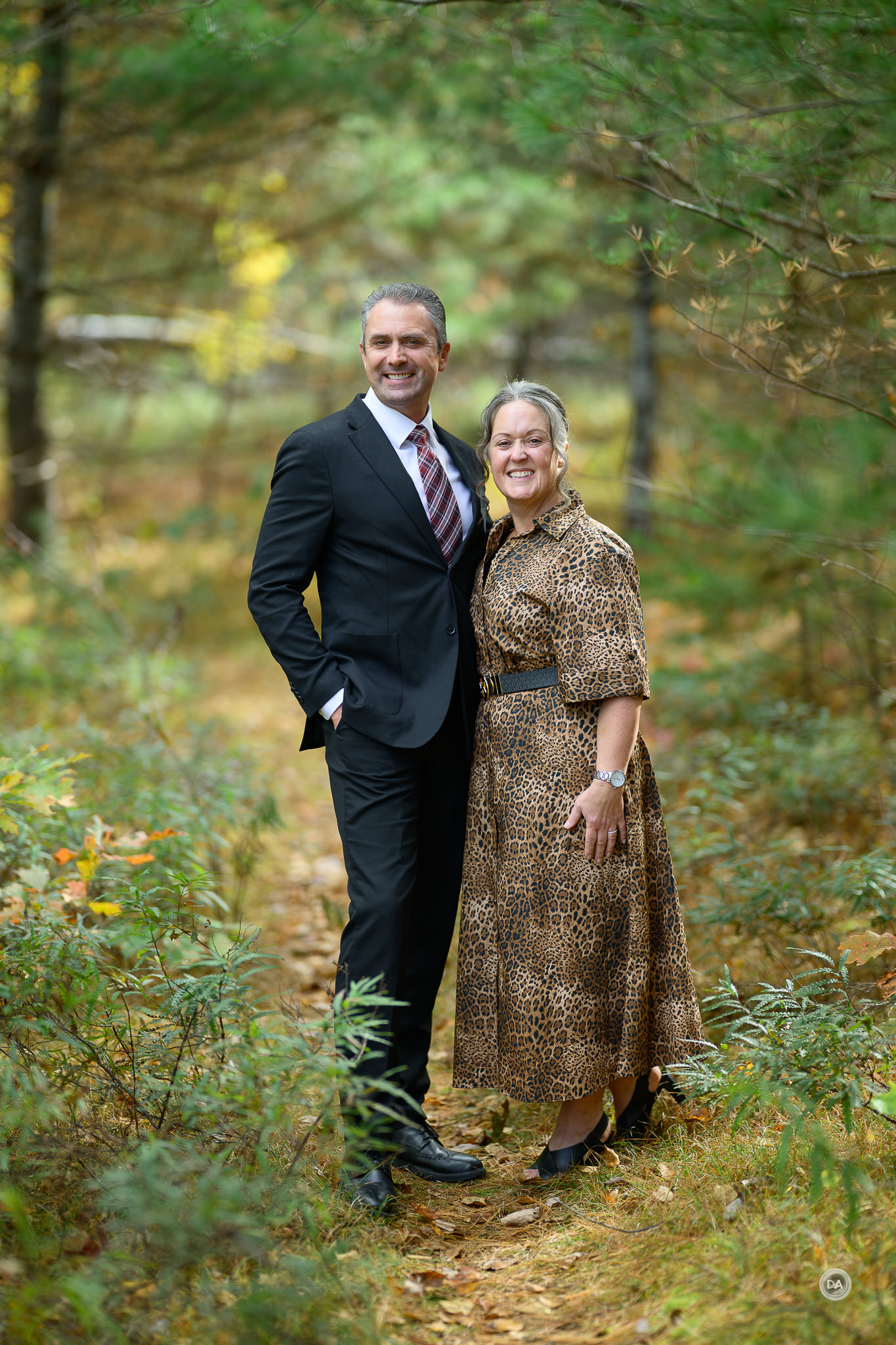
That’s clearly the single most important application of the lens.
I never saw any bokeh that I didn’t like. Even busy scenes like the one below are handled nicely.

I also felt like flare resistance was better than most bright lenses. Nikon’s Nano Crystal Coatings are employed here and seem to work very well. Shooting right into intense sun only created a little visual interest but no nasty ghosting artifacts.

The most I could find was when I stopped the lens down a lot, and even then it is fairly mild.

This is one of the most expensive 85mm prime lenses currently on the market, but it is a lovely one. It is a sharp, has great contrast, and adds lovely bokeh to that. There’s a reason why it has a five star rating on B&H Photo despite its high price.

If you’d like to see more images, check out the mini-gallery below.
Conclusion
For many photographers, Nikon’s F1.2 lineup of S-Line lenses makes little sense. It would cost you close to $9000 to own the 35mm, 50mm, and 85mm F1.2 lenses, and the combined weight would be approaching 4 kilos. But Nikon’s strategy was that the F1.8 S-Line lenses would be the “everyman” lenses, while the F1.2 lenses would be for the professionals who wanted the very best.
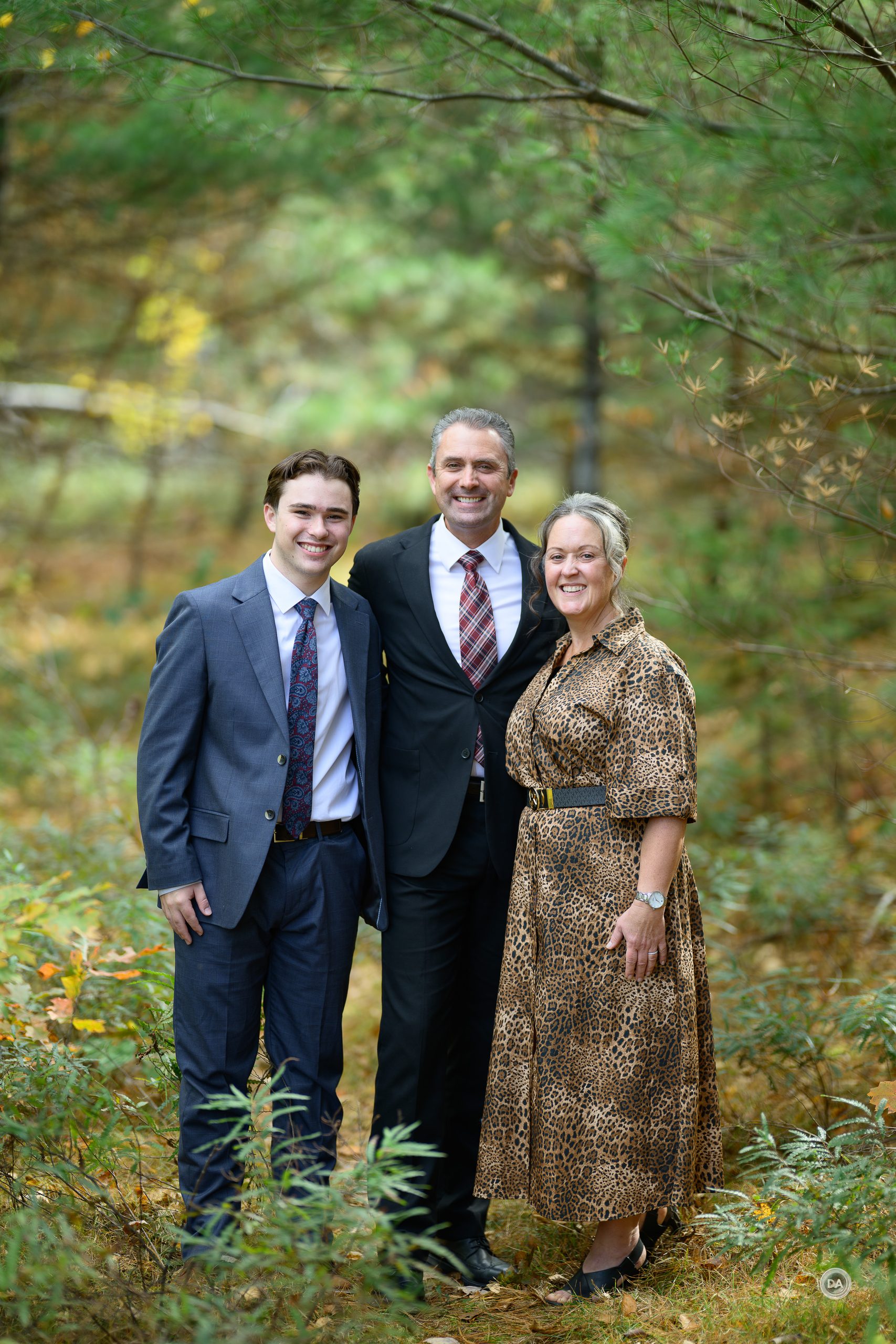
The 85mm F1.2 definitely falls into the latter category. It is an amazing optic, capable of beautiful results, but will probably mostly be attractive to professional portrait and wedding photographers who can appreciate the extra bit of sparkle that a lens like this can provide. Most mortals will be satisfied with something less.

Lenses like the SongRaw 85mm F1.2 and the upcoming Viltrox LAB 85mm F1.2 will almost certainly put pressure on the 85mm F1.2 S, but it will remain the lens of choice for those who either want the most complete package (backed up with the best service and support) and those that distrust third party brands. I’m glad they all exist, as together they max the Nikon Z-mount platform an increasingly great place to be.

Pros:
- Exceptional Image Quality: Delivers sharp, high-contrast images with excellent detail, even at wide apertures, and produces beautiful, creamy bokeh for stunning subject isolation.
- Great Build Quality: Constructed with a robust mix of metal alloys and engineered plastics, offering comprehensive weather sealing for outdoor shooting.
- Ideal for Portrait Photography: Long focal length combined with a bright F1.2 aperture excels in capturing flattering portraits and is ideal for shooting in challenging lighting conditions, maintaining focus against bright backgrounds.
- Reliable Autofocus for Stills: Generally accurate and precise autofocus performance, suitable for portrait work, maintaining sharp focus even at wide apertures like F1.2.
- Good Flare Resistance: Effective Nano Crystal Coating minimizes ghosting and flare, even in harsh lighting conditions.
Cons:
- Heavy and Bulky: Weighs 1160g and measures 141.5mm in length, making it difficult to carry for extended periods and may require specialized bags for transport due to its size.
- Limited Feature Set: Fewer physical controls compared to competitors like Sony, which can be a drawback for advanced users, and lacks an aperture ring with clicks, reducing precision for still photography.
- Autofocus Limitations for Video: Autofocus can be slow and less responsive during video recording, impacting cinematic quality, and focus breathing can be noticeable, complicating focus pulls.
- High Price Point: At nearly $3000, it may not be economical for amateur photographers or those on a budget.
- Great Competition: Newer options like SongRaw 85mm F1.2 and upcoming Viltrox LAB 85mm F1.2 present robust alternatives, potentially challenging the Nikkor’s market position.
_________________________________________________________________________
GEAR USED:
Purchase the Nikkor Z 85mm F1.2 S @ B&H Photo | Adorama | Amazon | Camera Canada | Amazon Canada | Amazon UK | Amazon Germany
Purchase the Nikkor Z 35mm F1.2 S @ B&H Photo | Adorama | Amazon | Camera Canada | Amazon Canada | Amazon UK | Amazon Germany
Purchase the Nikkor Z 50mm F1.2 S @ B&H Photo | Adorama | Amazon | Camera Canada | Amazon Canada | Amazon UK | Amazon Germany
Purchase the Nikkor Z 135mm F1.8 S Plena @ The Camera Store | B&H Photo | Adorama | Amazon | Camera Canada | Amazon Canada | Amazon UK | Amazon Germany
Purchase the Viltrox AF 135mm F1.8 LAB @ Viltrox (use code DUSTINABBOTT for 5% off) | B&H | Adorama | Amazon | Amazon Canada | Amazon UK | Amazon Germany
_______________________________________________________________
Purchase the Nikon Z8 @ B&H Photo | Adorama | Amazon | Camera Canada | Amazon Canada | Amazon UK | Amazon Germany
_________________________________________________________________
Want to support this channel? Use these affiliate links to shop at: B&H Photo | Amazon | Adorama | Camera Canada | Amazon Canada | Amazon UK | Ebay | Make a donation via Paypal
Buy DA Merchandise https://bit.ly/TWIMerch

Keywords: Nikkor, Nikkor Z 85mm, F1.2, F1.2 S, Nikkor Z, Nikkor Z 85mm F1.2 S review, Nikon 85mm, Nikon Z 85mm, Viltrox, LAB, SongRaw 85mm F1.2, Nikon, Nikon Z8, Z, Z-mount, Z8, Review, mirrorless, Full Frame, Sports, Tracking, Dustin Abbott, Real World, Comparison, Handling, Focus, Portraits, Resolution, High ISO, Image Quality, Sample Images, Photography, 45MP, #letthelightin, #DA, #NIKON, #Z8, #NIKONZ8, #NikonZ85mmF1_2S, #NikonLens, #PrimeLens, #PortraitPhotography, #WeddingPhotography, #Astrophotography, #FastAperture, #ProfessionalPhotography, #CameraGear, #NikonZmount, #PhotographyGear, #LensReview, #UltimatePortraitLens, #NikonPhotographers
Related posts:
 Nikkor Z 35mm F1.2 S Review
 Nikkor Z 50mm F1.2 S Review
 Nikkor Z 24-70mm F2.8 S II Review
 Nikkor Z 24-120mm F4 S Review
 Nikkor Z 14-30mm F4 S Review
 Nikkor Z 135mm F1.8 S Plena Review
 Nikkor Z 135mm F1.8 S Plena Gallery
 LAB vs PLENA: Nikon 135mm Showdown
 Viltrox LAB 35mm F1.2 Z-Mount Review
 Nikkor Z 85mm F1.8 S Review